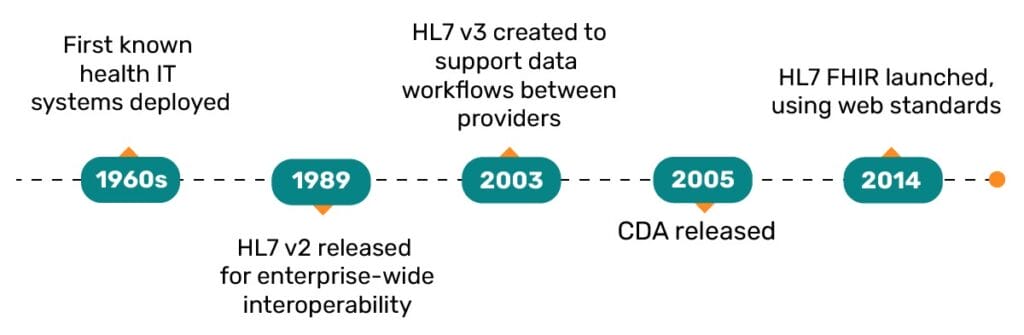









HL7 v2 remains the workhorse messaging standard in most hospital systems, with pipe-delimited events (ADT, ORU, ORM) flowing among registration, lab, pharmacy, and billing. This guide walks through how an HL7 v2 feed is actually wired into an EHR: the API gateway endpoint that receives messages, the AWS SQS queue that buffers them, the parser that maps segments to patient records, and the sandbox-to-production path that gets it live safely.
Understanding HL7 V2
As we interpreted in the introduction, HL7 V2 is a messaging standard that maintains consistency across different systems and is crucial for healthcare interoperability.

To effectively address your organization’s or project’s unique interfacing needs, it is important to understand the distinction between HL7 messaging versions 2.3, 2.3.1, and the most recent 3. x. Although most messaging still relies on the older versions, comprehending the differences will help you understand the landscape of HL7..
HL7 Version 2
HL7 v2 is a popularly used healthcare messaging standard, facilitating the exchange of medical and patient data across systems. It aims to establish interoperability among health information systems by employing standardized messages with important event information. These messages include patient administrative activities, demographics, medical history, results, and financial data.
Related Read: Navigating The Top Challenges in Custom Healthcare Software Development
How HL7 V2 is Configured in Healthcare Systems like EHRs?
The configuration of compliance regulations like HL7 v2 or FHIR is a critical step in enabling data exchange and interoperability. Often the whole process can be tiring and complex to implement which can also lead to different issues and errors. Let’s fix this by understanding the configuration process based on the context of a third-party app integration;
EHRs Implementation
EHR systems have completely digitized patient records, eliminating manual effort and paper trails. EHR systems are implemented in the operations to communicate with other existing systems. That’s where HL7 standards play their role. The standards translate the data, allowing data exchange between different systems and offering compliance and data security.
If we take the example of EPIC as our primary EHR system implemented in the hospital’s administration. The EPIC Client System Administrator (ECSA) plays an important role in configuring HL7 interfaces within the EHR system to provide data exchange with the external/ vendor application.
Establishing API Gateway Endpoints
API gateway endpoints serve as the entry points receiving HL7 messages from external sources. They ensure a secure and reliable transmission of these messages to the EHR system. The organizations can establish a standardized and controlled approach for external systems to communicate with EHR systems.
These endpoints provide a layer of protection by validating the incoming HL7 messages. The interconnected administrator will enable the necessary API required for integration. It can be either Hyperspace or Citrix administrator to assist with the configuration of the vendor app.
Transmission to AWS SQS
Once HL7 V2 messages have been transmitted to the API gateway endpoint, they undergo further processing through a well-established mechanism. These messages are forwarded to AWS SQS, which acts as a reliable and efficient queueing system. The AWS SQS is important to manage the flow of messages within the integrated architecture. It temporarily stores the HL7 messages in the queue, while ensuring protection in the processing.
The EHRs can efficiently handle large volumes of messages and distribute workloads across various other components with the help of AWS SQS.
Processing and Integrations
The after-process includes the extraction of medical data or clinical observations. It enables the integration within the EHR system to relevantly map out the processed HL7 data to patient records. This mapping process ensures the extracted data is correctly associated with the corresponding patient, allowing easy access and usage within the healthcare workflows. We’ve run this model for platforms handling multi-standard HL7 v2 + FHIR exchange, achieving a 90% reduction in manual data entry at the integration layer.
Now this HL7 data helps healthcare providers to make informed decisions, provide appropriate care, and manage complex workflows.
HL7 Parsing
All the interpreting processes of incoming messages and extraction depend on the parsing mechanisms. It involves systematically parsing HL7 segments, fields, and components to understand the data and integrate it into the system’s database.
The parsing identifies and separates the different categories of data in HL7 messages. This whole process helps the EHR system like EPIC understand the information in the HL7 message and appropriately store it in the database. Now healthcare providers, have updated data to make clinical decisions, ensuring interoperability across the different systems and organizations.
Handwriting the parse-and-map logic segment to the patient field, local code to standard code, is where these projects lose weeks. ConnectHealth’s Helix AI builds that mapping in plain English, with pre-built connectors for 20+ EHRs, so a small team can stand up the same pipeline without a dedicated integration engineer.
Sandbox Testing and Validation
Before launching the HL7 V2 configurations into a production environment, sandbox environments are used to test and validate the process. These environments serve as controlled testing environments where the compatibility of HL7 V2 configurations with external applications, can be monitored.
It involved various real-world scenarios by sending sample messages for testing. The messages are used to validate different aspects of the integration process. The developers can test the functionality and accuracy of the integration. This helps reduce errors and ensures reliable operation of the integration.
Production Environment Integration
Now that we have done successful testing in the sandbox environment, the HL7 configurations are ready to be launched in the production environment. Now the deployment enables real-time data exchange between the EHR system and vendor applications.
How Mindbowser Helps with HL7 v2 Configuration
Configuring HL7 v2 into a live EHR gateway, queue, parser, sandbox, and production is detailed, error-prone work. Mindbowser builds and maintains these interfaces end to end.
Where speed matters, ConnectHealth ships pre-built connectors to 20+ EHRs and maps HL7 v2 segments to FHIR resources in plain English with Helix AI, deployed inside your own AWS VPC. Handwriting the parse-and-map logic (segment to patient field, local code to standard code) is where these projects lose weeks. Helix AI compresses that stage so a small team without a dedicated integration engineer can stand up the same pipeline.


BLOGS
NEWSROOM
CASE STUDIES
WEBINARS
PODCASTS
ASSET HUB
EVENT CALENDAR