





 BLOGS
BLOGS  NEWSROOM
  CASE STUDIES
  WEBINARS
  PODCASTS
  ASSET HUB
  EVENT CALENDAR
























Why Do Standard EHRs Fall Short for Integrative Medicine?
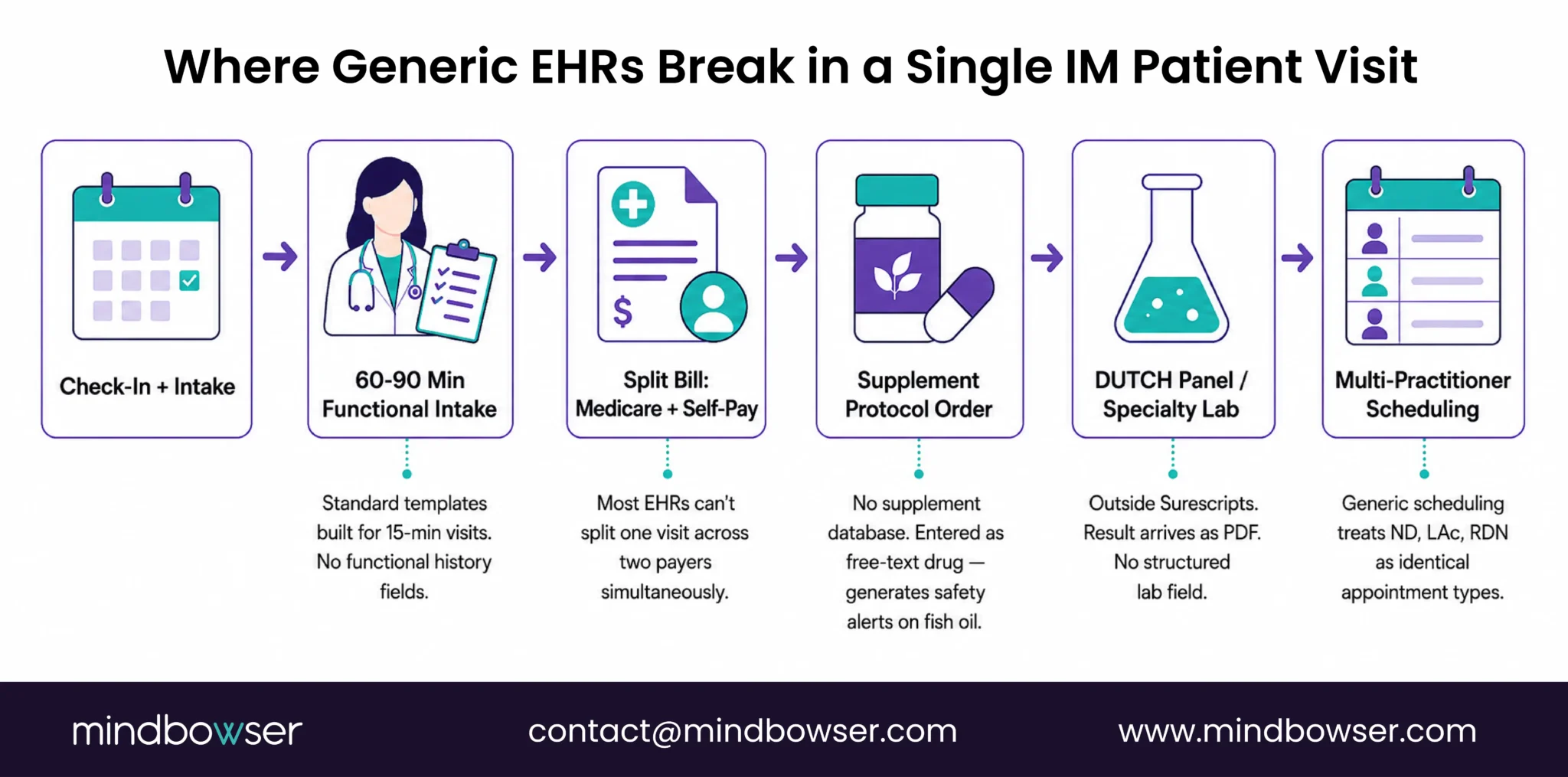
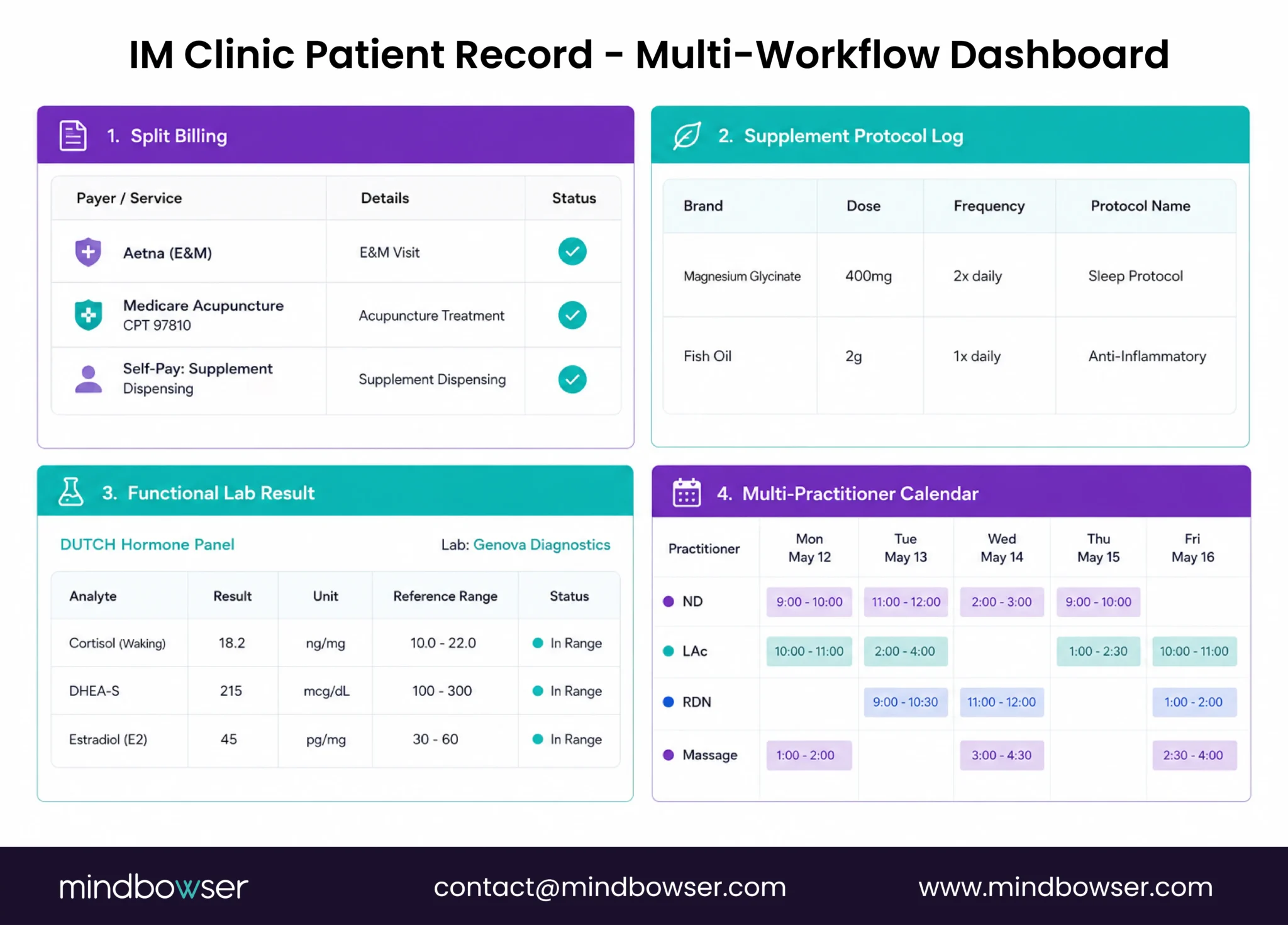
Consider what a single IM patient visit actually requires: an E&M encounter billed to insurance, acupuncture billed as a split Medicare/self-pay claim, a supplement protocol that doesn’t exist in any drug database, and a DUTCH hormone panel ordered from a specialty lab your EHR has never heard of. Four workflows. One patient. Zero off-the-shelf EHRs that handle all four without workarounds.
We’ve seen this pattern compound at IM practices that came to us running three separate systems: one for insurance billing, one for supplement dispensing, and a spreadsheet for everything else. The operational cost isn’t obvious at first. But it accumulates fast.
The scale of the problem is real. Americans spend approximately $30 billion per year on complementary and integrative health approaches, according to the National Center for Complementary and Integrative Health (NCCIH, 2023). That’s a market large enough to sustain major health system integrative programs: Cleveland Clinic’s Center for Integrative and Lifestyle Medicine sees more than 10,000 patients per year, per Becker’s Hospital Review’s 2023 coverage of enterprise IM adoption. Yet no dominant EHR vendor has built for this workflow.
Billing complexity deepened too. In 2020, CMS expanded Medicare coverage for acupuncture for chronic low back pain (CPT 97810-97814, up to 12 visits per year with documented medical necessity, per NCD 30.3.3). For any IM practice billing Medicare, this created a new layer: acupuncture sessions that split between Medicare and patient responsibility in the same visit as an E&M encounter.
And the operational gaps run deeper than billing:
1. IM initial intakes average 60-90 minutes with detailed functional history, lifestyle assessment, and multi-system review. Standard EHR intake templates are architected for 15-minute physician encounters. The mismatch is structural, not a configuration problem.
2. No major EHR vendor includes a supplement or nutraceutical protocol database. Practitioners document dosing instructions in free-text drug fields that generate irrelevant safety alerts, or track protocols in a separate spreadsheet the EHR doesn’t know about.
3. Specialty functional labs operate outside standard Surescripts directories. DUTCH hormone panels, Genova Diagnostics, Vibrant America, and Great Plains Laboratory results arrive as PDFs, are manually uploaded, and are disconnected from structured lab data.
4. 38% of US adults use complementary health approaches, per NCCIH National Health Interview Survey data. The patient demand has outpaced the infrastructure for years.
What Should You Look for in an Integrative Medicine EHR?
This is the framework we use when evaluating IM platforms with clients. Five categories. If a vendor can’t demonstrate capability in three or more of them with a live demo using your actual workflow, you’ve found your workaround cost before you sign anything.
1. Multi-modality billing
Simultaneous insurance E&M, Medicare acupuncture CPT, and self-pay supplement dispensing in one patient account. Split-billing capability is non-negotiable for any IM practice billing Medicare and self-pay in the same visit.
2. Supplement and nutraceutical protocol tracking
Structured documentation for brand, dose, frequency, and protocol name: not free-text in a drug field that doesn’t know the difference between a pharmaceutical and a supplement. Fullscript or Wellevate dispensing integration is the current standard for practices that dispense directly.
3. Functional lab ordering and tracking
Specialty lab panels ordered and tracked alongside conventional labs, with FHIR-based exchange for labs outside standard Surescripts directories. The goal: DUTCH results, Genova panels, and a standard CBC in the same patient lab view, not a PDF in a documents tab.
4. IM-specific documentation templates
Acupuncture point charting with meridian notation, herbal formula documentation, 60-90 minute functional intake forms, mind-body assessment SOAP notes, and lifestyle medicine protocol documentation. These are not configurable from physician SOAP templates.
5. Multi-practitioner scheduling with modality differentiation
ND, LAc, MD, RDN, massage therapist, and health coach on the same calendar: different appointment durations, different room requirements, different billing codes, and shared equipment conflicts. Generic scheduling systems treat all practitioners as interchangeable.
For a broader medical specialty EHR selection guide covering how to apply this framework across therapy, surgical, and diagnostic specialties, that reference is worth reading before running demos.
Talk to Our Healthcare Experts About Your Integrative Medicine EHR Needs
Which Integrative Medicine EHR Platforms Are Worth Comparing in 2026?
Jane App
Best for: Multi-practitioner IM clinics (1-20 practitioners), cash-pay dominant
Jane App is the strongest off-the-shelf option for multi-practitioner IM scheduling. Online booking, customizable intake forms, and multi-modality appointment types work cleanly without significant configuration. Both insurance billing and self-pay invoicing sit in the same patient account.
The IM community has broadly adopted Jane for a reason: it’s one of the few platforms that doesn’t require a workaround just to book an acupuncture appointment alongside a naturopathic consult.
- Strengths: multi-practitioner scheduling, online booking and intake, self-pay + insurance billing, clean UX, strong IM community adoption
- Weakness: no supplement protocol tracking, no functional lab integration, US insurance billing is limited (Canada-first design)
- Cost: ~$54-99/month per clinic (practitioner add-ons extra)
- Best fit: small-to-mid IM clinics, cash-pay dominant practices, Canadian clinics
Power2Practice
Best for: Functional medicine practices that dispense supplements
The only off-the-shelf option purpose-built for functional and integrative medicine. Supplement dispensing with Fullscript integration, structured functional lab ordering, and IM-specific note templates are designed in from the ground up.
If supplement dispensing is your core workflow, this is the most complete off-shelf option. The tradeoff is scheduling depth and multi-location support.
- Strengths: supplement protocol tracking native, Fullscript dispensing integrated, functional lab ordering, IM-specific templates
- Weakness: multi-practitioner scheduling not optimized for large teams; pricing scales steeply; verify current product status before committing
- Cost: verify at publish
- Best fit: functional medicine practices with supplement dispensing as core workflow; solo to small group
Charm EHR
Best for: Small IM practices prioritizing low cost and telehealth
Free tier for solo practitioners. Flexible note templates, telehealth built in, and both insurance billing and self-pay in one platform. The IM community uses it widely because the barrier to entry is low.
- Strengths: free tier available, flexible templates, telehealth, insurance + self-pay, widely adopted in IM community
- Weakness: no supplement tracking, no functional lab integration, complexity compounds at 5+ providers
- Cost: free (solo) to ~$350/month (small group)
- Best fit: solo IM practitioners, early-stage clinics, tight budget
DrChrono
Best for: Multi-modality practices needing maximum charting flexibility
DrChrono’s form builder is the most configurable on this list. Practices can build acupuncture point charting, herbal formula documentation, and functional intake forms from scratch. iPad-native for point-of-care charting. But DrChrono’s Surescripts-only drug database is the constraint most IM practices hit first.
- Strengths: form builder flexibility for IM-specific charting, iPad-native, self-pay + insurance, AppMarket for add-ons
- Weakness: Surescripts-only drug database (no supplement support), no functional lab integration out of the box, high setup complexity
- Cost: ~$199-499/month per provider
- Best fit: IM practices where charting customization is the top priority; technically capable admin team
Healthie
Best for: Nutrition-dominant IM practices (RDN + health coaching core)
Built for dietitians and health coaches: meal planning, nutrition protocol documentation, group program management, and client portal are the standout features.
- Strengths: nutrition protocol tools, meal planning, group programs, client portal, telehealth
- Weakness: not optimized for acupuncture or functional medicine charting; limited IM billing depth
- Cost: ~$45-135/month
- Best fit: nutrition-forward IM practices, health coaching programs
SimplePractice
Best for: Solo IM practitioners who prioritize simplicity over IM-specific features
Clean scheduling, telehealth, self-pay invoicing, easy setup. No IM-specific features at all. Works for a solo cash-pay IM practitioner who doesn’t need supplement tracking or functional lab integration.
- Strengths: easy to learn, telehealth, clean scheduling, self-pay billing
- Weakness: no supplement tracking, no functional lab, generic note templates require heavy customization
- Cost: ~$29-99/month
- Best fit: solo practitioners, low-complexity IM, cash-pay only
Custom IM EHR (Mindbowser)
Best for: Multi-modality enterprises, multi-location IM clinics, physician-founded IM platforms building for scale
When our five-category gap analysis reveals workarounds in two or more areas, that operational tax compounds every month. Supplement protocols tracked in a spreadsheet, functional labs uploaded as PDFs, acupuncture billed in a separate system: these aren’t minor inconveniences. They’re data quality problems that affect patient outcomes and billing accuracy.
A custom-built IM EHR closes those gaps permanently. Pre-built modules cover modality-type scheduling, split-billing (insurance + Medicare acupuncture CPT + self-pay), FHIR R4 specialty lab exchange, and supplement protocol tracking. Deployment runs 8-12 months with pre-built accelerators.

Learn more about custom EHR development for integrative practices.
When Should You Build a Custom Integrative Medicine EHR?
The practices we’ve worked with that hit these trigger points almost always regret waiting six months to have the conversation. Here’s what we watch for:

1. Multi-specialty clinical mix at scale: IM, behavioral health EHR integration, nutrition, rehabilitation, and acupuncture under one roof. No standard platform handles all five disciplines in a single scheduling, documentation, and billing environment without middleware overhead.
2. Supplement dispensing at clinical volume: More than roughly 20 supplement SKUs across active patient protocols: inventory management, protocol assignment, patient tracking, and reorder automation belong inside the EHR, not across a separate Fullscript tab and a spreadsheet.
3. 10+ practitioners or 3+ locations: Per-seat SaaS pricing compounds. At 10+ practitioners, custom is typically cost-neutral within 18-24 months. No per-seat ceiling, no API access fees when a new specialty lab wants to connect.
4. Value-based or capitated IM contracts: Payer contracts tied to inflammatory biomarker improvement, chronic pain reduction, or medication reduction require structured longitudinal outcome data. Generic EHRs produce reports; a purpose-built system produces the specific data points your contract requires.
5. Functional lab panel integration at depth: DUTCH, Genova, Vibrant America, Great Plains: FHIR-based bidirectional exchange with specialty labs that standard directories don’t include.
For practices comparing off-the-shelf against custom, the small practice vs custom EHR comparison covers the full financial decision framework.
Comparing off-the-shelf against custom, the small practice vs custom EHR comparison covers the full financial decision framework. Our custom EHR development capabilities cover all five scenarios with pre-built components.
What Does an Integrative Medicine EHR Implementation Look Like?
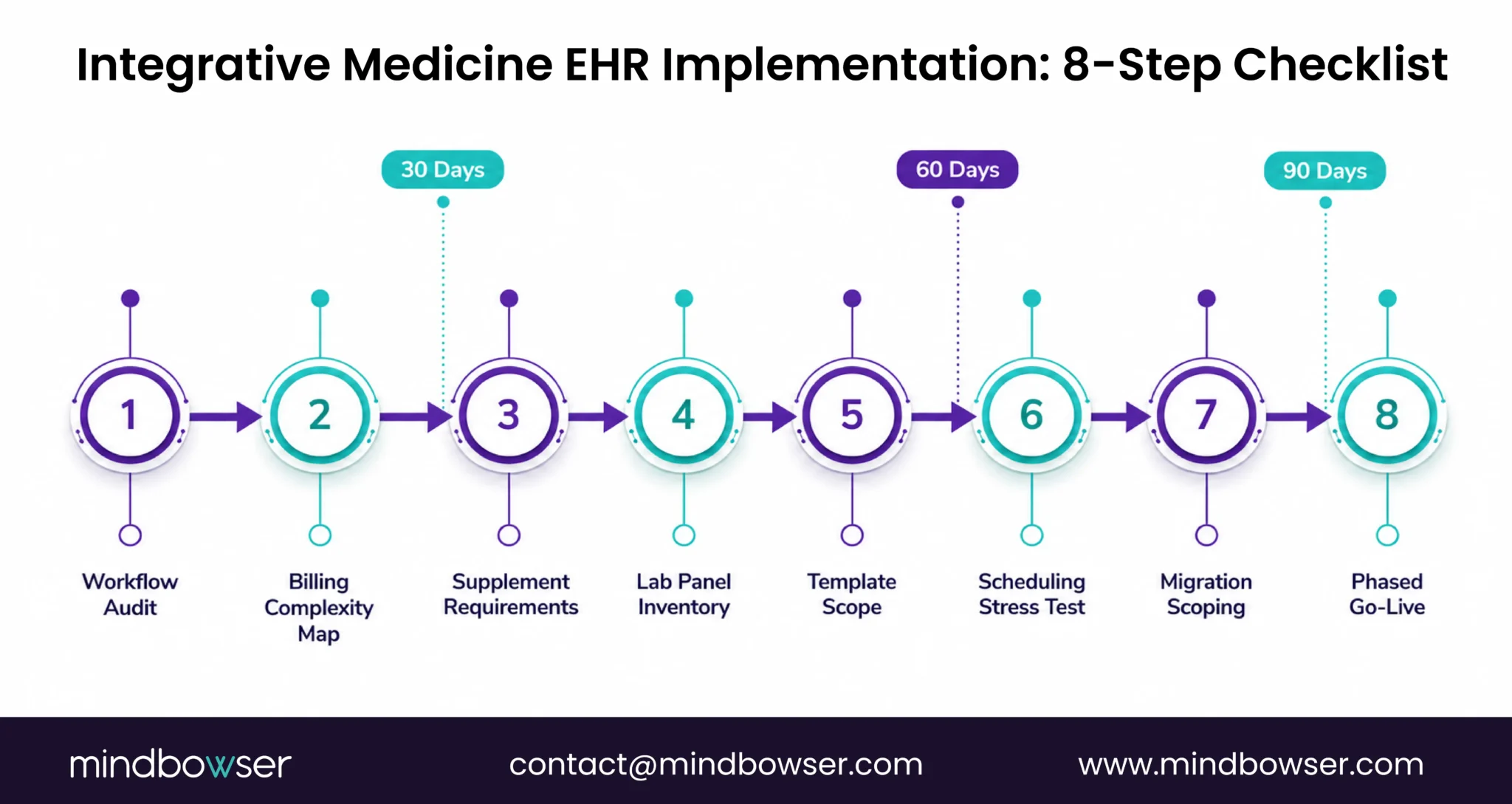
Whether you’re migrating from a generic system or deploying your first dedicated IM EHR, the same eight steps apply. In our builds, the data migration step is where most go-live timelines slip. The checklist below is where we’d start regardless of which platform you pick.
1. Modality workflow audit.
Document every visit type before touching a vendor demo. A new acupuncture intake, a functional medicine follow-up, a health coaching session, and a supplement protocol review are four different workflows. Map them all first.
2. Billing complexity map.
List every service line: insurance E&M, Medicare acupuncture CPT, self-pay cash visits, supplement dispensing, group programs. Any vendor that can’t demo all of them live on day one is a future workaround.
3. Supplement requirements documentation.
List every supplement brand, protocol database, and dispensing platform you use. Bring the list to every vendor demo and ask for a live supplement protocol creation: not a slide deck.
4. Functional lab panel inventory.
Top 10 specialty labs you order regularly. Verify which ones each vendor supports via direct FHIR exchange vs. PDF uploads. That distinction matters more than most salespeople acknowledge.
5. Template build scope assessment.
Inventory every note type your practitioners use. Estimate custom template configuration time per vendor: this is where “highly flexible” platforms reveal their real implementation cost.
6. Multi-practitioner scheduling test.
Run a realistic week in the demo: ND, LAc, RDN, and massage on the same calendar, shared rooms, different slot lengths. Watch where it breaks.
7. Data migration scoping.
Budget 20-40% more time than vendor estimates. IM records carry structured data that doesn’t map cleanly, and supplement protocol history is almost always stored in formats no migration tool recognizes; finding that out on migration day is expensive.
8. Phased go-live.
One modality or one practitioner for a 30-day pilot before full rollout.
I’ve reviewed enough EHR go-live implementations to know that the “we’ll clean up the data after launch” plan rarely happens. Supplement protocols and functional lab baselines captured incorrectly on go-live day have been a practice for years. Get the fields right before you switch, not after the first six months of bad data.
Conclusion
Standard EHRs consistently fail integrative medicine practices in three areas: split-billing for multi-payer visits, supplement protocol tracking, and functional lab ordering. The gap is structural. These workflows were never the design target.
Use the five-criteria framework before any vendor demo. Power2Practice is the strongest off-the-shelf option if supplement dispensing is the core workflow. Jane App wins on multi-practitioner scheduling. DrChrono wins on charting flexibility. For practices mixing three or more modalities at scale, evaluate custom before committing to an enterprise SaaS ceiling you’ll hit within 18 months.
We’ve run this evaluation for practices that chose off-the-shelf and some that chose custom. The pattern is consistent: the practices that waited too long to evaluate custom did so because they underestimated how fast the workaround cost compounds.
Power2Practice is the most purpose-built option for functional and integrative medicine practices that dispense supplements and order functional labs. Jane App is the strongest option for multi-practitioner scheduling. For practices with 10+ practitioners or complex multi-modality billing, a custom-built integrative medicine EHR typically provides better workflow coverage at a comparable three-year total cost.
Yes, partially. CMS expanded Medicare coverage for acupuncture for chronic low back pain in the 2020 Final Rule, covering up to 12 visits per year with documented medical necessity and applicable acupuncture CPT codes. Most other integrative medicine services, including naturopathic care, functional medicine, and nutrition counseling outside specific covered conditions, are generally billed as self-pay.
Not reliably. Most major EHR platforms do not include a structured supplement or nutraceutical database. Practices often enter supplement protocols as free text in medication fields or manage them in separate spreadsheets. Power2Practice and custom-built integrative medicine EHRs can support structured supplement protocol documentation.
A custom EHR may make sense for practices with 10+ practitioners, 3+ clinic locations, multiple specialties such as integrative medicine, behavioral health, nutrition, and rehabilitation, or supplement dispensing at scale. It can also be valuable when value-based payer contracts require longitudinal outcome data that the current EHR cannot easily produce.
Implementation timelines depend on the platform and level of customization. Off-the-shelf platforms may take around 30-90 days, while systems requiring extensive template configuration can take 3-6 months. Custom integrative medicine EHR builds with pre-built accelerators typically take around 8-12 months, depending on integration complexity, specialty lab connections, and data migration requirements.