BLOGS
BLOGS  NEWSROOM
  CASE STUDIES
  WEBINARS
  PODCASTS
  ASSET HUB
  EVENT CALENDAR






















TL;DR
- Most dermatology practices end up running two EMRs, one for insurance-billed medical dermatology, one for cash-pay cosmetic. Neither system was built to handle both cleanly.
- ModernizingMedicine EMA is the strongest all-in-one for practices with a true medical/cosmetic mix.
- Nextech is the better fit for cosmetic-heavy practices.
- Kareo/Tebra works for smaller practices that are primarily medical billing.
- Epic Dermatology belongs in health system departments, not independent groups.
- For high-volume cosmetic practices, Mohs surgery centers, or physician-founders building a commercializable platform, custom is the path that actually fits.
I review a lot of dermatology EMR implementations. The same problem comes up every time.
The practice has two systems running side by side: one for medical dermatology, where the patient comes in with psoriasis, atopic dermatitis, or a suspicious lesion and the visit gets billed to insurance. A second system for cosmetic, Botox, fillers, laser treatments, chemical peels, where the patient pays cash or credit, there is no insurance claim, and the workflow feels closer to a spa booking system than a clinical record.
Neither system talks to the other. The patient who has been treated for eczema for three years and now wants cosmetic skin rejuvenation has two charts. Treatment history does not transfer. The provider documents the clinical history in one system, takes cosmetic notes in another, and manually tracks product lot numbers for injectables in a spreadsheet.
Nobody designed it this way. It just grew.
The “best” dermatology EMR is almost never the one with the longest feature list. It is the one that handles this medical/cosmetic split cleanly from a single patient chart without requiring manual data bridging between two systems. Most of the market leaders still do not solve this cleanly.
Here is how to evaluate them honestly, and when none of the above is the right answer.
The medical specialty EMR development guide covers the full spectrum of specialty-specific builds if you want the wider context. For dermatology specifically, the distinctions matter enough to warrant their own analysis.
What Makes Dermatology Different From General EMR
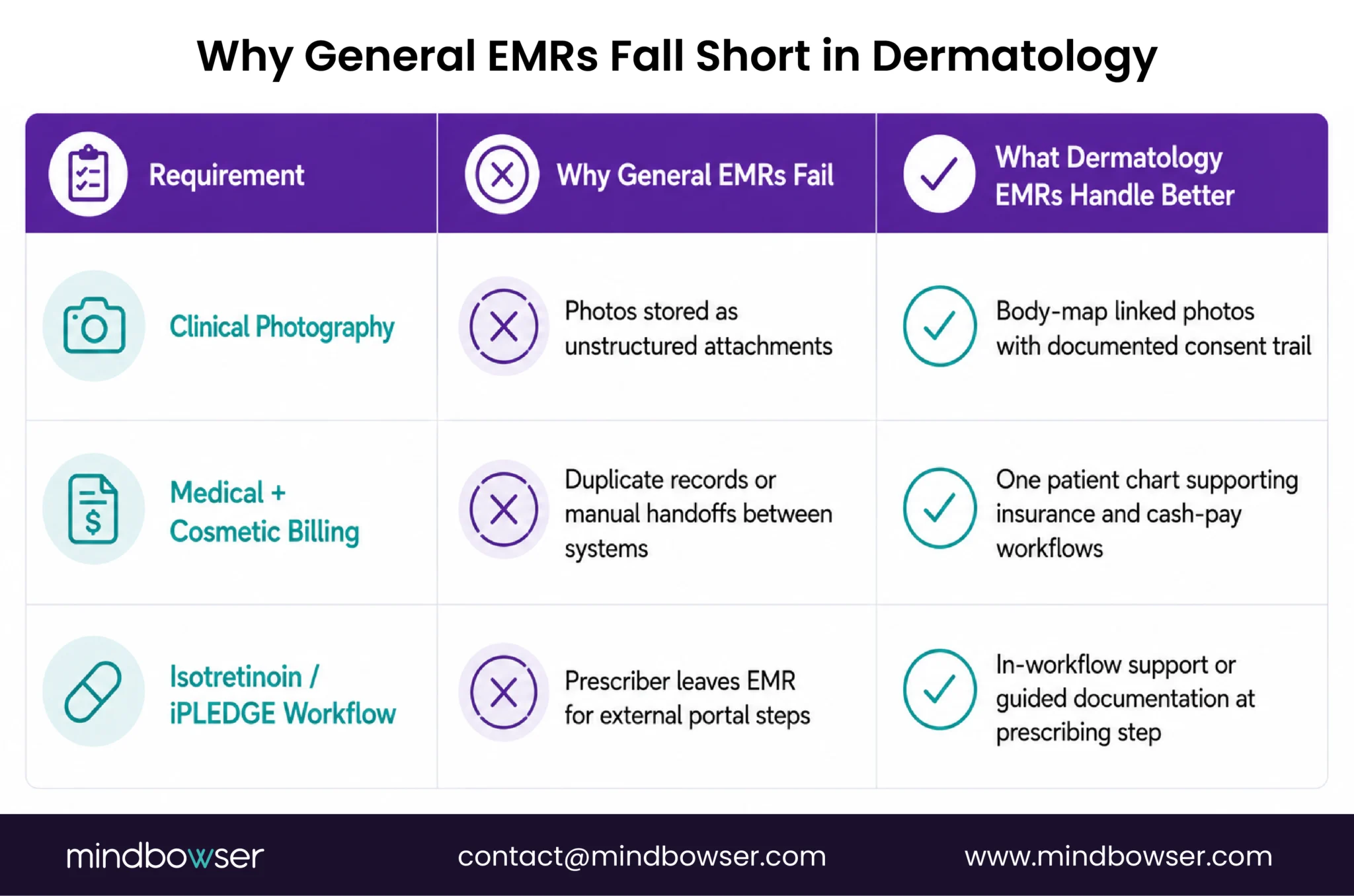
Three requirements that general EMRs handle poorly and dermatology-specific platforms handle natively.
Clinical photography as a liability record, not just a workflow tool. In dermatology, before-and-after photos are part of the clinical record. They document the progression of a lesion, the response to treatment, the outcome of a cosmetic procedure. HIPAA requires specific written consent before clinical photographs are taken. Some states have additional requirements. When a claim is disputed, either a cosmetic outcome complaint or a malpractice allegation about a missed lesion, the photo record is often the first thing subpoenaed.
General EMRs treat photos as unstructured attachments. The photo gets uploaded to a note, maybe, as a JPG file. There is no body-map location tagging, no consent log tied to the specific photo, no automatic linking of the photo to the body site documented in the exam. That creates a documentation gap that looks defensible until a litigation attorney starts asking when consent was obtained and where the original was stored.
A dermatology-specific EMR stores clinical photos in the chart at the body-map level, with HIPAA consent logged automatically at the point of capture. That is not a nice-to-have. It is a liability requirement.
The cosmetic/medical billing split. Same patient, potentially same visit, two completely different revenue streams. On the medical side: ICD-10 diagnosis codes, insurance claims, explanation of benefits, prior authorization for biologics like dupilumab. On the cosmetic side: cash or credit card payment at checkout, no insurance claim, product retail tracking, loyalty programs.
EMRs built for medical billing add cosmetic as a module. Pure cosmetic platforms (med spa software, aesthetic practice management tools) add medical billing as an add-on. Both directions result in a system that handles one workflow natively and the other with friction.
E-prescribing for topicals and controlled substances. Dermatology prescribing includes tretinoin and topical retinoids, high-potency corticosteroids, isotretinoin (iPLEDGE program), spironolactone, and occasionally controlled substances. Isotretinoin specifically requires integration with the iPLEDGE portal, an FDA-mandated REMS (Risk Evaluation and Mitigation Strategy) program. Prescribers must log each prescription event in the iPLEDGE system, confirm the patient has met the required pregnancy tests or counseling requirements, and document compliance before the pharmacy can dispense. Platforms without native iPLEDGE integration require the prescriber to manage this in a separate browser session. That is a workflow break and a compliance risk.
Must-Have Features in a Dermatology EMR
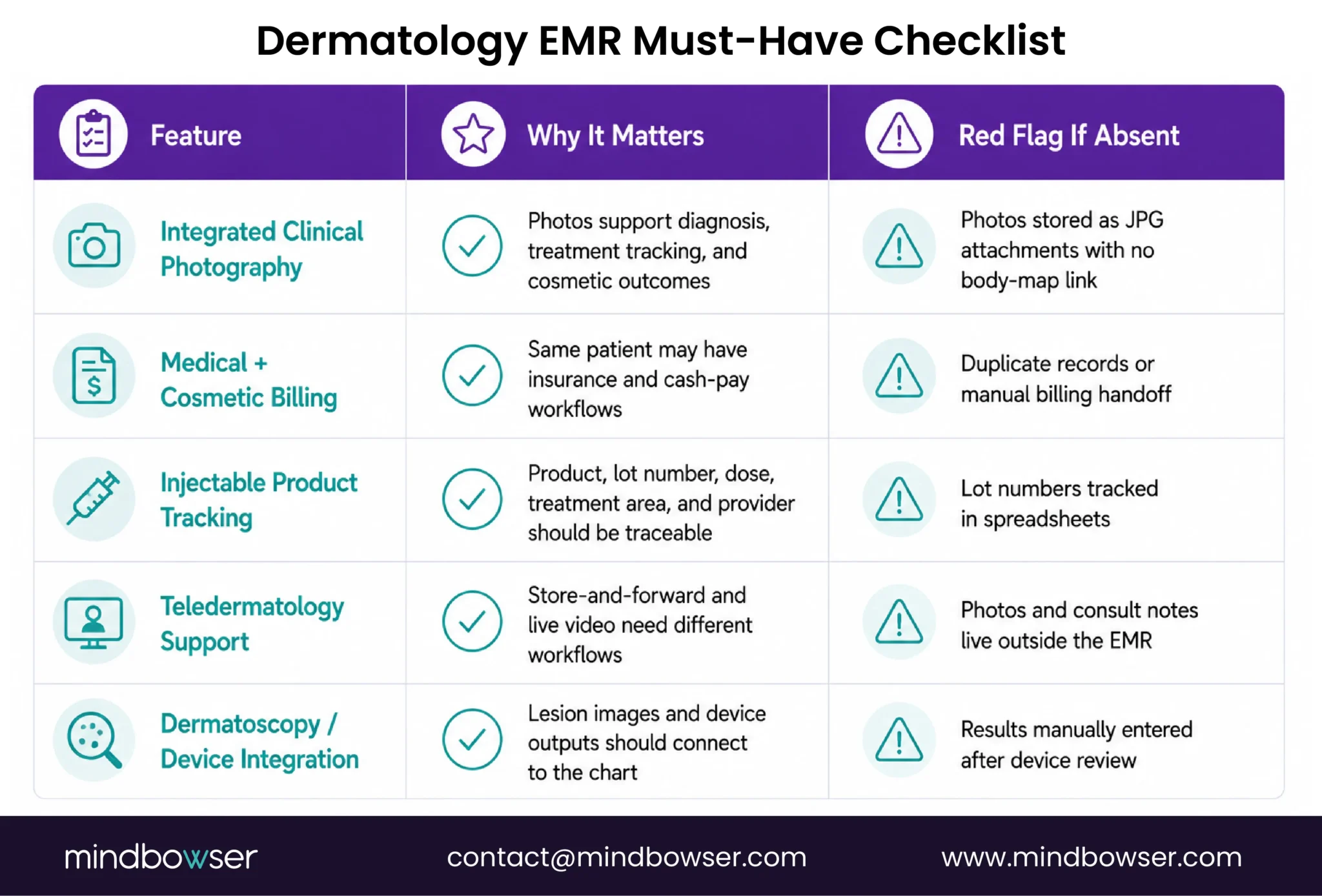
Here are the features that actually affect daily workflow.
- Integrated clinical photography. The photo should be taken inside the EMR workflow (or via a tethered device integration), linked automatically to the patient chart at the body location, with consent logged at the point of capture. Not “attach a JPG to a note after the visit.”
- Cosmetic and medical billing in one chart. One patient record. The same patient who has acne can also want laser treatment. The chart should support both billing types without creating a duplicate record or requiring manual data transfer between systems. The practice managing mixed medical and cosmetic workflows in a private practice has a specific set of requirements that most general EMR comparisons do not cover.
- Procedure tracking for injectables. FDA 510(k) requirements for medical devices apply to injectable products, botulinum toxin, hyaluronic acid fillers. Lot numbers must be traceable. If a patient has an adverse event and the lot number cannot be identified, the practice has a liability exposure. An EMR with integrated injectable product tracking logs lot number at the time of administration and links it to the patient encounter.
- Teledermatology support. Store-and-forward (patient submits photos for async clinical review) and live video are two different workflows with different reimbursement codes. An EMR that supports teledermatology should handle both, attach billing codes to the encounter type, and keep the photos in the clinical record rather than in a separate communication platform.
- Dermatoscopy integration. AI-assisted lesion analysis tools such as DermEngine and SkinVision integrate with EMRs via FHIR or proprietary API. Without integration, these tools run as standalone workflows and results have to be manually entered into the chart. Platforms that expose API hooks for third-party dermatoscopy tools make AI-assisted lesion analysis a native workflow rather than a parallel one.
Connect With Our Team Today to Plan Your Dermatology EMR Now
Best Dermatology EMR Options in 2026: An Honest Comparison
ModernizingMedicine (EMA)
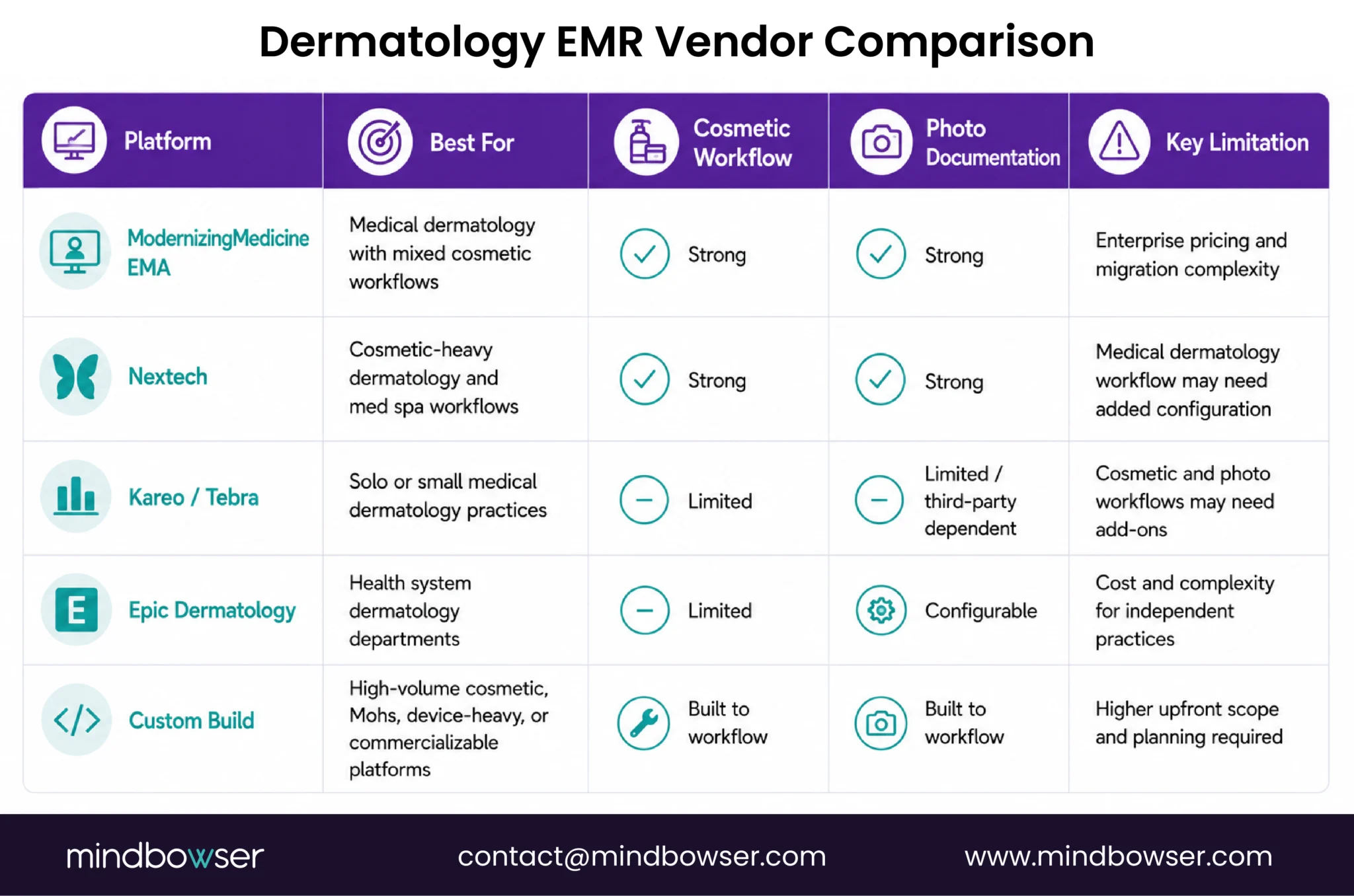
EMA is purpose-built for dermatology. The AI-assisted documentation engine builds notes from prior visit data, suggests ICD-10 codes based on the chief complaint and exam findings, and handles the cosmetic/medical billing split more cleanly than any other commercial platform in this category. Photo documentation is native: photos are taken in the workflow, linked to the chart at the body-map level, and consent is tracked automatically.
Pricing is enterprise-tier and not publicly listed, which makes evaluation a longer sales cycle. Integration with lab and pathology partners outside MM’s certified partner network requires custom HL7 work. For practices looking to swap vendors, the migration path out of EMA is difficult because of how deeply the AI documentation layer is integrated with the proprietary data model.
Best for: Multi-provider dermatology practices with a true medical/cosmetic mix, or any practice where the documentation burden is high and AI-assisted note-building has clear ROI.
Limitation: Pricing does not scale cleanly for small groups. Lock-in is real.
Nextech
Nextech is the category reference for cosmetic dermatology and plastic surgery. The appointment scheduling, payment workflow, loyalty programs, and before/after photo management are built for cash-pay cosmetic practices. Revenue cycle for cosmetic is as smooth as any platform in the market.
Where Nextech falls short is on the medical dermatology side. The ICD-10 coding workflow, insurance billing, and clinical documentation for medical visits feel like an add-on to the core cosmetic product. Practices with a 60/40 or higher cosmetic revenue split will find Nextech the right fit. Practices where medical dermatology is the primary revenue driver will find the clinical documentation side underpowered.
Best for: Cosmetic dermatology practices, med spas with a dermatologist on staff, plastic surgery groups.
Limitation: Medical billing workflow is weaker than cosmetic-first design suggests.
Kareo Dermatology (now Tebra)
Kareo’s dermatology offering works well for smaller practices that are primarily medical billing. The revenue cycle tools are solid for insurance-based practices. The interface is cleaner and easier to onboard than enterprise platforms. Photo documentation requires a third-party integration. The teledermatology module is limited.
The rebranding to Tebra following the Kareo/PatientPop merger introduced some platform instability that practices have reported. Worth checking current user reviews on the integration reliability before committing.
Best for: Solo and small group dermatology practices, primarily insurance-based medical dermatology.
Limitation: Photo documentation is third-party dependent. Cosmetic workflow support is thin.
Epic Dermatology
Epic is used in academic medical centers and large health system dermatology departments where dermatology is one specialty among many. The integration across specialties is the genuine advantage: a dermatologist in a health system who needs to cross-reference a patient’s rheumatology notes or oncology history has them in the same chart. Pathology results from the health system lab come back natively.
The AI-assisted note suggestion is genuinely useful for standard skin exams: I’ve seen it cut documentation time by 30-40%. The photo documentation is integrated into the EHR workflow rather than bolted on. For practices that are part of a health system, Epic Dermatology deserves serious evaluation.
For an independent dermatology group, the question shifts. Epic’s strength is integration across specialties, clinically valuable in a health system where a patient’s dermatology visit might need cross-reference to rheumatology, oncology, or internal medicine. For a dermatology-only independent practice, that integration strength is irrelevant. What matters instead is whether the standalone dermatology features (photo documentation, cosmetic/medical split, injectable tracking) compete with ModernizingMedicine and Nextech. They don’t.
The licensing cost, implementation timeline, IT staffing overhead, and the ongoing support model are all mismatched to the benefit for an independent group. I’ve reviewed enough dermatology implementations to know that the integration points that make Epic valuable in a health system are the same points that add friction and cost in an independent practice workflow.
Best for: Health system dermatology departments where integration with other specialties is a genuine clinical requirement.
Limitation: Wrong fit for independent practices.
Custom EHR for Dermatology
For practices where none of the above fits the workflow and for physician-founders building a commercializable dermatology platform a custom build is the path to a real solution. The specialty EMR development guide covers the landscape; the dermatology-specific use cases are covered in detail below.
Integration Points That Determine If Your EMR Actually Works
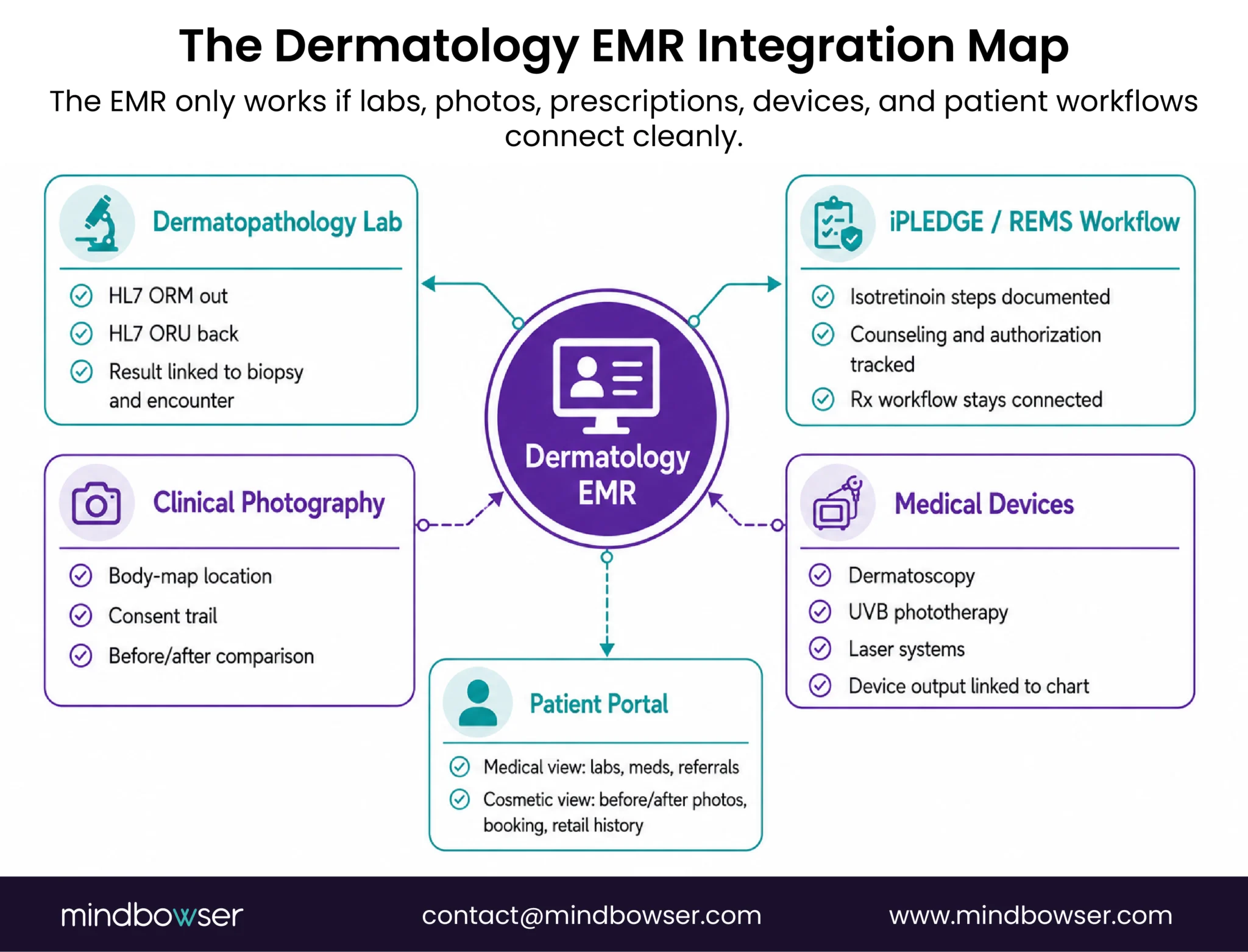
The EMR does not exist in isolation. Here is what it needs to connect to in a real dermatology workflow.
Lab and pathology.Biopsy specimens go to a dermatopathology lab. The path report needs to come back into the patient chart as a linked structured result, not a faxed PDF that someone uploads. HL7 ORM (Order Message) goes to the lab; HL7 ORU (Observation Result) brings the result back. Most major platforms have pre-built interfaces for Quest and LabCorp. Independent dermatopathology labs often require a custom HL7 interface. This is one of the most common integration gaps in mid-market dermatology EMRs.
iPLEDGE for isotretinoin.The iPLEDGE REMS program requires the prescriber to log each isotretinoin prescription in the FDA-managed portal, confirm patient counseling and negative pregnancy test (where applicable), and authorize the pharmacy dispense. Native iPLEDGE integration means this workflow happens inside the EMR at prescription time. Without it, the prescriber handles the iPLEDGE steps in a separate browser session and risks breaking the documentation chain.
Medical device integration.Narrowband UVB phototherapy units, dermatoscopy devices, and laser treatment systems typically connect via USB or proprietary software. True EHR integration for these devices is uncommon in commercial platforms. A custom build can implement structured device output capture and link treatment session data directly to the patient chart.
Patient portal two workflows, one view.Medical patients want lab results, referral notes, medication history. Cosmetic patients want before/after photo access, appointment booking, loyalty points, retail product history. The same patient may need both. Platforms that run two separate portals create confusion and increase support overhead. A well-designed portal uses role-based view controls to show each patient type the content relevant to their history.
TheEHR data integration guide covers the HL7 and FHIR pipeline patterns in depth for anyone building out custom lab and device integrations.
How to Choose the Right Dermatology EMR
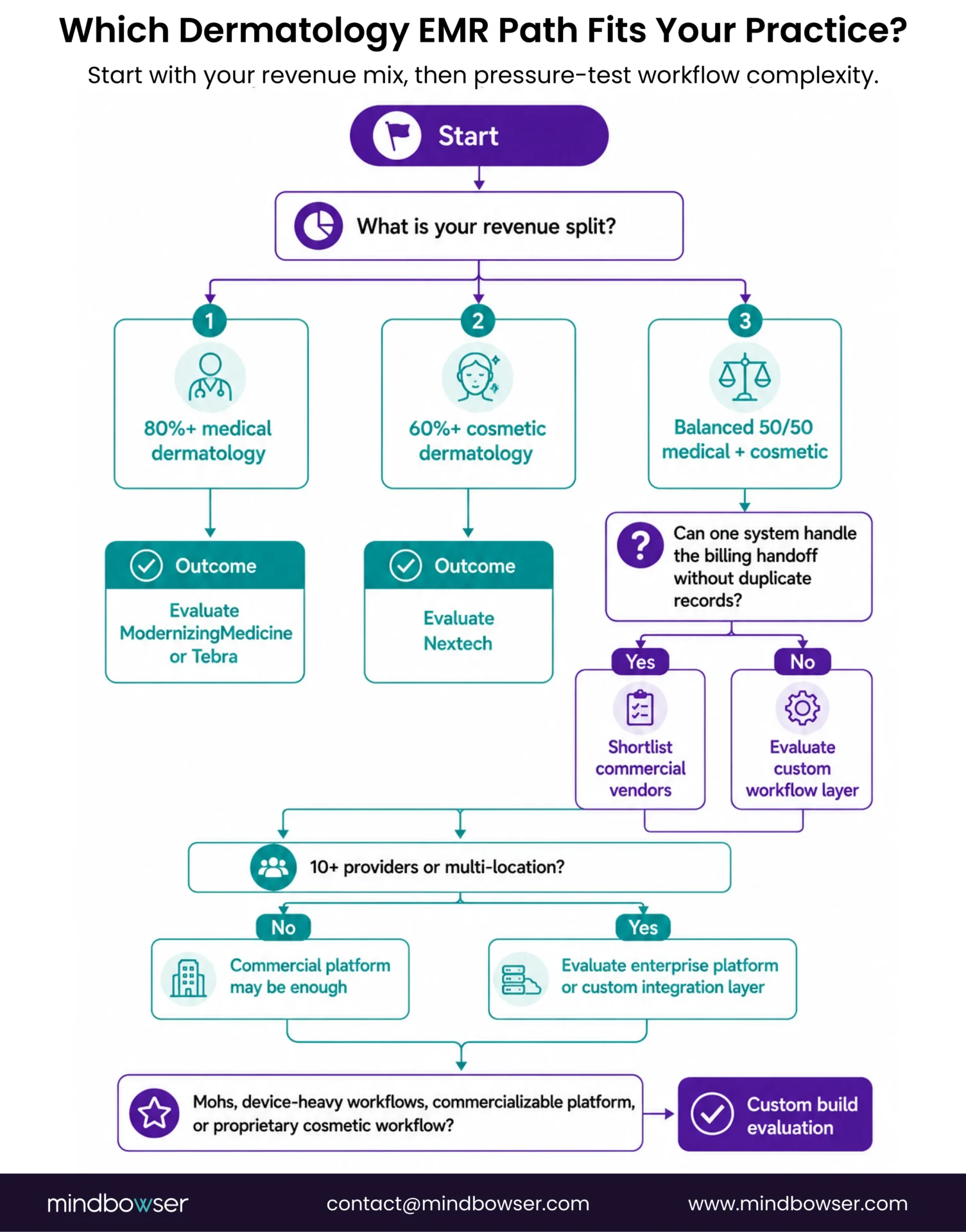
Three questions before shortlisting any vendor.
What is your revenue split?If medical dermatology is 80% or more of your revenue, ModernizingMedicine or Kareo/Tebra are the right starting points. If cosmetic is 60% or more, Nextech is the category fit. If the split is genuinely 50/50, ask every vendor for a live demo of the billing handoff between cosmetic and medical workflows for the same patient not a slide, a live workflow walk-through with a real patient scenario.
How many providers and locations?Solo and small group practices can be well-served by mid-market platforms. Ten or more providers across multiple locations, especially if the locations have different revenue mix profiles, means either evaluating enterprise platforms or building a custom integration layer between systems you already have.
Do you plan to add teledermatology?If yes, ask each vendor: store-and-forward or live video? Reimbursement codes attached to the encounter type? State telehealth licensure requirements met? HIPAA-compliant photo storage in the consult workflow? These are not standard features in most dermatology platforms.
Six questions to ask any vendor before signing:
- How does your platform handle the cosmetic/medical billing split in a single patient chart without creating a duplicate record?
- What is your native photo documentation workflow and where in the clinical record do photos live body-map, note attachment, or standalone gallery?
- Do you have native iPLEDGE integration for isotretinoin prescribing, or is that handled outside the EMR?
- Which dermatopathology labs do you have pre-built HL7 interfaces for?
- What is your teledermatology model store-and-forward, live video, or both?
- What does integration with an outside cosmetic service (a Botox distributor’s inventory system, a med spa POS) actually look like?
If you reach the shortlist stage and want a technical read on a specific vendor’s integration claims, evaluating an EHR development partnercovers the right questions to pressure-test.
When a Custom Dermatology EMR Makes Sense
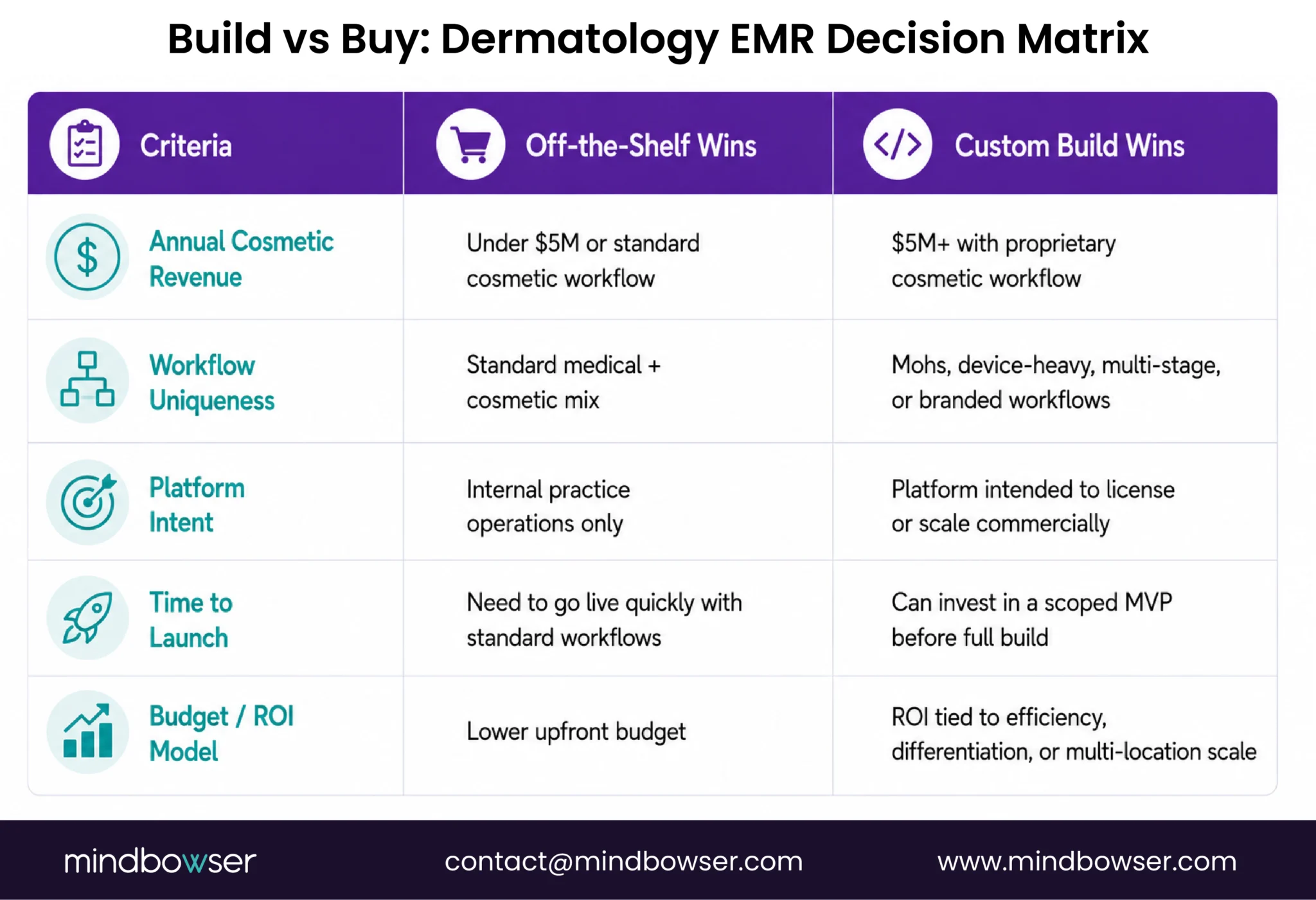
Three scenarios where the commercial platforms leave a real gap.
High-volume cosmetic practices with a proprietary workflow.A large cosmetic dermatology group or multi-location med spa with annual cosmetic revenue exceeding $5M often finds that Nextech’s customization ceiling becomes a constraint. Custom booking flows with integrated loyalty, a patient-facing before/after app, retail product inventory tracking linked to treatment records, and branded digital consent capture these are features that off-the-shelf platforms offer as modules that do not fully integrate with each other. A custom build makes them native workflow.
Mohs surgery centers.Mohs workflow is distinct from general dermatology: staged excision tracking, intraoperative pathology with margin clearance documentation, reconstruction planning, and the multi-stage visit structure that requires tracking across the same day. ModernizingMedicine’s Mohs module is the strongest commercial offering, but high-volume Mohs centers consistently identify gaps in the margin mapping and reconstruction documentation workflows. A custom build designed around the Mohs workflow fills those gaps without workaround behavior.
Physician-founders building a commercializable dermatology platform.A teledermatology SaaS for underserved markets, a dermatoscopy AI workflow system for independent practices, or a multi-specialty skin clinic platform that will be licensed to other practices these require FHIR-native API architecture from day one, HIPAA-compliant clinical photo storage with consent chain, and a workflow layer that can be adapted per deployment.
For these builds, Mindbowser uses EHRConnect for the FHIR integration layer (lab/pharmacy/patient portal connectivity, HL7 ORM/ORU for pathology, patient access API), PHISecure for HIPAA-compliant clinical photo storage with consent logging at the point of capture, and Launchpad for rapid workflow prototyping reaching a testable MVP in 10-12 weeks on the custom layer while the integration layer is pre-built.
The custom EHR development guide covers how these engagements are scoped and what a dermatology-specific build looks like from day one.
Where to Go From Here
The decision usually comes down to one question: is the problem primarily workflow (which platform solves it) or is it a structural gap (which no platform solves without custom work)?
For workflow problems, the vendor comparison above gives you the shortlist. For structural gaps, a technical scoping call is the fastest way to understand what a custom build would actually require and whether the economics make sense.
Talk to the team, bring your revenue split, your current system list, and the three workflow problems you most want to solve. We will tell you honestly whether an off-the-shelf platform covers it.
For a solo or two-provider dermatology practice that is primarily medical billing, Kareo/Tebra is the right fit: lower cost, faster onboarding, solid insurance billing workflow. For a small practice with a meaningful cosmetic revenue stream, ModernizingMedicine’s pricing is harder to justify at that scale; Nextech is worth evaluating if cosmetic is 40% or more of revenue.
ModernizingMedicine (EMA) is stronger for medical dermatology: AI-assisted clinical documentation, ICD-10 coding support, photo documentation native to the clinical workflow. Nextech is stronger for cosmetic: cash-pay workflow, loyalty programs, cosmetic appointment scheduling, before/after photo management for patient-facing use. If your practice is genuinely split, request live demos of both for a mixed-visit patient scenario before deciding.
Almost never. Epic Dermatology is built for health system departments where dermatology is one specialty inside a larger clinical infrastructure. For an independent dermatology group, the licensing cost, implementation timeline, and IT overhead are mismatched to the benefit. The complaint I hear most from groups that tried it outside a health system is the documentation burden and the complexity that comes from a platform designed for a much larger clinical environment.
Some do natively; others require the prescriber to handle iPLEDGE steps in a separate browser session. ModernizingMedicine has native iPLEDGE integration. Ask every vendor you evaluate to show you the isotretinoin prescribing workflow live, specifically the step where iPLEDGE authorization is obtained before the prescription is sent to the pharmacy.
The key features: store-and-forward photo submission with HIPAA-compliant storage, live video option (not just photo), reimbursement codes attached to the encounter type, and state telehealth licensure compliance. Ask whether teledermatology is a native workflow or a third-party integration. If it is a third-party integration, find out where the photos and consult notes live in the clinical record after the encounter is complete.
A custom build using pre-built integration components (FHIR layer, HIPAA photo storage, pharmacy connectivity) typically runs $150K-$400K for an initial production-ready system, depending on the complexity of the cosmetic workflow layer, the number of device integrations required, and the scale of the patient portal. A focused MVP covering the core clinical and cosmetic billing workflows can be scoped tighter.