












 BLOGS
BLOGS  NEWSROOM
  CASE STUDIES
  WEBINARS
  PODCASTS
  ASSET HUB
  EVENT CALENDAR





















For NEMT operators, software decisions used to sit safely in the operations bucket. Dispatch wanted better scheduling. Billing wanted cleaner claims. IT wanted fewer support tickets. Today, that framing no longer holds.
NEMT software cost has become a financial and compliance decision with direct impact on margins, cash flow timing, and contract risk. Subscription tools that once felt affordable now scale linearly with fleet size.
At the same time, Medicaid billing rules, EVV enforcement, and audit scrutiny continue to tighten. The result is a growing gap between what off-the-shelf platforms promise and what growing providers actually need.
CFOs and operators are now asking harder questions:
- What does our 3–5 year total cost of ownership look like, not just year one spend?
- How much revenue is at risk from denials, delayed updates, or billing workarounds?
- Are we building equity in an asset we own, or paying rent on one we can lose?
This 2026 NEMT Cost Guide is written for leaders making that call. It strips away marketing noise and focuses on executive-level tradeoffs. Cash outlay versus control. Subscription convenience versus compliance certainty. Short-term savings versus long-term exposure.
The goal is not to sell custom software on principle. The goal is to show, with clear math and real operator scenarios, when buying makes sense and when building becomes the financially responsible move.
I. NEMT Software Pricing Models (SaaS vs. Custom)
When executives compare NEMT platforms, the mistake is focusing on price instead of pricing mechanics. The model determines how costs behave as your fleet grows, rules change, and audits tighten. Below is a side-by-side view framed for a CFO-level total cost of ownership analysis.
A. Pricing Model Comparison
| Dimension | Off-the-Shelf SaaS | Custom-Built NEMT Platform |
| Cost Structure | Recurring subscription, typically per vehicle per month | One-time build plus predictable hosting and support |
| Typical Entry Cost | $50–$250 per vehicle per month | $80K–$150K upfront build |
| Year-One Extras | Setup, training, integrations, feature tiers | Discovery, prototyping, MVP build |
| Scaling Behavior | Costs rise linearly with every vehicle added | Costs scale with infrastructure, not fleet count |
| Billing & EVV Logic | Generic workflows, updated on vendor timelines | State-specific rules embedded into the system |
| Compliance Control | Vendor-defined, limited audit transparency | Full ownership of audit trails and PHI handling |
| IP Ownership | Vendor owns code and roadmap | Provider owns source code and workflows |
| Exit Risk | High switching friction and data dependency | Low. Platform and data remain yours |
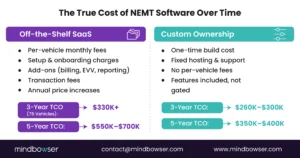
B. 3–5 Year TCO Snapshot (Illustrative)
Scenario: 75-vehicle fleet, Medicaid-heavy
SaaS model
- $125 per vehicle per month × 75 vehicles = $9,375/month
- Annual software spend ≈ $112,500
- 3-year TCO ≈ $337,500
- 5-year TCO ≈ $562,500
This excludes setup fees, transaction charges, EVV add-ons, and price escalations.
Custom model
- One-time build: $120,000
- Hosting + support: $4,000/month = $48,000/year
- 3-year TCO ≈ $264,000
- 5-year TCO ≈ $360,000
By year three, the cost curves diverge. SaaS keeps charging for scale. Custom stabilizes.
C. Why the Model Matters More Than the Sticker Price
SaaS pricing is attractive because it delays commitment. Custom pricing is uncomfortable because it forces one. But from a finance perspective, SaaS converts a core operational system into a permanent operating tax, while custom converts it into a depreciable asset.
For operators with growing fleets or Medicaid exposure, the question is not “Which is cheaper this year?” It is:
Do we want software costs that grow automatically with volume, or software we control as volume grows?
That answer sets the rest of the economics in motion.
II. The SaaS Hidden-Cost Trap: How $300K Sneaks Onto the P&L
Subscription NEMT platforms rarely break budgets in year one. They break them quietly in years two and three. What starts as a manageable operating expense turns into a structural cost problem as fleets grow, Medicaid volume increases, and compliance rules change faster than vendor roadmaps.
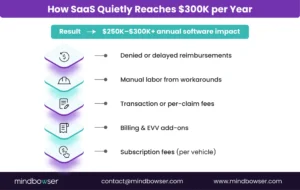
This is where many operators cross the $300,000 annual software spend line without ever signing a new contract.
A. The Per-Vehicle Tax Compounds Fast
Most SaaS pricing is anchored to a simple rule: more vehicles equal more fees. On paper, that feels fair. In practice, it disconnects software cost from business value.
Consider a mid-sized, Medicaid-heavy operator:
- 75 vehicles
- $125 per vehicle per month (well within published market ranges)
That equals $9,375 per month, or $112,500 per year in base subscription fees alone.
Now layer in reality:
- Fleet grows to 100 vehicles over 24 months
- Monthly software spend rises automatically to $12,500
- Annualized cost now exceeds $150,000, before add-ons
By year three, many operators are paying enterprise-level software costs without enterprise-level control.
B. Add-On Fees Disguised as “Optional”
SaaS vendors often advertise a core platform price, then monetize critical functionality separately. Common examples include:
- Medicaid claim submission modules
- EVV integrations
- API access for brokers or payers
- Advanced reporting and denial analytics
- Patient text and call notifications
Each add-on may look modest in isolation. Together, they materially change the total cost of ownership. For Medicaid-heavy providers, billing-related add-ons are not optional. They are table stakes.
The result is a software bill that no longer resembles the original quote.
C. Transaction Costs Hit Revenue, Not IT Budgets
Some platforms charge per claim, per ride, or per message. These fees are often booked as operating expenses, not IT costs, which makes them harder to track as software spend.
For CFOs, this creates a visibility problem. Software costs show up fragmented across billing, operations, and compliance lines. By the time they are consolidated, the spend is already locked in.
This is also where margins erode fastest. Transaction fees scale with volume, not efficiency. The better you perform operationally, the more you pay the vendor.
D. Vendor Timelines Become Financial Risk
When Medicaid or state EVV rules change, SaaS customers wait. During that wait:
- Claims may be delayed
- Manual workarounds increase labor costs
- Denials rise due to mismatched logic
- Cash flow stretches
None of these show up as “software fees,” yet all are downstream costs of limited control. From a finance lens, delayed reimbursement is a working capital issue, not an IT inconvenience.
E. Why the $300K Threshold Matters
Once annual SaaS spend approaches $250K–$300K, three things usually happen:
- Software becomes one of the top non-labor operating expenses
- Price increases compound faster than revenue growth
- Switching costs feel prohibitive, even if the system no longer fits
This is the trap. Providers stay not because the software works well, but because leaving feels risky.
If these costs sound familiar, you’re not alone!
it’s a systemic challenge across NEMT. The good news? Modern technology can stop the leaks before they drain your business. See how Mindbowser helps providers recover revenue and rebuild trust.
III. Custom NEMT Software Cost Breakdown (and Where ROI Starts to Flip)
Custom NEMT software often gets dismissed too early because leaders fixate on the upfront number. That reaction is understandable. Writing a six-figure check feels riskier than approving a monthly subscription.
From a CFO and operator perspective, though, the more relevant question is not how much it costs to build, but what it replaces over three to five years.
Below is a practical, finance-first breakdown of what custom NEMT software actually costs and why ownership changes the economics.
A. Phase 1: Discovery and Prototyping ($10K–$20K)
This phase is not overhead. It is risk reduction.
Discovery aligns dispatch workflows, Medicaid billing rules, EVV logic, and compliance controls before a single line of production code is written. The output is a validated blueprint that reflects how your operation actually runs, not how a generic vendor assumes it should.
From a cost perspective, this phase prevents expensive rework later. From a compliance perspective, it surfaces state-specific billing nuances that routinely cause denials when missed.
CFO lens: modest upfront spend that protects the larger capital investment.
B. Phase 2: Core Platform Build ($50K–$100K)
This is the functional backbone of the system. A typical MVP includes:
- Dispatch and scheduling tied to real-world routing logic
- Medicaid billing engine aligned to your state requirements
- EVV-ready trip validation and audit trails
- HIPAA-grade security architecture and role-based access
At this stage, most operators can fully replace spreadsheets, manual billing steps, and fragmented tools. Many go live here and add features incrementally.
CFO lens: this replaces recurring license fees and reduces revenue leakage tied to billing errors.
C. Phase 3: Enhancements and Advanced Features ($30K–$60K)
Enhancements are elective and timed to business priorities, not vendor tiers. Common additions include:
- Driver mobile apps with offline support
- GPS tracking and geofencing
- Denial and performance analytics
- Patient scheduling and notifications
Unlike SaaS add-ons, these features do not carry permanent per-vehicle fees. Once built, they belong to you.
CFO lens: capitalized improvements that do not inflate operating expenses as volume grows.
D. Ongoing Hosting and Support ($2K–$6K per Month)
Custom platforms still incur operating costs, but the behavior is different. Hosting and support scale with infrastructure complexity, not fleet size.
A 100-vehicle fleet and a 130-vehicle fleet often run on the same monthly infrastructure footprint. There is no automatic penalty for growth.
CFO lens: predictable OpEx that does not compound with success.
E. 3–5 Year TCO View (Illustrative)
Custom scenario
- Build and enhancements: $140,000
- Annual hosting and support: $48,000
3-year TCO ≈ $284,000
5-year TCO ≈ $380,000
At the same fleet size, many SaaS operators cross these numbers in subscriptions alone, before transaction fees or price increases.
F. Where ROI Begins to Flip
Custom software typically starts outperforming SaaS financially when one or more of the following are true:
- Fleet size exceeds 50 vehicles
- Medicaid represents the majority of trips
- Denials or delayed reimbursements impact cash flow
- Compliance updates are frequent or state-specific
At that point, ownership stops being an IT preference and starts functioning like a financial control.
Next up: ROI scenarios by fleet size, showing exactly when custom overtakes SaaS for small, mid-sized, and enterprise operators.
IV. ROI Scenarios by Fleet Size (Where the Math Changes)
Return on investment is where the build versus buy decision becomes clear. Not in theory, not in demos, but in how software costs behave over three to five years as fleets scale and Medicaid complexity increases. Below are realistic scenarios framed in the way CFOs and operators actually evaluate them.
A. Small Fleets: Under 20 Vehicles
Profile: Local or regional operators, limited Medicaid exposure, modest growth plans.
- SaaS cost profile:
At $75–$150 per vehicle per month, annual software spend typically stays under $36,000. - Custom cost profile:
An $80K–$120K build would take several years to recover.
ROI reality:
At this scale, SaaS remains financially rational. The subscription premium buys speed and convenience. Custom ownership does not yet justify the capital outlay.
Executive takeaway:
Buy time, not software equity. Revisit the decision once growth or Medicaid share increases.
B. Mid-Sized Fleets: 50–100 Vehicles
Profile: Multi-facility contracts, dialysis and rehab volume, Medicaid-heavy reimbursement.
- SaaS cost profile:
75 vehicles × $125/month = $9,375/month
3-year TCO ≈ $337,500, before add-ons and fee increases. - Custom cost profile:
$120K build + $48K/year support
3-year TCO ≈ $264,000
ROI reality:
This is the inflection point. By year two or three, SaaS costs overtake custom. More importantly, denial reduction, faster reimbursements, and EVV alignment begin improving cash flow, not just lowering IT spend.
Executive takeaway:
Once software becomes a top-five operating expense, ownership starts to outperform renting.
The real cost comparison isn’t license vs build
Comparing a SaaS subscription to a custom build on sticker price misses where NEMT money actually moves. The costs that matter are the ones the software prevents or leaks: denied claims you could have scrubbed pre-trip, dispatcher hours spent on manual handoffs, revenue lost to GPS-to-billing gaps, and clawbacks from documentation an audit rejected. A custom platform costs more up front and is meant to pay back through those, not through a cheaper monthly line item. Frame the decision as total cost of the operation, not total cost of the tool.
C. Enterprise Fleets: 200+ Vehicles
Profile: Statewide or multi-county contracts, frequent audits, broker and payer integrations.
- SaaS cost profile:
200 vehicles × $100/month = $20,000/month
Annual spend exceeds $240,000, often climbing past $500,000 with add-ons. - Custom cost profile:
$150K build + $60K/year support
5-year TCO remains under $450,000
ROI reality:
At this scale, SaaS is no longer a software decision. It is a recurring financial liability. Custom platforms deliver cost control, audit readiness, and operational continuity that subscription tools cannot match.
Executive takeaway:
For enterprise operators, custom software is not optional. It is part of risk management.
D. What CFOs Notice First
Across all scenarios, executives report ROI showing up in three places before IT savings:
- Lower denial rates and fewer resubmissions
- Shorter reimbursement cycles
- Reduced labor tied to manual billing and compliance work
Software ownership does not just reduce expense. It stabilizes revenue.
V. Vendor Lock-In Risks: When “Renting” Becomes a Financial Exposure
Vendor lock-in is often discussed as an IT inconvenience. For NEMT operators and CFOs, it is something more serious. It is counterparty risk tied directly to revenue continuity, audit readiness, and data access. This risk tends to surface only when it is too late to mitigate cheaply.
A. What Lock-In Actually Means in Practice
With off-the-shelf SaaS platforms, providers do not own the software, the roadmap, or, in many cases, the full structure of their own operational data. The vendor controls:
- Feature availability and prioritization
- Timing of Medicaid and EVV updates
- Data export formats and access rules
- Pricing changes and contract terms
As long as the vendor remains stable and responsive, this may feel acceptable. The problem is that NEMT operations depend on software as a system of record, not a convenience tool. When control is external, risk compounds quietly.
B. The Continuity Problem CFOs Worry About
Lock-in becomes a balance-sheet issue under four common conditions:
- Vendor instability or acquisition
When vendors restructure, get acquired, or wind down operations, customers often experience slowed support, frozen development, or forced migrations. Recent high-profile platform failures in adjacent software markets have shown how quickly customers can lose access to systems they assumed were stable. - Regulatory change outpaces vendor updates
Medicaid rules, EVV enforcement, and payer-specific billing logic change on state timelines, not vendor timelines. If updates lag, providers absorb the financial impact through delayed or denied claims. - Switching costs exceed tolerance
Migrating away from a SaaS platform often means reimplementing workflows, retraining staff, and rebuilding billing logic from scratch. Even when the software no longer fits, operators stay because leaving feels riskier than enduring inefficiency. - Data access becomes constrained
Audit defense depends on historical GPS logs, timestamps, authorization records, and billing trails if that data is difficult to export or incomplete, compliance risk increases regardless of current performance.
C. Why IP Ownership Changes the Risk Profile
Custom-built NEMT platforms reverse the risk equation by shifting ownership to the provider. That ownership includes:
- Source code and system architecture
- Billing and compliance logic
- Data models and audit records
If a development partner changes, the platform remains. If regulations change, updates are made on your timeline. If new integrations are required, you decide when and how they are implemented.
From a finance perspective, this is not about preference. It is about control over a mission-critical asset.
D. Long-Term Financial Impact of Lock-In
Over a five-year horizon, vendor lock-in typically manifests as:
- Escalating subscription costs with limited negotiation leverage
- Duplicate implementation expenses when switching become unavoidable
- Increased compliance exposure due to delayed updates
- Higher working capital strain from reimbursement delays
By contrast, ownership stabilizes long-term spend and protects prior investment. Software becomes an asset with compounding value instead of a recurring liability that resets every billing cycle.
Executive reality check:
If your dispatch, billing, and compliance systems failed tomorrow, how quickly could you recover without your vendor?
That question usually clarifies whether “renting” is still acceptable.
VI. Build vs. Buy Checklist
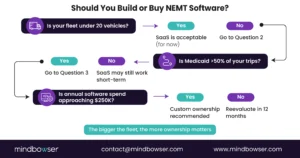
At this stage, most executives already know which direction they are leaning. What they need is a defensible framework they can take to the board, partners, or investors and say, This is why.
The checklist below is designed to do exactly that.
A. Build vs. Buy Decision Checklist
Fleet Size and Growth
- Under 20 vehicles with limited growth planned → SaaS is usually sufficient
- 50–100 vehicles or active expansion → custom starts winning on 3-year TCO
- 200+ vehicles or multi-county/state contracts → custom is financially safer
Medicaid Exposure
- Medicaid under 30% of trips → generic billing tools may be acceptable
- Medicaid over 50% of trips → state-specific logic and EVV control matter
- Frequent rule changes or audits → waiting on a vendor creates cash risk
3–5 Year Total Cost of Ownership
- SaaS spend projected under $150K over 3 years
- SaaS spend approaching or exceeding $250K–$300K
- Add-ons, transaction fees, or annual increases are not fully visible
If you are checking the second or third box more often than the first, the math is already shifting.
Compliance and Audit Readiness
- Comfortable relying on vendor updates and attestations
- Need audit-ready GPS logs, EVV proof, and billing history on demand
- Prior denials or delays tied to system limitations
Compliance gaps rarely show up as IT issues. They show up as delayed reimbursement, clawbacks, or lost contracts.
Control and IP Ownership
- Comfortable renting core operational systems
- Concerned about vendor lock-in or continuity risk
- Want the ability to change partners without rebuilding from scratch
Ownership is not about pride. It is about leverage and resilience.
Custom vs Off-the-Shelf NEMT Decision Framework
B. How Mindbowser Approaches Custom NEMT Builds
Mindbowser does not sell generic software packages. We design and build operator-owned NEMT platforms around three non-negotiables:
- Financial clarity
We model 3–5 year TCO upfront so CFOs can see when and how ROI materializes. - Compliance by design
HIPAA-grade security, EVV workflows, and state-specific Medicaid logic are built into the architecture, not bolted on later. - Ownership and speed
You own the IP. We move fast using proven accelerators, so you are not paying to reinvent fundamentals.
This is not about building software for its own sake. It is about replacing uncontrolled operating expense with a controlled, durable asset.
The CFO Question That Settles It:
If your software vendor raised prices, missed a compliance update, or disappeared tomorrow, what would that cost you over the next 90 days?
If that number is uncomfortable, it is time to evaluate ownership.
| Your Situation | Lean Off-the-Shelf | Lean Custom |
|---|---|---|
| Fleet size | Smaller, single-region | Larger or multi-region |
| Billing complexity | One state, one broker | Multiple states / brokers |
| EHR connectivity needed | No | Yes (discharge, eligibility) |
| Compliance exposure | Standard | State mandates + audit history |
| Platform ownership | Not a priority | You want to own it |
When compliance is the thing that pushes you custom
The trigger to build is often regulatory, not operational. When you are handling EHR-connected eligibility, meeting a state’s specific trip-verification rule (New York’s GPS breadcrumb mandate, for example), and encoding state-by-state Medicaid billing logic, the compliance surface has outgrown what a configurable product covers. At that point custom is not a luxury, it is how you stay auditable.
What we build
Mindbowser builds custom, EHR-connected NEMT platforms: Medicaid billing, dispatch, and FHIR/HL7 integration with Epic, Cerner, and athenahealth. Deep EHR integration is something off-the-shelf NEMT tools don’t do.
What operators tell us
A New York Medicaid NEMT operator came to us to replace third-party billing software — fighting prior-authorization timing, GPS-to-billing reconciliation, real-time eligibility, and denial leakage. These are the gaps custom software is built to close.
Tell us your fleet size, states, and broker count, and we'll tell you honestly whether custom is worth it for you.
The 2026 NEMT Cost Reality
NEMT software decisions age quickly. What looks efficient at 20 vehicles can become a structural cost problem at 80. What feels flexible under light Medicaid volume can turn into a compliance bottleneck once EVV rules tighten or audits increase.
Across fleets, we review three patterns that repeat:
- SaaS costs behave like a variable tax.
They scale with vehicles, transactions, and features, regardless of margin pressure. Over three to five years, subscription spend often exceeds the cost of ownership without delivering control. - Denials and delays are rarely random.
They correlate strongly with generic billing logic, delayed vendor updates, and limited audit visibility. These issues hit cash flow before they ever show up as “software problems.” - Ownership changes posture.
Providers who own their platform move from reactive to deliberate. Compliance updates happen on their timeline. Integrations follow contract needs, not vendor priorities. Software becomes infrastructure, not overhead.
The build-versus-buy decision is not ideological. It is situational.
- If your fleet is small and stable, buying time with SaaS can be rational.
- If your fleet is growing, Medicaid-heavy, or audit-exposed, continuing to rent core systems becomes a financial and operational risk.
That is the inflection point this guide is designed to surface.
A custom NEMT platform is a one-time build plus ongoing maintenance, scoped to your workflows, EHR integrations, broker formats, and Medicaid rules. There is no single sticker price — the cost tracks the complexity you need encoded. Run the math against what those workflows recover for your fleet size.
When state-specific Medicaid rules, multiple broker formats, EHR-connected eligibility, or reconciliation a generic tool can’t encode are what drive your revenue. A standalone, single-state fleet with simple billing is usually better served by off-the-shelf SaaS.
Model it, don’t assume it. Compare SaaS subscription over the build’s useful life against the one-time build plus maintenance, then add what custom recovers that SaaS leaves on the table: fewer denials, less manual reconciliation, fewer dispatch staff hours. Treat any break-even figure as a model for your fleet, not a guarantee.
Yes, through ADT feeds and FHIR APIs, built against each EHR’s specific implementation — not an app-store plugin. Off-the-shelf dispatch tools don’t reach the EHR; EHR-connected transport is a custom integration layer, and it is often the requirement that pushes operators from SaaS to custom.
Off-the-shelf suits a standalone, single-state fleet with simple billing. Custom wins when your revenue depends on state-specific Medicaid rules, multiple broker formats, EHR-connected eligibility, or reconciliation a generic tool can’t encode.