













 BLOGS
BLOGS  NEWSROOM
  CASE STUDIES
  WEBINARS
  PODCASTS
  ASSET HUB
  EVENT CALENDAR






















I. Common Dispatch Problems (Through a Day-in-the-Life)
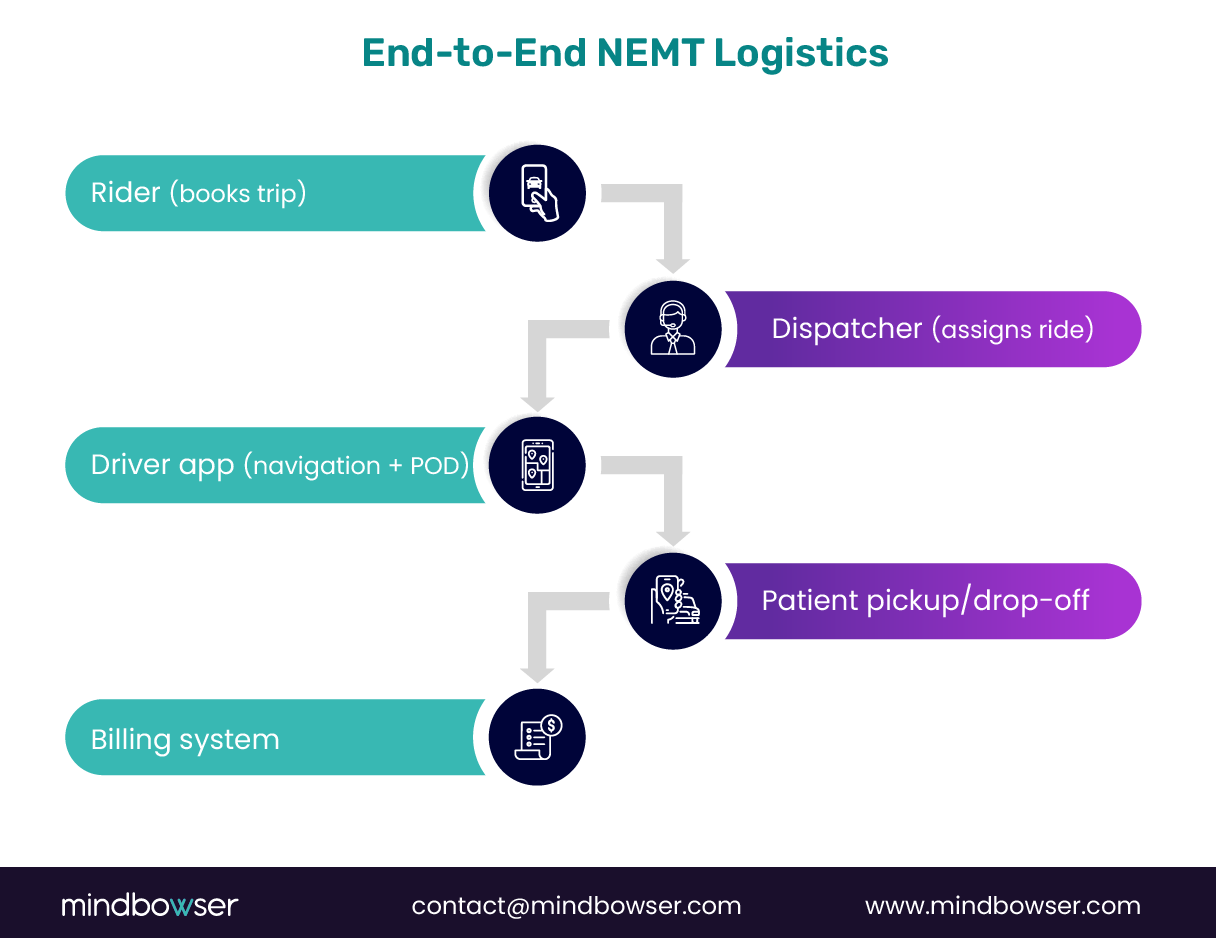
Picture this: 6:00 AM at a mid-sized NEMT operation. The dispatcher’s already juggling three spreadsheets, two phones, and one mistake—a dialysis patient’s pickup address got entered wrong. The driver’s now on the other side of town. Two more drivers are waiting for updates, and a Medicaid eligibility check has still not been confirmed. For many providers, this isn’t uncommon. It’s Tuesday.
Let’s break down the pain points:
A. Manual Scheduling Chaos
- Spreadsheets and paper manifests leave no room for error. One typo can strand a patient or waste a driver’s entire shift
- Dispatchers end up “firefighting” instead of managing the big picture
Net result: inefficiency, stranded riders, and constant stress.
B. Driver Communication Gaps
- Missed texts or calls mean wasted trips, late arrivals, and upset riders
- Without real-time communication tools, drivers operate in the dark
Bottom line: Drivers feel unsupported, patients lose trust.
C. Route Inefficiency
- Without route optimization, drivers often zigzag across town
- Studies suggest that poor routing can inflate
Impact: avoidable costs that sink margins.
D. No-Show Riders
- No automated reminders?
- Every missed trip equals wasted fuel, lost reimbursement, and an empty seat that could’ve served another patient
That’s the scary part: no-shows are predictable—and preventable.
E. Compliance Oversights
- In the scheduling chaos, eligibility checks and prior authorizations get skipped
- The result: claim denials, delayed reimbursements, and cash flow strain that can last 30 to 90 days
Meaning: revenue you never get back.
F. Billing Disconnect
- Dispatch data doesn’t always flow into billing
- Staff are forced into double-entry, creating compliance risks and higher error rates
Takeaway: Inefficiency moves downstream, not just in dispatch, but also in finance.
G. Vendor Lock-In
- Many providers feel trapped by third-party platforms that don’t adapt to their workflows
- That means inefficiencies, long wait times for support, and licensing fees that eat into margins
Net effect: technology meant to help actually adds friction.
II. The True Cost of Poor Dispatch
Every dispatch mistake creates a ripple. It’s not just a missed ride—it’s dollars lost, staff drained, patients destabilized, and reputations damaged. Many leaders don’t fully appreciate the impact of these hidden costs until they appear on the balance sheet or hear complaints from payers. Let’s unpack what’s really at stake.
A. Financial Impact
- Revenue leakage from denials and no-shows
- Medicaid denials in NEMT, often tied to eligibility checks missed or prior authorizations skipped.
- For a provider billing $3 million annually, that’s $ 450,000–$ 600,000 lost every year.
- Fuel and overtime waste
- Poor routing inflates fuel spend by 10–20%.
- For a 30-vehicle fleet, that’s tens of thousands of dollars in fuel and extra hours wasted.
- Rework costs
- Every denied claim requires staff to manually reprocess it.
- Instead of focusing on growth or patient experience, billing teams get stuck fixing yesterday’s mistakes.
Net result: Shrinking margins, wasted staff time, and recurring financial “leaks” that erode competitiveness.
B. Operational Strain
- Dispatcher burnout
- Hundreds of trips, managed via spreadsheets or outdated tools, push dispatchers to constant crisis management.
- Replacing one burned-out dispatcher can cost over $ 10,000 in training and lost productivity.
- Driver frustration
- Without live updates, drivers double back, idle, and miss pickups.
- Morale takes a hit, and turnover risk rises—at a time when driver shortages are already nationwide.
What this means: The workforce you rely on, dispatchers and drivers, is also the one pushed hardest by poor systems.
C. Patient Care Consequences
- Missed or delayed appointments
- Dialysis, oncology, wound care—these aren’t optional.
- The NIH estimates that missed appointments cost the U.S. healthcare system $150 billion annually.
- Health inequities widen
- Medicaid beneficiaries, seniors, and rural patients often bear the highest costs when transportation breaks down.
- Every no-show isn’t just an operational failure—it’s a widening of care gaps.
Bottom line: Dispatch errors directly translate into worse health outcomes.
D. Reputational Damage
- Trust with hospitals and brokers
- Payers closely track on-time performance (OTP) and denial rates.
- Inconsistent dispatch puts contracts at risk, no matter how strong your driver fleet is.
- Community trust
- For many patients, NEMT is their primary means of accessing care.
- One bad ride—being stranded, delayed, or dropped—can erode confidence in both the provider and the Medicaid system itself.
Takeaway: Poor dispatch doesn’t just cost money. It costs credibility, and once trust is lost, regaining it is a long and arduous process.
If these costs sound familiar, you’re not alone!
it’s a systemic challenge across NEMT. The good news? Modern technology can stop the leaks before they drain your business. See how Mindbowser helps providers recover revenue and rebuild trust.
III. How Technology Fixes These Problems
If poor dispatch is the disease, modern technology is the cure. But not just any tech—systems designed for healthcare. They must meet Medicaid rules, keep PHI safe under HIPAA, and bridge the gap from trip booking to billing. Done right, dispatch stops being a reactive call center and becomes the nerve center of your operation.
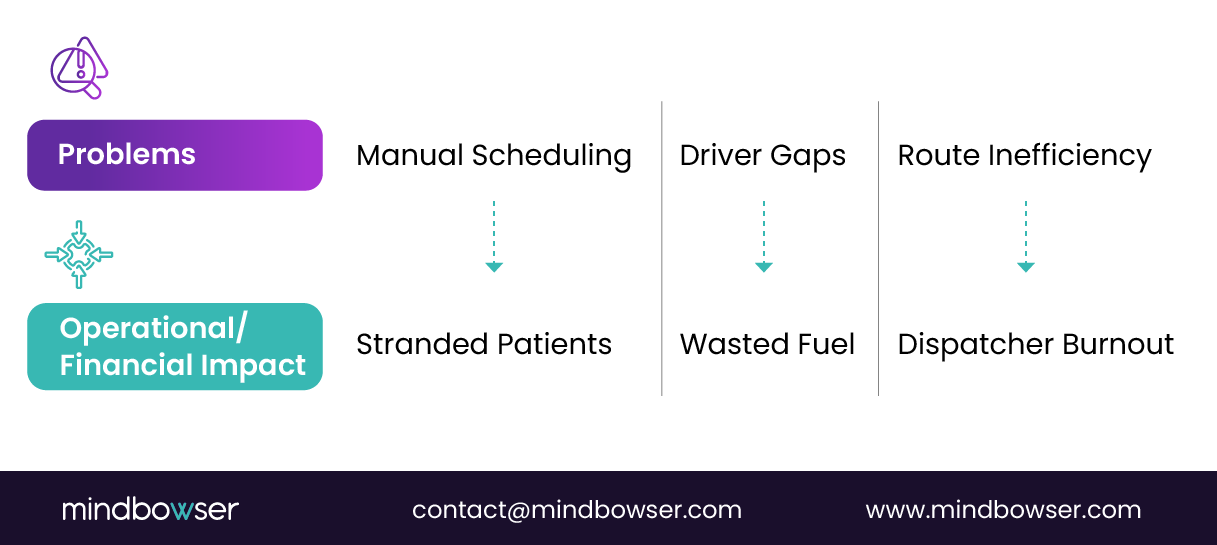
A. Automation: Taking the Firefighting Out of Dispatch
- Trip assignment & reminders
- Instead of dispatchers manually juggling calls, algorithms assign trips based on geography, capacity, and driver availability.
- Riders receive automated SMS or voice reminders 24 hours before pickup and again 1 hour before pickup. That alone can cut no-shows by up to 30%.
- Prior authorization & eligibility validation
- Medicaid rules vary by state, but real-time checks (X12 270/271 transactions) can verify eligibility instantly.
- Pre-dispatch validation ensures denials don’t come back 30 days later.
Impact: Dispatchers move from “crisis mode” to oversight. They manage exceptions instead of scrambling over every trip.
B. GPS + Route Optimization: Cutting Miles, Saving Money
- Dynamic routing
- AI adjusts routes in real time, accounting for traffic, clinic delays, or cancellations.
- Total mileage drops by 10–20%, resulting in annual savings of thousands in fuel and maintenance.
- Multi-pickup orchestration
- Riders can be grouped logically (such as dialysis patients on recurring trips) without compromising pickup windows.
- Compliance bonus
- GPS breadcrumbs and geofencing generate auditable trip records. Medicaid auditors increasingly expect this level of evidence.
Bottom line: smarter routes equal lower costs, better compliance, and happier drivers.
A note on EVV: The 21st Century Cures Act EVV mandate covers personal care and home health only. NEMT is excluded from the federal EVV mandate. NEMT trip verification is driven by your state and broker — for example, New York’s GPS breadcrumb mandate (effective April 2023), not a federal EVV requirement.
C. Driver Mobile Apps: Communication, Proof, and Compliance in One Place
- Real-time updates
- Trips, cancellations, and reroutes push instantly to drivers—no waiting for dispatcher callbacks.
- Proof of delivery (POD)
- Digital signatures, GPS-stamped drop-offs, and time logs give defensible audit evidence.
- Built-in compliance
- PHI stays encrypted in transit and at rest. Access is role-based, and MFA provides an additional layer of protection.
- Driver support
- Navigation tools, vehicle checklists, and incident reporting reduce errors and improve safety.
Net effect: drivers feel supported, disputes are reduced, and claims are processed more efficiently.
D. Data Dashboards: Turning Operations Into Intelligence
- KPI visibility
- Leaders can view denial rates, no-show percentages, trip costs, and OTPs in real-time.
- Predictive analytics
- Systems flag riders most likely to be no-shows, or clinics with chronic delays.
- Dispatchers can proactively adjust before the day goes off track.
- Contract competitiveness.
- Brokers and payers increasingly require OTP and compliance metrics. Dashboards turn reporting from a burden into a growth advantage.
Consultant tip: Reviewing denial “heatmaps” every week often reveals hidden gaps that can cost thousands in lost revenue.
Takeaway: Visibility isn’t a luxury—it’s a lever for gaining a competitive edge.
E. Integrated Billing: Closing the Dispatch–Claims Gap
- One-click claim submission
- Dispatch data flows into billing with the right HCPCS/CPT codes, modifiers, and mileage units.
- Auto-posting of remittances
- 835 payment files are matched automatically to trips. Days sales outstanding (DSO) drops by 7–10 days.
- Audit readiness
- Immutable logs tie GPS, POD, and time stamps to every claim. Providers walk into audits with defensible evidence.
Result: Denial rates fall from ~18% to under 5% when billing is closely tied to dispatch.
F. Built to Grow With You
- Multi-payer workflows
- Medicaid, Medicare Advantage, brokers, and private contracts can all be managed on a single platform. No need to toggle systems.
- Regional expansion
- State-specific compliance rules (like pre-auth triggers for >50-mile trips) can be configured centrally. Expansion becomes repeatable, not risky.
- Innovation-ready
- Custom platforms integrate with EHRs (HL7/FHIR), telehealth scheduling systems, predictive demand models, or even Uber/Lyft APIs for overflow rides.
Takeaway: growth doesn’t mean re-platforming. It means turning features on as your business scales.
Consultant’s Takeaway
Technology isn’t just about shaving minutes. It’s about compliance resilience, revenue integrity, and growth readiness. Every no-show ignored, every claim denied, and every manual entry repeated is an avoidable loss.
The NEMT operators who thrive are those who:
- Automate eligibility before rides, not after.
- Build defensible audit trails with GPS + POD.
- Use analytics to anticipate and prevent denials and no-shows.
- Scale flexibly across payers, regions, and service lines.
This works. Period.
IV. Why Off-the-Shelf Software Often Fails
On paper, off-the-shelf dispatch platforms look appealing. Quick setup, subscription pricing, pre-built modules. However, as fleets expand, payer contracts diversify, and compliance requirements intensify, the cracks appear rapidly.
I’ve watched providers adopt “cookie-cutter” SaaS systems with optimism, only to outgrow them within a few years—stuck in workarounds, facing mounting fees, and struggling with compliance gaps. Let’s break down why.
A. One-Size-Fits-All Doesn’t Work for Medicaid
- State-by-state complexity
- Medicaid isn’t uniform. Each state has its own eligibility checks, prior authorization rules, and mileage thresholds.
- Off-the-shelf platforms struggle to keep pace with this variability.
- Real-world example
- A mid-Atlantic provider waited over a year for their SaaS vendor to adapt to a new state Medicaid claims API.
- In the meantime, staff processed claims manually, losing over $ 300,000 in reimbursements.
Bottom line: Generic workflows result in manual intervention, higher denial rates, and slower cash flow.
B. Inflexibility With Mixed Business Models
- The reality of NEMT.
- Most operators don’t just run Medicaid trips. They also serve private pay, Medicare Advantage, and brokered contracts.
- The SaaS problem.
- Off-the-shelf systems enforce rigid workflows designed for the “average” Medicaid trip.
- Add a private payer with unique billing rules, and suddenly, staff are toggling between multiple systems.
Net effect: double entry, higher errors, and inefficiencies that scale with your growth.
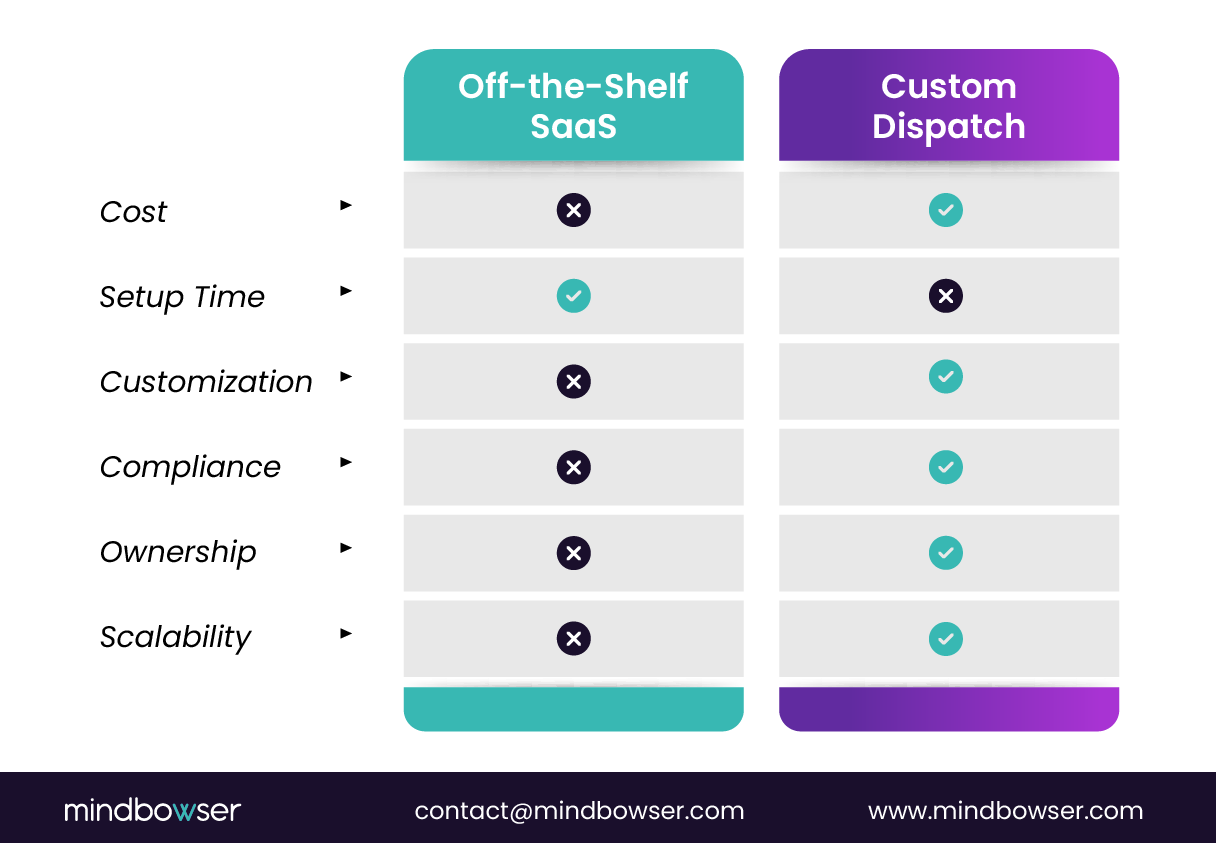
C. Hidden Costs That Grow With Your Fleet
- Licensing models
- SaaS vendors often charge per vehicle, dispatcher, or claim. Manageable at first, but costs balloon as fleets expand.
- 10-year horizon math
- A $1,500 monthly subscription equals $ 180,000 over a decade. That’s often more than the cost of owning a custom platform outright.
- Workarounds add costs, too
- Every missing feature or integration forces staff to revert to manual processes, which can be time-consuming and inefficient. That’s payroll waste, not “savings.”
Takeaway: SaaS appears cheaper upfront, but the total cost of ownership often shifts after the first year.
D. Weak Compliance & Audit Readiness
- HIPAA posture varies.
- Many SaaS vendors advertise HIPAA compliance, but fewer carry SOC 2 or HITRUST certifications.
- Without GPS-stamped POD and immutable logs, providers face clawbacks in audits.
What this means: in Medicaid-driven markets, compliance isn’t a feature request. It’s survival.
E. Vendor Lock-In: The Silent Trap
- No ownership.
- Off-the-shelf vendors control the source code and data models. Providers don’t.
- The risk
- If the vendor raises prices, sunsets features, or delays integrations, you’re left with no choice.
- Case story.
- A Midwest provider spent five years customizing a white-label SaaS. When the vendor doubled subscription fees, they discovered they had no rights to the code. No use to switch.
Net result: you’re building on rented land, not owned ground.
Consultant’s Takeaway
Off-the-shelf SaaS can be a reasonable starting point for very small providers (under 20 vehicles, with one or two payers). However, for operators with multi-county contracts, diverse payer mixes, or ambitious growth plans, SaaS can become a liability.
The pattern is predictable:
- Year 1: quick setup, modest gains.
- Year 3: staff frustrated by rigid workflows, rising denials, and slow vendor support.
- Year 5: ballooning costs, compliance gaps, and leadership exploring custom options.
What we build
Mindbowser builds custom, EHR-connected NEMT platforms — dispatch, Medicaid billing, and FHIR/HL7 integration with Epic, Cerner, and athenahealth. Deep EHR integration is something off-the-shelf dispatch tools don’t do.
What operators tell us
A New York Medicaid NEMT operator came to us to replace third-party billing software — fighting prior-authorization timing, GPS-to-billing reconciliation, real-time eligibility, and denial leakage. Those are the same data gaps that make dispatch problems expensive.
V. The Case for Custom Dispatch Software
When off-the-shelf systems stall, many NEMT leaders assume their only options are to limp along with workarounds or absorb vendor costs. However, there’s a better path: custom dispatch software tailored to your payers, workflows, and compliance environment.
Custom platforms aren’t about bells and whistles. They’re about control, resilience, and growth. They’re about control, resilience, and growth. Providers with complex payer rules, dispatch workflows, billing needs, or EHR integrations can benefit from custom NEMT software solutions designed around their operational and compliance requirements.
Instead of technology becoming the bottleneck, it becomes the enabler.
A. Designed Around Your Workflows
- Fit the process, don’t force it
- With custom workflows, the system matches how your dispatchers, drivers, and billing staff actually operate. No square pegs in round holes.
- Medicaid is baked in
- State-specific rules—such as pre-auth triggers for trips exceeding 50 miles, recurring dialysis scheduling, or payer-specific modifiers—are coded from day one.
Result: fewer workarounds, less staff frustration, and smoother audits, as compliance is built into the system’s DNA.
B. Flexible, Modular Architecture
- Building-block design
- Start with the modules you need today and expand as you grow. Examples:
- Trip Booking Portal (riders, caregivers, or clinics self-schedule).
- Driver App (GPS, proof of delivery, incident reporting).
- Dispatcher Control Center (live maps, exception alerts).
- Compliance Module (eligibility, prior auth workflows).
- Billing Integration (837P claims, 835 auto-posting).
- Analytics Dashboard (denial heatmaps, OTP scorecards).
Bottom line: you only pay for what you need, but you’re never boxed in.
C. Adaptable and Future-Ready
- Multi-payer capability.
- Medicaid, Medicare Advantage, private pay, and broker contracts can all be managed on a single platform.
- Geographic growth.
- Add counties or states without tearing out your system. Local Medicaid quirks (mileage thresholds, modifiers) are configured centrally.
- Innovation-ready integrations.
- EHRs (HL7/FHIR): Discharge planners can automatically trigger ride requests.
- Telehealth: align rides with hybrid visits.
- AI scheduling: Predict demand spikes (e.g., dialysis days, weather events).
- Rideshare APIs: use Uber/Lyft overflow capacity on peak days.
Net effect: expansion is proactive, not reactive.
D. Ownership = No Vendor Lock-In
- With custom, you own it.
- Source code and IP are yours. No surprise price hikes, no sunset features.
- You decide the evolution.
- Add modules, integrate new payers, or pivot workflows—on your timeline.
- Strategic asset.
- Your workflows, your compliance rules, your data—under your control.
Meaning: instead of renting a tool, you’re building long-term equity in your own system.
E. ROI and Strategic Payback
- Yes, upfront is higher ($50K–$200K). But the payback is measurable:
- Denial reduction: 18% → 5% = hundreds of thousands saved annually.
- Routing efficiency: 10–20% fewer miles = $40K–$80K in annual savings for mid-sized fleets.
- No-show reduction: SMS reminders free thousands of extra ride slots.
- Faster reimbursement: integrated billing cuts DSO by 7–10 days, easing cash flow.
Consultant’s Takeaway
Off-the-shelf systems help you “get digital.”
Custom systems help you compete.
If your operation is:
- Running in multiple counties or states,
- Managing more than 25 vehicles, or
- Struggling with denial rates above 10%,
…then a custom dispatch system isn’t just an IT issue. It’s a strategy.
See how NEMT Data Dashboards Improve ROI
VII. Industry Stats You Can’t Ignore
Numbers often speak louder than words. When it comes to NEMT operations, the data reveals both the urgency of the problem and the magnitude of the opportunity. Below are some of the most important industry benchmarks that every executive should be aware of.
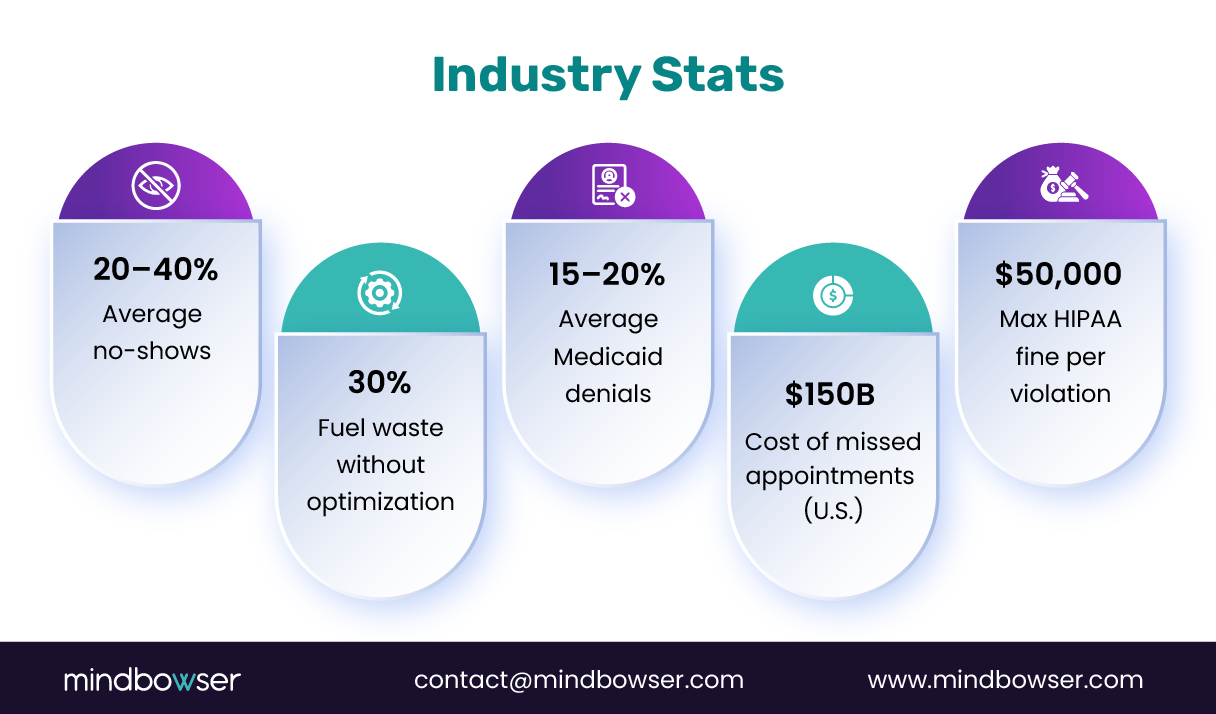
A. Patient No-Show Rates: 20–40%
- Across the U.S., 20–40% of NEMT rides result in patient no-shows.
- Each no-show represents wasted driver time, unreimbursed mileage, and lost revenue.
- Clinically, no-shows are devastating: patients miss dialysis, oncology treatments, or therapy appointments that directly impact health outcomes.
- Impact example: For a provider completing 40,000 annual trips, a 25% no-show rate equals 10,000 wasted rides—a staggering hit to both finances and patient care.
B. Fuel Waste: ~30% of NEMT Costs Without Optimization
- Fuel is one of the top three expenses in NEMT operations.
- Without route optimization, studies show that ~30% of fuel costs are wasted due to backtracking, inefficient trip grouping, and traffic delays.
- Financial reality: For a 30-vehicle fleet, even a 10% mileage reduction can save $40,000–$80,000 annually in fuel and maintenance.
- Rising fuel prices make optimization not just an efficiency move, but a survival strategy.
C. Claim Denials: 15–20% Average in NEMT
- Medicaid claim denials are consistently reported in the 15–20% range, often due to missed eligibility checks or errors in prior authorization.
- Each denial delays reimbursement by 30–90 days, straining cash flow. Some claims are lost entirely, resulting in hundreds of thousands of dollars in annual revenue leakage.
- Providers who adopt real-time eligibility verification and automated prior authorization workflows have seen denial rates fall to under 5%.
D. The Bigger Cost of Missed Appointments: $150 Billion Annually
- According to the National Institutes of Health (NIH), missed medical appointments cost the U.S. healthcare system over $150 billion annually.
- Medicaid beneficiaries and high-need populations carry a disproportionate share of this burden.
- NEMT is a key lever in reducing waste by ensuring patients receive consistent care.
E. Compliance Risk: $50,000 per HIPAA Violation
- Outdated dispatch systems that mishandle Protected Health Information (PHI) expose providers to significant liability.
- HIPAA fines can reach $50,000 per violation and stretch into the millions if systemic flaws are uncovered.
- Modern dispatch platforms must include encryption, audit trails, and SOC 2/HITRUST certifications to protect providers during audits and regulatory inspections.
Consultant’s Takeaway
These stats aren’t just trivia—they’re boardroom conversation starters.
- For CFOs, they highlight preventable revenue leakage.
- For COOs: they expose operational inefficiencies ripe for automation.
- For CMOs and clinical leaders, they reveal how transportation impacts health outcomes and value-based care.
The message is clear: doing nothing is costlier than modernizing.
VIII. How Mindbowser Helps?
Choosing dispatch technology isn’t just a software decision. It’s a healthcare decision. It impacts compliance, revenue, and patient access. This is where Mindbowser stands apart. For over a decade, we’ve helped NEMT providers, payers, and health systems modernize dispatch with HIPAA-compliant, Medicaid-ready, and fully customizable platforms.
Here’s how we work with operators step by step.
A. Discovery: Mapping Workflows and Compliance Needs
1. Listen first
- We shadow dispatchers, drivers, and billing staff to capture “as-is” workflows.
- Every state has quirks in Medicaid rules. We surface those early eligibility checks, prior auth triggers, rural mileage thresholds—so they don’t derail later.
2. Deliverable
- A workflow blueprint that highlights denial drivers, no-show patterns, and operational bottlenecks.
Consultant’s note: Most providers underestimate hidden payer rules. We bring them forward before they cost you revenue.
B. Prototype: Visualizing the Future System
1. Rapid wireframes
- Within weeks, you see dispatcher dashboards, driver app flows, and billing screens—not in theory, but in click-through prototypes.
2. Staff validation
- Dispatchers and billing teams weigh in early, ensuring that usability aligns with the frontline.
Result: the platform matches your operation, not a generic template.
C. Agile Delivery: Phased Rollouts With Visible Progress
1. Sprint-based build
- High-impact modules go first:
- Dispatch + GPS tracking
- Driver app with POD capture
- Medicaid billing automation
- Patient reminders
- Analytics dashboards and integrations
2. Milestone-driven
- Each sprint ends with a live feature, so ROI starts within months, not years.
3. Adoption built in
- We train “super users” inside your team to champion adoption.
Takeaway: Progress is visible, ROI is early, and staff are on board.
D. Long-Term Support: Compliance, Scaling, and 24/7 Coverage
1. Healthcare changes fast
- Medicaid rules shift, CMS updates requirements, payers adjust contracts. We push updates to keep systems audit-ready.
2. Support when you need it
- Options include 24/7 SLAs, because transportation doesn’t stop at 5 PM.
3. Growth-ready
- From 10 to 1,000+ vehicles, systems scale without re-platforming.
Bottom line: you’re never left behind as contracts grow or rules change.
E. Accelerators: Faster Time-to-Value
1. Not from scratch
- We use pre-built accelerators—modules for eligibility, routing, driver apps, and claims—that significantly reduce development time.
2. Still fully customizable
- You get SaaS-like speed with enterprise-grade flexibility.
Meaning: You launch quickly, but own the system in the long term.
F. Healthcare Pedigree: More Than Just Coders
1. Domain expertise.
- Teams fluent in HIPAA, HL7/FHIR, CMS guidelines, and Medicaid integrations.
2. Proven results
- Helped NEMT providers in New York, Illinois, and the Midwest:
- Measurable reduction in denial rates within the first year
- Automated eligibility checks across multiple states
- Boosted OTP to win new county contracts
3. Built for security
- Cloud-ready on AWS/Azure with SOC 2-ready infrastructure.
4. 100% code ownership
- Unlike SaaS, you keep the source code and data models. No lock-in, no surprises.
Tell us your state, your brokers, and where dispatch breaks down today, and we'll walk through what an EHR-connected build takes.
Conclusion
A. The Big Picture
Dispatch isn’t a back-office detail. It’s the heartbeat of NEMT and, by extension, patient access to care. When dispatch falters, the damage ripples everywhere:
- Patients miss dialysis, oncology, or therapy appointments.
- Providers bleed revenue through denials, no-shows, and wasted fuel.
- Payers and Medicaid agencies lose confidence in their transportation partners.
Message: Dispatch problems are solvable. But only with the right tools and mindset.
B. The Path Forward
This journey has shown the full lifecycle of the challenge:
- Common Pain Points — manual chaos, compliance gaps, no-shows, vendor lock-in.
- The True Cost — financial leakage, staff burnout, reputational damage, and inequitable care.
- Technology Fixes — automation, GPS optimization, driver apps, integrated billing, dashboards.
- Why SaaS Falls Short — one-size-fits-all workflows, mounting costs, weak compliance.
- The Custom Advantage — workflows designed for your payers, rules, and growth.
- Real-World Proof — providers cutting denials, saving fuel, reducing no-shows, and winning new contracts.
- Industry Stats — undeniable benchmarks on no-shows, fuel waste, denials, and compliance risk.
- Mindbowser’s Role — healthcare-focused partner with compliance-first design, accelerators, and full ownership.
Net result: Dispatch is not just logistics—it’s strategy.
C. Looking Ahead: The Future of NEMT Dispatch
The industry sits at an inflection point. Leaders who only fix today’s fires will fall behind. Leaders who invest in tomorrow’s tools will win. What’s next?
- AI & Predictive Scheduling.
- Anticipating demand surges (dialysis peaks, weather disruptions) before they overwhelm dispatchers.
- EHR Integration (HL7/FHIR).
- Auto-scheduling rides from hospital discharge planners.
- Ride-share Partnerships.
- Using Uber, Lyft, and mobility partners to flex fleets during demand spikes.
- Telehealth Coordination.
- Pairing transportation with hybrid care models—ensuring patients get to clinics when physical visits are required.
- Value-Based Care Data.
- Using transportation metrics (OTP, no-show reduction, adherence) to strengthen payer contracts and prove ROI on outcomes.
Bottom line: The future of NEMT dispatch isn’t just software—it’s healthcare integration.
D. Final Word
For over a decade, I’ve told providers, payers, and operators the same thing: The winners aren’t those with the cheapest fleets or the most drivers. The winners are those who align transportation technology with healthcare strategy.
Custom-built dispatch software isn’t just about efficiency. It’s about:
- Protecting revenue through denial prevention.
- Staying compliant with Medicaid, HIPAA, and CMS.
- Improving patient care through reliable, on-time rides.
- Future-proofing operations for growth and innovation.
With the right partner—one fluent in healthcare and technology—dispatch transforms from your biggest headache into your strongest advantage.
Software that assigns, routes, and tracks non-emergency medical transport trips in real time, matching the right vehicle and driver to each member’s pickup, appointment, and mobility need. Strong off-the-shelf options exist; the gap shows up when dispatch has to connect to Medicaid billing or the EHR.
Manual scheduling, no real-time tracking, and dispatch that doesn’t share data with billing or the EHR — so trips run uncovered, no-shows aren’t caught early, and claims fail later. Most dispatch problems are really data-integration problems.
Yes, in a custom build, dispatch, trip documentation, and billing share one record — so a completed trip carries its GPS proof, timestamps, and authorization straight into the claim. Off-the-shelf dispatch usually keeps these separate.
No. The Cures Act EVV mandate covers personal care and home health only; NEMT is excluded. Trip verification for NEMT is state- and broker-driven (e.g. New York’s GPS mandate), so dispatch should meet your state’s and broker’s rules.
Off-the-shelf suits a standalone, single-state fleet. Custom wins when you need EHR-connected dispatch, multi-state Medicaid rules, multiple broker formats, or GPS-to-billing reconciliation a generic tool can’t encode.
When dispatch and billing don’t share data, trips complete without GPS proof, authorization confirmation, or accurate timestamps — and those gaps become denied claims. Dispatch that writes to billing in real time removes the documentation gaps that auditors flag.
Broker portal fragmentation — each broker has its own trip format, submission portal, and reconciliation process. Without a dispatch layer that normalizes across brokers, operators end up doing manual work per broker that compounds with fleet size.
Yes, through ADT feeds and FHIR APIs built against each EHR’s specific implementation. ADT discharge alerts can trigger a ride booking; FHIR lets the platform read eligibility and appointment data. Off-the-shelf dispatch tools don’t reach the EHR.