BLOGS
BLOGS  NEWSROOM
  CASE STUDIES
  WEBINARS
  PODCASTS
  ASSET HUB
  EVENT CALENDAR




















Healthcare technology teams face an ongoing challenge: too many systems, not enough clarity. Nowhere is this confusion clearer than in the debate between LIS and LIMS. The alphabet soup of healthcare IT—LIS, LIMS, EHR, EMR has blurred functional boundaries that should instead define the precision of modern care delivery.
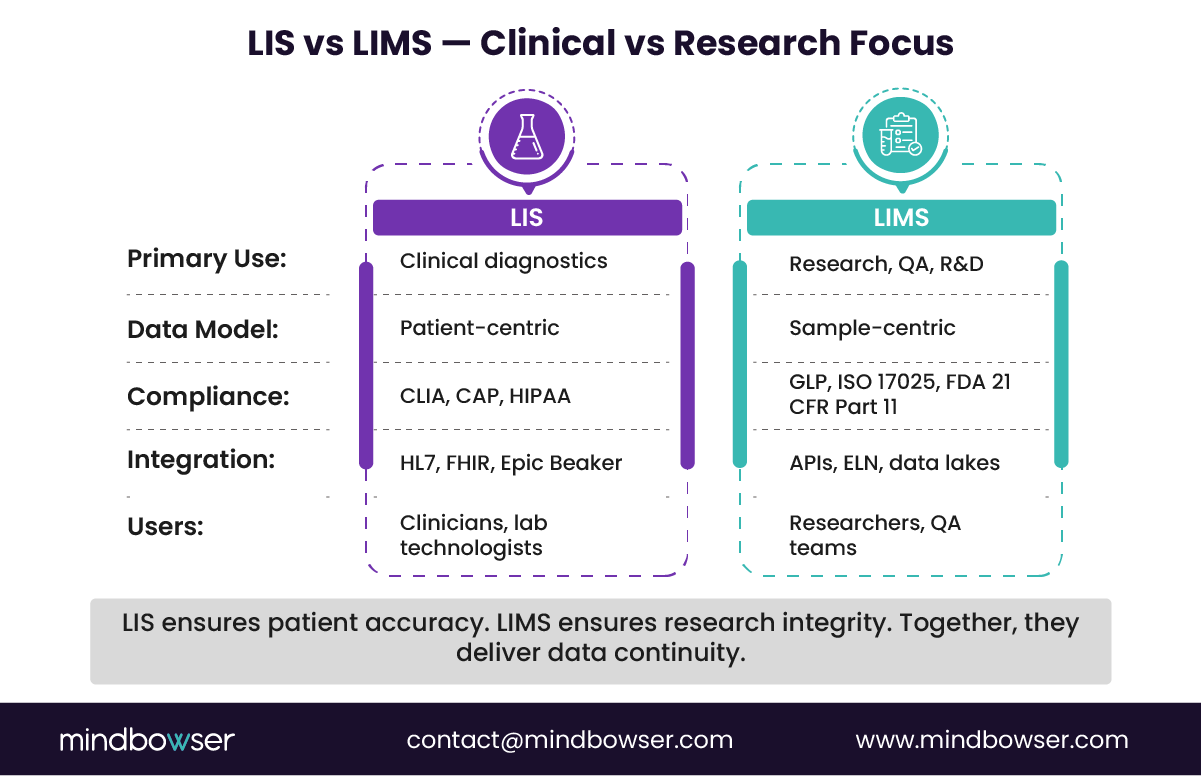
A Laboratory Information System (LIS) supports clinical diagnostics and workflows within hospitals and health networks. A Laboratory Information Management System (LIMS) supports research environments, from genomics labs to pharmaceutical QA testing. The EHR serves as the longitudinal bridge, housing the results and decisions generated by these systems.
In practice, most CIOs, compliance leads, and healthtech architects find themselves asking: Where does one system end and the other begin? And how can both feed structured, compliant data into platforms like Epic Beaker, which increasingly anchors the modern lab ecosystem?
This article explores those distinctions in depth. It defines the role of LIS and LIMS in the healthcare data landscape, clarifies how each aligns with EHRs, and provides a blueprint for integration that safeguards compliance while enhancing efficiency.
When health systems understand the boundaries and integration points between LIS, LIMS, and EHR, they stop debating and start designing for outcomes: faster diagnostics, cleaner data, and scalable research workflows that stay compliant from bench to bedside.
I. Understanding the Core Difference: LIS, LIMS, and EHR Defined
Healthcare data systems have evolved from simple repositories into connected ecosystems that support diagnostics, research, and patient management. To design efficient and compliant data architectures, CIOs and technology leaders must understand where each system fits and how they interact with one another.
A. LIS (Laboratory Information System): The Clinical Backbone
An LIS is designed for clinical environments where accuracy and compliance significantly impact outcomes. It manages patient-centric workflows in hospital laboratories, pathology departments, and diagnostic centers. Every process — from order entry and specimen tracking to result validation — revolves around the patient record.
Key characteristics of an LIS:
- Compliance and Standards: Meets CLIA, CAP, and HIPAA requirements to maintain traceability and protect patient health information.
- Integration-Ready: Connects with EHR platforms, such as Epic Beaker and Cerner PathNet, via HL7 and FHIR interfaces for test ordering and result exchange.
- Clinical Workflow Support: Automates result reporting, flags abnormal values, and ensures every data point is tied to the patient’s clinical context.
An LIS ensures that diagnostic data flows directly into the patient’s longitudinal record, enabling physicians to make faster, evidence-based decisions.
B. LIMS (Laboratory Information Management System): The Research and QA Workhorse
A LIMS operates on a different axis. Instead of managing patient-specific workflows, it manages samples — often in large batches — across research, pharmaceutical, and quality assurance environments.
Core functions of a LIMS:
- Sample-Centric Design: Tracks specimens, reagents, and equipment across multiple studies or production batches.
- Regulatory Compliance: Aligns with GLP, GxP, ISO 17025, and FDA 21 CFR Part 11 standards to ensure data integrity and audit readiness.
- Data Scalability: Manages high-volume, multi-format research data with integration into ELNs, analytics platforms, and data lakes.
In translational research or biopharma settings, LIMS systems form the data backbone that supports reproducibility, traceability, and cross-team collaboration.
C. EHR (Electronic Health Record): The Longitudinal Record
The EHR serves as the continuity layer, combining inputs from LIS, LIMS, and other clinical systems to build a full patient health narrative. It consolidates laboratory findings, imaging data, treatment notes, and real-time updates from wearable devices or monitoring equipment.
EHR functions within this ecosystem:
- Unifying Data Layer: Integrates structured data from LIS and unstructured or semi-structured data from LIMS to present a complete clinical picture.
- Interoperability Hub: Epic and Cerner dominate this layer, acting as central platforms that link laboratory, pharmacy, and care delivery systems.
- Decision Enablement: Supports population health management, predictive diagnostics, and clinical decision support through structured lab integration.
II. Workflow Comparison: From Sample to Clinical Insight
Understanding how LIS and LIMS differ in workflow design is essential for healthcare leaders who are aligning diagnostic and research systems. Although both manage laboratory data, their architecture, users, and compliance frameworks serve very different objectives. This section outlines how these systems function from the moment a sample is collected to the point where it drives clinical or research insights.
A. Why These Distinctions Matter
- Regulatory Alignment: Different regulatory frameworks govern healthcare and research environments. A clinical LIS must align with CLIA and HIPAA, while a research LIMS must comply with GLP or ISO 17025. Failing to recognize this separation risks noncompliance and data integrity issues.
- Data Architecture: The LIS links every data point to a patient’s health record, enabling care teams to make evidence-based decisions. The LIMS, on the other hand, operates on large datasets, often anonymized or de-identified, to study patterns and ensure reproducibility across experiments.
- Workflow Efficiency: In hospitals, LIS automation minimizes turnaround time for test results and reduces manual entry errors. In research, LIMS automation enables scalable experimentation and traceability, supporting complex datasets, such as those in genomics or drug assays.
- Operational Impact: A well-integrated LIS ensures faster diagnosis and better patient outcomes. A well-implemented LIMS enhances data accuracy and accelerates scientific discovery. When properly integrated, both systems reduce redundancy and reduce steps the flow of information between the lab bench and the bedside.
In short, the LIS drives clinical precision, while the LIMS powers research scalability. Their integration through structured standards such as HL7, FHIR, and APIs ensures that both systems contribute to a unified, compliant, and high-performing healthcare data ecosystem.
III. Integration in Action: The Epic Beaker Example
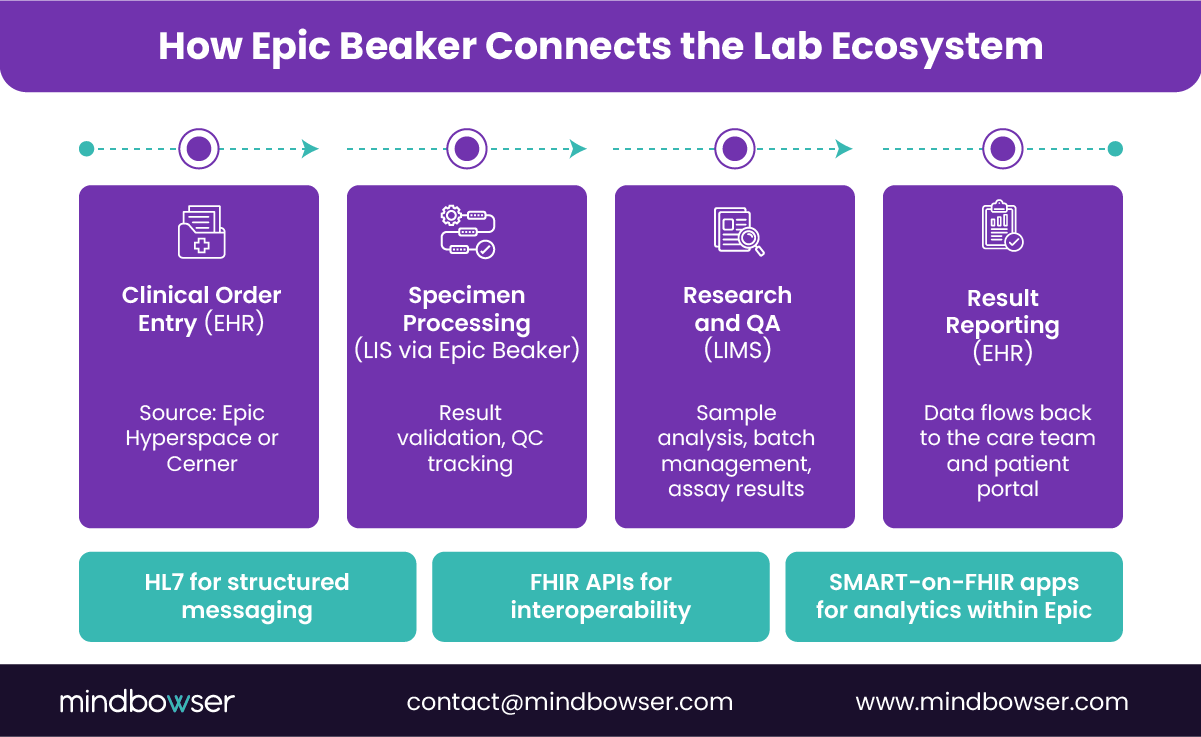
Integration is where the distinctions between LIS and LIMS matter most. For many healthcare organizations, Epic Beaker sits at the center of this ecosystem, functioning as the laboratory module within the Epic EHR suite. Understanding how Epic Beaker connects with other systems provides clarity on how clinical and research workflows coexist without conflict.
A. Epic Beaker as the Modern LIS Module
Epic Beaker is purpose-built to manage end-to-end clinical laboratory workflows. It enables order management, sample tracking, and results reporting within a patient-focused framework that aligns tightly with the EHR.
Core capabilities of Epic Beaker:
- Comprehensive Lab Workflow Management: Handles clinical diagnostics for pathology, microbiology, hematology, and molecular labs.
- HL7 and FHIR Integration: Facilitates interoperability with external systems and instruments for smooth data exchange.
- Patient-Centric Data Flow: Links each lab order directly to the patient’s medical record in Epic, ensuring results are visible to the care team in real time.
For hospitals, this integration eliminates data silos and ensures that diagnostic data is synchronized across the care continuum.
B. Where Epic Beaker Ends and LIMS Begins
Epic Beaker is optimized for clinical precision but not for managing complex research data. It supports patient-linked workflows, not sample batches or reagent tracking.
Key distinctions:
- Scope Limitation: Epic Beaker handles diagnostic data but not experimental or QA batch processing.
- Data Structure: While Epic Beaker stores results linked to patient identifiers, a LIMS organizes samples by experiment, study, or production lot.
- Complementary Role: In research hospitals, Epic Beaker delivers validated clinical data while the LIMS manages preclinical or exploratory data pipelines.
Together, they create a hybrid architecture that supports both patient care and research innovation without overlap or redundancy.
C. Integration Patterns That Work
Successful LIS and LIMS integrations rely on standard communication protocols and middleware that harmonize data models while maintaining compliance.
Effective integration strategies include:
- HL7 and FHIR Pipelines: Use HL7 for structured messaging between lab instruments and the LIS, and FHIR APIs for secure, scalable integration with the EHR.
- SMART on FHIR Applications: Embed analytics or visualization tools directly within Epic Hyperspace to present real-time lab intelligence.
- Case Insight: For a perioperative platform, structured HL7 syncing between the lab system and Epic Beaker cut missed lab results from about 15% to about 2%. The fix wasn’t a faster pipe — it was coding each result to LOINC and writing it back to the correct flowsheet row so nothing got buried.
When implemented correctly, these integrations not only improve data accuracy but also accelerate clinical decision-making and research outcomes.
D. How the Lab Standard Actually Gets Mapped
Whether the source is Epic Beaker, Cerner PathNet, or a regional LIS, the integration only holds if the result lands in the chart as structured data. That means coding it to LOINC and storing it as a FHIR Observation, not a free-text line.
A platform like ConnectHealth already carries the LOINC connectors and uses Helix AI to map each feed to the right Observation resource, which is what turns a per-lab custom interface into a configuration step. Where a local code has no LOINC equivalent, that’s a genuine gap — it gets a custom-built adapter plus a clinician-validated mapping workbook rather than a silent guess.
IV. When LIMS Complements (Not Replaces) LIS
For many hospitals and health systems, the path toward interoperability is not about replacing one system with another; it is about integrating existing systems. It is about aligning the LIS and LIMS so that clinical precision and research innovation can coexist. Both systems have distinct roles, and when integrated correctly, they form a continuous flow of data that supports diagnostics, discovery, and compliance.
A. Dual-System Models in Research Hospitals
Hospitals that operate both clinical and research divisions often need a dual-system strategy. The LIS handles regulated, patient-specific testing within the clinical environment, while the LIMS manages the research workflows that operate outside the clinical compliance perimeter.
Typical structure of a dual-system setup:
- Clinical Environment: The LIS processes orders from Epic Beaker, tracks specimen collection, and ensures results are compliant with CLIA and CAP standards.
- Research Environment: The LIMS manages experimental data, molecular analyses, and cross-study datasets that do not map directly to individual patients.
- Integration Middleware: A secure middleware layer maps identifiers, reconciles data models, and ensures PHI remains protected while enabling research use.
This configuration allows hospitals to maintain the integrity of their clinical systems while leveraging research-grade data analytics for innovation.
B. Real-World Applications
Several healthcare organizations have already demonstrated the value of running LIS and LIMS in tandem.
- Genomics and Precision Medicine Labs: These facilities use LIMS to manage sequencing pipelines and raw genomic data. Once validated results are generated, they are transmitted to the LIS and subsequently to the EHR for clinical interpretation.
- Cancer Research Institutes: Labs studying tumor biomarkers often rely on LIMS for trial and assay management, while the LIS supports diagnostic pathology and patient-facing reporting.
- Population Health Research: LIMS platforms aggregate de-identified lab data for trend analysis and cohort studies, providing high-level insights that are fed back into clinical decision support systems through standardized HL7 and FHIR interfaces.
This interoperability supports the principle of “bench-to-bedside” research, where findings from the lab are quickly translated into actionable clinical intelligence.
C. The Compliance Advantage
Integrating LIS and LIMS is not just about operational efficiency; it is also about maintaining compliance across environments with different regulatory obligations.
- The LIS adheres to patient privacy regulations under HIPAA.
- The LIMS ensures traceability and reproducibility in accordance with GLP and ISO standards.
- The middleware ensures that no protected data is transmitted into research without the appropriate de-identification and access controls.
Hospitals adopting this model report stronger data governance, faster turnaround for translational studies, and more confidence in their regulatory audits.
Healthcare LIMS software typically includes modules for sample chain-of-custody, instrument calibration records, stability testing, and audit trails required under GLP or FDA 21 CFR Part 11 — capabilities a clinical LIS does not need. When scoping a LIMS integration with your EHR, the key question is which LIMS vendor you’re running (LabVantage, LabWare, STARLIMS, Benchling) and whether it speaks HL7 or requires a custom adapter.
Map It Once. Deploy Across Every Site
V. Integration Challenges and Proven Solutions
Even when the value of connecting LIS, LIMS, and EHR systems is clear, execution can be complex. Healthcare organizations face technical, regulatory, and operational challenges that can stall integration projects if not addressed early. Understanding these barriers and applying tested strategies can help CIOs and technology leaders build a reliable and compliant data pipeline.
A. Common Pitfalls
- Identifier Mismatch: LIS platforms organize data around patient identifiers, while LIMS tools index data by sample ID or batch number. Without a common mapping logic, the systems cannot accurately reconcile records. This leads to duplicate data entries, breaking the traceability chain between patient results and research outcomes.
- Data Normalization Issues: Clinical systems, such as LIS and EHR, often rely on HL7 messaging standards, whereas LIMS may output data in CSV, XML, or JSON formats. These structural differences complicate synchronization, particularly when unstructured data, such as research notes or assay outputs, are involved.
- PHI Exposure Risk: When sharing data between systems, there is a risk of exposing Protected Health Information (PHI) if proper masking or de-identification protocols are not enforced. This is a frequent compliance gap when integrating research and clinical systems within the same institution.
- Limited Vendor Interoperability: Proprietary data formats and closed architectures from vendors can slow integration. Without open APIs or middleware, it becomes difficult to bridge LIS platforms like Epic Beaker with specialized LIMS environments or data warehouses.
B. Solutions That Scale
- Adopt a Unified Identifier Strategy: Use a middleware or integration engine to map patient and sample identifiers. A consistent crosswalk table ensures that patient-level clinical data and research-level sample data remain synchronized without duplication or loss of lineage.
- Implement Middleware for Data Transformation: Middleware tools or ETL (Extract, Transform, Load) pipelines convert data between HL7 and non-HL7 formats. This enables direct flow between LIS, LIMS, and EHR systems. Many hospitals utilize FHIR-based APIs to achieve real-time updates while maintaining the structured integrity of their data.
- Apply Strict Data Governance Protocols: Establish policies for de-identification, access control, and audit logging to ensure data security. Use encryption at rest and in transit to ensure PHI remains secure during data exchange. Periodic audits help maintain compliance with HIPAA, CLIA, and FDA regulations.
- Foster IT and Compliance Collaboration: Integration projects succeed when technology and compliance teams collaborate throughout the entire project lifecycle, from discovery through deployment. Including regulatory experts early in the architecture design phase reduces the likelihood of costly rework later.
VI. The Future: Unified Lab Intelligence Layer
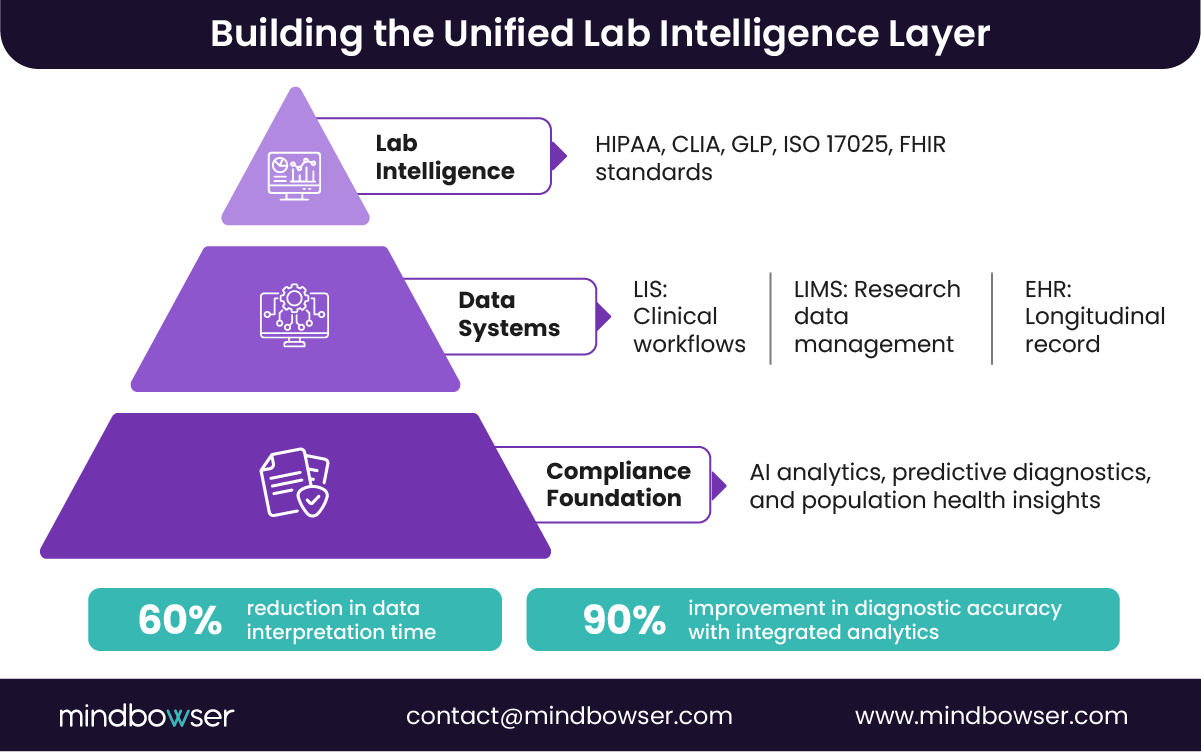
The healthcare data landscape is shifting toward an integrated model where clinical, research, and operational data no longer live in silos. This evolution is giving rise to what many refer to as the Unified Lab Intelligence Layer. In this interconnected ecosystem, LIS, LIMS, and EHR systems collaborate to deliver real-time, actionable insights across care and discovery.
A. Emergence of LabOps as a Strategic Discipline
The concept of LabOps is transforming how healthcare organizations view laboratory operations. Instead of treating labs as isolated data centers, forward-thinking CIOs are viewing them as intelligence hubs that power diagnostics, research, and operational efficiency.
- Convergence of Data Models: Modern interoperability frameworks are enabling clinical and research systems to communicate using a common language. Through HL7, FHIR, and open API standards, LIS and LIMS platforms can exchange structured data in real time, creating unified visibility across test results, research studies, and outcomes.
- Predictive and Proactive Operations: As labs adopt analytics-driven workflows, AI and machine learning models are identifying bottlenecks, predicting reagent usage, and flagging anomalies before they impact patient care. These capabilities are already improving turnaround times and reducing costs in large hospital networks.
- Data as a Strategic Asset: The future laboratory is not just a service department but a core contributor to population health management and precision medicine. The ability to aggregate and interpret lab data across systems enables more accurate diagnoses, faster clinical trials, and data-driven policymaking.
B. Strategic Outlook for CIOs and Healthtech Vendors
For healthcare technology leaders, the future of LIS and LIMS integration is about building scalable, compliance-first infrastructures that can adapt to changing regulatory and business demands.
- Integration-First Discovery: Before deploying new systems, CIOs are prioritizing discovery workshops that assess interoperability, data lineage, and compliance dependencies. This front-loaded approach prevents costly rework and accelerates the adoption of the system.
- Compliance-Led Architecture: Security frameworks rooted in HIPAA, GLP, and ISO standards will continue to serve as the foundation for all integrations. As APIs and cloud solutions expand, maintaining strong governance and auditability will be critical to sustaining trust.
- Collaboration Between Vendors and Providers: Healthtech vendors that align product design with the real-world constraints of clinical and research environments will lead the next phase of innovation. Vendors that offer prebuilt integration layers for Epic Beaker, Cerner PathNet, or similar systems will deliver measurable ROI faster.
- AI and FHIR as the Common Bridge: The rise of FHIR-based APIs and AI-driven normalization tools is enabling organizations to harmonize data without disrupting existing systems. These technologies are enabling the creation of a unified lab intelligence framework that continuously learns and evolves.
VII. How Mindbowser Can Help?
Mindbowser partners with healthcare organizations to design and integrate compliant, interoperable data systems that connect LIS, LIMS, and EHR environments. Our approach focuses on precision, compliance, and measurable ROI. We help hospitals, diagnostics companies, and digital health vendors reduce steps workflows that bridge clinical care and research.
A. Proven Expertise in LIS, LIMS, and EHR Integration
- Integration with HL7 and FHIR Standards: Our engineering teams specialize in HL7 and FHIR-based architectures that ensure reliable data exchange between systems, such as Epic Beaker, Cerner PathNet, and research LIMS environments. We design solutions that enable real-time interoperability without disrupting existing workflows.
- Epic Beaker and EHR Integration Experience: Mindbowser has delivered Epic Beaker integrations that automate test ordering, results reporting, and post-analysis data routing. This includes middleware design for hospital networks seeking faster data turnaround and stronger compliance traceability.
- Accelerators for Faster Deployment: Our in-house accelerators shorten implementation timelines and strengthen data accuracy.
- ConnectHealth: Our integration platform’s pre-built lab connectors map incoming results to LOINC and the FHIR Observation resource, so lab data lands in the EHR as structured, queryable records, not free text.
- AI Medical Summary: An AI-powered summarization tool that compiles patient and research data into clinical insights.
These solutions have enabled clients to achieve measurable outcomes such as:
- For a perioperative platform, structured HL7 syncing between the lab system and Epic Beaker cut missed lab results from about 15% to about 2%.
- For a multi-standard oncology platform, connecting HL7 and FHIR feeds across systems reached roughly 90% data coverage — proof that the same connector fabric handles more than one lab standard at a time.
B. Compliance-First, ROI-Driven Approach
Mindbowser’s strategy begins with discovery workshops focused on compliance and process alignment. Each engagement emphasizes:
- Regulatory Readiness: Ensuring HIPAA, CLIA, and GLP compliance from the first integration step.
- Operational ROI: Tracking measurable outcomes such as turnaround time, accuracy, and data reusability.
- Collaborative Design: Working directly with CIOs, lab directors, and compliance officers to design architectures that scale safely.
Our partnerships extend beyond deployment. We offer continuous optimization to ensure that systems evolve in line with emerging interoperability standards and new healthcare regulations.
Mindbowser bridges the gap between clinical precision and research innovation. By integrating LIS, LIMS, and EHR systems through a compliance-first lens, we help organizations achieve the balance of speed, safety, and scalability that modern healthcare demands.
Two Ways to Connect LIS, LIMS, and EHR:
Start on the platform: ConnectHealth’s pre-built connectors and LOINC-to-Observation mapping move standard lab data into the EHR in days.
Custom-build the Parts That Are Actually Custom: non-standard HL7 segments, LIMS-side identifier crosswalks, de-identification middleware between research and clinical environments. You don’t pick one route — you start on the platform and we build only the bespoke layer.
Conclusion
The debate between LIS and LIMS is not about choosing one over the other; it is about understanding the differences between them. It is about understanding how each contributes to the larger healthcare data ecosystem. The LIS drives diagnostic precision, ensuring that every test result aligns with patient care and clinical standards. The LIMS manages large-scale research workflows, ensuring reproducibility, data traceability, and regulatory compliance in non-clinical environments. Together, they form the backbone of modern laboratory data management.
The key lies in integration. By connecting LIS, LIMS, and EHR systems through secure, standards-based frameworks such as HL7 and FHIR, healthcare organizations can unify clinical and research operations. This approach strengthens compliance, enhances accuracy, and accelerates the generation of insights.
For CIOs and technology leaders, the future is clear: success depends on building an integration-first, compliance-led data infrastructure. When designed correctly, this ecosystem supports both clinical care and discovery, creating value that extends from the lab bench to the patient’s bedside.
An LIS (Laboratory Information System) manages clinical workflows tied to patient care, ensuring compliance with healthcare regulations like CLIA, CAP, and HIPAA. A LIMS (Laboratory Information Management System), on the other hand, manages research and quality assurance workflows, focusing on sample tracking, batch processing, and data integrity, under GLP and ISO 17025 standards.
No. While LIMS platforms offer flexibility for research, they are not typically designed for use in regulated clinical environments. LIS systems are required for diagnostic workflows because they ensure patient-specific traceability, regulatory compliance, and direct integration with EHRs like Epic or Cerner.
Epic Beaker serves as a comprehensive LIS module within the Epic EHR ecosystem. It supports test ordering, result reporting, and specimen management for clinical laboratories. However, it does not handle large-scale research data or batch experiments, which a LIMS typically manages. Integrating both allows for reliable flow between clinical diagnostics and research analytics.
The most common challenges include mismatches between patient and sample data identifiers, differing data formats (HL7 vs. CSV/XML), and risks of PHI exposure during data exchange. Overcoming these requires secure middleware, FHIR-based APIs, and strict governance frameworks.