












 BLOGS
BLOGS  NEWSROOM
  CASE STUDIES
  WEBINARS
  PODCASTS
  ASSET HUB
  EVENT CALENDAR

















TL;DR
Epic Nebula signals a fundamental shift from traditional EHR reporting to a cloud-first, AI-driven health data platform. Built on Microsoft Azure, it combines a lakehouse architecture with embedded machine learning to deliver real-time clinical and operational intelligence. For healthcare leaders, the opportunity is clear: faster insights, improved outcomes, and scalable analytics, but success depends on cloud strategy alignment, cost governance, and AI readiness. Early adopters gain a measurable edge in data-driven care delivery.
I. What is Epic Nebula?
A. Is Epic Becoming a Full-Stack Health Data OS?
Epic Nebula marks a turning point. What started as a transactional EHR is now evolving into something far broader, a full-stack health data operating system.
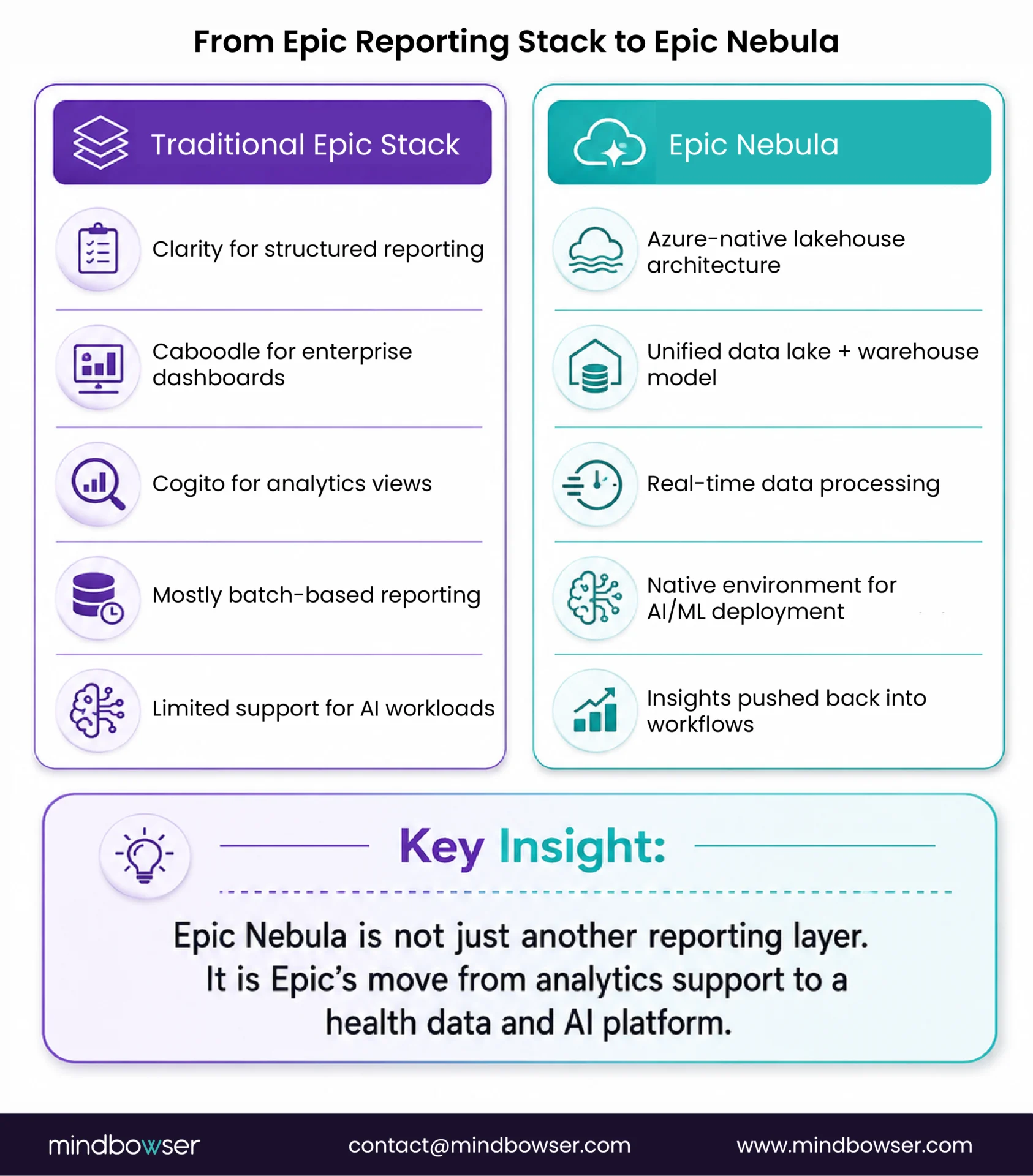
To understand this shift, you need to look at Epic’s analytics journey:
- Clarity → structured reporting database
- Caboodle → enterprise data warehouse
- Cogito → dashboards and reporting tools
- Nebula → Azure-native lakehouse for AI and real-time intelligence
This isn’t just product expansion. It’s a platform redefinition.
At its core, Epic Nebula is built on Microsoft Azure and Fabric, enabling healthcare organizations to manage and analyze data at scale. The architecture combines:
- Data lake + warehouse in a unified lakehouse model
- AI/ML deployment environments for predictive use cases
- Real-time data processing pipelines
So what’s actually changing?
Earlier, Epic systems were designed to record and report. Nebula is designed to predict and guide.
That’s where Nebula positions itself as the data and AI layer above the EHR.
Instead of being just a system of record, Epic is now aiming to become the system of intelligence.
Nebula is Epic’s move from documentation to decision-making infrastructure.
B. How Epic Nebula Works (Architecture Overview)
At a high level, Epic Nebula operates as a cloud-native data pipeline and intelligence engine embedded within the Epic ecosystem.
Here’s how the flow works:
1. Data Ingestion
Nebula pulls data from multiple sources:
- Epic modules (clinical, financial, operational)
- External systems (devices, payer data, third-party apps)
Think beyond EHR data, which includes unstructured inputs like notes, imaging metadata, and external feeds.
2. Unified Lakehouse Storage
All incoming data is stored in a centralized lakehouse, where:
- Structured data (labs, claims)
- Unstructured data (clinical notes, PDFs)
coexist in a single environment.
This eliminates the fragmentation seen in legacy Clarity and Caboodle setups.
3. AI/ML Model Deployment
Nebula supports the deployment of machine learning models using:
- Python-based frameworks
- PMML and other model formats
This enables both:
- Batch processing (e.g., nightly risk scoring)
- Real-time inference (e.g., alerts during patient encounters)
4. Workflow Integration
Insights don’t sit in dashboards; they are pushed back into clinical workflows:
- Best Practice Advisories
- Patient lists
- Care pathways
- Operational dashboards
Example: A patient flagged as high readmission risk triggers an alert during discharge planning.
This closes the loop between data → insight → action.
Nebula turns raw healthcare data into real-time, actionable intelligence inside the systems clinicians already use.
II. Why Epic Nebula Matters for Healthcare Organizations
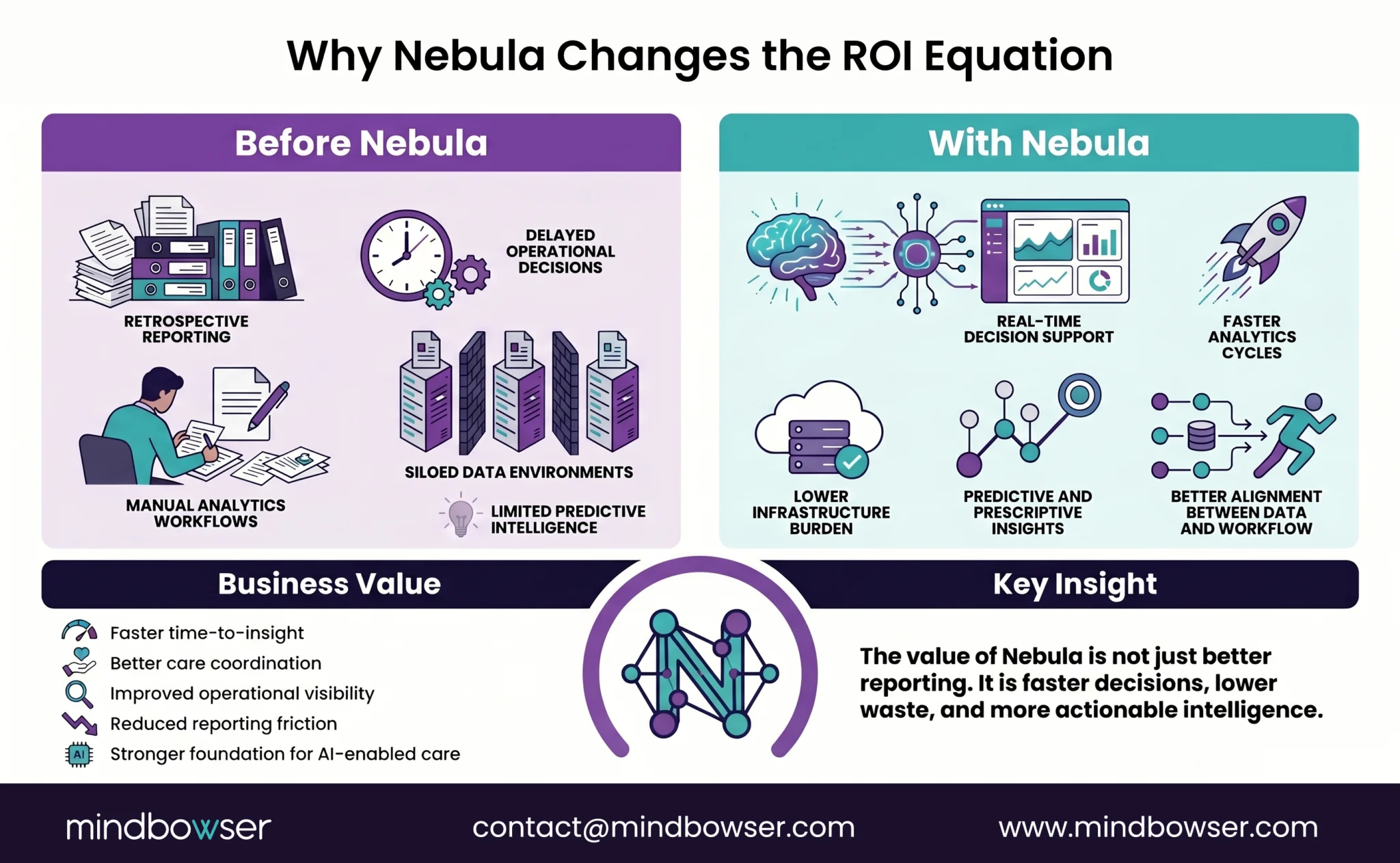
A. From Reporting to Real-Time Intelligence
Most health systems are still driving by looking in the rearview mirror.
Traditional Epic analytics environments, Clarity, and Caboodle were built for retrospective reporting. You ask a question. You wait. You get a report. By then, the moment has passed.
What if your system could intervene before the outcome happens?
That’s the shift Epic Nebula introduces.
Instead of static dashboards, Nebula enables:
- Predictive intelligence (what will happen)
- Prescriptive insights (what should be done next)
This is not incremental. It changes how decisions get made.
Consider these real-world use cases:
1. Readmission Risk Scoring
Patients are flagged before discharge, allowing care teams to intervene early. Not days later. Not after a report refresh. In the moment.
2. Capacity Optimization
Real-time data helps predict bed availability, staffing needs, and patient flow bottlenecks, critical for high-volume systems.
3. Population Health Insights
Instead of quarterly analysis, organizations can monitor risk cohorts dynamically and continuously adjust care plans.
Nebula addresses timing.
Old model: Report → Review → React
New model: Detect → Predict → Act
This works. Period.
Nebula shifts analytics from hindsight to foresight, where clinical and operational impact actually happens.
B. Business Impact (ROI Lens for CIOs)
If you’re a CIO, the question isn’t “Is this powerful?” It’s “Does this move the needle?”
Epic Nebula directly impacts three areas that matter at the executive level: cost, speed, and outcomes.
1. Cost Structure: CapEx to OpEx Shift
Legacy analytics infrastructure requires:
- On-prem hardware
- Maintenance overhead
- Periodic upgrades
Nebula, built on Azure, transitions this to a consumption-based model.
You pay for what you use. No idle capacity. No overprovisioning.
2. Faster Analytics Cycles
Traditional reporting cycles can take days or weeks.
With Nebula:
- Data pipelines update continuously
- Queries run faster on scalable compute
- Insights are delivered in near real-time
What used to take a week can now happen in minutes.
That speed compounds across departments, finance, operations, and clinical teams.
3. Improved Clinical Outcomes
This is where ROI becomes strategic.
Machine learning models embedded in workflows can:
- Identify high-risk patients earlier
- Reduce adverse events
- Improve care coordination
A HIMSS study shows that AI-enabled clinical decision support can improve outcomes by up to 15, 20% in targeted use cases.
4. Operational Efficiency Gains
Manual reporting is expensive. It consumes analyst time, delays decisions, and introduces variability.
Nebula reduces:
- Manual data extraction
- Report generation overhead
- Redundant analytics workflows
More automation. Less friction.
Scenario: A 300-bed hospital reduces average discharge delays by 10% using real-time insights. That translates into higher throughput, better patient experience, and measurable revenue impact.
Epic Nebula is not just a technology upgrade; it’s a financial and operational lever for modern healthcare systems.
III. Key Features of Epic Nebula
A. 1. Azure-Native Lakehouse Architecture
This is the foundation everything else depends on.
Epic Nebula replaces fragmented data layers with a unified lakehouse architecture built directly on Microsoft Azure. Instead of maintaining separate systems for reporting and analytics, organizations now operate from a single source of truth.
Why does that matter in practice?
Because Clarity and Caboodle often create duplication, latency, and reconciliation issues. Teams spend time validating data instead of using it.
Nebula changes that dynamic.
1. Unified Data Layer
Clinical, financial, and operational data all reside in one environment. No more siloed pipelines.
Clarity → detailed reporting
Caboodle → aggregated analytics
Nebula → both, plus real-time access
2. Elastic Scalability
Built on Azure, Nebula can scale compute and storage on demand.
- Handle growing patient data volumes
- Support large-scale analytics workloads
- Enable concurrent users without performance bottlenecks
3. Real-Time Processing
Unlike batch-heavy legacy systems, Nebula supports streaming data pipelines.
This allows:
- Immediate updates to dashboards
- Real-time triggers for alerts
- Continuous analytics workflows
The lake house architecture eliminates data fragmentation and unlocks real-time, enterprise-wide visibility.
B. 2. Embedded AI & Machine Learning
Data alone doesn’t create value. Decisions do.
Epic Nebula embeds AI and machine learning directly into its platform, enabling organizations to move from analysis to action.
But here’s the real shift: AI is no longer a side project.
It becomes part of daily operations.
1. Pre-Built and Custom Models
Epic provides pre-configured models for common use cases:
- Readmission prediction
- Sepsis detection
- Risk stratification
At the same time, organizations can deploy their own models using:
- Python environments
- Standard ML formats like PMML
This balance allows both speed and flexibility.
2. Batch and Real-Time Inference
Nebula supports two critical modes:
- Batch predictions for large datasets
- Real-time inference during clinical workflows
Example: A model evaluates a patient’s risk score instantly during a physician visit, not hours later.
3. Continuous Learning Loops
Models can be updated as new data flows in, improving accuracy over time.
Nebula operationalizes AI, turning models into everyday clinical and operational tools.
C. 3. Seamless Workflow Integration
Insights are useless if they live outside the workflow.
This is where many analytics initiatives fail. Data teams build dashboards. Clinicians ignore them.
Nebula avoids this trap by embedding intelligence directly into the Epic interface.
1. Clinical Decision Support
Insights appear within:
- Best Practice Advisories
- Patient charts
- Care pathways
No context switching. No extra clicks.
2. Operational Dashboards
Administrators and operations teams get:
- Real-time performance views
- Capacity and utilization insights
- Workflow alerts
3. Actionable Interfaces
Instead of just showing data, Nebula enables action:
- Trigger interventions
- Adjust care plans
- Prioritize high-risk patients
Nebula closes the gap between insight and execution, where real impact happens.
D. 4. Ecosystem Connectivity
No healthcare system operates in isolation.
Epic Nebula is designed to connect not just within Epic, but across the broader healthcare ecosystem.
1. Standards-Based Integration
Nebula supports key interoperability standards:
- FHIR APIs
- HL7 interfaces
- Epic’s proprietary APIs
This allows seamless data exchange across systems.
2. Microsoft Ecosystem Integration
Deep integration with Microsoft tools enables:
- Advanced analytics via Fabric
- AI model development using Azure services
- Data visualization and reporting
3. External Data Connectivity
Organizations can ingest data from:
- Medical devices
- Payer systems
- CRM platforms
- Remote monitoring tools
Think longitudinal patient records that go beyond the hospital walls.
However, this connectivity also raises a strategic question:
Are you building within an Azure-first ecosystem or designing for multi-cloud flexibility?
That decision will shape long-term architecture choices.
Nebula enables connected healthcare data environments, but requires a clear ecosystem strategy.
IV. Who Uses Epic Nebula? (User Personas)
A. Health System CIOs / CTOs
For CIOs and CTOs, Epic Nebula is a strategic infrastructure decision, not just a technology upgrade.
These leaders are typically dealing with:
- Aging on-prem analytics systems
- Rising infrastructure costs
- Increasing demand for AI-driven insights
Scenario: Your board asks for enterprise-wide predictive analytics. Your current stack takes weeks to generate reports. What changes?
Nebula becomes the answer when organizations are:
1. Planning Cloud Migration
Moving Epic workloads to Azure aligns analytics, storage, and compute into a single cloud strategy.
2. Modernizing Data Platforms
Instead of maintaining Clarity, Caboodle, and third-party tools, CIOs can consolidate into a unified lake house environment.
3. Enabling AI at Scale
Nebula provides the infrastructure needed to deploy AI models enterprise-wide, not just in isolated pilots.
CIOs use Nebula to align data, cloud, and AI into one scalable foundation.
B. CMIOs / Clinical Leaders
Clinical leaders care about one thing: better decisions at the point of care.
Nebula enables this by embedding intelligence directly into workflows.
What does that look like day-to-day?
1. AI-Driven Decision Support
- Real-time alerts for high-risk patients
- Predictive insights during diagnosis and treatment
- Evidence-based recommendations
2. Improved Patient Outcomes
Earlier interventions lead to:
- Reduced complications
- Lower readmission rates
- More personalized care plans
3. Reduced Cognitive Load
Instead of manually reviewing data, clinicians receive prioritized, actionable insights.
Less searching. More acting.
CMIOs leverage Nebula to turn data into timely clinical decisions that improve outcomes.
C. Data & Analytics Teams
This is where Nebula becomes a force multiplier.
Data teams are often constrained by:
- Slow data pipelines
- Fragmented tools
- Limited ability to deploy models
- Nebula removes those barriers.
1. Advanced Analytics Capabilities
Teams can run:
- Large-scale queries
- Complex analytics workflows
- Real-time data processing
- all within a single environment.
2. Machine Learning Deployment
Instead of exporting data to external platforms, teams can:
- Build models in Python
- Deploy directly within Nebula
- Monitor performance continuously
3. Self-Service Reporting
Business users gain access to:
- Real-time dashboards
- On-demand insights
- Reduced dependency on analysts
Nebula empowers data teams to move faster from data preparation to model deployment to insight delivery.
D. Digital Health Companies
Nebula is not just for providers; it opens new doors for innovators.
Digital health companies building on Epic can now access a more scalable and AI-ready data layer.
What changes for them?
1. App Development on Epic Ecosystem
Using FHIR APIs, developers can:
- Build patient-facing applications
- Create clinician support tools
- Integrate directly into Epic workflows
2. Access to Richer Data
Nebula enables access to:
- Real-time patient data
- Longitudinal health records
- Cross-system insights
3. Faster Innovation Cycles
With cloud-native infrastructure, companies can:
- Test and deploy features quickly
- Scale applications without infrastructure constraints
Think remote monitoring platforms, AI triage tools, or care coordination apps, all powered by real-time data.
Digital health companies use Nebula to build smarter, faster, and more integrated healthcare applications.
Talk to our Epic integration team
V. Pros and Cons of Epic Nebula
A. Pros
Epic Nebula delivers clear advantages, but only if you know where the value actually shows up.
Let’s break this down from an operator’s lens.
1. Scalability
Nebula is cloud-native by design, which means compute and storage scale on demand.
- No infrastructure bottlenecks
- No capacity planning cycles
- No performance degradation during peak loads
Translation: your analytics won’t slow down when your data grows.
2. Advanced Analytics
Traditional Epic environments rely on batch processing.
Nebula introduces:
- Real-time data pipelines
- Predictive analytics
- Prescriptive insights
3. AI Enablement
Nebula includes built-in environments for deploying machine learning models.
- Pre-built clinical models
- Custom model deployment
- Continuous learning loops
No need to bolt on external AI platforms.
4. Unified Data Environment
Clarity, Caboodle, and external systems often create fragmented datasets.
Nebula consolidates everything into a single lakehouse.
- One data layer
- One pipeline
- One version of truth
Less reconciliation. More trust in the data.
5. Operational Efficiency
Automation replaces manual reporting workflows.
- Faster decision-making
- Reduced analyst workload
- Streamlined operations
Nebula enables faster, smarter, and more scalable healthcare operations.
B. Cons
But let’s be clear, Nebula is not a plug-and-play upgrade.
There are real trade-offs that CIOs must evaluate up front.
1. Azure Dependency
Nebula is deeply aligned with Microsoft Azure.
- Tight integration with Azure services
- Limited flexibility for non-Azure environments
Question to ask: Are you comfortable committing to an Azure-first strategy long term?
2. Migration Complexity
Transitioning from legacy systems requires:
- Data migration planning
- Pipeline redesign
- Workflow adjustments
This is not a lift-and-shift. It’s a re-architecture effort.
3. Cost Unpredictability
Cloud introduces variable costs.
- Compute usage spikes
- Storage growth
- Data transfer charges
Without governance, costs can escalate quickly.
4. Vendor Lock-In Risks
Deep integration with Epic + Azure can limit flexibility.
- Harder to switch platforms
- Constraints on multi-cloud strategies
This is a strategic commitment, not just a technical one.
5. Skill Gaps
Nebula requires expertise in:
- Data engineering
- Cloud architecture
- Machine learning
Many healthcare organizations lack these capabilities internally.
Scenario: A health system adopts Nebula but lacks in-house ML expertise. The platform is powerful but underutilized.
Epic Nebula offers significant upside, but only for organizations prepared to manage cloud complexity, costs, and skills.
VI. Epic Nebula Interoperability with Other Epic Modules
A. How Nebula Integrates Across Epic Ecosystem
Epic Nebula does not replace the Epic ecosystem; it amplifies it.
The real value lies in how seamlessly it integrates with existing Epic modules and workflows.
Think of Nebula as the intelligence layer sitting above everything else.
Here’s how it integrates across the core stack:
1. Hyperspace / Hyperdrive (UI Layer)
Clinicians continue working in familiar interfaces.
- Nebula insights surface directly in workflows
- No need to switch systems
- No retraining burden
The experience stays the same. The intelligence improves.
2. Clarity & Caboodle (Legacy Analytics)
Nebula does not immediately eliminate these systems.
Instead, it:
- Extends their capabilities
- Gradually absorbs their workloads
- Enables transition to real-time analytics
Most organizations will run hybrid architectures during migration.
3. Cogito (Reporting & Dashboards)
Cogito tools continue to provide reporting interfaces.
But now:
- Data pipelines are faster
- Insights are richer
- AI outputs are integrated
4. Cosmos (Real-World Data Insights)
Nebula can leverage Cosmos datasets for:
- Population-level analytics
- Research insights
- Benchmarking across organizations
Data Flow Model:
Module → Nebula → AI Model → Insight → Back to Workflow
This closed loop is what enables continuous intelligence.
Nebula enhances every layer of Epic by injecting real-time intelligence into existing workflows.
B. Interoperability Beyond Epic
Healthcare doesn’t operate inside a single system, and neither should your data.
Nebula is designed to connect beyond Epic into the broader healthcare ecosystem.
1. SMART on FHIR Applications
Developers can build apps that:
- Integrate directly into Epic workflows
- Access real-time patient data
- Deliver contextual insights
This enables innovation without disrupting core systems.
2. HL7 Integrations
Nebula supports traditional interoperability standards:
- Lab systems
- Radiology platforms
- Billing systems
Legacy systems don’t get left behind; they get connected.
3. External Data Sources
Organizations can ingest data from:
- Remote patient monitoring devices
- Payer systems
- CRM platforms
- Social determinants of health datasets
This creates a longitudinal, 360-degree patient view.
4. Multi-Cloud Considerations
Here’s where things get strategic.
Many organizations already use:
- AWS for analytics
- Snowflake for data warehousing
- Google Cloud for AI workloads
So where does Nebula fit?
It introduces an Azure-centric model into potentially multi-cloud environments.
Nebula expands interoperability but forces organizations to rethink cross-platform data strategies.
C. Key Challenge: Multi-Cloud vs Azure-Centric Strategy
This is the decision that will define your architecture for the next decade.
Nebula’s deep integration with Azure creates a fork in the road:
1. Fully Align with Azure
Pros:
- Native performance
- Simplified architecture
- Faster implementation
Cons:
- Increased dependency on the Microsoft ecosystem
- Limited flexibility
2. Build a Multi-Cloud Abstraction Layer
Pros:
- Flexibility across platforms
- Reduced vendor lock-in risk
Cons:
- Higher complexity
- Increased integration overhead
There is no universal answer, only tradeoffs.
Scenario: A health system uses Snowflake for enterprise analytics but adopts Nebula for Epic data. Without proper abstraction, data silos re-emerge just in the cloud.
Interoperability is no longer just about connecting systems; it’s about choosing the right cloud strategy to sustain it.
VII. Epic Nebula vs Traditional Epic Analytics (Clarity & Caboodle)
This is where the difference becomes undeniable.
For years, Clarity and Caboodle have powered Epic analytics. They work, but they were built for a different era.
Batch reporting. Static dashboards. Delayed decisions.
Nebula changes that model completely.
Here’s a direct comparison:
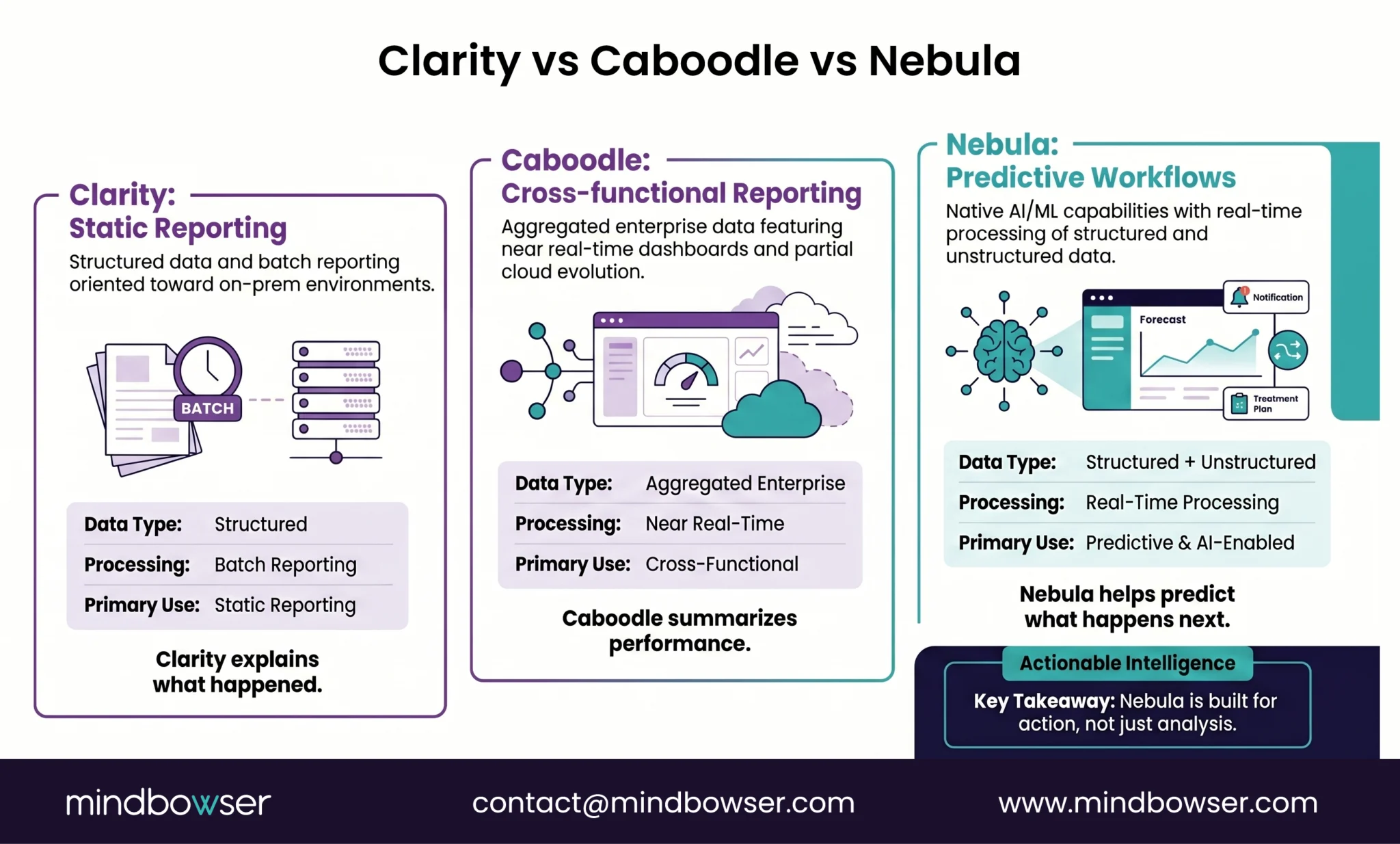
A. Capability Comparison
1. Data Type
- Clarity: Structured data
- Caboodle: Aggregated datasets
- Nebula: Structured + unstructured (notes, external data)
2. Speed
- Clarity: Batch processing
- Caboodle: Near real-time
- Nebula: Real-time streaming and analytics
3. AI/ML Capabilities
- Clarity: Minimal support
- Caboodle: Limited extensions
- Nebula: Native AI/ML deployment
4. Scalability
- Clarity: On-prem constraints
- Caboodle: Partial cloud support
- Nebula: Cloud-scale, on-demand compute
5. Use Cases
- Clarity: Reporting
- Caboodle: Dashboards
- Nebula: Predictive, prescriptive, AI-driven workflows
Scenario: A finance team needs monthly performance reports. Clarity handles it.
A clinical team needs real-time sepsis alerts. Only Nebula can deliver that.
Old stack: Data → Warehouse → Report
New stack: Data → AI → Action
Short. Direct. Different.
Clarity and Caboodle explain what happened. Nebula helps decide what to do next.
VIII. Implementation Considerations for CIOs
A. When Should You Adopt Epic Nebula?
Not every organization needs Nebula today, but many will need it soon.
The right timing depends on where you are in your data and cloud journey.
Ask yourself: are your current analytics slowing down decisions?
Nebula becomes relevant in three scenarios:
1. Planning Epic → Azure Migration
If you’re already moving infrastructure to Azure, Nebula fits naturally.
- Aligns data, compute, and analytics
- Avoids fragmented cloud strategies
2. Need for AI-Driven Workflows
If leadership is pushing for:
- Predictive analytics
- Clinical AI use cases
- Real-time decision support
- Then legacy systems won’t keep up.
Nebula provides the foundation for operationalizing AI, not just experimenting with it.
3. Scaling Analytics Across the Enterprise
When multiple departments rely on data:
- Finance
- Operations
- Clinical teams
You need a single, scalable data layer.
According to McKinsey, organizations that scale analytics enterprise-wide see up to a 20% increase in decision speed.
Adopt Nebula when analytics becomes core to how your organization operates, not just reports.
B. Key Questions to Ask Before Adoption
This is where most implementations succeed or fail.
Before committing, leadership teams must answer a few critical questions.
1. What Is Your Cloud Strategy?
Are you aligned with Azure long-term?
Or do you require multi-cloud flexibility?
This decision impacts architecture, cost, and vendor dependency.
2. Do You Have the Right Capabilities?
Nebula requires:
- Data engineering expertise
- Cloud architecture knowledge
- ML model development skills
Without this, adoption slows and value drops.
3. How Will You Govern Cost and Security?
Cloud brings flexibility, but also variability.
- Set cost controls early
- Define usage policies
- Ensure HIPAA-compliant data handling
Scenario: A CIO greenlights Nebula without a cost governance model. Within six months, cloud spend spikes without proportional value.
Successful Nebula adoption depends less on technology and more on strategy, skills, and governance.
Build your Epic integration strategy
IX. How Mindbowser Builds Custom EHR with Epic Integration Capabilities
A. Bridging Epic with Custom Digital Health Platforms
Epic Nebula is powerful, but it does not replace the need for custom digital layers.
Health systems still require tailored solutions for:
- Care management
- Patient engagement
- Virtual care delivery
Scenario: Your clinicians need a unified care management view across multiple systems. Epic alone cannot deliver that experience cleanly.
This is where custom EHR extensions come in.
Mindbowser builds modular digital layers on top of Epic that:
- Extend workflows beyond the EHR
- Unify fragmented patient journeys
- Deliver role-specific interfaces
The goal is simple: keep Epic as the core system, while enabling flexibility around it.
Custom layers turn Epic from a system of record into a system of experience.
B. Integration Approach
Integration is not about connecting systems; it’s about making them work as one.
Mindbowser follows a FHIR-first, API-driven architecture to ensure interoperability at scale.
1. FHIR-First Design
- Standardized data exchange
- Faster integration cycles
- Future-ready interoperability
2. HL7 + API Orchestration
- Support for legacy systems
- Real-time data synchronization
- Reliable data pipelines
3. Middleware for Orchestration
A middleware layer ensures:
- Data normalization across systems
- Workflow orchestration
- Reduced dependency on single vendors
This becomes critical in multi-system environments.
The right integration approach ensures Nebula works within a broader, connected ecosystem.
C. Accelerators We Use
Speed matters especially when building on top of complex systems like Epic.
Mindbowser uses pre-built accelerators to reduce time-to-value.
1. AI-Driven Clinical Summaries
- Auto-generate patient summaries
- Reduce clinician documentation burden
2. Care Plan Automation Engines
- Dynamic care pathways
- Rule-based + AI-driven recommendations
3. Predictive Analytics Integrations
- Nebula-ready ML models
- Real-time risk scoring and alerts
Accelerators help organizations move from concept to production faster without compromising quality.
D. Example Outcomes (Use Case Framing)
This is where strategy turns into measurable impact.
Organizations working with Mindbowser typically see:
1. Unified Patient 360 View
- Data from EHR, devices, and external systems
- Single interface for clinicians and care teams
2. Faster Time-to-Insight
- Real-time analytics powered by Nebula
- Reduced lag in decision-making
3. Reduced Clinician Workload
- AI-assisted workflows
- Less manual data entry
- Improved efficiency
Example: A care team receives automated risk alerts and pre-built care plans, reducing time spent on manual coordination.
Custom integration + Nebula creates a scalable, AI-ready healthcare ecosystem.
X. Future of Epic Nebula: AI, Multi-Cloud, and Data Ownership
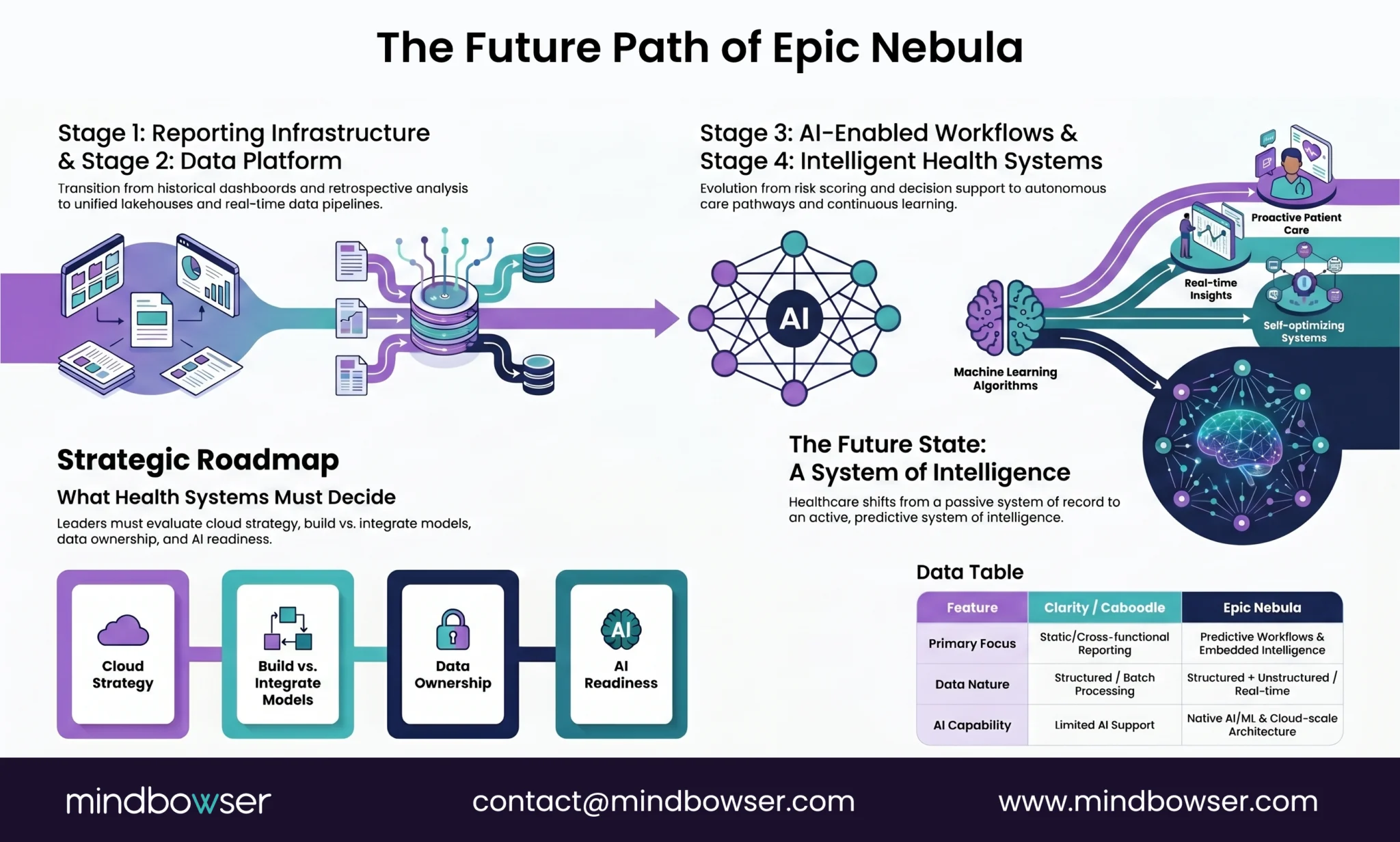
A. The Shift Toward AI-Native Healthcare Platforms
Healthcare is moving from digital to intelligent, and Nebula sits at the center of that shift.
What used to be decision support is becoming decision automation.
Nebula enables:
- Generative AI for clinical documentation
- Real-time decision support during care delivery
- Autonomous care pathways driven by predictive models
Imagine this: A patient arrives in the ED. Risk is calculated instantly. Care pathways adjust automatically. Clinicians act, not search.
That’s not future-state theory. It’s where the platform is heading.
The implication is clear: systems that cannot support AI-native workflows will fall behind.
Nebula positions Epic as the foundation for AI-driven healthcare delivery.
B. Will Epic Stay Azure-Centric?
This is the tension every CIO is watching.
Epic’s alignment with Microsoft Azure is deep and intentional.
But the market is evolving toward:
- Multi-cloud strategies
- Vendor-neutral architectures
- Data portability requirements
So what happens next?
Two forces are at play:
1. Enterprise Demand for Flexibility
Large health systems want:
- Freedom to choose best-of-breed tools
- Ability to avoid vendor lock-in
- Cross-platform analytics capabilities
2. Platform Optimization Pressure
At the same time, staying within Azure offers:
- Better performance
- Simpler architecture
- Faster deployment
This creates a strategic tradeoff: flexibility vs efficiency.
There is no perfect answer, only alignment with long-term goals.
Epic may remain Azure-first, but customer demand will push toward broader interoperability.
C. What This Means for Health Systems
Data strategy is no longer an IT concern; it’s a competitive advantage.
Health systems that treat data as infrastructure will lead. Others will lag.
Here’s what changes:
1. EHR Becomes a Platform
Epic is no longer just a system of record.
It becomes:
- A data platform
- An AI execution layer
- A foundation for digital innovation
2. Data Ownership Becomes Critical
Organizations must decide:
- Where data lives
- Who controls it
- How it is accessed and shared
This is not just technical, it’s strategic governance.
3. AI Readiness Defines Maturity
The gap between leaders and laggards will be defined by:
- Ability to deploy AI at scale
- Integration into workflows
- Speed of decision-making
According to HIMSS, digitally mature organizations are 2x more likely to achieve measurable improvements in patient outcomes.
Scenario: Two hospitals adopt Epic. One builds AI workflows on Nebula. The other sticks to reporting. Within 18 months, their outcomes and costs diverge significantly.
Epic Nebula shifts the battleground from systems to intelligence and from infrastructure to strategy.
From System of Record to System of Intelligence
Epic Nebula marks the moment healthcare data becomes actionable, not just accessible. It shifts Epic from a system that documents care to one that guides decisions in real time. The upside is clearer insights, better outcomes, and scalable AI, but only for organizations that align cloud strategy, interoperability, and execution. The real differentiator is not adoption, but how effectively you turn data into action.
Epic Nebula is a cloud-based data and AI platform built on Azure that sits on top of Epic. It helps healthcare organizations move from static reports to real-time, predictive insights embedded in workflows.
Clarity and Caboodle focus on historical reporting and dashboards, while Nebula enables real-time analytics and AI-driven decision-making. It also supports unstructured data and scalable cloud processing.
Yes, Nebula is deeply integrated with Microsoft Azure. Organizations typically need an Azure-aligned cloud strategy, though some may design multi-cloud layers depending on existing infrastructure.
The main challenges include migration complexity, cloud cost management, and skill gaps in data engineering and AI. Without proper planning, organizations may struggle to realize full value.
Yes, Nebula allows deployment of both pre-built Epic models and custom ML models using tools like Python. These models can run in batch or real time and integrate directly into clinical workflows.