BLOGS
BLOGS  NEWSROOM
  CASE STUDIES
  WEBINARS
  PODCASTS
  ASSET HUB
  EVENT CALENDAR






















TL;DR
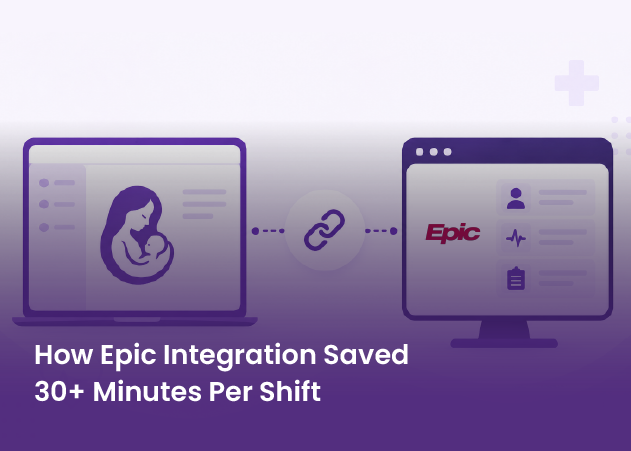
- Epic Bridges is Epic’s native integration engine that enables secure, real-time data exchange across healthcare systems.
- It plays a critical role in interoperability, but ROI depends on how well it’s architected, mapped, and governed, not just implemented.
How do you ensure real-time, accurate data flows across clinical systems without breaking workflows or compliance?
That’s the core challenge modern healthcare organizations face. Epic Bridges addresses this by acting as the integration backbone within the Epic ecosystem connecting EHR data with labs, billing systems, and digital health platforms.
But while the technology is powerful, its success depends less on availability and more on how strategically it is implemented.
I. What is Epic Bridges? (And Why It Matters for Healthcare Integration)
Epic Bridges is Epic’s native interface engine designed to build, manage, and maintain integrations between the Epic EHR and external systems.
At its core, it acts as a secure integration layer that enables communication between:
- Clinical systems (labs, radiology, pharmacy)
- Revenue cycle platforms (billing, claims, payments)
- Digital health applications (RPM, telehealth, AI tools)
- External providers and Health Information Exchanges (HIEs)
Unlike third-party middleware, Epic Bridges operates within the Epic ecosystem, allowing tighter alignment with clinical workflows, data models, and governance structures.
A. What Makes Epic Bridges Foundational
1. Native Integration with Epic Workflows
Epic Bridges is not an add-on; it is embedded within Epic’s architecture. This allows integrations to:
- Directly interact with Epic master files
- Align with clinical documentation workflows
- Maintain consistency across modules
2. Secure, Standards-Based Data Exchange
Bridges support industry-standard protocols such as:
- HL7v2 for clinical messaging
- EDI for billing and claims
- Custom mappings for specialized integrations
This ensures secure and compliant data exchange across both Epic and non-Epic systems.
3. Cross-System Connectivity at Scale
Healthcare ecosystems are rarely single-vendor environments. Bridges enable:
- Communication between Epic and legacy systems
- Integration with modern digital health platforms
- Data exchange across provider networks
B. Why It Matters Now
Healthcare is moving toward connected, data-driven care models, but integration remains the bottleneck.
What happens when lab results arrive late, or discharge data doesn’t sync in real time?
- Care decisions slow down
- Coordination breaks across teams
- Patient outcomes are impacted
Epic Bridges directly addresses this gap by enabling real-time, reliable data exchange across the care continuum.
C. Practitioner Insight
“If your product doesn’t integrate with Epic, you’re effectively locked out of the largest hospital ecosystem in the U.S.”
This is not just a technical limitation, it’s a market access constraint. For digital health companies and providers alike, Epic integration is often the difference between:
- Scaling adoption
- Or stalling at pilot stage
II. Why Epic Bridges is Critical for Modern Healthcare Systems
Healthcare leaders are under increasing pressure to connect fragmented systems, enable real-time decision-making, and reduce operational friction. Epic Bridges sits at the center of this transformation.
Without a robust integration layer, even the most advanced EHR becomes a siloed system limiting its clinical and financial impact.
A. Interoperability at Scale
1. Eliminating Fragmented Data Ecosystems
Most mid-market hospitals operate across:
- Multiple clinical systems (LIS, RIS, pharmacy)
- Legacy billing platforms
- New-age digital health tools
Without integration, these systems function in isolation, leading to:
- Duplicate data entry
- Inconsistent patient records
- Manual reconciliation workflows
Epic Bridges enables seamless connectivity across these systems, creating a unified data environment.
Deloitte highlights that improving interoperability and digital infrastructure can significantly reduce administrative inefficiencies and operating costs across health systems.
2. Enabling Ecosystem-Level Connectivity
Beyond internal systems, Bridges connects Epic with:
- Health Information Exchanges (HIEs)
- External provider networks
- Payer systems
This allows organizations to extend interoperability beyond hospital walls, a critical requirement for value-based care models.
How do you coordinate care effectively if referral data doesn’t flow across providers in real time?
B. Real-Time Clinical Data Exchange
1. Supporting Time-Sensitive Clinical Workflows
Epic Bridges enables real-time exchange of:
- Lab results
- Clinical summaries
- ADT (Admission, Discharge, Transfer) events
This directly impacts:
- Care coordination
- Clinical decision-making speed
- Patient safety outcomes
The CDC highlights that communication breakdowns and incomplete information are major contributors to preventable medical errors.
2. Improving Care Continuity
When data flows seamlessly:
- Physicians have complete patient context at the point of care
- Transitions between departments become smoother
- Readmission risks have reduced due to better follow-up coordination
What changes when discharge data reaches care teams instantly instead of hours later?
Care becomes proactive, not reactive.
C. Reduced Integration Complexity
1. Centralized Interface Management
Without Epic Bridges, organizations often rely on:
- Multiple middleware tools
- Point-to-point integrations
- Custom scripts across departments
This leads to:
- Increased maintenance overhead
- Higher failure rates
- Limited scalability
Epic Bridges centralizes integration logic into a single interface engine, reducing architectural sprawl.
2. Streamlined Operations and Governance
A centralized approach allows:
- Standardized data mappings
- Unified monitoring and alerting
- Easier compliance management
McKinsey reports that streamlined digital operations can improve healthcare productivity by up to 25% when supported by a strong data infrastructure.
Epic Bridges is not just an integration tool; it is a strategic enabler of interoperability, clinical efficiency, and scalable digital health infrastructure.
If your integration layer cannot scale with your ecosystem, how will your care model scale?
III. How Epic Bridges Works (Architecture + Data Flow)
Understanding Epic Bridges at a surface level is not enough. The real value and risk lie in how it is architected and implemented.
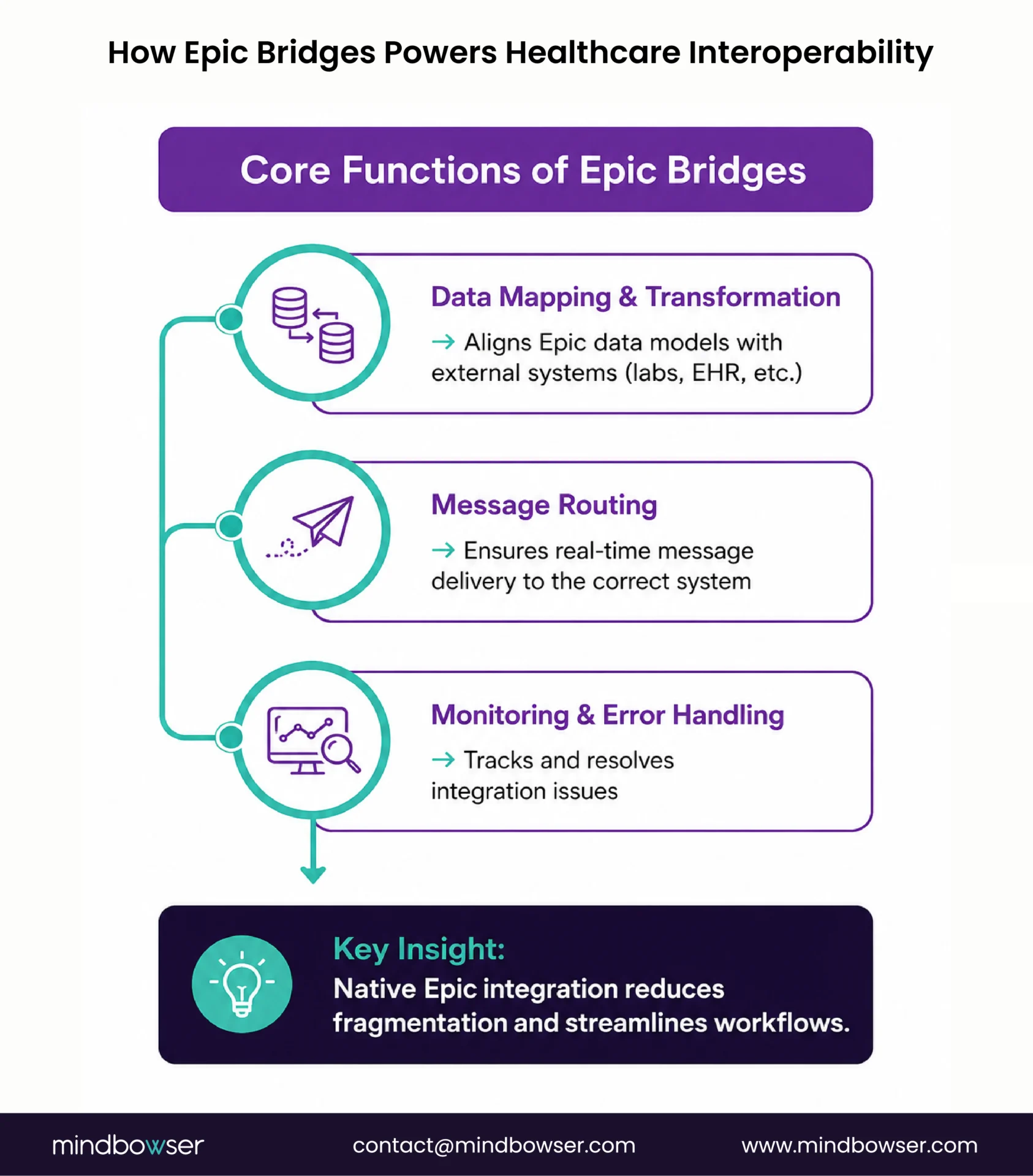
At its core, Epic Bridges operates as a message-driven integration enginehandling the flow of structured data between Epic and external systems in real time.
A. Core Functions
1. Interface Configuration and Management
Each integration in Epic Bridges is defined as an “interface.” These interfaces specify:
- Source and destination systems
- Communication protocols
- Message triggers (e.g., patient admission, lab result availability)
This allows teams to control how and when data moves across systems.
2. Data Mapping (Epic Master Files ↔ External Systems)
Healthcare systems rarely share identical data structures. Bridges solves this through custom data mapping:
- Epic master files (patients, encounters, orders) are mapped to external formats
- Field-level transformations ensure compatibility
What happens if a lab system interprets a patient ID differently than Epic?
Without precise mapping, data integrity breaks immediately.
3. Message Routing and Transformation
Bridges processes and routes messages using standards like:
- HL7v2 for clinical events
- EDI for billing transactions
It can:
- Transform message formats
- Route messages to multiple endpoints
- Apply conditional logic based on workflows
4. Monitoring and Error Handling
Every interface includes monitoring capabilities:
- Real-time message tracking
- Error detection and logging
- Retry and exception handling workflows
This ensures high reliability in mission-critical data exchange.
B. Integration Workflow (Step-by-Step)
1. Define the Integration Use Case
Start with clarity:
- What workflow are you enabling?
- What data needs to move and why?
Examples:
- Sending ADT events to a care coordination platform
- Integrating lab results into Epic from an external LIS
2. Configure Connection Endpoints
Set up communication between systems:
- Network protocols
- Authentication layers
- Secure transport mechanisms
3. Map Data Fields and Message Formats
This is the most critical step:
- Align Epic data structures with external schemas
- Define transformations for mismatched formats
4. Enable Routing and Transformation Logic
Configure how messages:
- Flow between systems
- Trigger downstream actions
- Adapt based on conditions
5. Monitor and Optimize Interface Performance
Post-deployment:
- Track latency and throughput
- Identify bottlenecks
- Continuously refine mappings and logic
C. Architecture Reality: Where Most Implementations Fail
Why do some Epic integrations scale smoothly while others collapse under complexity?
Because many teams treat Bridges as a configuration exercise, not an architectural decision.
Common pitfalls:
- Overloading interfaces with multiple use cases
- Poorly defined data ownership across systems
- Lack of reusable mapping frameworks
- No governance for interface growth
The result: interface sprawl, inconsistent data, and operational instability.
Key takeaway: Epic Bridges is powerful, but only when designed with clear workflows, precise data models, and scalable architecture principles.
IV. Key Features of Epic Bridges
Epic Bridges stands out not because it simply connects systems, but because it does so deeply within Epic’s clinical and operational workflows.
For healthcare leaders, the distinction is critical: integration depth determines whether data is just exchanged or actually usable in care delivery and operations.
A. Native Epic Integration (No External Engine Required)
1. Embedded Within Epic’s Core Architecture
Unlike third-party middleware, Epic Bridges is built directly into the Epic ecosystem. This enables:
- Direct access to Epic master files
- Tight coupling with clinical workflows
- Consistent data governance across modules
What’s the impact of this?
Integrations behave like native extensions of Epicnot external add-ons.
2. Reduced Dependency on External Layers
By eliminating additional middleware:
- System complexity decreases
- Points of failure are reduced
- Long-term maintenance becomes more manageable
This is especially important for mid-market health systems where IT bandwidth is constrained.
B. HL7v2 and EDI Support
1. Industry-Standard Messaging Protocols
Epic Bridges supports:
- HL7v2 for clinical messaging (ADT, ORU, ORM)
- EDI for financial transactions (claims, remittance)
This ensures compatibility with:
- Legacy systems
- Payer platforms
- External clinical applications
2. Flexibility for Complex Integrations
While HL7v2 is the baseline, Bridges allows:
- Custom message structures
- Hybrid integrations (HL7 + API layers)
- Tailored transformations for specialized workflows
Why does this matter?
Because real-world healthcare environments rarely follow “standard-only” implementations.
C. Real-Time Interface Monitoring
1. Visibility Into Data Flow
Epic Bridges provides real-time tracking of:
- Message delivery status
- Processing delays
- Interface failures
This enables teams to:
- Identify issues early
- Reduce downtime
- Maintain data reliability
2. Operational Control at Scale
As interfaces grow, monitoring becomes critical. Without it:
- Errors go unnoticed
- Data inconsistencies propagate
- Clinical workflows are disrupted
According to Deloitte, organizations with strong monitoring frameworks reduce integration-related incidents by over 25%.
D. Custom Interface Development Tools
1. Tailored Integration Logic
Epic Bridges allows teams to build:
- Custom routing rules
- Conditional workflows
- Data transformation layers
This is essential for aligning integrations with:
- Clinical protocols
- Operational workflows
- Compliance requirements
2. Adaptability to Evolving Needs
Healthcare systems evolve continuously, with new tools, new workflows, and new regulations.
Custom development capabilities ensure:
- Integrations can scale and adapt
- New use cases can be onboarded quickly
E. Pre-Built Templates for Common Integrations
1. Accelerated Deployment for Standard Use Cases
Epic Bridges includes templates for:
- Lab integrations (LIS)
- Radiology systems (RIS/PACS)
- Billing and claims workflows
These reduce:
- Initial setup time
- Configuration effort
2. Foundation for Customization
Templates are not endpoints; they are starting points.
What separates high-performing implementations?
Teams that customize templates to match real workflows, rather than deploying them as-is.
Epic Bridges combines native integration, standards support, real-time monitoring, and customization, making it a powerful but nuanced tool.
The question is not whether Bridges has the features, it’s whether those features are aligned to your workflows.
V. Common Use Cases of Epic Bridges
Epic Bridges is not a one-size-fits-all integration layer; it is a multi-use engine that powers critical workflows across clinical, financial, and digital health ecosystems.
The real value emerges when integrations are aligned with high-impact operational and clinical use cases.
A. Clinical System Integrations
1. Lab Systems (LIS)
Epic Bridges enables bi-directional communication between Epic and laboratory systems:
- Orders sent from Epic to LIS
- Results returned in real time
This eliminates:
- Manual result entry
- Delays in diagnosis
What happens when lab turnaround time drops from hours to minutes?
Clinical decision-making accelerates, and patient outcomes improve.
2. Radiology Systems (RIS/PACS)
Integration with imaging systems allows:
- Seamless order placement
- Real-time access to imaging reports
- Faster diagnostics workflows
This reduces:
- Scheduling friction
- Redundant imaging requests
3. Pharmacy Systems
Epic Bridges connects with pharmacy platforms to:
- Transmit prescriptions
- Update medication records
- Support medication reconciliation
Impact: Reduced medication errors and improved patient safety.
According to WHO, medication errors account for billions in avoidable healthcare costs globally each year, making integration a direct safety lever.
B. Revenue Cycle & Billing
1. Claims Processing (EDI)
Epic Bridges supports EDI transactions for:
- Claims submission
- Eligibility checks
- Remittance processing
This ensures:
- Faster reimbursement cycles
- Reduced claim denials
2. Payment Systems Integration
By connecting billing systems and payment gateways:
- Patient payments are tracked in real time
- Financial workflows become more transparent
How much revenue is delayed because billing data doesn’t sync in time?
C. Digital Health & Remote Care
1. Remote Patient Monitoring (RPM) Platforms
Epic Bridges enables integration with RPM solutions to:
- Capture patient vitals remotely
- Feed data directly into Epic
This supports:
- Chronic disease management
- Proactive care interventions
2. Telehealth Applications
Integration allows:
- Scheduling synchronization
- Clinical documentation alignment
- Real-time data exchange during virtual visits
3. AI-Driven Tools
Bridges can connect Epic with:
- Clinical decision support tools
- AI summarization engines
- Predictive analytics platforms
This enables data-driven care delivery at scale.
D. Cross-Provider Data Exchange
1. Referrals and Care Coordination
Epic Bridges facilitates:
- Referral data sharing
- Care plan synchronization
- Communication across providers
This improves:
- Continuity of care
- Patient experience
2. Health Information Exchanges (HIEs)
Integration with HIEs allows:
- Access to external patient records
- Broader clinical visibility
What changes when your care team sees the full patient journey, not just internal data?
Key takeaway: Epic Bridges supports high-impact, real-world use cases across the entire healthcare value chain from diagnostics to billing to digital care.
The highest ROI comes from prioritizing integrations that directly affect care delivery, revenue flow, and patient outcomes.
Talk to our Epic integration team
VI. Epic Bridges vs Other Integration Approaches
Choosing the right integration approach is not just a technical decisionit’s a long-term operational and financial strategy.
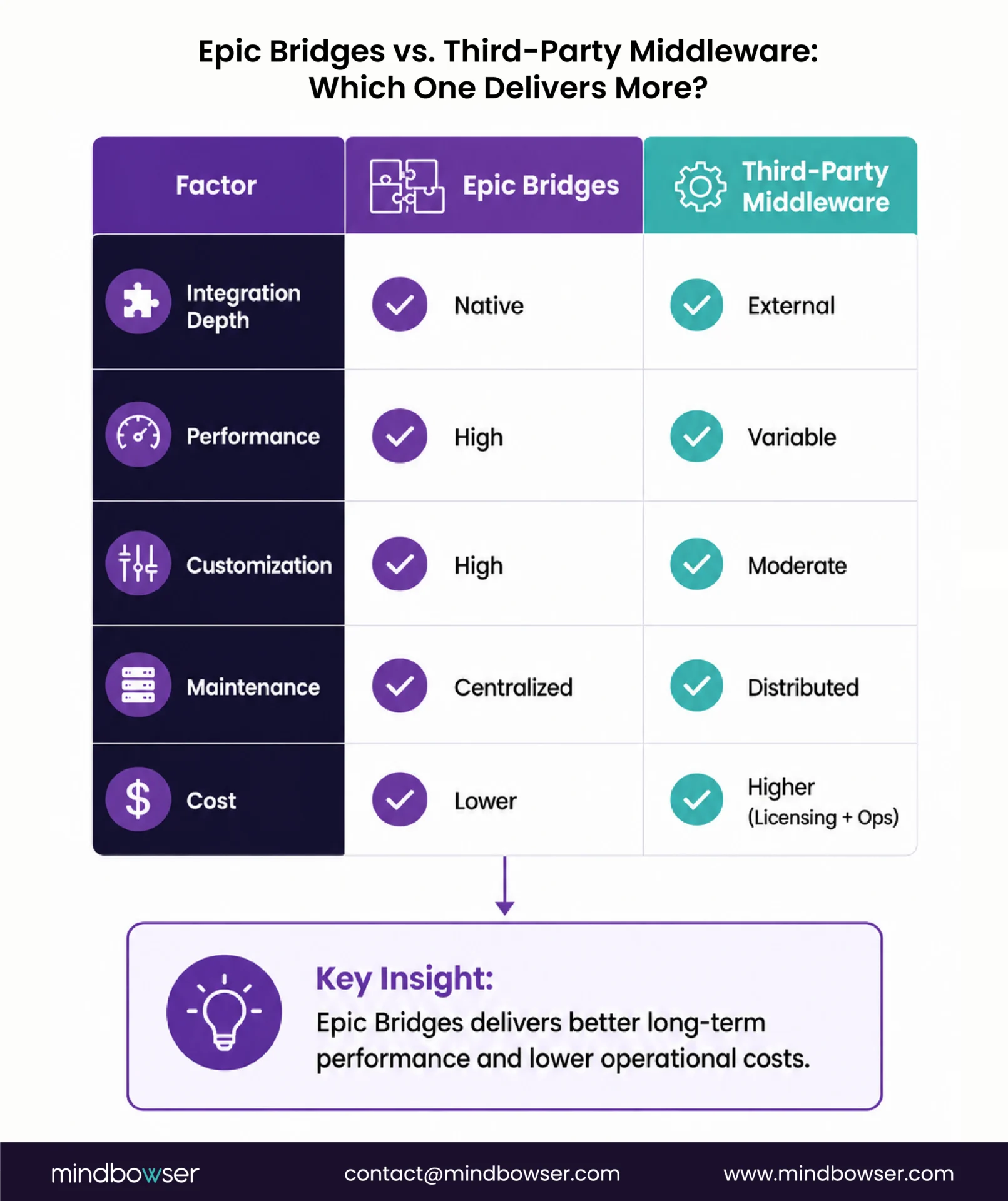
Many healthcare organizations evaluate Epic Bridges against third-party middleware. The difference lies in integration depth, control, and scalability.
A. Comparative Overview
| Approach | Epic Bridges | Third-Party Middleware |
|---|---|---|
| Integration depth | Native | External |
| Performance | High | Variable |
| Customization | High (Epic-native logic) | Moderate |
| Maintenance | Centralized | Distributed |
| Cost | Lower long-term | Higher (licenses + ops) |
B. Integration Depth: Native vs External
1. Epic Bridges (Native Integration)
Because Bridges is embedded within Epic:
- Data flows align directly with Epic workflows
- No translation layer is required for core operations
- Clinical context is preserved end-to-end
Impact: Higher data fidelity and better workflow alignment.
2. Third-Party Middleware
External engines sit between systems:
- Require additional transformation layers
- Introduce latency in data exchange
- May not fully align with Epic’s internal data models
What’s the tradeoff?
Flexibility increases, but clinical precision and performance can suffer.
C. Performance and Reliability
1. Epic Bridges
- Optimized for Epic’s internal architecture
- Lower latency for real-time data exchange
- Fewer integration failure points
2. Middleware Solutions
- Performance depends on the vendor and configuration
- Additional layers increase the risk of delays and outages
D. Customization and Control
1. Epic-Native Customization
Epic Bridges allows:
- Deep customization aligned with Epic workflows
- Direct manipulation of Epic master data mappings
- Workflow-specific routing and logic
2. Middleware Constraints
While middleware offers flexibility:
- Customization is often limited by vendor capabilities
- Requires additional configuration to align with Epic logic
Where do most implementations struggle?
When external tools try to replicate native Epic behaviorand fall short.
E. Maintenance and Operational Overhead
1. Centralized Management with Bridges
- All interfaces are managed within Epic
- Unified monitoring and governance
- Easier compliance tracking
2. Distributed Maintenance with Middleware
- Multiple systems to manage
- Separate monitoring tools
- Higher operational complexity
Result: Increased burden on IT teams and higher risk of inconsistencies.
F. Cost Considerations
1. Long-Term Cost Efficiency
Epic Bridges typically result in:
- Lower licensing costs (no external tools)
- Reduced operational overhead
- Fewer integration rework cycles
2. Middleware Cost Reality
External solutions often introduce:
- Licensing fees
- Infrastructure costs
- Ongoing maintenance expenses
Insight: Epic Bridges delivers tighter integration with Epic workflows, higher performance, and better long-term cost controlwhile middleware offers flexibility at the expense of complexity.
The real question isn’t “which tool is better?” It’s “which approach aligns with your workflow depth and scale requirements?”
VII. Challenges with Epic Bridges Implementation
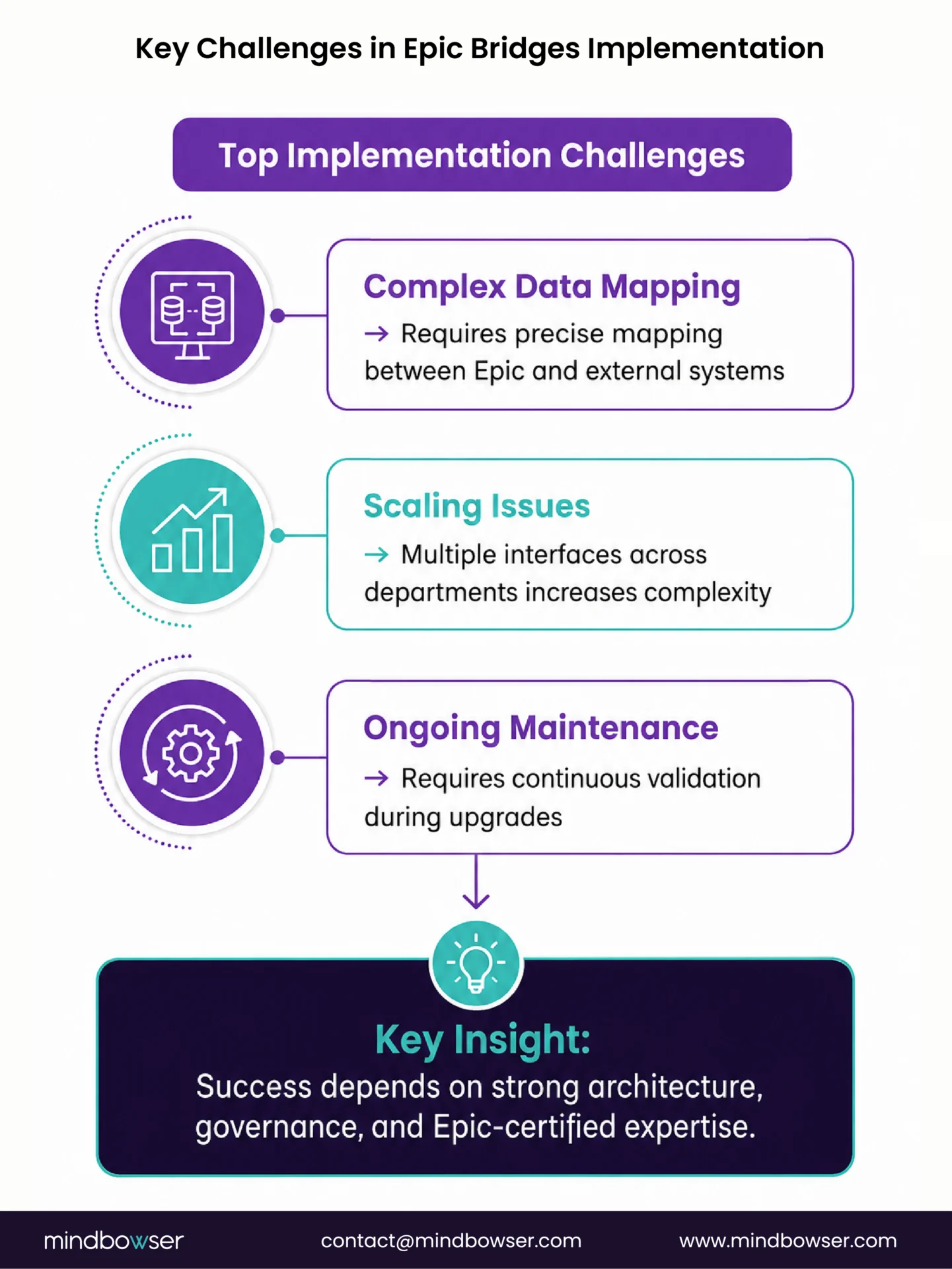
Epic Bridges is powerful, but it is not simple.
The gap between a functional integration and a high-performing, scalable one comes down to how well organizations navigate its inherent complexity.
Why do some health systems achieve seamless interoperability while others struggle with constant interface issues?
Because implementation is often underestimated.
A. Integration Complexity
1. Custom Mapping for Every Interface
Every integration requires:
- Field-level data mapping
- Message structure alignment
- Workflow-specific transformations
There is no universal template.
Impact:
- High setup effort per interface
- Increased risk of mapping errors
- Dependency on skilled resources
What happens when mappings are rushed or misaligned?
Data inconsistencies often surface in clinical workflows where accuracy is critical.
2. Dependence on Epic-Certified Expertise
Epic Bridges is not a plug-and-play system. It requires:
- Epic-certified interface specialists
- Deep understanding of HL7/EDI standards
- Knowledge of clinical workflows
Constraint: Limited availability of experienced resources can slow implementation timelines.
B. Scaling Issues
1. Interface Sprawl Across Departments
As organizations grow:
- Each department introduces new integrations
- Interfaces multiply rapidly
Without governance:
- Redundant interfaces emerge
- Data logic becomes inconsistent
Result: A fragmented integration landscape within a system designed to unify it.
2. Monitoring Complexity at Scale
More interfaces mean:
- More message traffic
- More potential failure points
Without structured monitoring:
- Errors go unnoticed
- Resolution times increase
- Operational risk rises
C. Data Consistency Risks
1. Misaligned Data Mappings
Even small discrepancies in mapping can lead to:
- Incorrect patient records
- Duplicate data entries
- Clinical misinterpretation
What’s the real risk?
Decisions are being made on incomplete or incorrect data.
2. Ongoing Maintenance During Upgrades
Epic upgrades and external system changes require:
- Continuous interface validation
- Mapping updates
- Regression testing
Without this:
- Previously stable integrations can break
- Data flow disruptions occur unexpectedly
According to McKinsey, poor data quality can reduce healthcare system efficiency by up to 20–30%, much of it tied to integration issues.
Key takeaway: The biggest risk with Epic Bridges is not the tool’s underestimating the complexity of implementation and scale.
If your integration strategy doesn’t account for growth, governance, and maintenance, will it still work 12 months from now?
VIII. Best Practices for Epic Bridges Implementation
Successful Epic Bridges implementations are not driven by tools; they are driven by architecture, governance, and workflow alignment.
Organizations that treat Bridges as a strategic capability, not just an interface engine, consistently achieve higher reliability, faster scalability, and stronger ROI.
A. Start with Integration Strategy (Not Tools)
1. Define Clinical and Business Workflows First
Before building interfaces, clarify:
- What workflows are being enabled?
- Who consumes the data, and when?
- What decisions depend on this integration?
This ensures integrations are:
- Purpose-driven
- Aligned with care delivery
- Built for measurable outcomes
What happens when integrations are designed without workflow clarity?
They technically “work” but fail to deliver impact.
2. Prioritize High-Impact Use Cases
Not all integrations are equal.
Focus first on:
- Real-time clinical data exchange
- Revenue cycle acceleration
- Care coordination workflows
Result: Faster ROI and stronger stakeholder buy-in.
B. Standardize Data Models Early
1. Align HL7/FHIR Mappings Upfront
Early standardization reduces:
- Rework during scaling
- Data inconsistencies
- Integration delays
Define:
- Data ownership across systems
- Naming conventions
- Mapping frameworks
2. Build Reusable Mapping Libraries
Instead of reinventing mappings:
- Create reusable templates
- Standardize transformation logic
Why does this matter?
Because integration speed compounds as systems grow.
C. Build for Scale
1. Modular Interface Design
Avoid monolithic interfaces.
Design:
- Independent, reusable components
- Clear separation of workflows
This enables:
- Faster updates
- Easier troubleshooting
- Better scalability
2. Template-Driven Expansion
Use pre-built templates as a base, but:
- Customize them for each workflow
- Ensure consistency across departments
Outcome: Controlled growth instead of interface sprawl.
D. Invest in Monitoring & Governance
1. Real-Time Monitoring and Alerts
Implement:
- Automated alerts for failures
- Latency tracking dashboards
- Message-level visibility
2. Data Validation Layers
Add safeguards to ensure:
- Data accuracy
- Schema consistency
- Error prevention before downstream impact
What’s the cost of catching errors late?
Clinical disruption, billing delays, and compliance risk.
3. Governance Frameworks
Establish:
- Interface ownership models
- Change management processes
- Upgrade validation protocols
This prevents:
- Redundant integrations
- Uncontrolled scaling
- Data inconsistencies
Key takeaway: High-performing Epic Bridges implementations are strategy-led, standardized, scalable, and governed.
The difference between a stable integration ecosystem and a chaotic one is not the tool, it’s the discipline behind how it’s implemented.
IX. ROI of Epic Bridges for Health Systems
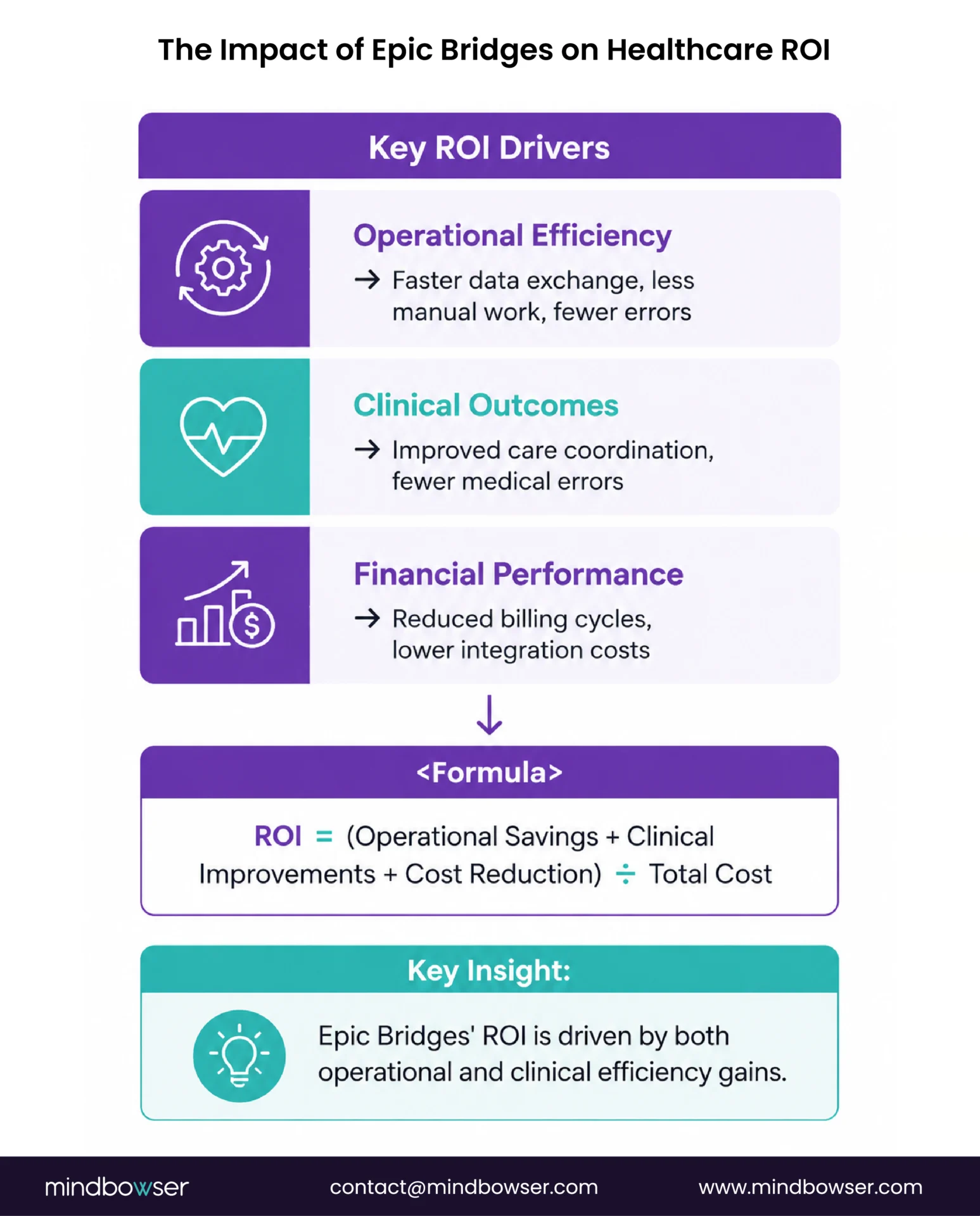
Epic Bridges is often evaluated as a technical investment, but its true value is realized in operational efficiency, clinical outcomes, and financial performance.
For healthcare leaders, the question is not “Does it integrate systems?”
It’s “What measurable impact does it create across the organization?”
A. Operational Efficiency
1. Reduction in Manual Workflows
By automating data exchange:
- Manual data entry is eliminated
- Staff no longer reconcile systems manually
- Administrative overhead decreases
Impact: Faster workflows and reduced human error.
2. Faster Data Exchange Across Systems
Real-time messaging ensures:
- Immediate availability of clinical and financial data
- Reduced delays between departments
What changes when data moves instantly instead of in batches?
Decisions accelerate, and bottlenecks disappear.
B. Clinical Impact
1. Improved Care Coordination
With integrated systems:
- Providers access complete patient records
- Care transitions become seamless
- Teams collaborate more effectively
Outcome: Better continuity of care.
2. Reduction in Medical Errors
Accurate, real-time data reduces:
- Miscommunication between systems
- Incomplete clinical information
What’s the ROI of avoiding a single critical clinical error?
It’s not just financial, it’s reputational and patient trust.
C. Financial Outcomes
1. Faster Billing Cycles
With integrated EDI workflows:
- Claims are submitted faster
- Errors in billing data decrease
- Reimbursement timelines improve
2. Reduced Integration Costs
Compared to fragmented middleware setups:
- Fewer systems to maintain
- Lower licensing and operational costs
- Reduced rework from failed integrations
D. ROI Snapshot (What Leaders Actually Measure)
High-performing health systems track Epic Bridges ROI through:
- Integration latency ↓ (faster data exchange)
- Data accuracy ↑ (fewer discrepancies)
- Manual effort ↓ (automation gains)
- Time-to-deploy ↓ (faster integrations)
- Revenue cycle efficiency ↑ (fewer denials, faster payments)
If your integration layer improves every one of these metrics, what does that mean for your overall system performance?
Epic Bridges delivers ROI across operations, clinical care, and financial performance but only when implemented with the right strategy and governance.
X. How Mindbowser Builds Custom EHR with Epic Integration Capabilities
Most Epic integrations fail not because of tooling, but because integration is treated as an afterthought.
At Mindbowser, the approach is different: integration is designed as a core architectural layer from day one.
A. Integration-First Architecture (Not Afterthought)
1. Designing Around Epic Workflows
Instead of forcing integrations later, systems are built to:
- Align with Epic data structures
- Support clinical workflows natively
- Enable real-time interoperability from the start
What’s the impact?
Fewer rework cycles, faster deployment, and higher adoption across clinical teams.
2. Workflow-Led System Design
Every integration begins with:
- Clinical journey mapping
- Data flow definition
- Decision-point alignment
This ensures that integration is not just technical but operationally meaningful.
B. Custom Interface Development (Not Template-Only)
1. HL7 + FHIR Hybrid Integrations
Modern healthcare ecosystems require flexibility.
Mindbowser builds:
- HL7v2-based real-time messaging
- FHIR APIs for modern application layers
- Hybrid models for legacy + digital systems
Outcome: Future-ready integrations that scale with evolving ecosystems.
2. Workflow-Aligned Data Mapping
Instead of generic mappings:
- Data is aligned with actual clinical usage
- Transformations reflect real-world workflows
Why does this matter?
Because accurate data is only valuable if it’s usable in context.
C. Accelerators for Faster Time-to-Value
1. Pre-Built Connectors
To reduce implementation timelines, accelerators are used for:
- Remote patient monitoring (WearConnect)
- AI-driven clinical tools (AI Medical Summary, CarePlan AI)
These are not rigid templates; they are customizable foundations.
2. Measurable Speed Gains
With accelerators:
- Integration timelines reduce by 30–40%
- Deployment cycles become predictable
- Early ROI is achieved faster
What does a 40% faster integration cycle mean for your go-to-market?
D. Compliance-Driven Integration
1. HIPAA-First Design
Every integration layer is built with:
- Data encryption
- Secure transport protocols
- Access control mechanisms
2. Audit-Ready Data Exchange
Systems are designed to:
- Track data movement
- Maintain audit logs
- Support regulatory reporting
Result: Reduced compliance risk and audit readiness by design.
E. Real-World Implementation Experience
Mindbowser has delivered integrations across:
- Care coordination platforms
- Digital therapeutics solutions
- Population health systems
This translates to:
- Faster problem-solving
- Proven integration patterns
- Reduced implementation risk
F. Outcome-Focused Delivery
1. KPI-Driven Execution
Success is measured through:
- Integration latency ↓
- Data accuracy ↑
- Time-to-deploy ↓
2. Business and Clinical Impact Alignment
Every integration is evaluated against:
- Operational efficiency gains
- Clinical workflow improvements
- Financial outcomes
Key takeaway: High-performing Epic integrations require custom architecture, workflow alignment, and compliance-first executionnot generic templates.
XI. When Should You Use Epic Bridges? (Decision Framework)
Not every integration scenario requires Epic Bridges, but when used in the right context, it becomes a high-leverage enabler of scalability and interoperability.
The decision should be driven by workflow depth, data requirements, and ecosystem complexity.
A. You Are Building Within the Epic Ecosystem
1. Direct Alignment with Epic Data and Workflows
If your system:
- Depends on Epic as the source of truth
- Requires deep interaction with patient records
- Needs tight workflow integration
Then Epic Bridges is the most efficient and reliable approach.
Why use an external layer when your core system is already Epic?
2. Long-Term Maintainability
Native integration ensures:
- Easier upgrades
- Better compatibility with Epic releases
- Lower long-term integration risk
B. You Need Deep Clinical Workflow Integration
1. Workflow-Critical Data Exchange
Use Epic Bridges when integrations directly impact:
- Clinical decision-making
- Care coordination
- Patient safety workflows
Examples:
- Real-time lab results
- Medication updates
- ADT event triggers
2. Contextual Data Usability
What’s the difference between data being available vs usable?
Usable data is:
- Timely
- Accurate
- Embedded in workflows
Epic Bridges ensures data is delivered in the right context.
C. You Require Real-Time Data Exchange
1. Time-Sensitive Use Cases
Bridges are ideal when:
- Delays in data exchange are unacceptable
- Decisions depend on immediate updates
Examples:
- Emergency department workflows
- Critical care monitoring
- Real-time alerts and notifications
2. Continuous Data Synchronization
For systems that need:
- Ongoing data feeds
- High-frequency message exchange
Epic Bridges provides low-latency, reliable communication.
D. You Want to Avoid Middleware Complexity
1. Simplified Integration Architecture
If your goal is to:
- Reduce architectural sprawl
- Avoid managing multiple integration tools
- Centralize interface management
Then Epic Bridges offers a cleaner, more controlled architecture.
2. Lower Operational Overhead
What’s the hidden cost of multiple middleware layers?
- Increased maintenance
- More failure points
- Higher operational burden
Bridges minimizes these risks through centralized control.
Decision Summary:
Use Epic Bridges when:
- You are deeply embedded in the Epic ecosystem
- Your workflows depend on real-time, accurate data
- Integration is mission-critical to care or revenue
- You want to minimize external complexity
Why Epic Bridges Defines Modern Healthcare Integration
Epic Bridges is not just an integration layerit is a strategic control point for how data flows across your healthcare ecosystem. When implemented with strong architecture, standardized data models, and governance, it enables real-time interoperability, faster workflows, and measurable ROI. When treated as a plug-and-play tool, it creates hidden complexity and operational risk. The difference is not the technology, it’s how you implement Epic Bridges.
Epic Bridges is used to connect Epic EHR with external systems like labs, billing platforms, and digital health applications. It enables secure, real-time data exchange using standards such as HL7 and EDI.
Epic Bridges acts as a central interface engine that enables standardized data exchange between Epic and other systems. It reduces data silos and ensures real-time, workflow-aligned information flow across the care ecosystem.
Epic Bridges provides native integration within the Epic ecosystem, allowing deeper alignment with clinical workflows. Third-party tools may offer flexibility, but they often add complexity and maintenance overhead.
The main challenges include complex data mapping, interface scaling, and ongoing maintenance. Without proper governance and expertise, integrations can lead to data inconsistencies and operational inefficiencies.
Organizations should use Epic Bridges when they need real-time data exchange and deep integration with Epic workflows. It is critical for use cases that directly impact clinical decisions, care coordination, or revenue cycle performance.