



 BLOGS
BLOGS  NEWSROOM
  CASE STUDIES
  WEBINARS
  PODCASTS
  ASSET HUB
  EVENT CALENDAR


















TL;DR
Epic Dorothy is Epic’s home health and hospice module that extends care beyond hospital walls. It enables point-of-care documentation, scheduling, compliance, and care coordination all within the Epic ecosystem. For health systems investing in hospital-at-home and value-based care, Dorothy creates a unified patient record across settings. The tradeoff? Strong enterprise capability comes with complex workflows and challenges in clinician onboarding. powerful inside Epic, demanding to be implemented.
Your hospital is discharging patients faster, but do you know what happens next?
Care shifts to the home. Visibility drops. Gaps appear.
For health systems investing in hospital-at-home and value-based care, that gap is a risk.
Epic Dorothy aims to close it, extending Epic workflows into the home to create a connected, longitudinal care experience.
But capability alone isn’t enough. Adoption and workflow alignment decide the outcome.
This blog breaks down what Epic Dorothy does, where it delivers value, and what leaders must get right.
I. What is Epic Dorothy? (And Why It Matters Now)
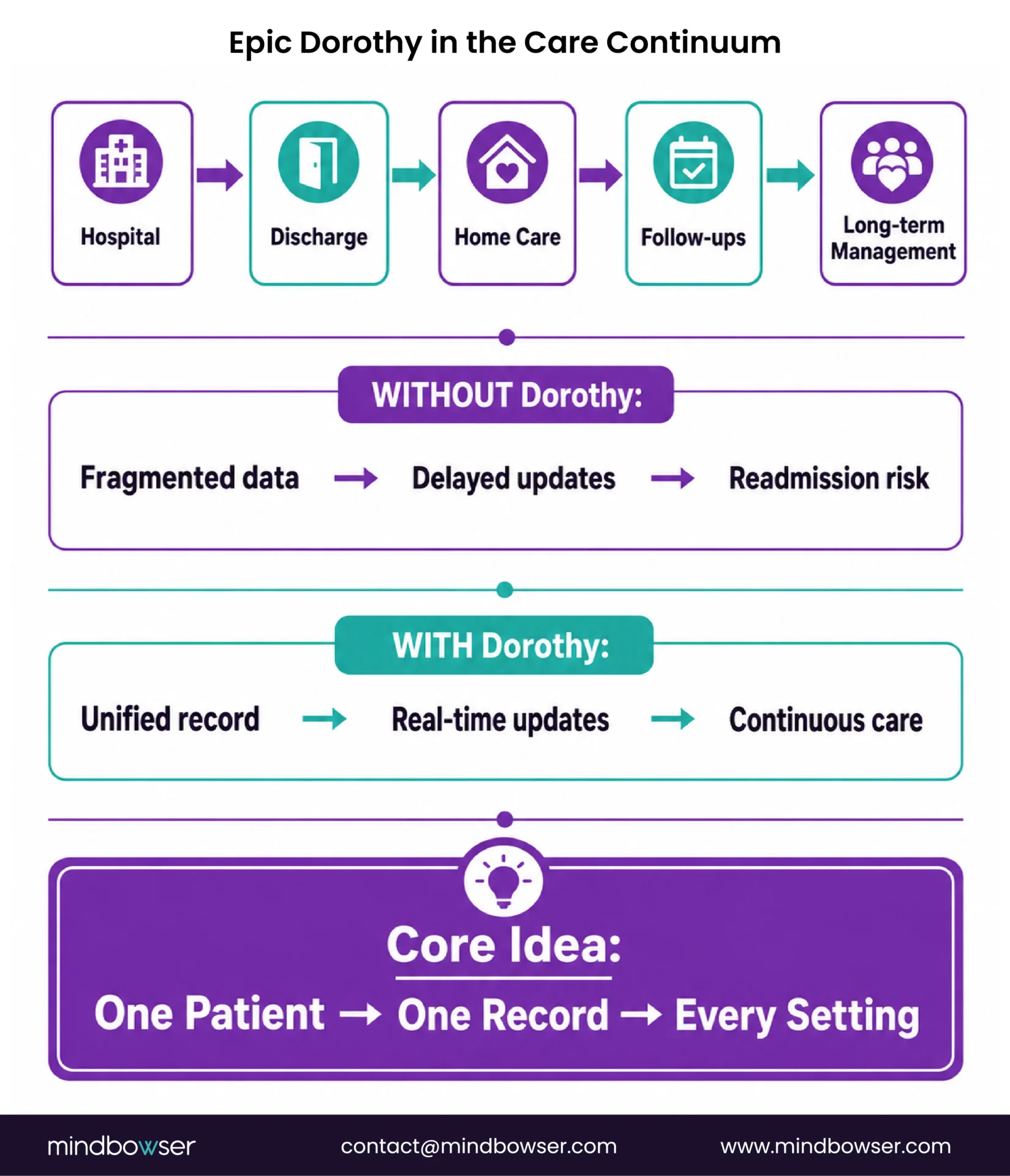
A. The Care Gap Nobody Talks About
Health systems have optimized inpatient throughput, reduced length of stay, and improved discharge efficiency. But the moment a patient leaves the hospital, visibility drops.
Post-discharge workflows often depend on fragmented communication between hospital teams, home health providers, and patients. Care plans are documented, but execution at home is inconsistent and difficult to monitor in real time.
This gap between discharge and home-based care is where coordination breaks down and where readmissions, missed interventions, and revenue leakage begin.
B. Epic Dorothy, Explained Simply
Epic Dorothy is Epic’s dedicated module for home health and hospice care management, also known as EpicCare Home Health.
It is built for:
- Home health nurses documenting visits in the field
- Therapists managing rehabilitation plans
- Hospice teams coordinating end-of-life care
- Remote caregivers tracking patient status outside clinical settings
Instead of treating home care as a separate workflow, Dorothy brings it into the same system clinicians already use.
One patient. One record. Every setting.
This continuity enables better care coordination and earlier intervention.
C. Why Epic Dorothy Matters Right Now
Healthcare is shifting. Fast.
Three forces are driving this:
1. Hospital-at-Home Models Are Scaling
Health systems are actively moving acute care into the home to reduce costs and expand capacity.
2. Remote Patient Monitoring Is Becoming Standard
Chronic conditions are no longer managed solely in clinics. Care happens continuously.
3. Value-Based Care Demands Outcomes, Not Encounters
Reimbursement depends on what happens after discharge, not just during admission.
If care continues at home, shouldn’t your system follow the patient there?
That’s the core idea behind Epic Dorothy.
It doesn’t just manage home visits. It extends the hospital’s clinical and operational backbone into the patient’s home.
Epic Dorothy turns home care from a blind spot into a measurable, managed, and connected part of the care continuum.
II. What Does Epic Dorothy Actually Do? (Core Capabilities)
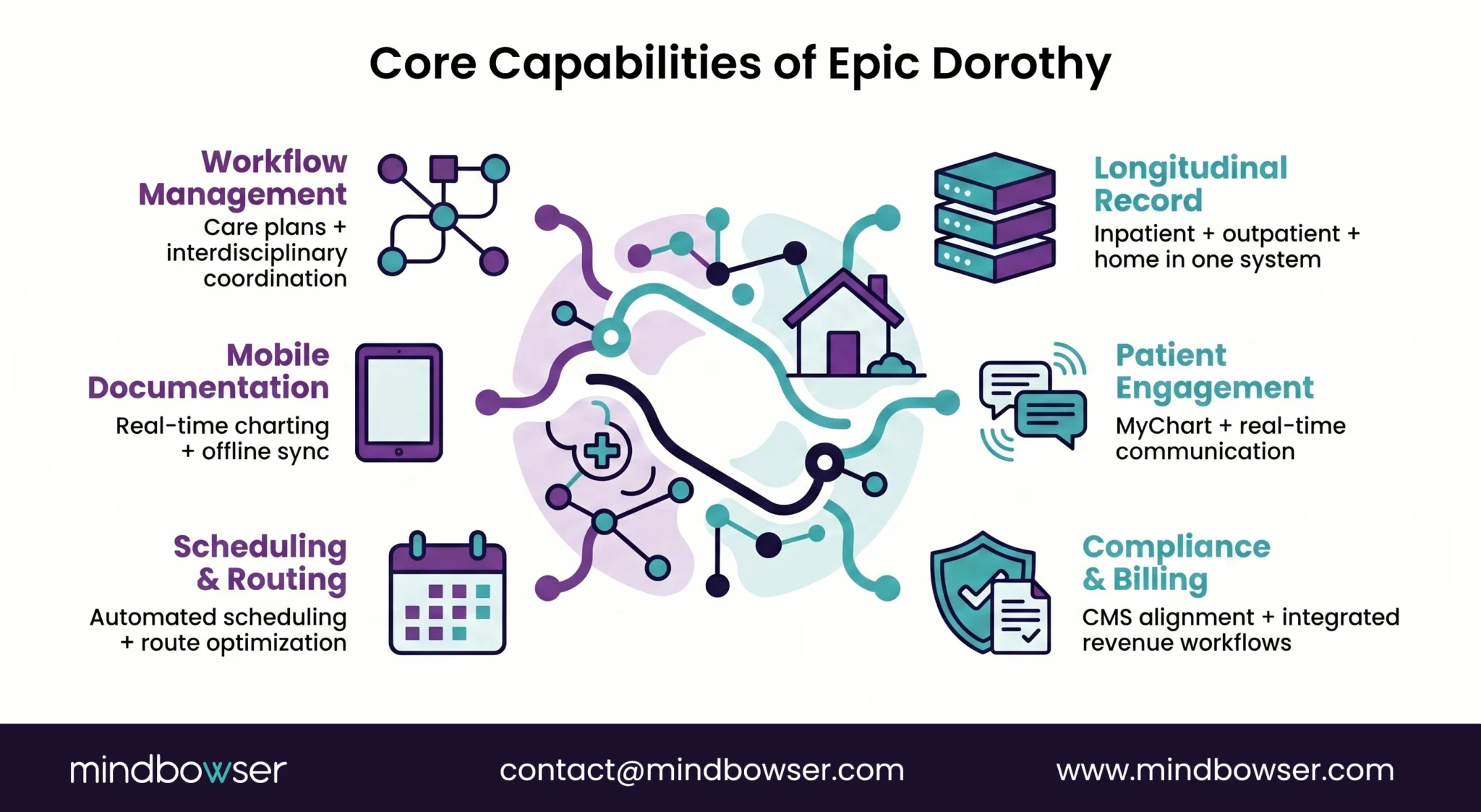
A. Home Health & Hospice Workflow Management
At its core, Epic Dorothy acts as the operational engine for home-based care.
It structures everything clinicians need once a patient leaves the hospital:
- Care plans tailored to home settings
- Visit scheduling across disciplines
- Coordination between nurses, therapists, and physicians
What makes this critical is compliance. Home health isn’t flexible documentation. It is CMS-driven, assessment-heavy, and audit-sensitive.
Dorothy supports standardized assessments required for Medicare reimbursement, helping ensure that documentation aligns with regulatory expectations.
Miss a required assessment? That’s not just a workflow issue; it’s lost revenue.
B. Mobile Point-of-Care Documentation
Care doesn’t happen at a desk. It happens in living rooms, kitchens, and bedside environments.
Dorothy enables real-time charting in the field through mobile devices.
Key capabilities include:
- Documentation during patient visits
- Offline access when connectivity drops
- Syncing data back into Epic once reconnected
This matters because delayed documentation leads to errors.
Capture data in the moment. Reduce risk later.
C. Integrated Scheduling & Routing
Scheduling in home health is a logistics problem disguised as a clinical one.
Dorothy addresses this with:
- Automated scheduling (often called “silent scheduling”)
- Route optimization for field staff
- Map-based views of patient visits
The impact is immediate.
Less travel time. More patient visits. Better staff utilization.
What if your nurses could see two more patients a day without working longer hours?
That’s where scheduling efficiency turns into margin improvement.
D. Longitudinal Patient Record
This is where Epic Dorothy stands apart.
Every interaction, whether inpatient, outpatient, or at home, feeds into the same longitudinal patient record.
No duplication. No fragmented histories.
A clinician can:
- Review hospital discharge notes
- Track home visit progress
- Monitor therapy outcomes
- All in one place.
Continuity isn’t a feature. It’s the foundation.
E. Patient Engagement & Communication
Dorothy connects directly with MyChart, Epic’s patient-facing platform.
This enables:
- Real-time updates for patients and families
- Secure messaging with care teams
- Visibility into care plans and visit schedules
- In-home care engagement is not optional.
If patients don’t follow the plan, outcomes don’t improve.
This layer ensures patients remain active participants, not passive recipients.
F. Compliance & Billing Integration
Home health sits at the intersection of care delivery and reimbursement complexity.
Dorothy integrates:
- Documentation workflows tied to billing
- Medicare and CMS compliance checks
- Coding support aligned with services delivered
The result is tighter alignment between clinical activity and financial outcomes.
McKinsey estimates that inefficient documentation and billing processes can erode up to 5% of healthcare revenue.
Dorothy helps close that gap.
Care delivered. Care documented. Care reimbursed.
Epic Dorothy is not one feature. It is a connected system that aligns clinical workflows, field operations, and financial performance in home-based care.
III. How Epic Dorothy Works in Real Life (Use Cases)
A. Post-Discharge Care (Reducing Readmissions)
A patient leaves the hospital after surgery. Instructions are clear. Medications are prescribed. Follow-ups are scheduled.
But reality kicks in fast.
Missed medications. Confusion at home. No real-time oversight.
Epic Dorothy bridges this gap by enabling continuous visibility into post-discharge care.
Home health nurses document visits directly into Epic. Care teams see updates instantly. Physicians can intervene early if something feels off.
According to CMS, avoidable readmissions cost the U.S. healthcare system over $17 billion annually.
What if your team could catch deterioration before it becomes a readmission?
That’s the operational shift Dorothy enables.
B. Chronic Disease Management
Chronic conditions don’t follow appointment schedules.
Diabetes. COPD. Heart failure. These require ongoing, adaptive care.
With Epic Dorothy:
- Care plans evolve based on home observations
- Clinicians track symptoms across visits
- Data feeds into the broader patient record
This creates a feedback loop between home and clinical settings.
A WHO report notes that chronic diseases account for nearly 74% of global deaths, making continuous management essential.
Care doesn’t pause between visits anymore.
C. Home Infusion and Dialysis
Specialized treatments such as infusion therapy and dialysis are increasingly being delivered in home settings.
But these workflows are complex:
- Strict protocols
- Frequent monitoring
- High documentation burden
Dorothy supports these through structured workflows and real-time documentation.
Clinicians can log treatment data, track complications, and coordinate with specialists all within Epic.
No spreadsheets. No disconnected logs. Just one system.
D. Palliative and Hospice Care
End-of-life care requires more than clinical precision. It demands coordination, empathy, and timing.
Dorothy supports hospice teams by:
- Managing care plans across interdisciplinary teams
- Tracking symptom progression
- Coordinating family communication
While Epic Comfort is more specialized for hospice, Dorothy still plays a role in broader palliative workflows.
Care becomes coordinated, not reactive.
E. Hospital-at-Home Programs
This is where Epic Dorothy becomes strategic.
Hospital-at-home models deliver acute-level care in patient homes, including:
- Monitoring vitals remotely
- Administering treatments
- Coordinating daily clinician visits
Dorothy supports the operational workflows for hospital-at-home programs by extending documentation, scheduling, and care coordination into the home. It works alongside remote patient monitoring, command center operations, and care logistics systems that together form the full hospital-at-home infrastructure.
It connects:
- Field clinicians
- Remote monitoring systems
- Hospital-based teams
If care moves home, can your infrastructure keep up?
Dorothy ensures the answer is yes if implemented correctly.
Epic Dorothy is not theoretical. It actively supports high-impact, real-world care models that reduce costs, improve outcomes, and extend care beyond hospital walls.
IV. Pros and Cons of Epic Dorothy
A. Where Epic Dorothy Excels
1. Deep Integration Across the Care Continuum
Epic Dorothy’s biggest strength is simple: it is not a standalone system.
Everything connects back to Epic.
- Inpatient discharge flows into home care
- Outpatient follow-ups stay visible
- Home health updates reflect in real time
No duplicate records. No reconciliation headaches.
One system. One source of truth.
This eliminates one of the most expensive problems in healthcare: data fragmentation.
2. Real-Time Documentation Improves Care Quality
Field clinicians document visits as they happen, not hours later.
That shift matters.
- Fewer missed details
- Better clinical accuracy
- Faster intervention when risks appear
Better data leads to better care decisions. Fast.
3. Mobile and Offline Capabilities
Home health doesn’t come with stable Wi-Fi.
Dorothy supports:
- Offline documentation
- Sync when connectivity returns
- Mobile-first workflows for field staff
No signal shouldn’t mean no documentation.
This keeps workflows moving, even in unpredictable environments.
4. Built-In Compliance Framework
Home health is tightly regulated, especially under Medicare.
Dorothy helps teams stay aligned with:
- CMS documentation requirements
- Assessment protocols
- Audit-ready records
This reduces compliance risk and protects reimbursement.
Less guesswork. More structured documentation.
5. Scales for Enterprise Health Systems
Dorothy is built for complexity.
It supports:
- Large clinician networks
- Multi-location operations
- High patient volumes
For integrated delivery networks, this scalability is not optional.
Can your system grow as your home care programs expand?
Dorothy can.
B. Where Epic Dorothy Falls Short
1. Complex UI for Field Clinicians
Here’s the friction point most leaders underestimate.
Dorothy inherits Epic’s depth but also its complexity.
Field clinicians often report:
- Too many clicks
- Dense interfaces
- Slower onboarding
A nurse in a patient’s home doesn’t have time to “figure out” software.
Adoption depends heavily on training and workflow design.
2. Requires the Epic Ecosystem
Dorothy doesn’t operate independently.
It relies on:
- Epic infrastructure
- Shared data models
- Existing modules
This makes it a strong fit for Epic customers, but a poor fit for everyone else.
No Epic, no Dorothy.
3. Implementation and Training Overhead
Deploying Dorothy is not plug-and-play.
It involves:
- Workflow configuration
- Integration alignment
- Staff training programs
Technology doesn’t fail. Adoption does.
4. Workflow Customization Is Often Necessary
Home care workflows vary widely.
Out-of-the-box configurations rarely fit perfectly.
Organizations often need:
- Custom forms
- Adjusted care pathways
- Tailored scheduling logic
This adds time, cost, and dependency on internal or external teams.
Flexibility exists, but it must be built.
Epic Dorothy delivers enterprise-grade integration and control, but success depends on how well you manage complexity, training, and workflow alignment.
V. Who Should Use Epic Dorothy? (Best-Fit Organizations)
A. Ideal Users
Epic Dorothy is not designed for everyone. It delivers the most value in environments where integration, scale, and continuity of care are already strategic priorities.
1. Mid-to-Large Health Systems on Epic
If your organization already runs on Epic, Dorothy becomes a natural extension.
- No new data silos
- Shared workflows across departments
- Unified reporting and analytics
Why build bridges between systems when everything can live inside one?
For CIOs, this means fewer integration headaches.
For clinicians, it means less context switching.
The value compounds because the foundation already exists.
2. Integrated Delivery Networks (IDNs)
IDNs operate across multiple care settings:
- Hospitals
- Outpatient clinics
- Home health services
Dorothy connects these layers into a continuous care model.
This is critical for value-based care contracts, where outcomes depend on coordination across the entire patient journey.
Integration isn’t efficiency. It’s margin protection.
3. Organizations Scaling Hospital-at-Home
Hospital-at-home programs demand:
- Real-time data flow
- Field clinician coordination
- Tight operational control
Dorothy provides the infrastructure to support this shift.
If acute care moves into the home, your systems must follow without breaking.
Health systems investing in this model need more than tools. They need operational continuity.
Dorothy delivers that within the Epic ecosystem.
B. Not Ideal For
1. Standalone Home Health Agencies
For organizations not using Epic, Dorothy creates more friction than value.
- Requires Epic infrastructure
- Limited standalone flexibility
- Higher implementation overhead
It’s not built as an independent home health platform.
2. Small Providers Without Enterprise IT Support
Dorothy assumes:
- Dedicated IT teams
- Structured training programs
- Ongoing system governance
Smaller providers often lack these resources.
Can your team support a system that requires continuous configuration and optimization?
If not, adoption becomes the bottleneck.
Epic Dorothy is a strong fit for enterprise health systems already invested in Epic and expanding into home-based care. For smaller or standalone providers, the complexity may outweigh the benefits.
VI. How Epic Dorothy Interacts with Other Epic Modules (Critical Section)
A. Core Integration Layer
Epic Dorothy is not a separate product layered on top of Epic.
It is built inside the same architecture.
That means:
- Shared data model
- Unified user interface
- Real-time data exchange across modules
Data flows across modules in near real time within the Epic environment, reducing the need for manual reconciliation and minimizing duplicate documentation when workflows are properly configured.
When a clinician updates a home visit, who sees it?
Everyone who needs to.
This is where Dorothy’s real value lives, not in features, but in connectivity.
B. Key Module Interactions
1. EpicCare Ambulatory
Dorothy connects outpatient care directly to home health workflows.
Physicians can review home visit data
Follow-ups align with real-world patient progress
Continuity doesn’t stop at discharge.
2. Inpatient (ClinDoc)
The transition from hospital to home is one of the highest-risk moments in care.
Dorothy links:
- Discharge summaries
- Care instructions
- Home health assignments
This creates a closed-loop workflow from inpatient to home.
3. MyChart
Patient engagement is built into the system.
With MyChart integration:
- Patients view care plans
- Families track visit schedules
- Messaging stays secure and centralized
If patients don’t stay engaged, does the care plan even work?
Dorothy ensures visibility on both sides.
4. Cadence (Scheduling)
Scheduling is not isolated in Dorothy.
Cadence enables:
- Resource allocation
- Appointment coordination
- Cross-department scheduling visibility
This ensures home visits align with broader clinical schedules.
Operations stay synchronized, not fragmented.
5. Resolute (Billing)
Clinical documentation feeds directly into revenue cycle workflows.
- Services documented in Dorothy
- Codes generated in Resolute
- Claims processed without manual handoffs
Integration helps reduce that waste.
6. Healthy Planet
Population health teams rely on aggregated data.
Dorothy contributes:
- Home-based outcomes
- Risk signals from field visits
- Longitudinal patient trends
This strengthens risk stratification and proactive care planning.
Home data becomes population insight.
7. Bridges (Interoperability)
Not every system is Epic.
Bridges enables Dorothy to:
- Exchange data with external systems
- Integrate with third-party tools
- Support broader interoperability strategies
Your ecosystem will never be 100% Epic. Can your data still flow?
This is how it does.
C. The Real Insight Most Teams Miss
Many organizations evaluate Dorothy based on feature checklists.
That’s the wrong lens.
Its true value comes from interoperability across the Epic ecosystem.
Standalone, it’s just a home health tool Integrated, it becomes a continuum-of-care engine
This is why adoption success depends less on configuration and more on how well your Epic environment is aligned.
Epic Dorothy delivers its full impact only when deeply integrated across Epic modules. Without that alignment, you get functionality. With it, you get transformation.
Talk to our Epic integration team
VII. Epic Dorothy vs Epic Comfort (Key Differences)
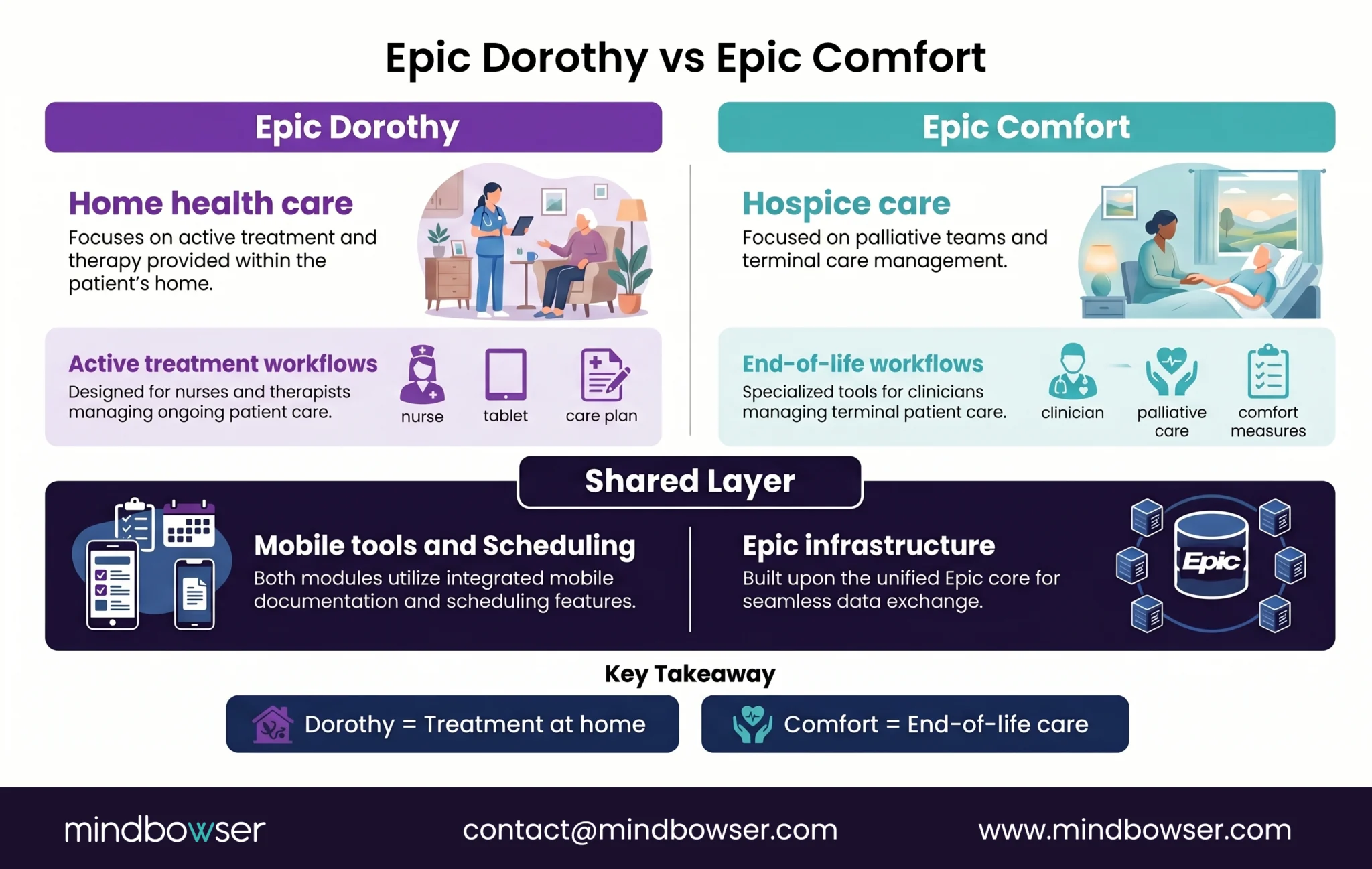
A. Understanding the Overlap and the Confusion
Epic Dorothy and Epic Comfort are often mentioned together. That’s where confusion starts.
Both operate in home-based care. Both support mobile workflows. Both integrate into Epic.
But they serve different clinical intents.
Are you managing ongoing treatment or end-of-life care?
That distinction matters more than most teams expect.
B. Side-by-Side Comparison
1. Primary Use
Epic Dorothy: Home health care
Epic Comfort: Hospice care
Dorothy supports patients who are actively receiving treatment at home.
Comfort focuses on end-of-life care and symptom management.
2. Clinical Focus
Dorothy: Clinical + operational workflows
Comfort: Palliative workflows and patient comfort
Dorothy emphasizes recovery, stabilization, and monitoring.
Comfort centers on quality of life and care transitions.
3. Primary Users
Dorothy: Nurses, therapists, care coordinators
Comfort: Hospice teams, palliative specialists
Different teams. Different priorities.
4. Care Model
Dorothy: Ongoing treatment and rehabilitation
Comfort: Terminal care and support
One extends treatment. The other transitions care goals.
5. Overlap Areas
There is shared ground:
- Mobile documentation tools
- Scheduling capabilities
- Core Epic infrastructure
But overlap does not mean interchangeability.
They complement each other. They don’t replace each other.
C. Strategic Takeaway for Health Systems
Here’s the simplest way to think about it:
- Epic Dorothy = Active care at home
- Epic Comfort = End-of-life care
Organizations running both can create a continuous home-based care pathway from recovery to palliative support.
Are your systems aligned with how patient needs evolve over time?
If not, gaps appear right where care matters most.
Epic Dorothy and Epic Comfort share infrastructure, but serve distinct clinical journeys. Choosing the right one depends on whether your focus is treatment, transition, or end-of-life care.
VIII. Epic Dorothy vs Alternatives (Brief Positioning)
A. Epic Dorothy vs Standalone Home Health EMRs
Most home health agencies start with standalone EMRs.
They’re simpler. Faster to deploy. Easier to train on.
But they come with a tradeoff: disconnected care.
Standalone systems typically require:
- Manual data transfer from hospital systems
- Limited visibility into prior encounters
- Separate reporting and analytics
What happens when your inpatient team can’t see what’s happening at home?
Care becomes fragmented.
Epic Dorothy flips this model.
- No system switching
- No duplicate documentation
- No data silos
Everything lives inside Epic.
Dorothy reduces that burden by keeping care inside one ecosystem.
B. Epic Dorothy vs Niche Point Solutions
Niche tools often focus on doing one thing well:
- Scheduling optimization
- Remote monitoring dashboards
- Mobile-first documentation
- They win on simplicity and speed.
But they struggle with:
- Integration into enterprise systems
- Longitudinal patient records
- Cross-functional workflows
Do you want the best tool for one task or a system that connects everything?
Dorothy takes the second path.
It may not be the simplest tool on day one. But it becomes more powerful as more workflows connect to it.
C. The Tradeoff That Defines the Decision
This decision comes down to one core tradeoff:
- Standalone tools: Faster to adopt, easier to use, limited integration
- Epic Dorothy: Deeper integration, broader visibility, higher complexity
There is no universal “better” option.
There is only better alignment with your operating model.
If your strategy depends on connected care, can isolated tools keep up?
For enterprise health systems, the answer is usually no.
Epic Dorothy wins on integration and scale, while alternatives win on simplicity and speed. The right choice depends on whether your priority is quick deployment or long-term care continuity.
IX. Implementation Challenges (What CIOs Underestimate)
A. Workflow Complexity
Home care is not a lighter version of hospital care.
It is different.
- Unstructured environments
- Variable visit durations
- Patient-specific conditions at home
Yet many organizations try to map hospital workflows directly into home health systems.
That’s where things break.
Home care requires its own operational logic.
Dorothy supports this, but only if workflows are thoughtfully configured.
Are you designing for the field, or forcing the field to adapt?
That question determines success.
B. Change Management Is the Real Risk
Technology rarely fails on features. It fails on adoption.
Field clinicians face:
- New documentation patterns
- Mobile-first workflows
- Real-time data entry expectations
Resistance is common.
According to McKinsey, nearly 70% of digital transformations fail due to change management gaps.
This is not a training issue. It’s a behavior shift.
Without structured onboarding and ongoing support, even the best systems underperform.
C. Integration Dependencies
Epic Dorothy does not operate in isolation.
Its effectiveness depends on:
- Proper Epic module alignment
- Clean data flows across systems
- Stable interoperability configurations
If upstream systems are inconsistent, Dorothy reflects those gaps.
If your foundation is fragmented, can your extension be reliable?
Integration is not a one-time task. It is an ongoing discipline.
D. Training Burden (Especially for Mobile + Offline Workflows)
Field workflows introduce complexity that traditional training often ignores.
Clinicians must learn:
- Offline documentation practices
- Sync protocols
- Mobile navigation under time pressure
This is not intuitive for everyone.
Deloitte reports that insufficient training can reduce system utilization by up to 40% in early adoption phases.
Training is not a phase. It is a continuous investment.
Organizations that treat it as a one-time event struggle with long-term adoption.
Implementing Epic Dorothy is less about software deployment and more about workflow design, behavioral change, and system alignment. Miss these, and ROI stays out of reach.
X. ROI & Business Impact of Epic Dorothy
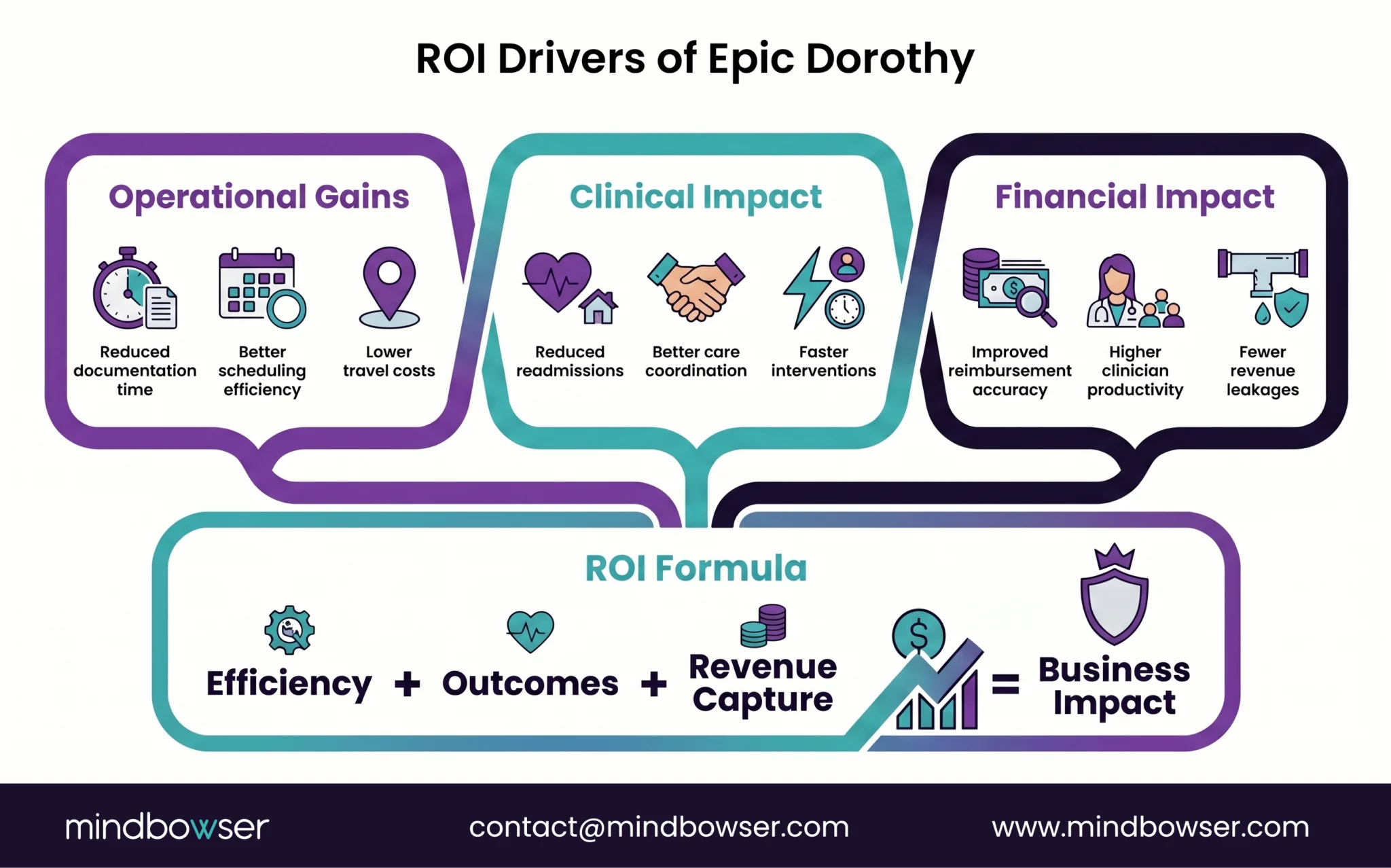
A. Operational Gains That Show Up Fast
Epic Dorothy’s value is not abstract. It shows up in day-to-day operations.
Less time documenting. More time delivering care.
With structured workflows and mobile documentation:
- Clinicians complete notes during visits
- Admin teams spend less time chasing missing data
- Care coordination improves across teams
- Scheduling adds another layer of impact.
Route optimization and automated scheduling reduce:
- Travel time
- Idle gaps between visits
- Manual coordination effort
What if your field teams could do more without adding headcount?
That’s where operational efficiency becomes measurable.
In several deployments, organizations have reported reduced travel costs and higher visit throughput after optimizing scheduling workflows.
B. Clinical and Financial Impact
The real ROI emerges when operations connect to outcomes.
1. Reduced Readmissions
Better post-discharge visibility means earlier intervention.
- Symptoms flagged sooner
- Care plans adjusted faster
- Escalations handled proactively
This directly impacts readmission rates, which CMS actively penalizes.
Fewer readmissions = protected revenue.
2. Improved Reimbursement Accuracy
Documentation and billing are tightly linked in Dorothy.
- Services documented in real time
- Compliance checks built into workflows
- Fewer rejected or delayed claims
Are you getting paid for the care you already deliver?
Dorothy helps ensure the answer is yes.
3. Higher Clinician Productivity
When workflows align with real-world conditions:
- Fewer redundant tasks
- Faster documentation cycles
- Better time allocation per patient
This leads to measurable productivity gains without increasing burnout.
Efficiency without overload. That’s the goal.
C. The ROI Equation Leaders Should Track
Epic Dorothy ROI is not one metric. It is a combination of:
- Time saved per clinician per visit
- Reduction in readmission penalties
- Improved claim acceptance rates
- Increased patient throughput
Individually, these gains look incremental.
Together, they reshape margins.
Are you measuring ROI at the workflow level or just at the system level?
The difference matters.
Epic Dorothy delivers ROI through operational efficiency, improved clinical outcomes, and stronger revenue capture. But these gains only materialize when workflows, training, and integration are aligned.
XI. How Mindbowser Builds Custom EHR Solutions with Epic Integration Capabilities
A. Why Standard Implementations Fall Short
Most Epic deployments focus on configuration.
That’s the problem.
Configuration follows software. Outcomes follow workflows.
In home health, workflows are messy, field-driven, and constantly evolving.
If your system doesn’t adapt to clinicians, will clinicians adopt the system?
That’s where many Dorothy implementations struggle.
B. Mindbowser’s Workflow-First Approach
We start where impact actually happens care delivery.
1. Discovery First (Compliance + Workflow Mapping)
- Map real home health workflows
- Align with CMS and HIPAA requirements
- Identify friction points in field operations
No assumptions. Just ground reality.
2. Epic Integration Layer
- FHIR and HL7 interfaces
- Epic Bridges integration
- Custom APIs were needed
This ensures Dorothy connects cleanly across your ecosystem.
3. Custom Extensions That Clinicians Actually Use
- Mobile-first clinician interfaces
- AI-powered care summaries
- Remote patient monitoring dashboards
Less clicking. More clarity.
4. Accelerators That Speed Outcomes
These reduce build time and improve usability from day one.
5. Outcome-Driven Execution
- Reduce clinician workload
- Improve adoption rates
- Deliver measurable ROI
This approach consistently improves clinician adoption and reduces workflow friction in home-based care programs.
Unlock faster home health ROI today
Mindbowser focuses on making Epic Dorothy work in real-world conditions, not just deploying it.
The Real Decision: Extending Care Beyond Hospital Walls
Epic Dorothy is not just another moduleit is a strategic extension of your health system into the patient’s home. For organizations already operating on Epic and investing in hospital-at-home or value-based care, it delivers what fragmented tools cannot: continuity, visibility, and control across the full care journey. But that value is not automatic. It requires aligned workflows, disciplined training, and a clear operating model for home-based care. So the question is not whether Epic Dorothy worksit’s whether your organization is ready to use it as intended. When implemented well, it reduces readmissions, improves clinician efficiency, and protects revenue. When treated as just another system, it adds complexity without impact. Epic Dorothy pays off when you treat home care as a core part of your clinical strategy, not an afterthought.