BLOGS
BLOGS  NEWSROOM
  CASE STUDIES
  WEBINARS
  PODCASTS
  ASSET HUB
  EVENT CALENDAR

























This pressure is exactly why Epic Aura exists. What is Epic Aura? Epic Aura, formerly known as the Orders and Results Anywhere Network, is a software suite designed to provide quick, direct connections between health systems using Epic to receive orders and send results to labs and specialty diagnostic partners. Instead of building and maintaining dozens of point-to-point connections, health systems connect once and operate on a shared network purpose-built for Epic environments.The timing matters. Specialty diagnostics, especially genetic testing, now play a central role in oncology, rare-disease management, and precision-medicine programs. These workflows require structured data, faster turnaround times, and results that land directly inside clinician workflows and MyChart, not scanned PDFs and manual reconciliation.For healthcare executives balancing interoperability, cost control, and clinical quality, Epic Aura integration represents a practical shift. It reframes lab connectivity from an IT burden into an enterprise capability that supports scale, accuracy, and patient trust.
I. What Is Epic Aura?
At a basic level, Epic Aura is Epic’s answer to a long-standing interoperability problem: how to move lab and specialty diagnostic orders and results across organizations without rebuilding interfaces every time. What is Epic Aura? It is the Orders and Results Anywhere Network, a software suite designed to provide quick, seamless connections between health systems that use Epic to receive orders and send results.
Instead of relying on one-off, point-to-point connections between a provider organization and each performing lab, Epic Aura integration operates as a shared network. Health systems connect once to Aura and can then exchange orders and results with multiple participating labs using standardized Epic workflows. This design shifts interoperability from a project-by-project exercise into a repeatable enterprise capability.
The contrast with traditional interfaces is stark. In a point-to-point model, each new lab relationship often requires provisioning a new Epic Aura interface, configuring message mappings, and engaging interface engine teams to standardize data formats. With Epic Aura, organizations need only maintain a single pair of Epic lab interfaces to connect to all performing labs on the network, as Epic handles data normalization centrally. This reduces interface sprawl, lowers long-term maintenance effort, and shortens implementation timelines from months to weeks in many cases.
From a CIO and CTO perspective, Epic Aura is not just another integration option. It is a networked architecture that replaces brittle connections with a scalable model aligned to Epic’s native ordering, results review, and MyChart workflows. Epic Aura integration reframes lab interoperability as infrastructure rather than ongoing custom work.
II. How Epic Aura Works: End-to-End Workflow
A. Test Ordering Inside Native Epic Workflows
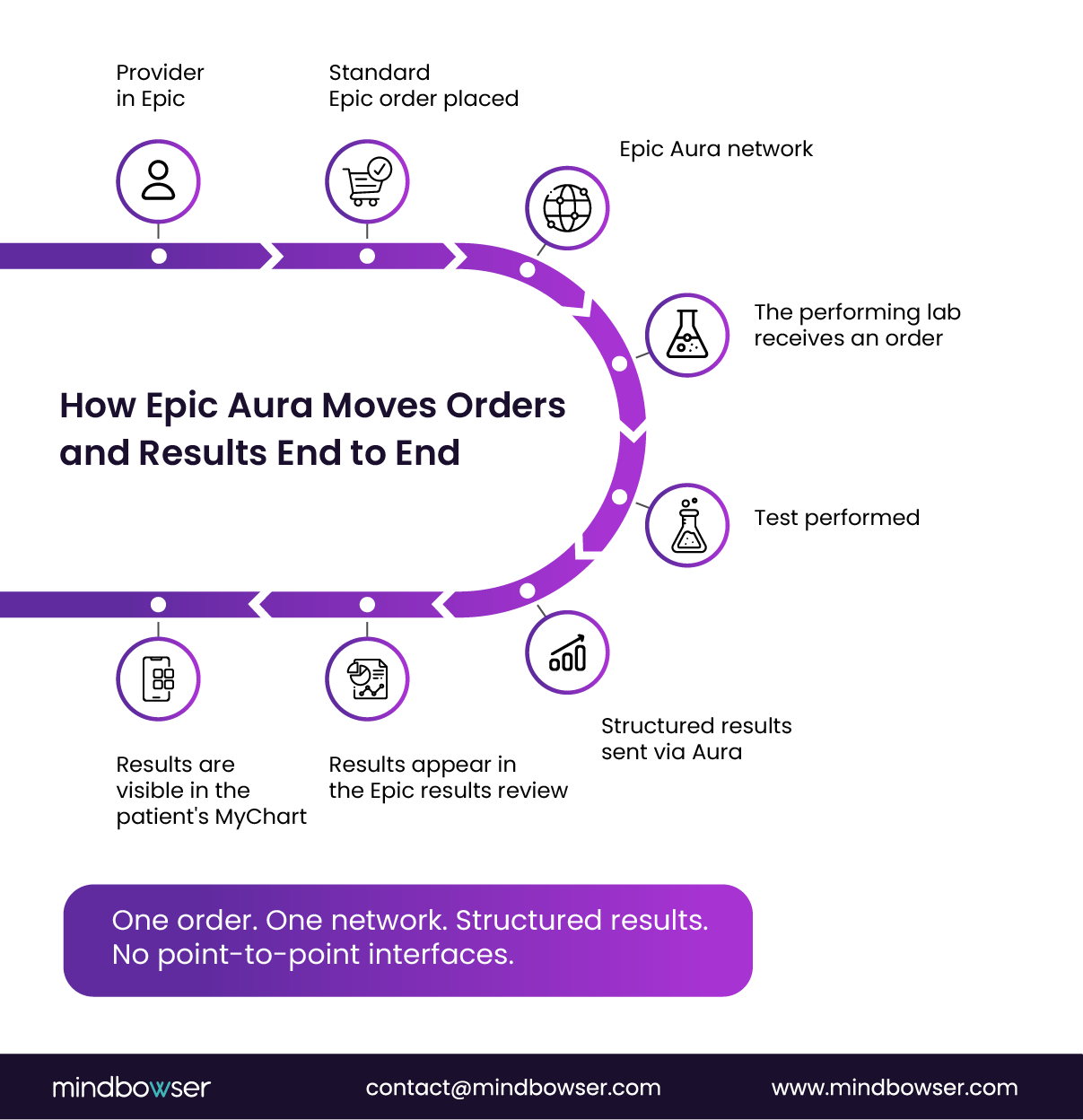
From the clinician’s perspective, Epic Aura does not introduce a new ordering experience. Providers continue to use their standard Epic ordering and specimen-collection workflows, reducing training friction and preserving existing clinical habits. Orders are placed once in Epic and routed through the Aura network to participating performing labs. This matters operationally. When ordering stays native to Epic, adoption rises, and workarounds disappear. What is Epic Aura solving here? It eliminates the need for custom order-routing logic while keeping clinicians in familiar workflows.
B. One-Time Lab Integration Model
Traditional lab connectivity requires onboarding each lab separately, often with unique interface builds and ongoing message maintenance. Epic Aura integration replaces that model with a one-time connection per organization. Provider organizations maintain a single pair of Epic lab interfaces to connect with all performing labs on the network, significantly reducing interface sprawl. Because Epic normalizes the data flowing through Aura, organizations do not need to involve their integration engine teams to manipulate message formats for each vendor. This design shortens implementation timelines and lowers long-term support effort, especially as new labs are added.
C. Structured Results into Epic and MyChart
Results sent over the Aura network are integrated directly into the provider’s results review workflows and the patient’s MyChart account. Unlike PDF-heavy result delivery, Epic Aura interface workflows support structured data that can be reviewed, trended, and analyzed inside Epic. For patients, this creates a single source of truth. For clinicians and executives, it unlocks downstream analytics, quality reporting, and precision medicine use cases without manual reconciliation.
III. Why Health Systems Are Adopting Epic Aura
A. Operational Efficiency
Health systems adopt Epic Aura first for operational relief. Traditional point-to-point models force IT teams to onboard each lab individually, maintain separate interfaces, and support them indefinitely. With Epic Aura integration, organizations connect once and reuse that connection across participating labs, reducing the interface count and the ongoing support burden. Implementation timelines are also shorter, often measured in weeks rather than months, enabling systems to respond more quickly to new diagnostic partnerships and service line growth. For CIOs and CTOs managing constrained teams, this shift turns lab connectivity into a predictable operating model instead of a recurring project queue.
B. Clinical and Data Accuracy
Clinical leaders see value in improved data quality. What is Epic Aura changing at the data layer? Results arrive as structured data rather than static PDFs, reducing transcription errors and preserving discrete fields for interpretation and analysis. Structured results support clinical decision-making, downstream analytics, and population-level insights that PDF-based workflows cannot reliably deliver. As genetic testing and specialty diagnostics expand, this accuracy becomes essential for oncology, rare disease identification, and longitudinal patient tracking.
C. Patient Experience
From the patient’s perspective, Epic Aura supports continuity and transparency. Results delivered through the Aura network flow directly into the patient’s MyChart account, creating a single, consistent view of diagnostic information. Patients no longer navigate fragmented portals or delayed uploads. For executives focused on patient satisfaction and engagement metrics, this seamless experience reinforces trust while aligning diagnostic delivery with modern consumer expectations.
We Improved Predictive Accuracy in Childbirth with Advanced EHR Integration
IV. Epic Aura in Precision Medicine and Genetic Testing
Precision medicine has moved from pilot programs to core clinical strategy, and Epic Aura plays a central role in operationalizing that shift. Genetic and molecular testing generate complex datasets that must be ordered correctly, delivered quickly, and interpreted in context. What is Epic Aura enabling in this space? A standardized, interoperable pathway for genomic workflows that fits directly into Epic’s clinical and patient-facing systems.
A. Genomic Ordering and Results at Scale
With Epic Aura integration, providers can order genetic tests using familiar Epic workflows while routing those orders to specialized performing labs without custom builds for each vendor. This matters as genomics expands beyond tertiary centers into community health systems. The one-time lab integration model allows organizations to add new genetic testing partners without reworking their Epic Aura interface architecture, supporting growth without operational drag.
B. Oncology, Rare Disease, and Pharmacogenomics Use Cases
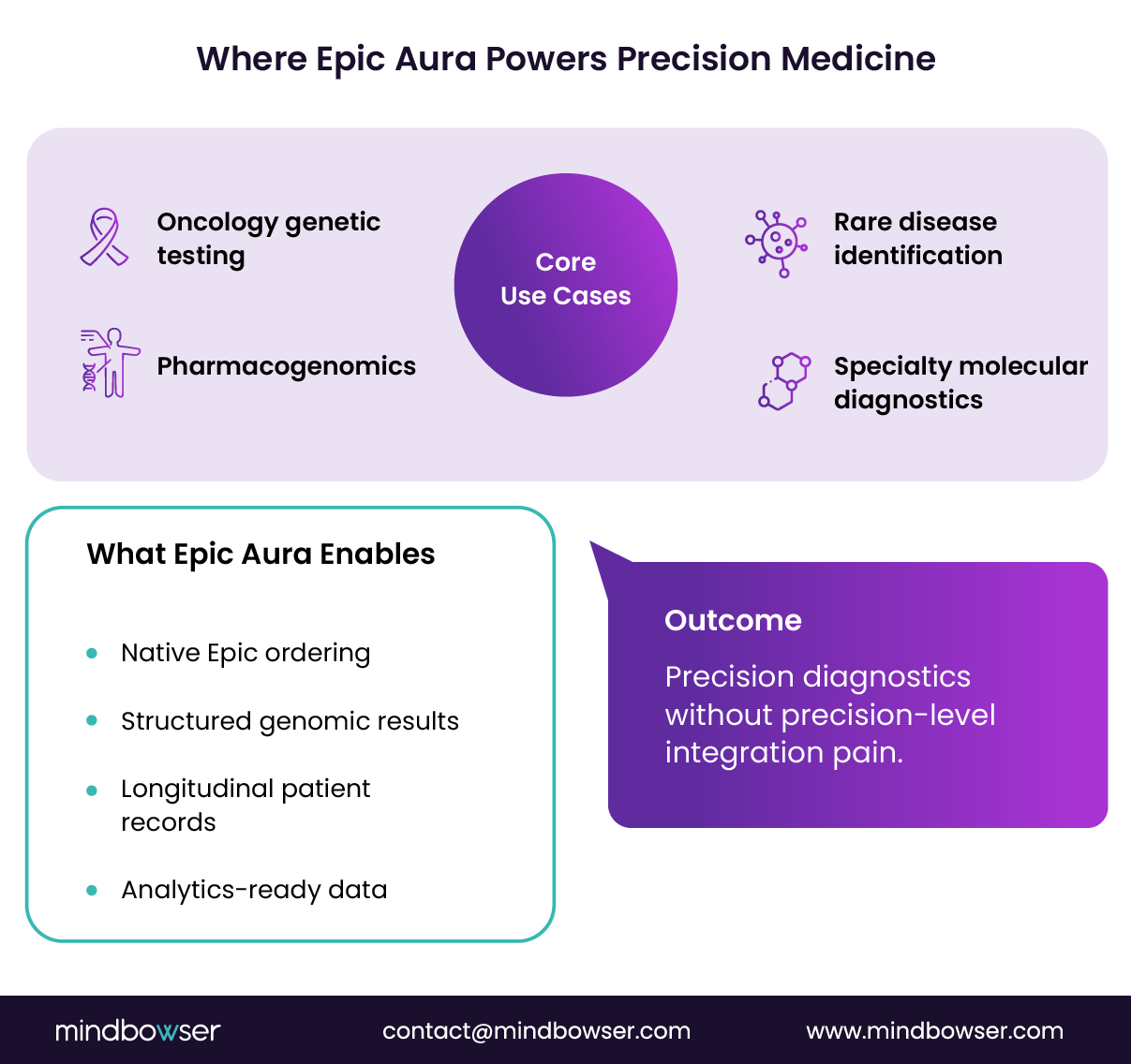
Epic Aura has been adopted to support oncology pathways, rare disease identification, and pharmacogenomic testing, where structured results are critical for clinical decision-making. Epic’s partnerships with medical genetics companies have demonstrated that Aura simplifies provider access to actionable genetic insights while keeping results embedded within Epic workflows. This structured delivery supports longitudinal tracking, clinical decision support, and care coordination across specialties.
C. Data Integrity for Advanced Analytics
Precision medicine depends on clean, discrete data. Epic Aura ensures that genetic test results are delivered as structured data rather than unsearchable documents, enabling analytics, reporting, and downstream AI applications. For CMIOs and data leaders, this foundation supports population-level risk identification and personalized treatment strategies without adding manual data normalization steps.
V. Epic Aura Implementation: What to Plan For
Adopting Epic Aura is not a plug-and-play decision. Health systems that succeed treat it as an enterprise interoperability initiative with clear technical ownership, realistic timelines, and defined governance. What is Epic Aura requiring in practice? Alignment across IT, lab operations, compliance, and clinical leadership from day one.
A. Technical Architecture: Epic Aura vs Epic Bridges and Epic Beaker
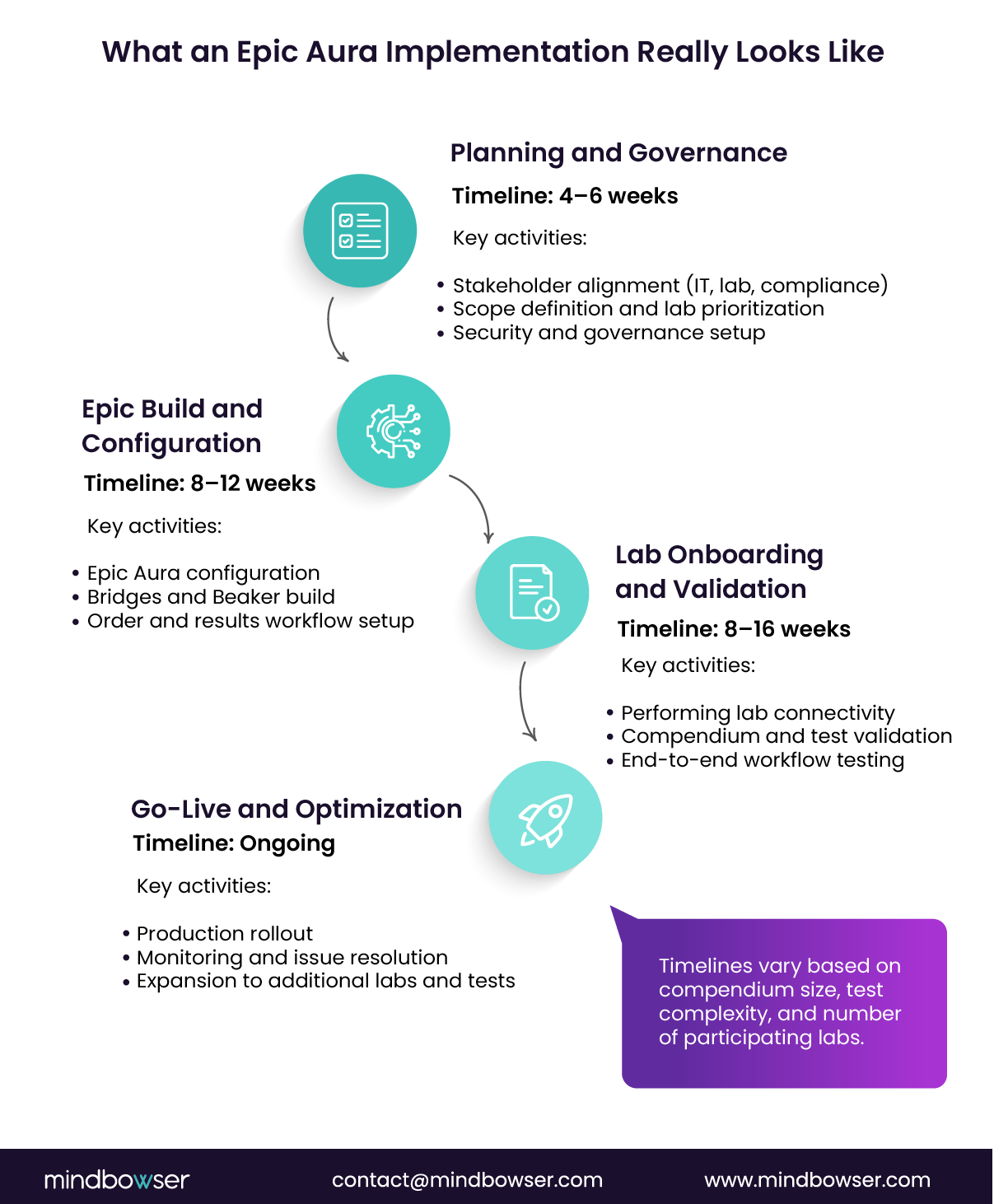
From an architectural standpoint, the Epic Aura integration sits alongside existing Epic components, such as Bridges and Beaker, rather than replacing them. Organizations still perform Epic Aura configuration work, including Bridges and Beaker build, to support order routing and results ingestion. Aura operates through a unique, pared-down Epic instance that standardizes data exchange across the network, reducing the need for custom message manipulation by local interface engines. For CTOs, this means fewer bespoke transformations and clearer separation between the core Epic build and external lab connectivity.
B. Timeline and Resource Expectations
While Aura shortens interface build time, overall implementation is not instantaneous. Typical timelines range from six to twelve months, depending on compendium size, test complexity, and the number of participating labs. Successful programs follow a phased approach, starting with high-volume or high-impact labs before expanding to specialty diagnostics. Internal Epic expertise, lab stakeholder engagement, and experienced integration partners all influence speed and outcomes.
C. Governance, Security, and Compliance
Because Epic Aura handles protected health information and structured clinical data, governance cannot be an afterthought. Organizations must maintain appropriate security protocols, ensure that access controls align with Epic standards, and validate that data exchange processes comply with industry regulations. Clear ownership between IT, lab operations, and compliance teams is essential to maintain trust, data integrity, and long-term sustainability.
VI. Surfacing Aura Data in Your Own App or Workflow
Aura standardizes how orders and results move inside Epic. The moment you want that structured lab and genomic data in your own app, analytics layer, or care-management tool, you’re integrating through Epic’s APIs—FHIR, HL7, and App Orchard.
Built from scratch, that’s a six-month effort. ConnectHealth, Mindbowser’s healthcare integration platform, ships with a pre-built Epic connector plus Helix AI to build those workflows in days instead.
See the full Epic integration picture, or browse the rest of the Epic modules.
VII. Real-World Epic Aura Use Cases and Ecosystem Adoption
As Epic Aura matures, its value becomes most evident in how health systems, labs, and third-party vendors adopt it at scale. What is Epic Aura becoming in practice? A shared interoperability layer that reduces friction across the diagnostic ecosystem while preserving Epic-native workflows.
A. Health System Adoption Patterns
Health systems adopt Epic Aura integration to simplify lab connectivity across inpatient, outpatient, and specialty service lines. Large systems use Aura to reduce interface sprawl, while mid-sized organizations adopt it to accelerate access to high-value specialty diagnostics without expanding internal integration teams. In both cases, the one-time connection model supports faster onboarding of new lab partners and consistent data exchange as networks grow.
B. Performing Labs and Diagnostic Vendors
From the lab perspective, Epic Aura lowers the barrier to serving Epic-based provider organizations. Rather than building custom interfaces for each customer, labs can connect through Aura and reuse standardized workflows. This model encourages broader participation from genetic testing companies, specialty diagnostics providers, and reference labs, expanding the ecosystem available to Epic health systems.
C. Third-Party Platform Growth
Third-party digital health and analytics platforms increasingly design their solutions to align with Epic Aura interface patterns. By relying on structured data delivered through Aura, these vendors can build applications for care coordination, precision medicine, and reporting without managing direct EHR integrations for every customer. The result is an ecosystem where innovation happens on top of Epic Aura rather than around it.
VIII. Challenges and Best Practices for Epic Aura
While Epic Aura simplifies lab and specialty diagnostic interoperability, adoption is not without challenges. Health systems that approach Aura as a purely technical install often struggle. Those who pair technology with process alignment see sustained value. What is Epic Aura teaching organizations? Interoperability success depends as much on governance and adoption as it does on architecture.
A. Order Standardization Across Service Lines
One of the first hurdles is order standardization. Because Epic Aura integration relies on shared workflows, inconsistencies in test naming, compendiums, or ordering logic can slow onboarding. Best-performing organizations invest early in harmonizing lab orders and engaging lab leadership during build. This upfront work reduces downstream rework and supports smoother expansion as new labs join the network.
B. Clinician Adoption and Workflow Trust
Even when the technology works, clinician adoption can lag if workflows feel unfamiliar. Epic Aura succeeds when ordering and results review remain native to Epic, minimizing clicks and preserving clinical context. Training should focus on what stays the same, not what changes. Clear communication that results will arrive faster and in structured formats builds trust and accelerates adoption.
C. IT and Lab Coordination
Aura implementations touch IT, lab operations, compliance, and external partners. Without clear ownership, delays emerge. Best practices include defining a single program owner, establishing escalation paths, and aligning IT and lab teams on validation and go-live criteria. Strong coordination ensures that Epic Aura interface workflows remain reliable as volumes grow and partners change.
Build a Custom EHR with Epic Integration Capabilities
Epic Aura as a Strategic Interoperability Advantage
For healthcare leaders facing rapid growth in specialty diagnostics and genomics, Epic Aura is more than an interface upgrade. It is a strategic shift in how orders and results move across the enterprise. By replacing point-to-point builds with a shared network model, Epic Aura integration allows health systems to add lab partners without adding a long-term IT burden.
What is Epic Aura delivering in practice? Faster lab onboarding, structured results embedded directly into Epic and MyChart, and fewer interfaces to support over time. CIOs gain operational predictability. CMIOs gain cleaner data for clinical decisions, analytics, and precision medicine programs.
Health systems that treat Epic Aura as core infrastructure, not a one-off project, see the strongest returns. Early governance, standardized ordering, and downstream systems designed to use structured data turn Aura into a durable advantage.
As diagnostic ecosystems expand, Epic Aura interface strategies will increasingly distinguish between organizations that react and those that scale with confidence.