














 BLOGS
BLOGS  NEWSROOM
  CASE STUDIES
  WEBINARS
  PODCASTS
  ASSET HUB
  EVENT CALENDAR






















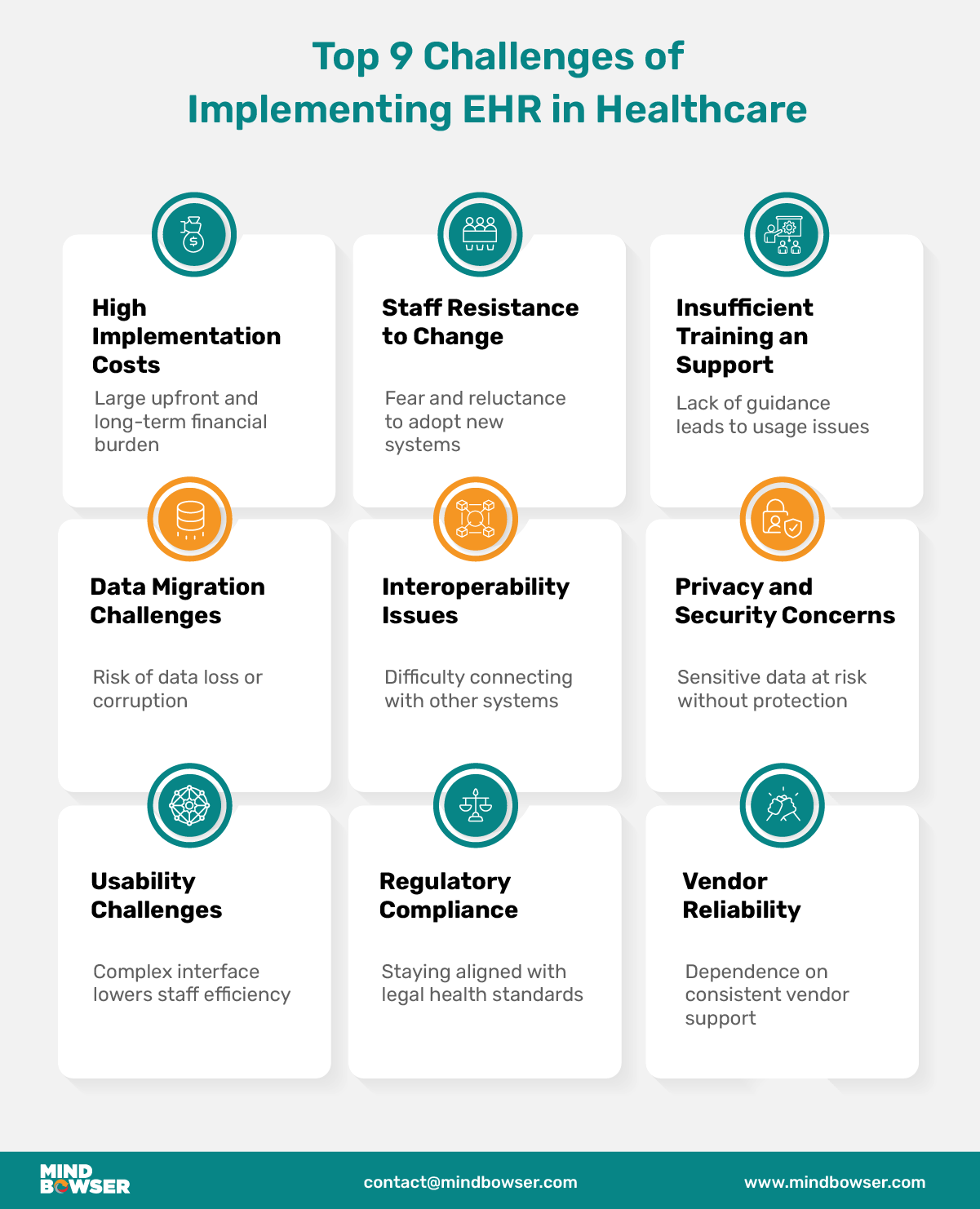
E. Interoperability Issues
Another pressing challenge of implementing EHR is ensuring interoperability; getting the system to communicate smoothly with other health IT platforms. Lack of standardization can make sharing patient data between departments or with external providers difficult. This creates silos and inefficiencies in patient care. If systems can’t talk to each other, coordination suffers.
Organizations should prioritize custom EHR solutions supporting HL7, FHIR, and other widely accepted standards to avoid this. Ensuring compatibility upfront saves time and avoids costly retrofits later. True interoperability improves care continuity and clinical outcomes by enabling secure and consistent data exchange.
Related Read: The Road to Value-based Healthcare: How Interoperability Paves the Way
F. Privacy and Security Concerns
Patient health data is highly sensitive, and protecting it is one of the core challenges of implementing EHR systems. Digital records are vulnerable to cyberattacks, breaches, and unauthorized access. Even a slight lapse in security can result in HIPAA violations and legal consequences. Implementing comprehensive security protocols, encryption, multi-factor authentication, access restrictions, and regular audits is crucial.
Staff must also be trained to recognize phishing attempts and follow best practices. Ensuring strong security measures protect and build trust in the system and the institution that uses it.
Related Read: Common Mistakes in Healthcare Compliance and How to Avoid Them
G. Usability Challenges
Complex, non-intuitive interfaces are one of the overlooked challenges of implementing EHR. A system may offer many features, but clinicians will struggle to use it effectively if it’s hard to navigate. Poor usability can slow down data entry, increase documentation errors, and frustrate users, negatively impacting staff morale and patient care.
Selecting an EHR with a clean, user-friendly design is essential. It’s also wise to involve end-users in the evaluation phase so the final system fits their real needs. A well-designed interface improves adoption, minimizes training time, and supports better clinical decision-making.
H. Regulatory Compliance
Compliance with legal and regulatory standards presents ongoing challenges in implementing EHR. Systems must adhere to rules set by HIPAA, ONC, and CMS to protect patient information and ensure proper reporting. As regulations evolve, the EHR must be updated accordingly; failure to comply can lead to fines or reputational damage.
Organizations must choose EHR vendors who stay current with compliance requirements and offer system updates. Additionally, internal policies and user training should reflect these standards. Maintaining compliance avoids penalties and reinforces ethical data practices and trust in healthcare delivery.
Related Read: Navigating the Regulatory Landscape: A Guide to Healthcare Compliance Regulations
I. Vendor Reliability
Vendor dependency is a hidden yet critical challenge in implementing EHR systems. Once implemented, healthcare providers rely on vendors for system maintenance, technical support, updates, and even future upgrades. If the vendor is slow to respond or lacks expertise, it can derail operations and frustrate users.
Worse, switching providers becomes a complex and costly affair if the company folds or discontinues service. To safeguard against this, organizations must assess vendor reputation, support quality, scalability, and financial stability. Setting clear service level agreements (SLAs) and conducting regular vendor reviews ensures ongoing support and business continuity.
II. How Mindbowser Can Help You with Its EHR Implementation Services
Mindbowser supports healthcare organizations in overcoming the challenges of implementing EHR through specialized integration services designed for real-world clinical workflows. With deep domain expertise and a healthcare-focused workflow, HealthConnect CoPilot, our team makes EHR integration smoother, faster, and compliant from day one.
Here’s how we help:
A. Connect with Leading EHR Systems
We’ve built integrations with Epic EHR, Cerner EHR, Athenahealth EHR, and other major EHR platforms. Whether you need FHIR APIs, HL7 messaging, or custom connectors, our team ensures your applications talk to the EHR securely and efficiently.
B. Unified Patient Data Across Systems
Fragmented data is one of the top challenges of implementing EHR. To create a unified patient view, we standardize and harmonize data across platforms, including EHRs, wearables (Dexcom, Fitbit, Apple Health), and remote monitoring tools.
C. Compliance Built-In
Our architecture ensures HIPAA, HL7, and FHIR compliance throughout. From identity management to audit trails and encryption, we handle it all, so you can stay focused on care delivery, not technical headaches.
D. Faster Time-to-Market with HealthConnect CoPilot
HealthConnect CoPilot accelerates integration, offering pre-built modules and templates for EHR workflows, Consolidated Clinical Document Architecture (CCDA) document exchange, patient demographics sync, scheduling, billing, and more, reducing development cycles by up to 40%. HealthConnect CoPilot speeds up Epic Integration, Cerner EHR Integration, amongst many.
E. Custom Workflows and Support
Need to integrate with a lesser-known EHR or a custom EHR system? No problem. Our team builds to spec and provides 24/7 support, documentation, and ongoing optimization so your integration remains reliable and scalable.
Conclusion
The challenges of implementing EHR systems can feel overwhelming, ranging from high costs to staff resistance and data security concerns. Still, each challenge presents an opportunity to strengthen operations, improve care coordination, and drive better outcomes.
Engaging key stakeholders, offering hands-on training, and selecting technology that fits your goals can help healthcare providers confidently move through the transition. With a thoughtful approach, implementing EHR systems becomes both manageable and impactful.
A common challenge is the high setup cost and ongoing maintenance, which can strain healthcare budgets, especially in smaller practices.
Staff resistance to change is a frequent challenge. Many providers struggle with adjusting to new digital workflows and technology.
A major barrier is a lack of interoperability. EHR systems often fail to connect smoothly with other software, affecting data exchange.
Poor usability is often the biggest issue. Complex interfaces and clunky workflows slow down clinicians and impact care quality.