











 BLOGS
BLOGS  NEWSROOM
  CASE STUDIES
  WEBINARS
  PODCASTS
  ASSET HUB
  EVENT CALENDAR























TL;DR:
- Generic EMRs fail medical spas on 5 workflow dimensions: before/after photo management, membership billing, toxin lot tracking, aesthetic consent forms, and medical director sign-off workflows
- AestheticsPro and PatientNow are the two options built with med spa workflows in mind. Everything else requires significant configuration overhead
- Custom-built makes sense for three practice profiles: multi-location chains (20+ sites), physician-founders building commercializable platforms, and groups with complex loyalty and supplier integrations
- The 6-question demo checklist at the end will tell you more than any G2 review
The 3-year EMR contract is the most expensive mistake I see medical spa operators make: not because the software is wrong, but because nobody asked the right questions at demo day.
I. Why the Wrong EMR Contract Is a Medical Spa’s Most Expensive Technology Decision
Nine months into a 3-year contract is not the time to discover that before/after photos are stored in a separate cloud drive, membership billing runs in a different system, and consent forms are still printed on paper.
I’ve seen this exact situation in medical spas across the country. The pattern is consistent: the vendor gave a polished demo, the practice manager liked the interface, and nobody asked the hard questions before signing.
The financial math is uncomfortable. EMR contracts typically run 3 years. Exiting early costs a buyout fee. Migration adds $15,000-$40,000 in data transfer, staff retraining, and operational downtime. An incompatible system doesn’t just create friction; it creates a productivity tax you pay every single day.
Two factors make the medical spa software decision harder than most.
First, the “module trap.” Generic EHR vendors add aesthetic modules to existing platforms built for primary care or internal medicine. The result is bolt-on features that require workarounds for every med spa-specific workflow. It looks like a medical spa solution in the demo. It behaves like a general EHR in practice.
Second, the industry is consolidating. Private equity is building multi-location medspa chains at speed. A system that works for 3 locations often breaks at 15. Practices that sign a single-location contract and then grow get locked into software that can’t scale.
Start a Conversation, I’ll help you identify the right questions before you sign anything.
II. What Makes Medical Spas a Hard Fit for Generic EHR Platforms?

Six specific requirements separate medical spa workflows from general clinical documentation. Most generic EHRs cover zero of them natively.
Before/after photography (HIPAA-compliant): When a photo is linked to a patient record, it is PHI under HIPAA. Most generic EHRs treat photos as file attachments: no per-image consent workflow, no treatment linkage, no structured storage. For practices that want to use before/after photos in marketing, PHISecure de-identifies all 18 PHI identifiers before any image reaches an external channel.
Membership and subscription billing: Medical spas run hybrid revenue models. Membership packages, treatment bundles, rollover credits, freeze requests, and transfers are daily operations. Standard medical billing modules are built for insurance claims, not recurring membership management.
Toxin lot tracking: Botox, Dysport, and Xeomin each arrive with a lot number and expiration date. Many states require practices to log the lot number and dose per patient encounter for liability protection. DEA-regulated injectables add chain-of-custody requirements on top. No generic EMR captures this inside the clinical workflow.
Aesthetic informed consent: A compliant consent form captures the specific compound or device used, expected side effects (bruising, swelling, migration risk), pre-care and post-care instructions, and the patient’s signature with a timestamp. Generic EHR consent modules are designed for surgical consent, not aesthetic procedure consent.
Retail and product sales: Medical spas sell skincare products. Almost no EMR has a native POS integration.
Medical director oversight: Over 30 US states require physician’s sign-off on aesthetic treatment plans. The EMR must support asynchronous co-sign with a logged audit trail, not just shared note access. Generic platforms have no concept of a medical director workflow.
Telehealth consultations: Medspas increasingly offer virtual consults for treatment planning and follow-up reviews. When you add telemedicine into the mix, a generic EMR has to handle HIPAA-compliant video, virtual consent capture, and async follow-up documentation, all tied back to the patient record. Generic EHRs weren’t built for this workflow either.
III. What a Medical Spa EMR Actually Needs (5 Non-Negotiables)
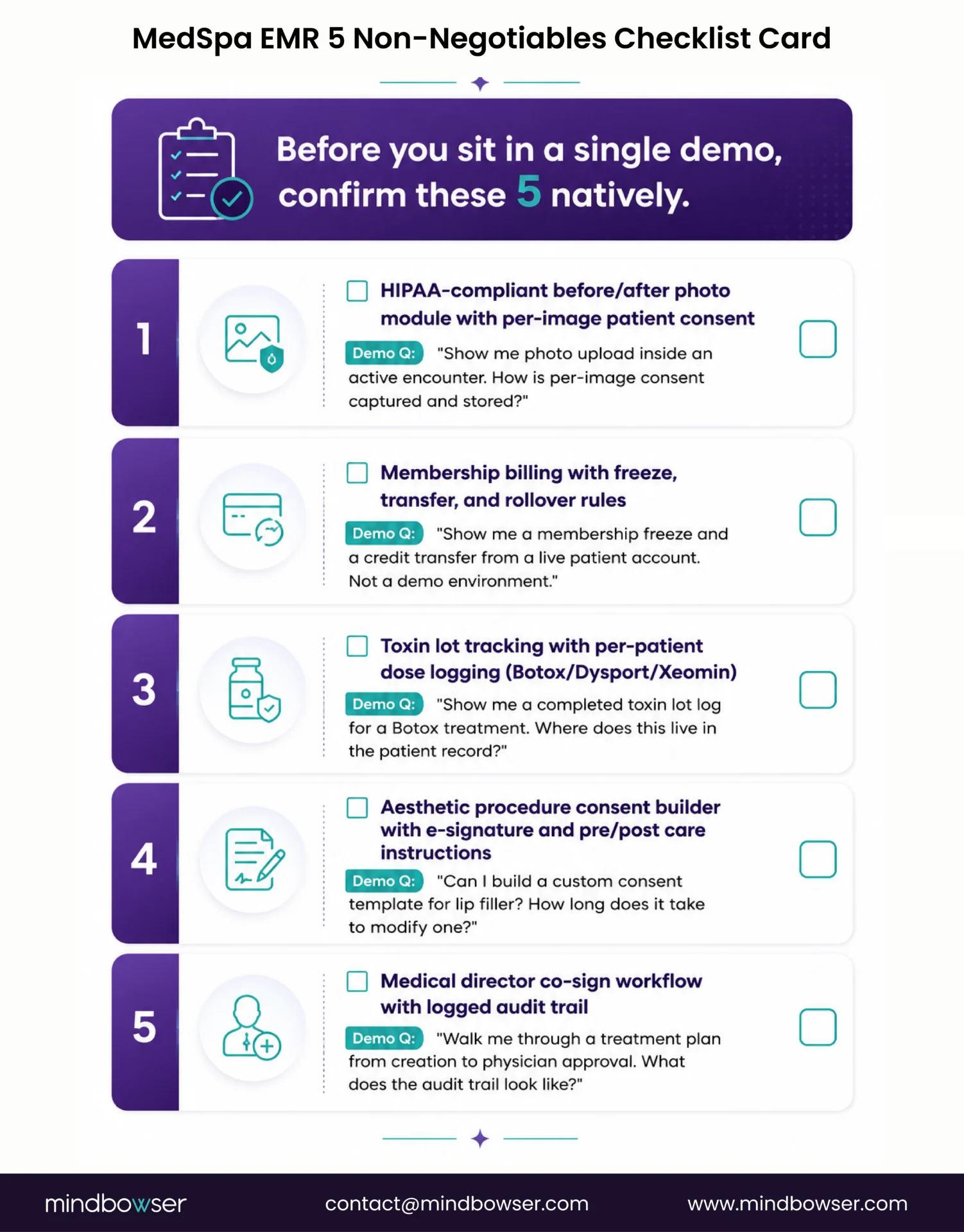
Any vendor requiring a workaround for 3 or more of these items is a generic EHR with medical spa marketing language applied to it.
- HIPAA-compliant before/after photo module with per-image patient consent
Demo Q: “Show me photo upload inside an active encounter. How is per-image consent captured and stored?” - Membership billing with freeze, transfer, and rollover rules
Demo Q: “Show me a membership freeze and a credit transfer from a live patient account. Not a demo environment.” - Toxin lot tracking with per-patient dose logging
Demo Q: “Show me a completed toxin lot log for a Botox treatment. Where does this live in the patient record?” - Aesthetic procedure consent builder with e-signature and pre/post care instructions
Demo Q: “Can I build a custom consent template for lip filler? How long does it take to modify one?”
The Patient Questionnaire Form handles digital intake with real-time validation and FHIR EHR submission for practices that want to decouple consent from their core EMR entirely. - Medical director co-sign workflow with logged audit trail
Demo Q: “Walk me through a treatment plan from creation to physician approval. What does the audit trail look like and who can see it?”
IV. Best EMR Options for Medical Spas in 2026
AestheticsPro: Built for medical aesthetics from the ground up. Native before/after photo module with consent workflow, membership billing, toxin lot tracking, aesthetic consent templates. Strongest clinical depth on this list. Limitation: scheduling slows at 10+ concurrent providers; interface shows its age. Price: approximately $150-300/month.
PatientNow: Strong patient engagement and marketing automation. Membership billing is solid. Good patient portal and recall automation. Limitation: toxin lot tracking requires a workaround; photo consent workflow needs additional setup. Best fit when patient retention and marketing automation is the primary bottleneck. Price: approximately $200-400/month.
Nextech: Dermatology and plastic surgery pedigree, KLAS-rated in that segment. Strong clinical documentation. Limitation: priced for larger practices ($400-700/month), overkill for medspa-only operations. Best fit for practices running both derm and aesthetics under one roof.
Modernizing Medicine (EMA Aesthetics): Built for derm and plastics with an aesthetic module. Limitation: medspa-specific workflows require a customization engagement; pricing is opaque and enterprise-tier. Not the right fit for a standalone medspa or small chain.
Boulevard: Scheduling and membership management for wellness-adjacent medspas. Not a clinical EMR: no medical documentation, no toxin lot tracking, no medical director workflow. If you are performing injectables, laser procedures, or body contouring and need clinical documentation, Boulevard is the wrong product category. It belongs in the spa management column, not the medical EMR column.
For a broader view of specialty-specific EMR considerations, this guide on medical specialty EHR development walks through build vs. buy across 8 specialties.

Explore EHR Options Built for Your Medical Spa Now!
V. AestheticsPro vs PatientNow: How to Choose
These are the two most common choices at 3-15 location medspas. The decision comes down to which bottleneck costs you more.
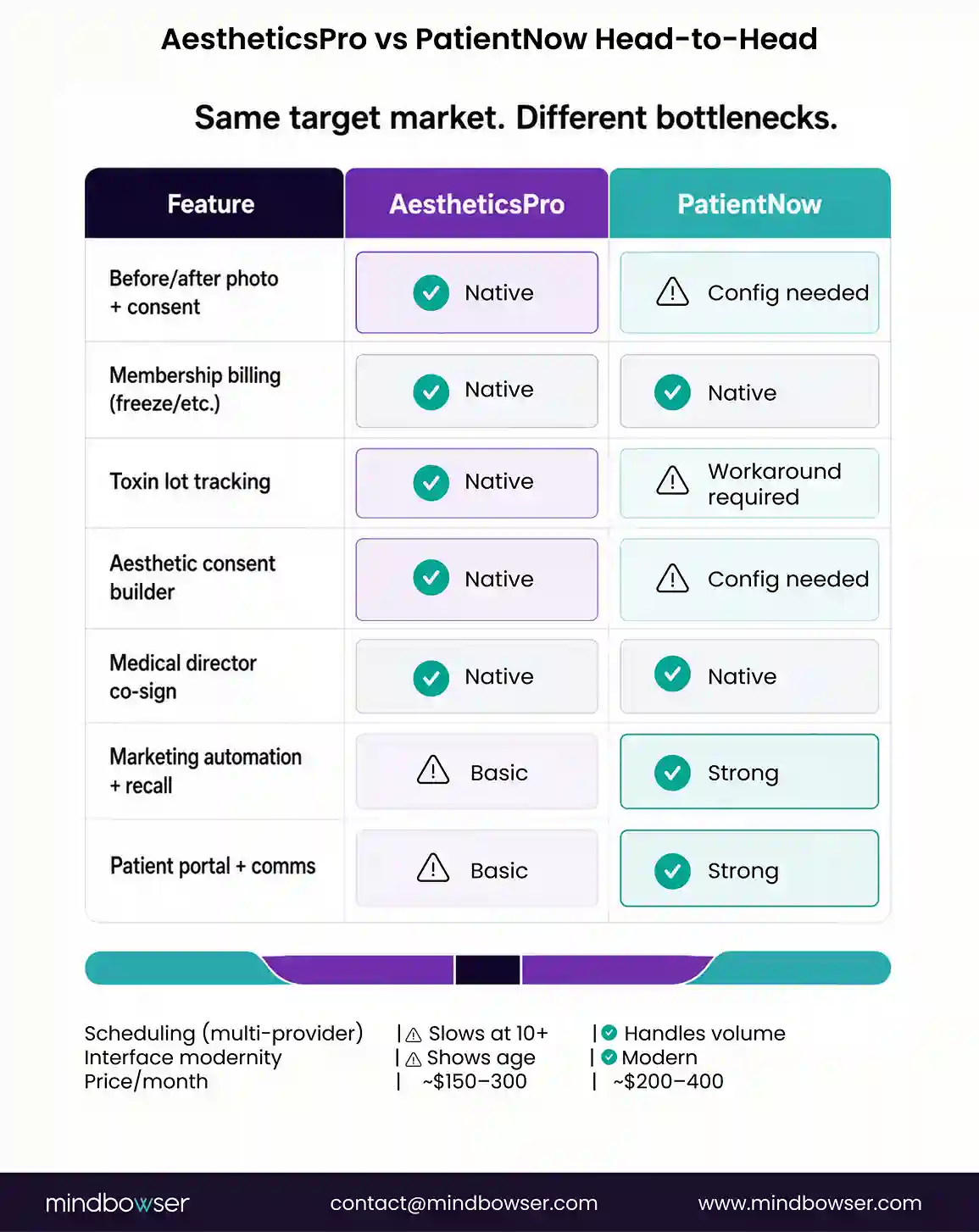
Choose AestheticsPro when: Documentation compliance is the bottleneck. You’re doing volume injectables and staff is manually logging lot numbers. Your state has specific medspa regulations and you’ve had a compliance flag. Clinical accuracy matters more than marketing automation.
Choose PatientNow when: Patient retention is the bottleneck. You have a strong clinical workflow already and the gap is in rebooking, marketing automation, and patient communication. You want an integrated patient portal and recall system.
Neither is “better.” They’re built for different pain points.
VI. When Off-the-Shelf Fails and a Custom-Built Medspa Platform Makes More Sense
Three practice profiles where no vendor on this list solves the actual problem.
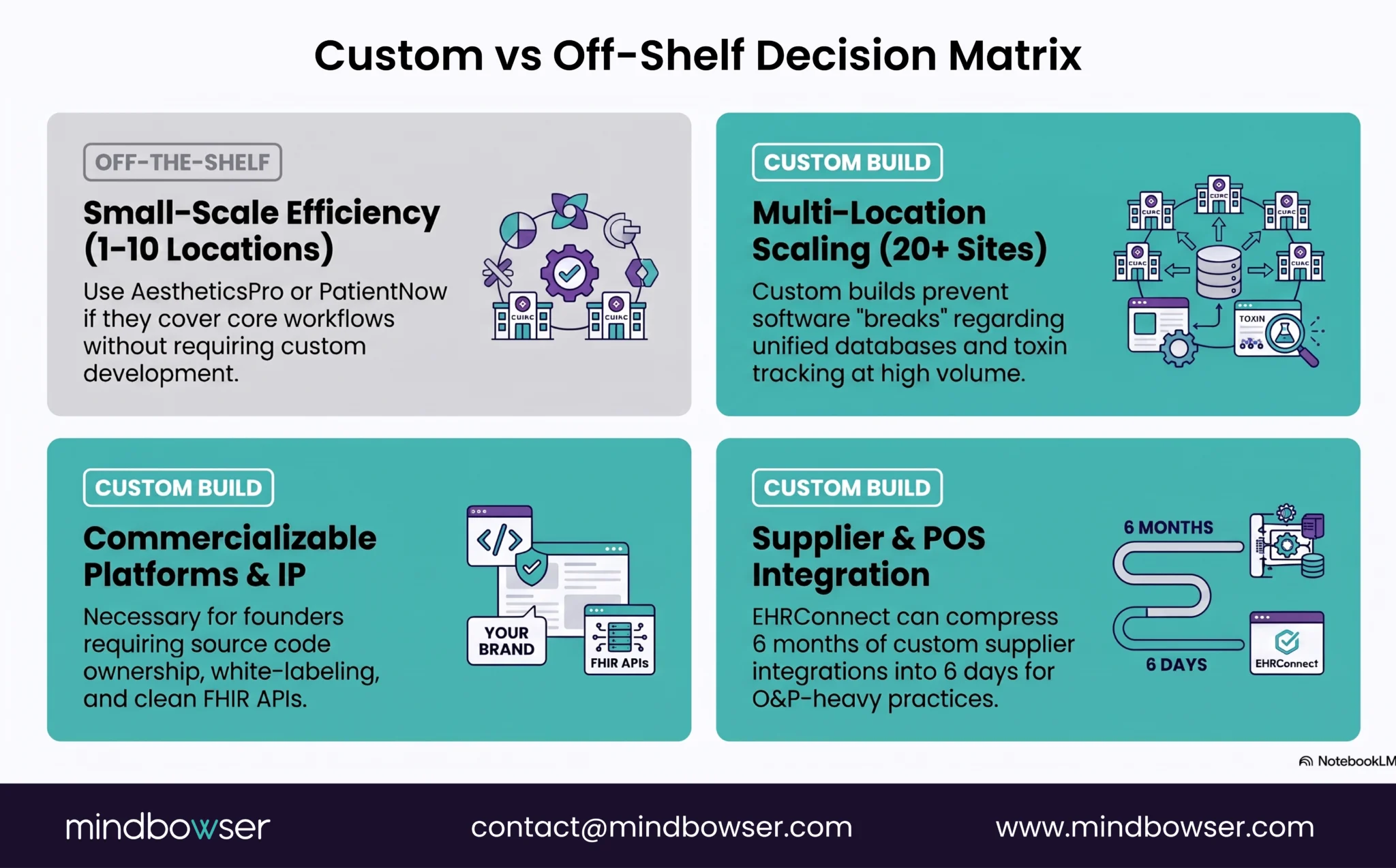
Multi-location chains (20+ locations): Unified membership database across all locations, cross-location appointment booking, consolidated reporting, single toxin tracking schema. AestheticsPro and PatientNow are built for single-location or small chain operations. Multi-location functionality is an afterthought in both. Chains above 20 locations regularly hit walls: membership credits that don’t transfer across sites, reporting that can’t aggregate across locations, staff login management that doesn’t scale.
Physician-founders building a commercializable aesthetics platform: Off-the-shelf software is not a product foundation. If you’re building something to license, franchise, or sell, you need source code ownership, clean FHIR APIs, and white-label capability. None of the platforms above offer this.
Practices with complex loyalty and supplier integrations: Allergan Aspire, Galderma Aspire, skincare brand POS, loyalty program cross-redemption, inventory tied to treatment protocols. Integrations that take 6 months via custom development can be compressed to 6 days using ConnectHealth, which handles EHR-to-supplier data connections for aesthetic practices.
Documentation efficiency applies here too: AI Medical Summary reduces clinical documentation time by approximately 50% and improves accuracy by approximately 45%. For a custom EHR development engagement, this becomes a native feature rather than a third-party add-on.
For groups weighing this decision, this comparison of ready-made vs. custom EHR and this cost guide for EHR development are the two resources I point practices to first.
Custom build cost range: $150,000-$500,000+ depending on scope and whether you’re building a single-location platform or a commercializable product.
VII. 6 Questions to Ask at Every Medical Spa EMR Demo
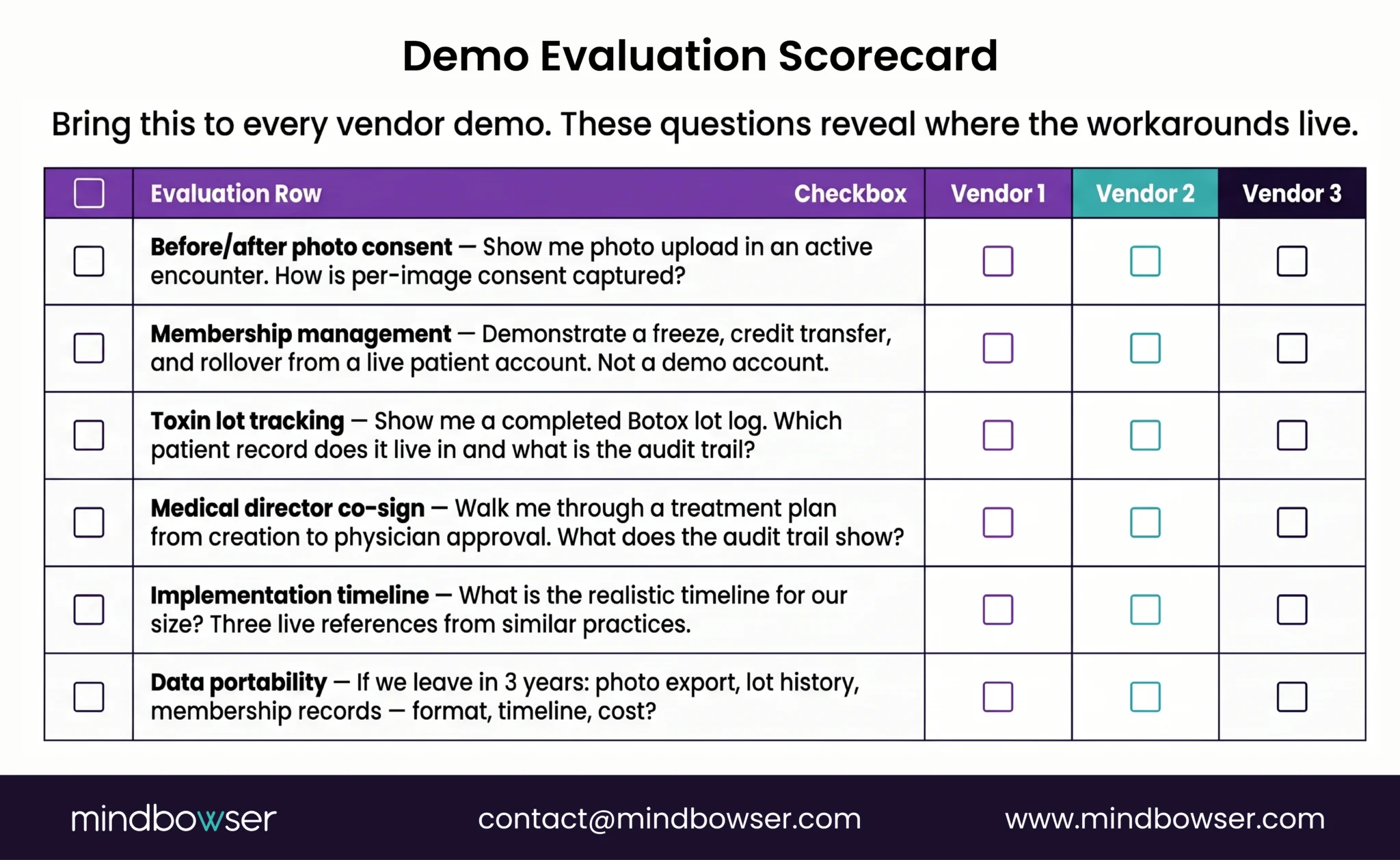
These six questions will reveal more about a vendor’s real capability than an entire sales deck. Bring this list to every demo.
- Before/after photo consent: “Show me photo upload inside an active encounter. How does per-image consent work? Where is it stored?”
- Membership management: “Demonstrate a membership freeze, a credit transfer, and a rollover rule from a live patient account. Not a demo account.”
- Toxin lot tracking: “Show me a completed Botox lot log. Which patient record does it live in, and what’s the audit trail?”
- Medical director workflow: “Walk me through a treatment plan from creation to physician co-sign. What does the audit trail show, and who has access to it?”
- Implementation timeline: “What’s the realistic implementation timeline for a practice our size? Three live references from similar practices, please. Not a case study PDF.”
- Data portability: “If we leave in 3 years, what does data export look like? Format, timeline, and cost for photos, lot history, and membership records?”
VIII. 3 Contract Questions Before You Sign Anything
- Uptime SLA for billing-critical workflows: Membership billing outages cost revenue in real time. Push for 99.9% or higher, specifically for the billing and scheduling modules. Get it in writing.
- Full data export rights: HIPAA gives you legal ownership of your patient data. Ask specifically: what format does photo export come in? Timeline? Cost per record? The answer tells you how the vendor thinks about your exit.
- Live references at comparable size: Not a case study. Not a video testimonial. Three practices at your location count and patient volume, currently using the platform. If the vendor can’t produce this, that’s the answer.
If you’ve already decided to build, this guide on evaluating an EHR development partner is where to go next.
Before You Sign, Make Sure the Workflow Fits
The medical spa software market has a vendor problem: too many scheduling platforms marketed as clinical EMRs, too many generic EHRs with aesthetic “modules” that require workarounds for every core workflow, and too few platforms built specifically for the documentation and compliance requirements of aesthetic medicine.
AestheticsPro is the strongest native fit for practices where clinical compliance is the primary concern. PatientNow is the stronger choice when patient retention and marketing automation is the bottleneck.
For multi-location chains, physician-founders building platforms, and practices with complex integration requirements, off-the-shelf is a workaround, not a solution.
The 3-year contract mistake is avoidable. Thirty minutes of the right questions at demo day, and reading the data portability clause before signing, are the two interventions that protect most practices from it.
For specialty EMR decisions in other practice areas, the approach we take with pediatric EMR development and other specialty builds applies the same framework: clinical workflow requirements first, vendor evaluation second, build vs. buy last.