











 BLOGS
 NEWSROOM
 CASE STUDIES
 WEBINARS
 PODCASTS
 ASSET HUB
 EVENT CALENDAR





















TL;DR
- Most anesthesia EHR evaluations stall at the wrong question. The real problem is not which vendor has the best UI. It is which system can connect ORCA vital sign data, intra-op drug logging, and post-op pain handoff into a single continuous record.
- Today, most cannot. This piece runs through the five systems most anesthesia practices evaluate in 2026, where each breaks down, and how to decide whether building custom makes more sense than licensing another system that will need workarounds in six months.
Choosing an anesthesia EHR is not like choosing a general-purpose hospital system. ORCA integration, vital sign automation, and post-op pain documentation are non-negotiable, and most vendor systems simply do not handle all three well.
I have worked through enough anesthesia workflow evaluations to recognize the pattern. A surgical center buys a well-reviewed EHR, spends several months on implementation, and then watches the post-op handoff problem reappear in a different form. The nurses are still charting pain scores in a separate system. The anesthesia notes still do not connect to recovery room orders. Someone is reconciling both manually at the end of each shift.
That problem is structural, not a configuration gap. Understanding why requires looking at what anesthesia workflows actually demand before evaluating any vendor.
What Makes an Anesthesia EHR Different From Everything Else?
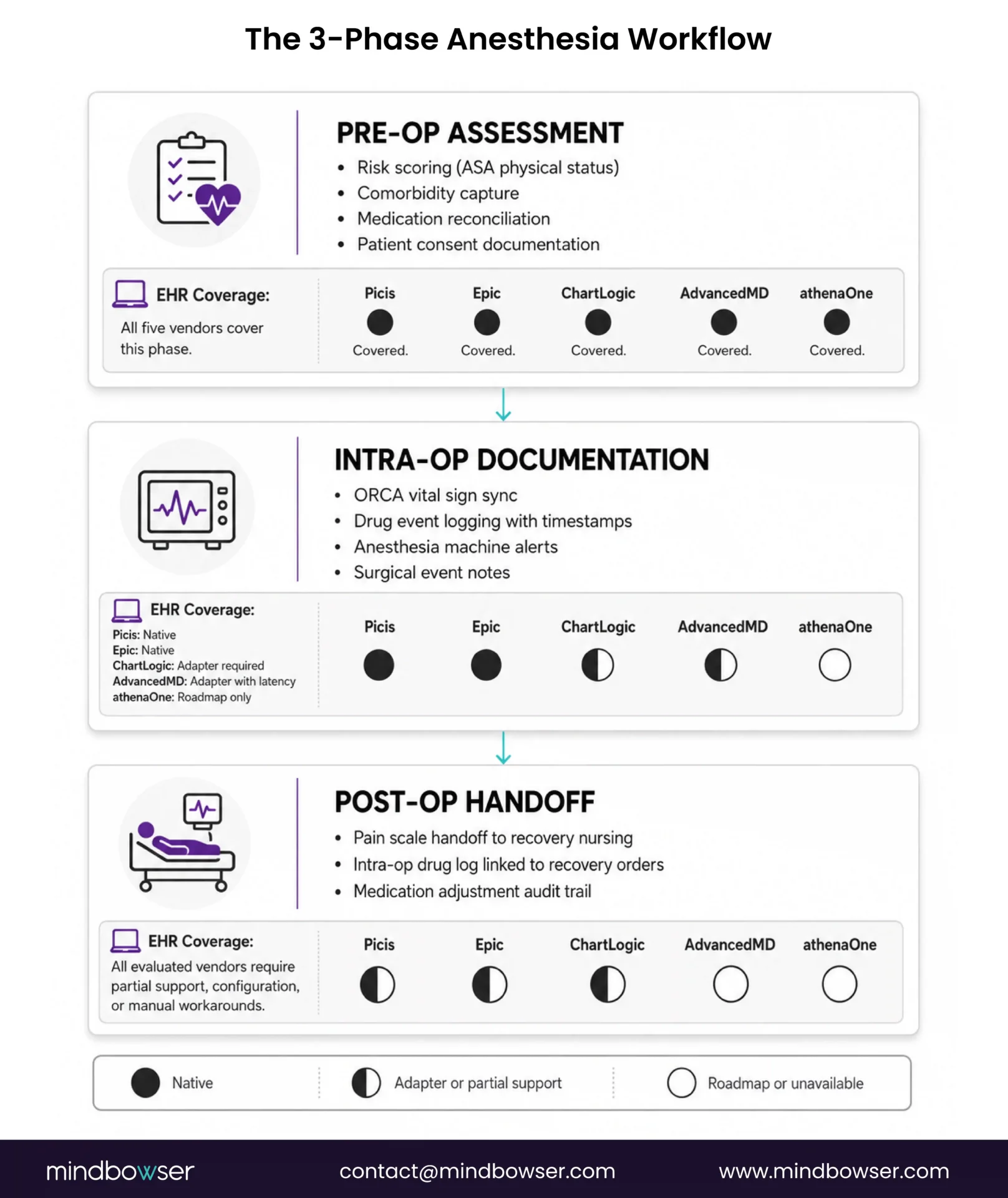
Unlike a general EHR serving 20 departments, anesthesia software lives in a narrow, high-stakes corridor. Pre-op assessment. Intra-op vital sync. Post-op pain handoff. Each of those phases has specific data requirements, and a system that handles one well often handles another badly.
1. ORCA integration is the baseline expectation: The Operating Room Communication Adaptation standard, defined under ASTM E2828, enables real-time vital sign synchronization between anesthesia machines, monitoring devices, and the clinical record. Without it, vitals are manually transcribed, error probability climbs, and documentation time per case roughly doubles.
According to Healthcare IT News coverage from January 2026, ORCA-compliant system adoption among U.S. surgical centers rose 23% year-over-year, and a growing share of centers now list ORCA compliance as a non-negotiable term in vendor RFPs.
2. Reimbursement pressure is tightening the documentation math: The CMS Anesthesia Fee Schedule for 2026 reduced per-unit reimbursement by 1.5% compared to the 2025 schedule. That is not a catastrophic cut, but it raises the stakes on documentation efficiency. Practices running on thin margins cannot absorb two hours of manual reconciliation per day and stay profitable.
3. Post-op pain handoff is the gap no vendor has fully closed: Anesthesia notes end at patient transfer to recovery. Pain scale entries begin in a nursing module that anesthesia providers typically cannot access in real time. Post-op medication adjustments are triggered by recovery nurses, not linked to the intra-op drug log.
The result is a broken chain that clinical staff works around through sticky notes, verbal handoffs, and parallel documentation. That is not a workflow deficiency unique to one vendor. It is a structural gap in how most AIMS (Anesthesia Information Management Systems) were designed.
The 5 Best Anesthesia EHRs in 2026 (and Where Each Breaks Down)
Most anesthesia practices end up evaluating one of five systems. Here is what each actually delivers, where each falls short, and the type of practice each fits best.
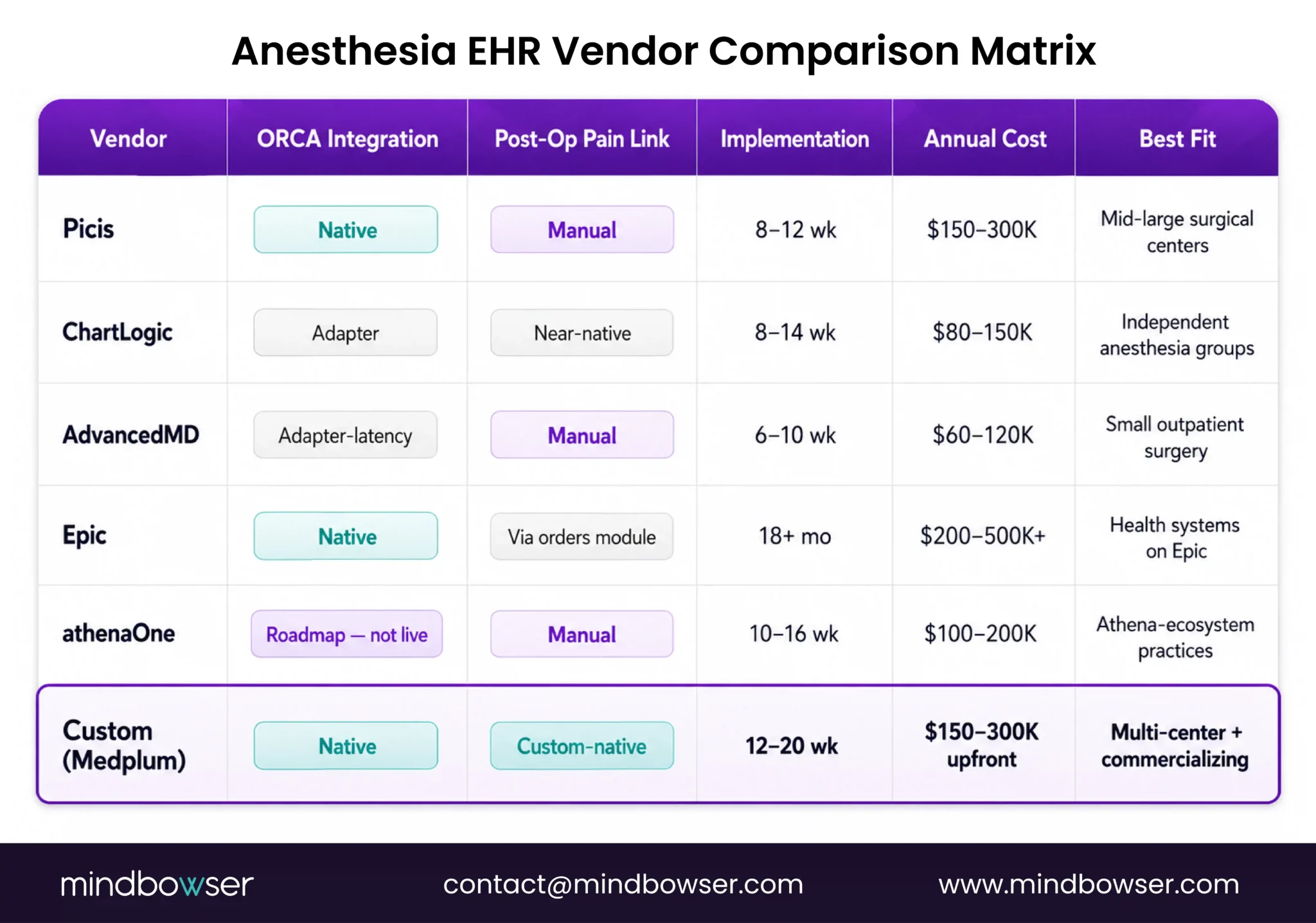
Picis Anesthesia Manager
Picis is purpose-built for anesthesia and perioperative care. That is its core strength. ORCA integration is native, intra-op documentation is structured around OR workflows, and implementation timelines for standalone deployments run 8 to 12 weeks according to KLAS’s 2026 Anesthesia Information Management Systems report, which ranked Picis first for integration speed among specialty AIMS vendors.
Where it breaks down: post-op pain management. Pain tracking after handoff to recovery is handled through manual documentation. Anesthesia notes do not push into post-op pain orders without custom configuration, and that configuration is not part of the standard deployment. For surgical centers managing high post-op volume, this costs 2 to 3 hours per day in manual entry and verbal reconciliation.
Cost range: $150,000 to $300,000 annually.
Best fit: medium to large surgical centers where ORCA integration is the priority and post-op workflows are managed separately.
ChartLogic
A reasonable fit for independent anesthesia groups that want integrated billing and clinical documentation without the complexity of an enterprise system. ORCA integration is available via a third-party adapter. Post-op pain documentation is closer to native than Picis, though still not clean enough to eliminate manual steps at shift handoff.
Where it breaks down: compliance depth. Becker’s Hospital Review flagged anesthesia compliance module gaps as a recurring concern in specialty EHR evaluations heading into 2026, particularly for groups managing payer audit exposure. If your practice is under active payer review or operates in a high-audit specialty segment, the compliance infrastructure in ChartLogic requires supplementation.
Cost range: $80,000 to $150,000 annually.
Best fit: independent anesthesia groups prioritizing billing integration over AIMS depth.
AdvancedMD Anesthesia
Handles basic anesthesia documentation and billing for smaller practices. Straightforward to implement, reasonable support, adequate for low-to-medium OR volume environments.
Where it breaks down: ORCA integration under load. The adapter-based ORCA connection in AdvancedMD shows documented latency at higher OR volumes. For a single-OR outpatient surgery practice, this may be acceptable. For a multi-OR center running 20+ cases per day, real-time vital sync is not reliable enough to depend on.
Cost range: $60,000 to $120,000 annually.
Best fit: small outpatient surgery practices with limited OR volume.
Epic with Anesthesia Module
If your organization is already running Epic, the anesthesia module is the most straightforward integration path. ORCA is native. Epic’s certified device list covers the major anesthesia machine and monitoring vendors. Fierce Healthcare’s coverage of Epic’s 2025 roadmap confirmed continued investment in perioperative workflows, with ORCA compatibility maintained across new device certifications.
Where it breaks down: timeline and cost for specialty-only deployments. A fresh Epic deployment for a standalone anesthesia group runs 18 months or more and $200,000 to $500,000 before you go live. Epic’s anesthesia module is built for health systems managing multi-specialty environments. For a group that only needs anesthesia, the implementation burden is disproportionate to the problem being solved.
Cost range: $200,000 to $500,000+ for fresh deployments.
Best fit: health systems already on Epic where the module adds coverage to an existing investment.
athenaOne with Anesthesia Workflows
Suitable for practices already running athenaOne across their practice, particularly groups migrating from NextGen. The overall practice management infrastructure is solid.
Where it breaks down: ORCA. As of 2026, ORCA integration is on athenaOne’s roadmap but not in production. Healthcare IT News coverage of athena’s 2026 feature release timeline confirmed the delay. For any group with ORCA as a current requirement, this is a hard blocker. Post-op pain documentation is handled manually.
Cost range: $100,000 to $200,000 annually.
Best fit: practices without immediate ORCA requirements that are already committed to athenaOne.
Build a Scalable Anesthesia EHR for Multi-Site Growth
When Does Building Custom Make More Sense?
Building a custom anesthesia EHR used to mean 18 months, $500,000, and significant risk before you had a working system. The economics have shifted.
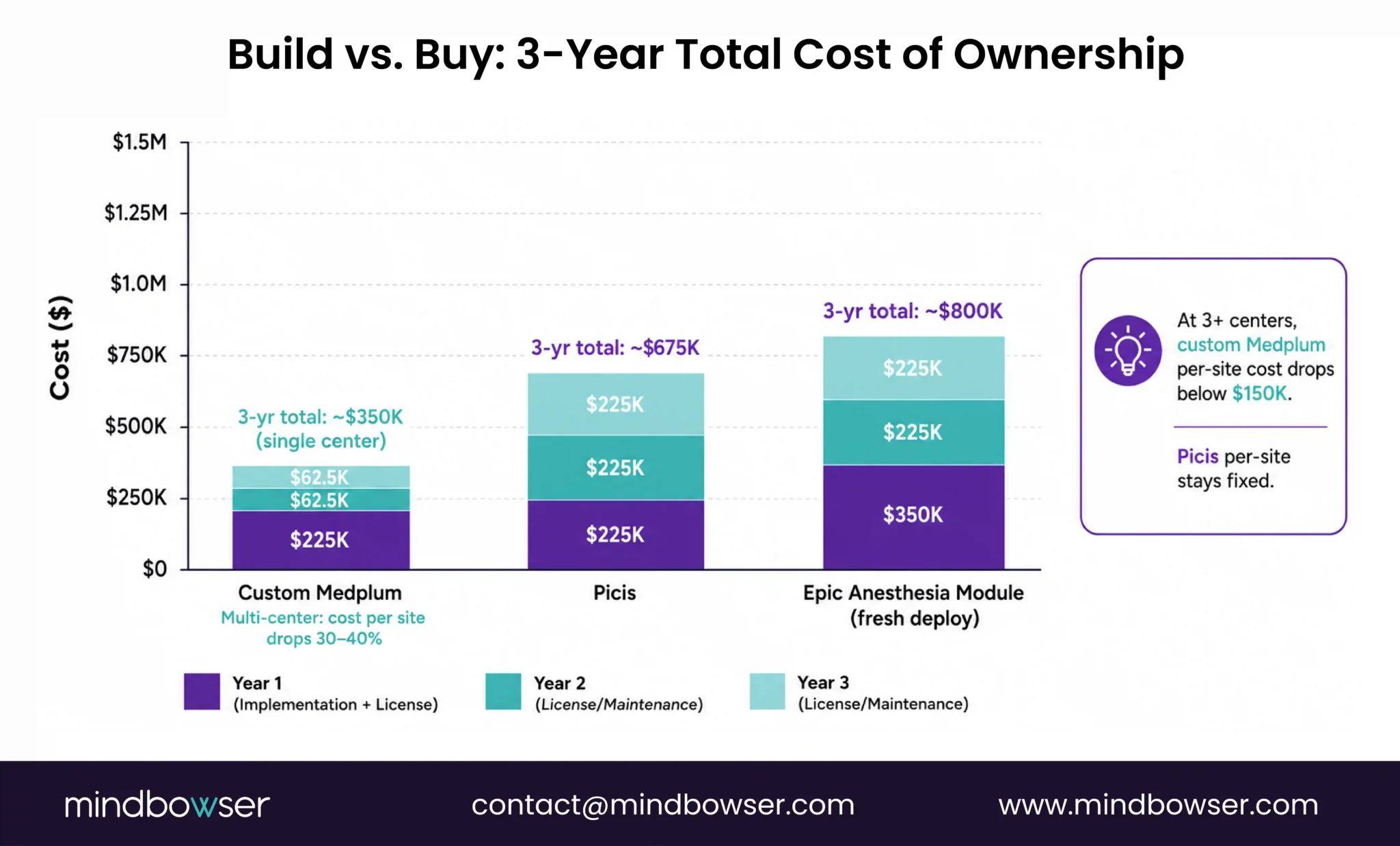
A custom anesthesia build on a FHIR-native foundation like Medplum can go live in 12 to 20 weeks at a cost of $150,000 to $300,000. That is comparable to Picis on a three-year total cost of ownership basis, faster than Epic by a significant margin, and with no per-location licensing as you scale. The ONC certification pathway for custom-built systems is clearer than it was two years ago. USCDI v3 requirements are published, and compliance tooling exists for Medplum-based architectures.
Five signals that custom is worth the evaluation:
1. Your post-op pain workflow is a clinical protocol you have built and refined. If you have developed pain management documentation standards that other practices reference, you need a system that reflects them rather than forces a generic compromise.
2. You need ORCA on a six-month timeline. Custom with Medplum is achievable in that window. Epic is not.
3. You are already on Epic but need anesthesia-specific charting and billing. A custom SMART on FHIR module on top of Epic is faster and less expensive than replacing your broader stack or reconfiguring Epic’s perioperative module for specialty-only use.
4. You operate five or more surgical centers. Picis and most AIMS vendors license per location. Custom is multi-tenant by design. The cost curve inverts at scale.
5. You are building a platform you intend to commercialize. Anesthesia workflow software is an active market, and you cannot build a differentiated product on top of a vendor system you do not control.
The AI Medical Summary accelerator handles post-op documentation natively, producing structured discharge and recovery notes that wire directly into a FHIR stack without additional build. For practices where post-op documentation time is the primary pain, this is the fastest path to closing the handoff gap. On that same note, specialty EHR development across surgical verticals follows similar architecture patterns, so prior builds in cardiology, orthopedics, or oncology settings transfer directly to anesthesia implementations.
How to Evaluate a Custom Anesthesia EHR Builder
If custom is the direction, five questions will separate a builder with real anesthesia depth from one that will spend your first three months learning what ORCA actually requires in an OR environment.
1. ORCA integration experience: Ask for three prior ORCA integrations and which anesthesia machines were involved. Dräger, GE Carescape, and Mindray all have different output formats under operating conditions. “We know FHIR and can integrate anything” is not the same as having mapped those outputs in a live OR.
2. ONC certification pathway: A builder who has walked this before can produce a compliance dossier from a prior engagement. Ask for it. If they describe certification as something they will figure out during the build, their timeline estimate is optimistic.
3. Post-op handoff architecture: Ask them to sketch how anesthesia notes push to recovery nursing orders and how pain scale entries feed back to the anesthesia record. “We will wire that in later” means it is not in scope. That section of the architecture should exist in a schematic before any contract is signed.
4. Multi-specialty modularity: Your builder should explain how specialty-specific features stay modular while maintaining a shared patient record. A monolithic schema where all specialties share one charting flow creates maintenance problems and feature-release conflicts as your clinical needs evolve.
5. Ownership after go-live: Who maintains the system 18 months from delivery? A builder strong on implementation but vague on post-launch operations creates a different kind of vendor dependency, where every configuration change requires engagement with the original build team.
Mindbowser has built specialty EHR workflows across anesthesia, cardiology, oncology, and radiology verticals using Medplum and SMART on FHIR architectures. The ORCA integration work, ONC compliance documentation, and post-op handoff architecture are part of the standard engagement scope, not post-delivery extras.
What This Comes Down to
If ORCA and fast implementation are the priority, Picis or a custom Medplum build. Not Epic.
If post-op pain handoff is the workflow you have invested clinical energy in defining, custom is worth the evaluation. Vendor plus workaround is a recurring cost that does not resolve over time.
If you are already on Epic and looking for anesthesia-specific functionality, the Epic Anesthesia module keeps your environment consolidated. Evaluate the configuration cost honestly before assuming the module covers your specific workflow.
If none of these fit cleanly, that is usually a signal that your workflows have specific requirements that a vendor evaluation alone will not resolve. Our custom EHR development team does a 30-minute architecture review of your requirements a faster path to clarity than another round of demos.
Depends on OR volume and workflow complexity. For three to five ORs with standard pain management, ChartLogic handles the workload at a reasonable cost. For eight or more ORs with post-op tracking requirements, Picis is the stronger option. Custom wins when pain workflows are non-standard, the ORCA timeline is tight, or multi-center scale makes per-location licensing economically irrational.
Most surgical centers do. Configuring a general EHR to handle anesthesia billing, ORCA integration, and post-op workflows adds months of implementation and rarely produces the right result. The exception: if your organization is already on Epic, the Epic Anesthesia module integrates within your existing environment without requiring a separate system.
Vendor systems run $60,000 to $300,000 per year depending on scale and features. A custom build using Medplum architecture runs $150,000 to $300,000 upfront, with approximately $50,000 to $75,000 per year in maintenance. The three-year total cost of ownership is often comparable. The difference is workflow control and the absence of per-location licensing fees at scale.
ORCA integration for real-time vital sync, structured pre-op assessment documentation, intra-op charting with drug logging and event timestamps, post-op pain management handoff that connects to recovery nursing, CPT billing with anesthesia modifiers (P1 through P5 physical status), and comorbidity documentation for reimbursement optimization under the 2026 CMS Anesthesia Fee Schedule.
Not yet. Picis and Epic offer native ORCA. ChartLogic and AdvancedMD use third-party adapters. athenaOne does not have ORCA in production as of 2026. Before any evaluation moves past the demo stage, ask for a live ORCA integration demonstration in an environment that mirrors your anesthesia machine configuration.
Picis runs 8 to 12 weeks for standard deployments. Epic runs 18 months or more for health system implementations. Custom builds with Medplum run 12 to 20 weeks depending on ORCA complexity, the number of OR suites, and the scope of post-op pain integration.
Yes. Custom systems built on Medplum integrate with Epic via SMART on FHIR or HL7 FHIR R4. That means anesthesia-specific charting and billing can live in a purpose-built system while the patient record remains in Epic. This is a common architecture for organizations that need anesthesia depth without replacing the broader Epic environment.
HIPAA at baseline. ONC certification under USCDI v3 applies if the system generates clinical decision support outputs or qualifies as a certified health IT module. Accreditation standards layer on top depending on setting: AAAHC for ambulatory surgery centers and The Joint Commission for hospital-based ORs. Medplum-based builds reduce custom code surface area, which compresses the compliance audit scope compared to a fully from-scratch build.