













 BLOGS
BLOGS  NEWSROOM
  CASE STUDIES
  WEBINARS
  PODCASTS
  ASSET HUB
  EVENT CALENDAR
























TL;DR
Athenahealth Integration in brief:
- Benefits: unified patient data, workflow automation, real-time data exchange, HIPAA-compliant security, API extensibility
- Considerations: FHIR scope limits, per-practice config variability, build-vs-buy timeline (4–6 months custom vs. days on pre-built connectors)
- Next step: see the Athenahealth Integration Platform → for connector options and a scoping call
As patient data grows increasingly complex, the need for reliable EHR integration becomes more critical. A well-integrated EHR system lightens the administrative load and improves patient outcomes by giving clinicians timely, accurate information.
Athenahealth has become a leading choice in EHR systems, known for its easy-to-use interface, cloud-based design, and adaptability across various healthcare settings. Trusted by thousands of organizations, Athenahealth centralizes patient data, simplifies workflows, and offers valuable insights. Its flexibility and scalability make it an excellent fit for healthcare teams looking to boost efficiency without sacrificing the quality of care.
With data from over 140,000 clinicians, 170 million patient records, and thousands of healthcare organizations across the country, Athenahealth has one of the largest repositories of outpatient data in the U.S.
Integrating Athenahealth with your existing systems is key to unlocking its true potential. This integration breaks down silos, supports real-time data sharing between departments, and reduces redundant efforts. By syncing Athenahealth with your current workflows, you can improve operations, build a more connected healthcare environment, and ultimately deliver better care while enhancing staff satisfaction.
I. Why Your Healthcare Team Needs Athenahealth Integration?
Healthcare is moving fast, and staying ahead means having a system that works for you. Integrating Athenahealth into your workflow simplifies operations, improves care coordination, and boosts efficiency across the board. For C-suite executives, this integration helps manage resources better, cuts down on costs, and keeps patient satisfaction high. As healthcare evolves, Athenahealth adapts to your organization’s needs, making it a strong fit for today’s demands.
Athenahealth integration ensures patient data flows smoothly between systems, giving care teams smooth access to important information. It supports informed decision-making and helps deliver more personalized care without adding extra admin work.
Its real-time data sharing keeps you compliant with regulations while allowing staff to focus on what matters most—patient outcomes. Plus, Athenahealth’s tools simplify revenue cycle management, making billing and patient engagement easier. Its cloud-based system helps quickly scale services without getting stuck in IT challenges.
II. Key Features of Athenahealth EHR Integration
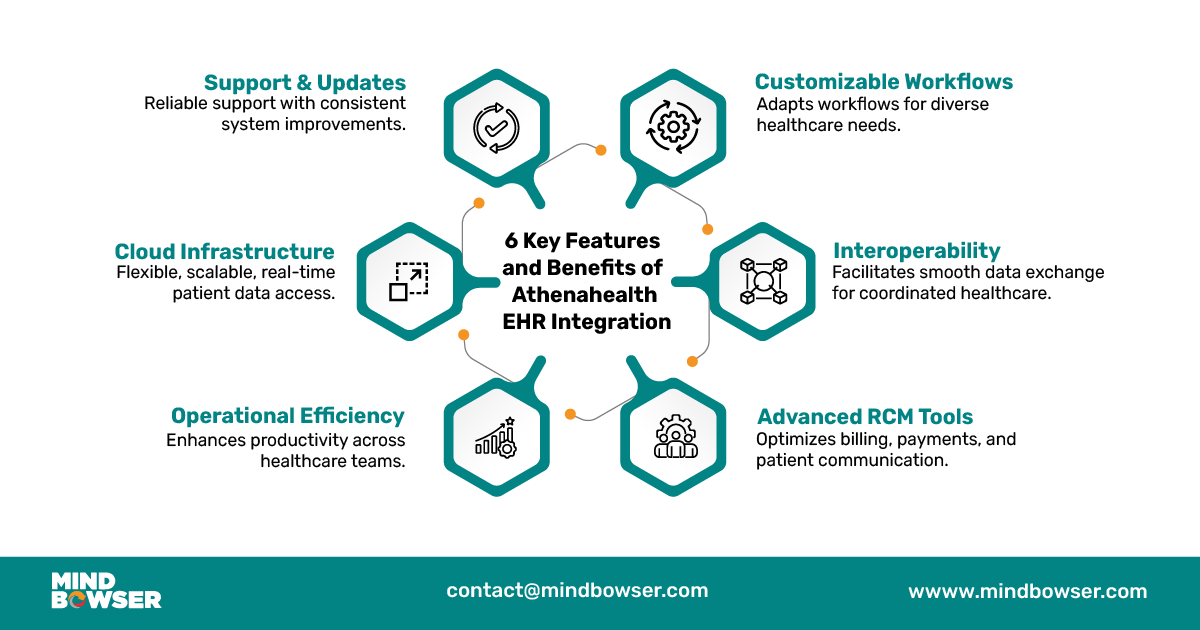
Customizable Workflows for Various Healthcare Specialties
Athenahealth provides flexible, customizable workflows tailored to your organization’s specific healthcare needs, whether you’re managing a general practice or a specialized clinic. The platform allows you to adjust templates, appointment types, and treatment plans, ensuring your system works precisely how your teams need it to.
Interoperability with a Wide Range of Health Information Systems
Real-time data exchange is vital in modern healthcare. Athenahealth’s interoperability ensures that your EHR system connects smoothly with other healthcare information systems, improving the sharing of vital patient information and reducing manual data entry errors.
Advanced Tools for Revenue Cycle Management and Patient Engagement
Athenahealth streamlines billing, collections, and reimbursement processes, which improves cash flow and revenue tracking. Additionally, it enhances patient engagement through appointment reminders, telehealth solutions, and patient portals, increasing satisfaction and compliance.
Improved Operational Efficiency and Better Patient Care Coordination
Athenahealth Integration improves overall operational efficiency, enabling healthcare providers to collaborate more effectively. Real-time access to patient data means that your team can make faster, more informed decisions, improving patient outcomes and care coordination.
Cloud-Based Infrastructure with Real-Time Updates and Scalability
Athenahealth’s cloud-based system ensures your organization benefits from real-time updates, improved security, and scalability. This flexibility allows your healthcare practice to adapt quickly to new regulations, scale services, and integrate cutting-edge features without cumbersome software updates.
Detailed Support and Frequent Feature Updates
Athenahealth integration offers responsive customer support, ensuring that your team gets the help they need when they need it. Frequent updates mean your system remains current with the latest healthcare innovations and regulatory requirements, keeping your organization competitive and compliant.
III. Benefits of Athenahealth EHR Integration
Unified Data Management
Athenahealth integration ensures that patient records, appointment schedules, and clinical data are unified in one platform, making it easier for healthcare teams to access and update patient information in real time.
Workflow Automation
The system automates many routine tasks such as appointment scheduling, billing, and follow-up reminders, significantly reducing administrative workload and allowing your team to focus more on patient care.
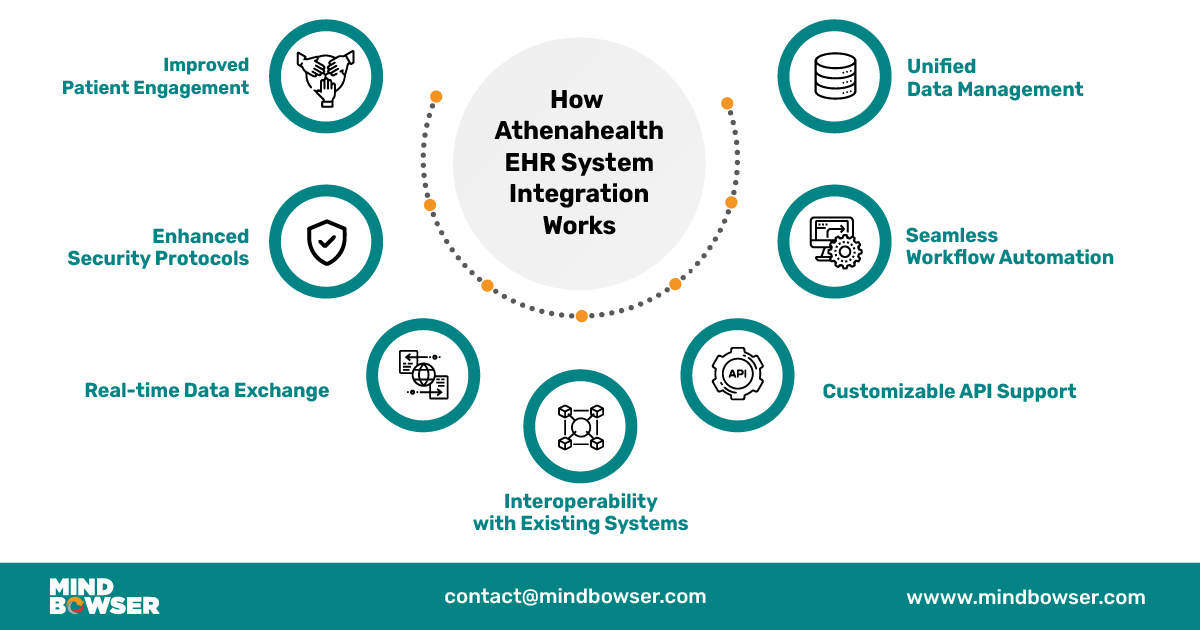
Customizable API Support
Athenahealth integration offers extensive API support, which allows you to integrate third-party apps and systems. This flexibility helps tailor the system to your specific operational needs, whether it’s connecting billing systems, telehealth apps, or patient portals.
Interoperability with Existing Systems
Athenahealth is designed to work with your existing healthcare systems. Whether it’s a legacy EHR system or a specific billing platform, Athenahealth can integrate without disrupting existing workflows.
Real-time Data Exchange
The Athenahealth integration enables real-time data sharing between departments, devices, and locations. This provides timely and accurate care, especially in larger, multi-location healthcare organizations.
Enhanced Security Protocols
With Athenahealth integration, data security is a priority. The system uses advanced encryption and secure data-sharing protocols to ensure patient information is protected, keeping your organization compliant with healthcare regulations like HIPAA.
Related read: Healthcare Data Security Checklist
Improved Patient Engagement
Athenahealth enables better patient communication through portals that allow patients to book appointments, access their medical records, and communicate with their healthcare providers directly.
IV. What to Consider Before Integrating Athenahealth
- FHIR resource scope limits: Athenahealth’s FHIR API covers the core resources (Patient, Encounter, Observation, DocumentReference) well, but some legacy data types and write-back flows require custom HL7 interfaces or additional API agreement with athenaOne. Map your exact data contract before scoping.
- Practice configuration variability: Athenahealth is heavily configurable per practice appointment types, custom fields, billing workflows. An integration built for one practice’s configuration may need adjustment for another site in the same organization. Budget for per-site QA.
- Build vs. buy timeline: Custom integrations typically run 4–6 months end-to-end (discovery → development → sandbox testing → go-live). Pre-built connectors compress this to days for standard FHIR flows, but custom HL7 feeds or non-standard write-backs still require engineering time.
- HIPAA and audit requirements: Any Athenahealth integration that moves PHI needs HIPAA-compliant logging, access controls, and BAA coverage with both Athenahealth and any middleware in the stack. Confirm BAA coverage before going live.
Integrating Athenahealth: Build vs. Buy
Most Athenahealth integration projects stall at the same point every practice configures Athenahealth a little differently, FHIR scopes have to be requested and approved, and a custom interface has to be built, tested, and maintained for each connection. For an ambulatory team without a dedicated integration department, that’s months of engineering before any data moves. A healthcare integration platform like ConnectHealth already handles that layer: pre-built Athenahealth connectors with the common FHIR resources mapped, deployed inside your own AWS VPC so patient data never leaves your environment. What a from-scratch build runs in 6 months, a pre-built connector ships in days.
ConnectHealth runs Athenahealth integration in production including for Plenful, a pharmacy and RCM automation platform connecting Athenahealth with multiple EHRs. Where it gets honest: if your workflow needs a non-standard data type, a write-back no connector covers yet, or a legacy HL7 feed, that’s custom engineering and Mindbowser’s team builds it on the same FHIR/HL7 foundation. You’re not forced into one path.
See the full connector, deployment model, and scoping options: Athenahealth Integration Platform
Athenahealth integration organizes workflows by centralizing patient data, enhancing communication, and automating administrative tasks, improving overall efficiency.
Integrating Athenahealth with existing systems ensures clean data exchange, reduces duplication, and supports better decision-making for healthcare providers.
Yes, by providing real-time access to patient records, Athenahealth integration enables faster diagnosis, personalized treatments, and better patient care coordination.
Athenahealth integration fosters collaboration by allowing team members to access the same up-to-date patient information, improving communication and care management.