












 BLOGS
BLOGS  NEWSROOM
  CASE STUDIES
  WEBINARS
  PODCASTS
  ASSET HUB
  EVENT CALENDAR


















TLDR;
MedPlum is a FHIR-native, headless EHR that gives healthcare teams a modern backend for building interoperable, scalable, and AI-ready applications. It simplifies integrations, accelerates development, and provides a secure foundation aligned with HIPAA, ONC, and SOC 2 requirements.
Is your organization ready for a future where every digital health product requires FHIR-native interoperability out of the box?
With 71% of countries globally already using FHIR in live use cases and over half expecting rapid adoption growth, building on a FHIR-native platform is no longer optional.
MedPlum is a headless EHR and FHIR-native development platform that helps healthcare organizations build modern digital health applications without carrying the complexity of a legacy EHR. As a full FHIR server, MedPlum stores, manages, and retrieves healthcare data using standardized FHIR resources, enabling developers to build interoperable applications that align with today’s regulatory and operational requirements.
I. Why FHIR-Native Backends Matter in Real-World Integrations
In practice, many healthcare teams still rely on CSV uploads, flat files, or scheduled batch jobs because live EHR integrations are slow, brittle, or simply unavailable. These stopgap workflows help teams move data early, but they collapse as volume increases and expectations shift toward real-time automation.
CSV-based pipelines introduce lag, manual intervention, and data inconsistency. They also block event-driven use cases such as automated care actions, AI-triggered workflows, and near-real-time reporting. What starts as a workaround quickly becomes technical debt.
FHIR-native backends remove the need for these patterns by establishing a canonical data layer from day one. Instead of stitching together exports and transformations, teams work with standardized FHIR resources accessible via APIs and events.
A true FHIR server simplifies downstream development because every system reads and writes from the same structured model. Developers spend less time reconciling formats and more time building product logic that depends on consistent, real-time data access.
FHIR is now central to healthcare data exchange, allowing EHRs, payers, providers, and digital health platforms to share data reliably. MedPlum’s FHIR-first architecture ensures seamless interoperability through APIs that reduce integration effort and accelerate data exchange.
This is especially valuable for engineering teams building clinical workflows, care management tools, RPM platforms, AI-enhanced applications, or patient-facing solutions.
Reshma Khilnani, CEO of MedPlum, said in one of her podcasts,
We build an open-source health record development platform and think of ourselves as a DevTools company, though we are also in EHR land.
One of MedPlum’s strongest advantages is its ability to future-proof healthcare systems. As standards evolve, MedPlum’s adherence to FHIR, SMART, and modern API patterns allows organizations to avoid costly replatforming or backend rewrites. This reduces long-term operational overhead and ensures consistency as organizations scale.
II. Medplum Features: FHIR Server, Subscriptions, and CDS Hooks
A. What real-time data exchange capabilities does MedPlum offer?
MedPlum supports real-time data exchange between healthcare applications, ensuring patient information remains up to date across systems. This reduces manual data transfers, lowers administrative workload, and enables care teams to collaborate more effectively. Up-to-date data improves decision-making, reduces errors, and enables responsive care delivery.
B. How does MedPlum support FHIR compliance and interoperability?
MedPlum is fully compliant with FHIR standards, enabling secure, structured data exchange across healthcare systems. Organizations can integrate MedPlum with EHRs, third-party apps, and partner systems through FHIR APIs, improving overall interoperability.
As FHIR becomes the global standard for healthcare data exchange, MedPlum helps teams ensure consistency and compatibility across platforms.
C. How does MedPlum scale for growing healthcare organizations?
MedPlum is designed to scale with growing clinical, administrative, and data workloads.
Whether supporting a specialty clinic or a large multisite provider, MedPlum can expand to handle increased patient volume, data complexity, and workflow requirements. Its backend architecture supports predictable scaling without operational disruption.
D. What does MedPlum’s EHR layer include?
MedPlum includes a streamlined EHR layer that simplifies charting, ordering, scheduling, and core clinical workflows.
Providers can create notes, manage encounters, track orders, and oversee patient schedules in a clean and structured interface. The platform also supports billing and revenue cycle workflows, helping organizations manage claims and reimbursement processes efficiently.
E. What certifications and compliance standards does MedPlum meet?
MedPlum meets key healthcare compliance standards, including ONC certification, SOC 2 Type II, and HIPAA compliance. These certifications ensure that patient data is secured, systems are auditable, and workflows meet regulatory expectations.
Healthcare organizations can adopt MedPlum with confidence that data privacy and security are handled appropriately.
For a deeper look at real-world implementation risks, explore our analysis of HIPAA compliance in wearable technology, which highlights key security considerations relevant to any FHIR-powered system.
Make healthcare data management easier with MedPlum and Mindbowser’s experienced team.
III. How Does MedPlum Fit Into a Modern FHIR Architecture?
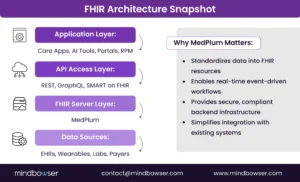
MedPlum serves as the central FHIR layer in a modern healthcare architecture, enabling developers to standardize data models across complex systems.
It supports the core building blocks of FHIR, including Resources, Profiles, Bundles, and RESTful interactions, enabling predictable integration with EHRs, partner platforms, and AI-based applications.
Teams can use MedPlum as the authoritative FHIR server or layer it alongside existing EHRs to unify data structures without replacing the core system of record. This flexibility is essential for organizations transitioning to FHIR or modernizing legacy environments that still rely on HL7 v2, CCDs, or proprietary interfaces.
Teams modernizing their legacy systems or moving from HL7 v2 to FHIR can reference our HL7 to FHIR migration guide to plan a smooth transition.
For developers, MedPlum provides a consistent backend foundation that handles identity, resource validation, versioning, persistence, and access control, so engineering teams can focus on building new clinical capabilities rather than managing infrastructure.
Replacing brittle HL7 glue with a stable FHIR backbone
Teams transitioning from HL7 v2 often underestimate the long-term complexity of message-based integrations. Variations across feeds, subtle mapping drift, and delivery acknowledgements introduce ongoing operational overhead that grows with every new interface.
Maintaining HL7 pipelines is not a one-time effort. Schemas change. Source systems evolve. Edge cases accumulate. Engineering teams end up maintaining fragile glue code instead of advancing the product.
A centralized FHIR server changes that equation. Legacy data can be normalized once into FHIR resources, rather than repeatedly transformed for each downstream consumer. The result is fewer pipelines, fewer mappings, and more predictable data behavior.
MedPlum can serve as the authoritative FHIR layer alongside existing EHRs, allowing organizations to modernize incrementally. Instead of rebuilding integrations repeatedly, teams rely on a stable backbone that supports applications, analytics, and automation without multiplying integration effort.
IV. Benefits of Using MedPlum for Healthcare Data Management
A. How does MedPlum simplify integration across healthcare systems?
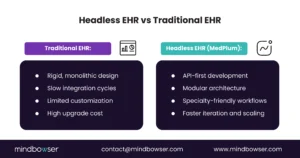
MedPlum simplifies integration with a flexible FHIR API that enables data exchange across EHRs, care platforms, payers, and third-party systems. Engineering teams can build or modify applications to meet their organization’s needs without being constrained by rigid EHR frameworks. Its open-source foundation enables faster customization with fewer disruptions.
B. How does MedPlum improve patient care through real-time data?
Timely access to patient information is essential for care delivery. MedPlum retrieves data from multiple sources, providing clinicians with a complete and up-to-date view of each patient. Real-time updates reduce clinical errors, improve coordination, and enable more accurate diagnoses and treatment decisions.
C. How does MedPlum ensure compliance with healthcare data standards?
managing and transferring patient data, MedPlum reduces the risk of non-compliance and data breaches. Healthcare organizations benefit from a secure, auditable, and compliant data management environment.
D. How flexible is MedPlum for specialty-specific workflows?
MedPlum is adaptable to various specialties such as cardiology, oncology, behavioral health, and primary care. Clinicians can customize templates, forms, workflows, and integrations to match their practice’s needs. Specialty-specific data can be incorporated seamlessly into care pathways.
E. How does MedPlum support developers through its API?
MedPlum is built with developers in mind. Its intuitive FHIR API, GraphQL support, real-time synchronization, and robust documentation make it straightforward for engineering teams to build and deploy new features. The open-source ecosystem enables rapid iteration and innovation.
F. Reducing engineering drag from integration complexity
Custom integration stacks often take months to stabilize. During that time, engineering teams are pulled away from core product development to troubleshoot mappings, reconcile data discrepancies, and manage edge cases across environments.
Even when AI-assisted connector generation is used, teams still face testing, validation, and ongoing maintenance. The integration work does not disappear. It just shifts into a different form of operational load.
FHIR-native platforms are adopted to protect engineering velocity. By standardizing how data is stored and accessed, teams reduce long-term overhead tied to maintaining bespoke pipelines and transformations.
MedPlum provides a consistent backend foundation that allows teams to focus on building clinical and product capabilities rather than managing integration infrastructure.
G. Build vs Buy: Why Teams Adopt FHIR-Native Platforms
As organizations scale, CTOs and platform leaders face a recurring decision: build custom integration layers or adopt a FHIR-native system of record.
Custom builds introduce hidden complexity. Ongoing mapping changes, monitoring requirements, and environment management compound over time, especially as new partners, data sources, and use cases are added.
FHIR-native platforms reduce the need for repeated transformation by enforcing consistent data models and predictable access patterns. Integrations become simpler because downstream systems rely on standardized behavior rather than bespoke logic.
MedPlum often serves as a stable foundation for integrations, AI workflows, and applications, allowing them to build on it without re-engineering the data layer at each step.
Related Read – Headless EHR Comparison: Medplum vs Healthie vs OpenEMR vs Oystehr vs Canvas
V. How Mindbowser Builds and Integrates on Medplum
One digital health startup used Medplum as their FHIR data layer, cut clinical documentation time by 70%, and deployed a production-ready EHR platform in under 90 days.
Integration work: connecting your existing systems to Medplum FHIR
Integrating with MedPlum gives healthcare organizations a modern, FHIR-native foundation that removes many of the constraints of traditional EHR architectures.
Its combination of a headless EHR, a full FHIR server, and open-source flexibility enables teams to build faster, integrate systems more reliably, and scale digital products with fewer backend limitations.
This positions MedPlum as a strong fit for health systems and digital health teams moving toward more interoperable and automation-ready care models, including those looking to design and deploy custom EHR solutions tailored to their unique workflows and care delivery models.
With a strategic implementation approach, MedPlum becomes more than a development tool; it becomes the backbone for real-time data exchange, clinical workflow automation, and AI-driven innovation.
Watch this webinar: Building AI & FHIR-First Clinical Platforms with MedPlum; a practical walkthrough of how teams are building AI-ready, interoperable clinical platforms using MedPlum, including real-world use cases and a live demo.
Mindbowser ensures that organizations adopt MedPlum with the right infrastructure, alignment with compliance requirements, and integration patterns to unlock its full value and support long-term digital transformation
Build work: clinical platforms and EHR products built on Medplum
MedPlum provides the foundation but real value is realized when that foundation is aligned with clinical workflows, business goals, and scalable architecture patterns.
Mindbowser builds on MedPlum by combining deep healthcare domain expertise with hands-on platform implementation experience to accelerate production-ready outcomes.
Our approach goes beyond basic integration. We design and implement MedPlum-powered platforms that support custom EHR development, care management workflows, patient engagement layers, and AI-driven use cases; all while maintaining strict compliance with HIPAA and interoperability standards.
This includes:
- Designing FHIR-native data models aligned with real clinical workflows
- Building custom EHR interfaces and modules tailored to provider needs
- Integrating MedPlum with legacy EHRs, payer systems, and third-party platforms
- Enabling real-time data pipelines for analytics, automation, and AI applications
- Implementing security, audit, and compliance frameworks from day one
With experience across digital health platforms and mid-market provider systems, Mindbowser ensures that MedPlum is not just implemented but operationalized as a scalable, future-ready healthcare data platform.
When to Choose Medplum for Your Healthcare Platform
MedPlum gives healthcare organizations a modern, FHIR-native foundation that removes many of the constraints of traditional EHR architectures.
Its combination of a headless EHR, a full FHIR server, and open-source flexibility enables teams to build faster, integrate systems more reliably, and scale digital products with fewer backend limitations.
This positions MedPlum as a strong fit for health systems and digital health teams moving toward more interoperable and automation-ready care models.
With a strategic implementation approach, MedPlum becomes more than a development tool; it becomes the backbone for real-time data exchange, clinical workflow automation, and AI-driven innovation.
Mindbowser ensures that organizations adopt MedPlum with the right infrastructure, alignment with compliance requirements, and integration patterns to unlock its full value and support long-term digital transformation.
MedPlum is an open-source, FHIR-native backend platform that functions as both a headless EHR and a full FHIR server. Teams use it to build interoperable healthcare applications, streamline data exchange, and support workflows that depend on standardized clinical data models.
MedPlum provides RESTful FHIR APIs, GraphQL support, resource validation, versioning, and event-driven capabilities that allow engineering teams to integrate EHRs, care platforms, and third-party systems with predictable data structures. This makes it easier to build applications that rely on consistent FHIR resources.
In practice, this reduces reliance on batch jobs, file-based exchanges, and custom transformation layers, which often slow development. By standardizing access to FHIR resources early, teams can build real-time and event-driven workflows without accumulating brittle integration logic.
Yes. MedPlum can connect with existing EHR systems through FHIR APIs, HL7 interfaces, and custom data pipelines. It serves as an interoperability layer, enabling organizations to unify data across modern and legacy systems without replacing their core EHR systems.
MedPlum is HIPAA-compliant, SOC 2 Type II-certified, and ONC-certified. It includes access controls, audit logging, secure data storage, and validated FHIR resource handling, ensuring that patient data is protected and that implementations meet regulatory requirements.
Yes. MedPlum’s real-time synchronization, event-triggered workflows, and structured FHIR data support AI-enabled features that depend on consistent, interoperable data rather than delayed or manual data movement.
MedPlum is both. It provides a headless EHR layer for charting, ordering, scheduling, and documentation, while also acting as a developer-first FHIR server and API platform. Organizations can use it as their primary EHR or as a modern interoperability and development layer.
MedPlum is used by digital health startups, health systems, specialty practices, care management platforms, and AI-driven healthtech products that need modern FHIR infrastructure, customizable workflows, and scalable backend capabilities.