














 BLOGS
BLOGS  NEWSROOM
  CASE STUDIES
  WEBINARS
  PODCASTS
  ASSET HUB
  EVENT CALENDAR



















TL;DR
Epic owns 42.3% of the acute care hospital market (Becker’s, 2026). For hospitals, it’s the default. For specialty practices – fertility, behavioral health, home health, oncology, dental – it’s an expensive mismatch. Custom templates cost $5K-$15K each. Specialty modules run $75K+. Five-year customization budgets hit $50K-$200K for small practices. At that point, you’re paying Epic to be something it wasn’t designed to be. Here’s when custom makes sense, when it doesn’t, and the bridge option nobody talks about.
A medical director at a specialty practice group said something to us that stuck: “The 10% of our workflow that Epic doesn’t cover is the 10% that IS our specialty.”
That’s the problem in one sentence. Epic is excellent at what it was built for: hospital workflows, enterprise standardization, and network interoperability across large health systems. KLAS Research (2025) measured a 30-point satisfaction gap between the most satisfied specialty (hospital medicine) and the least (ophthalmology) on the same platform. That’s not a bug report. That’s an architecture mismatch.
Trinity Health is spending $800 million on its Epic rollout. Endeavor Health is consolidating 3 separate Epic instances into 1 because even within Epic, configuration sprawl creates problems. Meanwhile, specialty-focused alternatives like ModMed have been named #1 in 11 specialties by Black Book.
The migration wave isn’t just Cerner-to-Epic. It’s also specialty-practices-away-from-Epic.
I. What’s the Epic Problem for Specialty Practices?
Epic wasn’t designed for your fertility clinic. Or your behavioral health practice. Or your home health agency. It was designed for hospitals. The specialty features are configurations of a hospital platform, not purpose-built tools.
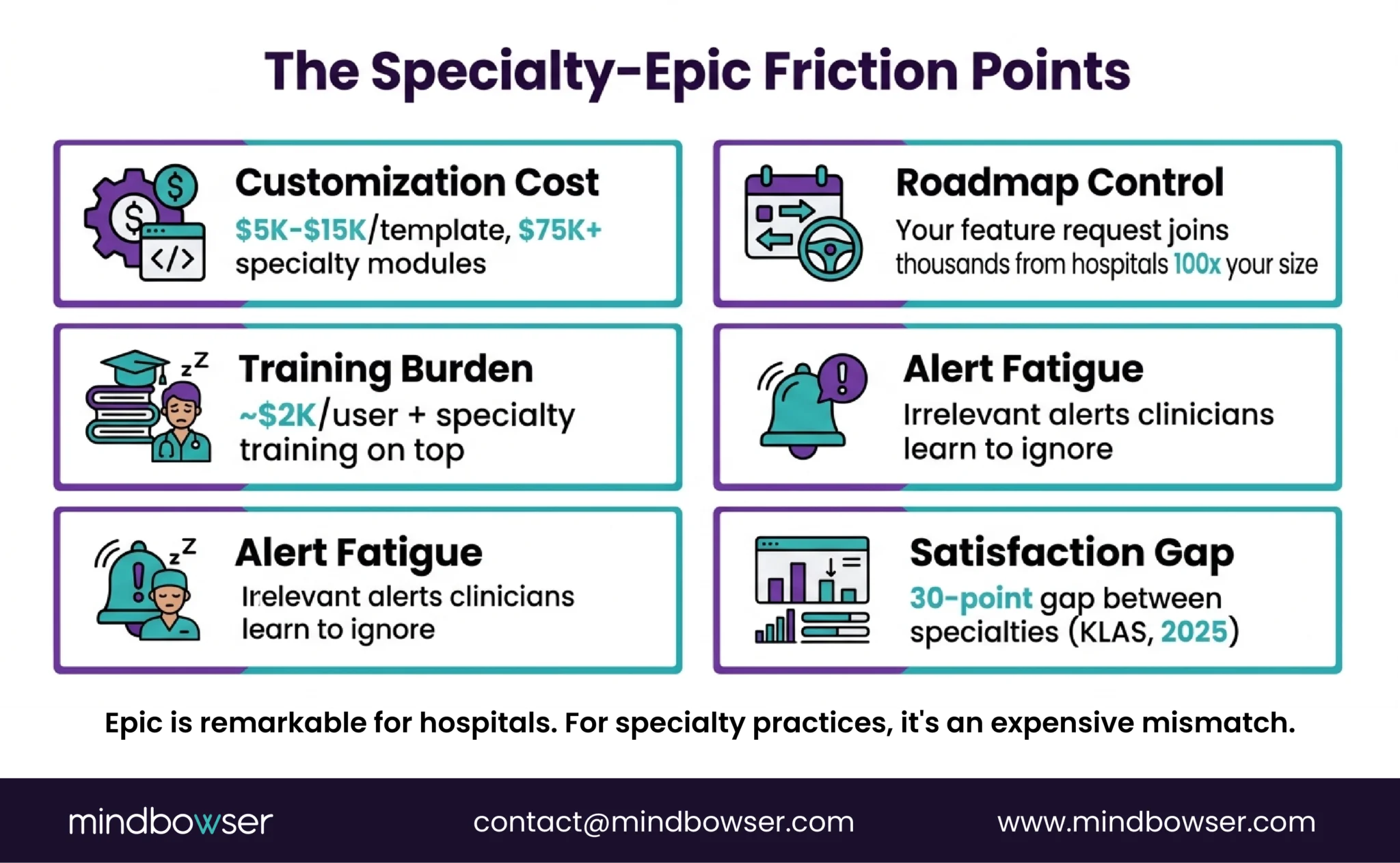
That creates five friction points:
- Customization is expensive and slow. Epic professional services charge for every template, workflow, and report modification:
- Custom templates: $5K-$15K each
- Workflow adjustments: $8K-$20K per change
- Custom reports: $3K-$10K each
- Specialty modules: $75K+
- Small practice 5-year customization total: $50K-$200K
- Feature requests go into a roadmap you don’t control. Your fertility clinic needs gestational carrier tracking. That feature request joins a queue with thousands of other requests from hospitals 100x your size. Your priority is not Epic’s priority.
- Training complexity compounds for specialties. Epic’s general training takes approximately $2,000 per user. For specialty-specific modules, clinicians must learn the general system AND the specialty configuration. Staff at specialty practices report the system feels “clunky” and that “finding simple patient info feels like a maze”.
- Alert fatigue is a documented problem. Epic’s Best Practice Alerts are powerful but generate excessive notifications that clinicians learn to ignore without active governance. In specialties with unique clinical protocols, the default alerts are often irrelevant – and the relevant ones require custom configuration (see cost point above).
- The satisfaction gap is measurable. KLAS (2025): 30-point gap between hospital medicine satisfaction and ophthalmology satisfaction on the same Epic platform. That gap represents hours of workarounds, frustrated clinicians, and workflows that fight the software instead of flowing through it.
The link between EHR and burnout is “settled science” – Annals of Internal Medicine published a landmark paper establishing the direct connection between EHR design and physician burnout. For specialty practices where the EHR is an even worse fit than general medicine, the burnout risk is amplified.
II. Which Specialties Hit the Wall First?
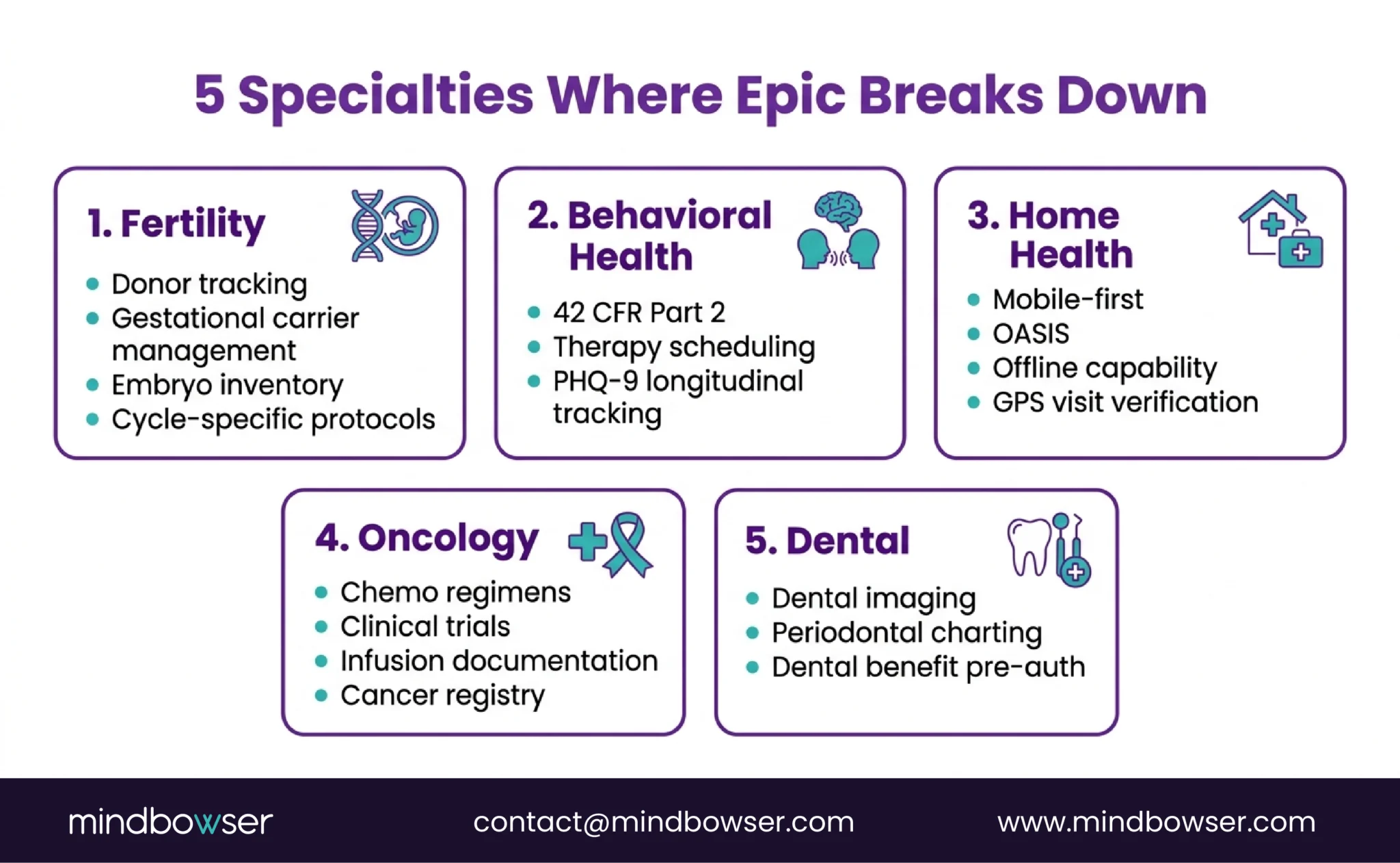
Five specialties consistently outgrow Epic’s template-based approach. Each has workflow requirements that don’t map to hospital-centric data models.
A. Fertility and Surrogacy
What breaks: Donor tracking across multiple cycles. Gestational carrier management (the patient isn’t the person carrying the pregnancy). Egg/embryo inventory with chain-of-custody documentation. IVF protocol management with medication timing that changes cycle-to-cycle.
Epic’s OB module assumes the patient IS the pregnant person. In surrogacy, that assumption breaks every workflow.
B. Behavioral Health
What breaks: 42 CFR Part 2 requires substance use disorder records to be segmented from the rest of the chart – a separate consent model that most EHR configurations don’t handle natively. Therapy session scheduling needs different rules (50-minute slots, not 15-minute). No-show and cancellation policies differ from medical appointments. PHQ-9/GAD-7 outcome tracking over time needs longitudinal visualization, not just point-in-time documentation.
For deeper context on behavioral health EHR, see our mental health EHR guide.
C. Home Health
What breaks: Mobile-first is non-negotiable – clinicians work in patients’ homes, not at hospital workstations. OASIS assessment requirements generate specific documentation flows that don’t fit hospital templates. Offline capability is required for areas with poor connectivity. Visit verification needs GPS and timestamp integration. Epic is a desktop application. Home health is a mobile workflow.
D. Oncology
What breaks: Chemotherapy regimen management with complex multi-drug protocols that change based on response. Clinical trial eligibility screening and data capture. Infusion administration documentation with weight-based dosing calculations. Cancer registry reporting with specific data elements. Epic has an oncology module, but practices with complex protocols often find themselves maintaining spreadsheets alongside it.
E. Dental
What breaks: Dental imaging integration (periapical, panoramic, CBCT) with a viewer designed for dental anatomy. Periodontal charting with probing depths at 6 sites per tooth. Treatment planning with insurance pre-authorization specific to dental benefit structures (not medical). Dental workflows are so different from medical workflows that dental-specific EHRs (Dentrix, Open Dental) dominate the market entirely outside of hospital-based dental clinics.
Build a Custom EHR
III. What’s the Real Cost of Epic Workarounds?
The customization costs above are the visible expense. The invisible costs are larger.

A. Staff time on manual processes
When Epic doesn’t support a workflow natively, staff create manual workarounds: copying data between screens, maintaining external tracking sheets, manually routing referrals that should be automated. For a 10-provider specialty practice, this can consume 2-4 hours per provider per week in inefficiency.
B. Revenue loss from billing complexity
Specialty billing codes don’t always map cleanly to Epic’s billing configuration. A behavioral health practice billing E/M codes + psychotherapy add-on codes + distinct encounter services for the same visit needs the billing engine to handle that combination without manual routing. When it doesn’t, claims go out wrong, get denied, and require rework.
C. Clinician burnout from fighting the system
EHR-driven burnout isn’t theoretical. The Annals of Internal Medicine (2018) established the link as “settled science.” For specialties where the EHR fit is worst, the burnout risk is amplified. A clinician spending 30 minutes per day on workarounds that a purpose-built system would eliminate is losing 120+ hours per year.
The shadow system problem: When the EHR doesn’t work, staff build shadow systems – Excel trackers, paper forms, personal notes, WhatsApp groups. Each one is an unaudited, non-compliant data source that creates HIPAA risk. We’ve seen practices with 5+ shadow systems running alongside Epic. That’s not an EHR implementation. That’s a compliance incident waiting to happen.
The math:
| Cost Category | Epic (5 years) | Custom Platform |
|---|---|---|
| Licensing/customization | $50K-$200K | $0 (you own it) |
| Staff inefficiency | 1,000-2,000 hours/year | Eliminated by design |
| Shadow system risk | Unquantifiable HIPAA exposure | No shadow systems needed |
| Platform build | $0 (already paying Epic) | $50K-$150K (Medplum-based) |
| Ongoing maintenance | Vendor-dependent ($300-$500/hr) | 15-25% of build/year ($10K-$30K) |
| 5-year outcome | $50K-$200K spent, still doesn’t fit | $80K-$200K, designed for your workflow |
IV. When Does Custom Make Sense – and When Does Epic Win?
This isn’t an anti-Epic piece. It’s an architecture-fit piece. Epic wins in some scenarios. Custom wins in others. There’s also a bridge option.
A. When Custom EHR Wins
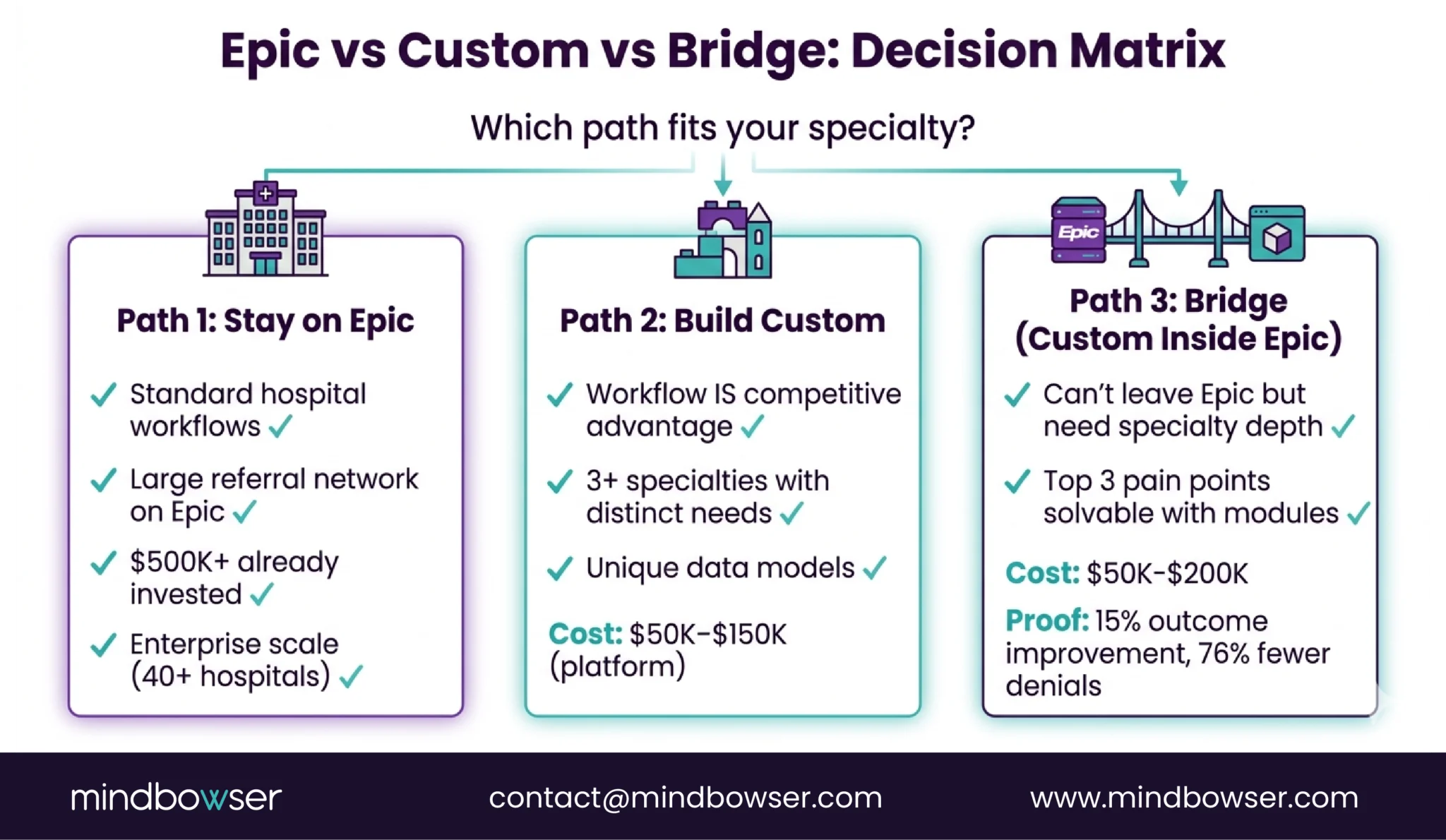
- Your workflow IS your competitive advantage. If the clinical workflow is what makes your practice different (fertility protocols, behavioral health outcome tracking, home health mobile documentation), custom protects and enhances that advantage.
- You have 3+ specialties with distinct documentation needs, and Epic forces workarounds in 2+ departments. (Multi-specialty EHR guide covers this in depth.)
- Your data model is unique. Gestational carrier tracking, donor inventory, or clinical trial data capture – these aren’t configurations. They’re different data models.
- Platform-based builds are affordable. $50K-$150K on Medplum or another headless platform. That’s less than many practices spend on Epic customization over 3 years.
B. When Epic Wins
- Standard hospital workflows. If your practice runs on the same workflows as every other primary care or internal medicine practice, Epic’s template works fine.
- Network effects matter. If your referral network is entirely Epic-based, being on Epic simplifies data exchange (though FHIR APIs are closing this gap).
- You’ve already invested. Sunk cost isn’t nothing. If you’re 3 years into an Epic implementation with $500K+ invested, building custom may not be the right next step.
- Enterprise scale requires it. For 40+ hospital systems, Epic’s enterprise capabilities (standardization, governance, interoperability) are hard to replicate with custom builds.
C. The Bridge Option: Custom Modules Inside Epic
This is what nobody talks about. You don’t have to choose between Epic and custom. You can build custom clinical modules that run inside Epic via SMART on FHIR.
Our proof: We built a custom clinical decision support module that integrates with a major EHR platform via SMART on FHIR. It provides specialty-specific guidance that the platform’s native modules don’t offer. 15% improvement in clinical outcomes. 76% fewer coding denials. The host EHR handles scheduling, billing, and general documentation. The custom module handles the specialty workflow.
This is a $50K-$200K project that gives you the best of both worlds: Epic’s enterprise infrastructure + custom specialty capabilities. For practices that can’t leave Epic but need deeper specialty tooling, this is the realistic path.
Evaluating whether to customize Epic, build alongside it, or replace it entirely? Tell us about your specialty workflow, and we’ll map the options.
V. How Do You Actually Make the Transition?
Five steps. You don’t have to do them all at once.
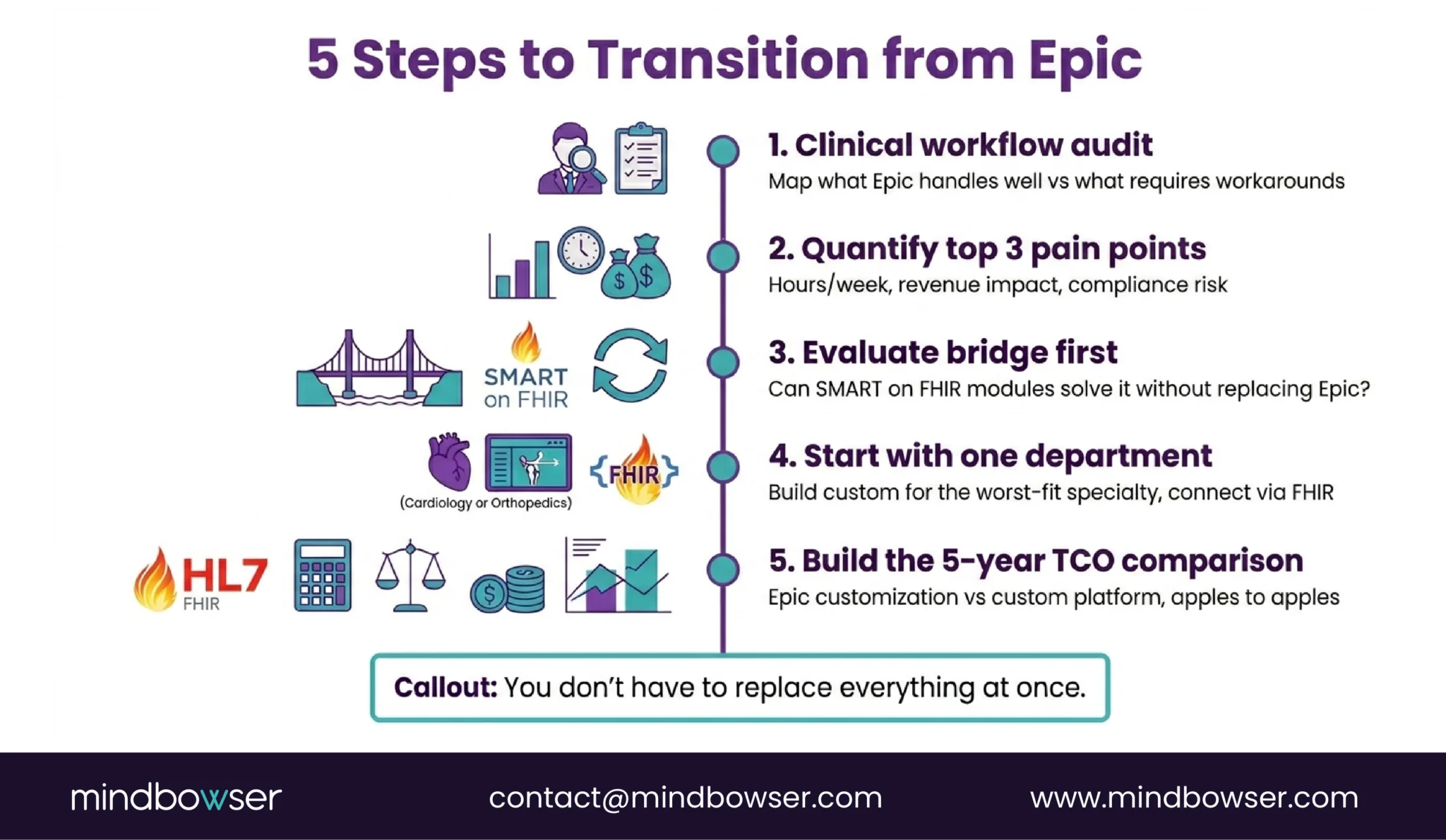
- Start with a clinical workflow audit. Map every workflow in your specialty. Identify which ones Epic handles well and which ones require workarounds.
- Quantify the 3 most painful workarounds. Hours per week. Revenue impact. Compliance risk. Turn frustration into numbers. This becomes your business case.
- Evaluate the bridge option first. Can a custom SMART on FHIR module inside Epic solve the top 3 pain points without replacing the whole system? If yes, that’s a $50K-$200K project with lower risk than a full replacement.
- If full custom is needed, start with one department. Don’t replace everything. Build a custom platform for the specialty that breaks Epic most severely. Connect it to Epic via FHIR for data exchange. Expand from there.
- Build the budget comparison. Five-year TCO of Epic customization + workarounds vs custom platform build + maintenance. For reference, we’ve built a country-scale national health records system for $131K. Your specialty module is likely less.
Where Does This Leave You?
Epic is a remarkable platform – for hospitals. For specialty practices where the clinical workflow IS the product, it’s an expensive mismatch.
Three things worth remembering:
- Epic’s strength is enterprise standardization. That’s also its weakness for specialties. The same architecture that makes Epic consistent across 40 hospitals makes it rigid for a fertility clinic or a behavioral health practice. The 30-point KLAS satisfaction gap between specialties is the evidence.
- The bridge option exists. You don’t have to choose between “stay on Epic and suffer” or “replace everything.” Custom SMART on FHIR modules inside Epic give you specialty capabilities without abandoning Epic’s infrastructure. We’ve shipped this with 15% clinical outcome improvement and 76% fewer coding denials.
- Platform-based custom builds cost less than 5 years of Epic workarounds. $50K-$150K on Medplum vs $50K-$200K in Epic customization that still doesn’t fully fit. And the custom build is designed for your workflow from day one.
Running a specialty practice where Epic doesn’t fit? Tell us about the workflow that breaks and we’ll map the options: customize Epic, build alongside it, or build something purpose-built.
Five reasons: (1) Customization is expensive – $5K-$15K per template, $75K+ per specialty module, $50K-$200K over 5 years for small practices. (2) Feature requests go into a roadmap controlled by hospital priorities, not specialty needs. (3) KLAS (2025) measured a 30-point satisfaction gap between hospital medicine and ophthalmology on the same platform – specialties are measurably less satisfied. (4) Clinician burnout from fighting workarounds compounds the direct EHR-burnout link established in Annals of Internal Medicine. (5) Platform-based custom alternatives now cost $50K-$150K – less than many practices spend on Epic customization over 3 years.
It depends on the approach. A custom SMART on FHIR module inside Epic (the bridge option) costs $50K-$200K – you keep Epic for standard workflows and add custom specialty capabilities. A full custom platform on Medplum costs $50K-$150K for an MVP covering your core specialty workflows. A from-scratch custom build costs $200K-$500K+. Compare to: $50K-$200K in Epic customization over 5 years that still doesn’t fully fit your specialty. For a complete cost analysis, see our EHR cost guide.
Yes. SMART on FHIR is the standard for building applications that run inside Epic (and other major EHRs). Your custom module launches within the Epic interface, reads patient data via FHIR APIs, provides specialty-specific functionality (CDS, documentation templates, workflow automation), and writes results back to Epic’s record. We’ve built a custom clinical module that achieved 15% improvement in clinical outcomes and 76% fewer coding denials while running inside a major EHR platform. This is the bridge option for practices that can’t fully leave Epic but need deeper specialty capabilities.