












 BLOGS
BLOGS  NEWSROOM
  CASE STUDIES
  WEBINARS
  PODCASTS
  ASSET HUB
  EVENT CALENDAR





















“When your board asks, “Where did this number come from?” Can your analytics team answer in one query or ten spreadsheets?
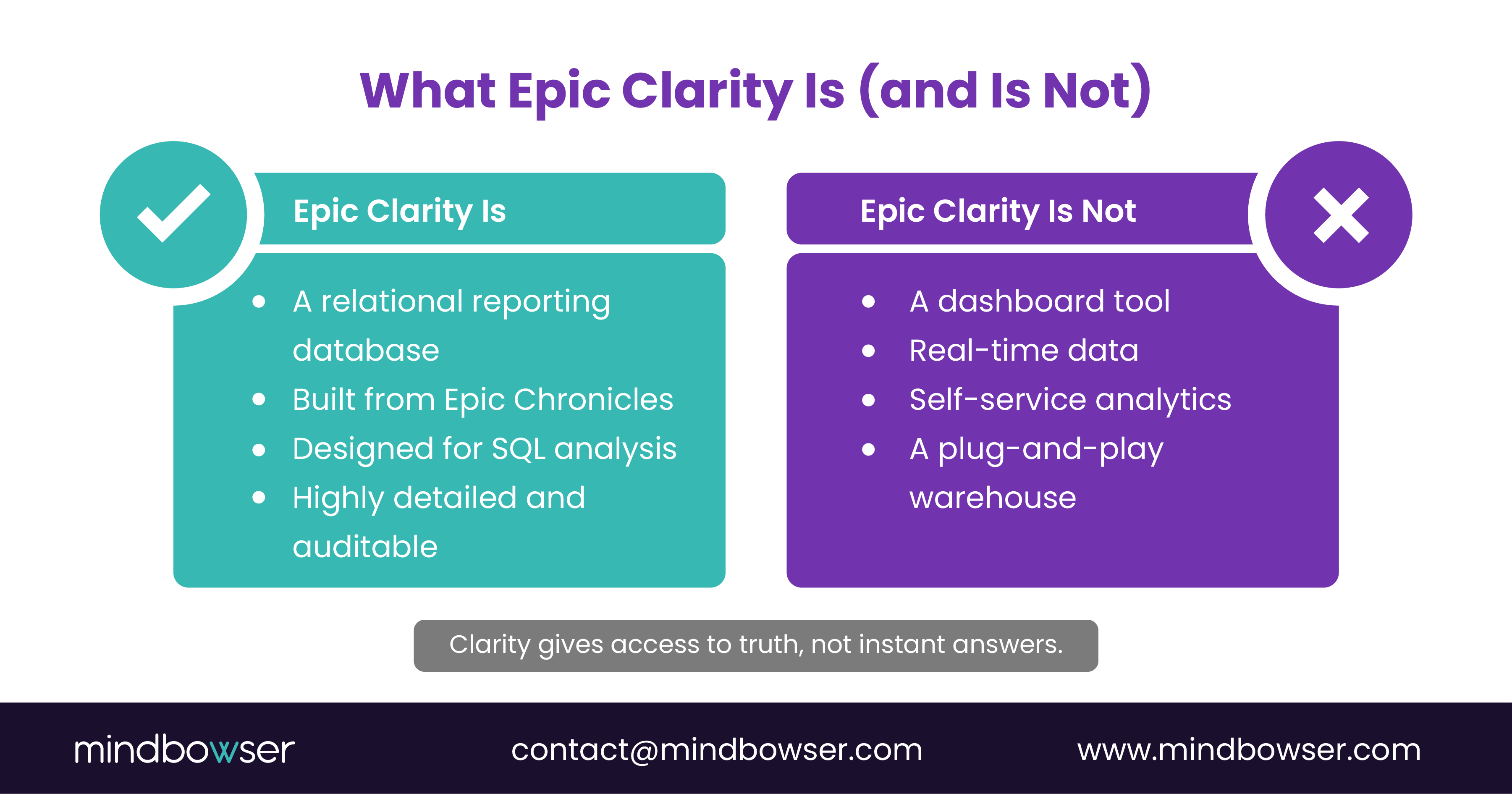
That question is why Epic Clarity exists. It is Epic’s primary reporting database, built to turn transactional clinical data into defensible analysis without touching live workflows. Yet many organizations treat Clarity like a dashboard tool or a simplified warehouse. That misunderstanding slows insight and erodes trust.
Epic Clarity is one of the key Epic modules used by healthcare organizations for operational reporting and database-level analytics.
Analytics expectations have changed. CIOs and CMIOs need detail, traceability, and performance simultaneously. Quality leaders need numbers they can audit. Finance needs answers that tie clinical decisions to margin.
Epic Clarity can deliver all of that. It just does not do it automatically.
This guide is for healthcare technology and analytics leaders who need to understand what Clarity is, how it works, and where it fits alongside Caboodle and modern data platforms.
Clarity is not easy by accident. Teams that respect its design turn Epic data into a strategic advantage.
I. What is Epic Clarity?
Epic Clarity is Epic’s relational reporting database. It is not the live system clinicians use, nor is it a finished analytics product. Clarity is the structured, query-ready layer that makes Epic data usable for serious analysis.
Its purpose is simple: to give analytics teams access to detailed Epic data without compromising patient care. Everything about Clarity’s design flows from that goal.
A. Data Architecture
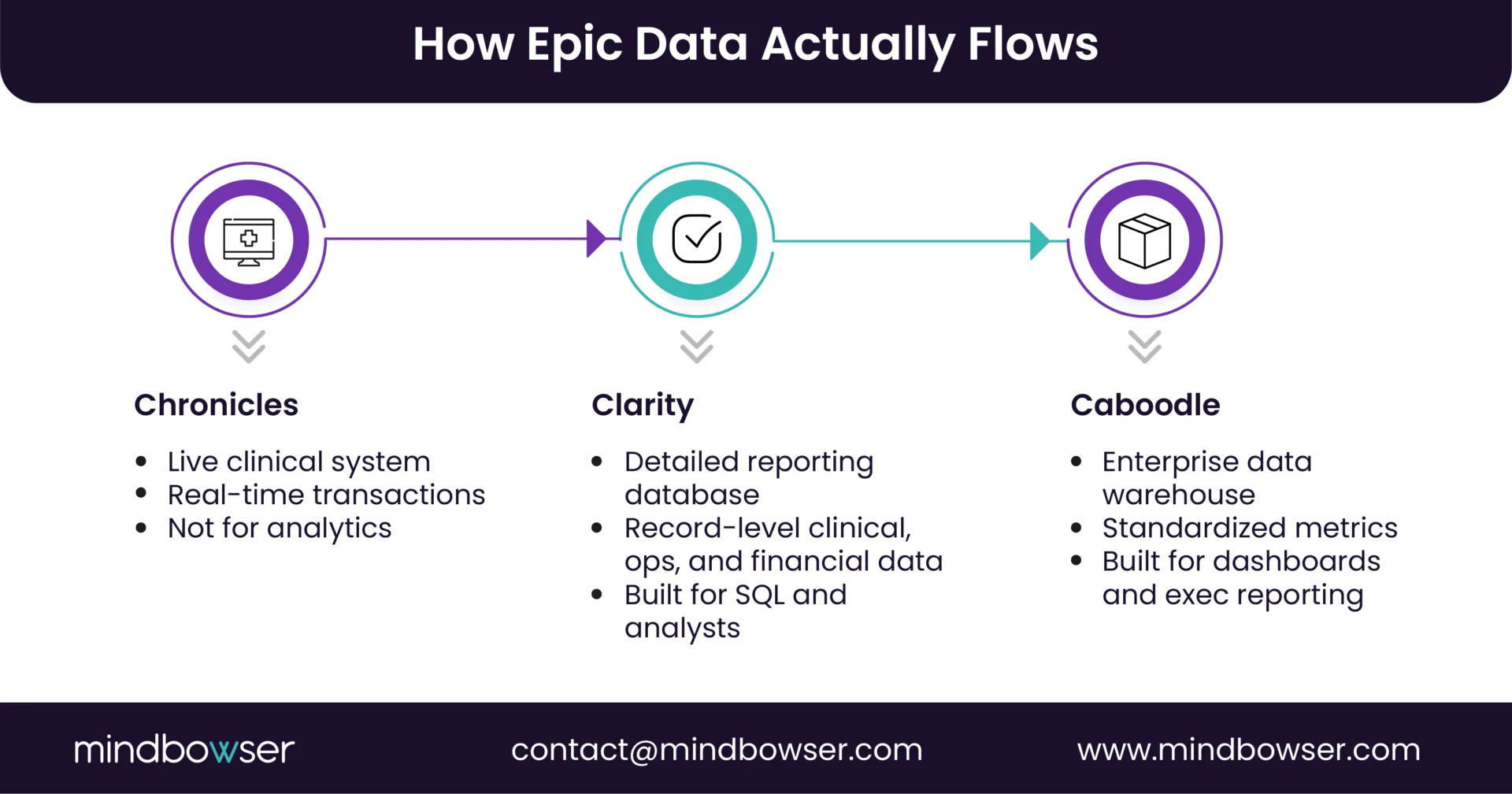
Epic’s production environment runs on Chronicles, a high-performance transactional database built for clinical speed rather than analytics. Running complex SQL queries directly against Chronicles would slow workflows and create operational risk.
Epic solves this by extracting data from Chronicles into Clarity through a scheduled ETL process, transforming hierarchical records into relational tables designed for reporting.
The result is a layered architecture:
- Epic Chronicles handles real-time clinical transactions
- Epic Clarity stores a reporting-friendly copy of that data
- Epic Caboodle aggregates and curates data for enterprise analytics
Clarity sits in the middle. It preserves detail while protecting production performance. That middle position is what makes it powerful and why it requires discipline.
B. Data Types
Clarity is broad by design. It spans nearly every domain that matters to healthcare leaders, which is why it supports both clinical and financial analytics in the same environment.
C. Core Data Types in Epic Clarity
Data Category | What It Covers |
Clinical | Encounters, diagnoses, procedures, medications, labs |
Operational | Scheduling, throughput, bed management, LOS |
Financial | Charges, payments, claims, reimbursement |
Administrative | Providers, departments, locations, users |
This breadth enables cross-domain analysis. You can tie clinical quality measures to operational bottlenecks and financial outcomes in a single query set.
The tradeoff is complexity. Clarity does not simplify the data for you. It gives you access to it. What you do next determines whether analytics accelerates or stalls.
II. How Epic Clarity Works
Understanding how Clarity works matters more than memorizing table names. Architecture decisions show up later as performance issues, data disputes, or stalled dashboards. This is where most analytics programs either gain leverage or lose credibility.
A. ETL Process
Epic Clarity is populated through a scheduled extract, transform, and load process from Chronicles.
Epic extracts data from Epic Chronicles into Epic Clarity on a recurring schedule, most commonly nightly, converting hierarchical production records into relational reporting tables.
This design protects patient-facing workflows. It also introduces a clear rule: Clarity data is not real-time. For quality reporting, finance, and population health, that tradeoff is acceptable. For operational command centers, it often is not.
Strong teams plan around this reality. Weak teams fight it.
B. Data Model
Clarity’s schema is highly normalized. Data is split across thousands of tables, joined by keys that preserve accuracy and lineage.
That normalization delivers three benefits:
- Precise clinical detail
- Reduced duplication
- Clear traceability back to source records
It also introduces cost. Queries can be complex. Poor joints hurt performance. Analysts need training and shared patterns.
This is the core tradeoff of Epic Clarity. You gain depth and auditability at the expense of simplicity. Organizations that accept this build reusable views and semantic layers. Organizations that do not end up with fragile one-off queries.
C. Reporting Access
Clarity is a database, not a reporting interface.
Epic supports Clarity access via SQL and external reporting tools such as Tableau, Power BI, and Crystal Reports, allowing organizations to layer visualization and distribution on top of the data model.
This separation is intentional. It gives CIOs flexibility to standardize tools while keeping Epic data governed at the source.
The implication is straightforward. If reporting feels slow or inconsistent, the issue is rarely the visualization layer. It is almost always upstream in query design, data modeling, or governance.
Clarity works exactly as designed. The question is whether your analytics strategy works with it or against it.
We Improved Predictive Accuracy in Childbirth with Advanced EHR Integration
III. Epic Clarity vs Caboodle
This is the question every Epic analytics leader faces sooner or later. Sometimes it is framed as a technical debate. In reality, it is a decision about depth, speed, and trust.
Epic Clarity and Epic Caboodle are complementary by design. Problems arise when organizations expect one to behave like the other.
A. Depth vs Usability
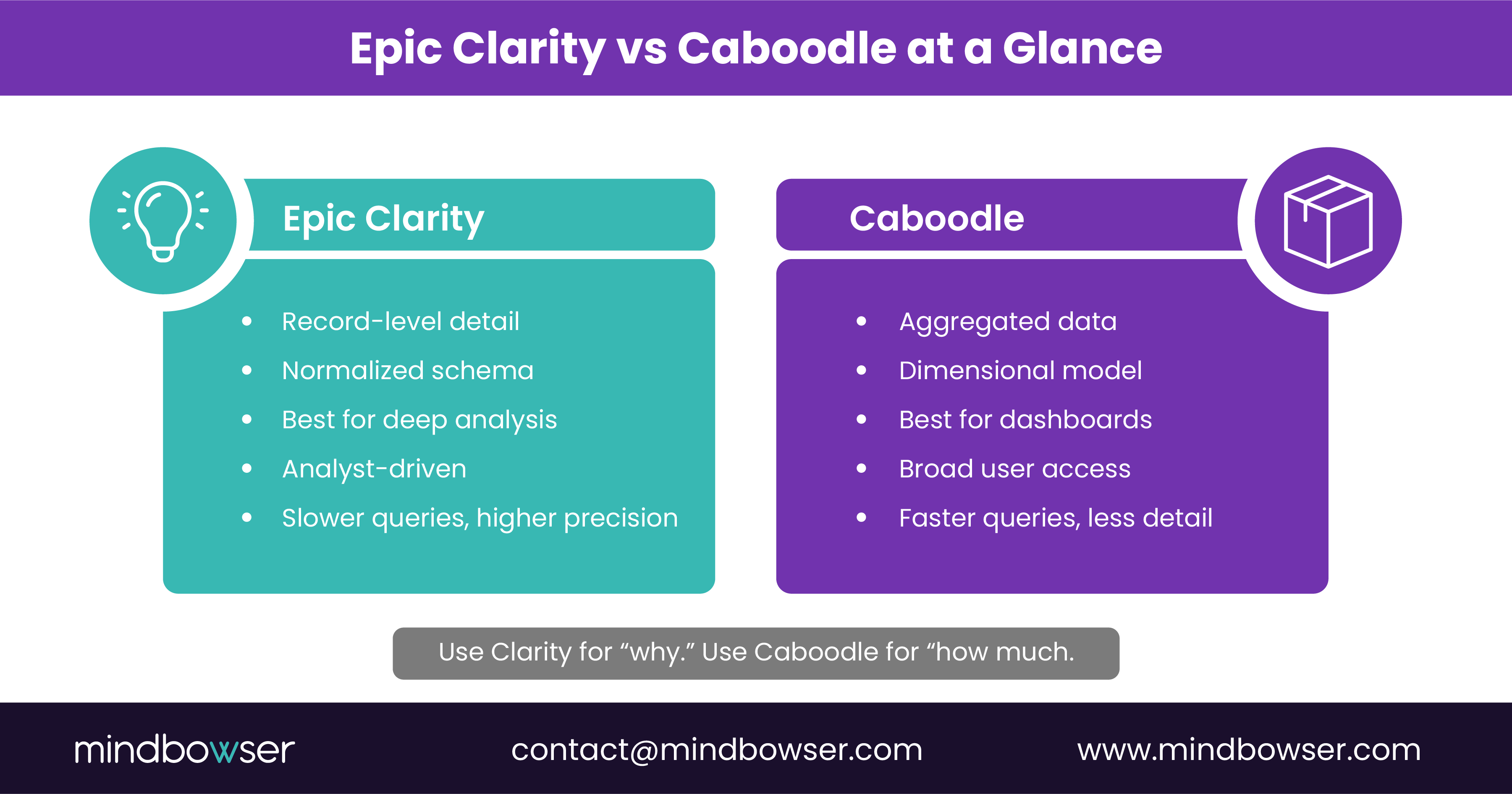
Epic Clarity delivers record-level, highly detailed data, while Caboodle is an enterprise data warehouse optimized for usability, performance, and consistency across the organization.
Clarity answers “why” questions. Why did this patient fall out of a quality measure? Why did the length of stay spike for this cohort? You can trace results back to individual encounters, orders, and timestamps.
Caboodle answers “how much” and “how often.” It is built for trend analysis, executive dashboards, and standardized KPIs that need to load fast and look consistent.
One favors precision. The other favors speed.
B. When to Use Each
Use Epic Clarity when:
- You need clinical or financial detail
- Logic must be auditable
- Measures require custom definitions
- Analysts need full control
Use Epic Caboodle when:
- Metrics are standardized
- Performance matters more than granularity
- The audience is broad
- Consistency beats flexibility
High-performing organizations do not choose one. They design a pipeline where Clarity feeds Caboodle, and Caboodle feeds leadership.
C. Common Mistakes
A common failure pattern is forcing Clarity to power executive dashboards or pushing Caboodle to answer questions that require encounter-level clinical detail.
Other mistakes show up quickly:
- Duplicating business logic in both systems
- Letting departments define metrics independently
- Treating Caboodle as a replacement for Clarity
Those errors create conflicting numbers and erode confidence. Once leaders stop trusting analytics, regaining credibility is expensive.
Clarity and Caboodle are not competitors. They are layers. Use each where it was meant to work.
For a deeper breakdown of Epic’s enterprise data warehouse layer, read our guide on Epic Caboodle.
IV. Common Use Cases of Epic Clarity
Epic Clarity earns its keep when questions demand detail, context, and proof. These are not vanity dashboards. They are analyses that influence reimbursement, staffing, and clinical programs.
A. Clinical Quality
Quality reporting is one of Clarity’s strongest use cases. Measures tied to CMS, HEDIS, and internal quality programs often require precise inclusion and exclusion logic.
Clarity allows analysts to:
- Trace the numerator and denominator logic to individual encounters
- Validate timestamps, diagnoses, and procedures
- Audit results when scores are challenged
That auditability matters. When quality scores affect reimbursement and public reporting, “trust us” is not an acceptable answer.
B. Population Health and Risk
Population health programs depend on accurate cohort definitions. Risk contracts raise the stakes.
Clarity supports longitudinal analysis across encounters, settings, and time. Teams can build cohorts based on diagnoses, utilization patterns, and outcomes without flattening the data too early.
This level of control enables:
- Risk stratification models
- Care gap identification
- Value-based care performance tracking
The detail is what makes the insights defensible.
C. Operational and Financial Performance
Operational leaders use Clarity to understand throughput, capacity, and cost drivers. Finance teams connect those insights to revenue and margin.
Common analyses include:
- Length of stay by service line
- Bottlenecks in patient flow
- Charge capture and reimbursement patterns
The power comes from combining domains. Clinical decisions show up in operational metrics. Operational delays show up in financial results. Clarity lets teams connect those dots.
D. Research and AI
Clarity is often the source layer for research datasets and AI pipelines.
Its structured, record-level data supports:
- Retrospective clinical studies
- Feature engineering for predictive models
- Training datasets for machine learning
This is also where performance tuning and governance become critical. AI workloads amplify weaknesses in data design. Teams that prepare Clarity properly move faster with fewer surprises.
For health systems building research pipelines, converting Epic’s FHIR exports to OMOP is often the step that makes Clarity data usable for multi-site studies and longitudinal analytics FHIR to OMOP conversion explained here.
Clarity is most valuable when questions require precision. If the answer must stand up to scrutiny, this is the right tool.
V. Challenges of Epic Clarity
Epic Clarity delivers precision, but that precision comes with friction. Most issues leaders face are not surprises. They are the predictable cost of working with detailed clinical data at scale.
A. Schema Complexity
Clarity’s schema is large, normalized, and unforgiving—thousands of tables, long join paths, and domain-specific logic embedded in the table design.
For new analysts, this is the first wall they hit. Without shared standards, teams build queries that technically work but are hard to reuse or maintain.
The organizations that struggle with Clarity treat it like a self-service sandbox. The ones that succeed invest early in training, documentation, and certified views.
Complexity does not disappear. It is either managed or it spreads.
B. Performance and Latency
Clarity performance problems are almost always self-inflicted.
Poorly written joins, unfiltered queries, and uncontrolled ad hoc access can slow the entire environment. At the same time, Clarity’s batch refresh model means data is not current to the minute.
That creates tension with operational teams who expect real-time insight. When expectations are not aligned, Clarity gets blamed for problems it was never designed to solve.
Strong teams separate workloads, tune queries, and clearly communicate latency. That discipline keeps trust intact.
C. Governance
Effective Clarity environments require strong governance, including standardized definitions, access controls, and oversight of data querying and sharing.
Without governance, metrics drift. Different departments calculate the same measure in different ways. Meetings turn into debates about whose number is right.
Governance is not bureaucracy. It is how analytics scales without losing credibility.
Epic Clarity’s challenges are manageable. Ignoring them is expensive.
Build a Custom EHR with Epic Integration Capabilities
VI. Best Practices for Epic Clarity
Epic Clarity rewards teams that treat analytics like infrastructure, not an afterthought. The patterns that work are consistent across health systems, regardless of size.
A. Build a Source Layer You Trust
High-performing organizations create governed source views on top of Clarity base tables to standardize logic and protect performance.
Instead of letting every analyst query raw tables, they expose certified views with clear definitions. That single move reduces duplicate logic, speeds development, and lowers the risk of bad joins that could take down the system.
Think of source views as guardrails, not red tape.
B. Separate Layers on Purpose
Mature teams separate analytics into layers:
- Source layer: Clarity base tables and certified views
- Semantic layer: Reusable logic aligned to business definitions
- Presentation layer: Dashboards, reports, and extracts
This structure keeps business logic out of dashboards and prevents metric drift when tools change.
C. Govern Access and Naming
Clarity access should be role-based. Not everyone needs the same level of detail.
Consistent naming standards matter more than teams expect. When table usage and logic are easy to understand, onboarding accelerates and errors drop.
Clarity is hard enough. Do not make it harder by relying on tribal knowledge.
D. Design for Performance Early
Performance tuning is cheaper early than late.
Best practices include:
- Filtering early in queries
- Avoiding unnecessary joins
- Monitoring heavy workloads
- Scheduling large extracts intentionally
These habits keep Clarity responsive as demand grows.
Best practices are not about control. They are about speed, trust, and sustainability.
VII. How Mindbowser Helps
Epic Clarity rarely fails because of missing data. It fails because teams underestimate the work required to turn detailed data into trusted insight. This is where most analytics programs stall.
A. Why Integrations Fail
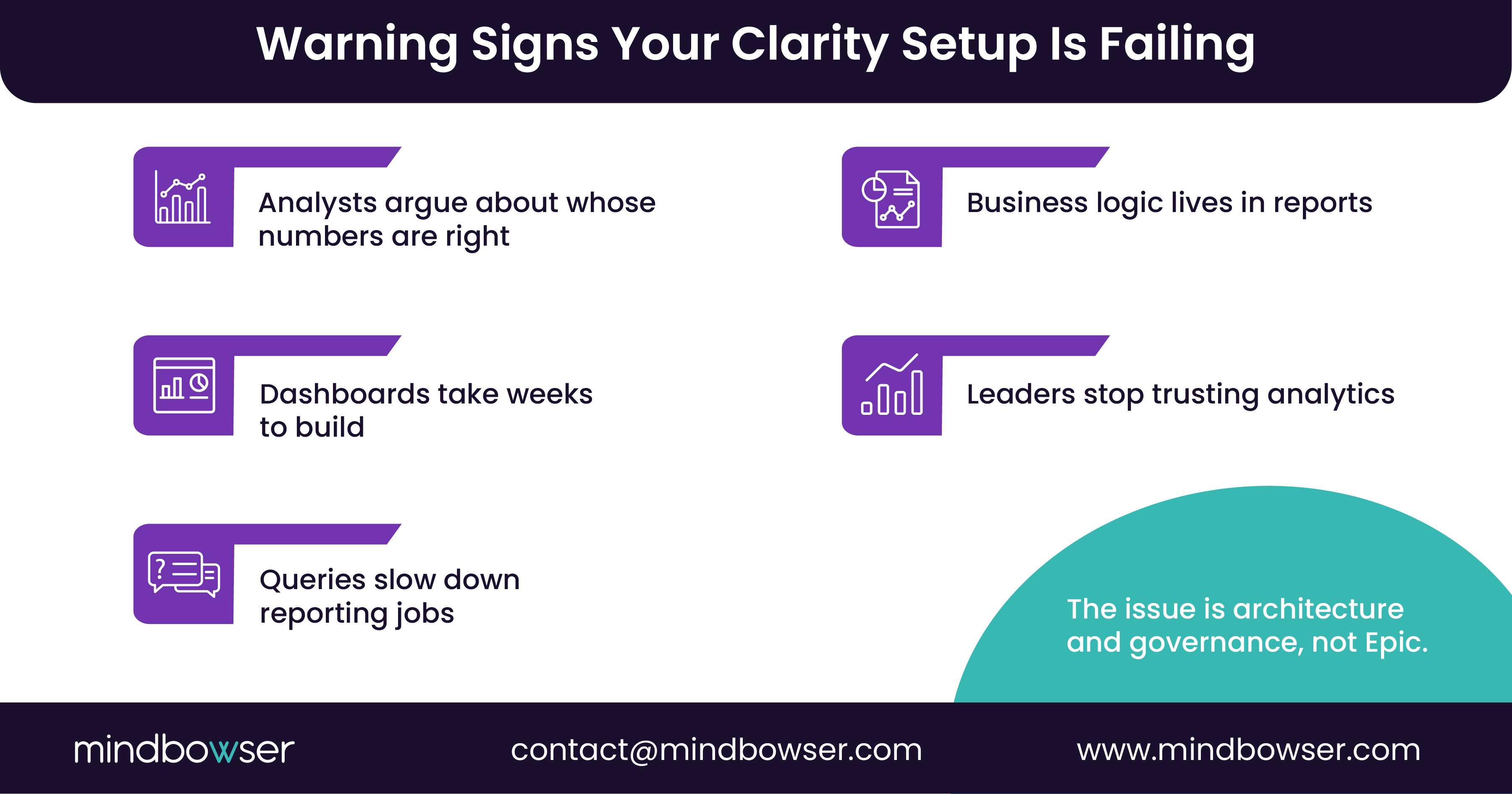
Most Clarity initiatives break down for three reasons. First, teams rush to dashboards before stabilizing the data layer. Second, business logic resides in reports rather than in governed views. Third, performance tuning is treated as an afterthought.
The result is predictable. Queries slow down—numbers conflict. Analysts burn time explaining instead of analyzing. Leadership loses patience.
These are not Epic problems. They are design problems.
B. A Clarity-Led Approach
Mindbowser starts where Epic analytics should start: Clarity itself.
We design certified views, reusable pipelines, and performance-aware models that align with Epic’s architecture. Logic lives once—queries scale. Governance is built in, not bolted on later.
Because our teams are healthcare-native, HIPAA and SOC 2 requirements shape design decisions from day one. No retrofits. No shortcuts.
C. Use Cases Enabled
A strong Clarity foundation unlocks more than reports.
Clients use our Clarity-led approach to support:
- Population health and risk analytics
- Quality and regulatory reporting
- Financial and operational dashboards
- AI-ready datasets for advanced modeling
When the data layer is stable, new use cases move faster with less rework.
D. The Mindbowser Difference
Mindbowser builds custom solutions. Always.
Our engineers understand Epic data, clinical workflows, and enterprise analytics. Clients own their IP. Our accelerators reduce build time without locking teams into rigid frameworks.
That balance matters when analytics needs evolve.
E. When to Engage
Engage Mindbowser when Clarity feels slow, fragile, or politically risky. Engage before launching a major reporting or AI initiative, not after confidence has already been lost.
Strong Epic analytics start with Clarity done right.
VIII. Epic Clarity in a Modern Data Stack
Epic Clarity does not need to be your final analytics destination. For many organizations, it is the most trusted starting point.
As data volumes grow and use cases expand, health systems increasingly extend Clarity across modern cloud platforms such as Snowflake and lakehouse architectures. In this model, Clarity remains the authoritative clinical source, while downstream platforms handle scale, advanced analytics, and cross-system integration.
This approach solves three common problems.
First, it offloads heavy workloads. Complex joins and detailed logic stay close to Clarity, while aggregated and enriched datasets move downstream for broad consumption.
Second, it enables enterprise analytics. Claims data, CRM systems, social determinants, and device data can be combined with Epic data without forcing everything into Clarity.
Third, it supports AI and advanced modeling. Cloud platforms are better suited for feature engineering, model training, and iterative experimentation. Clarity provides the clean, governed inputs that those models require.
The mistake is skipping Clarity or treating it as a temporary extract source. When Epic data is poorly modeled upstream, those flaws scale downstream.
A modern data stack works best when Clarity is respected as the clinical source of truth and integrated intentionally, not bypassed.
Mindbowser’s ConnectHealth accelerator connects directly with Epic Clarity’s reporting layer, enabling faster FHIR-compliant data extracts without custom middleware builds.
IX. Why Epic Clarity Separates Insight from Noise?
Epic Clarity is not misunderstood because it is flawed. It is misunderstood because it is precise.
Clarity was built to protect clinical systems while giving analytics teams full access to Epic’s details. That design choice makes it both powerful and demanding. Leaders who expect instant simplicity get frustrated. Leaders who invest in structure, governance, and architecture get answers they can defend.
The strategic advantage is not having Clarity. Every Epic customer has it. The advantage is knowing when to use it, how to govern it, and how to extend it into a modern data stack without breaking trust.
When Clarity is treated as infrastructure, analytics scale, and quality improve. Financial insight sharpens. AI becomes possible instead of theoretical.
Epic Clarity does not make analytics easy. It makes it right.
Epic Clarity as Your CDR Source Layer
For healthcare organizations building a Clinical Data Repository, Epic Clarity often becomes one of the most important source layers. It is not the final analytics layer by itself. It is the detailed, SQL-ready foundation that can feed governed downstream models for quality reporting, population health, financial analytics, AI pipelines, and research use cases.
A strong CDR architecture usually separates data into layers. Clarity data is extracted into a raw or landing layer, validated and standardized in a curated layer, and then modeled into trusted data products for analytics teams, executives, and clinical users. This structure helps healthcare organizations preserve traceability while making data easier to govern, query, and reuse across departments.
This pattern also fits well with modern cloud platforms. In Databricks-style lakehouse architectures, Clarity extracts can move through bronze, silver, and gold layers to support governed analytics and machine learning use cases. In Snowflake environments, Clarity data can be organized into secure analytical models for reporting, cross-domain analysis, and controlled data sharing. The platform choice matters less than the architecture discipline behind ingestion, transformation, governance, and access control.
This is where Mindbowser’s data engineering approach becomes valuable. Our teams help healthcare organizations design ingestion pipelines, normalize Epic-derived data, build reusable semantic models, enforce PHI-aware access controls, and connect Clarity data with broader interoperability and research models. For organizations moving from operational reporting to advanced analytics, Clarity can also become a stepping stone toward FHIR and OMOP-based architectures.
Read how FHIR to OMOP conversion supports healthcare analytics.
Every Epic organization needs some in-house Clarity knowledge. What breaks teams is assuming they need it all internally.
Best practice is a hybrid model:
- In-house teams own business logic, priorities, and validation
- Partners support schema expertise, performance tuning, and complex builds
This avoids single points of failure while keeping institutional knowledge where it belongs. If only one analyst truly understands Clarity, risk is already high.
For an experienced SQL analyst new to Epic, expect 3–6 months to reach baseline productivity and 9–12 months to work independently on complex domains.
That timeline surprises leaders. It should not.
Clarity is not hard because SQL is hard. It is hard because clinical context, Epic conventions, and schema relationships take time to internalize. Teams that plan for this ramp succeed. Teams that ignore it churn talent.
Yes. And they do.
Epic upgrades can introduce:
- Table changes
- New fields or deprecated logic
- Measure definition updates
This is why governance and abstraction layers matter. When logic lives in governed views rather than hundreds of reports, upgrades become manageable rather than chaotic.
Upgrade readiness is not optional for mature analytics programs.
Not directly.
Epic Clarity is best treated as a managed source layer rather than an open, self-service environment. Unrestricted access increases the risk of performance issues and inconsistent metrics.
Self-service works best downstream, through:
- Epic Caboodle
- Curated datasets
- Semantic layers in BI tools
Clarity enables self-service. It should not be self-service.
There are clear warning signs:
- Analysts argue about whose query is correct
- Dashboards take weeks instead of days
- Performance issues appear during peak reporting cycles
- Leaders question numbers in meetings
When these show up, the issue is rarely headcount. It is almost always architecture, governance, or both.
That is the moment to reassess before confidence erodes further.
Epic Clarity is Epic’s operational reporting database. It extracts data from the Epic Chronicles source database and stores it in a relational SQL format, making it accessible for reporting tools like Crystal Reports, Tableau, and SQL Server Reporting Services.
Epic Clarity is a near-real-time operational reporting database built on a relational schema. Epic Caboodle is an enterprise data warehouse optimized for analytics and historical trend reporting. Clarity is used for day-to-day operational reports; Caboodle is for deeper population health and BI workloads.
Clarity supports operational reports including patient volumes, scheduling utilization, billing reconciliation, clinical documentation audits, and department-level performance metrics. Most Epic-certified report writers use Crystal Reports or SQL directly against Clarity tables.
No. While Crystal Reports is the most common tool used with Clarity, organizations can query Clarity using any SQL-compatible BI tool. Tableau, Power BI, SSRS, and direct SQL queries can all be used with Clarity.
Clarity is included with Epic but requires a separate server environment and database infrastructure. Organizations need a certified Clarity database administrator and a reporting tool license, such as Crystal Reports or an equivalent BI tool, to fully leverage it.