












 BLOGS
BLOGS  NEWSROOM
  CASE STUDIES
  WEBINARS
  PODCASTS
  ASSET HUB
  EVENT CALENDAR





















TL;DR:
EHR integration is one of the biggest technical walls health-tech startups hit – and the cost is usually the surprise: per-hospital connection fees, recurring middleware bills, and 6-18 month build cycles. This guide covers the real landscape, the tech stack that works, and how Mindbowser builds reusable middleware layers that get you live across multiple EHRs without rebuilding per client.
As digital health companies build new healthcare products, EHR integration is consistently the technical wall that stalls them. Healthcare systems rely on platforms like Epic, Cerner, and Athena to store patient data – but these systems weren’t designed to talk to each other. The real surprise isn’t just complexity: it’s cost. Per-hospital connection fees, recurring middleware bills, and 6-18 month build cycles make EHR integration one of the highest-risk bets a health-tech startup can take.
The Importance of EHR Integration
EHR integration plays an important role in improving patient care by enabling reliable data exchange across the healthcare ecosystem. By accessing comprehensive patient data, health tech solutions can provide personalized, real-time care recommendations that improve treatment outcomes and cut manual workflow steps for healthcare providers. However, the complexity and fragmented nature of EHR systems make this integration process time-consuming, costly, and challenging.
Understanding the EHR Integration Landscape
Integrating with EHR systems like Epic or Cerner requires navigating complex proprietary systems and dealing with various standards, including FHIR and HL7. Each EHR system operates differently, making the process of unifying data from multiple sources challenging. This is where health tech companies often struggle—especially when trying to connect with multiple EHR systems used by hospitals and clinics across different regions.
Each hospital may use a different EHR system, and these systems often evolve over time with software updates that require the integration solutions to be flexible and continuously adaptable. For health tech companies, the task of maintaining and updating integrations to keep pace with evolving technologies and regulations can be overwhelming.
Related Read: Epic EHR Integration – Unlocking Seamless Healthcare Connectivity
The Technology Stack Behind Successful Integration
At Mindbowser, we help digital health companies clear these hurdles with ConnectHealth – our integration accelerator that acts as a reusable middleware layer connecting your platform to Epic, Cerner, and others without rebuilding per EHR.
Our technology stack includes:
🔸 Cloud platforms for hosting integrations and ensuring scalability and security.
🔸 API integrations that enable fast, standards-based data transfer between healthcare systems.
🔸 FHIR and HL7 protocols for standardized data exchange, enabling interoperability between different systems.
🔸 Data pipelines that aggregate and process patient data in real-time, making it actionable for healthcare providers.
By using standardized frameworks and pre-engineered solutions, we can significantly reduce the time required to implement EHR integrations, allowing your product to go live faster.
The Benefits of Connected EHR Integration
Achieving seamless EHR integration offers a multitude of benefits for both healthcare providers and patients:
✅ Improved Decision-Making: With access to complete and real-time patient data, healthcare professionals can make more informed decisions, leading to better treatment outcomes.
✅ Increased Efficiency: Integrating with EHR systems reduces the need for manual data entry and minimizes the risk of errors, ultimately improving operational efficiency across the healthcare system.
✅ Better Patient Outcomes: Real-time access to patient histories, diagnoses, and lab results enables clinicians to provide timely interventions, ensuring that patients receive the right treatment at the right time.
✅ Cost Reduction: Centralizing data collection and sharing lowers operational costs — fewer manual tasks, less administrative overhead, and no need to rebuild integrations per EHR system.
Related Read: Healthcare Integration: The Understanding & Its Impact in Healthcare
Unlock Seamless EHR Integration and Accelerate
Your Health Tech Innovation
Real-World Use Case: Accelerating Clinical Trials
For example, one of the key benefits of EHR integration is in the field of clinical trials. By automating the process of patient screening and enrollment, EHR integration can accelerate clinical trials and improve recruitment. EHRs store rich patient data that can be leveraged to identify highly eligible patients for trials, ensuring better recruitment rates and minimizing the time spent on manual screening processes.
Mindbowser has worked with several digital health companies to build and integrate middleware solutions for clinical trials, improving the efficiency of patient recruitment and enhancing trial data quality.
Addressing the Challenges of EHR Integration
While the benefits are clear, integrating with EHR systems does come with its own set of challenges:
Diverse Standards: Different EHR systems support different data formats, making it difficult to create a one-size-fits-all integration solution. Health tech companies often need to customize their integrations based on the specific requirements of each EHR system.
Complex Maintenance: Once the integration is in place, it requires ongoing maintenance and updates to keep up with changes in the EHR systems, which can be a significant drain on resources.
Regulatory Compliance: EHR integration needs to adhere to strict healthcare regulations such as HIPAA and SOC2 to ensure that patient data is kept secure and compliant.
Related Read: Benefits and Challenges of The Electronic Health Record
How Mindbowser Can Help
At Mindbowser, we specialize in helping digital health companies overcome these integration challenges. Here’s how we approach the process:
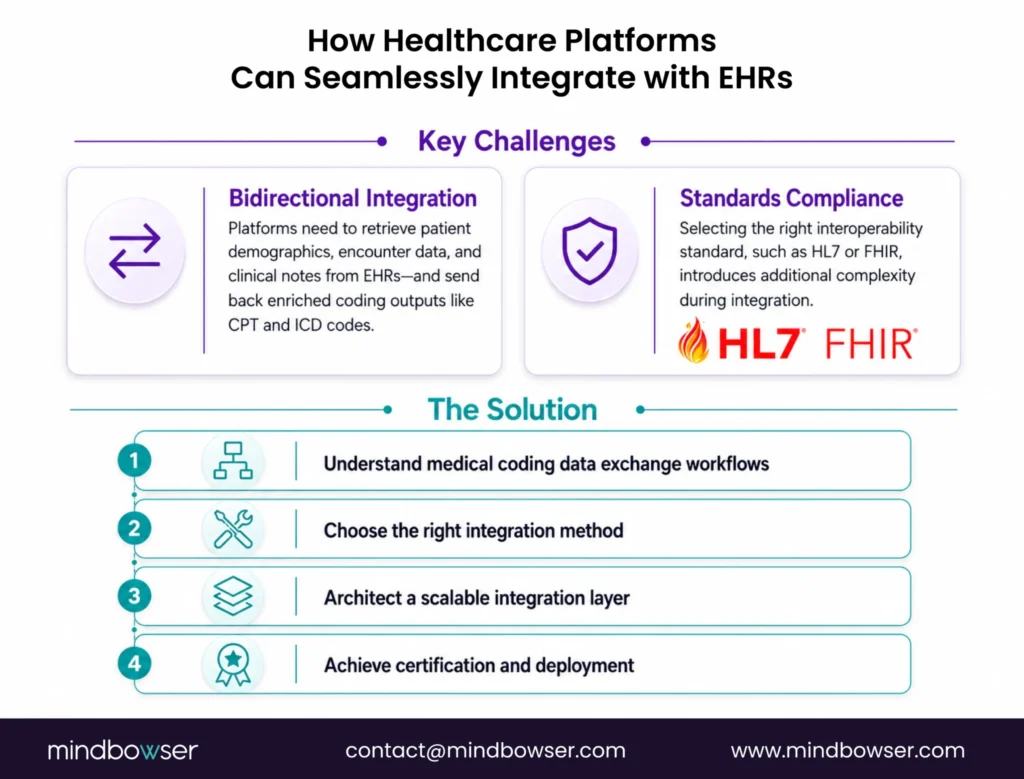
➡️ Discovery and Planning: We begin by understanding your specific data needs, including which EHR systems you need to integrate with and what data points are required. This helps us design a tailored solution that meets your unique requirements.
➡️ Custom Middleware Development: Our team builds a middleware solution that acts as a bridge between your platform and the EHR systems. This solution is designed to be scalable, secure, and adaptable to changing technology.
➡️ Integration and Testing: We ensure the integration works reliably with the selected EHR systems by running extensive tests in sandbox environments. Once everything is functioning as expected, we deploy the solution to your production environment.
➡️ Ongoing Support and Maintenance: We don’t just stop at implementation. Mindbowser offers ongoing support to ensure that your integration remains operational and up-to-date, minimizing downtime and ensuring compliance with healthcare regulations.
The Path Forward: What’s Next for Your Company
As a digital health company, deciding how to approach EHR integration is crucial for your long-term success. Here are the next steps you can take:
🔰 Schedule a Discovery Call: Contact us to schedule a discovery session where we can dive deep into your specific EHR integration needs and explore the best solution.
🔰 Get a Ballpark Estimate: Based on your requirements, we will provide an estimate for the time, cost, and resources needed to implement the integration solution.
🔰 Collaboration and Implementation: Once we have a clear understanding of your needs, our team will work closely with yours to ensure that the integration is successfully implemented and meets your expectations.
🔰 Ongoing Optimization: As your business scales, we will continue to optimize and expand the integration, helping you stay ahead of the curve and maximize the value of your health tech solutions.
Conclusion
EHR integration is a critical component for modern health tech companies seeking to improve patient outcomes, streamline operations, and enhance clinical research capabilities. With the right strategy and a strong integration partner like Mindbowser, you can overcome the complexities of connecting with EHR systems, reduce the costs associated with integration, and ultimately deliver better healthcare solutions.
For health-tech companies that need to move fast without a six-figure middleware bill, the right integration layer is the difference between a 3-month MVP and an 18-month build. Want the cost breakdown of building vs. buying? → How to Build an EHR Integration Engine
If you’re ready to move forward on EHR integration, Mindbowser is here to help. Contact us today to start the conversation.
Costs range widely: a point-to-point API connection with one EHR can run $20K-$80K. Connecting to multiple EHRs without a reusable middleware layer can push well past $200K over 18 months. The cost variable most startups miss is the per-hospital or per-EHR license fee many middleware vendors charge – plus ongoing maintenance. Reusable integration layers (like ConnectHealth) absorb this cost across deployments, which is what makes the unit economics workable at scale.
For most startups: buy or accelerate with a pre-built layer. Building from scratch means maintaining HL7 v2 parsers, FHIR converters, and per-EHR auth flows – each EHR system evolves independently. The faster path is a purpose-built accelerator that handles the standards layer, then customizes above it for your use case.
A basic SMART on FHIR read integration with Epic can take 4–12 weeks for a vendor with existing Epic experience (including App Orchard review). A full bidirectional integration (read + write, custom EHR data flows) typically runs 3–6 months. Pre-built middleware layers that already have an Epic App Orchard footprint can compress this significantly.
Epic supports FHIR R4 for production integrations via its SMART on FHIR framework. Earlier versions (DSTU2) exist in legacy Epic environments but new integrations should target R4.
HL7 v2 is the dominant legacy standard – text-based messages (ADT, ORU, ORM) exchanged via point-to-point connections. FHIR uses RESTful APIs and JSON/XML, making it far easier to consume with modern web tech. Most enterprise EHRs (Epic, Cerner) support both; most new integrations target FHIR R4.