




 BLOGS
BLOGS  NEWSROOM
  CASE STUDIES
  WEBINARS
  PODCASTS
  ASSET HUB
  EVENT CALENDAR






















TL;DR
SNF operators running PointClickCare or MatrixCare aren’t facing a shortage of EHR options, they’re contending with systems designed for fundamentally different care settings. The core problem isn’t missing features; it’s an architectural mismatch. Skilled nursing workflows (MDS assessments, PDPM billing, interdisciplinary care plans, therapy orders, care transitions) differ structurally from what ambulatory or hospital EHRs support. These gaps are addressable through custom development: SNF networks can leverage existing FHIR infrastructure, payer integration layers, and AI documentation tools rather than starting from scratch.
Long-Term Care EHR: The SNF-Specific Workflows Off-the-Shelf Systems Get Wrong
SNF operators running PointClickCare or MatrixCare aren’t facing a shortage of EHR options, they’re contending with systems designed for fundamentally different care settings. The core problem isn’t missing features; it’s an architectural mismatch. Skilled nursing workflows (MDS assessments, PDPM billing, interdisciplinary care plans, therapy orders, care transitions) differ structurally from what ambulatory or hospital EHRs support. When SNF clinical operations run through systems built around 15-minute office visits, documentation accuracy and billing yield typically suffer.
However, these gaps are addressable through custom development. SNF networks can leverage existing FHIR infrastructure, payer integration layers, and AI documentation tools rather than starting from scratch.
CMS data reveals that MDS coding errors cost SNFs an estimated 3-5% of PDPM revenue annually, a consequence of EHRs treating MDS as a generic form rather than a reimbursement driver.
Related Read: For a broader look at when custom EHR development makes more sense than an off-the-shelf vendor, and how specialty EHR builds differ from general-purpose implementations, those guides cover the decision framework in detail.
Why Long-Term Care EHR Is a Different Animal

SNF residents stay an average of 27.2 days, neither a brief appointment nor a short inpatient stay. During this period, five clinical disciplines (PT, OT, SLP, nursing, non-therapy ancillaries) document independently while billing through separate PDPM components. Each clinical touchpoint maps to a reimbursement event, creating a data relationship ambulatory and most acute systems don’t accommodate.
The MDS 3.0 Resident Assessment Instrument exemplifies this distinction. Section GG requires scoring 16 self-care and 17 mobility items at admission and discharge, with scores feeding directly into PDPM functional calculations. A system treating this as a standard intake form produces technically complete yet clinically inaccurate documentation.
Most off-the-shelf SNF vendors address this through LTC modules bolted onto ambulatory or acute cores. Configuration options exist, but the underlying data model doesn’t align. When Section GG scores must automatically populate PDPM groupings, drive care plan goals, and trigger billing thresholds simultaneously, module-level configuration reaches its limits quickly.
The configuration ceiling becomes harder than expected for SNF operators managing 10+ facilities with custom referral workflows, health system ADT integration, and cross-facility analytics requirements. Common EHR implementation mistakes, underestimating workflow fit, over-relying on vendor configuration, and skipping data model validation, show up here more than anywhere else in post-acute care.
The 4 SNF Clinical Workflows That Break Generic EHRs
Fourteen years of EHR implementation work reveals consistent failure points
1. MDS Assessment Workflow
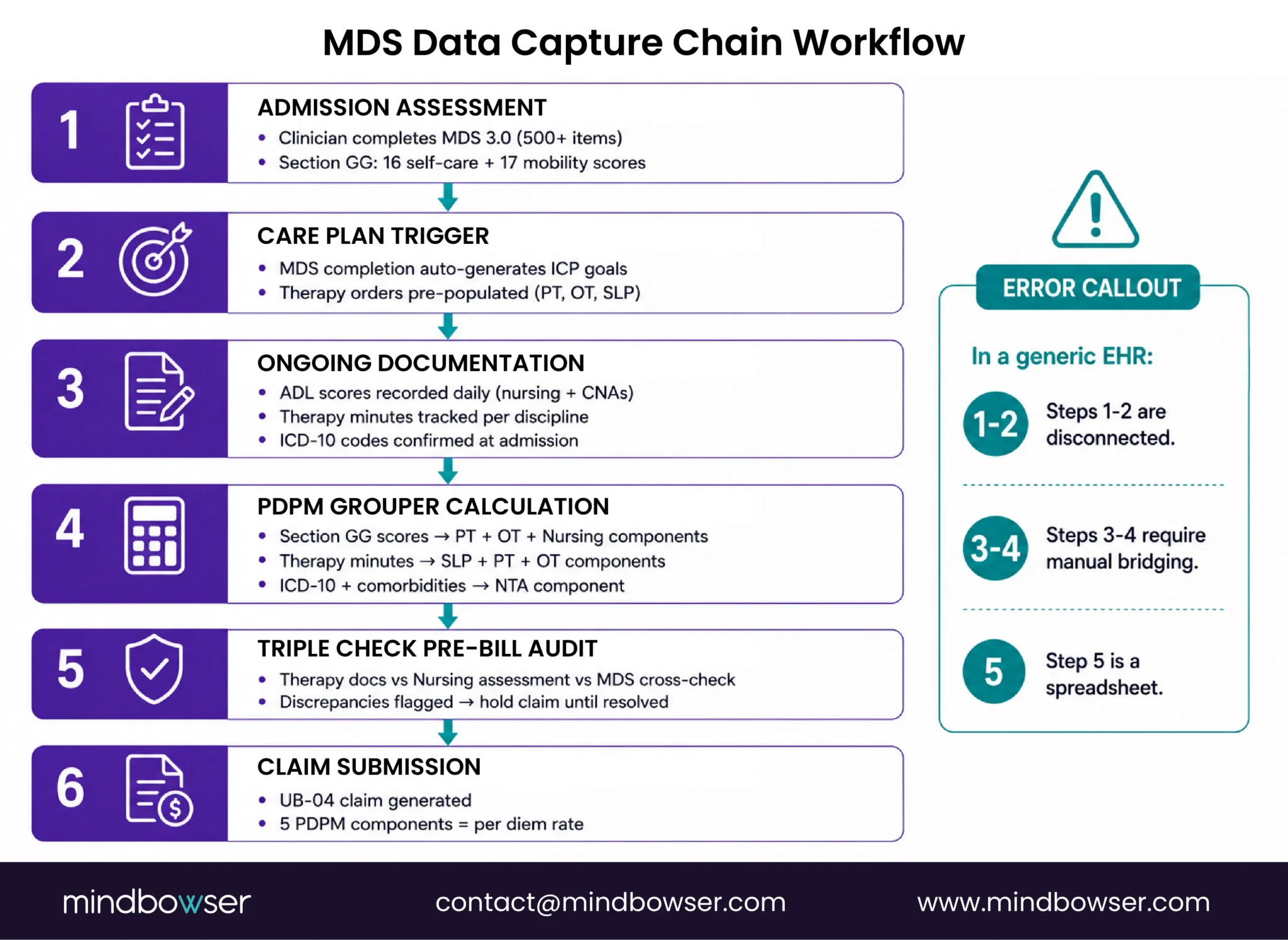
The MDS 3.0 comprises 500+ structured items governed by CMS guidance, it’s a clinical and reimbursement instrument, not merely a form. Generic EHRs handle it as a series of fields, meaning the system lacks awareness of how those fields relate to care plans or downstream PDPM claims.
In purpose-built systems, MDS completion triggers care plan goal generation, pre-populates therapy orders, and queues PDPM grouper calculation. The form and workflow operate as one object. In generic EHRs, they’re separate, creating documentation errors and billing gaps.
2. Interdisciplinary Care Plan (ICP)
Every discipline should document to the same care plan, yet most generic systems don’t support this. PT, OT, SLP, nursing, and social work typically maintain separate note templates without structured links to a unified care plan object.
This matters for CMS survey compliance under 42 CFR Part 483, which mandates coordinated interdisciplinary team input in care plans. It also impacts PDPM accuracy: when therapy documentation doesn’t flow into nursing assessments, NTA component revenue gets left behind.
3. eMAR / Medication Pass
SNF residents average more than seven concurrent medications. State survey protocols under CMS Appendix PP require the eMAR to cover every administration event with time-stamped verification. Generic outpatient-oriented eMARs don’t handle SNF medication cadence, PRN documentation, or the exception reporting surveyors examine.
4. ADL Tracking for PDPM
Every ADL score affects nursing and NTA PDPM components. Late entries shift case-mix groups retroactively; missed entries create documentation gaps auditors identify quickly. Purpose-built systems wire ADL tracking directly to the PDPM grouper; late or amended entries trigger recalculation and billing review flags. Generic EHRs treat ADL documentation as a clinical record only.
Planning to modernize your long-term care technology?
PDPM Reimbursement: What Your EHR Needs to Get Right
PDPM replaced RUG-IV on October 1, 2019, under CMS FY2020 SNF PPS Final Rule. The shift from procedure-volume to patient-complexity fundamentally altered what clinical documentation means for revenue.
Under PDPM, each SNF stay generates a claim built from five components: PT, OT, SLP, nursing, and NTA. Each derives from specific clinical data: ICD-10 codes from admission assessments, functional scores from MDS Section GG, therapy minutes from therapist documentation, and comorbidity flags from NTA lookup tables.
The Triple Check process (standard pre-bill audit) cross-verifies therapy documentation, nursing assessment, and MDS data before submission. Well-designed SNF EHRs surface discrepancies and hold claims until resolution. Generic EHRs typically reduce this to manual spreadsheet work.
The IMPACT Act of 2014 mandates standardized patient assessment data across post-acute settings with USCDI-compliant exchange at every transition. Under PDPM, documentation gap tolerance shrunk, an error in functional scores feeding the PT component creates both clinical and billing problems.
PDPM data capture chain:
- PT: Section GG functional scores + PT therapy minutes, failure results in wrong case-mix group and underpayment
- OT: Section GG + OT minutes + cognitive performance, failure means missed cognition flags and lower NTA scoring
- SLP: SLP minutes + swallowing/communication flags, failure miscalculates SLP component
- Nursing: Nursing intensity indicators + comorbidities, failure drops NTA component
- NTA: ICD-10 codes + comorbidity lookup + services list, failure produces NTA score error (often the largest revenue miss)

Care Transitions and Interop: The Gap That Costs Readmissions
SNF-to-hospital and hospital-to-SNF transitions represent where interoperability debt becomes clinical liability. 30-day readmission rates for SNF patients historically range from 20-25%, with many rooted in discharge information gaps: incomplete medication reconciliation, missing functional status data, late care plan transmission.
The IMPACT Act requires USCDI-compliant care summaries via FHIR at admission and discharge, covering demographics, medications, diagnoses, functional status, care plan goals, and advance directives. For SNF operators building toward TEFCA-compliant exchange, the FHIR care summary is the first required output.
Most off-the-shelf vendors handle ADT feeds to health system EHRs, but ADT signals patient arrival, not functional status at discharge, care plan goals, or readmission risk. A complete SNF admission/discharge FHIR package should include patient demographics, active medications, functional status scores, care plan goals, and advance directives. Most SNF EHRs provide basic demographics inconsistently; many rarely include functional status, care plan goals, or advance directives. The CMS USCDI requirements apply here directly.
Most off-the-shelf SNF EHR vendors handle ADT feeds to health system EHRs (Epic, Cerner). ADT is not interoperability. It tells the receiving system the patient arrived. It doesn’t tell them what the patient’s functional status was at SNF discharge, what care plan goals were set, or whether the patient was high-risk for readmission. That data lives in the SNF EHR; without a proper FHIR care summary exchange, it stays there.
EHR data integration between SNFs and acute care systems remains one of the most underbuilt parts of the post-acute technology stack, and the one with the clearest clinical ROI.
| Data Element | FHIR Resource | Most SNF EHRs Send It? |
|---|---|---|
| Patient demographics | Patient | ✅ Usually |
| Active medications | MedicationRequest | ✅ Sometimes (via CDA) |
| Functional status (GG scores) | Observation (Functional Status) | ❌ Rarely |
| Care plan goals | CarePlan | ❌ Rarely |
| Advance directives | Consent / DocumentReference | ❌ Rarely |
| 30-day readmission risk flags | Observation (Custom Profile) | ❌ Almost never |
This is where pre-built accelerates the timeline meaningfully. Mindbowser’s ConnectHealth is a pre-built FHIR exchange layer tested against 15+ payers and health systems. It handles USCDI-compliant care summary exchange for admissions and discharges, CRD/PAS for prior auth workflows, and payer integration: the infrastructure that any SNF EHR needs but almost no one wants to build from scratch. For a custom SNF EHR build, ConnectHealth removes 6–9 months of interop foundation work from the roadmap.

What Off-the-Shelf SNF EHR Software Vendors Get Wrong at Scale
Major vendors (PointClickCare, MatrixCare, American HealthTech) addressed core SNF problems. Issues emerge at scale, edges, and integration boundaries:
- Configuration vs. Customization: Off-the-shelf offers options within product architecture. When workflows don’t fit, configuration reaches its ceiling.
- Multi-facility Reporting: Cross-facility analytics require add-on modules or third-party BI layers, quality metrics, ADL trending, PDPM distribution aren’t edge cases at network scale.
- Health System EHR Integration: While ADT feeds to Epic and Cerner exist, real FHIR-based exchange requires custom work vendors charge separately.
- Cost Math at Scale: Per-seat licensing plus implementation and add-ons shift the total cost picture. By facility 10-30, TCO calculations look different than per-bed rates suggest.

What a Custom SNF EHR Actually Looks Like to Build
The question isn’t whether to build custom, it’s when. The answer almost never means starting from scratch.
Mindbowser has already constructed relevant infrastructure: FHIR-based patient registries, longitudinal record architectures, and cross-facility data governance. These patterns transfer directly to SNF network contexts. For a full breakdown of the decision framework, the ready-made vs. custom EHR guide walks through the financial inflection point in detail.
ConnectHealth serves as the interoperability layer, already built and tested, eliminating the longest lead-time item in custom EHR builds. The AI Medical Summary tool addresses documentation burden through ambient charting that reduces manual MDS-linked ADL tracking and care plan updating. For teams evaluating headless architecture foundations, Medplum and similar platforms offer FHIR-native options worth including in the scoping conversation.
4-Phase Custom SNF EHR Build Roadmap:
- Phase 1 (Months 1-6): Core clinical, MDS 3.0 workflow, ICP object, SNF eMAR with medication pass logic, ADL tracking with PDPM grouper, Section GG engine
- Phase 2 (Months 4-9): Billing layer, PDPM case-mix calculation, Triple Check workflow, UB-04 claim generation, late-entry recalculation triggers
- Phase 3 (Months 6-12): Interoperability, FHIR care summary exchange, ADT + clinical feeds to health systems, CRD/PAS, USCDI packages, IMPACT Act compliance
- Phase 4 (Months 9-15): Analytics, cross-facility quality metrics, PDPM case-mix distribution, readmission risk modeling, MDS coding accuracy reporting
SNF networks at 10 or more facilities rarely need convincing their EHR limits them. They’re already working around it: manual Triple Check spreadsheets, shadow Excel analytics, one-off integrations per referral partner.
Mindbowser has already solved the FHIR foundation, payer integration, and AI documentation. The SNF-specific workflows, MDS, PDPM, ICP, eMAR, represent the remaining scope.
For operators scoping custom SNF EHRs or evaluating whether a build makes sense, explore custom EHR development options or request an assessment to map your specific workflow gaps against what’s already built.