











 BLOGS
BLOGS  NEWSROOM
  CASE STUDIES
  WEBINARS
  PODCASTS
  ASSET HUB
  EVENT CALENDAR




















TL;DR
- Most bedside devices already expose serial or USB outputs, but never reach the EHR in real time.
- A Raspberry Pi running as an IT gateway reads those outputs, buffers locally, and converts each reading into HL7 ORU or FHIR Observation without touching the device, so no FDA recertification.
- Store-and-forward guarantees no lost measurements, and one mapping workbook drives both HL7 and FHIR.
- The result: faster integration, flowsheet-ready data, and RPM billing compliance, with less vendor dependency.
I. Why a Gateway First
A. Speed and Approvals
In every hospital project I have led, the biggest delay has not been technology. It has been approvals. If you change a medical device, you trigger regulatory reviews that can drag on for months. By using Raspberry Pi as a gateway, you keep the device untouched and maintain FDA clearance. The Pi is treated as an IT component, not a clinical device. That means faster security review, quicker sign-off from biomedical engineering, and shorter time to production.
B. Compatibility
Most devices in hospitals already expose serial or USB outputs. Monitors, anesthesia machines, and pumps often ship with RS-232 or USB ports. What they lack is a modern interface to the EHR. The Raspberry Pi fills that gap. It can read data from these existing connections, parse it, and send it upstream without asking the vendor to redesign anything. In environments where multiple vendors are present, this flexibility is critical. One gateway can normalize data across units, freeing analysts from managing one-off builds.
C. Reliability
Clinicians expect data to be complete and on time. Missed heart rate values or gaps in flowsheets create both risk and rework. We designed the gateway to buffer data locally whenever networks are unstable. If the hospital network is down, the Pi retains the data until connectivity is restored. Store-and-forward with retry logic ensures delivery without duplicates. In practice, this means clinicians can trust that every measurement will be accurately recorded.
The result is a system that avoids hardware redesign, works with the connections hospitals already have, and delivers data reliably under real-world conditions. Bottom line: The gateway approach provides hospitals with a faster and safer path to integration.
II. Edge Design (Pi with Docker)
A. Device Data Ingestion
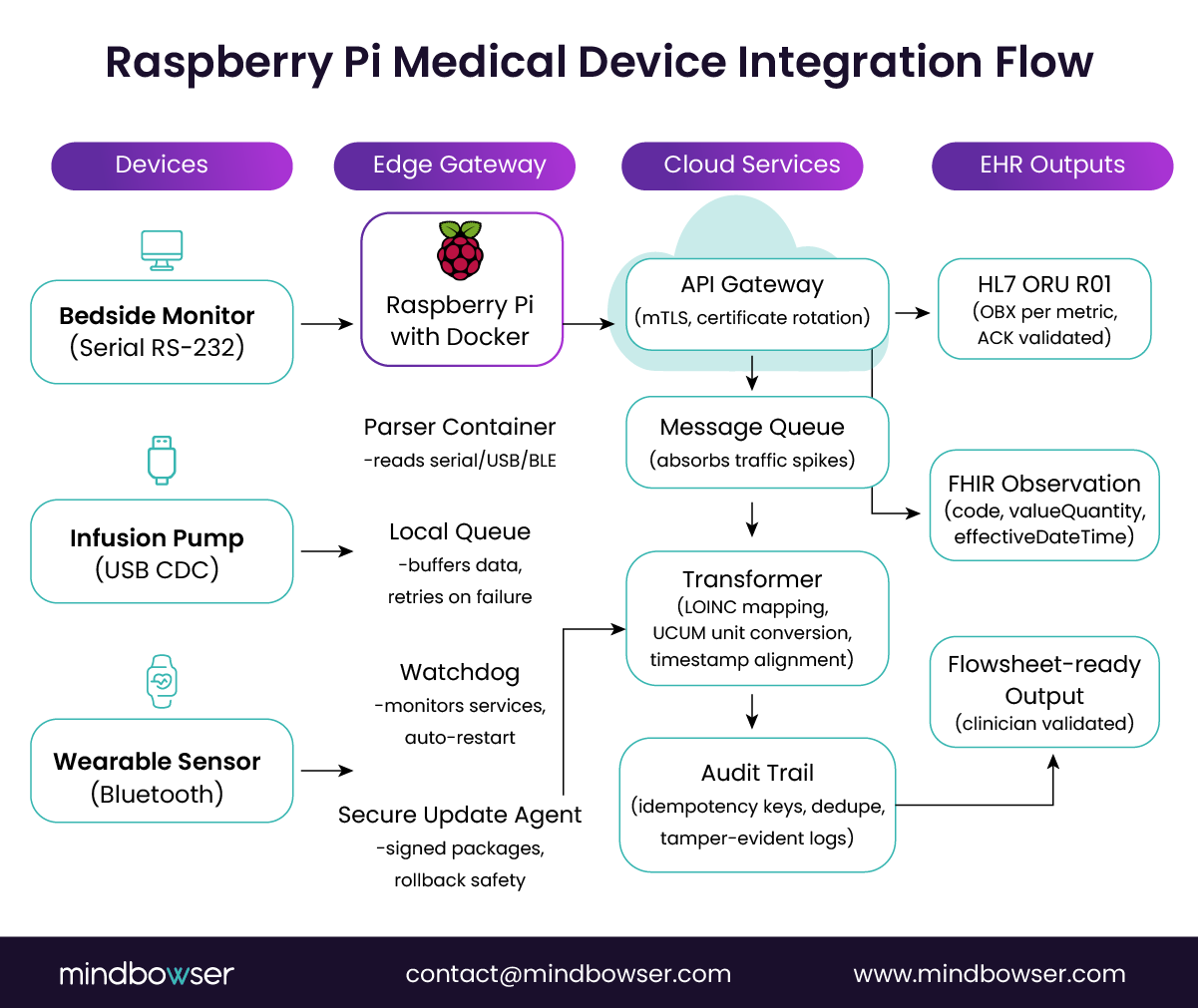
The starting point is the device connection. We used a Raspberry Pi with Docker to create a flexible edge stack. Each container handles a specific function. One container is a parser that connects to serial or USB ports. Baud rate and protocol are configurable, so the same build works with different monitors or pumps. This design lets us onboard new devices without rewriting core code.
B. Local Resilience
Hospitals cannot afford gaps in patient data. That is why we built a local queue on the Pi. Every measurement enters the queue, and if the network is unavailable, the data waits. Once the path is restored, the queue flushes in order. We added backoff and retry mechanisms to prevent the system from overloading upstream systems. To keep the gateway healthy, we run watchdog services that check containers, restart them if needed, and send alerts if a process stalls. Logs are minimized, with no raw PHI stored locally, to simplify compliance.
C. Deployment and Lifecycle
Keeping software safe and predictable is as important as collecting data. Updates to the Pi are signed and version pinned. If something goes wrong, we can roll back to a previous version without downtime. The operating system image is hardened, with only the minimum packages needed. Containers run with least privilege. This approach means when hospital IT reviews the build, they see a controlled environment, not an uncontrolled hobby board.
D. BLE Medical Device Integration via Edge Gateway
Bluetooth Low Energy (BLE) is the dominant wireless protocol for modern medical devices. Wearable patches, portable glucometers, pulse oximeters, and blood pressure cuffs all expose BLE interfaces. A Raspberry Pi gateway running a BLE scanner (BlueZ stack on Linux) can discover and pair with BLE peripherals, read GATT characteristics (heart rate, SpO2, glucose), and forward readings through the same store-and-forward pipeline described above.
The BLE scan-to-HL7/FHIR path follows the same LOINC/UCUM mapping workbook used for serial devices. The GATT service UUID for heart rate (0x180D) maps to LOINC 8867-4; the same pattern applies across standard BLE profiles.
Key BLE-specific considerations for the gateway implementation:
- Device pairing state management (maintain pairing across reboots)
- GATT characteristic UUID mapping to LOINC codes
- Battery-state monitoring and alerting before data gaps occur
For devices that expose BLE rather than serial or USB, this gateway pattern removes the need for a proprietary bedside hub; the Pi handles discovery, parsing, and the FHIR write-back.
III. Cloud Services Layer
A. Secure Ingress
Once data leaves the gateway, the first checkpoint is security. Every message passes through an API gateway that enforces mutual TLS between the Pi and the cloud. Certificates are automatically rotated to maintain channel security. Behind the gateway sits a message queue that smooths spikes in traffic. If hundreds of devices send at once, the queue absorbs the load and delivers data at a steady rate to downstream systems. This prevents dropped messages and maintains consistent response times.
B. Data Transformation
Raw device data is rarely ready for the EHR. We built a transformer service that standardizes each measurement before delivery. It maps vendor codes to LOINC or IEEE values, converts units using UCUM, and aligns timestamps with the hospital clock. It also attaches encounter keys, ensuring the right data is stored in the correct patient record. This service transforms raw output into clinical-grade data.
C. Integrity and Auditability
Hospitals need to know that every record is accounted for. To achieve this, each message carries an idempotency key. If the same measurement is sent twice, the system keeps only one. We also log every step in an audit trail. Logs are encrypted and tamper-evident, allowing compliance teams to verify integrity. Dead-letter flows catch any message that fails validation, so no data disappears without a trace.
The cloud layer serves as a bridge between flexible edge devices and rigid hospital systems. It secures, cleans, and tracks data so that what enters the EHR is complete, standardized, and verifiable.
For the broader integration patterns beyond the gateway itself, see our medical device EHR integration guide.
Speed Up Your Hospital’s Data Integration
IV. Delivery to EHR
A. HL7 ORU R01 Path
Most hospitals still depend on HL7 v2 feeds for clinical data. Our gateway creates HL7 ORU R01 messages with an OBX segment for every metric. Device identifiers are included to keep provenance clear. The Pi acknowledges each message, retries if no ACK is returned, and moves any persistent failures into a dead-letter queue for review. This ensures every observation is either delivered or flagged, never lost in transit.
B. FHIR Observation Path
For newer systems and digital health platforms, we also produce FHIR Observations. Each record carries a standard code, a value quantity, and an effective date and time. Authentication follows the SMART on FHIR security model with scopes that restrict access to only the intended data. The same mapping workbook that defines HL7 segments is reused here. This means one translation effort covers both integration models, which saves analyst hours and reduces inconsistency.
C. Clinical Validation
Hospitals care about one thing above all: whether the data is flowsheet-ready. That is why every deployment includes validation with the hospital IT team. We replay golden datasets from devices and confirm that the values are correctly placed in the corresponding rows of the EHR flowsheet. Clinicians then run a shadow period, during which manual entry continues alongside automated feeds. Once they sign off on that, the two match, and the gateway is cleared for production.
The delivery layer gives hospitals a choice. HL7 for legacy systems and FHIR for modern ones, both driven by a single mapping source. Teams that want pre-built connectors for both paths can use an EHR integration platform to remove the mapping effort entirely. The result is consistent data that meets clinical expectations without doubling the integration effort.
V. Security Framework
A. Core Controls
Security is the first question every hospital IT team asks. We built the framework to satisfy both HIPAA and SOC 2 standards from day one. All traffic uses TLS or mutual TLS with automated key rotation. Access is limited with least-privilege IAM policies so that every process can do only what is required. Patient data is minimized at the edge. Only values required for clinical use are transmitted, and any data stored locally is encrypted at rest. Logs are tamper-evident and stripped of raw PHI to simplify audits.
B. Deployment Safety
Hospitals want assurance that updates will not introduce risk. That is why every agent package is signed before it is released. Version pinning ensures each deployment runs a known build. If a problem occurs, the gateway can roll back to the previous version without downtime. This prevents outages during clinical operations and gives IT teams confidence in every update cycle.
C. Monitoring and Oversight
We added dashboards and alerts to provide visibility and transparency. Certificate expirations, failed retries, or unusual traffic patterns trigger notifications, allowing issues to be addressed before they impact clinicians. Hospitals can monitor the health of every gateway in real-time, which reduces the support burden on frontline staff.
VI. Rollout Plan
A. Lab Stage
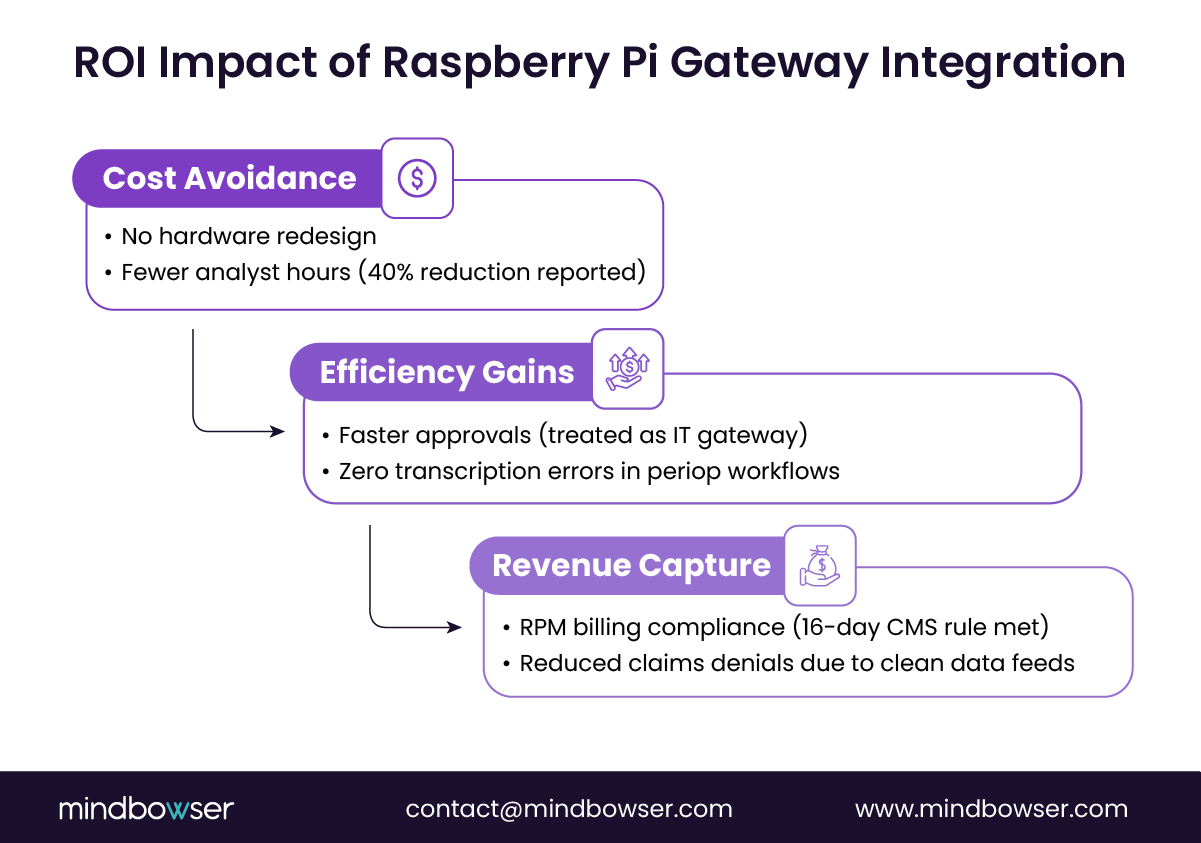
Every rollout starts in the lab. We begin by specifying the device protocol and creating golden datasets. These datasets include known values for vitals such as heart rate, SpO₂, and blood pressure. Unit tests verify that the parser reads the signals correctly and maps them to the right codes. This stage confirms that the gateway logic is sound before it ever touches a clinical network.
B. Pilot Stage
Once the lab results are solid, we move to a single pilot site. The goal is to prove reliability in a live environment. We enable full monitoring of acknowledgments and HTTP responses to track message delivery. Clinicians compare the flowsheet outputs with manual entries. Their sign-off is what matters most. A pilot succeeds when the data appears in the correct rows, without gaps or duplicates, and when clinicians trust the feed enough to stop manually entering values.
C. Scale Stage
After a pilot is accepted, scaling becomes a playbook. Templates define how new sites are configured, how flowsheet rows are mapped, and how security is applied. Dashboards provide a view of every active gateway, with service level objectives and alerts built in. This standardization enables us to expand rapidly across units and facilities without having to reinvent the process each time.
The rollout plan ensures that integration is not a one-off project, but a repeatable program. It starts small, validates carefully, and then scales with confidence.
VII. Case Studies
A. Eliminating Manual Transcription in Perioperative Workflows
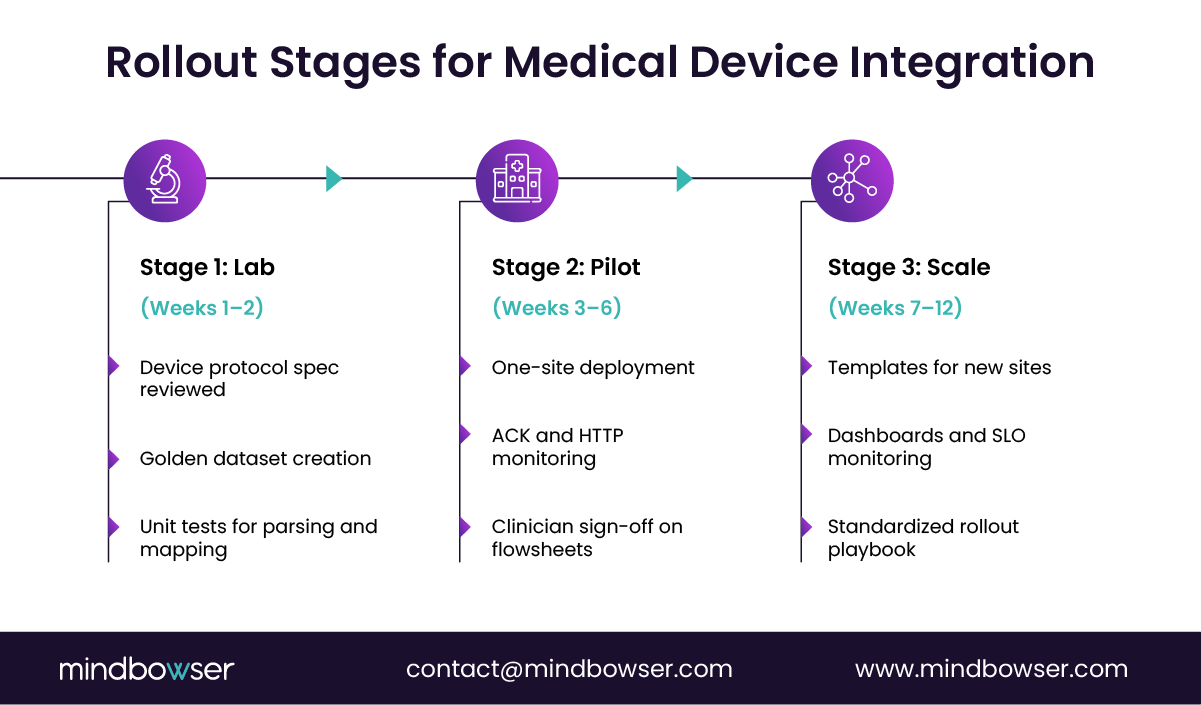
A large regional hospital struggled with anesthesia monitors that required nurses to type vitals into the EHR. By deploying Raspberry Pi gateways, data was parsed from serial ports and mapped directly into flowsheets. Within three months, manual transcription errors dropped to near zero, and reconciliation time in billing was cut in half.
B. Building a Reliable Home RPM Hub
A digital health company needed a home-based solution that could support CMS remote patient monitoring codes. Raspberry Pi gateways served as home hubs, capturing vitals from connected devices and sending them securely to the cloud. With local buffering and retry logic, the system achieved consistent data sufficiency for RPM billing, thereby improving patient adherence and reducing claims denials.
C. Standardizing Vitals Across Multi-Vendor Devices
A health network had multiple device vendors across different sites, creating a patchwork of inconsistent data. Raspberry Pi gateways were introduced as edge collectors, applying standardized LOINC codes and UCUM units. IT teams reported a 40 percent reduction in analyst hours spent on interface troubleshooting, and new sites went live weeks faster than before.
Unlock Seamless Device Data Integration with Raspberry Pi
VIII. Accelerator Tie-ins
A. ConnectHealth Device Ingestion at the Edge
ConnectHealth handles the wireless and wired device feeds that the gateway collects: Bluetooth Low Energy support, a device registry, and over-the-air firmware management, so adding a new sensor does not mean writing a new parser.
B. RPMCheck AI Compliance for Remote Monitoring
RPM billing hinges on data sufficiency. CMS requires at least 16 days of data per patient in 30 days for reimbursement. RPMCheck AI runs alongside the gateway to score data sufficiency in real time. If a patient falls behind, the system triggers outreach alerts. This protects revenue and ensures that device data flows are not only technically correct but financially viable.
C. ConnectHealth Templates and Audit Trails
ConnectHealth ships pre-built HL7 and FHIR route templates with built-in audit logging. Paired with the Pi gateways, it cuts interface build time and leaves behind documentation that stands up in an audit.
IX. How Mindbowser Can Help
A. Engineering Expertise
We have built and deployed gateway models in hospitals where vendor roadmaps were not an option. Our team delivers pilots within 90 days, utilizing a compliance-first approach. Raspberry Pi is configured with hardened images, secure containers, and signed update pipelines. We provide hospitals with golden datasets and validation scripts, enabling them to reproduce test results independently.
B. Compliance Leadership
Hospitals cannot accept shortcuts. That is why every engagement includes documentation that maps to HIPAA and SOC 2 controls. We prepare risk management files, supply chain attestations, and installation qualification artifacts. When compliance teams ask for evidence, you will have it ready.
C. ROI Delivery
Technology is only part of the equation. Our work focuses on measurable results. By reducing manual transcription, hospitals cut error rates. By meeting RPM sufficiency rules, digital health companies protect billing. By moving faster on integration, both sides free clinical analysts for higher-value tasks. The outcome is a project that justifies itself in operational savings and new revenue.
The gateway pattern in this article is the custom-built version of what ConnectHealth productizes: its connectors already speak HL7 ORU and FHIR Observation, and Helix AI maps each device’s raw output to the right FHIR resource (Observation, Device) in days. When the device uses standard outputs, the connector replaces most of the edge work; when it does not, the Pi gateway is how Mindbowser bridges the gap.
Two routes. Standard device feeds: ConnectHealth’s connector maps them to FHIR resources and routes them to the flowsheet the fastest path. Non-standard feeds (legacy serial outputs, proprietary protocols, offline-first sites): the Raspberry Pi gateway in this article, built by Mindbowser’s engineers. Same data quality, chosen by what the device exposes.
Conclusion
Raspberry Pi medical device integration is not about experimenting with hobby hardware. It is about solving a real bottleneck in hospital workflows. By placing the Pi as a gateway, hospitals avoid hardware redesigns, speed up approvals, and connect to the serial and USB outputs that already exist on monitors and pumps.
The model is reliable because it buffers data locally and delivers it with acknowledgments and retries. It is flexible because one mapping workbook supports both HL7 and FHIR. It is safe because every update is signed, every connection is encrypted, and every message is logged in an audit trail.
Hospitals gain faster projects, clinicians gain flowsheet-ready data, and finance teams gain billing compliance for programs like RPM. Digital health companies gain a pathway to scale without waiting on device vendors.
Bottom line: The Raspberry Pi as a medical device gateway turns a long-standing integration problem into a repeatable process that saves time, reduces errors, and supports revenue growth. For the broader integration patterns beyond the gateway itself, see our medical device EHR integration guide.