














 BLOGS
BLOGS  NEWSROOM
  CASE STUDIES
  WEBINARS
  PODCASTS
  ASSET HUB
  EVENT CALENDAR














01
Full FHIR operations.
Update now joins create, read, search and delete, alongside bulk export.

Convert between HL7 v2, X12 EDI and FHIR/JSON in a single visual mapper, without building an interface layer first.
Built for product teams shipping on an EHR, and deployed inside your own cloud so patient data never leaves your environment.
The hospital sends HL7 v2. The payer sends X12. Your product speaks FHIR and JSON.
None of those go away. FHIR became a federal requirement under the Cures Act and the CMS deadlines land in 2027, so every team is standing up FHIR while keeping the older formats alive underneath. That means running all three at once, and the cost is not in any one of them. It is in the bridging.
Traditionally that is three different toolchains and three sets of expertise: an interface engine for HL7, clearinghouse tooling for X12, a FHIR server on top. Universal Data Mapping puts all three on one canvas, and moves that work into the interface for the team you already have.
| From | To | What handles it |
|---|---|---|
| Hospital feed. HL7 v2 ADT and ORU messages | FHIR R4 Bundles and Observations | Pre-built Liquid templates: ADT to FHIR R4 Bundle, PID to FHIR Patient, ORU to FHIR Observation, Patient Bundle |
| Claims and eligibility. X12 270/271 and 837/835 | Clean FHIR or JSON your billing stack can read | X12 Liquid templates, plus a real-time eligibility node running against Stedi |
| Many EHRs | One consistent FHIR shape | Eleven EHR connections, one FHIR R4 output |
Three formats, one canvas. Interface engines handle HL7. Clearinghouse tooling handles X12. FHIR servers handle FHIR. Doing all three in the same visual mapper is the part that removes the toolchain, not just the code.
It deploys into your cloud, not ours. Most integration platforms pull your patient data into their multi-tenant cloud and hand you an API. ConnectHealth deploys directly into your own cloud account. It runs in private subnets with no public IPs, encrypts at rest with keys you control, and keeps a six-year immutable audit trail. PHI stays in your environment, and your security team can read every log, metric and query.
For anyone who has had an integration platform fail a security review, that is usually the whole conversation.
There is no engine to run. Workflows are exposed over an HTTP endpoint. There is no separate interface engine to license, host or staff.
Mapping throughput is CPU-bound, and large Liquid templates are the real ceiling rather than message volume.
End-to-end latency is set by the EHR on the other side, not by the mapper. If Epic’s FHIR endpoint takes 300 milliseconds, the round trip takes about 300 milliseconds, and no amount of tuning on our side changes that.
Above roughly 100 messages per second, the documented pattern is to buffer through a queue rather than push synchronously.
We publish these because integration decisions get made on them, and because a platform that only tells you what it is good at is a platform you will find the edges of in production.
Update now joins create, read, search and delete, alongside bulk export.
Per-deployment admin credentials with no shared defaults, and safer embedded EHR launches for surfaces rendered inside the EHR.
Connection handling and usability improvements across the workflow builder.
ConnectHealth is Mindbowser’s AI-first healthcare integration engine. Connect to Epic, Cerner, Athena, and 20+ EHRs, deployed inside your own AWS VPC so PHI never leaves your environment. Helix AI generates production-ready FHIR and HL7 workflows from plain English. No custom code. Predictable pricing. Sandbox in minutes.
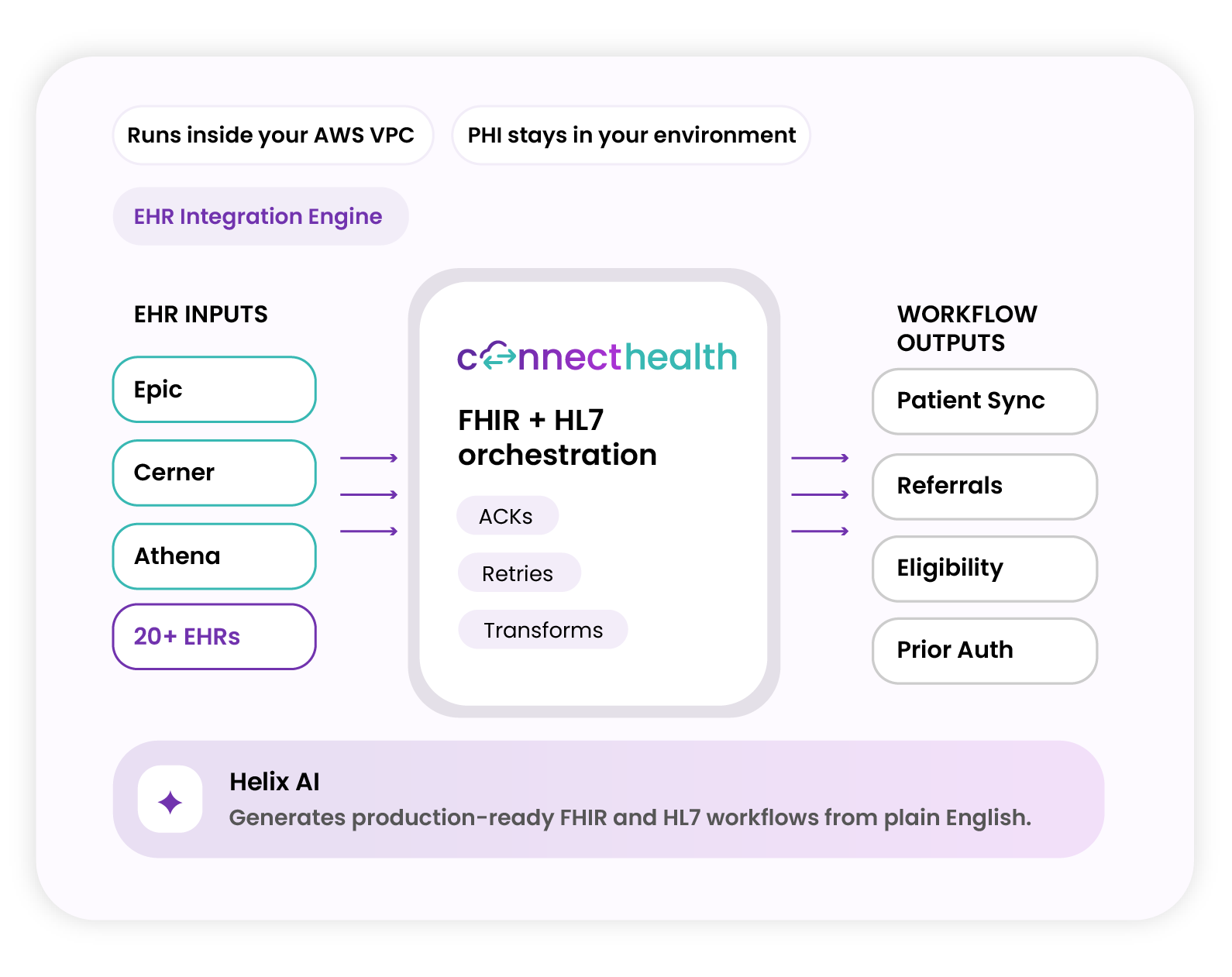
No. Workflows run over an HTTP endpoint, and inbound HL7 v2 arrives on a standard MLLP listener. There is no separate engine to license or host.
In your own cloud account. The platform deploys into your environment, runs in private subnets with no public IPs, and encrypts with keys you control. PHI is not stored or transited by us.
270 and 271 for eligibility, 837 for claims and 835 for remittance, with pre-built mapping templates for each. Real-time eligibility runs against Stedi. Prior authorisation (278) is not a supported transaction today.
Yes. Mappings are Liquid templates and they are editable. Pre-built templates are a starting point, not a fixed schema.
The parser validates the MSH segment and returns an HL7 acknowledgement, positive or negative, so the sending system knows. Failures land in the audit log with the payload snapshot, and sensitive fields are masked.
Eleven EHR connections today, including Epic, Cerner, athenahealth, eClinicalWorks and MEDITECH. Capabilities differ per vendor. See the full list.
Engineers who want the segment-level detail should read our HL7 v2 to FHIR R4 mapping guide , which covers mapping patterns, Cerner DSTU2, error handling and deployment with worked code.
An ADT feed, an eligibility response, whatever is currently costing you time. We will map it and show you the output. No deck required.
Partner with us to design, build, and scale digital solutions that drive better outcomes.
Global Tech Teams LLC, 525 Washington Blvd, Industrious at Newport Tower, Jersey City, NJ 07310, United States.
Let’s discuss your goals, workflows, and next steps in a focused consultation call.
 Schedule a Call