









 BLOGS
BLOGS  NEWSROOM
  CASE STUDIES
  WEBINARS
  PODCASTS
  ASSET HUB
  EVENT CALENDAR
















TL;DR
– FHIR and OMOP solved the foundation — the next wave is real-time streaming, federated analytics, and AI-optimized data pipelines.
– Patient-generated data (wearables, apps, SDOH) and genomics are pushing architectures beyond what episodic clinical data models handle well.
– Cloud-native, serverless, and privacy-preserving computation (federated learning, differential privacy) are the near-term priorities for any health system planning a data integration roadmap.
Healthcare organizations today are under increasing pressure to integrate vast amounts of complex, diverse, and high-velocity data. Traditional standards, such as FHIR and OMOP, have laid a strong foundation, enabling greater interoperability and enhancing research potential.
However, as real-time analytics, AI, patient-generated data, and precision medicine become central to care delivery, new demands are reshaping what constitutes effective healthcare data integration.
This blog explores the next frontier in clinical data platforms and what it means for the future of health systems.
I. The Current State: FHIR and OMOP Success
The convergence of FHIR and OMOP has solved many healthcare data integration challenges. FHIR provides a modern, API-driven approach to clinical data exchange, while OMOP offers a proven framework for research analytics. Together, they’ve enabled unprecedented collaboration and insight generation across healthcare organizations.
But healthcare data needs continue to evolve. Emerging requirements around real-time analytics, AI/ML applications, patient-generated data, and precision medicine are pushing the boundaries of current architectures. These demands are setting new expectations for scalable and responsive healthcare data integration.
II. Emerging Data Sources
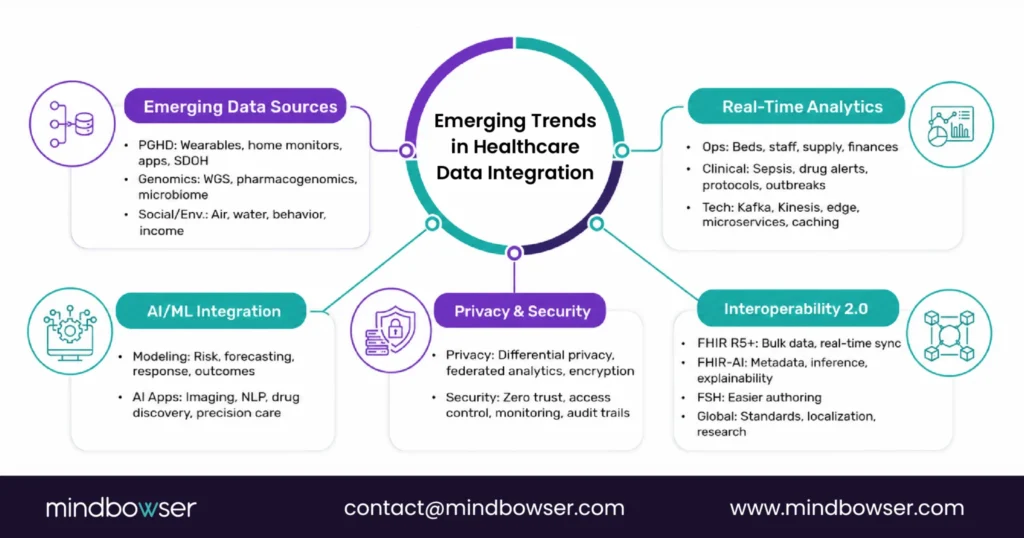
Patient-Generated Health Data (PGHD)
The explosion of consumer health devices creates new integration challenges:
Wearable Devices: Continuous monitoring of vital signs, activity, and sleep
Home Monitoring: Blood glucose, blood pressure, and weight scales
Mobile Health Apps: Symptom tracking, medication adherence, mental health
Social Determinants: Housing, food security, transportation, and employment
Integration Challenge: How do you incorporate continuous streams of patient-generated data into research datasets designed for episodic clinical encounters?
Effective healthcare data integration must now support continuous, unstructured, and patient-owned data.
Genomic and Molecular Data
Precision medicine requires integration of:
Whole Genome Sequencing: Individual genetic variations
Pharmacogenomics: Drug metabolism genetic markers
Tumor Profiling: Cancer genomic characteristics
Microbiome Data: Gut health and disease associations
Proteomics: Protein expression patterns
Integration Challenge: Genomic data volumes dwarf traditional clinical data, requiring new storage and processing architectures.
Social and Environmental Factors
Healthcare outcomes depend on factors beyond clinical care:
Environmental Exposures: Air quality, water safety, chemical pollutants
Behavioral Data: Physical activity, diet, sleep patterns, substance use
Socioeconomic Indicators: Income, education, employment, housing
Community Resources: Healthcare access, transportation, social support
Integration Challenge: Social and environmental data arrives fragmented across housing agencies, employment records, and community databases — most with no HL7 or FHIR mapping. Getting it into a clinical dataset requires custom ETL pipelines and governance frameworks that most health systems haven’t built yet.
III. Real-Time Analytics Revolution
From Batch to Stream Processing
Traditional healthcare analytics operate on historical data with batch processing cycles. Emerging use cases require real-time insights. These evolving needs require more responsive healthcare data integration systems:
Operational Analytics
Bed Management: Real-time capacity optimization
Staffing Optimization: Dynamic resource allocation
Supply Chain: Just-in-time inventory management
Financial Monitoring: Real-time revenue cycle tracking
Clinical Decision Support
Early Warning Systems: Sepsis, deterioration, mortality risk
Drug Interaction Alerts: Real-time prescription monitoring
Care Protocol Adherence: Evidence-based care compliance
Population Health Alerts: Disease outbreak detection
Technical Architecture Evolution
Real-time healthcare analytics require:
Stream Processing Platforms: Apache Kafka, Amazon Kinesis, Azure Event Hubs
Edge Computing: Processing at the point of care
Event-driven Architectures: Microservices responding to clinical events
Distributed Caching: Sub-second response times for clinical queries
IV. AI/ML Integration Patterns
From Analytics to Intelligence
Healthcare is transitioning from descriptive analytics to predictive and prescriptive intelligence:
Predictive Modeling
Risk Stratification: Patient deterioration, readmission, mortality
Demand Forecasting: Resource planning, capacity management
Treatment Response: Personalized therapy selection
Outcome Prediction: Surgical success, medication effectiveness
Clinical AI Applications
Medical Imaging: Radiology, pathology, ophthalmology diagnostics
Natural Language Processing: Clinical note analysis, voice recognition
Drug Discovery: Molecular target identification, compound optimization
Precision Medicine: Genomic-guided therapy selection
AI success depends on well-prepared, high-quality data. This raises the importance of structured healthcare data integration processes to feed machine learning pipelines.
ML-Optimized Data Architecture
AI applications require specialized data patterns:
Feature Stores: Centralized ML feature management
Model Versioning: Reproducible model deployment and rollback
Federated Learning: Multi-site model training without data sharing
Continuous Training: Models that adapt to new data patterns
V. Privacy and Security Evolution
Privacy-Preserving Analytics
Growing privacy requirements drive new technical approaches:
Differential Privacy
Statistical Guarantees: Mathematically proven privacy protection
Utility Preservation: Maintain analytical value while protecting individuals
Scalable Implementation: Privacy budgets for organizational data use
Federated Analytics
Distributed Computation: Analysis without data centralization
Query Federation: Cross-organizational research without data sharing
Homomorphic Encryption: Computation on encrypted data
Secure Multi-party Computation: Collaborative analytics with privacy guarantees
Maintaining data protection while enabling use is now a core healthcare data integration challenge.
Zero-Trust Architecture
Identity-based Access: Every request is authenticated and authorized
Least Privilege Access: Minimal permissions for specific use cases
Continuous Monitoring: Real-time threat detection and response
Data Lineage Tracking: Complete audit trails for compliance
VI. Interoperability 2.0
Beyond FHIR: Next-Generation Standards
While FHIR revolutionized healthcare interoperability, new requirements drive standards evolution:
FHIR R5 and Beyond
Enhanced Terminology: Better support for complex medical vocabularies
Bulk Data Improvements: Faster, more reliable large-scale exports
Real-time Subscriptions: Event-driven data synchronization
Quality Measures: Built-in support for performance measurement
HL7 FHIR Shorthand (FSH)
Simplified Authoring: Easier creation of FHIR implementation guides
Version Control: Better management of FHIR profile evolution
Automated Validation: Quality assurance for FHIR specifications
Fast Healthcare Interoperability Resources for AI (FHIR-AI)
Model Metadata: Standardized AI model descriptions
Training Data Requirements: Structured specification of ML data needs
Inference Endpoints: Standardized AI service integration
Explainability: Structured representation of AI decision rationale
Global Harmonization
Healthcare data integration is becoming increasingly international:
Cross-border Research: Global clinical trial coordination
Regulatory Alignment: Harmonized data standards across jurisdictions
Cultural Adaptation: Localized vocabularies and care patterns
Technology Transfer: Sharing analytical insights across healthcare systems
Ready to Move Beyond FHIR and OMOP? Let’s Build Your Next-Gen Data Platform.
VII. Cloud-Native Healthcare Platforms
Serverless Healthcare Computing
The future of healthcare IT emphasizes serverless, event-driven architectures:
Benefits
Automatic Scaling: Handle variable healthcare workloads efficiently
Cost Optimization: Pay only for actual compute consumption
Reduced Maintenance: Platform-managed infrastructure
Faster Innovation: Focus on business logic rather than infrastructure
Use Cases
FHIR API Endpoints: Auto-scaling API gateway for clinical data access
ETL Processing: Event-triggered data transformation pipelines
Analytics Workloads: On-demand compute for research queries
ML Inference: Scalable model serving for clinical applications
For teams building FHIR-native real-time pipelines today, a pre-built integration layer like ConnectHealth handles the cloud-native API gateway and FHIR streaming infrastructure — so engineering effort goes toward clinical logic, not plumbing.
Multi-Cloud Strategies
Healthcare organizations increasingly adopt multi-cloud approaches:
Vendor Independence: Avoid cloud provider lock-in
Geographic Distribution: Data sovereignty and disaster recovery
Best-of-breed Services: Optimal service selection across providers
Risk Mitigation: Reduced dependency on a single cloud provider
VIII. Quantum Computing Impact
Quantum Advantage in Healthcare
Quantum computing promises to revolutionize healthcare analytics:
Drug Discovery
Molecular Simulation: Quantum modeling of drug-protein interactions
Optimization Problems: Complex drug design parameter optimization
Chemical Reaction Pathways: Quantum simulation of biological processes
Genomic Analysis
Sequence Alignment: Quantum algorithms for genomic matching
Protein Folding: Quantum simulation of 3D protein structures
Population Genetics: Quantum-enhanced statistical analysis
Privacy-Preserving Computation
Quantum Cryptography: Unbreakable encryption for healthcare data
Quantum Key Distribution: Secure communication channels
Post-quantum Security: Protection against quantum decryption attacks
IX. Blockchain and Distributed Ledger Applications
Healthcare Use Cases
Blockchain technology addresses specific healthcare challenges:
Patient Identity Management
Decentralized identity: Patient-controlled health identity
Cross-provider authentication: Consistent identity verification across systems
Consent management: Immutable record of data use permissions
Supply Chain Integrity
Drug authentication: Anti-counterfeiting for pharmaceuticals
Medical device tracking: Complete supply chain visibility
Clinical trial data: Immutable research data integrity
Healthcare Payments
Smart contracts: Automated payment processing
Value-based care: Automated outcome-based payments
Insurance claims: Transparent, auditable claims processing
X. Implementation Roadmap
Near-Term (1-2 Years)
Real-time FHIR Streaming: Event-driven clinical data processing
Enhanced Privacy Controls: Differential privacy for research datasets
Cloud-native Architectures: Serverless healthcare computing adoption
AI/ML Integration: Standardized model deployment patterns
Medium-Term (3-5 Years)
Federated Analytics Platforms: Privacy-preserving multi-site research
Quantum-enhanced Security: Post-quantum cryptography implementation
Global Interoperability: Cross-border healthcare data standards
Patient-generated Data Integration: Consumer device data incorporation
Long-Term (5-10 Years)
Quantum Computing Applications: Drug discovery and genomic analysis
Artificial General Intelligence: Comprehensive clinical decision support
Precision Medicine at Scale: Individualized care for entire populations
Global Health Intelligence: Worldwide disease surveillance and response
At this stage, mature healthcare data integration will support high-impact population health management.
XI. Preparing for the Future
Organizational Readiness
Healthcare organizations should prepare for these trends:
Technical Capabilities
Cloud-native Expertise: Serverless and containerized application development
AI/ML Competencies: Data science and machine learning engineering
Privacy Engineering: Implementing privacy-preserving technologies
Security Operations: Zero-trust security architecture management
Data Governance
Federated Data Management: Governing data across organizational boundaries
Algorithm Governance: Managing AI model development and deployment
Privacy Compliance: Implementing evolving privacy regulations
Ethical Frameworks: Ensuring responsible use of healthcare AI
Cultural Change
Data-driven Decision Making: Analytics-informed clinical and operational decisions
Continuous Learning: Adapting to rapidly evolving healthcare technologies
Collaboration Mindset: Working across organizational and disciplinary boundaries
Patient-centred Design: Prioritizing patient needs in technology development
XII. Conclusion
The future of healthcare data integration will be characterized by real-time insights, AI-driven intelligence, privacy-preserving collaboration, and global interoperability. Organizations that invest in these capabilities today will lead tomorrow’s healthcare transformation.
This vision of future healthcare data integration builds on current industry trends and emerging technologies. The organizations moving fastest are the ones treating integration infrastructure as a strategic capability — not a legacy IT problem.
Planning your healthcare data integration architecture for the next 2–5 years? Talk to our team — we’ve built FHIR-native, cloud-native integration layers for mid-market health systems and digital health companies.