












 BLOGS
BLOGS  NEWSROOM
  CASE STUDIES
  WEBINARS
  PODCASTS
  ASSET HUB
  EVENT CALENDAR

















TL;DR
Epic Happy Together gives providers and patients a single view of patient data across participating Epic organizations. In MyChart, patients can bring records from multiple healthcare organizations into one place, helping them see a more complete care story instead of chasing portals one by one.
For CIOs, the value is practical: fewer blind spots, better medication reconciliation, stronger care continuity, and less duplicate work. The deeper question is not whether Epic Happy Together improves access to cross-system patient data. It does. The question is whether your governance, workflows, and integration strategy are mature enough to turn that access into better decisions.
This matters now because interoperability has moved from an IT backlog item to a board-level operating risk. CMS continues to push standards-based APIs for patient and provider access, while TEFCA is creating a national framework for trusted health information exchange across providers, patients, public health agencies, and payers.
Epic Happy Together is a strong step toward longitudinal patient records, but it is not the final architecture. Data may still be incomplete, delayed, duplicated, or unevenly documented. The CIO question is simple: can your teams trust the merged record enough to act on it?
I. What Is Epic Happy Together? (And Why It Matters Now)
A. What does Epic Happy Together actually do?
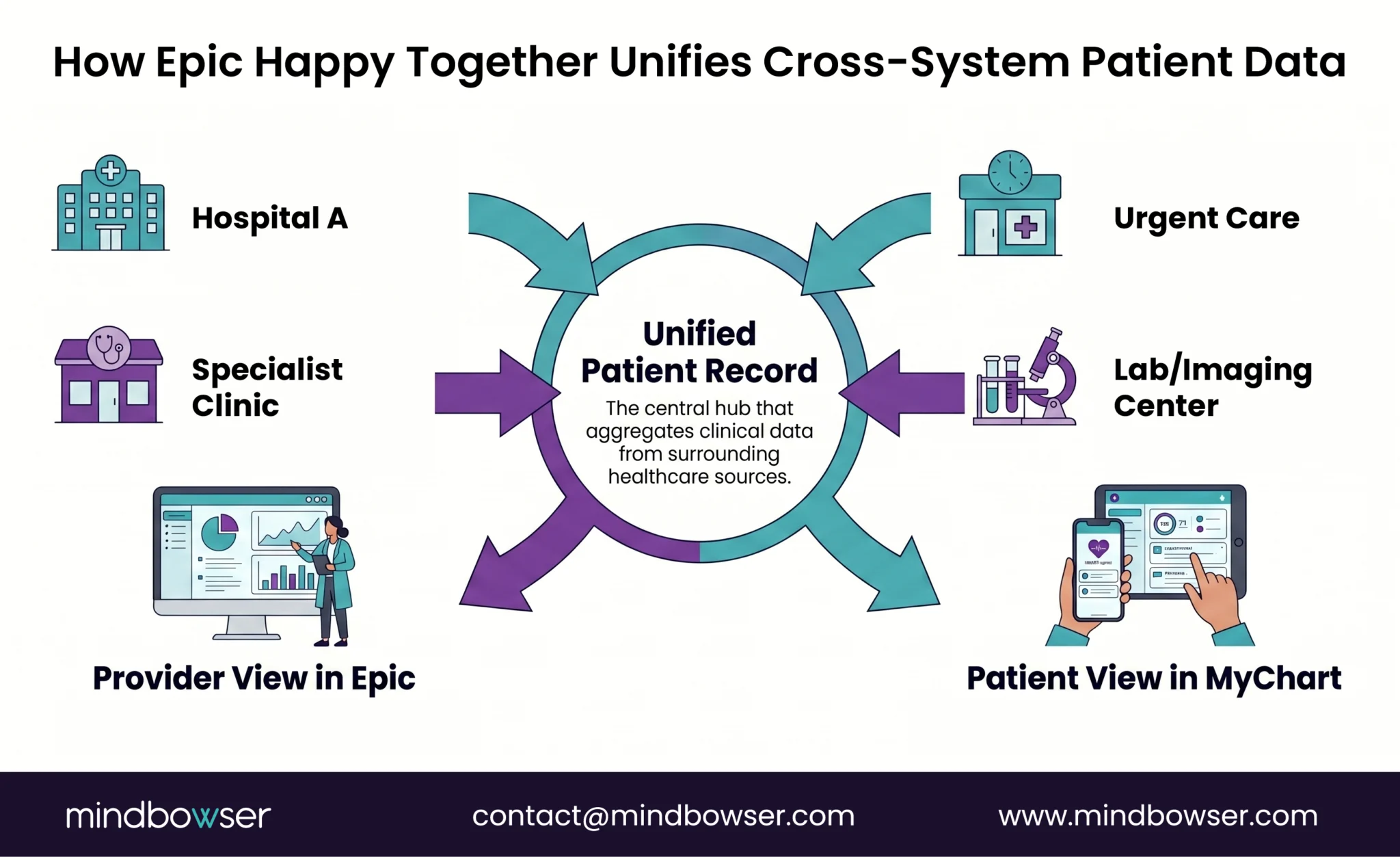
Epic Happy Together helps turn scattered patient records into one usable clinical view. Instead of asking a physician to search across portals, outside notes, faxed records, and patient memory, it brings information from participating Epic organizations into a single longitudinal record.
For patients, MyChart clearly states that people who have been seen at more than one healthcare organization can pull records together and view data such as allergies, appointments, care team members, health issues, medications, messages, and test results in one centralized place.
For clinicians, that unified view can support three practical decisions:
First, cross-organization clinical insight. A cardiologist can see what happened at the regional hospital, not just what happened inside their own network.
Second, medication reconciliation. Duplicate prescriptions, missing renewals, or conflicting drug histories become easier to spot.
Third, care gap identification. Missed screenings, incomplete follow-ups, and fragmented chronic care histories become more visible.
What happens when the most important clinical detail lives outside your EHR instance? That is the operational problem Epic Happy Together is trying to reduce.
B. Why this matters for mid-market providers
Mid-market health systems often sit in the messiest part of interoperability. They serve patients who move between hospitals, specialists, urgent care centers, retail clinics, and payer networks. The patient journey is connected in real life, but the data often is not.
That gap now has policy weight behind it. ONC says TEFCA is designed to remove barriers to electronic health record sharing among providers, patients, public health agencies, and payers, creating a national framework for trusted exchange. CMS also continues to push standards-based API access, including FHIR-based requirements tied to patient access and interoperability.
For CIOs, Epic Happy Together is not just an Epic feature. It is a response to a bigger boardroom question: how do we make care safer, faster, and easier to coordinate without replacing every system in the enterprise?
Unified data is useful only when it changes workflow, risk, and patient outcomes. That is where the real work starts.
II. How Epic Happy Together Works: A Practical Breakdown
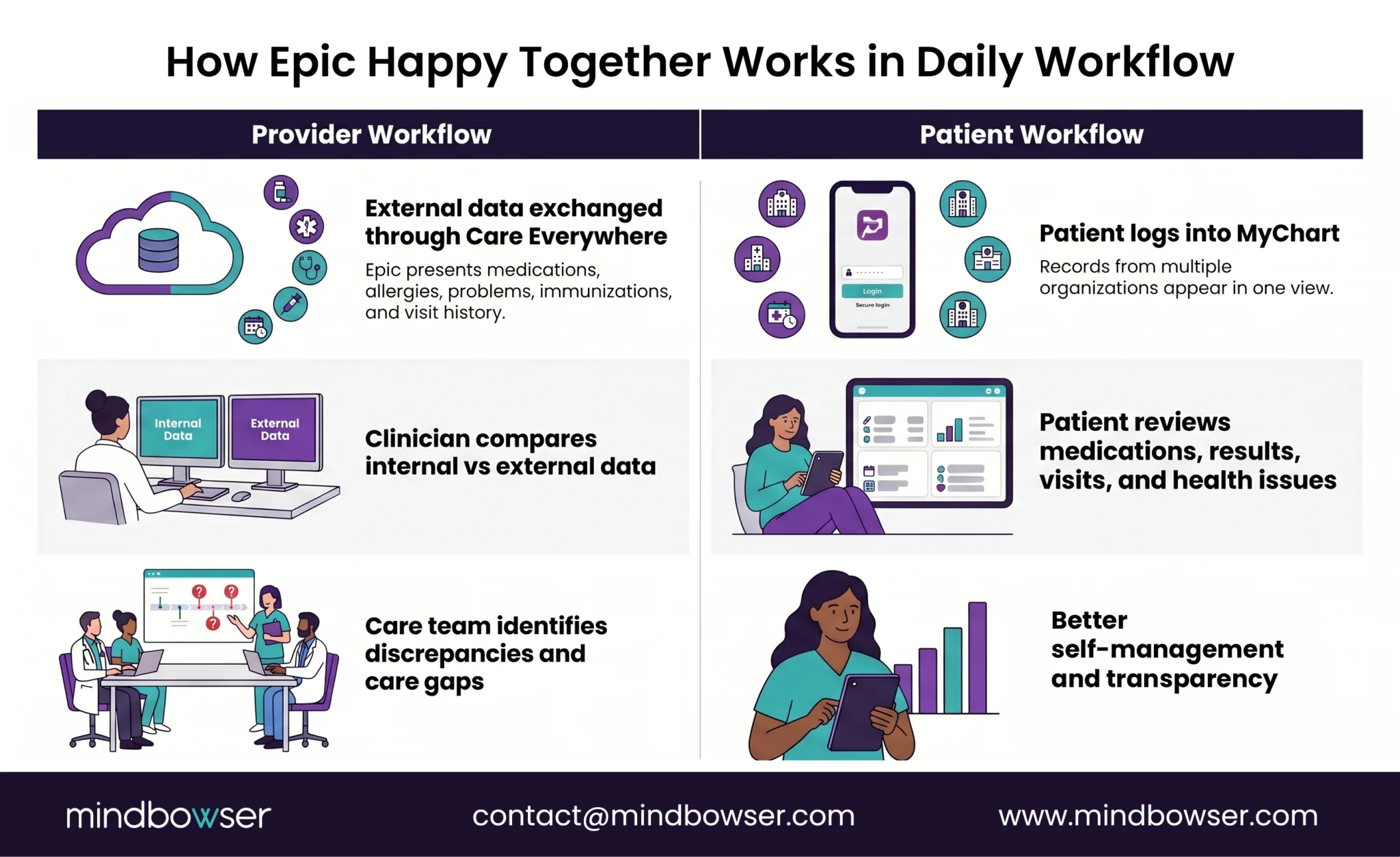
A. How is data merged and presented?
Epic Happy Together builds on existing Epic interoperability connections to display external information within a familiar record view. The practical idea is simple: when a patient has records across more than one organization, Epic can bring those records together so the care team does not have to chase them manually.
Epic says Care Everywhere supports patient data exchange across systems, with organizations exchanging more than 20 million patient records daily. About half of those exchanges are with organizations using a different interoperable EHR, which matters for CIOs planning beyond an Epic-only network.
Inside the unified view, clinicians can typically review:
- Medications
- Allergies
- Problems
- Immunizations
- Visit history
- Test results
- Care team context
The key is presentation. Data access alone does not improve care. It has to appear where clinicians already make decisions, with enough context to compare internal and external records. Otherwise, it becomes another tab, another click, another reason to miss the signal.
B. Provider workflow (inside Epic)
During an encounter, clinicians can use Epic Happy Together to review external records alongside local data. A physician might compare an outside medication list with the current chart, spot a duplicate anticoagulant, and ask one more question before signing the order.
Is this external diagnosis still active, or did it follow the patient from an old encounter?
That question matters. Unified records are useful, but they still require clinical judgment. The workflow should help providers identify discrepancies, not add extra review time. For CIOs and CMIOs, the adoption test is straightforward: does the feature reduce uncertainty at the point of care, or add another review burden?
C. Patient workflow (via MyChart)
For patients, Happy Together appears through MyChart as a way to view medical records from more than one healthcare organization in one place. MyChart describes the feature as a way for patients with multiple health records to pull them together into a single view.
This improves self-management in plain ways. A patient can see medications, upcoming appointments, results, and health issues without remembering which portal owns which piece of the story. That improves transparency and engagement.
Epic Happy Together works best when it supports three workflows at once: clinical review, patient access, and operational follow-through. Miss one, and the value drops fast.
III. Who Uses Epic Happy Together?
A. Primary Users
Epic Happy Together is not only a clinician convenience feature. It touches the operating model for care delivery, pharmacy safety, care coordination, and population health.
For physicians and specialists, the value shows up at the decision point. A specialist can review outside diagnoses, medications, lab history, and prior visits before ordering another test or changing a care plan. That matters when the patient has moved across hospitals, ambulatory clinics, and referral networks.
For nurses and care coordinators, the benefit is continuity. They can see where the patient has been, what was already addressed, and what still needs follow-up. Less detective work. More care work.
For pharmacists, the impact is direct: medication reconciliation becomes safer when external prescriptions and allergy history are visible. A missed medication conflict is not an IT issue. It is a patient safety issue.
For health system administrators, the greater value lies in pattern recognition. Cross-system visibility can help teams understand leakage, care gaps, follow-up delays, and avoidable duplication across the network.
B. Secondary Users
Patients are the most visible secondary users because Happy Together extends into MyChart. A patient who receives care from multiple organizations can view a more complete record without logging into every portal separately.
What does that mean in real life? A patient managing diabetes, cardiology visits, urgent care encounters, and lab work can see more of the story in one place. That helps with self-management, family support, and visit preparation.
Health Information Management teams also benefit because fewer record requests may need manual chasing. Population health and value-based care teams gain a broader view of patient history, which helps with risk scoring, quality tracking, and care gap closure.
Epic Happy Together works when each user group gets a different kind of clarity: clinicians get context, patients get access, administrators get visibility, and care teams get fewer blind spots.
IV. Epic Happy Together vs Traditional Data Exchange
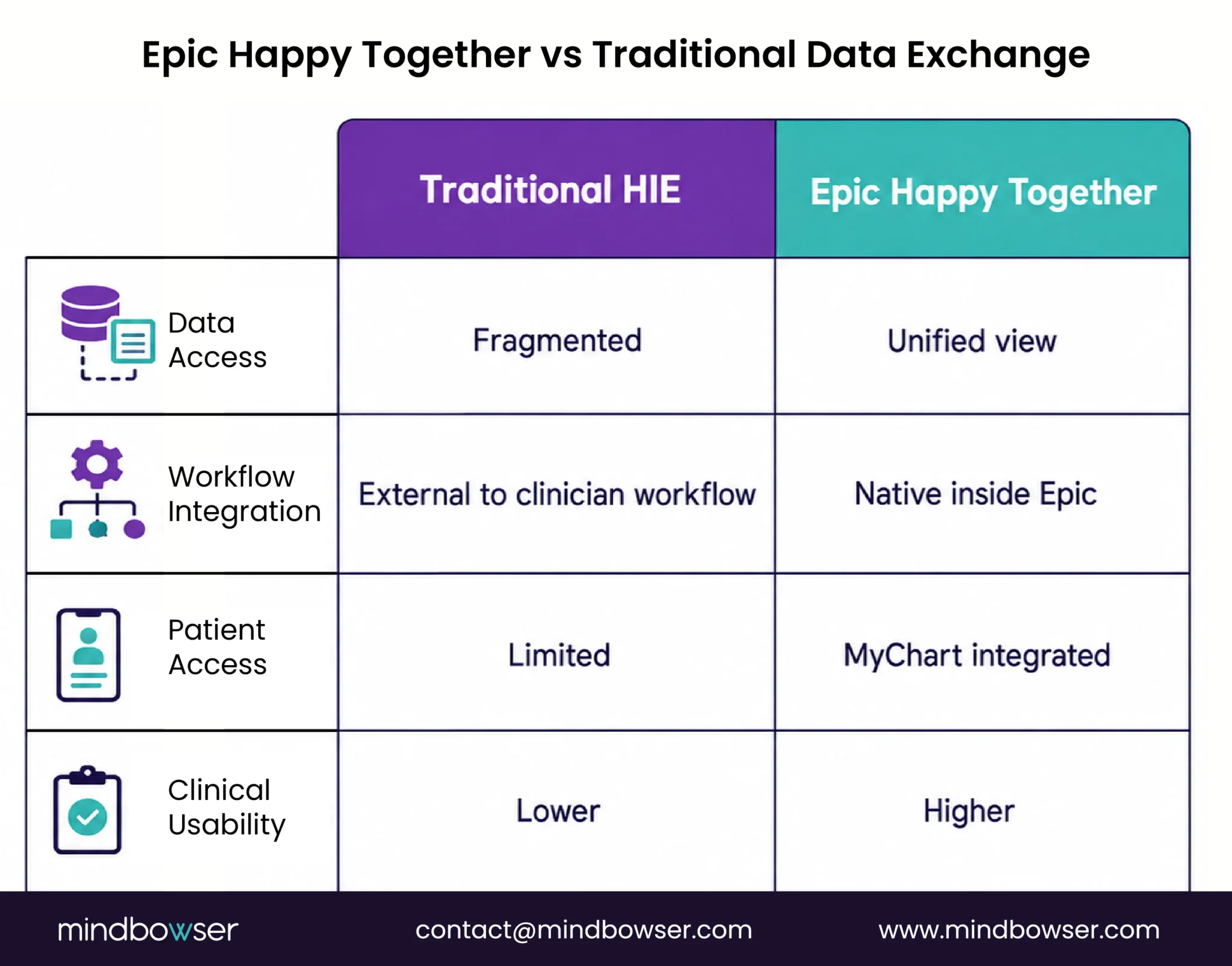
The difference is not just where the data comes from. It is where the data shows up. Traditional HIE access often requires clinicians to leave their normal workflow, search external records, interpret inconsistent documents, and decide what matters while the patient is already in the room. Epic Happy Together brings more external information into the Epic experience itself.
That shift matters because clinician adoption usually fails at the workflow layer rather than the policy layer. A data exchange can be technically available yet unused if it feels slow, fragmented, or untrustworthy.
| Capability | Traditional HIE | Epic Happy Together |
|---|---|---|
| Data Access | Fragmented | Unified view |
| Workflow Integration | External | Native to Epic |
| Patient Access | Limited | MyChart integrated |
| Clinical Usability | Low | High |
A. Why the native workflow matters
With a traditional HIE, the clinician often has to search for outside data, open documents, scan for relevance, and manually compare them with the local chart. That creates friction. In a busy clinic, friction becomes avoidance.
With Epic Happy Together, the value is not that every data problem disappears. This way, the care team can view cross-system patient data closer to the point of decision-making. Medications, allergies, problems, immunizations, and visit history become easier to compare against the local chart.
Would your physicians trust external data more if it appeared inside the workflow they already use?
For many CIOs, that is the real adoption question.
B. What traditional exchange still does well
Traditional HIEs still matter, especially when your market includes non-Epic hospitals, public health agencies, labs, payers, post-acute networks, or community providers. Epic Happy Together is stronger inside the Epic experience, but it does not remove the need for a broader interoperability architecture.
Think of it this way: Happy Together improves usability for Epic-centered workflows. HIEs and standards-based APIs expand reach across a mixed healthcare network.
The winning strategy is not Happy Together versus HIE. It is native workflow plus broad exchange, so clinicians get useful data, and the enterprise still connects beyond Epic.
V. Key Benefits of Epic Happy Together
1. Better Clinical Decision-Making
A single patient view reduces clinical blind spots. When a provider can see outside medications, allergies, problems, immunizations, and visit history, the encounter starts with a better context.
This matters most in high-risk moments: a new specialist visit, an emergency department handoff, a medication change, or a discharge follow-up. The CDC notes that adverse drug events remain a serious public health threat, especially as adults age and take more medications.
Would a physician order differently if they saw the full medication story before clicking sign?
That is where Epic Happy Together earns attention. It can help identify conflicting medications, missed diagnoses, and duplicate procedures before they turn into cost, risk, or harm.
2. Reduced Administrative Burden
Cross-system data access also reduces the manual work hiding in the margins. Less chart chasing. Fewer phone calls. Fewer faxes. Less patient-by-patient reconstruction before a visit.
For CIOs, this is not only a clinician satisfaction issue. It is an operating cost issue. When staff spend time retrieving records, reconciling gaps, and scanning documents, the system pays twice: once in labor and again in delayed decisions.
Native workflow matters here. If the data appears inside Epic, teams are more likely to use it during normal care instead of treating it as a separate research task.
3. Improved Patient Engagement
In MyChart, Happy Together helps patients see records from multiple healthcare organizations in one place. That can make care easier to understand, especially for people managing several conditions, specialists, and test results across systems.
A patient who understands the care journey is more likely to prepare for visits, notice gaps, and ask better questions. Not perfect. Better.
4. Stronger Value-Based Care Outcomes
Value-based care depends on the complete patient context. Risk stratification, care coordination, quality reporting, and care gap closure all weaken when patient history is split across organizations.
HIMSS has reported interoperability challenges, including privacy and security concerns, a lack of data standardization, data fragmentation, and inconsistent exchange standards across providers. Epic Happy Together does not erase those challenges, but it provides Epic-centered organizations with a stronger workflow layer for leveraging external data.
The benefit is not “more data.” The benefit is better action: safer medication decisions, faster coordination, clearer patient access, and stronger performance in risk-based models.
VI. Limitations and Challenges You Should Know
1. Data Completeness Issues
Epic Happy Together can only show what connected organizations make available. That sounds obvious, but it is the first place CIOs should slow down. A unified view is not the same as a complete view.
External data can vary by source, data type, documentation quality, and exchange configuration. One organization may share a rich medication history. Another may send a limited encounter context. A third may document problems in a way that clinicians still need to interpret what they are seeing.
What happens when a merged record looks complete, but the missing detail is the one that changes the care plan?
That is why implementation cannot stop at enablement. Teams need reconciliation workflows, data quality checks, and clear training on what external information can and cannot be trusted at face value.
2. Governance & Data Ownership
Cross-organization visibility creates governance questions that are not only technical. Consent, access control, release of information, patient matching, audit trails, and legal responsibility all need clear ownership.
The CIO’s job is to make the rules visible before the data becomes widely visible. Who can see what? Which teams validate disputed data? How are corrections handled? What happens when patient identity matching is uncertain?
These are not edge cases. They are operating realities in health systems where patients move across affiliated and unaffiliated organizations.
3. Workflow Friction
Even useful data can fail if it adds cognitive load. Clinicians may ignore external records if the display feels cluttered, repetitive, or hard to interpret. They may also miss important signals if alerts fire too often or if outside data is not clearly separated from local chart data.
More data can become more noise. The better goal is to filter context: what changed, what conflicts, what needs action, and what can wait.
4. Epic-to-Non-Epic Interoperability Gaps
Epic Happy Together works best when the patient’s care journey stays inside participating Epic environments. In mixed markets, CIOs still need to account for non-Epic EHRs, labs, imaging centers, post-acute providers, payer data, and community resources.
That does not weaken the value of Epic Happy Together. It defines its boundary. It is a strong workflow layer within Epic, not a full enterprise interoperability strategy on its own.
The limitation is not access. The limitation is trustworthy use. Data must be complete enough, governed enough, and workflow-ready enough to change decisions.
Talk to our Epic integration team
VII. How Epic Happy Together Integrates with Other Epic Modules
A. Care Everywhere
Care Everywhere is the interoperability foundation. Epic describes it as the platform used to exchange patient data with healthcare institutions, HIEs, and government agencies during treatment and care coordination workflows. It can exchange information directly between systems and supports standards from groups such as IHE, ONC, and HITSC.
Happy Together builds on that foundation by making exchanged data more usable in the clinician’s workflow. For a CIO, this distinction matters. Care Everywhere helps move data. Epic Happy Together helps present it in context.
B. MyChart
MyChart is the patient-facing layer. When Happy Together is enabled, patients can see information from multiple organizations in one place, including medications, allergies, test results, appointments, and health issues.
That can strengthen the digital front door because patients do not experience their care journey as a series of separate EHR instances. They experience it as one condition, one family concern, one confusing billing and clinical trail. Why should the patient need to know which system owns which record?
C. Healthy Planet (Population Health)
Healthy Planet supports population health workflows, including risk stratification, outreach, prevention, and care coordination. Epic’s population health materials describe examples in which care data inform outreach and help teams focus on high-needs, rising-risk, and preventive care populations.
When Happy Together improves cross-system visibility, Healthy Planet programs can gain better context for risk scoring, cohort management, and care gap closure. The caveat: external data still needs validation before it drives outreach rules or quality workflows.
D. Epic Cosmos
Epic Cosmos is a broader analytics layer. Epic describes Cosmos as a dataset built with a community of Epic-using health systems to improve patient care, support discoveries, and power point-of-care insights tailored to the patient in front of the clinician.
For CIOs, the link is strategic. Happy Together improves the local cross-system patient view. Cosmos supports broader evidence, benchmarking, and clinical intelligence.
E. Clinical Decision Support (CDS)
Clinical Decision Support becomes more useful when it has better context. A medication alert, care gap reminder, or follow-up prompt can carry more weight when it reflects data from more than one organization.
But this is where governance gets serious. If external data is incomplete or duplicated, CDS can misfire. The goal is not more alerts. The goal is fewer, better, more trusted prompts.
Epic Happy Together works best as part of an Epic operating layer: Care Everywhere for exchange, MyChart for patient access, Healthy Planet for population health, Cosmos for analytics, and CDS for timely action.
VIII. Where Epic Happy Together Falls Short (Content Gap Section)
A. What competitors won’t tell you
A unified view is not the same as fully normalized data. That is the point many interoperability conversations skip.
Epic Happy Together can help clinicians view cross-system patient data within a more usable workflow. However, the underlying information may still come from different documentation practices, care settings, coding patterns, and update cycles. One organization’s “active problem” may be another organization’s historical note. One medication list may be current. Another may be copied forward from a prior encounter.
That creates a quiet risk: the record looks complete enough to trust, but uneven enough to mislead.
Would your clinical team know which external data element was verified, which was imported, and which still needs reconciliation?
That is why CIOs should treat Epic Happy Together as a workflow asset rather than a governance shortcut. It still requires:
- Data reconciliation workflows
- Clinical validation rules
- Patient identity controls
- Audit practices
- Training for external data interpretation
The hard truth: visibility improves the odds of better care, but it does not remove the need for judgment. And judgment needs a clean workflow design.
B. Common misconceptions
1. “It replaces HIEs”
It does not. Epic Happy Together complements HIEs by improving how shared data appears inside Epic-centered workflows. Health systems still need broader exchange strategies for non-Epic providers, labs, imaging groups, payers, public health networks, post-acute care, and community partners.
The better frame is not a replacement. It is role clarity. HIEs expand reach. Happy Together improves usability.
2. “It’s fully real-time”
Not always. Data freshness depends on connection design, source system behavior, exchange timing, and workflow configuration. A CIO should never assume that every external data point reflects the latest clinical reality unless the architecture proves it.
That matters for medication safety, discharge follow-up, emergency care, and quality reporting. Latency is not just a technical detail. It can change the decision.
Epic Happy Together is valuable, but it is not magic. The winners will be the organizations that pair it with data governance, clinical review, workflow discipline, and cross-platform integration.
IX. Real-World Use Cases
A. Use Case 1: Multi-System Patient Journey
Picture a patient treated across three hospitals in six months. The first visit starts in the emergency department. The second happens with a specialist across town. The third occurs after a complication at a different health system.
Without a unified view, each team sees only part of the story. Lab results sit in one record. Medication changes sit in another. Diagnoses sit somewhere else. The patient becomes the messenger, and the clinician becomes the investigator.
With Epic Happy Together, the care team can view a more complete record across participating Epic organizations. Lab results, medications, diagnoses, allergies, problems, immunizations, and visit history become easier to review inside the clinical workflow.
What changes when the care team sees the journey instead of one isolated encounter?
The answer is simple: fewer blind spots, faster decisions, and less repeated work.
B. Use Case 2: Medication Safety
Medication safety is one of the clearest use cases. A patient may receive prescriptions from a primary care physician, cardiologist, urgent care provider, and hospitalist. Each provider may act correctly based on the information available locally, yet the total medication picture may still create risk.
Epic Happy Together can help surface duplicate prescriptions, allergy conflicts, and medication history gaps across systems. That gives pharmacists and clinicians a better starting point for reconciliation.
The important word is starting. External medication data still needs review, especially when lists are copied forward, incomplete, or outdated. The feature helps expose the question. The clinical team still owns the answer.
C. Use Case 3: Value-Based Care Programs
Value-based care teams need a more comprehensive patient history to manage risk effectively. A patient with multiple admissions, missed screenings, specialist visits, and medication changes may look low-risk in one system and high-risk across the full journey.
That gap affects risk scoring, outreach, care management, and quality reporting.
When Epic Happy Together gives care teams more cross-system context, it can support better cohort management and care gap closure. A care coordinator can see recent visits outside the home organization. A population health team can understand why a patient’s risk changed. A CMIO can push for better clinical rules based on broader history, not just local encounters.
These use cases show the real value of Epic Happy Together. It is not about having more records. It is about making the next clinical, operational, or value-based decision with fewer missing pieces.
X. Implementation Considerations for CIOs & CTOs
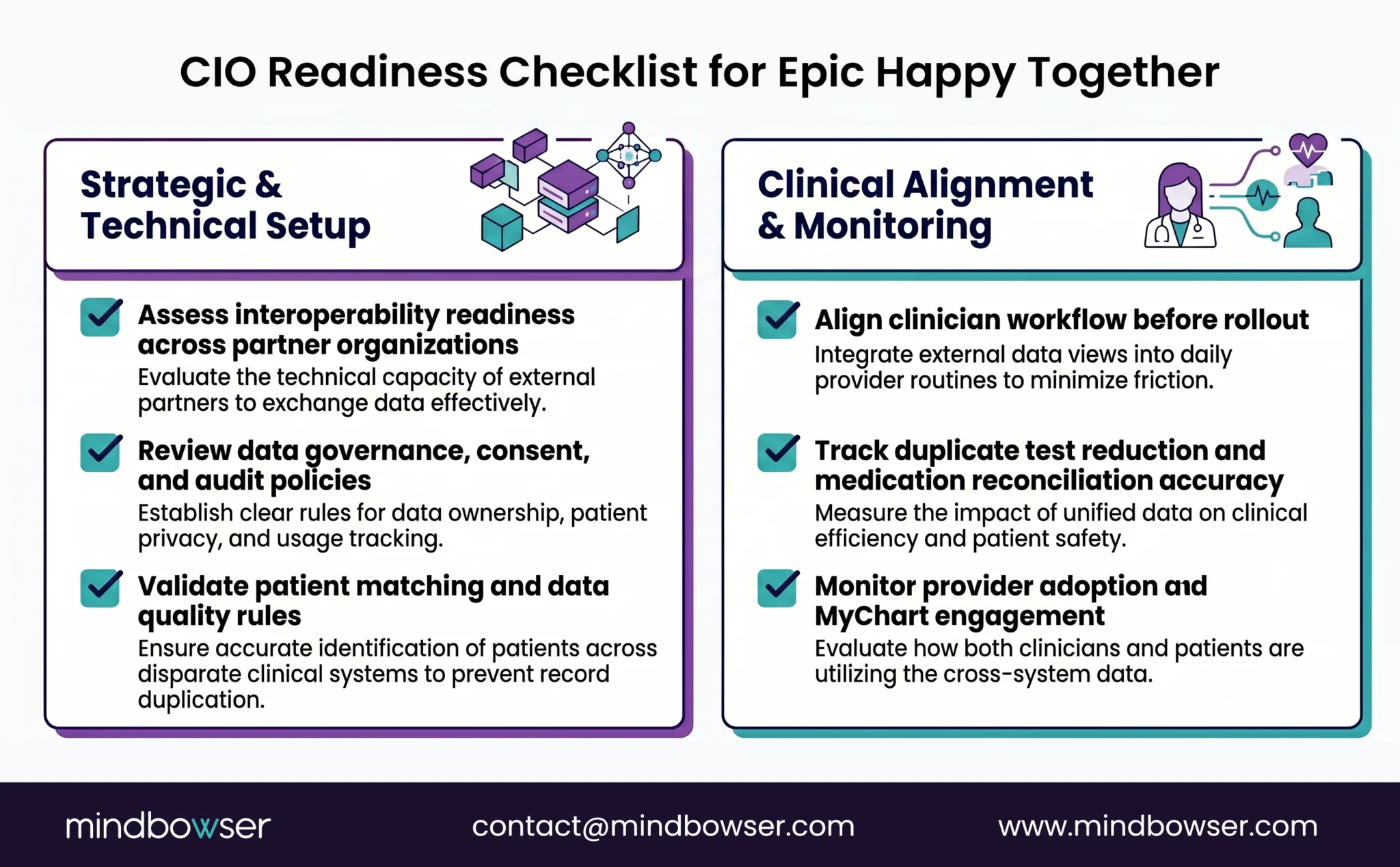
A. What to evaluate before enabling
Epic Happy Together should not be treated as a switch-flip project. The feature may be available inside the Epic environment, but the business value depends on readiness across data, governance, workflow, and adoption.
Start with interoperability readiness. Which partner organizations exchange data today? Which records arrive consistently? Which data types are useful enough for clinical action? A CIO should map the current exchange network before promising clinicians a complete patient view.
Next, review data governance policies. Cross-system data raises questions around consent, access, patient matching, data correction, audit logging, and legal accountability. These rules should be clear before external data becomes part of everyday clinical decision-making.
Then test clinical workflow alignment. The CMIO and frontline teams need to define where external data should appear, when it should interrupt, and when it should stay available without creating noise.
Does the workflow help a physician make a better decision in less time, or does it ask them to become a chart detective?
That question should guide configuration.
B. Key success metrics
The most useful metrics connect Epic Happy Together to operational outcomes, not feature usage alone.
Track reduction in duplicate tests. If clinicians can see recent labs or imaging from another organization, avoidable repeat orders should fall in targeted workflows.
Measure medication reconciliation accuracy. Look for fewer duplicate medications, fewer unresolved discrepancies, and faster pharmacist review.
Watch provider adoption rate. Adoption should include frequency of use, time spent reviewing external data, and whether clinicians act on the information.
Monitor patient portal engagement. If patients can see a more complete record in MyChart, portal logins, record views, message patterns, and visit preparation may improve.
Here is the simple implementation lens:
Access → Trust → Workflow → Action → ROI.
If any link breaks, the value drops.
Map your Epic integration roadmap.
Epic Happy Together succeeds when CIOs manage it like a clinical operating change, not an interoperability checkbox.
XI. How Mindbowser Builds Custom EHRs with Epic Integration Capabilities?
A. Why off-the-shelf interoperability isn’t enough
Epic Happy Together improves visibility, but most health systems still need a custom workflow around the record. That is where CIOs and CTOs should draw the line between access and execution.
A unified patient view helps clinicians see more context. It does not automatically create specialty-specific dashboards, automate care team handoffs, summarize complex histories, connect non-Epic data sources, or route follow-up tasks to the right team.
What happens after the clinician sees the cross-system data?
That is the gap where custom digital health products matter. Mid-market providers often need workflows built around their service lines, payer contracts, care management models, and operating constraints. A cardiology group may need longitudinal risk views. A behavioral health network may need consent-aware record sharing. A value-based care team may need outreach rules tied to quality measures.
The record is the source. The workflow is the product.
B. Our approach
Mindbowser builds custom EHR extensions and digital health platforms that integrate with Epic while supporting the work that happens around Epic.
That may include integrations through:
- FHIR APIs
- HL7 interfaces
- Care Everywhere frameworks
- Custom analytics layers
- Remote monitoring data streams
- Patient engagement workflows
The goal is not to replace Epic. The goal is to extend what your teams can do with it. Better summaries. Faster handoffs. Cleaner dashboards. More useful patient engagement. Less swivel-chair work. The good stuff.
C. What we typically deliver
For CIOs and digital health leaders, the most valuable work usually sits in four areas.
Unified patient dashboards beyond the Epic UI help care teams see the right data for a specific use case, not every data element in the chart.
AI-driven summaries through AI Medical Summary can help condense complex patient history into a more usable clinical briefing, with guardrails for review and validation.
Care coordination tools through CarePlan AI can support task routing, care gap tracking, and follow-up workflows across teams.
Remote monitoring integrations through RPMCheck AI and WearConnect can connect device data, symptoms, alerts, and engagement patterns back into care workflows.
D. Example outcomes
When Epic data is paired with custom workflow design, health systems can target measurable operating gains: 30 to 40% reduction in care coordination delays, better readmission risk prediction using unified datasets, and higher clinician adoption because the tool fits the way teams already work.
That last point matters most. Clinicians do not adopt platforms because the architecture diagram looks clean. They adopt tools that save time, reduce uncertainty, and help them act with confidence.
E. Where we add value
Mindbowser’s role is to help bridge Epic with non-Epic systems, patient-facing tools, AI layers, remote monitoring programs, and value-based care workflows.
Epic Happy Together can show the broader record. Mindbowser helps turn that record into action.
For CIOs, that means designing around the full operating chain: data intake, identity, governance, workflow, analytics, patient engagement, and measurable ROI.
Interoperability is no longer just a connection problem. It is a product strategy problem.
Is Epic Happy Together Enough for Longitudinal Care?
Epic Happy Together is a strong step toward interoperability, but it is not the final destination. It gives providers and patients a clearer view of cross-system patient data, especially when care happens across multiple Epic organizations. But CIOs should be careful not to confuse visibility with readiness.
A merged record can still include missing data, outdated medications, duplicate problems, uneven documentation, and gaps from non-Epic systems. For health systems focused on true longitudinal patient records, advanced analytics, AI-driven care, and value-based performance, Epic Happy Together should be part of a broader strategy that includes governance, clinical validation, non-Epic integration, workflow design, patient engagement, and automation.
The future is not one record in one system. It is a connected care architecture where the right data reaches the right person, in the right workflow, with enough trust to support action.
Epic Happy Together is an Epic feature that combines patient data from multiple participating Epic organizations into one unified record view.
It helps clinicians and patients see a more complete care history without replacing existing EHR systems.
It gives clinicians better visibility into medications, allergies, problems, immunizations, visit history, and external records.
This can reduce duplicate work, improve medication reconciliation, and support safer clinical decisions.
Yes, patients can use Happy Together through MyChart to view records from multiple healthcare organizations in one place.
This improves transparency and helps patients better understand their care journey across systems.
No, Epic Happy Together does not replace health information exchanges.
It complements HIEs by making shared data easier to view inside Epic workflows, while HIEs still support broader cross-network exchange.
Its value depends on data completeness, governance, patient matching, and how well external records fit clinical workflows.
It works best when paired with strong data policies, non-Epic integrations, and workflow design.