













 BLOGS
BLOGS  NEWSROOM
  CASE STUDIES
  WEBINARS
  PODCASTS
  ASSET HUB
  EVENT CALENDAR



















TL;DR
- Epic Beacon is Epic’s oncology module treatment planning, regimen management, clinical decision support, built into Epic.
- Used by 280+ health systems including CHRISTUS, Dana-Farber, Rush, Weill Cornell, and MSK.
- Integrates natively with Willow, pharmacy; Radiant, imaging; MyChart; and Stork for full care-team coordination.
- Epic Beacon analysts configure treatment plans and protocols; Epic Beacon certification is a separate build credential.
- To pull Beacon treatment and outcome data into your own app or analytics layer, ConnectHealth ships a pre-built Epic connector days, not months.
II. Key Features of Epic Beacon for Oncology
A. Chemotherapy Regimen Management and Customization
One of Beacon’s strongest features is its ability to manage complex chemotherapy regimens with precision. Clinicians can choose from pre-built protocols or customize treatment plans tailored to each patient’s specific needs. The system supports dose adjustments, cycle planning, and administration schedules—all in one place. This reduces manual work and ensures each plan is both evidence-based and tailored.
B. Protocol-Based Treatment Planning
Beacon aligns treatment with nationally recognized oncology protocols. Whether it’s NCCN guidelines or custom pathways adopted by the hospital, providers can standardize care across patients with similar diagnoses. This consistency improves outcomes and supports peer review, quality checks, and research initiatives.
While Beacon provides standard protocol templates, pairing it with solutions like CarePlan AI allows mid-sized hospitals to layer in more personalized care adjustments based on real-time insights.
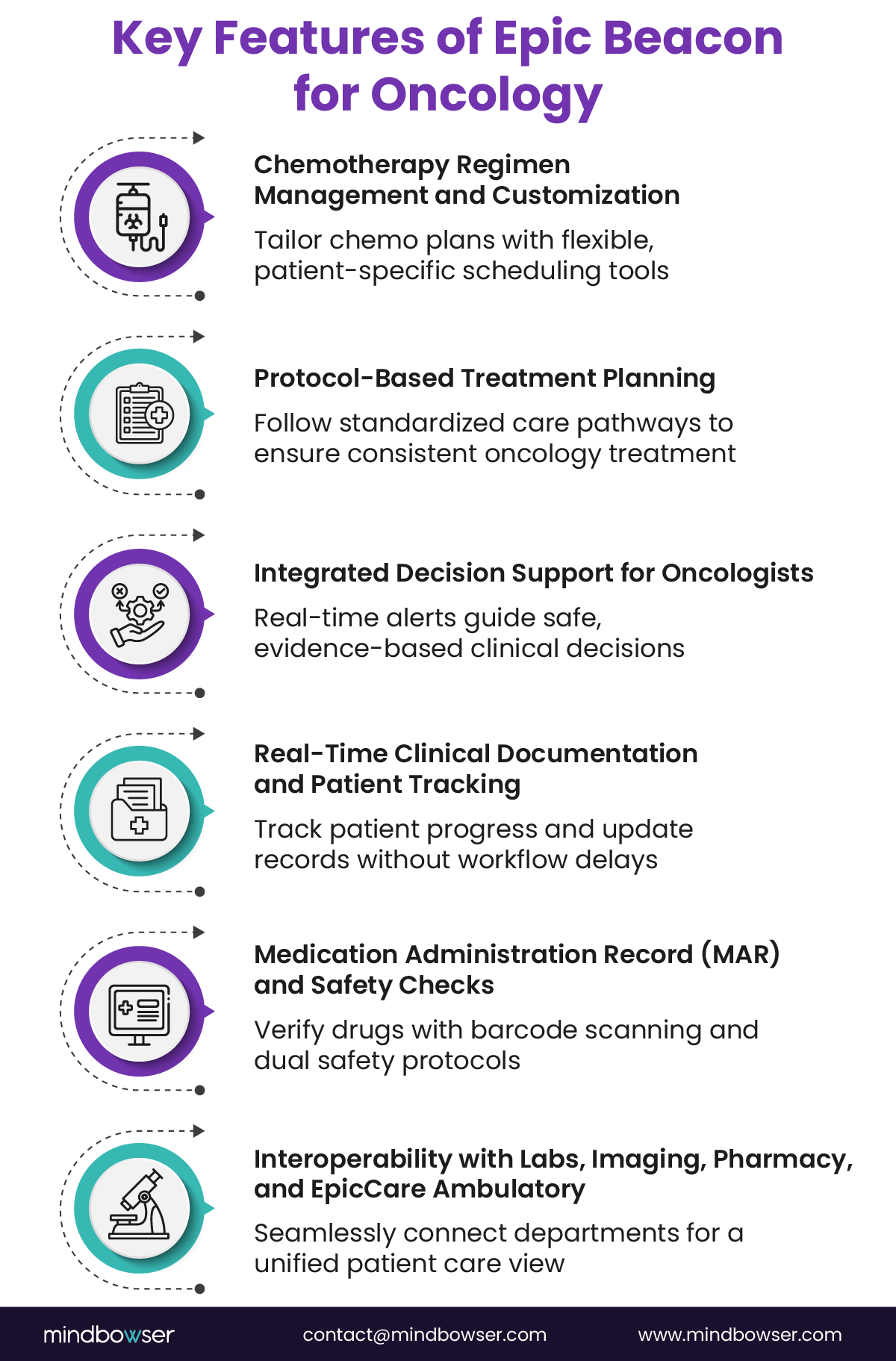
C. Integrated Decision Support for Oncologists
The module provides real-time clinical decision support, flagging potential drug interactions, incorrect dosages, or deviations from established protocols. These built-in alerts help providers catch issues early—before they impact patient safety—without interrupting the care process.
D. Real-Time Clinical Documentation and Patient Tracking
Everything, from treatment updates to lab values and imaging reports, flows into the system in real-time. This provides the care team with a comprehensive view of each patient’s status—whether they’re mid-cycle, recovering from side effects, or ready for the next phase of treatment. Nurses, physicians, pharmacists, and administrative staff can all stay on the same page.
E. Medication Administration Record (MAR) and Safety Checks
With Beacon, administering chemo isn’t just about checking boxes. The system requires barcode scanning, double verification, and documentation at each step. It adds a layer of safety where it matters most—during drug delivery—helping reduce administration errors and ensuring compliance with oncology safety standards.
F. Interoperability with Labs, Imaging, Pharmacy, and EpicCare Ambulatory
Because it’s part of the larger Epic ecosystem, Beacon doesn’t operate in a silo. It pulls in lab results, pharmacy updates, imaging reports, and visit notes from connected modules. This simplifies communication between departments, reducing the need for duplicate entries and follow-ups.
Looking to Build a Custom EHR with Epic Integration?
III. Benefits of Epic Beacon in Oncology Care
A. Improved Clinical Accuracy
In oncology, there’s little room for error. Beacon helps reduce variability by guiding clinicians through protocol-driven care. When treatment plans are based on standard pathways and updated in real-time based on patient response, it leads to more consistent outcomes. This type of built-in guardrail supports not only accuracy but also clinical confidence.
B. Enhanced Patient Safety
Beacon incorporates multiple layers of safety checks, especially around chemotherapy administration. It flags potential interactions, enforces double verification of medications, and tracks every step of the treatment cycle. These safeguards reduce the chances of dosing mistakes or missed steps, which is especially important when working with high-risk drugs.
C. Streamlined Workflows
Oncology care is a team effort—doctors, nurses, pharmacists, lab techs, and schedulers all need access to the same information. With Beacon, everything lives in one place. From treatment orders to infusion schedules to progress notes, the system eliminates silos and reduces back-and-forth communication. That means fewer delays, less confusion, and better use of everyone’s time.
D. Better Data Coordination Across Teams
Whether it’s a hematologist, radiation oncologist, or infusion nurse, every provider involved in a patient’s care can view the same data, updated in real-time. Beacon makes it easier to coordinate care, spot trends, and respond quickly when adjustments are needed. It supports multi-disciplinary collaboration without the usual data friction.
E. Regulatory Compliance Made Easier
Epic Beacon comes with built-in tools that make it easier to meet regulatory and accreditation requirements. From documentation templates to audit trails, hospitals have the necessary tools to stay compliant with oncology standards and federal reporting guidelines. This not only simplifies inspections and reporting but also strengthens trust with patients and payers.
Related Read: How to Integrate a Health App with Epic EHR/EMR
IV. Why Mid-Sized Hospitals Are Adopting Epic Beacon?
A. Rising Cancer Caseloads in Community and Regional Hospitals
Cancer care is no longer limited to large academic centers. Mid-sized hospitals and community-based facilities are seeing a steady rise in oncology cases. As patient demand increases, these hospitals need more than spreadsheets and disconnected tools to keep up. Epic Beacon provides a structured and reliable way to manage complex treatments without overwhelming staff or systems.
B. A Shift from Fragmented Tools to Integrated Solutions
Many mid-sized hospitals have traditionally relied on a patchwork of software—one tool for chemo scheduling, another for lab results, and a separate one for billing. This fragmentation slows down care and increases the risk of mistakes. With Epic Beacon, everything is connected. Scheduling, treatment planning, medication management, and documentation all happen in the same system. That level of integration simplifies operations and improves the care experience for both patients and providers.
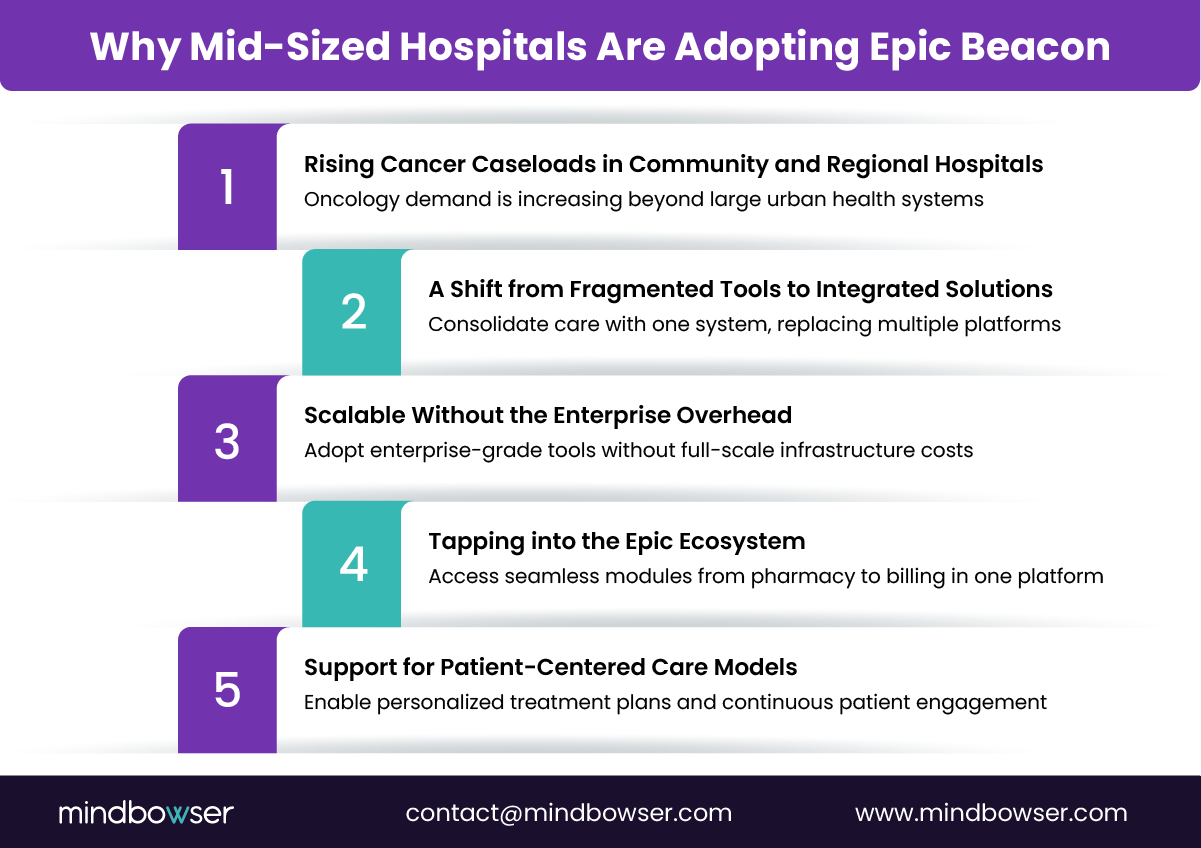
C. Scalable without the Enterprise Overhead
One of the primary reasons mid-sized hospitals hesitate to adopt new systems is the cost and complexity associated with them. Beacon meets them in the middle. It brings the depth and reliability of Epic’s technology but allows for tailored rollouts. Through programs like Epic Community Connect, smaller hospitals can gain access to Beacon without having to build an entire Epic infrastructure from scratch. That means lower upfront investment and faster time to value.
D. Tapping into the Epic Ecosystem
Adopting Beacon doesn’t just mean better oncology workflows—it also opens the door to everything else Epic offers. Whether it’s MyChart for patient access, integrated pharmacy tools, or smoother billing processes, mid-sized hospitals benefit from being part of a larger, proven system. And since Beacon works seamlessly with these modules, scaling up becomes a lot less painful down the line.
E. Support for Patient-Centered Care Models
Mid-sized hospitals often take pride in providing personalized care and fostering community relationships. Beacon helps reinforce this by enabling more tailored treatment plans, improving communication with patients, and ensuring more consistent follow-ups. In an era where patient satisfaction directly impacts reputation and reimbursement, having the right tools in place makes a significant difference.
Build Your EHR Platform with Us
V. Implementation Considerations
A. Cost and Infrastructure: Cloud vs. On-Prem
Implementing Epic Beacon involves a financial and technical commitment, but mid-sized hospitals have more flexibility today than they did a few years ago. Some choose to host Beacon on-premise, which gives them more control but requires a larger internal IT footprint. Others opt for cloud-hosted deployments—either directly or through a larger health system using Epic Community Connect. This approach lowers the burden of setup and maintenance while still delivering full functionality.
B. Training and Adoption Across Oncology Teams
Even the best software won’t deliver value if teams don’t know how to use it. With Beacon, success depends heavily on structured training, not just for physicians but also for nursing, pharmacy, and support staff. Most hospitals roll out Beacon in stages, focusing on workflow alignment, protocol setup, and user comfort before going fully live. Hospitals that invest in proper onboarding tend to experience better adoption and smoother operations in the early stages.
C. Integrating with Existing Systems
Hospitals don’t operate in a vacuum. Tools like ConnectHealth simplify this step by offering pre-built templates and APIs for Epic and non-Epic environments, helping oncology departments go live faster.
Many already have lab systems, pharmacy tools, or billing platforms in place. One of Beacon’s strengths is its ability to integrate with both Epic and non-Epic modules. However, every integration requires upfront planning—making sure that data flows correctly, user roles are mapped, and there’s minimal disruption during the switch. IT and clinical leads typically work closely together to ensure continuity.
Related Read: Epic EHR Explained: How It Transforms Healthcare Operations and Patient Care
D. Planning for Change and Measuring ROI
Rolling out Beacon isn’t just a technical project—it’s a change management exercise. Oncology workflows will shift, processes will evolve, and people will need time to adjust. Hospitals that set realistic timelines, define clear goals, and assign internal champions often handle this better. And while ROI can take months to show up in hard numbers, many see early wins through reduced errors, improved documentation, and happier care teams.
VI. Real-World Examples and Industry Insights
Epic Beacon isn’t just making its way into large academic hospitals—it’s gaining traction in regional and mid-sized facilities across the country. According to data from Enlyft, over 280 healthcare organizations in the U.S. currently use Epic Beacon, with a strong concentration in hospitals with 500 or fewer employees. This trend highlights a growing shift: cancer care is becoming a strategic focus area for hospitals of all sizes, and systems like Beacon are helping them deliver it with confidence.
Many hospital CIOs and clinical directors point to Beacon’s direct integration with Epic’s existing ecosystem as a key factor in their decision to adopt it. Rather than adding yet another standalone oncology system that requires separate logins, data entry, and support teams, Beacon fits naturally into the workflows that staff already know. This reduces resistance to change and accelerates the learning curve—something smaller organizations particularly value.
Insights from Surety Systems indicate that Beacon is most commonly implemented in partnership with Epic Community Connect, particularly by hospitals seeking to expand oncology care within a regional network. This shared model enables smaller facilities to leverage the capabilities of a larger Epic installation without the burden of managing it themselves. It’s not just about tech—it’s about access, collaboration, and smarter resource allocation.
VII. Epic Beacon vs. Other Oncology EHR Solutions
When it comes to oncology-focused EHR tools, hospitals have options. Platforms like Varian’s ARIA and Elekta’s MOSAIQ are popular choices, especially in radiation oncology. These systems are built with deep functionality in their specific domains. However, they often operate in silos, meaning hospitals need separate systems for medical oncology, lab integration, pharmacy workflows, and scheduling. That separation creates friction, not only for the care team but also for patients who expect a more connected experience.
Epic Beacon offers a different path. Because it’s part of the broader Epic ecosystem, it doesn’t just support oncology—it ties it into the full patient journey. From the moment a patient books an appointment to follow-ups months after treatment ends, Beacon stays connected to the EHR, patient portal, billing, and care coordination tools. This unified approach eliminates the need to bridge multiple systems manually or reconcile duplicate records across platforms.
Of course, there are trade-offs. Hospitals not already on Epic may find the initial transition to Beacon more involved compared to deploying a standalone oncology solution. That said, for organizations already within the Epic framework—or those planning to move in that direction—the long-term benefits tend to outweigh the short-term effort. The value comes not only from Beacon’s oncology-specific features but from the way it streamlines everything around it.
VIII. Future Outlook: The Role of Epic Beacon in Value-Based Oncology Care
As healthcare continues to shift toward value-based models, oncology departments are under increasing pressure to deliver better outcomes while maintaining cost control.
A. Supports outcome-based care tracking
Epic Beacon helps hospitals measure and track key oncology outcomes—like survival rates, treatment responses, adverse events, and readmissions. These insights are essential for both internal performance reviews and meeting external reporting or reimbursement requirements.
B. Enables participation in research and clinical trials
With standardized data capture and reporting, Beacon simplifies participation in clinical research, cancer registries, and real-world evidence programs. It also makes it easier to identify trial candidates using treatment history, genetic markers, or disease progression.
C. Integrates with remote monitoring for post-treatment care
Hospitals using remote patient monitoring tools can connect them to Beacon. For example, RPMCheck AI accelerator allows for real-time tracking of symptoms, vitals, and side effects, extending care beyond the clinic and supporting early interventions.
D. Prepares hospitals for personalized, data-driven care
As oncology care becomes more tailored and predictive, Beacon is evolving to support smarter clinical decisions. Its roadmap includes enhanced support for predictive modeling, beyond traditional alerts, making it a flexible platform for future-ready care delivery.
IX. How Mindbowser Can Help?
At Mindbowser, we work closely with healthcare organizations—especially mid-sized hospitals and digital health companies—to simplify EHR integration, streamline oncology workflows, and support the delivery of value-based care. If you’re exploring Epic Beacon or looking to optimize how your oncology team delivers care, here’s how we can support you:
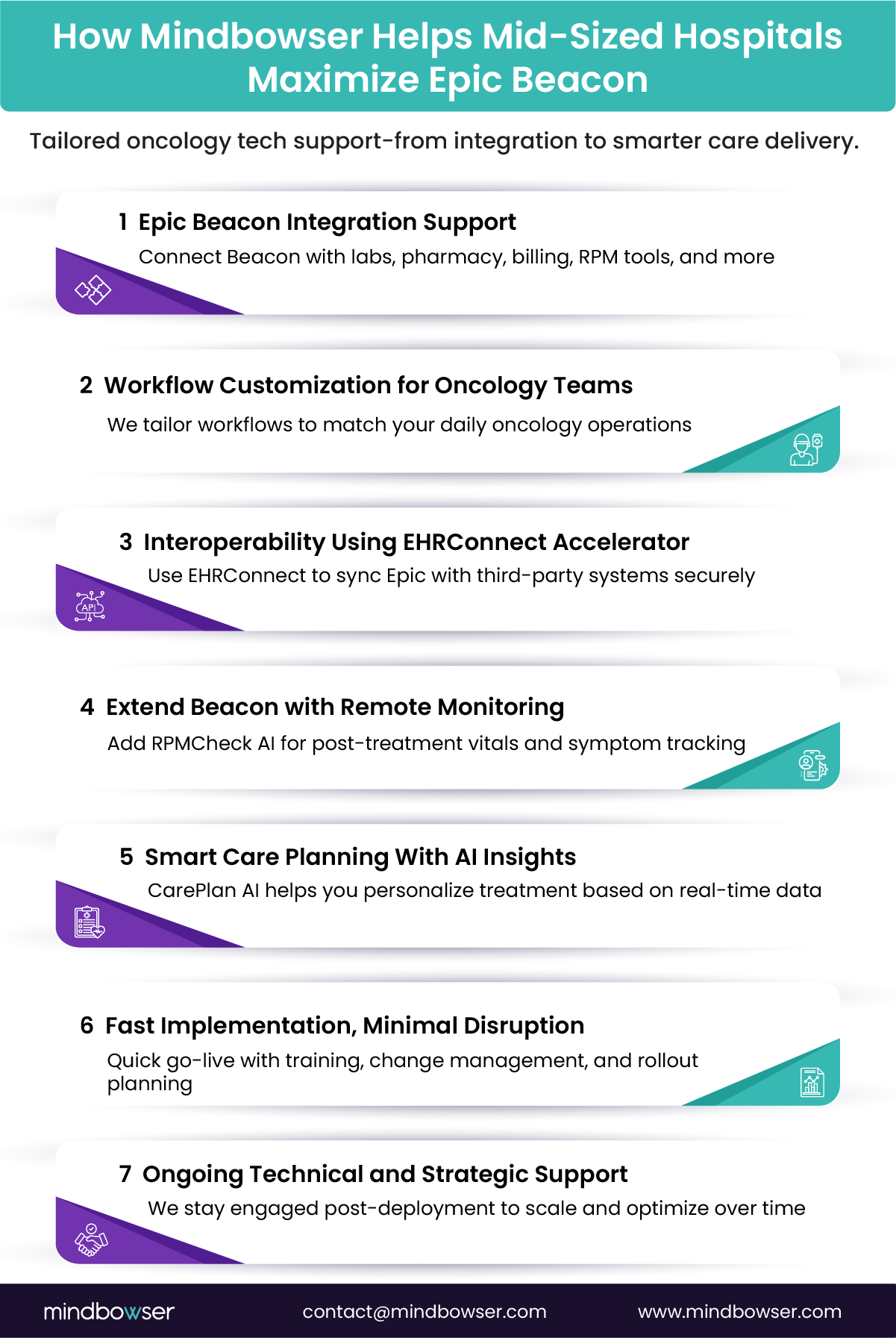
A. Epic Integration Expertise
We help you connect Epic Beacon with labs, pharmacies, RPM tools, billing platforms, and more using proven frameworks, such as our ConnectHealth accelerator.
B. Custom Oncology Workflow Enhancements
From chemotherapy scheduling to outcome tracking, we fine-tune your workflows to reduce friction, increase safety, and align with your team’s day-to-day reality.
C. Quick Start, Minimal Disruption
Whether you’re launching Epic Beacon through Community Connect or expanding your Epic environment, we support smooth rollouts with minimal disruption.
Let’s discuss how we can support your oncology roadmap—whether you’re just getting started or looking to scale.
X. What Does an Epic Beacon Analyst Do?
An Epic Beacon analyst is the build and configuration specialist responsible for keeping the oncology module running in Epic. The role sits at the intersection of clinical workflow and Epic build — not a coder, not a clinician, but someone who translates oncology protocols into the Epic system.
Core responsibilities:
- Build and maintain cancer treatment plans and regimens (chemotherapy, immunotherapy, radiation protocols) aligned to NCCN guidelines
- Configure order sets, clinical decision support alerts, and dosing rules
- Set up Beacon’s integration touchpoints Willow (pharmacy), Radiant (imaging), MyChart (patient portal), and Stork (obstetrics overlap cases)
- Validate treatment plan workflows end-to-end before go-live and after each Epic upgrade
- Troubleshoot build issues flagged by oncology nursing, pharmacy, or physician teams
- Manage Environment moves (BUILD → TEST → PRODUCTION) for Beacon configuration
Most Epic Beacon analysts sit in a health system’s IT department or work for an Epic consulting firm. Staffing volume depends on system size — a standalone cancer center may need one analyst; a multi-site health system running Beacon across 10+ oncology clinics typically needs a team.
For organizations building their own clinical apps or analytics layers on top of Beacon data, the analyst role expands to include API and FHIR integration coordination defining what structured data needs to flow out of Epic and where it goes.
XI. What Is Epic Beacon Certification?
Epic Beacon certification is a module-specific credential issued by Epic to individuals who have completed Epic’s oncology build training and passed the associated proficiency exam. It signals that the holder can independently configure and maintain Beacon in a production environment.
How it works:
- Training is delivered through Epic’s Galaxy (UserWeb) learning management portal self-paced courses covering Beacon build, regimen configuration, order management, and clinical decision support setup
- The certification exam tests build knowledge, not clinical oncology knowledge it validates that you can correctly configure Beacon, not that you can design a chemotherapy regimen
- After the exam, Epic requires validation of hands-on build experience at a live Beacon site before issuing the full certification
- Certification is renewal-based, Epic issues version-specific certs, so analysts recertify when major Epic upgrades, like a new annual version, introduce significant Beacon build changes
Who can get certified:
- Employees of Epic-licensed health systems, access through their health system’s Epic relationship
- Third-party consulting firm employees, through Epic’s consulting partner program
- Epic’s own implementation staff
The certification is not publicly purchasable, you get access through an existing Epic client relationship. Analysts at consulting firms, such as Avanade, Pivot Point Consulting, Nordic, Sagacious, etc., often hold multiple module certifications including Beacon.
For health systems hiring or contracting Beacon analysts, Epic certification is the baseline qualification filter. It does not replace institutional onboarding every Beacon implementation has site-specific build conventions, and certified analysts still need org-specific ramp time.
Conclusion
Epic Beacon has quietly become one of the most impactful tools in oncology care—not by making big promises, but by solving the right problems. It helps providers manage chemotherapy safely, follow evidence-based protocols, and maintain alignment, keep everyone aligned through a single source of truth. For mid-sized hospitals that are balancing complex care with limited resources, that kind of reliability isn’t just helpful—it’s necessary.
What sets Beacon apart isn’t just the feature set, but how it fits into the broader workflow. It works the way clinical teams already do, integrates with existing Epic tools, and scales without forcing a massive overhaul. Hospitals don’t have to choose between specialized care and operational simplicity—they can have both.
As more mid-sized hospitals assume greater responsibility for cancer care, Epic Beacon providers take on greater responsibility for cancer care, Epic Beacon offers a path forward that’s both practical and future-ready. It supports the realities of today’s oncology teams while laying the groundwork for smarter, more connected care tomorrow.
Yes, Epic Beacon is a module within the broader Epic EHR system. While it can be added to an existing Epic setup, hospitals not currently using Epic would need to implement Epic’s core platform first. However, mid-sized hospitals often gain access through partnerships or Epic Community Connect arrangements.
Epic Beacon includes built-in safety checks such as dosage validation, drug interaction alerts, and barcode-based medication administration. These features help ensure each step of chemotherapy delivery is verified, reducing the risk of human error.
Yes. One of Beacon’s strengths is its interoperability, especially within the Epic ecosystem. It connects seamlessly with Epic modules for labs, imaging, pharmacy, and outpatient care. If a hospital uses non-Epic tools, integrations are still possible but require proper planning and support during implementation.
An Epic Beacon analyst builds and maintains the oncology module configuration inside Epic treatment plans, cancer regimens, chemo, immunotherapy, radiation, order sets, clinical decision support alerts, and Beacon’s integration touchpoints with Willow, pharmacy; Radiant, imaging; and MyChart. The role sits in IT or consulting, translating NCCN protocols and oncology clinical workflows into Epic build. Analysts also manage Environment moves, build → test → production, and validate configuration before go-lives and after each Epic upgrade.
Epic Beacon certification is a module-specific credential issued by Epic after completing training through the Galaxy, UserWeb, portal and passing a proficiency exam. The exam tests build knowledge — not clinical oncology and Epic requires hands-on validation at a live Beacon site before issuing the full cert. Certification is renewal-based and version-specific, analysts recertify after major Epic upgrades. It is available to employees of Epic-licensed health systems and consulting partner firms, not publicly purchasable. For health systems hiring or contracting Beacon analysts, certification is the standard baseline qualification.