










 BLOGS
 NEWSROOM
 CASE STUDIES
 WEBINARS
 PODCASTS
 ASSET HUB
 EVENT CALENDAR


















TL;DR
- A care plan is for one patient. A care pathway is for a population, and that single difference is why one lives in a document and the other has to live in software.
- A care pathway standardizes the route a defined group of patients takes over a defined period, including the decision points along it.
- Conflating the two is why pathway projects get scoped as documentation exercises and then fail to change anything.
- Pathways only alter behavior when something enforces them at the moment a decision is made.
- The hard part is not writing the pathway. It is the engine underneath – versioning, amendments, and who is allowed to change what.
- We have built one at scale: 255 protocols, 36,653 participants, 39.9 million data points. That was a clinical-trials protocol engine rather than a clinical decision support deployment, and the distinction matters.
What A Care Pathway Is
A care pathway is a standardized route through care for a defined group of patients over a defined period, setting out what should happen, in what order, and at which points a decision has to be made.
The academic definition, and it is worth reading closely, describes it as a complex intervention for the mutual decision-making and organization of care processes for a well-defined group of patients during a well-defined period. Two phrases in that sentence carry the weight. Well-defined group means a pathway is written for a population, not a person. Well-defined period means it has a start and an end, rather than running indefinitely.
Pathways go by several names and the differences are mostly regional. Clinical pathway, integrated care pathway, critical pathway and care map all describe the same object. If you are reading a requirements document where the terms shift between paragraphs, that is usually vocabulary rather than scope.
What a pathway is for is reducing unwarranted variation. Where three clinicians would reasonably do three different things for the same presentation, a pathway says which one the organization has agreed on, and makes the other two a deliberate deviation rather than an accident.
Care Plan Versus Care Pathway
This is the distinction most often collapsed, and collapsing it is expensive.
| Care plan | Care pathway | |
|---|---|---|
| Scope | One patient | A defined patient population |
| Author | The clinician or team treating that patient | A committee, usually multidisciplinary |
| Lifespan | That episode of care | Years, with versions |
| Changes when | The patient’s condition changes | The evidence or the organization’s policy changes |
| Lives in | The record | The system that generates records |
| Answers | What are we doing for this person? | What do we do for people like this person? |
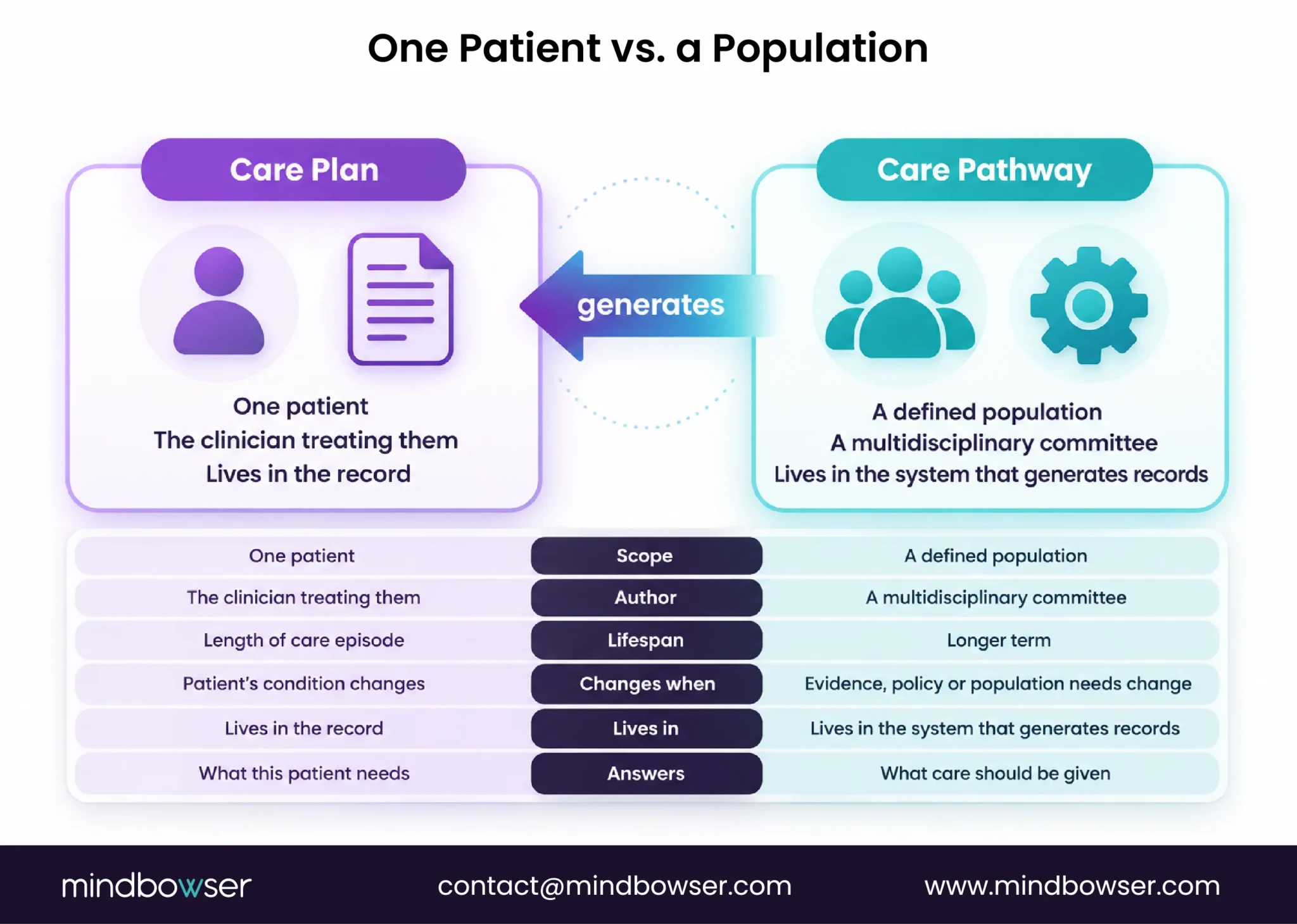
The relationship is that a pathway generates plans. When a patient enters a pathway, the pathway proposes what their plan should contain. The clinician accepts it, adjusts it, or departs from it, and the departure gets recorded as variance.
Why the confusion is costly: a care plan is a document, so a project scoped as “writing care plans” is a documentation project. A pathway is a rule that has to fire at the right moment for the right patient, which is a software project. organizations that scope the second as the first produce a well-written pathway that nobody follows, because nothing surfaces it while the decision is being made.
What Care Pathways Look Like In Practice
Pathways cluster into a few recognisable shapes.
- Condition pathways follow a diagnosis from presentation to discharge or stable management. Cancer pathways are the most developed examples, often with timed targets between referral, diagnosis and first treatment.
- Procedure pathways run from decision-to-treat through preparation, the procedure itself, and recovery. Elective surgery is the common case, and the preparation stage is where most of the avoidable delay sits.
- Episode pathways cover a defined window regardless of diagnosis, such as the first seventy-two hours of an admission.
- Population pathways manage a cohort over a long horizon, which is where long-term condition management and much of value-based care sits.
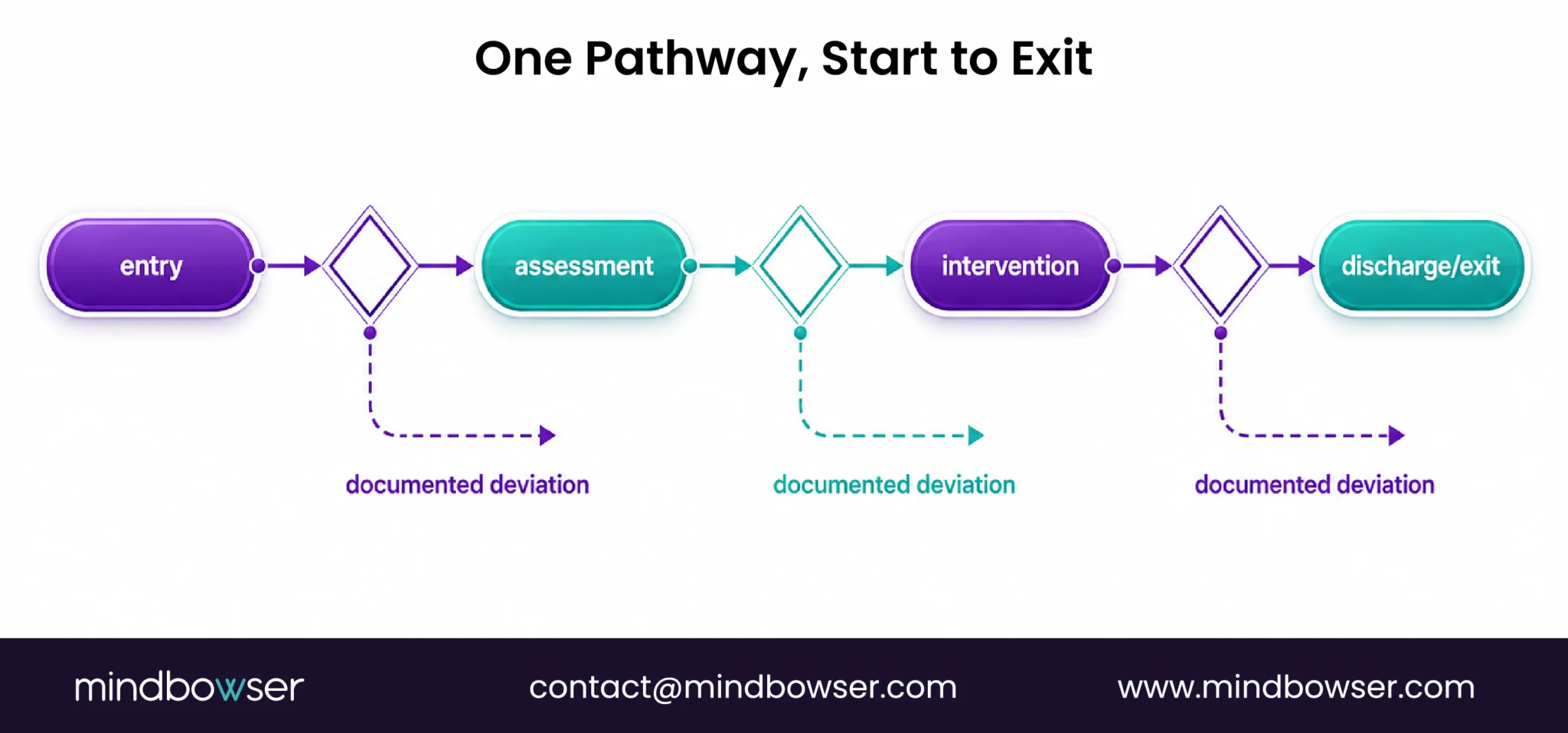
What varies most between organizations is not the clinical content, which usually derives from the same guidelines, but how much variance the pathway tolerates and what happens when someone departs from it. That is a policy choice, and it is worth settling before anyone writes a line of it.
Build Care Pathways That Scale With Your Organization
How A Care Pathway Gets Designed
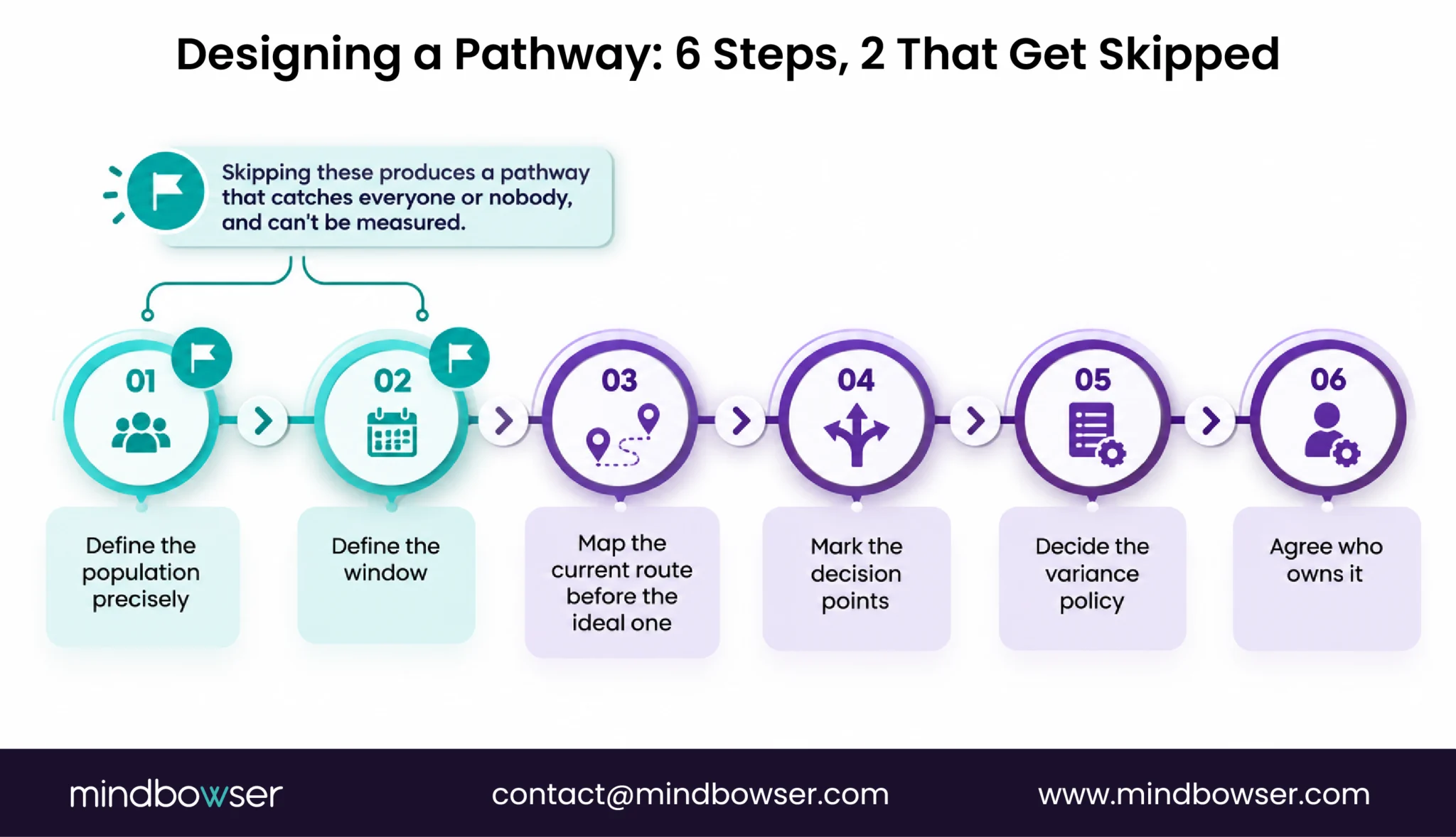
Design follows a fairly consistent sequence, and skipping the first two steps is the most common failure.
- Define the population precisely: Which patients are on this pathway, and which are explicitly excluded. Vague entry criteria produce a pathway that either catches everyone or nobody.
- Define the window: When does a patient enter, and what ends it. Pathways without an exit accumulate patients indefinitely and stop being measurable.
- Map the current route before the ideal one: What actually happens today, including the informal steps. A pathway designed against an imagined baseline will not survive contact with the ward.
- Mark the decision points: These are the only places a pathway can change behavior. Everything between them is sequence, not decision.
- Decide the variance policy: Which departures are expected and fine, which need a reason recorded, and which should be prevented.
- Agree who owns it before go-live, not after.
For the broader picture of how decision support fits into clinical workflow, see clinical decision support systems and worked examples.
The Engine Underneath: What Enforcement Actually Requires
Here is where most of the writing about care pathways stops, and where the work actually is.
A pathway that exists as a document changes nothing. To change behavior it has to evaluate a specific patient against a specific rule at a specific moment, and put the result somewhere a clinician will see it. That is four separate technical problems.
- Patient-to-pathway matching: Deciding which pathway a patient is on, continuously, as their data changes. Entry criteria written in prose have to become logic that runs against real records, and real records are incomplete.
- Firing at the decision point: A pathway prompt that arrives after the decision is made is worse than none, because it trains people to ignore the source. In an EHR supporting CDS Hooks, the pathway’s decision points map onto named moments in the clinician’s workflow, which is what makes the timing controllable rather than incidental.
- Capturing variance as data: When someone departs from the pathway, that has to be recorded as a structured deviation with a reason, not as free text. Variance you cannot count is variance you cannot learn from, and the whole justification for pathways is learning from it.
- Holding multiple versions at once: Patients who entered under version three stay on version three while new patients enter on version four. This is the requirement teams most often discover late, and retrofitting it is expensive.
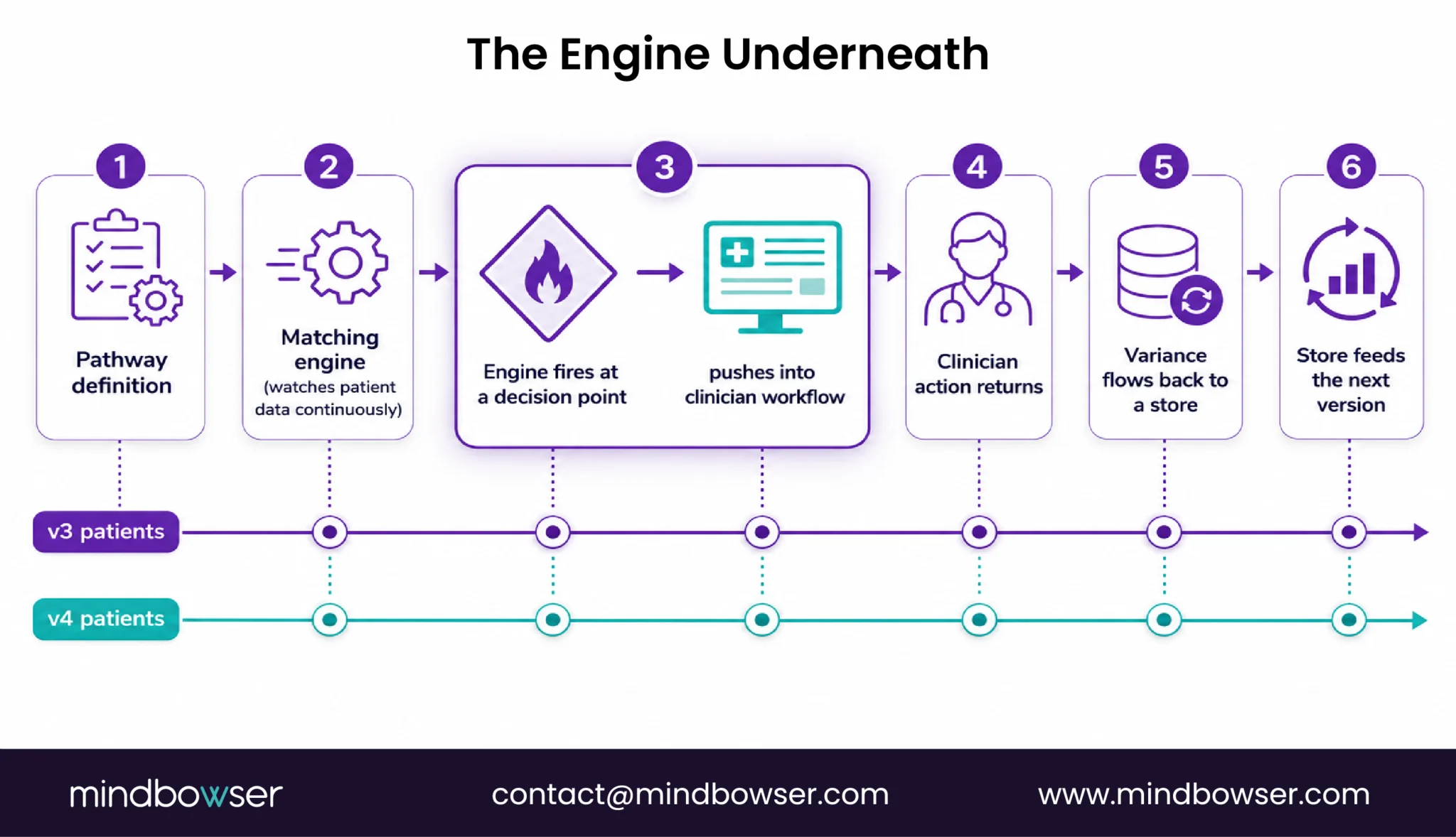
That last point is why pathway work resembles workflow engineering more than content authoring. If you are looking at this as part of a wider automation program, clinical workflow automation covers the surrounding layer.
What We Built, And What It Was
We have not deployed a clinical decision support system built on care pathways. What we built is adjacent, and being precise about the difference is more useful than blurring it.
For a clinical research client we built a protocol engine: a platform that takes a study protocol, matches participants to it, drives them through its stages, enforces what has to happen at each one, and records every deviation.
It has run 255 protocols across 36,653 participants, capturing 39.9 million data points.
A clinical trial protocol and a care pathway are close cousins. Both define a population, a window, a required sequence and permitted deviations. Both are versioned, both are governed by a committee, and both are worthless if the people executing them can ignore them silently. The engineering underneath is substantially the same problem, which is why the numbers above are relevant here even though the domain is research rather than routine care.
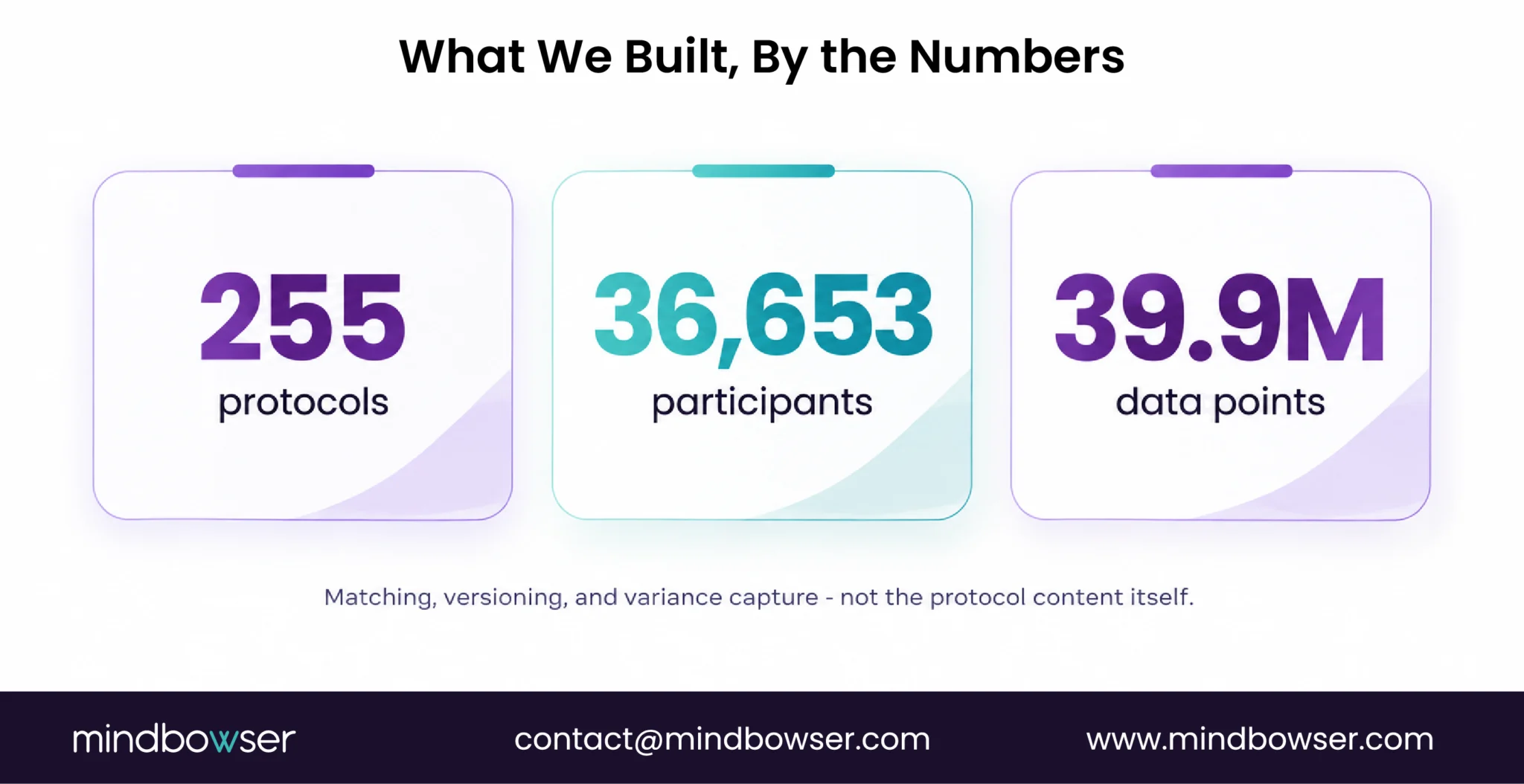
What that work taught, and it transfers directly: the protocol content is the easy part. Every difficult conversation was about version boundaries, about who could authorize an amendment, and about what to do with participants already mid-protocol when it changed. Those are governance problems that present as technical ones.
All client details are anonymized. The figures are from delivered work.
Why Care Pathways Drift After Go-live
Pathways decay, reliably, and the causes are predictable enough to design against.
- The evidence moves and the pathway does not: A guideline updates, the pathway does not follow, and clinicians who know the new guidance start departing from it. Every departure is correct and the pathway is now generating noise.
- Nobody owns it: A pathway authored by a committee that then dissolves has no route to change. Ownership needs a named person and a review cadence agreed before launch.
- Variance is captured but never read: This is the most common one. The system dutifully records deviations for two years and nobody looks, so the single most valuable output of running a pathway is discarded.
- The prompts become noise: If pathway prompts fire alongside every other alert without prioritisation, they get cleared with everything else. That is a broader problem than pathways, and we cover the design and governance of alert burden in reducing alert fatigue in clinical decision support.
The practical guard is a scheduled review with a named owner, a standing report on variance, and a rule that a pathway nobody has reviewed in a year is retired rather than left running.
What To Ask Before You Build One
- Ask whether you need a pathway or a plan template: If the answer is genuinely about one patient at a time, a pathway is over-engineering.
- Ask where it will fire: If nobody can say which screen and which moment, the project is a documentation exercise with a software budget attached.
- Ask how versions will work before anything is built. Retrofitting version boundaries onto a live pathway is the most expensive change you can make.
- Ask who owns it in eighteen months, and what happens to it if that person leaves.
- Ask what you will do with variance data. If there is no answer, do not capture it, because capturing data nobody reads costs money and buys credibility problems later.
If you are evaluating build-versus-buy across this category, our clinical decision support software buyer’s guide sets out the criteria, and what a clinical decision support system is covers the fundamentals.
A standardized route through care for a defined group of patients over a defined period, setting out what should happen, in what order, and where decisions have to be made. Its purpose is reducing unwarranted variation, so that departures from the agreed route become deliberate and recorded rather than accidental.
A care plan is for one patient and is written by the team treating them. A care pathway is for a defined population and is written by a committee. The pathway is the template a plan is drawn from: when a patient enters a pathway, it proposes what their plan should contain, and the clinician accepts, adjusts or departs from it. Conflating the two is why pathway projects get scoped as documentation work when they are software work.
They fall into a few shapes. Condition pathways follow a diagnosis from presentation through to discharge, of which cancer pathways with timed diagnostic targets are the most developed. Procedure pathways run from decision-to-treat through preparation and recovery. Episode pathways cover a fixed window such as the first seventy-two hours of an admission. Population pathways manage a cohort over a long horizon.
It needs a named owner and an agreed review cadence, both settled before launch. The common failure is a pathway authored by a committee that then dissolves, leaving no route to update it when guidance changes. A pathway that has not been reviewed within a year should be retired rather than left running, because clinicians who know the current guidance will already be departing from it.
To write one, no. To change behavior, in practice yes. A pathway alters what happens only if it evaluates a specific patient against a specific rule at the moment a decision is being made and puts the result where the clinician will see it. That requires continuous patient-to-pathway matching, firing at the decision point, structured variance capture, and the ability to hold several versions at once.