BLOGS
BLOGS  NEWSROOM
  CASE STUDIES
  WEBINARS
  PODCASTS
  ASSET HUB
  EVENT CALENDAR

























TL;DR
- Most practices run three disconnected systems general EMR, RIS, and PACS with clinical context (referral notes, prior imaging, PA status) trapped in a separate tab from where reports get generated.
- Five platforms, five different fits: Epic Radiant (enterprise, Epic-ecosystem only), Merge RIS (mid-market, slower FHIR roadmap), Intelerad (teleradiology/turnaround leader, thin on clinical context), Sectra (academic/subspecialty strength), and custom builds for the rest.
- Imaging is CMS’s #1 prior-auth category by volume; vendors with live PA API connections (eviCore, Carelon, Availity) can automate 60-80% of submissions; without it, that burden lands on front-desk staff.
- The real breakage isn’t the platform; it’s the pipeline. DICOM SR-to-FHIR DiagnosticReport mapping and CDS Hooks for AI reading tools are where vendors’ “FHIR support” claims fall apart in practice.
- Custom wins in three specific cases: subspecialty workflows with no vendor coverage (interventional, nuclear medicine, lung nodule tracking), physician-founders building a commercializable platform, and multi-specialty groups that have outgrown their bolted-together system.
I get this question a few times a quarter: “We need a RIS. Should we go with Epic Radiant, or look at a standalone system?” The honest answer is: it depends on which problem you are actually trying to solve, and most buyers conflate three different problems.
At a busy radiology group, the daily workflow looks something like this: orders arrive in the RIS, images get stored and pulled in PACS, but the clinical context, the referring physician’s notes, the patient’s prior imaging history, the prior auth status for the MRI, sits in a separate EMR. The radiologist switches between tabs. Reports get generated in one system, sent via HL7 ORU message to another, and reviewed in a third. Nobody designed this for efficiency. It just grew.
CMS data from 2025 flagged prior authorization for imaging as its single highest-volume PA category by transaction count. That administrative burden is almost entirely a systems-integration problem, not a clinical one. The right platform, or the right custom build, fixes it structurally.
Here is how to think through the decision.
What Are You Actually Buying? RIS vs. PACS vs. Radiology EMR
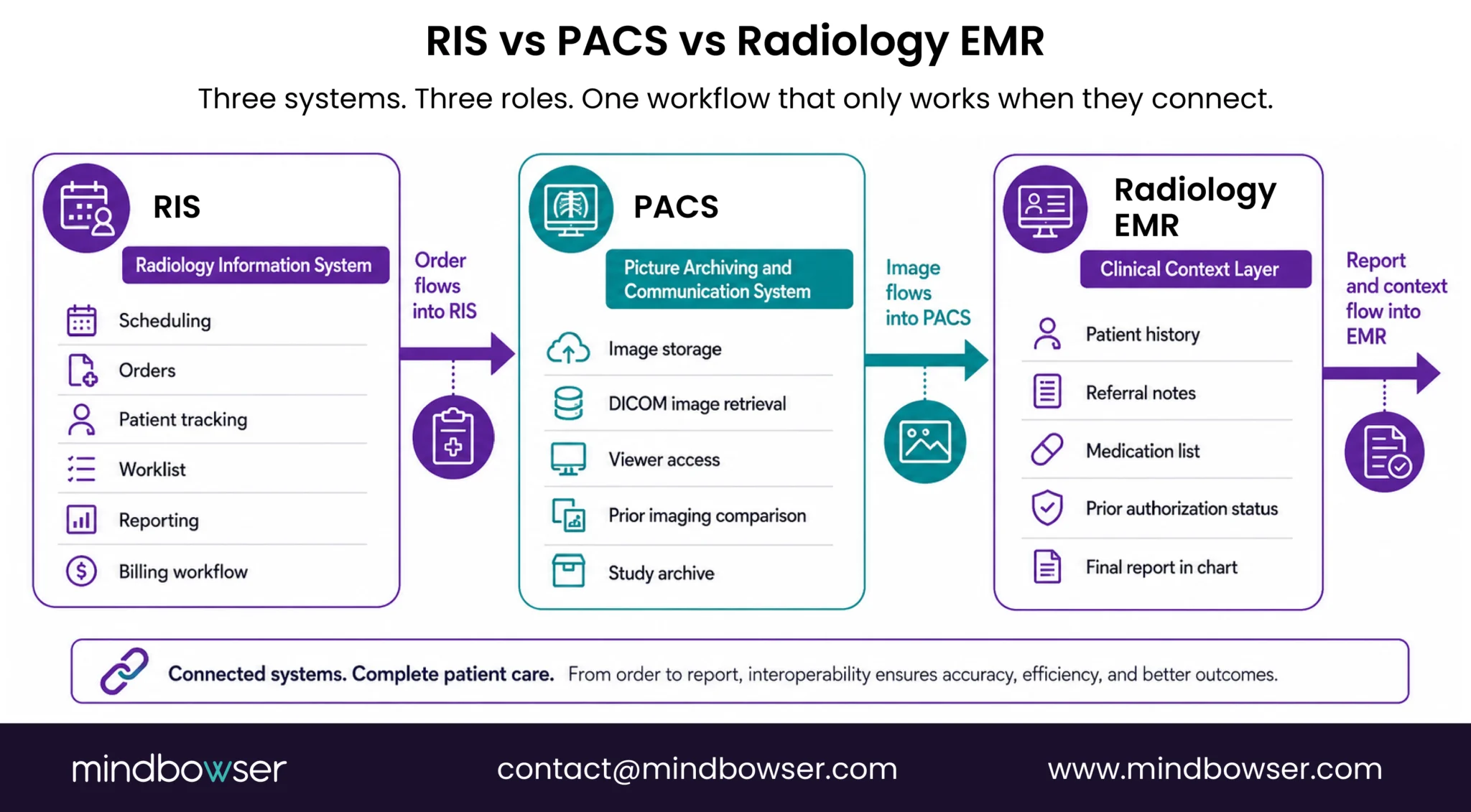
Before shortlisting any vendor, it helps to separate three terms the market uses interchangeably, and should not.
- RIS (Radiology Information System): Handles scheduling, patient tracking, workflow management, and reporting. It is the operational hub of a radiology department, where orders come in, where technologist assignments happen, where reports get signed. A RIS without PACS integration is just a scheduling and billing tool with a reporting module bolted on.
- PACS (Picture Archiving and Communication System): Stores and retrieves medical images. DICOM (Digital Imaging and Communications in Medicine) is the universal imaging standard that makes PACS interoperable across vendors. A PACS without a RIS means images exist but workflow does not.
- Radiology EMR: Brings the full clinical context into the radiology workflow: patient history, referral notes, medication lists, prior imaging comparisons, active prior auth status. Most general EMRs do not natively integrate with PACS or support DICOM structured reporting. That gap is where the three-tab problem lives.
Most 2026 vendors bundle two or three of these. The decision you are making is about which bundle fits your practice type.
Quick-match guide:
- Solo or small group: standalone RIS + PACS partner + basic EMR access. Epic Radiant is almost certainly overkill.
- Multi-specialty group: general EMR with a strong radiology module (Epic Radiant, Oracle Health Radiology) + existing PACS. The EHR systems for multi-specialty practices guide covers the full integration picture across departments.
- Teleradiology-first: RIS built for remote reading, Intelerad is the category reference.
- Subspecialty practice (interventional, nuclear medicine, breast imaging, radiation oncology): none of the above covers the full workflow without customization. This is where the custom-build case starts.
Must-Have Features in a Radiology EMR / RIS
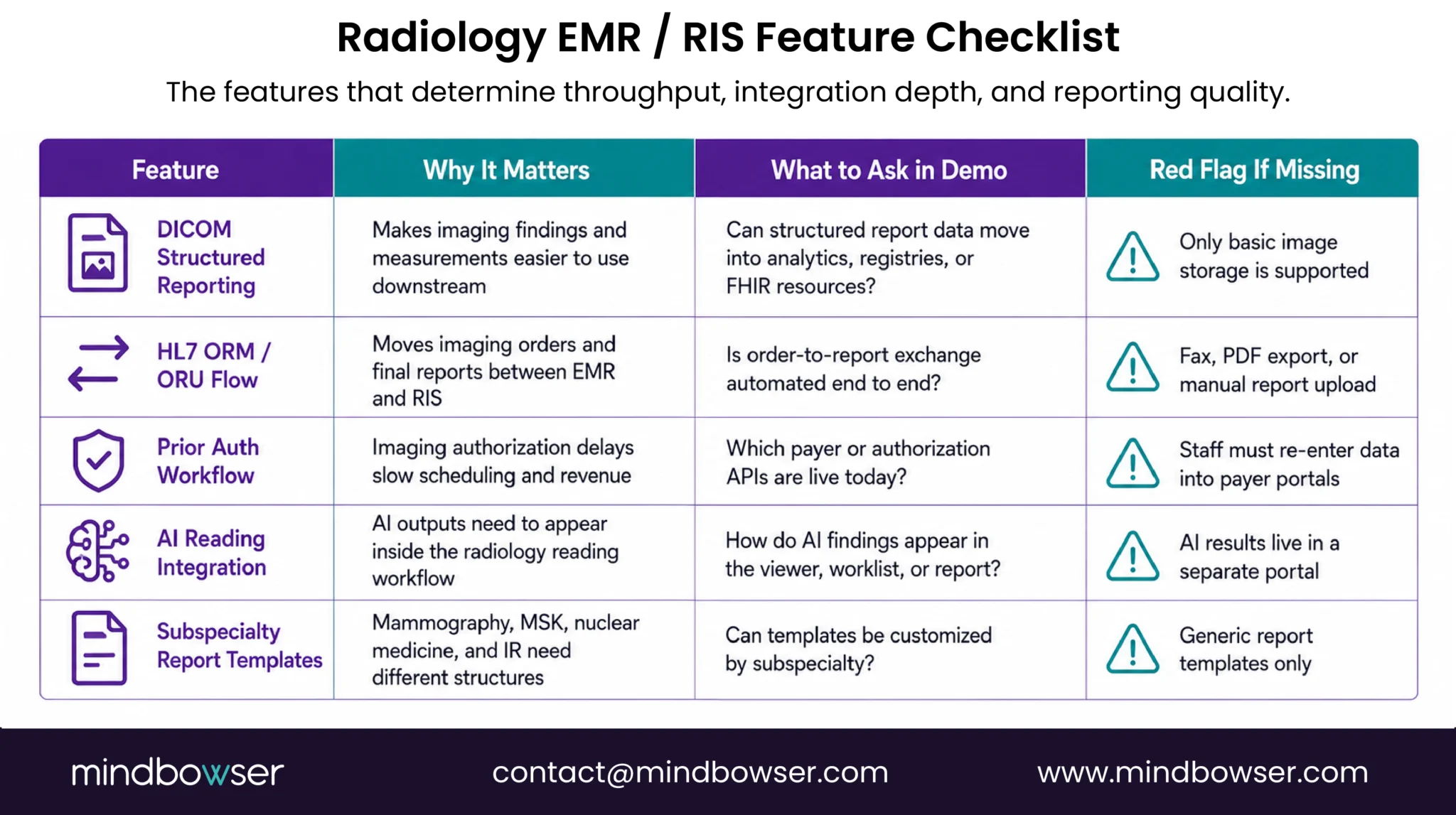
Feature marketing for radiology platforms has gotten noisy. Here are the features that actually affect throughput, with what to watch for if they are absent.
- DICOM SR (Structured Reporting) support: DICOM SR converts free-text reports into machine-readable structured data that downstream systems (oncology registries, population health tools, payer prior auth APIs) can parse. Vendors who only support basic DICOM but not SR are limiting your ability to connect report data to anything outside the reading room.
- HL7 ORM/ORU message flow: ORM (Order Message) carries the imaging order from the referring EMR to your RIS. ORU (Observation Result) carries the final report back. If your vendor requires manual fax or PDF export for either direction, you are rebuilding a 1990s workflow with 2026 pricing.
- AI-assisted reading integration: Several FDA-cleared AI tools (Aidoc, Viz.ai, Gleamer, Annalise.ai) slot into radiology reading workflows as background analysis layers, flagging PE, intracranial hemorrhage, fractures, lung nodules. Integration is via DICOM worklist injection. Not every RIS supports the API hooks needed for this. Ask before signing.
- Automated prior auth API: Imaging is the single largest PA category by volume in CMS data. Vendors with a live prior auth API connection (eviCore, Carelon, Availity) can automate 60-80% of radiology PA submissions. This alone can save 20-30 minutes per complex case in a busy practice. Vendors without it are pushing PA back onto your front desk staff.
- Structured report templates: Meaningful templates matching your subspecialty, mammography, chest CT, MSK MRI, nuclear medicine SPECT, are a real workflow accelerator. Ask for a demo of the actual template library, not a screenshot.
The integration with EHR systems guide covers the HL7 and FHIR plumbing in more detail if you need the technical depth behind any of these.
Best Radiology EMR / RIS Systems in 2026: An Honest Comparison
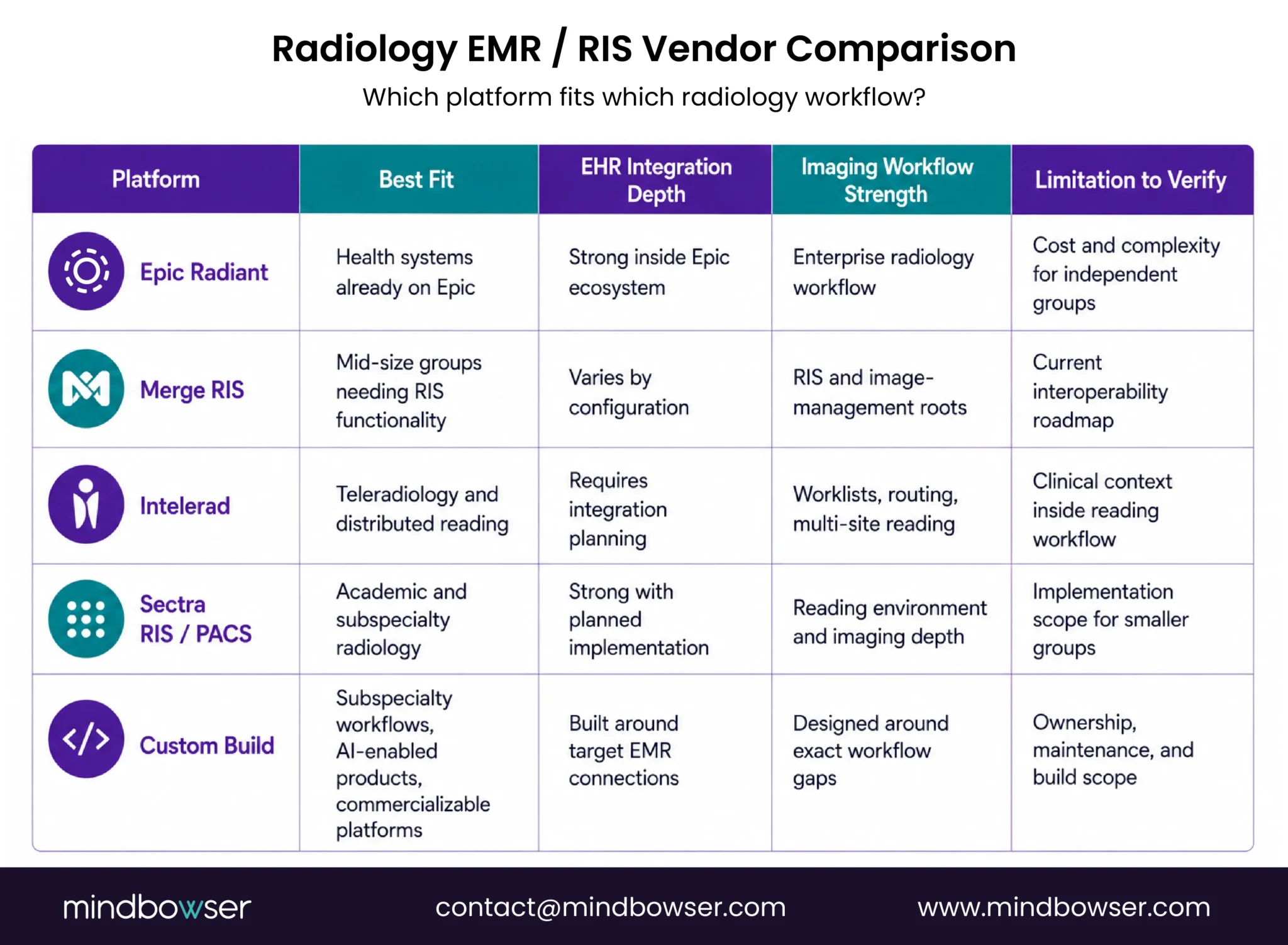
Five platforms come up consistently when radiology groups are shortlisting. Honest fit-vs-gap read on each.
Epic Radiant, deeply integrated with the Epic ecosystem. Orders flow natively; PACS integration with Epic-certified partners (Sectra, Fujifilm) is well-documented; reporting connects to the Epic chart without an HL7 hop. Trade-offs are real: built for enterprise deployments, not independent groups. Why some specialty practices leave Epic covers the specific workflow gaps that drive groups to evaluate alternatives.
Best for: Health system radiology departments already running Epic.
Limitation: Cost and complexity mismatched for independent or smaller groups.
Merge RIS (IBM Watson Health), mid-market RIS, strong image management roots. Post-IBM acquisition, the roadmap has slowed. FHIR-native APIs available but require configuration work.
Best for: Mid-sized groups that don’t need deep clinical EMR integration.
Limitation: FHIR and modern interoperability development slowed; check the current roadmap.
Intelerad, category reference for teleradiology and distributed reading. Report turnaround dashboards, multi-site worklist management, and image routing are its strengths. Falls short on clinical context, integrating referring physician notes or prior auth status requires additional integration work.
Best for: Teleradiology operations, multi-site networks.
Limitation: Thin on clinical context; requires integration builds beyond image reading.
Sectra RIS/PACS, strong in academic + subspecialty radiology (breast imaging, nuclear medicine, women’s imaging). FHIR support exists, but the strength is in the reading environment.
Best for: Academic radiology departments, breast imaging centers, subspecialty work.
Limitation: Implementation is complex; smaller groups typically don’t justify the overhead.
Custom-Built, for subspecialty practices where none of the above fits, and for physician-founders building a commercializable platform. The specialty EMR development guide covers the full landscape of how these builds work and who they make sense for.
Radiology EMR Gaps? Request a Workflow Assessment
Where Most Radiology EMR Implementations Break: DICOM, HL7, and FHIR
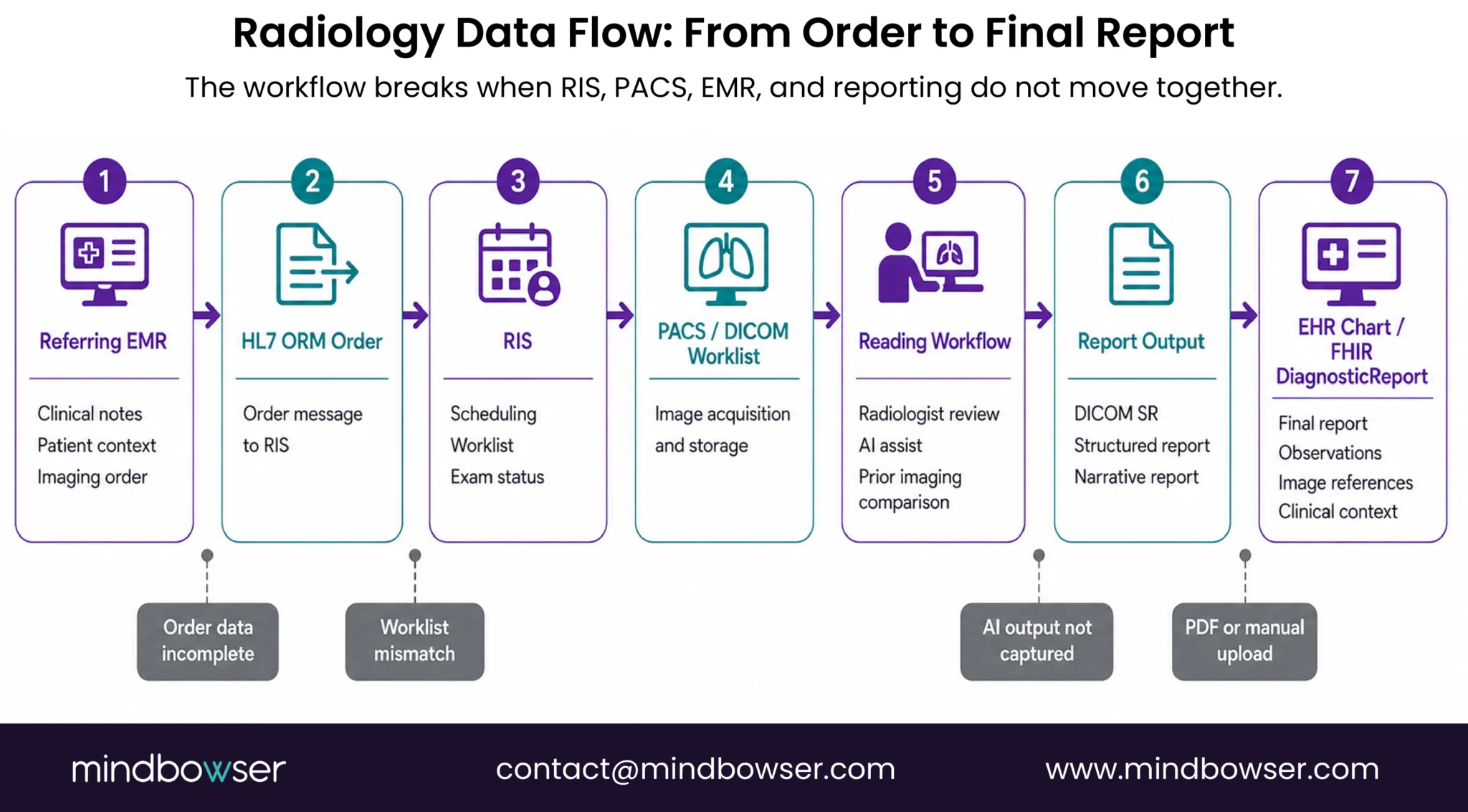
This section is the one most vendor comparison guides skip. What breaks in practice is specific.
- The ORM-to-ORU pipeline: An imaging order leaves the referring EMR as an HL7 ORM. It arrives at the RIS, triggers scheduling and PACS worklist, the study gets read, and the report needs to travel back as an HL7 ORU. In a clean implementation, this is automated. In reality, most practices have at least one manual step, and that step is where delays and errors accumulate. The referring physician waiting 48 hours for a report that has been sitting in a result queue for 12 of those hours is experiencing a workflow break, not a clinical one.
- DICOM SR to FHIR DiagnosticReport mapping: FHIR R4 has a DiagnosticReport resource designed to carry radiology results. The DICOM SR object model and the FHIR DiagnosticReport schema do not align cleanly on measurement values, coded observations, or image references. Vendors who claim “FHIR support” sometimes mean “we have a FHIR API endpoint”, not “we produce well-formed DiagnosticReport resources from your DICOM SR data.” The difference matters for anything downstream: oncology registries, payer prior auth APIs, population health analytics.
- CDS Hooks for AI integration: The cleanest way to inject FDA-cleared AI tools into a reading workflow is via CDS Hooks, an HL7 standard that fires when a specific event (opening a worklist item, signing a report) occurs in the RIS/EMR. Most enterprise platforms support CDS Hooks on paper. Very few have it wired to the worklist opening event that would allow Aidoc or Viz.ai to pre-populate findings before the radiologist starts reading. Ask for a live demo, not a slide.
- ConnectHealth handles the DICOM/HL7 bridge in Mindbowser builds: ORM inbound, PACS worklist injection, ORU outbound, and FHIR DiagnosticReport generation are pre-built integration patterns adapted to your stack rather than built from scratch. For practices connecting a custom RIS to Epic or Cerner, this is typically 30-40% of total implementation work. The EHR data integration guide covers the specific FHIR pipeline patterns in more depth.
How to Choose the Right Radiology EMR / RIS
Four variables determine which direction makes sense:
- Practice size and structure: Solo radiologist reading for three referring groups vs. a 20-radiologist group with a subspecialty breast imaging center and a teleradiology contract, very different needs.
- Existing EHR stack: Epic-network practices: Epic-certified PACS + Radiant. Multi-EMR independent groups: need clean HL7/FHIR APIs to all of them.
- Imaging volume and subspecialty depth: Volume determines worklist infrastructure; subspecialty depth determines whether any off-the-shelf platform covers the workflow.
- AI reading roadmap: CDS Hooks support and DICOM worklist API openness are non-negotiable if you’re adding FDA-cleared AI in the next 18 months.
Eight questions to ask any vendor before signing:
- Which DICOM version? Do you support DICOM SR or only basic image storage?
- Are HL7 interfaces ORM/ORU native, or custom per site?
- Do you produce FHIR R4 DiagnosticReport resources from structured reports, or just expose a FHIR endpoint?
- Which prior auth APIs do you have live connections to (eviCore, Carelon, Availity)?
- What is your CDS Hooks support, and at which workflow events does it fire?
- What is your PACS failover SLA, and how many imaging sites run on your platform today?
- Can I customize structured report templates per subspecialty, or is the template library fixed?
- Who owns the integration work when we connect to a referring EMR you haven’t certified before?
Evaluating an EHR development partner covers the questions to pressure-test vendor integration claims before signing.
When a Custom Radiology EMR or RIS Actually Makes Sense
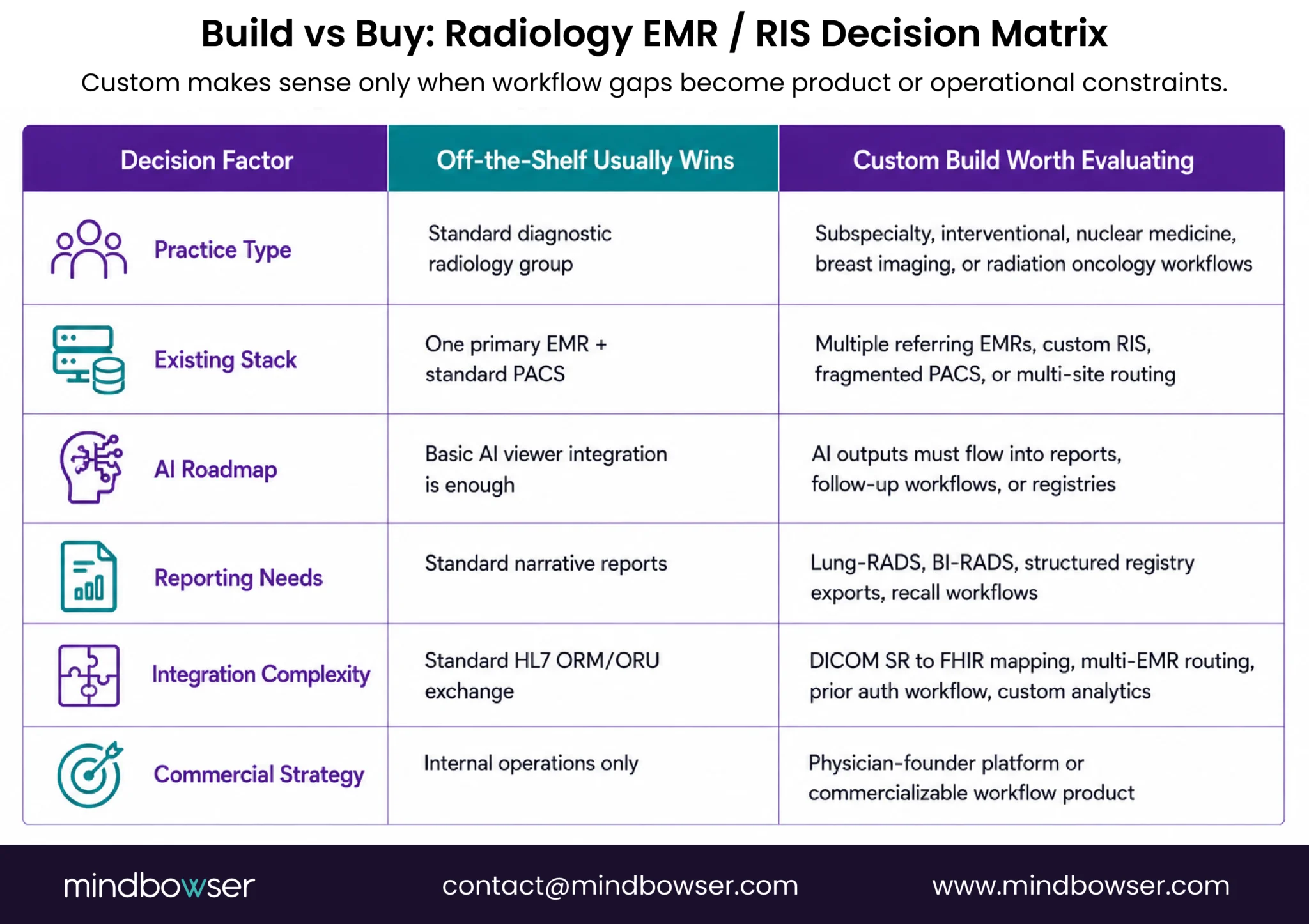
Three specific scenarios where off-the-shelf leaves a real gap.
- Subspecialty workflows with no vendor coverage: Interventional radiology procedure tracking, radiation oncology treatment plan documentation, nuclear medicine quantitative imaging, mammography AI with CAD linkage, generic RIS platforms partially cover these. Radiologists work around the gaps. That workaround behavior is the signal the platform is not a fit. A lung nodule tracking program is a specific example: Lung-RADS structured reporting, baseline/follow-up comparison workflows, automatic recall scheduling, and registry export to a state cancer database require a workflow layer most general RIS platforms don’t have.
- Physician-founders building a commercializable radiology platform: Mindbowser’s approach: ConnectHealth for the integration layer (DICOM/HL7 bridge, FHIR DiagnosticReport generation, EHR connectivity), PHISecure for HIPAA-compliant imaging data handling, Launchpad for standardized project setup and team onboarding. Integration patterns are pre-built; subspecialty workflow is designed custom. Typically saves 30-40% of build time vs. building the integration layer from scratch.
- Multi-specialty groups that have outgrown their existing system: 300+ studies per day across three sites, AI tools added via workarounds, often at the inflection point where the cost of working around the platform exceeds the cost of replacing it. The custom EHR development guide covers the build vs. buy framework in full.
The Right Radiology EMR Starts With Workflow Integration
The best radiology EMR or RIS is not the platform with the longest feature list. It is the one that connects orders, scheduling, PACS, reporting, prior authorization, and clinical context without forcing radiologists to work across disconnected tabs.
For health systems already standardized on Epic, Radiant may be the right path. For teleradiology or distributed reading groups, standalone RIS/PACS platforms may fit better. For subspecialty radiology, AI-enabled workflows, lung nodule tracking, or commercializable platforms, custom becomes worth evaluating when off-the-shelf systems leave too many integration gaps.
Start with the workflow break. If orders, images, reports, prior auth, and clinical context do not move cleanly together, that is where your radiology software decision should begin.