













 BLOGS
BLOGS  NEWSROOM
  CASE STUDIES
  WEBINARS
  PODCASTS
  ASSET HUB
  EVENT CALENDAR
























TL;DR
- Hospice EMRs fail the IDT on 4 specific dimensions: narrative charting, GIP documentation, bereavement tracking, and the election statement/revocation audit trail
- Axxess and Brightree are the two purpose-built hospice platforms worth evaluating. MatrixCare fits larger post-acute organizations. Netsmart is enterprise-scale. Everything else is a home health EMR with a hospice module bolted on.
- The HOPE tool replacing HIS in FY2026 changes what your EMR must capture structurally. Not every vendor has updated their data model yet.
- Custom-built makes sense for 3 profiles: hospital-based hospice programs needing ADT integration, physician-founders building palliative/hospice platforms, and pediatric palliative care programs.
The Interdisciplinary Team Meeting Is Where the Friction Lives
The interdisciplinary team meeting is the center of hospice care. Most hospice EMRs treat it like a scheduling problem rather than a clinical documentation workflow.
I’ve worked alongside hospice care teams long enough to know where the friction lives. It’s not in intake. It’s not in billing. It’s in the moment when an RN, a social worker, a chaplain, and a physician are each trying to document their contribution to the same patient’s care plan inside a system that was built for one clinician at a time.
I. Why Most Hospice EMR Guides Miss the Clinical Reality
In 2022, 1.72 million Medicare beneficiaries used hospice (MedPAC 2024). The average length of stay was 97.0 days (NHPCO Facts and Figures 2024). That’s a long-duration care model with frequent IDT documentation cycles per patient, per week.
CMS 42 CFR Part 418 requires IDT assessment, care plan documentation, and visit notes as distinct structured events. Not just notes. Not free-text entries. Structured documentation with specific fields for specific disciplines.
Most vendor comparison guides compare Axxess vs Brightree on billing automation and then stop. They skip the IDT charting workflow entirely. They say nothing about GIP documentation. They don’t mention bereavement modules. They’ve never asked about the election statement audit trail.
That’s where this guide starts.
II. What Makes Hospice Documentation Structurally Different From Home Health?
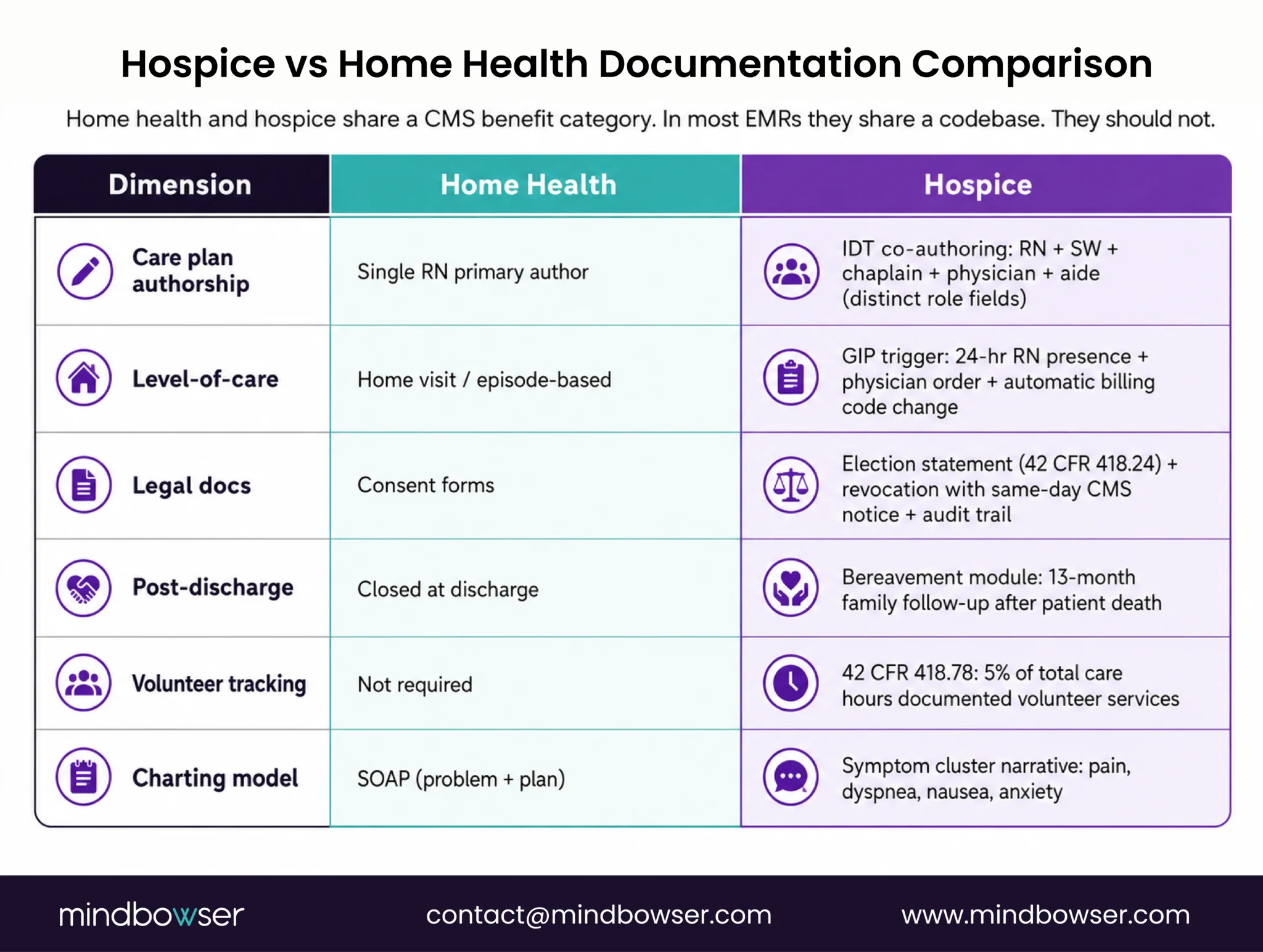
Home health and hospice share a CMS benefit category. In many EMRs, they share a codebase. They should not.
Six Structural Differences:

1. IDT care plan co-authoring: hospice requires documented contributions from the RN, social worker, physician, chaplain, and aide as distinct entries in the same care plan. Not one clinician’s note with other disciplines listed. Most home health EMRs have no architectural concept of this.
2. GIP documentation: when a patient’s pain or symptom burden can’t be managed at home, GIP requires 24-hour RN presence documentation and physician oversight. The EMR needs a level-of-care workflow that triggers GIP documentation automatically and changes the billing code. No home health EMR has this.
3. Election statement and revocation with audit trail: The hospice election statement is a legal document under 42 CFR Part 418.24. Revocation carries a same-day CMS reporting requirement. Your EMR needs a timestamped audit trail, not a free-text note.
4. Bereavement tracking: CMS Conditions of Participation require bereavement services for 13 months post-death. Most EMRs close the record at death. Hospice needs a separate bereavement module tracking the surviving family through the full follow-up period.
5. Volunteer coordination: 42 CFR 418.78 requires documented volunteer services covering at least 5% of total patient care hours. Tracking this in a spreadsheet creates an audit exposure.
6. Symptom management narrative charting: Comfort care documentation is built around symptom clusters (pain, dyspnea, nausea, anxiety). SOAP templates designed for curative-intent medicine generate meaningless noise in a hospice record.
For practices managing complex chronic conditions alongside hospice-adjacent populations, chronic care management software shares the care coordination complexity, though the documentation model is entirely different.
III. What a Hospice EMR Actually Needs (5 Non-Negotiables)

Before you sit in a single vendor demo, these five capabilities must exist natively. If any vendor says they’re “on the roadmap” or “handled by a workaround,” that’s your answer.
1. IDT Care Plan Co-Authoring: Multi-disciplinary structured care plan with role-specific fields, co-signature workflow, and version history.
Demo Q: “Show me how an RN, social worker, and chaplain each contribute to the same care plan without overwriting each other’s documentation.”
2. GIP Level-of-Care Documentation: Dedicated GIP workflow with 24-hour RN documentation, physician order linkage, and automatic billing code change.
Demo Q: “Walk me through a GIP admission from the point of care. What triggers the level-of-care change and what documentation does the system require?”
3. Election Statement and Revocation With Timestamped Audit Trail: Structured election workflow with same-day revocation notice capability and a pullable audit log.
Demo Q: “Show me the election statement workflow and the revocation audit trail. Can I pull a timestamped report for a CMS survey?”
4. Bereavement Module: Post-death family contact tracking for 13 months, contact log, and bereavement plan documentation that persists after the patient record closes.
Demo Q: “Show me what happens in the patient record at death. Where does bereavement documentation live and how is it tracked over the following year?”
5. HOPE-Ready Data Model: 47 HOPE items must map to structured fields in the EMR, not free-text notes.
Demo Q: “Has your HOPE data model been updated for FY2026? Which items are structured fields and which require free text? Can I see the HOPE submission workflow?”
Patient Questionnaire Form handles digital admission intake with real-time FHIR validation for programs that want to standardize the admission documentation flow.
IV. Best Hospice EMR Options in 2026
Four platforms account for the majority of hospice EMR market share. Two are purpose-built. Two are post-acute platforms where hospice is one module.
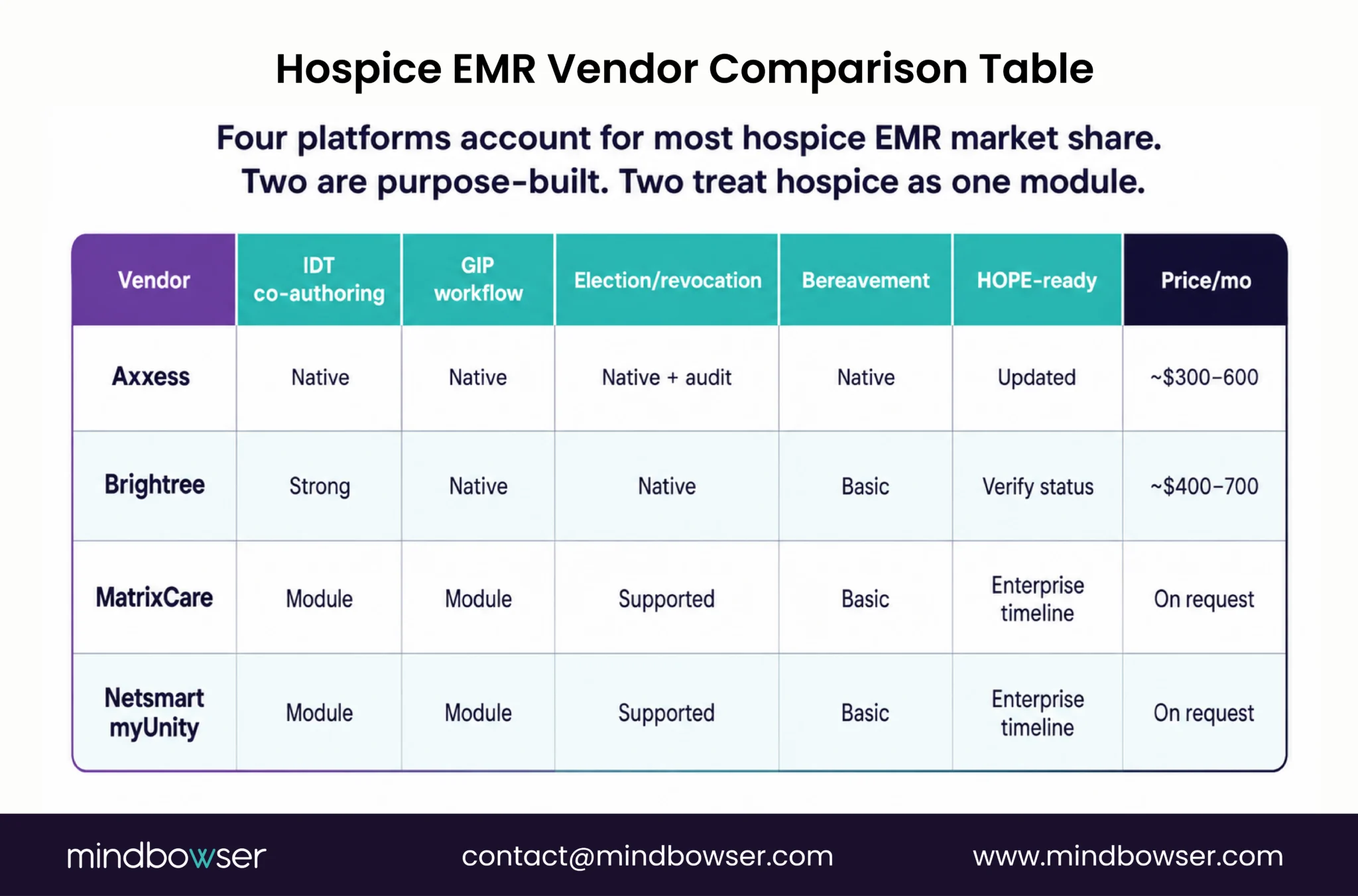
Axxess: Purpose-built for hospice and home health. Strong IDT workflow, native election and revocation workflow, HOPE-ready data model, and best-in-class billing automation. Best fit: standalone hospice agencies with 50–500 patients on census. KLAS-rated. Approximately $300–600/month. Limitation: Some clinical teams report the interface prioritizes billing over clinical charting depth.
Brightree (ResMed): Purpose-built for post-acute care, including hospice. Strong billing and revenue cycle capabilities. A good fit for multi-service agencies running hospice alongside home health and DME. HOPE update status: Verify current implementation before signing. Approximately $400–700/month.
MatrixCare: Enterprise post-acute platform with hospice as one module within a larger suite. Strong choice for hospital-based programs or large multi-location agencies. Requires a more extensive implementation. Best fit: 500+ patient census, multi-site organizations, or hospital-affiliated providers.
Netsmart myUnity: Enterprise platform for behavioral health and post-acute care with a dedicated hospice module. Best fit: Large non-profit hospice organizations or providers operating hospice alongside behavioral health and long-term post-acute care (LTPAC).
What to Avoid: Any home health EMR with a bolt-on hospice module. IDT co-authoring and GIP workflows are typically afterthoughts in platforms originally designed for home health episodic billing.
Related Read: Medical specialty EHR development.
V. Axxess vs Brightree: How to Choose
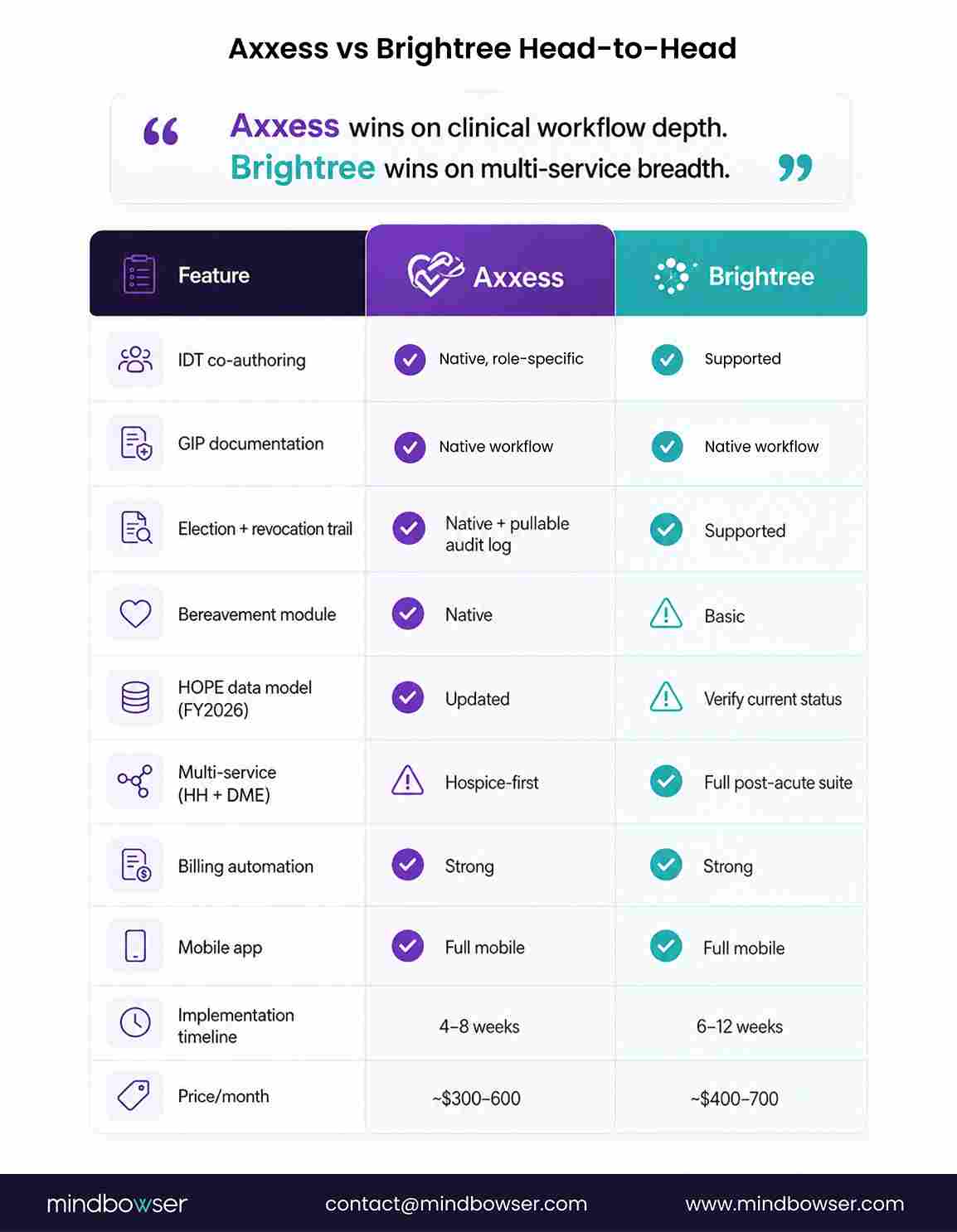
Choose Axxess When: You’re a standalone hospice agency where clinical workflow depth is the primary requirement.
Choose Brightree When: You’re a multi-service post-acute organization that needs a single platform for hospice, home health, and DME billing.
Neither is wrong for the right organization. The mistake is choosing Brightree for a standalone hospice agency because of brand recognition, or choosing Axxess for a multi-service operation because of clinical depth.
Releatd Read: EHR development cost guide
VI. What the HOPE Tool Means for Your EMR Decision Right Now
This is the most time-sensitive section of this guide.
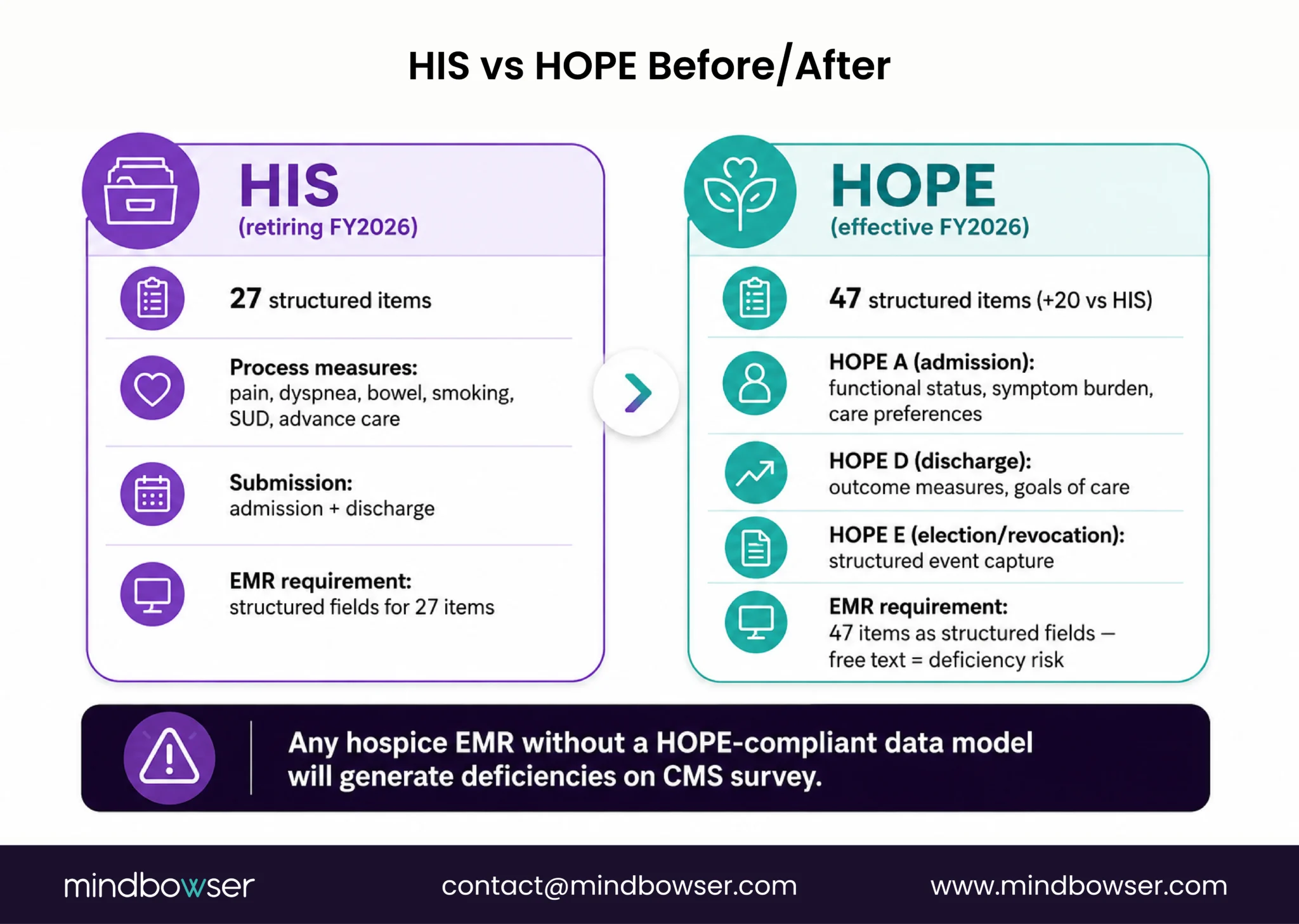
CMS is replacing the Hospice Item Set (HIS) with the Hospice Outcomes and Patient Evaluation (HOPE) tool beginning FY2026. HOPE adds 47 new structured data items vs HIS’s 27. Items cover admission assessment (HOPE A), discharge (HOPE D), and election and revocation events (HOPE E).
Any hospice EMR without a HOPE-compliant data model will generate deficiencies on the CMS survey. This is not a future risk. It’s a current compliance gap for every vendor that hasn’t updated its structured data layer.
The question to ask every vendor: “Which of the 47 HOPE items are captured as structured fields and which require free text?” Structured fields are auditable. Free-text entries are a deficiency waiting to happen.
AI Medical Summary reduces clinical documentation time by approximately 50% and improves accuracy by approximately 45%. In a model where HOPE is adding structured requirements, the parallel reduction in narrative burden matters.
Releated Read: EHR Development Partner Evaluation.
Get a Hospice EMR Built for Your Clinical Team Now!
VII. When Off-the-Shelf Fails and a Custom-Built Hospice Platform Makes More Sense
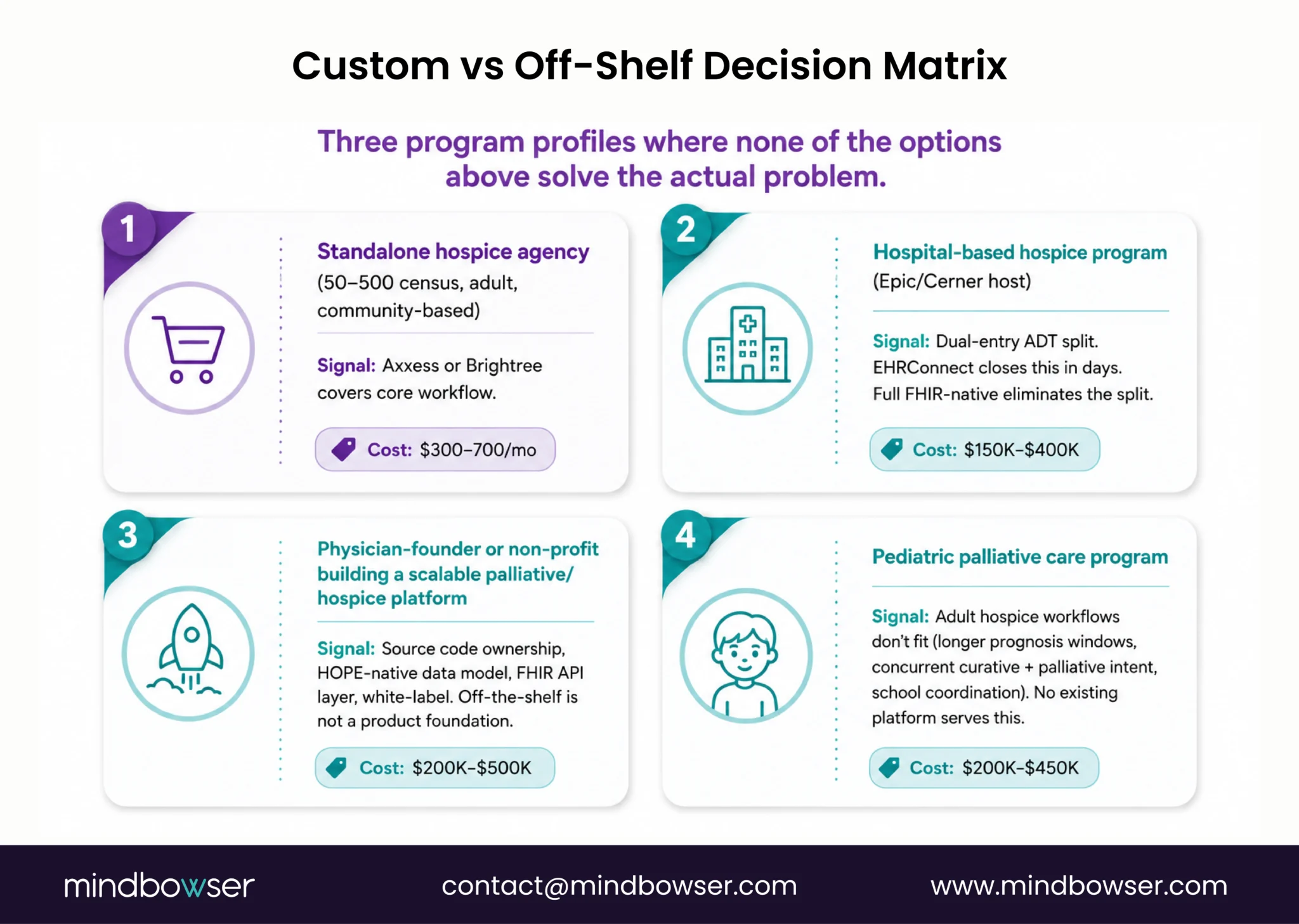
Three program profiles where none of the options above solve the actual problem.
Hospital-Based Hospice Programs Needing Deep ADT Integration:
A hospital EHR (Epic or Cerner) running alongside a separate hospice EMR creates a documentation split. Every admission, discharge, and level-of-care change requires dual entry. ConnectHealth connects hospice EMR data to the hospital ADT feed in days rather than months. For programs that want to eliminate the split, a custom FHIR-native hospice module built on the hospital’s existing FHIR R4 layer is the architectural answer. ConnectHealth handles the HL7 and FHIR integration layer for lab, pharmacy, and payer connections.
Physician-Founder or Non-Profit Building a Scalable Palliative/Hospice Platform:
Building to deploy across a network or license to other programs. Source code ownership, FHIR API layer, HOPE-native data model from day one, and white-label capability. Mindbowser builds these platforms on Medplum in 60-90 days.
Pediatric Palliative Care Programs:
Pediatric hospice has a fundamentally different clinical model. Longer prognosis windows, concurrent curative and palliative intent, complex family coordination, school coordination. None of the adult hospice EMRs serve this workflow. A purpose-built pediatric palliative care platform is the only architectural answer.
Related Read: Ready-Made vs Custom EHR
Custom build cost: $150,000-$500,000+, depending on scope.
VIII. 6 Questions to Ask at Every Hospice EMR Demo
1. IDT Care Plan: “Show me multi-disciplinary co-authoring. How does the RN and social worker contribution stay distinct in the same record?”
2. GIP: “Walk me through a GIP admission workflow. What triggers the level-of-care billing change?”
3. Election and Revocation: “Show me the election statement workflow and the revocation audit trail for a CMS survey.”
4. HOPE: “Which of the 47 HOPE items are structured fields? Show me the HOPE submission workflow.”
5. Bereavement: “Walk me through bereavement documentation from death through the following 13 months.”
6. Data Portability: “If we leave in 3 years: patient data, HOPE data, IDT documentation — format, timeline, cost?”
IX. Hospice EMR Strategy Starts With the Interdisciplinary Team
Hospice care is built on the interdisciplinary team. The EMR either supports that team or creates friction against it. Most generic post-acute platforms create friction.
For standalone agencies: Axxess for hospice-first depth, Brightree for multi-service breadth. For enterprise: MatrixCare or Netsmart. For hospital-based programs, scalable platform builds, and pediatric palliative care: off-the-shelf is the wrong starting point.
The HOPE transition is happening now. The EMR you sign today needs a HOPE-ready data model today.
EHR cost guide and the partner evaluation framework for programs further down the custom path.
Hospice EMR Strategy Starts With the IDT
The best hospice EMR is the one that supports the interdisciplinary team, not just billing and visit documentation. IDT care planning, GIP documentation, election and revocation audit trails, bereavement tracking, and HOPE-ready structured data should be treated as core requirements.
For standalone hospice agencies, Axxess or Brightree may be enough depending on whether clinical depth or multi-service breadth matters more. For hospital-based programs, pediatric palliative care, or scalable hospice platforms, custom development may be the better path.
The HOPE transition makes this decision more urgent. Before signing with any vendor, confirm that the system can capture hospice-specific workflows as structured, auditable data.