








 BLOGS
 NEWSROOM
 CASE STUDIES
 WEBINARS
 PODCASTS
 ASSET HUB
 EVENT CALENDAR















TL;DR
- Lab accuracy is answered; patient benefit isn’t. Judge dental AI the way medicine judges any test: accuracy, then the dentist’s decision, then the patient. Dental AI is strong on the first, mixed on the second, and has almost no evidence on the third.
- Accuracy: across five meta-analyses, AI caries detection on radiographs and intraoral photos shows sensitivity of 0.76-0.94 and specificity of 0.85-0.91, and a 2026 umbrella review concludes the evidence doesn’t support stand-alone use.
- The dentist’s decision: in randomised trials, dentists reading with AI found more caries. In one trial they also made more invasive treatment decisions, and a model built on that trial found no cost-effectiveness gain. In another, AI made their decisions more conservative.
- FDA: deep-learning dental radiograph AI has been cleared since May 2021, mostly reviewed under the Radiology panel. A dental-specific “dental image analyzer” classification has existed since May 2024, created through a De Novo grant. A 510(k) clearance means substantially equivalent to a device already on the market; a De Novo grant covers a new device type. FDA calls neither “approved”.
- Payers run AI too. California’s 2024 law bars AI from denying, delaying or modifying care on medical necessity, and it names specialized plans, which include dental.
- Before you buy or build, ask the 12 questions further down. The first four are about evidence, not features.
In outcomes research, there are three questions to ask of any new diagnostic test: does it find what it’s looking for, does it change what the clinician does, and are patients better off for the change? I’ve spent most of my career on the third question, in medicine. I’m a physician, not a dentist, and that’s the point of this piece. Dentistry is now asking medicine’s oldest question about a new kind of test.
In a July 2026 panel survey by the ADA Health Policy Institute, 43.3% of responding dentists said they use AI for at least one task, and another 26.4% plan to. FDA’s list of AI-enabled medical devices, current as of September 4, 2026, carries dental radiograph software cleared every year since 2021. At Mindbowser, we build dental AI products and the integrations they run on, so I read this evidence with two readers in mind: the dental group deciding what to buy, and the dental software team deciding what to build.
One image runs through this guide: a bitewing with a shadow between two lower molars. Watch what happens to it at each step.
What Is AI in Dentistry, and What Does It Do in a Practice Today?
AI in dentistry is software trained on images, notes or conversations that flags, measures, drafts or schedules something a dentist or staff member would otherwise do by hand. A clinician or team member still makes the call. In practices today it does five jobs.
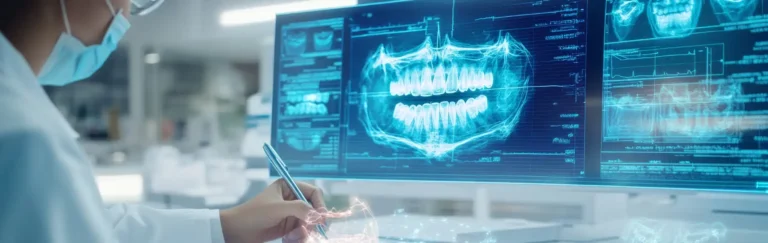
- Reads the image. Flags caries, bone loss and periapical lesions on bitewings, periapicals, panoramics and CBCT scans, and marks them up so the dentist can show the patient.
- Plans treatment. Places cephalometric landmarks, segments teeth on CBCT, and supports aligner and implant planning.
- Writes the note. Drafts clinical notes and fills perio charts from voice.
- Takes the history. Turns a patient’s medical history into a summary and flags what a dentist should check.
- Runs the front desk. Answers calls, books into the schedule, verifies insurance.
Dentists use these jobs unevenly. In the same ADA survey, the most common use was imaging and diagnostics (22.8%), then insurance verification (13.6%) and explaining findings to patients (13.2%), with front-desk check-in at 10.1%. Fewer than 5% use AI for treatment recommendations, and 82.6% don’t plan to. A survey can’t settle whether AI will replace dentists, but it shows where dentists draw the line today: they hand the software reading, paperwork and booking, and keep treatment decisions for themselves.
How Accurate Is AI in Dental Radiology and Diagnostics?
Back to the bitewing. Say the software outlines the shadow between the molars and labels it caries. How much should the dentist trust that outline? The answer depends on the job, and on a number most vendor pages leave out. (Imaging AI across medical specialties, from mammography to CT, follows the same logic; we cover it in AI in medical imaging.)
Caries
A 2026 umbrella review in the Journal of Dentistry, covering radiographs and intraoral photographs, pooled what five meta-analyses found: sensitivity of 0.76 to 0.94 and specificity of 0.85 to 0.91, and the authors write that “current evidence does not support their use as stand-alone diagnostic tools.”
A 2024 meta-analysis of AI on bitewings found pooled sensitivity of 0.94 and specificity of 0.91, yet the share of AI-flagged lesions that were real, the positive predictive value, ranged from 0.15 to 0.87 across studies. At 0.15, most flags are false. PPV falls when the condition is rare in the images being read, which is why a tool that looks excellent in a decay-heavy test set can over-call in a practice full of healthy adult mouths.
The authors’ advice: positives “should be verified by dental experts to prevent unnecessary treatments.” A separate 2026 review graded the certainty of this evidence low, with 22 of 28 studies at high risk of bias.
Periodontal bone loss
A 2025 review of 64 studies (16 of them pooled) reported sensitivity of 92.3% and specificity of 91.7% for marginal bone loss, with a caveat worth more than the headline: “No study evaluated changes in bone levels over time or was performed in a clinical setting.” A second review, of 30 studies, found lower figures, 87% and 76%, and no study it rated very high quality.
Periapical lesions
For radiolucencies at the root tip, a 2024 review of 24 studies (4 pooled) found sensitivity of 0.94 and specificity of 0.96, then added that “nearly all studies did not test fully fledged software systems.” In other words, much of the evidence comes from research models, not the products a practice licenses.
Cephalometric landmarks and CBCT
Here the question is the yardstick. A 2024 systematic review found a mean 2D landmark error of 1.39 mm, inside the usual 2 mm tolerance. An umbrella review the same year argued that 2 mm is too generous a cut-off and concluded that AI “has exceeded the recommended magnitude of error for most cephalometric landmarks”, so it still needs an orthodontist’s final check. On CBCT, automated tooth segmentation reaches a pooled Dice score of 0.95, a strong overlap with expert outlines, with metal artifacts still unresolved.
Oral cancer
Detection of oral squamous cell carcinoma on intraoral photographs reached sensitivity of 0.97 and specificity of 0.93 in a 2026 review, but only 8 studies used photographs. Across model types, another 2026 review found heterogeneity of 100%, built on retrospective data. Promising, and nowhere near a screening program.
What Changes When a Dentist Reads the X-Ray With AI?
The second question is the one a buyer is really paying for. The software’s accuracy alone isn’t the dentist’s accuracy with the software, and only a few studies have measured the second.
The clearest is a cluster-randomised cross-over trial with 22 dentists reading bitewings, published in 2021. With AI, their sensitivity rose from 0.72 to 0.81 and the area under the curve from 0.85 to 0.89, with no significant loss of specificity. The gain came in early enamel lesions, not in dentin. The authors also noted that AI “may also increase invasive treatment decisions.”
The same team then fed the trial’s results into a lifetime simulation model. Modelled cost came out at 330 euros with AI and 330 euros without: “Higher accuracy of AI did not lead to higher cost-effectiveness, as more invasive treatment approaches generated costs.”
For our shadow, that means AI helps the dentist see it, and some shadows like it end up drilled when they could have been watched.
The direction depends on the job. A 2025 randomised trial on a different task, periapical lesions on panoramic radiographs, with 30 dentists and CBCT as the reference, found AI help lifted accuracy from 91.6% to 93.3% and cut false positives from 4.3% to 2.0%, while sensitivity stayed near 46% either way, and treatment decisions shifted toward more conservative care.
Back on caries, a controlled study of early enamel lesions, by authors linked to the company that makes the software tested, saw dentists find 75.8% of lesions with AI versus 44.3% without, while false positives on healthy surfaces rose from 3.7% to 14.6%.
FDI World Dental Federation’s 2024 policy statement names the risk plainly as “automation bias (i.e., over-reliance of practitioners using AI)“. The third question, whether patients end up with fewer cavities, less pain or longer-lasting teeth, has no trial answer yet: none of the reviews and trials cited here measures patient outcomes, as of October 2026.
Which Dental AI Tools Has the FDA Cleared?
FDA keeps one public list of AI-enabled medical devices, and it’s worth reading the way you’d read a drug label: what exactly was cleared, for which images, on what date. A 2025 review in BMC Oral Health counted 52 AI or machine-learning dental devices in FDA’s 510(k) database as of December 2024, 48% of them for oral radiology.
The record has a clear sequence:
- May 19, 2021: Overjet Dental Assist, K210187, the first deep-learning dental radiograph clearance on the list, under an image-processing product code.
- 2022: caries-detection clearances under the computer-assisted detection code, including Pearl’s Second Opinion (K210365, March 4), Videa Caries Assist (K213795, April 21) and Overjet Caries Assist (K212519, May 10).
- 2023-2024: periapical radiolucency, pediatric caries and charting software join the list.
- May 17, 2024: FDA granted De Novo DEN230035 and created a dental-specific classification, “dental image analyzer” (21 CFR 872.1770), for remote orthodontic monitoring from patient photos.
- 2025-2026: CBCT, panoramic and 3D clearances, including Overjet’s Iris imaging system (K253930, April 10, 2026).
Three things trip buyers up. First, most dental radiograph AI went through FDA’s Radiology panel, not the Dental panel, so search both. Second, a 510(k) clearance means FDA found the device substantially equivalent to one already on the market for a stated use; “FDA approved” is the wrong phrase, and the stated use matters (each device is cleared for its stated indication, so check it covers the image types you take).
Third, models change after clearance. FDA’s final guidance on a Predetermined Change Control Plan lets a manufacturer pre-specify how a model will be updated, so ask whether one covers the version you’re buying. FDA’s broader AI lifecycle guidance is still a draft.
Not every AI feature is a device. The Cures Act amendment to the FD&C Act takes software “for administrative support of a health care facility“, including scheduling and billing, out of the device definition, while software intended to “acquire, process, or analyze a medical image” stays in. If you’re building, which of your own features could be a device is a product decision to settle early; it’s covered for builders on our dental AI development page, and the general rules on software as a medical device.
AI in Dental Care Beyond the X-Ray: Notes, Charts, and the Medical History
Most of a dental visit never touches a radiograph, and here the evidence gets thin fast.
Take documentation. A 2026 narrative review in the British Dental Journal found only one study evaluating ambient voice technology in dentistry, which reported lower accuracy on dental terms and “clinically significant errors and hallucinations”; no dental study had evaluated AI-written records or letters.
A 2025 pilot that turned spoken perio exams into charts hit 67.4% overall field accuracy, and 53.3% on probing depths, across 15 recordings. Note-drafting in medicine has more behind it; that side is covered in AI in healthcare documentation.
The medical history is the job I watch most closely, because it’s where a dental office meets medicine: anticoagulants, bone-modifying drugs, heart conditions that change what a dentist does. There’s no direct evidence yet on language models reading dental histories. The nearest is a different task: a 2026 meta-analysis of 39 studies put their accuracy on dental exam questions at 63.7%, which the authors call “insufficient for autonomous clinical decision-making.” None of the dental reviews cited here evaluates AI-written medical-history summaries, as of October 2026.
For a dental clinical-AI startup founded by a practicing oral surgeon, we built a platform that turns a patient’s history into a summary and risk report. The design splits the work: a JSON clinical-rules engine decides what gets checked (conditions, medications, surgeries, prescribing-safety rules), Gemini on Vertex AI writes the summary on top of it, and every history is versioned so the dentist sees what changed since the last visit. Because the rules are explicit, each one can be tested case by case before a patient sees output, and the dentist signs off every summary.
The front desk is the other busy area. AI receptionists that book into the practice management system are their own integration problem, covered in AI receptionist integrations, and automated benefits checks are covered in dental insurance verification software.
Connect Dental AI With Your Imaging and Patient Records. Book a Demo Today.
Where Does the AI’s Output Land in the Practice’s Systems?
A flag nobody sees in the chart changes nothing. Before buying or building, trace the AI’s output to three places.
- The chart. The finding should land on the right tooth and link to the image it came from, so the dentist can accept or overrule it where they already work. Each practice management system (Dentrix, Eaglesoft, Open Dental, Denticon and others) gates write access its own way; dental PMS integration covers the routes per system.
- The treatment plan. An accepted finding should become a planned procedure without retyping, and an overruled one should be recorded as overruled.
- The claim. Many AI tools draw colour overlays on radiographs. Those help chairside, but the image attached to a claim should be the clean, unannotated one, so check what your imaging software exports by default. What reviewers expect to see is covered in dental claim narratives.
Behind all three sits the imaging stack: the sensor software, the imaging bridge, and whether images move as DICOM. That’s covered in dental imaging software. The work is mostly mapping. On the clinical-AI build above, the team mapped about 12 data sources for API availability during a four-week design sprint, before any development started.
ConnectHealth, when your dental AI needs the medical record. ConnectHealth is a separate product from the builds above. It fits DSOs and integrated medical-dental groups whose dental tools need the patient’s medical record, because a medical-history AI is only as good as the medications and conditions it can see. ConnectHealth reads them from 20+ EHRs, including Epic and athenahealth, over FHIR, inside your own cloud environment. For AI steps, use a model inside your environment or the Guardrails node so PHI stays there.
Do Dental Insurers Use AI to Review Claims?
The shadow on the bitewing may get a second AI read after it leaves the office. Payer-side AI is documented mostly in vendors’ own announcements. A 2019 release from one AI vendor said a regional dental insurer’s system “assesses every claim submitted” and “analyzes all claim-related files, including digital images such as radiographs,” then queues them for clinician review.
In 2021, a dental AI imaging company announced it had bought a dental claims-review firm to offer payers AI-assisted claim review with licensed clinical reviewers.
Law has started to set limits. California’s SB 1120, signed September 28, 2024, says an AI or algorithm used for utilization review “shall not deny, delay, or modify health care services based, in whole or in part, on medical necessity,” and that a licensed physician or health care professional makes that determination. It applies to “a specialized health care service plan,” and California law defines that to include dental care. More broadly, 29 jurisdictions had adopted the NAIC model bulletin on insurers’ use of AI as of October 8, 2026.
For a practice, the practical answer hasn’t changed: send the clean image, and write a narrative that answers the reviewer’s published criteria, because a person reviewing an AI-queued claim reads the same file. This is a summary of public documents, not legal advice.
12 Questions to Ask Before You Buy or Build Dental AI
Most sales decks start with the last eight questions. Start with the first four, which are about evidence.
- Is it FDA cleared for our image types and sensors? Ask for the 510(k) number and read the indications: bitewings, periapicals, panoramics and CBCT are separate.
- Was it validated on images it wasn’t trained on? The ANSI/ADA Standard No. 1110-1:2025, the first US standard on AI in dentistry, covers how validation datasets are annotated and collected; ADA Technical Report No. 1109:2025 covers evaluation.
- How does it perform by subgroup? Age, dentition, sensor type. A 2026 review found 0 of 10 dental AI studies ran a subgroup analysis.
- What’s its positive predictive value in a population like ours? Sensitivity alone hides false positives.
- Is there evidence of dentists reading with it, not just the model alone?
- Where does each finding land in our PMS, and can we export clean images for claims?
- How is it monitored after go-live, and does a Predetermined Change Control Plan cover model updates?
- Will you sign a BAA, and where is patient data processed?
- Is there an audit trail of what the AI suggested and what the dentist decided?
- How will we tell patients AI was used? Settle it before launch.
- Who signs off, and how are disagreements recorded?
- If we’re building: which logic sits in rules, which in the model, and how is each tested? Test cases per rule are part of testing AI in healthcare software.
What Changes Next for AI in Dentistry
As of October 2026, five things are worth watching through 2027:
- FDA’s AI lifecycle guidance is still a draft; a final version would set expectations for how dental AI is documented and updated. If you build: write your model-change plan now, so it maps onto a final guidance. If you buy: ask how the vendor will handle it.
- FDA revised its Clinical Decision Support guidance in January 2026, which matters for history and decision-support tools that aren’t image analysis. If you build one: check each feature against the January 2026 version with your regulatory partner before launch.
- The ADA Standards Program is developing an AI “model fact label” standard, according to the ADA HPI’s July 2026 report, a plain summary of what a model was trained and tested on. If you buy: ask vendors now for the facts such a label would carry (training data, test sets, subgroup results).
- There’s still no AI-specific CDT code. For CDT 2027, the ADA’s Code Maintenance Committee voted 0-24 against a request for a code for AI-supported remote monitoring and pointed to existing code D9996. For practices: there’s no separate fee to bill for the AI, so its value has to come from the work it saves or the care it improves.
- State rules on AI in utilization review are spreading beyond California, through laws and NAIC bulletin adoptions. For practices: keep the clean image and a narrative on file for every claim a payer’s AI might question.
Judge Dental AI by What Happens to the Patient
Back to the shadow between the two molars. The software found it, and the evidence says it’s good at that. But whether that shadow should have been drilled, or whether finding it earlier saves the tooth, remains unanswered at scale.
Practices can begin answering these questions by tracking the AI flags dentists accept or overrule, restorations started based on AI-only flags, and what recall visits reveal a year later.
That’s outcomes research at the level of a single practice, and it provides the data needed for your next vendor conversation.
If you’re building a dental AI product or integrating one into your PMS and imaging stack, Mindbowser builds dental AI products using the rules, tests, and integrations described here.
Next Read: Explore dental AI development, from the design sprint to testing, and dental imaging software to understand how images move from the sensor to the chart and where AI fits into the process.