













 BLOGS
BLOGS  NEWSROOM
  CASE STUDIES
  WEBINARS
  PODCASTS
  ASSET HUB
  EVENT CALENDAR

























The healthcare industry is constantly seeking innovative solutions to improve patient care, reduce costs, and enhance operational efficiency. One groundbreaking technology making waves in 2025 is Robotic Process Automation (RPA) for healthcare.
RPA for healthcare allows professionals to focus on patient care and intricate decision-making processes by automating repetitive and monotonous operations. According to Precedence Research, the US robotic process automation market reached USD 6.53 billion in 2023 and is set to grow at a CAGR of 23.90% from 2024 to 2033, reaching USD 54.83 billion.
The effects of RPA in the healthcare industry are becoming more obvious as its use grows. RPA can drastically alter healthcare operations by improving clinical accuracy and streamlining administrative processes. By implementing RPA for healthcare, organizations can experience significant improvements in efficiency, accuracy, and cost savings.
This blog explores the use of Robotic Process Automation (RPA) for healthcare, its benefits, and its impact on operational excellence and patient satisfaction.
What is RPA for Healthcare?
Imagine a tireless, super-efficient assistant in a healthcare organization. That’s essentially what Robotic Process Automation (RPA) for healthcare is—a technology that uses software robots to handle repetitive tasks. These bots can mimic human actions on computers, much faster and without errors.
RPA becomes a significant asset because many tasks involve shuffling data between different systems, filling out forms, and following up on claims in healthcare.
Here’s how RPA for healthcare comes in:
Automating Paperwork
For new patients, RPA can manage tasks like collecting insurance information, scheduling appointments, and updating electronic health records. This automation frees up staff to focus on interacting with patients.
Streamlining Billing and Claims
Hospitals handle numerous bills and insurance claims. RPA for healthcare can automate tasks such as collecting data from various sources, generating invoices, and even following up on overdue payments. This reduces errors and saves time.
Managing Medical Records
Accurate and up-to-date medical records are crucial. RPA for healthcare can automate tasks like transferring data between different systems, flagging missing information, and generating reports.
These are just a few examples. RPA in the healthcare industry can be applied to many other administrative tasks, allowing staff to focus on providing care to patients. It’s important to note that RPA for healthcare doesn’t replace humans—it works alongside them. Think of it as a helping hand that frees up valuable time for doctors, nurses, and other healthcare professionals.
Use Cases of RPA for Healthcare
Robotic Process Automation (RPA) in healthcare is transforming how administrative, clinical, and operational tasks are handled. This shift improves productivity, reduces errors, and frees up medical staff to concentrate on providing excellent patient care, eventually improves health outcomes and streamlining operations.
Here are some of the key use cases:
➡️Administrative Tasks
▪️Patient Scheduling
RPA for healthcare can streamline the scheduling process by automating appointment bookings, reminders, and follow-ups. This reduces the administrative burden on staff and ensures patients receive timely care.
▪️Billing and Claims Processing
Managing billing and insurance claims can be tedious and error-prone. RPA for healthcare automates data collection from various sources, generates invoices, and even takes follow-up on overdue payments, significantly reducing errors and saving time.
▪️Data Entry and Management
RPA in healthcare industry can automate data entry tasks, ensuring that patient records are accurately updated across multiple systems. This enhances data accuracy and frees up staff to focus on more critical tasks.
➡️Clinical Tasks
▪️Patient Data Analysis
RPA for healthcare can analyze large volumes of patient data, identifying trends and patterns that inform treatment decisions. This helps healthcare providers deliver more personalized and effective care.
▪️Electronic Health Record (EHR) Updates
Keeping EHRs up-to-date is essential for quality patient care. RPA for healthcare can automate the process of updating patient records, ensuring that all relevant information is accurately recorded and easily accessible.
▪️Lab Results Processing
RPA in healthcare industry can automate the processing and delivery of lab results, ensuring that they are quickly and accurately communicated to the relevant healthcare providers. This speeds up diagnosis and treatment.
➡️Operational Tasks
▪️Inventory Management
RPA for healthcare can monitor inventory levels, automatically reordering supplies when they run low. It ensures that healthcare facilities are always stocked with the necessary items, preventing shortages and delays in patient care.
▪️Supply Chain Management
Managing the supply chain in a healthcare setting can be complex. RPA for healthcare can streamline this process by automating the tracking of supplies, optimizing ordering processes, and ensuring timely delivery of necessary items.
▪️Regulatory Compliance
Ensuring compliance with healthcare regulations is critical. RPA for healthcare can automate compliance-related tasks, such as monitoring regulatory changes, updating protocols, and generating compliance reports. This reduces the risk of non-compliance and associated penalties.
RPA has multiple benefits in the healthcare industry, including increased patient care, operational management, efficiency, and accuracy. Healthcare professionals can focus more on providing high-quality care to patients, ultimately leading to better health outcomes, by automating routine tasks.
For example, – A large hospital chain used RPA to streamline compliance. It automated tracking regulatory updates and generating reports, ensuring adherence to healthcare regulations across facilities, minimizing risks, and improving operational efficiency.
Related reads: Top 10 RPA Use Cases In Healthcare Industry 2024
Benefits of RPA for Healthcare
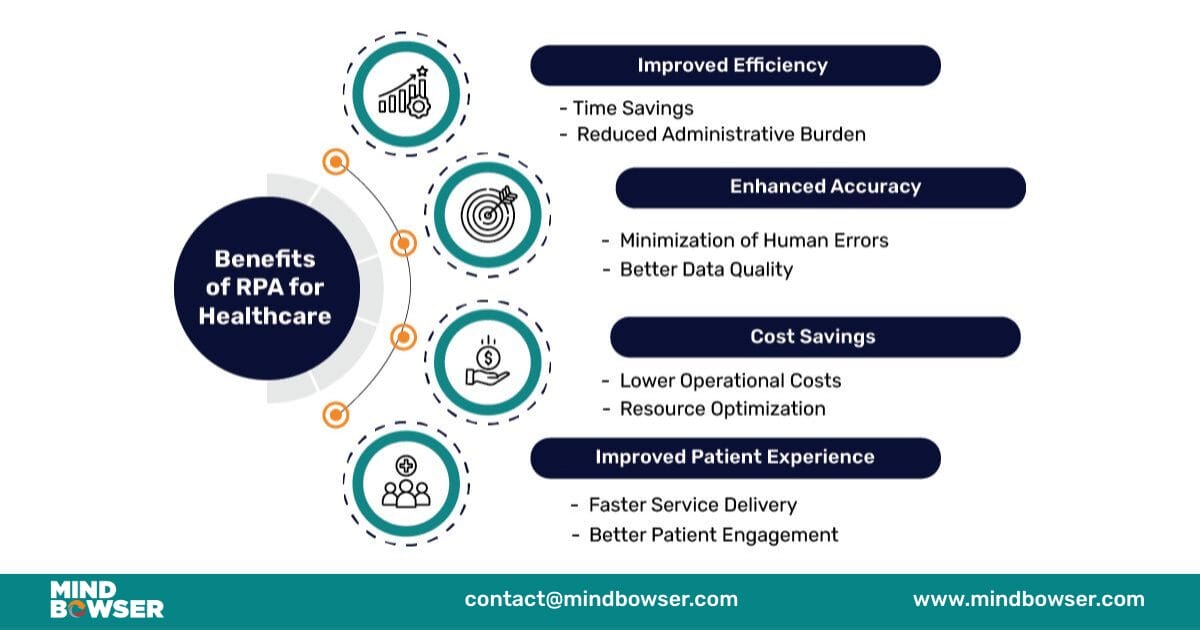
Improved Efficiency
The healthcare sector may benefit greatly from RPA, which can improve efficiency by saving time and reducing administrative hassles. Healthcare practitioners may devote more time to patient care by using RPA to automate monotonous operations like data input, appointment scheduling, and claim processing.
Faster reaction times, more efficient processes, and increased operational productivity are all results of this efficiency, which eventually improves the provision of healthcare services as a whole. Additionally, RPA reduces the mistakes that come with human procedures, guaranteeing regulatory compliance and accuracy in data handling. RPA for healthcare is a useful tool for improving healthcare operations because of these benefits.
Enhanced Accuracy
RPA reduces human error in repetitive processes, improving accuracy in healthcare operations. RPA guarantees accuracy and consistency in managing patient data and financial transactions by automating data entry, record keeping, and invoicing procedures.
Error minimization increases patient care quality overall, data integrity, and compliance with laws like HIPAA. RPA enables healthcare practitioners to accurately charge patients and keep accurate records, which improves patient satisfaction and financial management.
Cost Saving
RPA saves a lot of money in the healthcare industry by optimizing resources and reducing operating costs. RPA lowers labor expenses by automating repetitive operations like scheduling, data entry, and claims processing. This eliminates the need for human labor.
Healthcare providers are able to improve staff productivity and patient care delivery by reallocating resources to more vital areas due to this efficiency. RPA for healthcare also lessens mistakes in administrative and invoicing tasks, which lowers income leakage and improves financial efficiency.
RPA generally assists healthcare institutions in achieving significant cost reductions while upholding strong operational performance criteria.
Improved Patient Experience
By enabling quicker service delivery and enhancing patient involvement, RPA improves the patient experience. Routine operations like making appointments and retrieving data are automated using RPA, which shortens wait times and simplifies administrative procedures.
Due to this efficiency, medical professionals can give timely and attentive treatment, which improves patient satisfaction levels overall. Additionally, RPA-driven systems can improve patient-provider relations by proactively engaging patients with individualized messages and reminders.
RPA for healthcare enhances the patient experience in healthcare settings by enhancing operational efficiency and communication. It leads to a more positive and efficient patient encounter.
Ready to Transform Your Healthcare Operations with RPA?
Improved Efficiency
The healthcare sector may benefit greatly from RPA, which can improve efficiency by saving time and reducing administrative hassles. Healthcare practitioners may devote more time to patient care by using RPA to automate monotonous operations like data input, appointment scheduling, and claim processing.
Faster reaction times, more efficient processes, and increased operational productivity are all results of this efficiency, which eventually improves the provision of healthcare services as a whole. Additionally, RPA reduces the mistakes that come with human procedures, guaranteeing regulatory compliance and accuracy in data handling. RPA for healthcare is a useful tool for improving healthcare operations because of these benefits.
Enhanced Accuracy
RPA reduces human error in repetitive processes, improving accuracy in healthcare operations. RPA guarantees accuracy and consistency in managing patient data and financial transactions by automating data entry, record keeping, and invoicing procedures.
Error minimization increases patient care quality overall, data integrity, and compliance with laws like HIPAA. RPA enables healthcare practitioners to accurately charge patients and keep accurate records, which improves patient satisfaction and financial management.
Cost Saving
RPA saves a lot of money in the healthcare industry by optimizing resources and reducing operating costs. RPA lowers labor expenses by automating repetitive operations like scheduling, data entry, and claims processing. This eliminates the need for human labor.
Healthcare providers are able to improve staff productivity and patient care delivery by reallocating resources to more vital areas due to this efficiency. RPA for healthcare also lessens mistakes in administrative and invoicing tasks, which lowers income leakage and improves financial efficiency.
RPA generally assists healthcare institutions in achieving significant cost reductions while upholding strong operational performance criteria.
Improved Patient Experience
By enabling quicker service delivery and enhancing patient involvement, RPA improves the patient experience. Routine operations like making appointments and retrieving data are automated using RPA, which shortens wait times and simplifies administrative procedures.
Due to this efficiency, medical professionals can give timely and attentive treatment, which improves patient satisfaction levels overall. Additionally, RPA-driven systems can improve patient-provider relations by proactively engaging patients with individualized messages and reminders.
RPA for healthcare enhances the patient experience in healthcare settings by enhancing operational efficiency and communication. It leads to a more positive and efficient patient encounter.
Challenges of RPA for Healthcare and Their Solutions
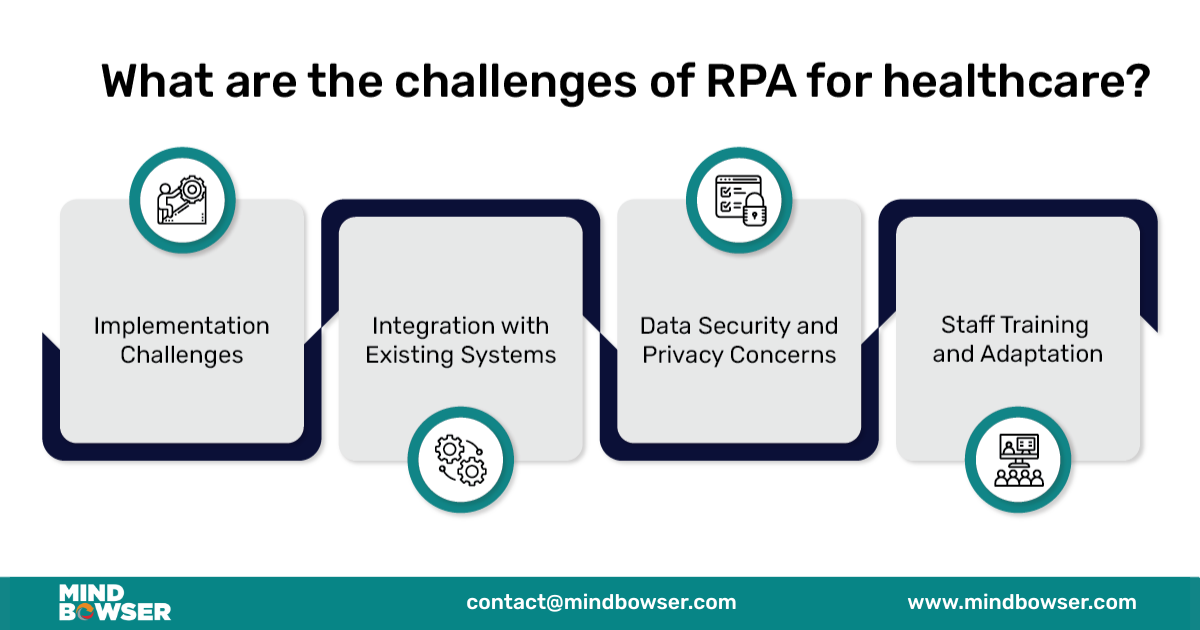
Implementation Challenges
Deploying RPA in healthcare industry can be intricate and time-consuming. Aligning the technology with existing workflows and processes requires meticulous planning and execution.
Engage with experienced RPA providers specializing in healthcare to ensure thorough planning and execution. Conduct pilot projects to test workflows and refine processes before full deployment. Use a project management system to manage timelines and resources effectively.
Integration with Existing Systems
RPA needs seamless integration with current healthcare systems, including Electronic Health Records (EHRs) and other medical software. Compatibility issues may arise, complicating the integration process.
Perform comprehensive compatibility assessments upfront to identify potential integration issues. Choose RPA platforms with strong integration capabilities that support seamless interaction with existing EHRs and medical software. Collaborate closely with IT teams and system vendors to address compatibility challenges early in the implementation process.
Data Security and Privacy Concerns
Healthcare data is extremely sensitive, necessitating stringent security measures. Implementing RPA for healthcare involves ensuring process automation complies with strong data protection regulations to prevent breaches.
Implement robust security measures, including encryption, access controls, and regular security audits, to protect sensitive healthcare data. Ensure RPA processes comply with stringent data protection regulations, such as HIPAA. Partner with cybersecurity experts to conduct thorough risk assessments and develop a secure RPA implementation strategy.
Staff Training and Adaptation
Introducing RPA for healthcare requires training staff to utilize and manage the technology effectively.
Overcoming resistance to change and ensuring all team members are proficient with the new system are crucial for successful implementation.
Understanding and addressing these challenges will empower healthcare organizations to make informed decisions when adopting RPA, fostering a more efficient and secure healthcare environment.
Provide comprehensive training programs for healthcare staff to familiarize them with RPA tools and workflows. Offer hands-on training sessions and workshops to build proficiency in using RPA software effectively. Create change management plans to address resistance to technology adoption and promote a culture of continuous learning and adaptation.
Conclusion
Robotic Process Automation (RPA) in healthcare offers transformative benefits that can significantly enhance the efficiency, accuracy, and overall quality of healthcare services. For those seeking new healthcare solutions or considering replacing existing systems, understanding the above key points is important.
By automating administrative activities, reducing human errors, optimizing resource allocation, and increasing patient interaction, RPA improves efficiency, accuracy, cost savings, and patient experience in healthcare.
RPA for healthcare is a powerful tool that can revolutionize how healthcare organizations operate. Its ability to streamline processes, enhance data accuracy, and improve patient care makes it an attractive solution for modern healthcare challenges.
Frequently Asked Questions
What is RPA in medical terms? RPA (Robotic Process Automation) in medical terms refers to using software robots to automate repetitive, rule-based tasks in healthcare, such as data entry, billing, and scheduling.
What is intelligent process automation in healthcare? Intelligent Process Automation (IPA) in healthcare combines RPA with artificial intelligence (AI) to automate more complex tasks, such as patient data analysis and predictive diagnostics, enhancing decision-making and operational efficiency.
What does RPA mean in healthcare? In healthcare, RPA means using automated software bots to handle routine administrative and clinical tasks, improving efficiency, reducing errors, and allowing healthcare professionals to focus on patient care.
In which scenario can RPA help? RPA can help in scenarios like patient scheduling, billing and claims processing, updating electronic health records (EHRs), managing medical records, and ensuring regulatory compliance, thereby streamlining operations and improving accuracy.