BLOGS
BLOGS  NEWSROOM
  CASE STUDIES
  WEBINARS
  PODCASTS
  ASSET HUB
  EVENT CALENDAR






















TL;DR
- Most urgent care EMR comparison content compares feature checklists: “Does it have this? Does it have that?”
- This one compares what breaks first when you’re running 400 patient visits a month with three providers cycling through rooms every eight minutes.
Three facts that change the shopping list:
- Experity holds ~70% of purpose-built UC EMR market (UCAOA 2024). Market share is not clinical workflow fit. The other 30% exists because the remaining 11,000 centers have different operational models.
- Documentation speed at scale is the real KPI, not feature count. The test: can a provider close a straightforward chart in under 90 seconds, consistently, across a 10-hour shift? Most generic ambulatory EMRs fail this by hour 6.
- If you run occupational health alongside standard walk-ins, your realistic shortlist is shorter than you think. Your EMR needs to speak two billing languages at once: standard E&M codes and Workers’ Comp. Most purpose-built UC systems punt on this.

Fig 1: Urgent Care EMR Stress Test

I. Why Is Urgent Care EMR a Different Problem Than Any Other Clinical Setting?
It’s 6 PM on a Tuesday. Your urgent care center is at capacity. 45 patients in queue. Three providers cycling through rooms. Nurse triage is triaging into open rooms. Front desk is checking in a new patient every 90 seconds. Every eight minutes, a provider needs to open a chart, document, close it, and route it to billing.
The KPI is not patient satisfaction scores or provider experience. The KPI is door-to-discharge time and billing accuracy. Miss either one and your unit economics break.
Why this matters for EMR choice:
- UCAOA 2024 data: 11,000+ urgent care centers in the US. Average visit volume: 350-400 visits per month per center.
- CMS E&M restructure 2021 changed how walk-in visits get billed (MDC vs. time-based coding for office visits 99202-99215). Most EMR templates still don’t auto-capture MDC correctly.
- An EHR built for primary care assumes 15-20 patients per provider per day. UC runs 40-60. The architectural assumption breaks at scale.
The honest take: You’re not shopping for an EHR because you want better patient care or clinician satisfaction. You’re shopping because your current system is either charging you API fees every time you want to integrate with a lab, or it takes three clicks to document a straightforward visit, or your billing module hasn’t talked to your clinical module since 2018.
II. What Should You Actually Evaluate When Comparing Urgent Care EMRs?
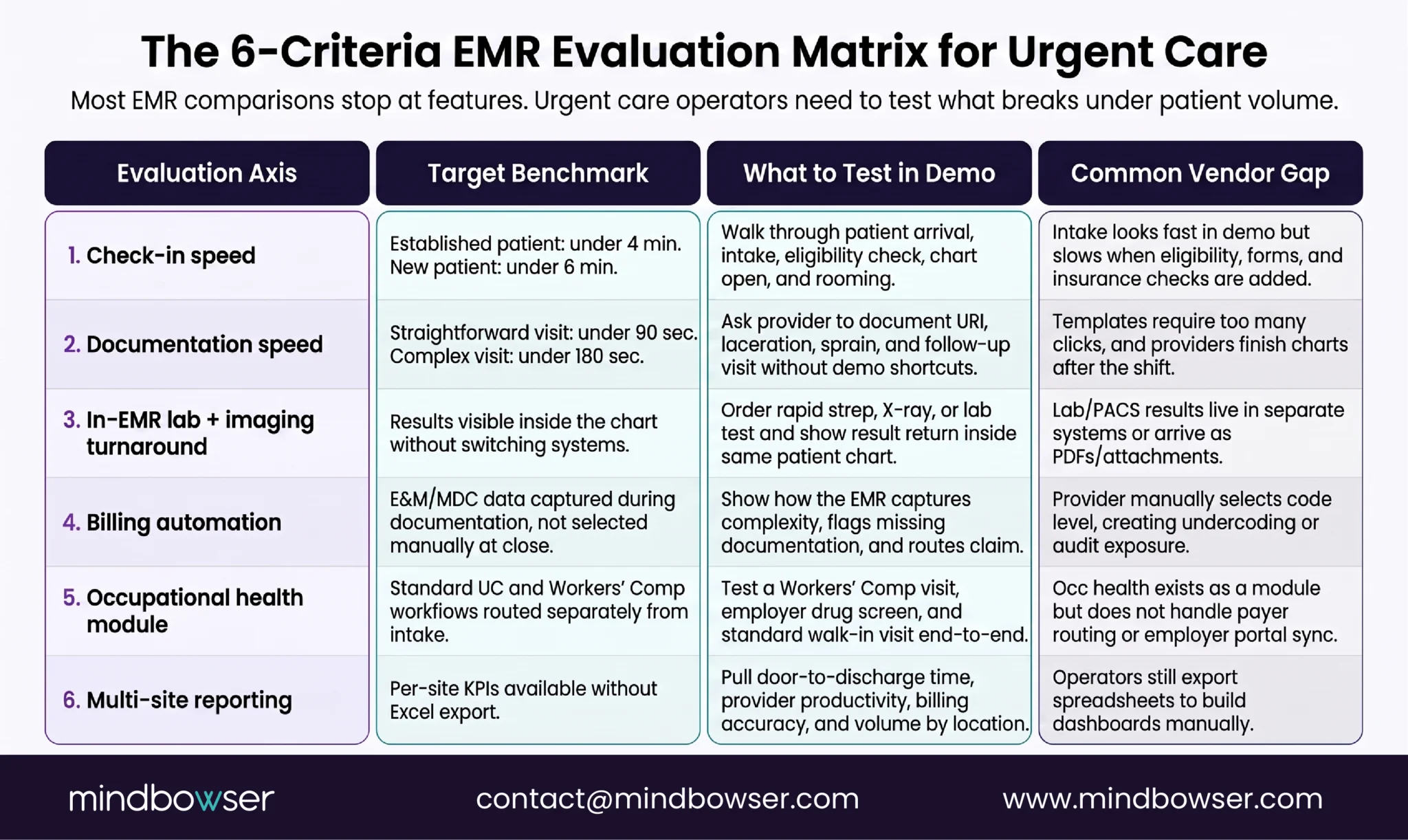
The wrong question is “Does it have X feature?” The right question is “What breaks first at 400 visits a month?”
Six evaluation axes matter. Most UC EMR comparisons ignore four of them.
- Axis 1: Check-in speed. Target: under 4 minutes for established patients, under 6 for new.
- Axis 2: Documentation speed. Target: under 90 seconds for straightforward visits, under 180 for complex.
- Axis 3: In-EMR lab and imaging turnaround. If your EMR requires switching to a separate lab system or imaging PACS, you’ve lost 30-60 seconds per result per visit. At 400 visits a month, that’s two FTEs worth of wasted provider time.
- Axis 4: Billing automation (CPT/E&M accuracy). Your EMR auto-assigns E&M codes based on MDC. Most UC EMRs do this poorly or not at all.
- Axis 5: Occupational health module. Most purpose-built UC EMRs are silent on Workers’ Comp billing, OSHA routing, and employer portal integration.
- Axis 6: Multi-site reporting and analytics. Most EMRs require Excel exports instead of per-site KPI dashboards.
The KLAS finding: KLAS Arch Collaborative 2024 surveyed 500,000+ clinicians. Only 44% agreed their EHR provided the expected outside integrations. When billing, lab, and imaging are separate islands, providers route around the EMR, slower charts, incomplete claims.
The honest frame: You’re not evaluating vendors. You’re evaluating operational KPIs under stress. Pick the system that doesn’t degrade when you’re full.
III. Which Purpose-Built Urgent Care EMRs Are Worth a Serious Look?
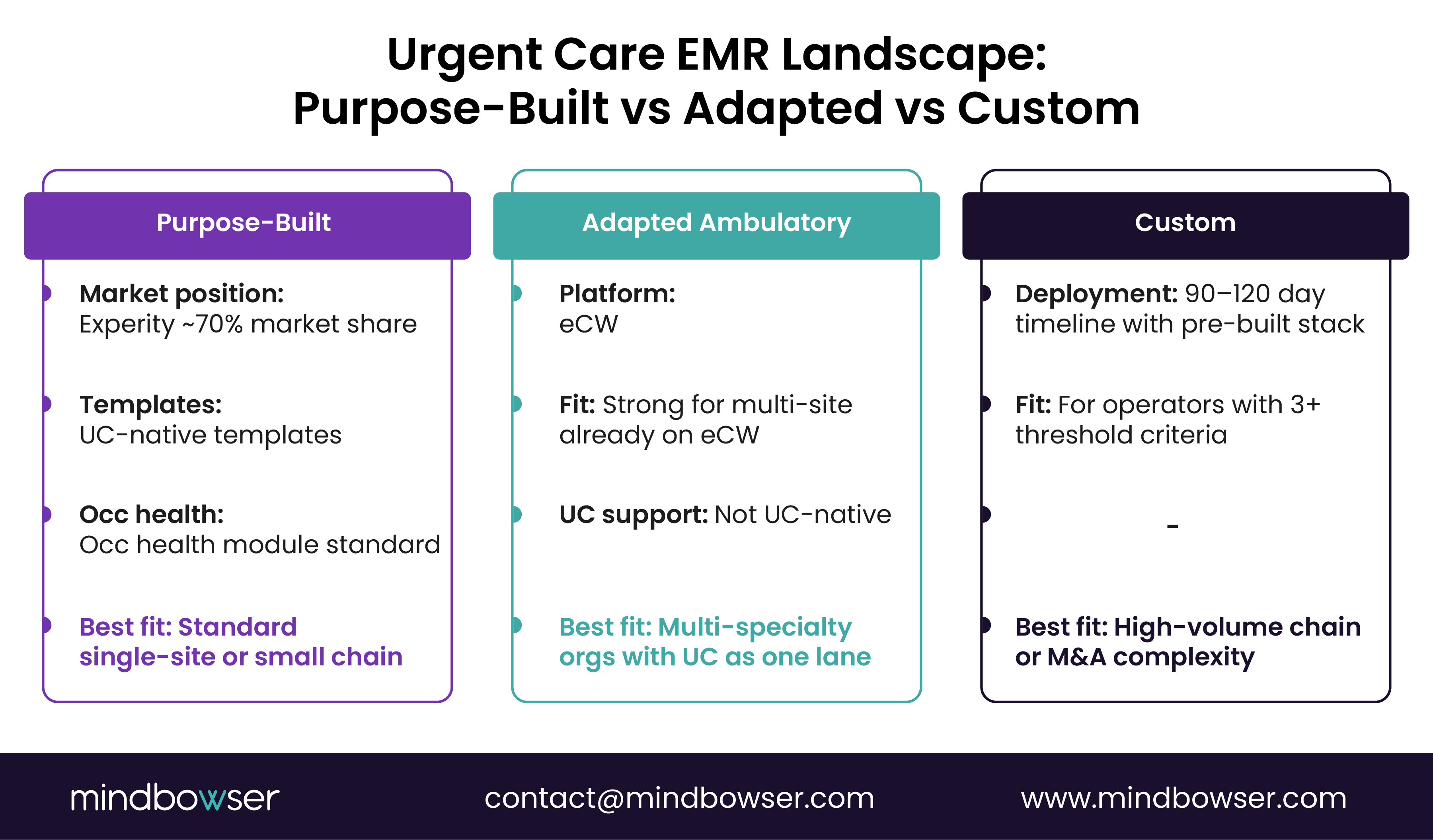
Three categories exist. Most comparison articles conflate them.
Category 1: Purpose-built UC systems
Experity (~70% market share, UCAOA 2024). Designed from the ground up for UC throughput. Template-driven charting, built-in occ health module, billing logic tuned for UC code mix. Market share = default for standard single-site or small-chain operators with clean payer mix. If your operation is more complex, Experity’s standard build may require workarounds that turn into maintenance overhead.
Category 2: General ambulatory EMRs adapted for UC
eClinicalWorks is most common here. Works if your org is already running eCW across primary care and UC is one lane. Not UC-native. Templates require customization. Billing logic requires configuration. Value: consolidated records across care settings, not UC-specific speed.
Category 3: Health system-owned UC chains using Epic or Cerner
EMR choice is often inherited. Benefit: patient record continuity across the health system. Cost: configurations add implementation complexity and support overhead. For context on how EHR integration layers reduce that friction: EHRConnect.
The honest frame: Experity dominates because it’s purpose-fit for the majority. That majority is single-site or small-chain, standard walk-in mix, no complex occ health contracts. If you’re outside that majority, the shortlist changes fast.
IV. How Does Documentation Speed Actually Hold Up When You’re Running 400 Visits a Month?

KLAS Arch Collaborative 2024: EHR chart time is the single largest driver of provider burnout across care settings. In UC, this compounds because providers have no buffer between patients.
AI Medical Summary reduces documentation time by 50% and improves chart accuracy by 45% in integrated deployments. Mechanism: ambient AI captures the encounter, auto-populates structured note fields, flags documentation gaps, routes the chart to billing review.
This is not about cutting clinical staff. It’s about not losing 90 seconds per chart to a system designed for a 20-patient-per-day primary care practice.
What’s changing in 2026: ONC USCDI v3 becomes the baseline standard for certified health IT systems in July 2026. If your EMR vendor hasn’t built against USCDI v3, AI scribing tools and lab/imaging integrations may hit interoperability friction. Ask your vendor specifically: “which modules are certified and what’s the update path?”
V. What Does Occupational Health Integration Actually Require from an Urgent Care EMR?
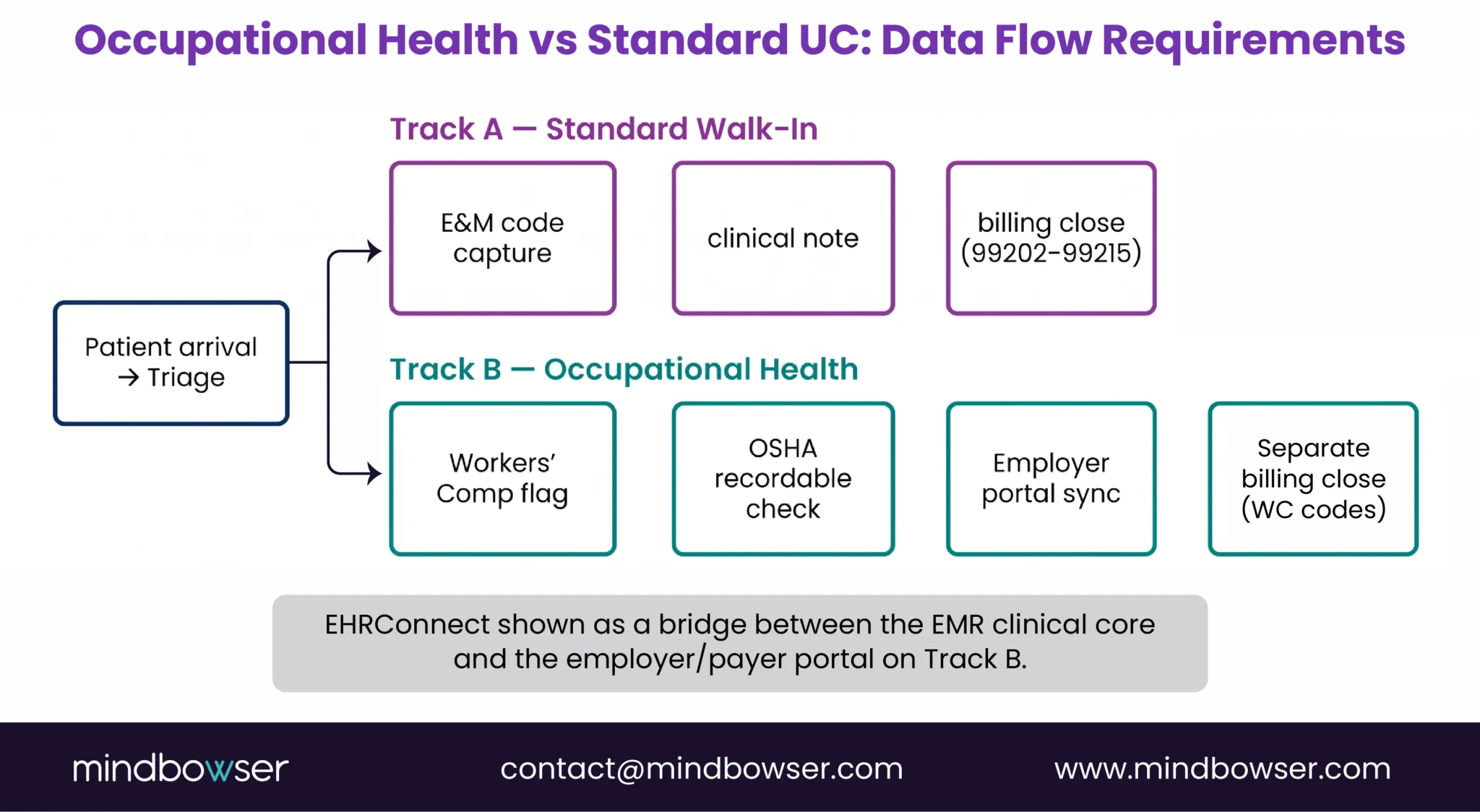
Standard UC runs on E&M codes (99202-99215). Occupational health billing is a different code universe: OSHA recordkeeping, Workers’ Comp payer rules (vary by state), employer-direct billing. The same visit may need to be routed two ways depending on why the patient is there.
Most purpose-built UC EMRs handle walk-in throughput well. Occ health is where they diverge. Either the module exists but lacks payer routing flexibility, or it requires a separate system that doesn’t talk to the clinical EMR in real time.
The integration layer that closes the gap: EHRConnect reduces EMR-to-employer/payer integration timelines from 6 months to 6 days via HL7/FHIR translation. The intake side pairs with the Patient Questionnaire Form for digital pre-registration with FHIR validation that routes patients to the right billing workflow before they hit the front desk.
The operational test: Workers’ Comp patient, employer-contracted drug screen, OSHA-recordable incident. Follow the chart from intake to billing close. If the system requires manual switching between clinical and occ health modules, that overhead compounds at 400 visits a month.
Not Sure Which EMR Path Fits Your Operation? We'll Map It.
VI. How Do the 2021+ E&M Coding Changes Affect Your Urgent Care EMR Requirements?

CMS-1734-F, effective January 1, 2021 (85 FR 84472): Office and outpatient E&M codes (99202-99215) shifted from a 3-element requirement (history, exam, MDC) to a 2-element choice: MDC alone, or total time. In practice, your EMR template must capture MDC explicitly (level of problem complexity, data reviewed, risk of complications) or providers manually select code levels at chart close. That’s slow and audit-exposed.
The UC-specific implication: Most UC visits are low-to-moderate complexity (99202-99204). Without auto-MDC capture: providers default to conservative selection (systematic undercoding) OR coders manually review charts before claims ship (added RCM overhead per visit).
The right question for your vendor: Does your EMR capture MDC data points inline during clinical documentation, or does the provider select an E&M level at chart close?
Note: verify payer-specific interpretations against your billing team. CMS-1734-F governs Medicare/Medicaid; commercial payer adoption varies.
VII. When Does a Custom Urgent Care EMR Build Actually Make Sense?
Fewer than 5% of UC operators take the custom build path. That’s probably right. But there’s a specific profile where purpose-built falls short.
The 5-criteria threshold:
- Multi-specialty UC plus occ health with unusual payer contracts (employer direct-pay, multi-state Workers’ Comp, federal contractor drug screening)
- Chains of 10+ locations with reporting requirements no purpose-built vendor meets out of box
- M&A debt: two or three acquired practices on different legacy EMRs, needing a unified clinical data model
- Differentiated clinical workflow that is core to your product (physician-founded company building a commercializable UC platform)
- Integration complexity that exceeds API add-ons: lab, imaging, pharmacy, employer portal, Workers’ Comp payer, all needing real-time bidirectional data
Meet three or more and the build-vs-buy math changes. ConnectHealth handles the HL7/FHIR interoperability layer for custom clinical builds.
The honest frame: Mindbowser builds custom EMR components and still says: don’t pursue it unless you meet the threshold.
Related read: EHR Implementation Guide , covers the full decision framework
VIII. How Does Mindbowser Build EMR Workflows for Urgent Care Operators?
Four gaps drive operators to Mindbowser:
- Gap 1: Documentation overhead at scale. AI Medical Summary: -50% documentation time, +45% chart accuracy. Ambient AI captures encounter, auto-populates note fields, routes to billing review.
- Gap 2: Payer and employer integration friction. EHRConnect: 6 months to 6 days for EMR-to-payer/employer integration timelines via HL7/FHIR translation. Occ health billing, Workers’ Comp routing, and employer-direct portal connections.
- Gap 3: Interoperability across systems. ConnectHealth: FHIR/HL7 layer connecting lab, imaging, pharmacy, and payer systems to a unified clinical data model.
- Gap 4: Intake routing. Patient Questionnaire Form: digital pre-registration with FHIR validation, routing patients to the correct billing workflow before the front desk.
Operators starting from this stack skip 6-9 months of from-scratch integration build and reach live workflows in 90-120 days.
IX. What’s the Honest Verdict on Urgent Care EMR Selection in 2026?
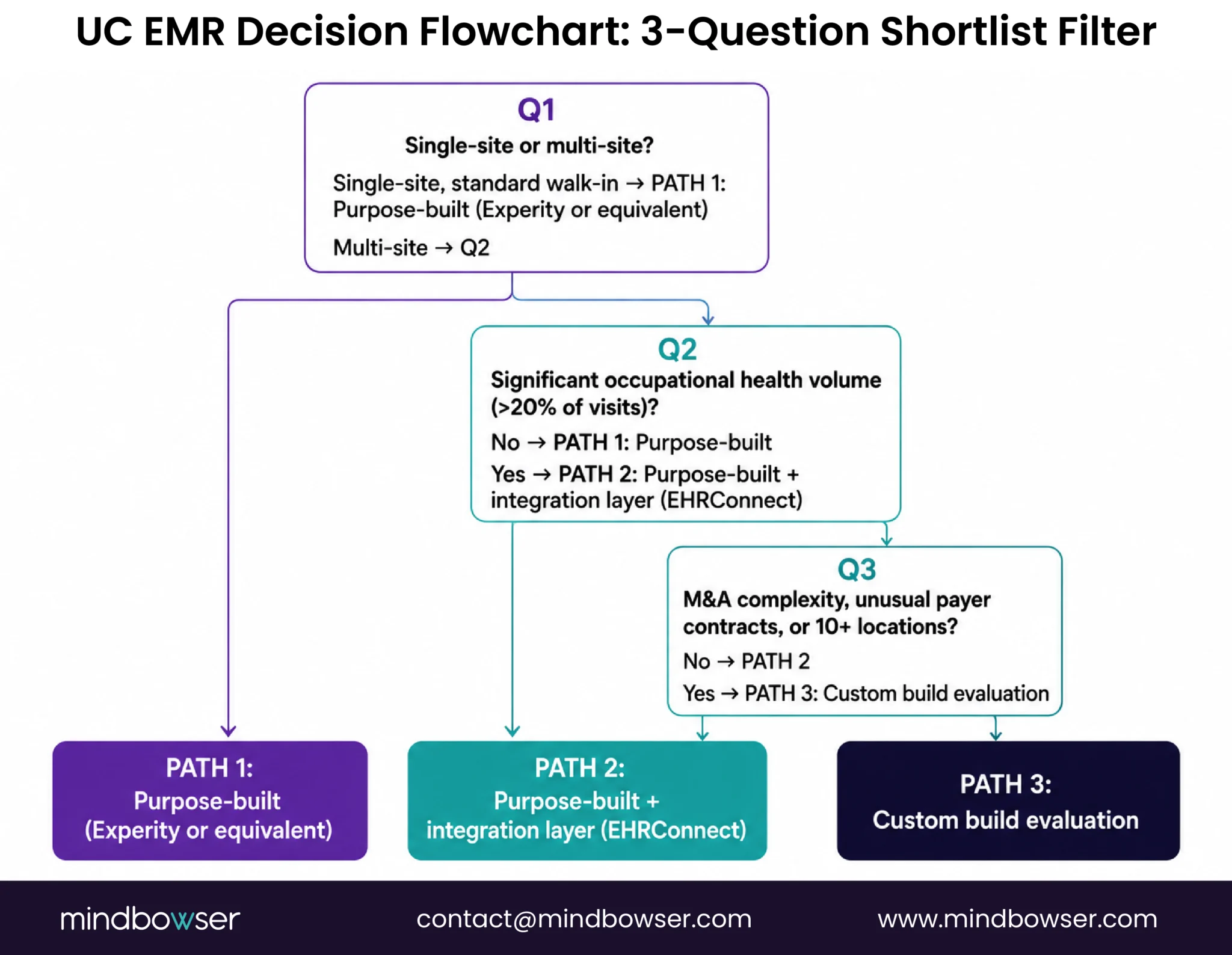
No universal winner. Right EMR depends on visit volume, payer mix, occ health split, and whether you’re standalone or health-system-owned.
Three-path decision matrix:
Path 1: Single-site, standard walk-in mix, clean payer contract.
Purpose-built (Experity or equivalent). No custom integration layer needed. Evaluate on documentation speed under load, E&M auto-capture accuracy, multi-site reporting if growth is on the roadmap.
Path 2: Multi-site or occ health split.
Purpose-built EMR plus an integration layer EHRConnect closes the employer/payer gap without replacing your core system). Evaluate EMR on occ health module depth; evaluate integration layer on payer routing flexibility.
Path 3: High-volume chain, legacy acquisition debt, or unusual payer complexity.
A custom build is worth a structured evaluation. Not an automatic yes. An honest build-vs-buy analysis against your specific integration requirements and 5-year trajectory.
Choose the EMR That Protects Throughput
There is no single best urgent care EMR for every operator. The right choice depends on your visit volume, payer mix, occupational health needs, and how much integration complexity your team can manage.
For standard single-site centers, a purpose-built urgent care EMR is usually enough. For multi-site or occupational health-heavy operators, an integration layer may be the better path. For high-volume chains with legacy systems, unusual payer contracts, or M&A complexity, a custom build is worth evaluating.
The best urgent care EMR is not the one with the longest feature list. It is the one that protects throughput, documentation speed, billing accuracy, and integration flexibility when the waiting room is full.
No single best for all operators. Experity is the dominant purpose-built option (~70% market share, UCAOA 2024) and the right default for standard single-site or small-chain walk-in centers. For multi-site operators with occ health workflows, M&A complexity, or unusual payer mixes, the shortlist changes.
For a standard single-site UC center with a clean walk-in payer mix, yes. The variable is occ health volume. That’s where Experity’s standard build requires the most customization.
Yes, and health system-owned chains frequently do. The trade-off: record continuity across the health system, at the cost of EMR configurations not designed for UC throughput. Both require significant template customization to get close to purpose-built documentation speed.
Hospital EMRs (Epic, Cerner, Meditech): built for inpatient care management (bed tracking, multi-day care plans, complex billing across settings). UC EMRs: built for high-throughput episodic visits (fast chart open/close, E&M billing automation, walk-in queue management). Architectural assumptions are different.
Purpose-built UC EMR platforms: $500-$1,500 per provider per month depending on module selection. Integration layers add cost as vendor add-ons or custom builds. Custom EMR development for complex requirements: $200K-$1M+ depending on scope, with 90-120 day timelines starting from pre-built integration components.