BLOGS
BLOGS  NEWSROOM
  CASE STUDIES
  WEBINARS
  PODCASTS
  ASSET HUB
  EVENT CALENDAR






















B. Why Hospitals Choose Epic Stork
Many hospitals opt for Epic Stork because it helps standardize care protocols while still allowing for flexibility in documentation. The module facilitates coordination between OB/GYN teams, anesthesiology, NICU, and even outpatient follow-ups. For large health systems, this consistency is essential to improving quality metrics and meeting compliance standards such as those set by the American College of Obstetricians and Gynecologists (ACOG).
C. Market Presence and Adoption
Epic’s dominance in the hospital EHR space is a major factor in Stork’s widespread use. Between 2017 and 2022, Epic captured 79% of all new U.S. hospital EHR contracts, adding over 600 hospitals to its network. Today, more than half of all U.S. acute care hospital beds, 51.5% are managed through Epic.
This scale means hospitals using Stork can tap into a mature, widely supported platform. At the same time, many see opportunities to customize and extend the module to better match their clinical workflows, patient engagement strategies, and device ecosystems.
We Improved Predictive Accuracy in Childbirth with Advanced EHR Integration
D. Why It Matters for Hospitals
While Epic Stork provides a solid foundation for maternal care, out-of-the-box configurations often leave gaps. Some hospitals need custom prenatal intake forms, integration with third-party fetal monitors, or additional analytics for maternal-fetal outcomes. Others may want to embed predictive alerts or patient-facing tools directly into Stork.
Custom Epic EHR development enables hospitals to address these gaps without replacing the core system—preserving interoperability while tailoring the experience to their needs.
III. Key Features of Epic Stork
Epic Stork offers a set of tools designed specifically for labor and delivery. Each feature is built to help OB/GYN teams work more efficiently, document accurately, and respond quickly to changes in maternal or fetal condition.
A. Labor and Delivery Dashboard
What it is:
A centralized, real-time view of critical patient data, including maternal vitals, fetal heart rate, contraction patterns, and care team notes. The dashboard also integrates nurse and physician documentation so all stakeholders can see the same updated information.
Why it matters:
In labor and delivery, delays can be dangerous. A single interface that presents the most relevant data reduces the need to navigate multiple screens, allowing care teams to make faster, more informed decisions during active labor.
B. Partogram Integration
What it is:
A visual representation of labor progression, charting cervical dilation, fetal descent, and other key indicators over time. It also includes overlays for fetal heart rate trends and contraction frequency.
Why it matters:
The partogram helps clinicians spot deviations from expected labor patterns, enabling early intervention before emergencies occur. This is especially valuable for high-risk deliveries or when multiple providers share patient care.
Need a faster way to connect wearables or remote cardiac monitors to Epic?
C. OB-Specific Templates
What it is:
Pre-built documentation templates designed for obstetric care, covering cervical checks, delivery summaries, newborn assessments, and complication events like shoulder dystocia.
Why it matters:
Standardized templates help maintain compliance with ACOG documentation guidelines while ensuring all necessary information is captured. This improves data quality and reduces variability in charting.
We have helped hospitals implement predictive analytics within Epic that reach over 80% accuracy in forecasting delivery timelines. By combining real-time monitoring with historical patient data, these tools enable care teams to plan interventions before emergencies arise.
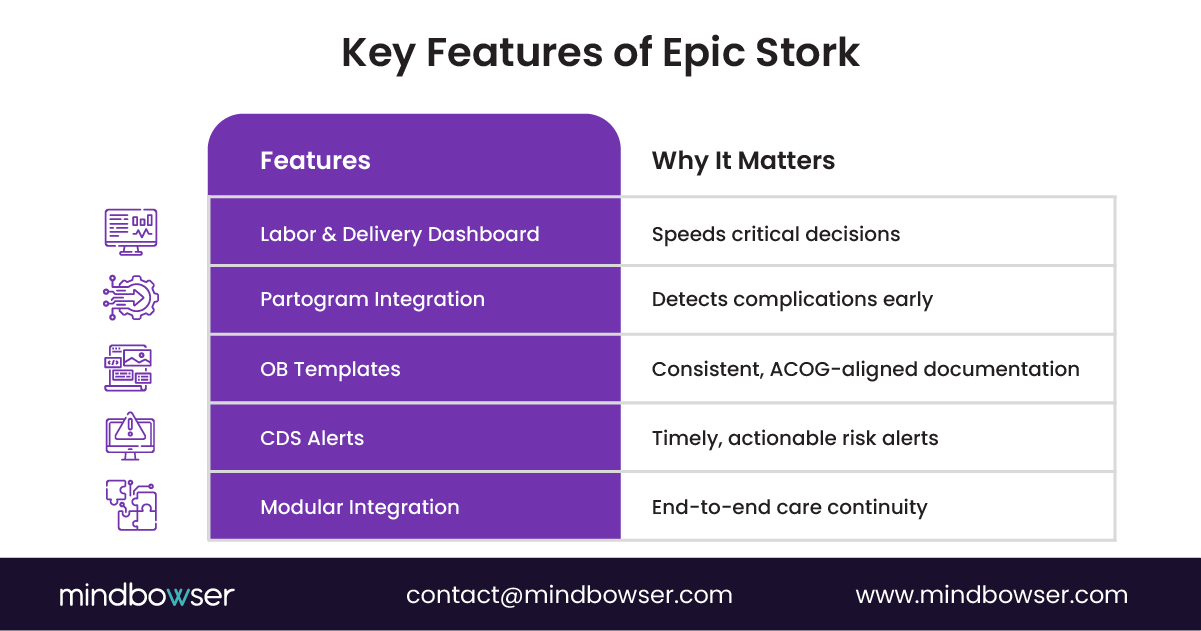
D. Clinical Decision Support (CDS)
What it is:
Built-in alerts that notify care teams of potential risks such as fetal distress, maternal hypertension, or overdue gestation. Alerts can be triggered based on real-time monitoring data or pre-set thresholds.
Why it matters:
Timely alerts help clinicians respond before conditions escalate, supporting better maternal and fetal outcomes. Hospitals can also align CDS settings with internal protocols for more targeted decision support.
Related Read: What Are CDS Hooks? A Simple Guide for Healthcare Providers
E. Modular Integration
What it is:
Epic Stork connects with other Epic modules, such as:
- Epic Anesthesia (Optime) for perioperative care
- NICU modules for newborn care coordination
- Epic Cupid (Cardiology) for cardiac monitoring during pregnancy
- MyChart for patient communication and education
Why it matters:
This integration ensures continuity of care across multiple specialties. For example, an expectant mother’s cardiology data can be viewed alongside her obstetric chart, reducing the risk of missed information during labor.
IV. Benefits for OB/GYN Providers
Epic Stork’s design goes beyond documentation; it’s built to help providers deliver safer, faster, and more coordinated care in one of the most high-pressure environments in healthcare. The real value emerges when its features translate into measurable improvements for both clinicians and patients.
A. Reduce Documentation Time During High-Pressure Events
In labor and delivery, time spent on documentation is time not spent directly with the patient. Epic Stork’s OB-specific templates, consolidated dashboards, and automated data capture from connected devices cut down on repetitive charting.
Example: A labor nurse can document cervical checks, fetal heart rate, and contraction patterns in a single view without toggling between modules. Throughout a shift, this can save hours—time that can be redirected to patient care.
B. Improve Patient Safety Through Timely Alerts
The module’s issues real-time alerts for conditions such as fetal distress, elevated maternal blood pressure, or prolonged labor stages. These alerts give the care team actionable information while there is still time to intervene.
Why it matters: Early intervention is often the deciding factor in avoiding adverse maternal or neonatal outcomes. By surfacing critical changes quickly, Epic Stork can help reduce complications.

C. Support Compliance With ACOG and Hospital Standards
Standardized templates and structured data capture help ensure that every delivery is documented consistently. This supports compliance with ACOG guidelines and hospital quality metrics while also simplifying chart reviews for audits, legal documentation, and peer review.
Impact: Hospitals can reduce variability in care documentation, making it easier to measure performance and improve outcomes across the board.
D. Streamline Handoffs Across Departments
From triage to delivery, through the operating room and into postpartum recovery, multiple teams touch the patient record. Epic Stork centralizes updates so the NICU (neonatal intensive care unit) team, anesthesia providers, and OB/GYN staff all see the same information in real time.
Benefit: This eliminates gaps in communication that can delay care or lead to duplication of work.
V. Real-World Use in Hospitals
Epic Stork is more than just a documentation tool; it is embedded in the daily operations of labor and delivery units. In practice, it enables multiple clinical teams to work from the same set of information, ensuring care is coordinated from the moment a patient arrives to the time she leaves the hospital.
A. How OB/GYN Teams Use Epic Stork
- Nurses in Labor and Delivery
L&D nurses use Stork to monitor vitals, track fetal heart rate, and document every step of labor progression. Because Stork consolidates data from connected devices and manual inputs, nurses can keep patient records updated in real time without juggling multiple systems. - OB/GYN Physicians
Physicians rely on Stork’s dashboards and partograms to assess labor progress, evaluate potential risks, and decide when interventions such as induction or C-section are needed. Alerts for abnormal readings ensure that critical changes are not overlooked. - Anesthesiology Teams
When a patient needs an epidural or surgical anesthesia, the anesthesiology team can access relevant maternal health data directly in Stork. This eliminates delays that can occur when moving between systems or requesting information verbally. - NICU Teams
For high-risk births or premature deliveries, the NICU (neonatal intensive care unit) team uses integrated Stork data to prepare for immediate newborn care. Data flows from the delivery record into the newborn’s chart, reducing duplication and ensuring continuity.
Related Read: Epic Modules for Mid-Sized Hospitals: Which Ones Matter Most?
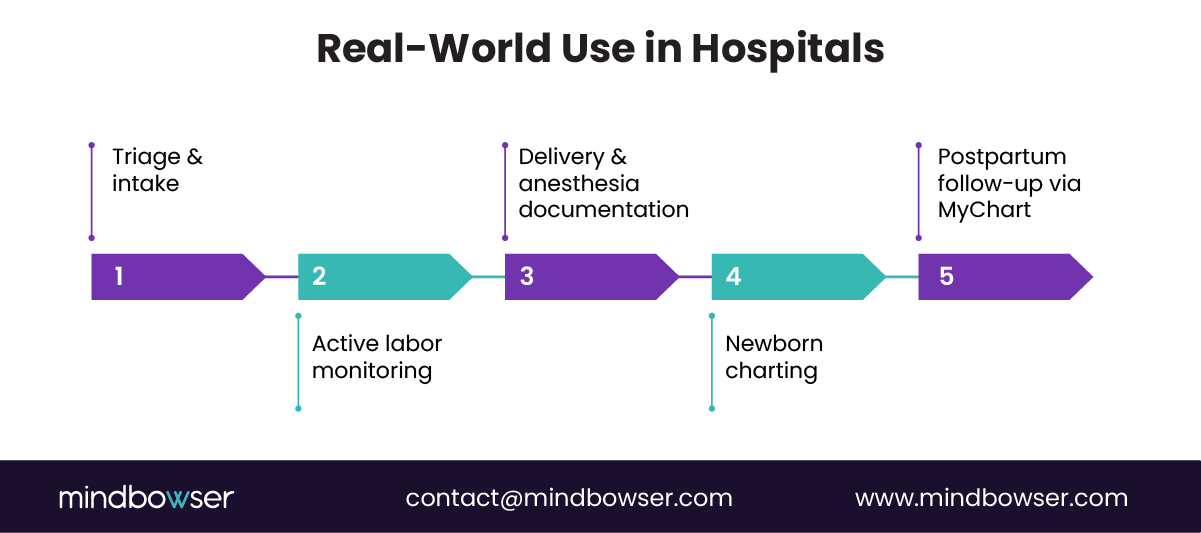
B. Example Scenario: From Triage to Postpartum
- Triage Admission
A patient arrives with early labor signs. The triage nurse logs vitals, maternal history, and fetal monitoring data into Stork. Alerts flag elevated blood pressure, prompting a preeclampsia evaluation. - Active Labor
OB physicians monitor the partogram to track labor progression. The system alerts them to slower-than-expected dilation, allowing timely decision-making on whether to augment labor. - Delivery
An anesthesiologist uses Stork data to review recent vitals before administering an epidural. All procedural notes are captured in the same patient record. - Postpartum Recovery
Post-delivery, the nurse documents newborn APGAR scores and maternal status in Stork. This information is visible to the NICU and postpartum units without any hand-entry duplication. - Patient Engagement
Through MyChart, the patient can review her birth plan, read discharge instructions, and schedule follow-up appointments—all linked to her Stork record.
C. Why This Matters
Hospitals that use Stork effectively see fewer delays in care transitions, reduced duplication in charting, and better communication between departments. These efficiencies can directly impact clinical outcomes, patient satisfaction, and compliance with quality standards.
VI. Challenges and Limitations
While Epic Stork delivers strong baseline capabilities for obstetric care, hospitals often encounter limitations when adapting it to their specific workflows, device setups, and patient engagement goals. Recognizing these challenges is the first step in identifying where custom development can deliver significant operational and clinical gains.
A. Training Requirements for OB/GYN Teams New to Epic
The challenge:
For hospitals transitioning to Epic or onboarding new OB/GYN staff, Stork’s interface can feel overwhelming. The module offers a large set of features, and without targeted training, users may only leverage a fraction of its potential.
The opportunity:
Hospitals can build custom onboarding modules, simulation environments, or role-specific dashboards that streamline the learning curve. Tailoring the user interface to show only the most relevant fields during early adoption can boost confidence and speed up proficiency.
B. Workflow Misalignment With Hospital Protocols
The challenge:
Out-of-the-box Stork workflows are based on standard labor and delivery practices, which may not fully match the policies, checklists, or patient flow unique to each facility. This can lead to extra clicks, redundant data entry, or inconsistent charting.
The opportunity:
Custom OB workflows, such as hospital-specific prenatal intake forms, triage protocols, or delivery checklists, can be embedded directly into Stork. This alignment reduces workarounds, improves compliance with internal standards, and makes documentation more efficient.
C. Limited Flexibility for AI, Wearables, or Third-Party Tools
The challenge:
Hospitals interested in advanced features such as predictive analytics for labor progression, or data capture from wireless fetal monitors, may find native integration options limited or complex to configure.
The opportunity:
By leveraging SMART on FHIR and APIs, hospitals can connect Stork to third-party apps, AI models, and wearable devices. With the right integration, real-time vitals from devices like blood pressure cuffs or fetal monitoring systems can flow directly into the patient’s Stork record.
D. Complex Device Syncing and Interface Setup
The challenge:
Integrating medical devices like fetal monitors or anesthesia systems with Stork requires both technical configuration and workflow coordination. Delays in setup can push back go-live timelines and frustrate clinical teams.
The opportunity:
Hospitals can use integration workflows such as ConnectHealth to reduce implementation time. Pre-built device connectors, testing frameworks, and validation scripts help ensure data flows reliably from day one.
E. The Bottom Line
Each of these limitations points to a customization pathway that can make Epic Stork more intuitive, more integrated, and more aligned with the realities of a busy labor and delivery unit. Addressing them improves staff satisfaction and directly influences patient safety and operational efficiency.
VII. How Mindbowser Extends Epic Stork
Mindbowser extends Epic Stork through ConnectHealth, our Epic integration layer, helping hospitals adapt maternal-care workflows to their clinical, operational, and compliance requirements. We support custom prenatal intake, triage, delivery, postpartum, and follow-up workflows; embedded SMART on FHIR applications; integration with fetal monitors, blood pressure devices, and other wearables; and compliance-first development aligned with HIPAA and SOC 2 requirements. These extensions reduce manual work, improve documentation and monitoring, and give care teams a more connected view of maternal and fetal health across the care journey. See the wider Epic integration picture or the other Epic modules.
VIII. Future of Epic Stork
The next phase of Epic Stork will be shaped by emerging technologies, evolving regulatory frameworks, and the increasing demand for personalized maternal care. Hospitals that plan for these changes now will be better positioned to deliver safer, more efficient labor and delivery experiences in the years ahead.
A. Predictive AI for Labor and Delivery
What’s coming:
AI models can analyze historical and real-time data to forecast labor progression, identify potential complications, and recommend proactive interventions. With more hospitals capturing detailed maternal and fetal data through Stork, predictive analytics will become a standard part of decision support.
Potential impact:
- Earlier identification of conditions like preeclampsia or prolonged labor
- Reduced emergency interventions
- More precise resource planning for delivery rooms and NICU staffing
B. Interactive Patient Tools in MyChart
What’s coming:
Patients will have more opportunities to engage directly with their care via MyChart-linked tools. This includes interactive birth plans, tailored pre-labor education modules, and secure two-way messaging with care teams.
Potential impact:
- Higher patient satisfaction through clearer communication
- Better adherence to pre-labor instructions
- More personalized postpartum care pathways
C. Expanded FHIR Integration
What’s coming:
FHIR-based APIs will enable faster, more flexible integration with OB-specific devices and third-party apps. This opens the door for connected wearables, home monitoring tools, and specialty software to feed data directly into Stork.
Potential impact:
- Real-time maternal and fetal vitals from remote or outpatient settings
- More seamless data exchange between inpatient and outpatient care teams
- Reduced manual entry errors and workflow delays
Related Read: Epic FHIR Integration: Making Interoperability Seamless for Healthcare Providers
D. Smarter Clinical Decision Support
What’s coming:
Hospitals will be able to tailor CDS alerts more precisely to their protocols, patient demographics, and risk thresholds. Instead of generic warnings, alerts will be contextual and actionable.
Potential impact:
- Fewer alert fatigue issues among providers
- Higher trust in decision support recommendations
- Faster response to condition-specific risks
E. Unified Cross-Department Dashboards
What’s coming:
A single, role-based dashboard that consolidates data from OB, anesthesia, NICU, and social work teams into one view will make it easier to coordinate care in complex cases.
Potential impact:
- More efficient multi-specialty collaboration
- Better preparation for high-risk deliveries
- Stronger continuity of care from admission to discharge
F. TEFCA Alignment for Maternal Data Exchange
What’s coming:
With the U.S. moving toward TEFCA (Trusted Exchange Framework and Common Agreement) for nationwide interoperability, Epic Stork will be part of Qualified Health Information Networks (QHINs). This will allow maternal records to move securely between institutions.
Potential impact:
- Improved continuity for patients who transfer between facilities during pregnancy
- Easier sharing of high-risk pregnancy data for second opinions or specialized care
- Enhanced public health tracking of maternal outcomes
Related Read: TEFCA in Healthcare: A Complete Guide
Conclusion
Epic Stork gives OB/GYN teams a powerful foundation for managing labor and delivery bringing together real-time data, structured documentation, and cross-department visibility. But for many hospitals, the real potential is unlocked when Stork is adapted to match their unique workflows, protocols, and patient engagement strategies.
Custom Epic EHR development allows hospitals to close functional gaps, integrate with advanced monitoring tools, and provide decision support that is tailored to their own standards of care. Whether it’s streamlining documentation, enabling predictive analytics, or improving postpartum follow-up, these enhancements can make a measurable difference in both clinical outcomes and operational efficiency.
Mindbowser partners with hospitals to deliver these capabilities. With expertise in SMART on FHIR, wearable device integration, and HIPAA-compliant development, we help health systems extend Epic Stork in ways that align with their goals and deliver real-world results.