








Blog featured image
Remote Patient Monitoring (RPM)

Remote Patient Monitoring Devices List 2026: Every Device Category, From Clinical-Grade to Consumer Wearable

CORTEX
Mindbowser AI

TL;DR

This is a categorized reference of every RPM device type available in 2026, organized by clinical category and connectivity type. Each entry covers what the device measures, how its data moves, whether it meets CMS 99454 billing requirements, and the company behind it. Mindbowser’s engineering team has integrated 23 different devices and wearables into RPM platforms across BLE, cellular, WiFi, and HealthKit protocols. This guide is compiled from that integration experience and verified by the review team.

Twenty-three different medical devices and consumer wearables have been integrated into Mindbowser RPM platform builds over the past three years, across BLE, cellular, WiFi, and HealthKit protocols. The device spec sheet rarely predicted which integrations would succeed in production.

Devices that performed cleanly in vendor demos often broke in production environments. Devices with less polished documentation sometimes had the most reliable data pipelines. The single biggest predictor of integration success had nothing to do with the device itself: it was whether the data reached the care team in a format they could act on between patients.

This guide covers every major RPM device category in 2026. It is structured differently from the vendor lists available elsewhere. Each device entry includes the company behind it (funding, scale, trajectory), the connectivity method, CMS billing eligibility, and integration notes from production builds.

How to Read This Device Guide

RPM devices are organized along two axes.

Clinical category: what the device monitors (blood pressure, glucose, oxygen saturation, cardiac rhythm, weight, activity, respiratory function).

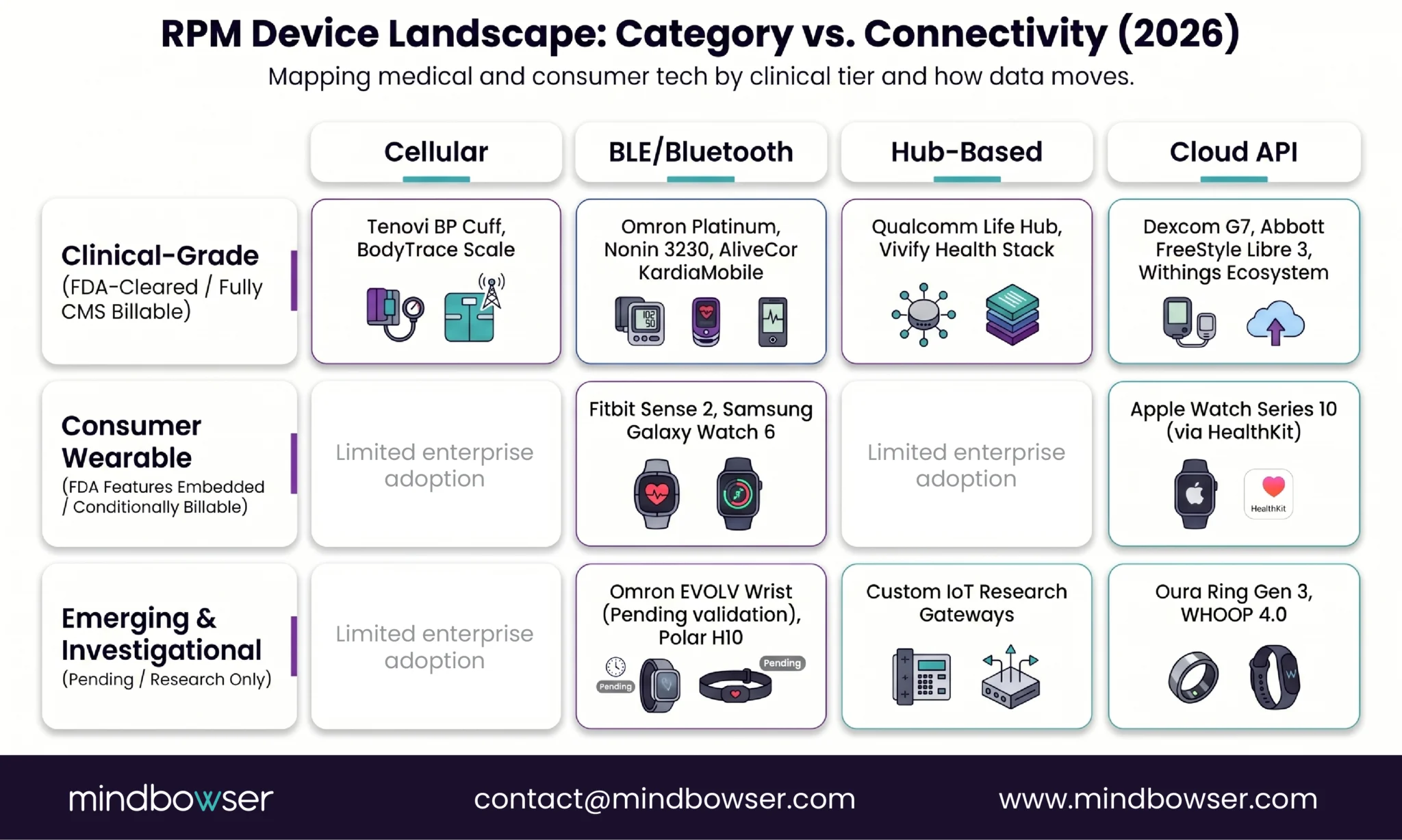
Device tier:

  • Clinical-grade: FDA-cleared or validated medical device. CMS 99454 eligible. Designed for clinical monitoring programs
  • Consumer wearable: FDA-cleared features embedded in a consumer product (Apple Watch ECG, Fitbit irregular rhythm). Partially CMS billable depending on data flow configuration
  • Emerging/investigational: Not yet cleared for RPM billing. Clinically interesting but not production-ready for reimbursed programs

Connectivity:

  • Cellular: data transmits over cellular network. No patient phone required
  • BLE (Bluetooth Low Energy): connects to patient’s phone, data syncs through an app
  • Hub-based: BLE devices connect to a home gateway that relays data over WiFi or cellular
  • Cloud API: data already in manufacturer’s cloud, pulled by RPM platform through API

Every device entry below tells you: what it measures, how the data moves, whether CMS pays for it, and what we know about integrating it.

Visual Brief #1: 2×4 matrix diagram. Rows: Clinical-grade, Consumer, Emerging. Columns: Cellular, BLE, Hub, Cloud API. Each cell contains 2-3 example device names. Title: “RPM Device Map: Category x Connectivity.” File name: rpm-device-landscape-matrix.png. Alt text: “Matrix showing remote patient monitoring devices organized by clinical tier and connectivity type, with example devices in each cell.” Sizes: 1200×800 blog, 1080×1080 social.

Blood Pressure Monitors

Hypertension is the #1 RPM use case by patient volume (119.9 million Americans, 47.7% of adults). The BP cuff is the most commonly deployed RPM device. For detailed clinical protocols and billing, see the remote blood pressure monitoring guide.

DeviceTypeConnectivityReadingsFDACMS 99454Est. Cost
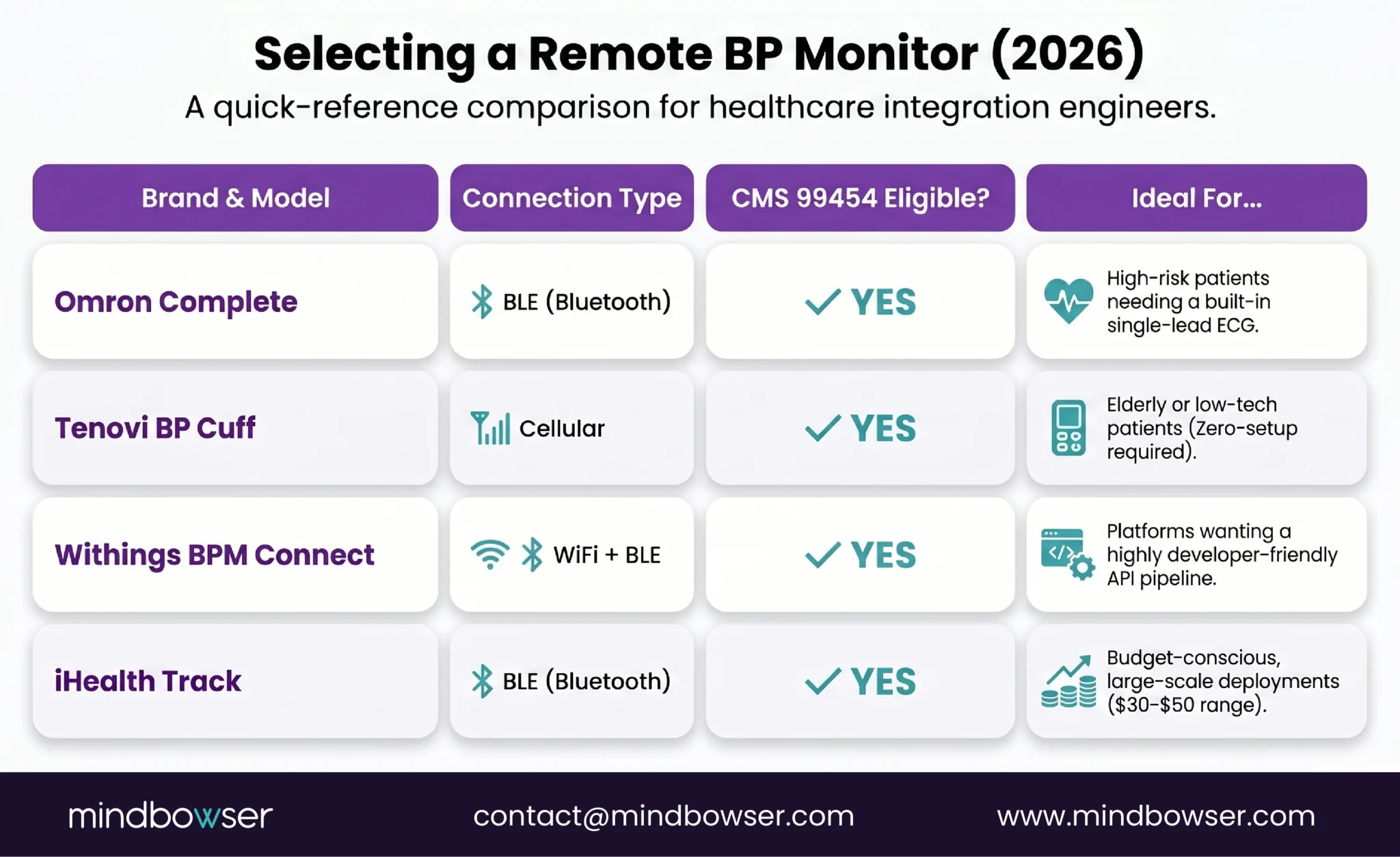
Omron Complete (BP + ECG)ClinicalBLEOn-demandClearedYes$100-130
Omron PlatinumClinicalBLEOn-demandClearedYes$60-80
Tenovi BP CuffClinicalCellularOn-demandClearedYes$80-120
BodyTrace BPClinicalCellularOn-demandClearedYes$90-130
Withings BPM ConnectClinicalBLE + WiFiOn-demandClearedYes$100-130
iHealth TrackClinicalBLEOn-demandClearedYes$30-50
Omron EVOLV (wrist)EmergingBLEOn-demandClearedPending validation$130-170
Samsung Galaxy Watch BPConsumerBLEOn-demandSelect markets onlyNo (US)$250-400

Company Intelligence

Omron Healthcare | Subsidiary of Omron Corporation (TYO: 6645)

HQ: Hoffman Estates, IL, USA (parent: Kyoto, Japan). Employees: ~268 (US healthcare division). Parent Omron Corp revenue: $6.5B+. The dominant brand in home blood pressure monitoring globally. EVOLV wrist-worn model with AI-powered AFib detection announced 2025. Partners: Amazon, major pharmacy chains. The default choice when a program needs maximum brand recognition and patient trust.

Tenovi | Private, Series A

HQ: Portsmouth, NH. Founded: 2020. Employees: ~34. Funding: $4.3M (Series A, 2024). Revenue: $1M-10M range. Inc. 5000 rank #55 (2025, fastest-growing companies in America). Seven FDA-cleared cellular-connected RPM devices. Integrated with 100+ RPM firms. The cellular-first company: every Tenovi device transmits without a patient smartphone. Best fit for programs targeting elderly or low-tech populations.

Withings | Private

HQ: Issy-les-Moulineaux, France (US office: Boston, MA). Founded: 2008. Employees: ~350. Funding: $93.8M across 3 rounds. Revenue: ~$100M. CEO: Cédric Hutchings. Strong API for developers. BPM Connect is one of the most developer-friendly BP devices in Mindbowser’s integration portfolio. Also makes connected scales (Body+, Body Cardio) and sleep tracking devices.

Visual Brief #2: Styled BP device comparison table with Omron, Tenovi, Withings, iHealth logos. Title: “Blood Pressure Monitors for RPM: 2026 Comparison.” File name: rpm-bp-device-comparison-2026.png. Alt text: “Comparison table of eight blood pressure monitors for remote patient monitoring including Omron, Tenovi, BodyTrace, and Withings with connectivity, FDA status, and cost.” Sizes: 1200×700 blog.

Continuous Glucose Monitors (CGMs)

Diabetes is the #2 RPM condition by revenue opportunity. CGMs generate continuous data (up to 288 readings/day on Dexcom G7). For integration architecture and clinical outcomes, see the diabetes remote patient monitoring guide.

DeviceTypeConnectivityReadingsSensor WearFDACMS 99454Est. Cost/Mo
Dexcom G7ClinicalBLE to phone → Cloud APIEvery 5 min (288/day)10 daysClearedYes$75-100
Abbott FreeStyle Libre 3ClinicalBLE to phone → CloudEvery 1 min14 daysClearedYes$65-85
Medtronic Guardian 4ClinicalBLE to pump/phoneEvery 5 min7 daysClearedYes$80-120
Dexcom SteloConsumer (OTC)BLE to phone → Cloud APIEvery 5 min15 daysCleared (OTC)Yes$49-99

Company Intelligence

Dexcom | NASDAQ: DXCM

HQ: San Diego, CA. Founded: 1999. Employees: ~8,300. Market cap: ~$25B (March 2026). Revenue guidance 2026: $5.16-5.25B. The CGM market leader with the most developer-friendly API (OAuth 2.0, near-real-time EGV data). Stelo OTC launch in 2024 opened CGM to non-insulin Type 2 patients without a prescription. Best API for RPM integration based on five platform builds by the Mindbowser engineering team.

Abbott | NYSE: ABT (Libre is a division)

HQ: Abbott Park, IL. Abbott total employees: ~115,000. Abbott revenue: ~$40B. FreeStyle Libre is the world’s most-used CGM by sensor volume. Libre 3 has the thinnest sensor and highest sampling rate (1-min readings). LibreView platform provides data access but the API path is less developer-friendly than Dexcom’s. Lowest per-sensor cost, making it attractive for large-scale programs.

Medtronic | NYSE: MDT

HQ: Dublin, Ireland (operational HQ: Minneapolis, MN). Employees: ~95,000. Revenue: ~$33B. Guardian 4 is tightly integrated with Medtronic’s MiniMed 780G insulin pump system. For patients on closed-loop insulin delivery, Guardian data flows through CareLink. Integration is more siloed than Dexcom or Abbott.

Visual Brief #3: CGM device comparison table with company logos and sensor images. Title: “Continuous Glucose Monitors for RPM: 2026.” File name: rpm-cgm-device-comparison-2026.png. Alt text: “Comparison of four continuous glucose monitors for diabetes remote patient monitoring including Dexcom G7, Abbott Libre 3, Medtronic Guardian 4, and Dexcom Stelo with reading frequency, sensor wear, and monthly cost.” Sizes: 1200×600 blog.

Pulse Oximeters and Respiratory Monitors

COPD is the #2 chronic RPM use case by patient volume. SpO2 is the single most predictive remote biomarker for COPD exacerbation prediction. For clinical thresholds and care team workflows, see the COPD remote patient monitoring guide.

DeviceTypeConnectivityMonitoring ModeFDACMS 99454Est. Cost
Masimo MightySatClinicalBLESpot-check + continuousClearedYes$300-400
Nonin 3230 (finger)ClinicalBLESpot-checkClearedYes$200-300
Wellue O2RingClinicalBLEOvernight continuousClearedYes$100-160
Strados RESP BiosensorClinicalBLEContinuous lung soundsClearedYes~$500 (clinical)
Vitalograph Lung MonitorClinicalBLESpirometryClearedYes$200-400
NuvoAir Air NextClinicalBLESpirometryClearedYes$50-80
Propeller Health (inhaler sensor)ClinicalBLEMedication adherenceClearedYes$30-80

Company Intelligence

Masimo | NASDAQ: MASI

HQ: Irvine, CA. Founded: 1989. Employees: ~2,200. Market cap: ~$9.6B (March 2026). Revenue: $2.18B (trailing 12 months, Sep 2025). The gold standard in clinical pulse oximetry. MightySat is the consumer/RPM version of their hospital-grade technology. Highest accuracy of any portable pulse oximeter. Premium price reflects clinical validation depth.

Strados Labs | Private, Pre-Series A

HQ: Philadelphia, PA. Founded: 2016. Funding: ~$11.2M (including NSF grant). Estimated valuation: ~$18.3M. The RESP Biosensor is FDA-cleared for continuous lung sound monitoring (cough frequency, wheeze detection). This is genuinely new technology: continuous auscultation from a wearable was science fiction five years ago. Best fit for COPD and asthma programs that need respiratory-specific data beyond SpO2.

Nonin Medical | Private

HQ: Plymouth, MN. Founded: 1986. The original finger pulse oximeter inventor. Nonin 3230 is the most widely deployed BLE pulse oximeter in RPM programs. Reliable, established, well-understood integration path.

Visual Brief #4: Respiratory device comparison table. Title: “Pulse Oximeters and Respiratory Monitors for RPM: 2026.” File name: rpm-respiratory-device-comparison-2026.png. Alt text: “Comparison table of seven pulse oximeters, spirometers, lung sound monitors, and inhaler sensors for respiratory remote patient monitoring.” Sizes: 1200×700 blog.

Cardiac Monitoring Devices

Heart failure is the #1 RPM condition by clinical evidence and payer support (even UHC still covers it). Cardiac devices range from single-lead ECG to multi-parameter monitoring patches.

DeviceTypeConnectivityWhat It MonitorsWear DurationFDACMS 99454Est. Cost
Zio Patch (iRhythm)ClinicalStore + uploadContinuous ECG14 daysClearedYes (diagnostic)Service-based
BioTelemetry MCOTClinicalCellularContinuous ECG30 daysClearedYesService-based
AliveCor KardiaMobileClinicalBLESingle-lead ECGOn-demandClearedYes$79-150
Apple Watch ECGConsumerBLE to phoneSingle-lead ECGOn-demandCleared (ECG, AFib)Conditional$400-800
Hexoskin MedicalClinicalBLEECG + respiratory + activityContinuous (shirt)ClearedYes$400-600
Polar H10 (chest strap)ConsumerBLE + ANT+Heart rateContinuous during wearNot cleared (medical)No$80-100
Withings Body CardioClinicalWiFi + BLEWeight + PWVDailyClearedYes$150-180

Company Intelligence

iRhythm Technologies | NASDAQ: IRTC

HQ: San Francisco, CA. Founded: 2006. Employees: ~1,800. Revenue: $747M (trailing 12 months, Dec 2025). Funding raised: $468M (pre-IPO). The Zio patch is the dominant extended cardiac monitoring device in the US. Over 4 million patients monitored. Service-based pricing model (analysis included with device).

AliveCor | Private

HQ: Mountain View, CA. Founded: 2010. Employees: ~200. Funding: $318M from 12 investors including GE HealthCare, Mayo Clinic, Pegasus Tech Ventures. KardiaMobile is the most widely used personal ECG device. Six-lead capability in the latest model. FDA-cleared for AFib detection. The device most likely to already be in your patient’s pocket.

Withings (see BP section for full company profile)

Body Cardio is unique: a connected scale that also measures pulse wave velocity (PWV), a cardiovascular health indicator. Doubles as a weight monitor and cardiac risk assessment tool.

Visual Brief #5: Cardiac device comparison table with ECG trace graphics. Title: “Cardiac Monitoring Devices for RPM: 2026.” File name: rpm-cardiac-device-comparison-2026.png. Alt text: “Comparison table of seven cardiac monitoring devices for remote patient monitoring including Zio Patch, AliveCor KardiaMobile, Apple Watch ECG, and Hexoskin with monitoring type, wear duration, and FDA status.” Sizes: 1200×700 blog.

Weight Scales and Body Composition

Connected scales are critical for CHF monitoring (daily weight tracks fluid retention), metabolic monitoring (GLP-1 patients), and multi-condition RPM programs.

DeviceTypeConnectivityWhat It MeasuresFDACMS 99454Est. Cost
Withings Body+ClinicalWiFi + BLEWeight, BMI, body compositionClearedYes$70-100
Withings Body CardioClinicalWiFi + BLEWeight, BMI, PWVClearedYes$150-180
Garmin Index S2ConsumerWiFi + ANT+Weight, BMI, body water, bone massNot cleared (medical)Conditional$150
BodyTrace ScaleClinicalCellularWeightClearedYes$80-120

BodyTrace is the cellular-first choice. Like Tenovi’s BP cuff, the BodyTrace scale transmits without a patient phone. For CHF programs targeting elderly patients, cellular scales eliminate the smartphone dependency.

Withings API is one of the most developer-friendly in the RPM device market. If your program already uses Withings BPM Connect for blood pressure, adding the Body+ or Body Cardio creates a two-device setup with a single integration point.

Visual Brief #6: Scale comparison table. Title: “Connected Weight Scales for RPM: 2026.” File name: rpm-weight-scale-comparison-2026.png. Alt text: “Comparison of four connected weight scales for remote patient monitoring including Withings Body+, Body Cardio, Garmin Index S2, and BodyTrace with connectivity, measurements, and cost.” Sizes: 1200×500 blog.

Consumer Wearables with Clinical Applications

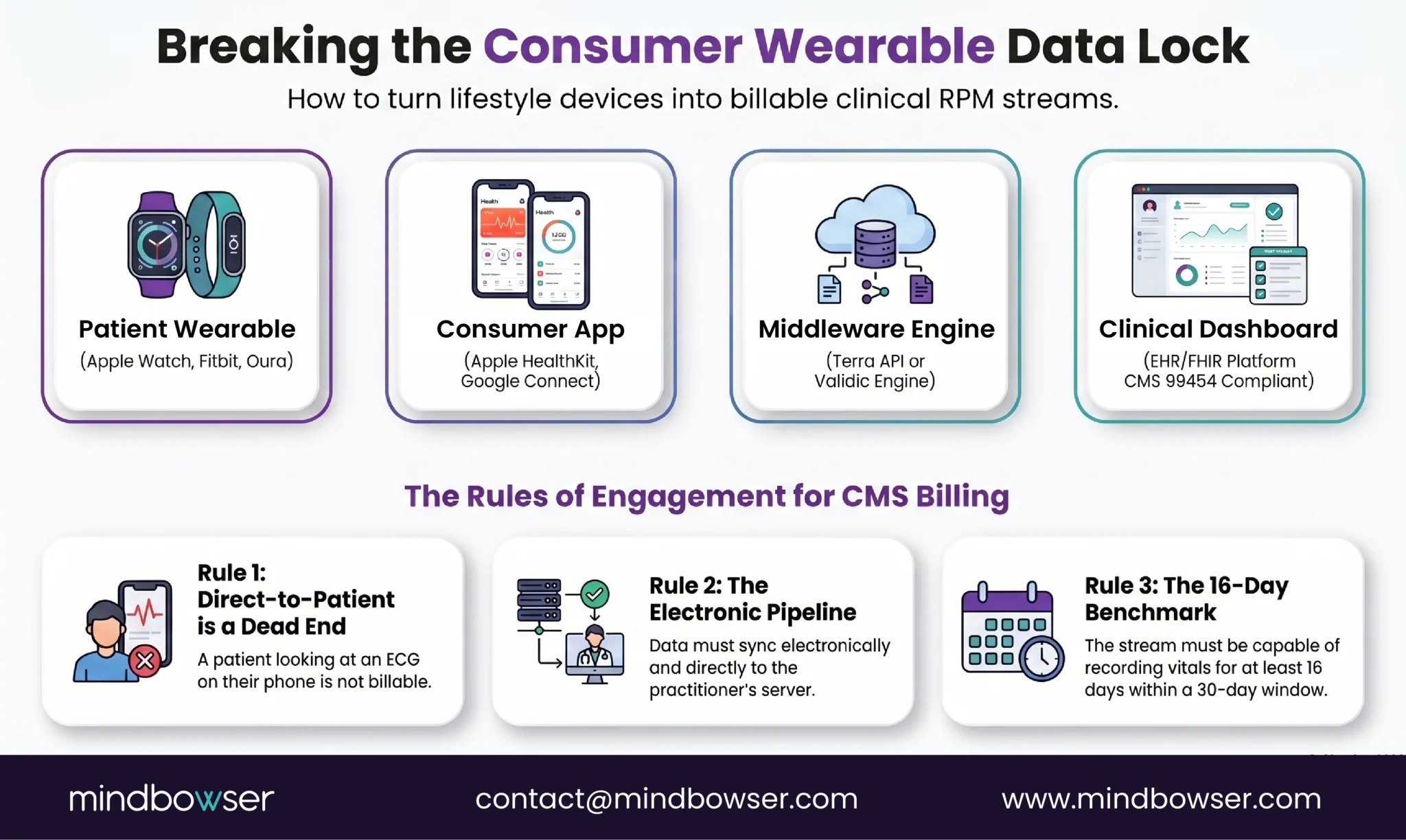
Consumer wearables sit in a middle zone: clinically useful data generated by consumer devices, accessible through consumer app platforms. The question for RPM programs is whether the data can flow from the consumer platform into a clinical monitoring platform in a billable, actionable format.
DeviceFDA-Cleared FeaturesKey Health MetricsData AccessRPM ApplicabilityEst. Cost
Apple Watch Series 10ECG, AFib, SpO2, fall detectionHR, HRV, SpO2, ECG, sleep, activity, temperatureApple HealthKit APIHigh (via HealthKit)$400-800
Fitbit Sense 2 / Charge 6ECG (Sense), irregular rhythmHR, HRV, SpO2, sleep, stress, activityGoogle Health ConnectMedium$150-350
Oura Ring Gen 3None (wellness device)HRV, sleep stages, body temp, activity, SpO2Oura API / HealthKitMedium (research/wellness)$300-350 + $6/mo
Garmin Venu 3None (wellness device)HR, HRV, SpO2, sleep, body battery, activityGarmin Connect APIMedium$350-450
WHOOP 4.0None (wellness device)HR, HRV, respiratory rate, sleep, strainWHOOP APILow-Medium (no display)$30/mo subscription
Samsung Galaxy Watch 6ECG, AFib (US)HR, HRV, ECG, SpO2, sleep, body compositionSamsung Health / Health ConnectMedium$280-430

Company Intelligence

Apple | NASDAQ: AAPL

Market cap: ~$3T. Apple Watch has the largest installed base of any smartwatch. FDA-cleared ECG and AFib detection since Series 4. SpO2 monitoring, fall detection, crash detection. Apple HealthKit is the most important middleware layer in consumer health data: it aggregates data from Apple Watch, CGMs, BP cuffs, scales, and third-party apps into a single pull point. For RPM platforms, HealthKit integration is often the fastest path to multi-device data access.

Oura | Private

HQ: Oulu, Finland (US office: San Francisco). Founded: 2013. Funding: ~$200M+. Employees: ~600. The Oura Ring is the only mainstream health wearable in ring form factor. Exceptional sleep and HRV tracking. No FDA clearance for clinical monitoring, but widely used in clinical research (including COVID-19 early detection studies at UCSF). We integrated Oura data alongside Dexcom and Withings in the Hearty platform build.

The honest take on consumer wearables for RPM: clinically useful data locked behind consumer app platforms. Apple HealthKit and Google Health Connect are the bridges. Aggregation APIs like Terra and Validic normalize the data across wearables into a format RPM platforms can ingest. But CMS billing eligibility depends on whether the data flows to the practitioner’s monitoring system, not just the patient’s phone. A patient wearing an Apple Watch that only syncs to their iPhone is not generating billable RPM data. That same Apple Watch syncing through HealthKit to your RPM platform is.

Visual Brief #7: Consumer wearable comparison matrix with device photos. Title: “Consumer Wearables for RPM: Clinical Features and Data Access.” File name: rpm-consumer-wearable-comparison-2026.png. Alt text: “Comparison matrix of six consumer wearables for remote patient monitoring including Apple Watch, Fitbit, Oura Ring, Garmin, WHOOP, and Samsung Galaxy Watch with FDA-cleared features, health metrics, and data access methods.” Sizes: 1200×800 blog, 1080×1350 social carousel.

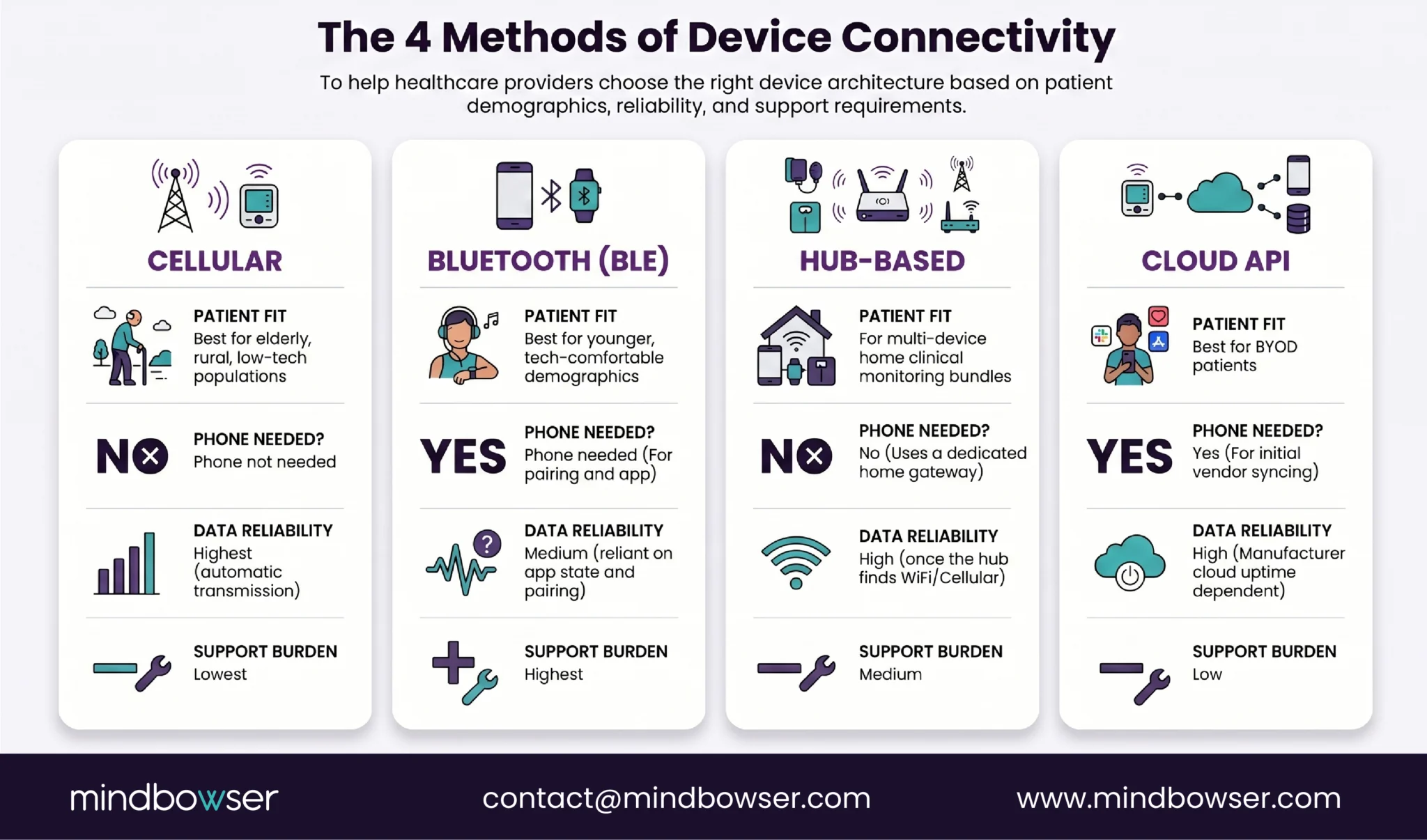
Cellular vs Bluetooth vs Hub vs Cloud API: How Device Data Moves

The connectivity decision drives everything downstream: patient compliance, data reliability, support burden, and integration architecture.

FactorCellularBLE (Bluetooth)Hub-BasedCloud API
Patient phone required?NoYesNo (hub needs WiFi)Yes (for initial device sync)
Best populationElderly, rural, low-techYounger, tech-comfortableMulti-device householdsAlready using CGM/wearable
Data reliabilityHigh (automatic)Medium (pairing dependent)High (once configured)High (manufacturer uptime)
Device costHigher ($80-150)Lower ($30-80)Medium + hub costN/A (patient owns device)
Integration complexityLow (direct to platform)Medium (app + API)Medium (hub management)Low (API pull)
Support burdenLowHighest (pairing issues)Medium (WiFi setup)Low
Example devicesTenovi BP, BodyTrace scaleOmron, Nonin, AliveCorQualcomm Life hub, VivifyDexcom, Withings, Apple HealthKit

The pattern from Mindbowser’s builds: cellular wins for programs targeting the 60+ population. BLE wins for digital health apps targeting younger users. Cloud API wins when patients already own the device (CGM patients on Dexcom, consumers with Apple Watch). Hub-based is declining as cellular costs drop and phone penetration increases, but still relevant for multi-device home monitoring setups.

Start a Conversation about which connectivity approach fits your patient population and program design.

Visual Brief #8: Connectivity comparison table (above) styled with icons for each type. Title: “How RPM Device Data Moves: Connectivity Comparison.” File name: rpm-device-connectivity-comparison.png. Alt text: “Table comparing cellular, Bluetooth, hub-based, and cloud API connectivity for remote patient monitoring devices across six factors including patient phone requirement, population fit, and support burden.” Sizes: 1200×600 blog, 1080×1080 social.

Device Aggregation APIs: Terra, Validic, and Native Integration
Supporting 10 or more devices means 10 or more integration points. Each device speaks a different protocol, uses different data formats, sends readings at different intervals. Aggregation APIs solve this by normalizing device data into a single pipeline.

Terra API | Private (Y Combinator W21)

HQ: London, UK. Founded: 2021. Employees: ~25. Funding: $3.3M. Investors: Y Combinator, General Catalyst, Samsung NEXT. FHIR-native data format. Supports Apple HealthKit, Google Health Connect, Garmin, Fitbit, Oura, WHOOP, Samsung, Polar, and more. Mobile SDK (Swift, React Native, Flutter) for HealthKit integration. Webhook-based data delivery. Best fit for startups and digital health companies building multi-wearable platforms.

Validic | Private

HQ: Durham, NC. Founded: 2010. Employees: ~70-130. Funding: $31.6M across 8 rounds. Supports 600+ connected devices. Dual product: wearable data API for digital health companies + EHR-integrated RPM for health systems. Epic integration. AI-powered clinical insights layer. Showcased at HLTH 2025. Best fit for health systems that need enterprise-grade device aggregation with EHR integration.

Apple HealthKit / Google Health Connect (native)

Free. No API cost. HealthKit aggregates data from Apple Watch, CGMs, BP cuffs, scales, and 300+ third-party health apps. Google Health Connect does the same for Android. The limitation: data only accessible through mobile SDK, not server-side API pull. For RPM platforms with a patient-facing mobile app, HealthKit is the fastest path to multi-device data. For server-side platforms without a mobile app, you need Terra or Validic as middleware.

When to use aggregation vs native integration:

  • Consumer wearables (Apple Watch, Fitbit, Oura): aggregation. The vendor surface is too broad for native integration with each vendor
  • Clinical-grade medical devices (Tenovi, Nonin, Omron cellular): often better native. The data flow is simpler and you want direct control
  • CGMs (Dexcom, Abbott): native API integration is well-documented and worth the direct connection. Aggregation adds unnecessary latency for real-time glucose data

WearConnect is Mindbowser’s pre-built normalization layer that handles both aggregated and native device data. It standardizes the time-series data from devices with different sampling rates, aligns timestamps across timezones, and delivers a unified patient data view to the care team dashboard.

Cross-link: we’re publishing a dedicated Terra vs Validic deep dive later this year covering architecture trade-offs in detail.

Visual Brief #9: Architecture diagram showing three paths: Direct device integration (left), Aggregation API layer in the middle (Terra/Validic), and RPM platform + EHR on the right. Arrows show data flow. Title: “Device Data to RPM Platform: Direct vs Aggregated.” File name: rpm-device-aggregation-architecture.png. Alt text: “Architecture diagram showing how RPM devices connect to monitoring platforms through direct integration or aggregation APIs like Terra and Validic, with data flowing to care team dashboards and EHR systems.” Sizes: 1200×600 blog, 1080×1080 social.

Which Devices Map to Which Conditions?

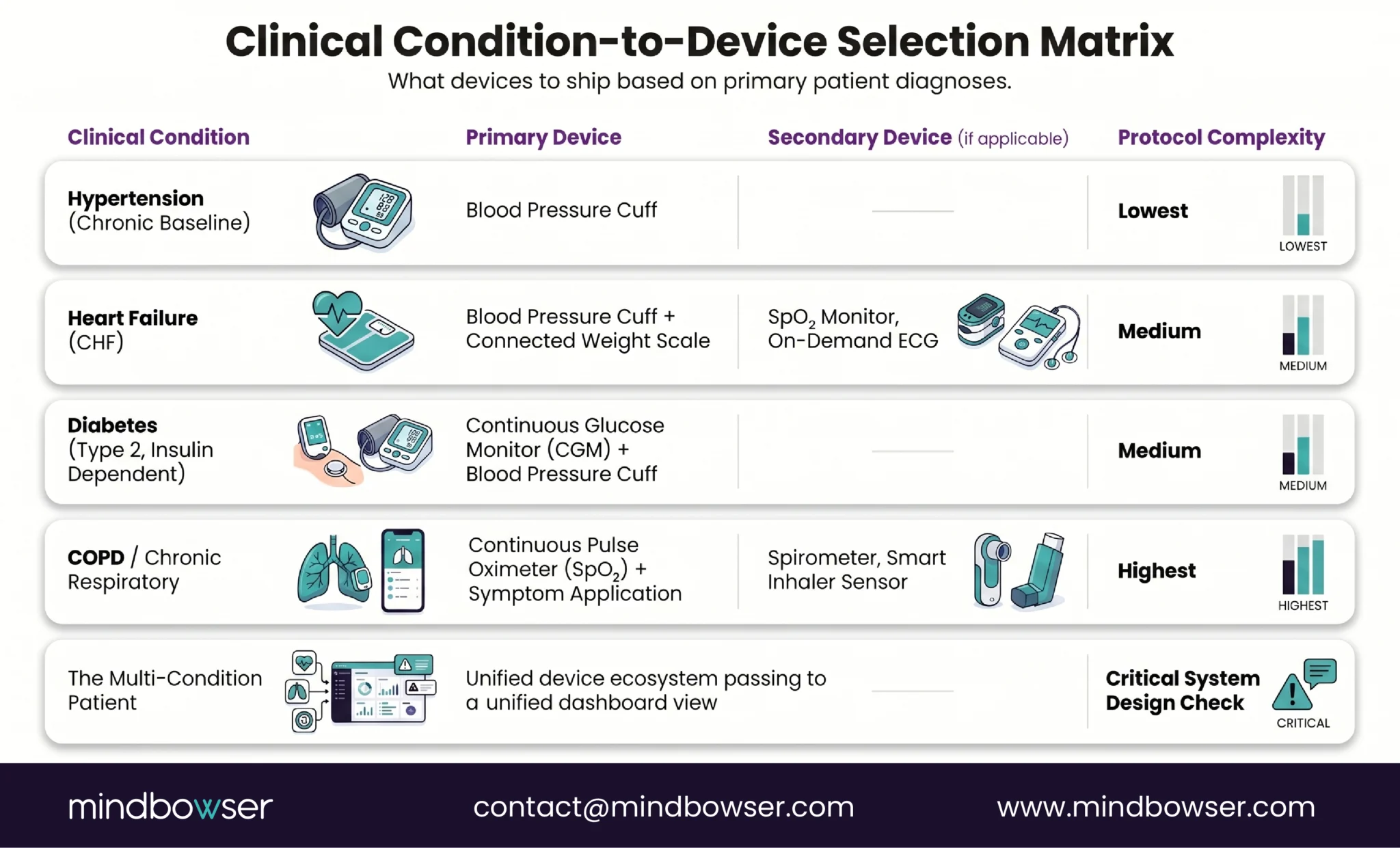
The most common question from programs launching RPM: which devices do I need for which patients?

ConditionPrimary DevicesSecondary DevicesProtocol Complexity
Heart failure (CHF)BP cuff + weight scaleSpO2 monitor, ECG patchLow-Medium
Hypertension (chronic)BP cuffNone requiredLowest
Hypertension (pregnancy)BP cuff + weight scaleSpO2 (high-risk)Low
Diabetes (Type 2, insulin)CGM + BP cuffWeight scale (GLP-1 patients)Medium
Diabetes (Type 2, non-insulin)Blood glucose meter or OTC CGM + BP cuffWeight scaleLow-Medium
Gestational diabetesCGM + BP cuffWeight scaleMedium
COPDPulse oximeter (continuous) + symptom appSpirometer, activity tracker, respiratory rateHigh
Cardiac arrhythmiaECG patch or AliveCorBP cuffMedium
Post-surgical recoveryThermometer + SpO2 + BP cuffActivity trackerMedium
Multi-condition (common)Unified stack across 2-3 conditionsPer patient clinical judgmentHighest

The multi-condition row is the one most programs underestimate. A Type 2 diabetes patient with hypertension and early-stage CKD needs glucose data, blood pressure data, and weight data flowing into one clinical view. That’s three device types, three data streams, three sets of alert thresholds, and one care manager who needs to see it all on a single dashboard. This is where custom platform architecture earns its keep.

Request an Assessment to map your patient population to the right device stack.

Visual Brief #10: Condition-to-device mapping matrix. Conditions as rows, device types as columns, checkmarks in cells. Color-coded by protocol complexity. Title: “RPM Device Selection by Condition.” File name: rpm-device-condition-mapping-matrix.png. Alt text: “Matrix mapping ten clinical conditions to their required and optional remote patient monitoring devices, color-coded by protocol complexity from lowest to highest.” Sizes: 1200×700 blog, 1080×1350 social.

What Makes a Device CMS 99454 Eligible?

CMS does not publish a list of approved RPM devices. Instead, the requirement is functional: the device must collect and transmit health data digitally to the billing practitioner’s monitoring system.

Three criteria matter:

1. Digital data transmission. The device must transmit data electronically (not manually recorded and entered). Cellular, BLE-to-app, and cloud API all qualify. A patient writing down their blood pressure reading and faxing it does not.

2. Daily recording capability. For standard RPM code 99454, the device must be capable of recording data at least once daily for 16 or more days in a 30-day period. CGMs, continuous pulse oximeters, and connected BP cuffs all meet this threshold. The 2026 short-duration code 99445 drops this to 2-15 days.

3. Data reaches the practitioner. This is where consumer wearables get complicated. An Apple Watch that syncs glucose data only to the patient’s iPhone does not meet the requirement. That same data flowing from HealthKit through an RPM platform to the care team’s monitoring dashboard does. The data flow to the practitioner is what makes it billable, not the device itself.

FDA clearance is not required for CMS RPM billing. But clinical-grade, validated devices are the standard of care and reduce liability risk. Programs using consumer wearables for RPM billing should document the data flow architecture clearly.

The Device Is Commodity. The Integration Is the Product.

Every device on this list will get cheaper, smaller, more accurate, and longer-lasting. That trajectory has been consistent for a decade and it will continue.

The question for anyone building or running an RPM program has never been “which device should I pick?” The question is: once the reading leaves the device, what happens to it? Does it reach the care team in time to change a clinical decision? Does it land in the EHR where the physician sees it during the visit? Does it generate a billable event under the right CPT code?

Mindbowser’s engineering team has built RPM platforms integrating devices from 6 of the companies listed above (Dexcom, Apple HealthKit, Oura, Withings, Fitbit, Garmin through the Hearty build; BLE medical devices through Endoluxe; wearable + EHR integration through Beek Health; AWS IoT + BLE + Fitbit/Garmin through Mango Mirror; BLE wearables through TodayHealth; AI + multi-device vitals through Health Monitoring Platform). The device was never the hard part.

For organizations evaluating devices for an RPM program and looking for integration validation from real production deployments, Mindbowser has built with most of the devices listed in this guide.

Start a Conversation about RPM device selection and integration for your program.

What are the most common remote patient monitoring devices?

The five most commonly deployed RPM devices are blood pressure cuffs (hypertension monitoring), connected weight scales (heart failure fluid retention), pulse oximeters (COPD and respiratory monitoring), continuous glucose monitors (diabetes management), and ECG monitors (cardiac arrhythmia detection). Blood pressure cuffs are the most widely deployed because hypertension is the largest RPM condition by patient volume (119.9 million Americans).

Do RPM devices need to be FDA-cleared?

CMS does not require FDA clearance for RPM billing. The requirement is functional: the device must digitally collect and transmit health data to the billing practitioner’s monitoring system. However, clinical-grade FDA-cleared devices are standard of care, reduce liability risk, and are preferred by most health systems. Consumer devices (Apple Watch, Fitbit) can generate billable RPM data if the data flow to the practitioner’s system is properly configured.

What is the difference between cellular and Bluetooth RPM devices?

Cellular devices (Tenovi, BodyTrace) transmit data directly over the cellular network without requiring a patient smartphone, app installation, or Bluetooth pairing. Higher per-unit cost ($80-150) but highest compliance rates, especially for elderly populations. Bluetooth (BLE) devices connect to the patient’s smartphone, which syncs data through an app. Lower cost ($30-80) but subject to pairing failures, app crashes, and phone compatibility issues, the most common support requests in RPM programs.

Which RPM devices does Medicare cover?

Medicare covers RPM through CPT codes 99453-99458 and the 2026 short-duration code 99445. Any device that digitally transmits health data to the practitioner’s monitoring system qualifies, including blood pressure cuffs, glucose monitors, CGMs, pulse oximeters, weight scales, ECG devices, and spirometers. The billing eligibility is tied to the data transmission method, not the specific device brand. Consumer wearables qualify if data flows through a configured RPM platform to the care team.

What devices are used to monitor COPD remotely?

COPD RPM programs use continuous pulse oximeters (SpO2 trending, the most predictive biomarker), home spirometers (FEV1/FVC tracking), respiratory rate monitors (wearable chest patches), activity trackers (6-minute walk test proxy), smart inhalers (medication adherence), and emerging devices like the Strados RESP Biosensor (continuous lung sound monitoring). Most programs start with a pulse oximeter and symptom questionnaire, adding spirometry and activity tracking as the program matures.

Can consumer wearables like Apple Watch be used for RPM?

Yes, with configuration. Apple Watch generates clinically useful data (ECG, AFib detection, SpO2, heart rate, HRV, fall detection) and several features are FDA-cleared. For CMS RPM billing, the data must flow from the device through Apple HealthKit to your RPM monitoring platform and into the care team’s dashboard, not just to the patient’s iPhone. Aggregation APIs like Terra or Validic can bridge this gap. The same principle applies to Fitbit, Samsung Galaxy Watch, and other consumer wearables.

How do RPM devices connect to the EHR?

RPM device data reaches the EHR through a multi-step pipeline: device transmits to patient phone or directly to cloud, RPM platform ingests the data, normalization engine standardizes the format, and the platform pushes structured FHIR Observations to the EHR (Epic, Cerner, Athena). HealthConnect CoPilot handles this RPM-to-EHR pipeline. The key standard is FHIR R4: device readings mapped to FHIR Observation resources with proper coding (LOINC codes for vitals), allowing them to appear in the clinician’s workflow during patient visits.

What is a device aggregation API for RPM?

A device aggregation API (like Terra or Validic) normalizes data from multiple device manufacturers and wearable platforms into a single, standardized data feed for your RPM platform. Instead of building separate integrations for Dexcom, Abbott, Apple HealthKit, Fitbit, Oura, and Garmin, you connect once to the aggregation layer and receive unified data. Terra (YC-backed, FHIR-native, 25 employees) is best for startups. Validic ($31.6M funding, 600+ device support, Epic integration) is best for enterprise health systems.

Your Questions Answered

The five most commonly deployed RPM devices are blood pressure cuffs (hypertension monitoring), connected weight scales (heart failure fluid retention), pulse oximeters (COPD and respiratory monitoring), continuous glucose monitors (diabetes management), and ECG monitors (cardiac arrhythmia detection). Blood pressure cuffs are the most widely deployed because hypertension is the largest RPM condition by patient volume (119.9 million Americans).

CMS does not require FDA clearance for RPM billing. The requirement is functional: the device must digitally collect and transmit health data to the billing practitioner’s monitoring system. However, clinical-grade FDA-cleared devices are standard of care, reduce liability risk, and are preferred by most health systems. Consumer devices (Apple Watch, Fitbit) can generate billable RPM data if the data flow to the practitioner’s system is properly configured.

Cellular devices (Tenovi, BodyTrace) transmit data directly over the cellular network without requiring a patient smartphone, app installation, or Bluetooth pairing. Higher per-unit cost ($80-150) but highest compliance rates, especially for elderly populations. Bluetooth (BLE) devices connect to the patient’s smartphone, which syncs data through an app. Lower cost ($30-80) but subject to pairing failures, app crashes, and phone compatibility issues, the most common support requests in RPM programs.

Medicare covers RPM through CPT codes 99453-99458 and the 2026 short-duration code 99445. Any device that digitally transmits health data to the practitioner’s monitoring system qualifies, including blood pressure cuffs, glucose monitors, CGMs, pulse oximeters, weight scales, ECG devices, and spirometers. The billing eligibility is tied to the data transmission method, not the specific device brand. Consumer wearables qualify if data flows through a configured RPM platform to the care team.

COPD RPM programs use continuous pulse oximeters (SpO2 trending, the most predictive biomarker), home spirometers (FEV1/FVC tracking), respiratory rate monitors (wearable chest patches), activity trackers (6-minute walk test proxy), smart inhalers (medication adherence), and emerging devices like the Strados RESP Biosensor (continuous lung sound monitoring). Most programs start with a pulse oximeter and symptom questionnaire, adding spirometry and activity tracking as the program matures.

Yes, with configuration. Apple Watch generates clinically useful data (ECG, AFib detection, SpO2, heart rate, HRV, fall detection) and several features are FDA-cleared. For CMS RPM billing, the data must flow from the device through Apple HealthKit to your RPM monitoring platform and into the care team’s dashboard, not just to the patient’s iPhone. Aggregation APIs like Terra or Validic can bridge this gap. The same principle applies to Fitbit, Samsung Galaxy Watch, and other consumer wearables.

RPM device data reaches the EHR through a multi-step pipeline: device transmits to patient phone or directly to cloud, RPM platform ingests the data, normalization engine standardizes the format, and the platform pushes structured FHIR Observations to the EHR (Epic, Cerner, Athena). HealthConnect CoPilot handles this RPM-to-EHR pipeline. The key standard is FHIR R4: device readings mapped to FHIR Observation resources with proper coding (LOINC codes for vitals), allowing them to appear in the clinician’s workflow during patient visits.

A device aggregation API (like Terra or Validic) normalizes data from multiple device manufacturers and wearable platforms into a single, standardized data feed for your RPM platform. Instead of building separate integrations for Dexcom, Abbott, Apple HealthKit, Fitbit, Oura, and Garmin, you connect once to the aggregation layer and receive unified data. Terra (YC-backed, FHIR-native, 25 employees) is best for startups. Validic ($31.6M funding, 600+ device support, Epic integration) is best for enterprise health systems.

CORTEX

CORTEX

Mindbowser AI

CORTEX is Mindbowser’s content intelligence system. It produces data-heavy research and cross-cluster analyses, reviewed and validated by our named human subject-matter experts before publish. Every CORTEX-authored post discloses the reviewing SME by name.

Share This Blog

Read More Similar Blogs

Let’s Transform
Healthcare,
Together.

Partner with us to design, build, and scale digital solutions that drive better outcomes.

Location

5900 Balcones Dr, Ste 100-7286, Austin, TX 78731, United States

Contact form