












 BLOGS
BLOGS  NEWSROOM
  CASE STUDIES
  WEBINARS
  PODCASTS
  ASSET HUB
  EVENT CALENDAR






















TL;DR
- Aggregation APIs normalize data from 200-600+ wearable devices into a single pipeline, compressing 20-40 weeks of per-vendor integration into 1-2 weeks. Terra ($3.3M funding, YC W21, 500+ sources) is the fastest for startups building consumer health apps.
- Validic ($31.6M funding, 600+ devices, Epic integration) is built for enterprise health systems. Momentum’s Open Wearables (MIT-licensed, launched December 2025) eliminates vendor lock-in.
- Apple HealthKit is free but mobile-only. Each option trades something. The right choice depends on whether you need clinical-grade data, EHR connectivity, developer speed, or zero vendor lock-in.
We evaluated Terra, Validic, and native Apple HealthKit integration for a multi-wearable RPM platform built last year, and the decision came down to a question none of the vendor marketing addresses: what happens to the data after the aggregation layer delivers it?
Every aggregation API solves the same upstream problem: instead of building separate integrations for Dexcom, Abbott, Apple HealthKit, Fitbit, Oura, Garmin, and Withings, you connect once to an aggregation layer and receive normalized data from all supported devices. That is genuinely valuable. Ten vendor integrations at 2-4 weeks each is 20-40 weeks of engineering. One aggregation integration is 1-2 weeks.
But the aggregation layer delivers raw or semi-structured data. It does not interpret it clinically. It does not detect trends across devices. It does not generate composite risk scores. It does not route alerts to the care team. It does not write FHIR Observations to the EHR. The clinical value is created downstream, in the platform layer that sits on top of aggregation. Understanding what each aggregation option delivers (and what it leaves for you to build) is the real architecture decision.
What Problem Do Aggregation APIs Solve?
A multi-device RPM platform needs data from multiple manufacturers. Each manufacturer has a different API, different authentication (OAuth, API key, SDK), different data format (JSON structures vary), different sampling rates (Dexcom every 5 minutes, Libre every minute, Oura hourly), and different delivery methods (webhook, polling, SDK callback).
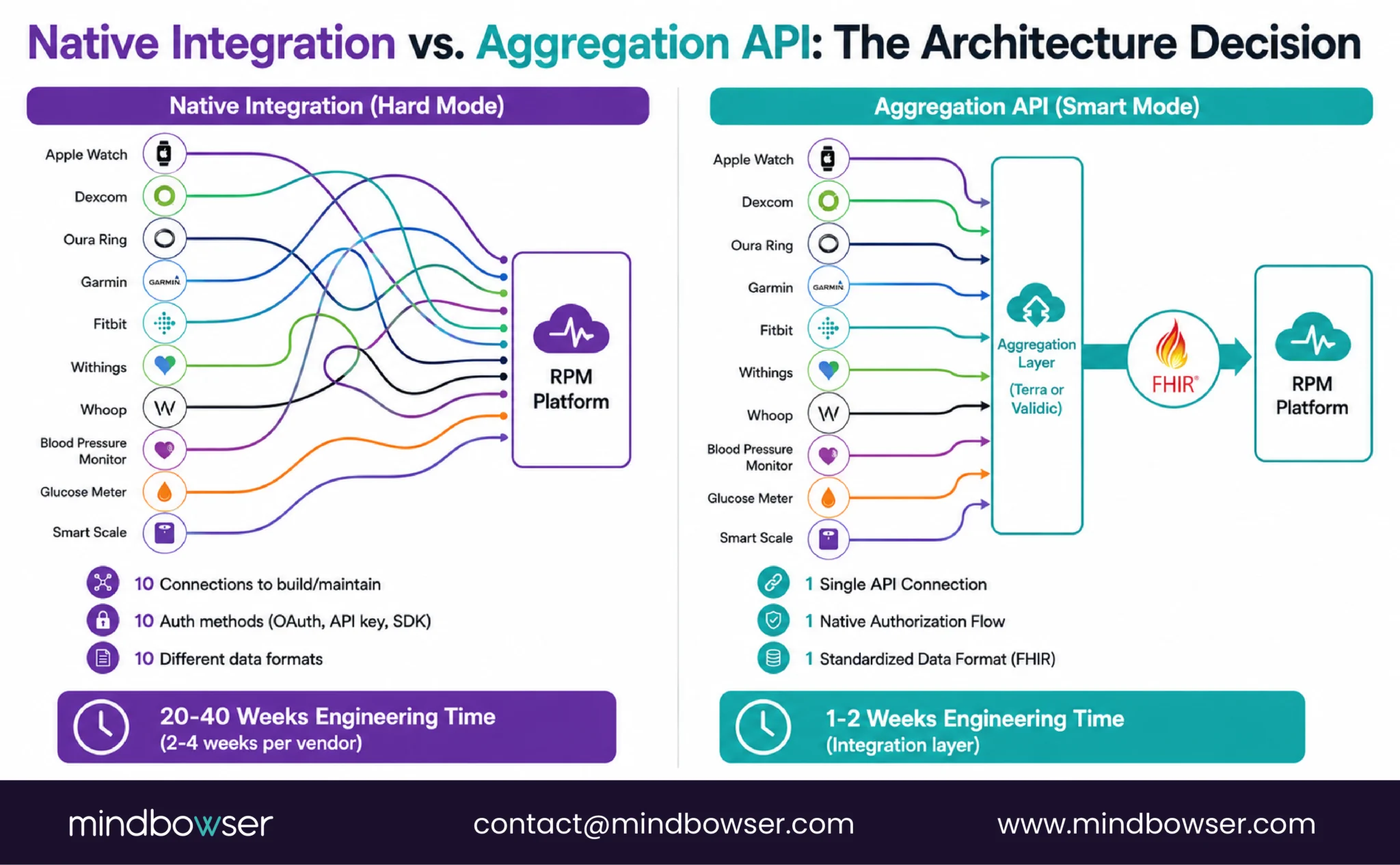
Native integration means building and maintaining each connection independently. For 5 vendors, that is manageable (we did it for Hearty). For 10 or more, the engineering cost becomes a significant line item. Two to four weeks per vendor for initial integration, plus ongoing maintenance as vendors update their APIs.
Aggregation APIs eliminate this by providing a single connection point. Your platform connects to the aggregation layer once. The aggregation layer maintains connections to all supported device vendors. When a patient’s Dexcom sends a glucose reading or their Withings scale sends a weight, the aggregation layer normalizes it and delivers it to your platform in a consistent format.
The trade-off: you add a dependency between your platform and your data. If the aggregation vendor has an outage, your data stops. If they change their pricing, your costs change. If they deprecate support for a device vendor you rely on, you scramble.
Terra API: Fast, Developer-Friendly, Fitness-First
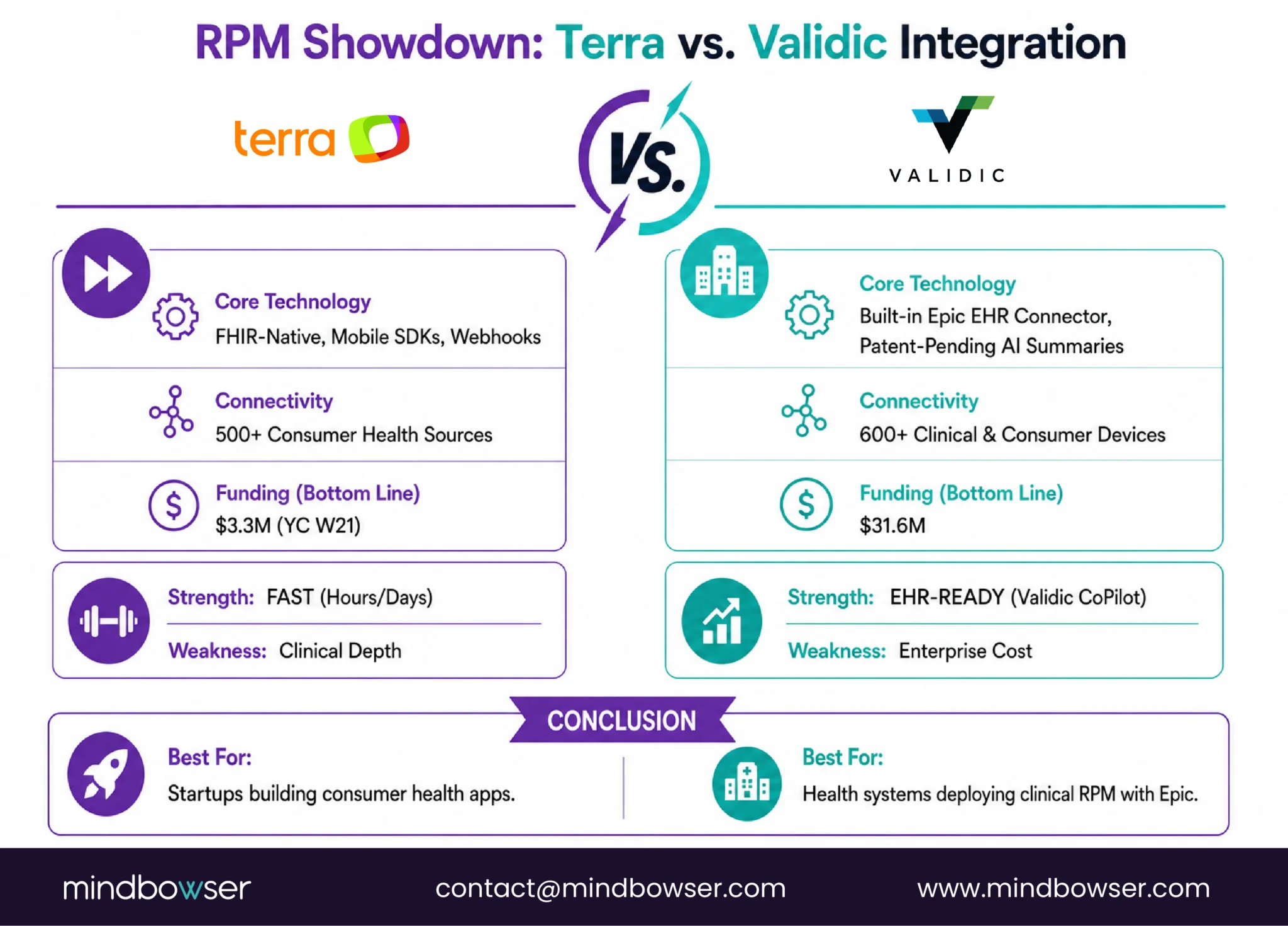
Company profile: Founded 2021, London. Y Combinator W21 batch. $3.3M funding from Y Combinator, General Catalyst, Samsung NEXT. Approximately 25 employees (Crunchbase).
What it does: Health and fitness API providing access to data from 500+ sources, including Apple HealthKit, Google Health Connect, Garmin, Fitbit, Oura, WHOOP, Samsung, Polar, Dexcom, Libre, and Withings. Mobile SDKs in Swift, React Native, and Flutter for HealthKit integration. Data delivered via webhooks or destination connectors.
Technical strengths:
- FHIR-native data format from day one. Data arrives in a structure compatible with healthcare interoperability standards
- Best developer documentation we have encountered in this category. Clear, well-organized, with working code examples
- Integration time: days, not weeks. We had a proof-of-concept pulling HealthKit data within 48 hours of account creation
- Webhook-based delivery: data pushes to your platform automatically when new readings arrive. No polling required
- Pricing is usage-based and competitive for startups. No enterprise contract required to start
Where it falls short for RPM:
- Clinical device depth is moderate. Terra excels at consumer wearables (Fitbit, Garmin, Oura, Apple Watch) and major CGMs (Dexcom, Libre). Clinical-grade medical devices (Tenovi cellular cuffs, BodyTrace scales, Nonin pulse oximeters) are not covered. If your RPM program uses clinical-grade cellular devices, Terra cannot replace native integration for those devices. Clinical-grade cellular devices also carry distinct FDA requirements for RPM software that aggregation APIs do not address.
- No EHR integration product. Terra delivers data to your platform. Getting that data into Epic or Cerner is your engineering problem
- A smaller team (25 employees) means less enterprise support infrastructure. Suitable for developer-led startups. May not meet enterprise SLA requirements for large health systems
- No AI or clinical intelligence layer. Terra delivers raw data. Trend analysis, risk scoring, and alert generation are downstream
Best for: Series A-B digital health companies building consumer-facing wellness or RPM apps. Development teams that prioritize API documentation quality and integration speed over clinical depth.
Validic: Enterprise, Clinical, EHR-Integrated
Company profile: Founded 2010, Durham, North Carolina. $31.6M total funding across 8 rounds from 15 investors. Approximately 70-130 employees (Crunchbase, varies by source).
What it does: Health IoT platform with two distinct products. Product 1: wearable data API for digital health companies (similar to Terra but with clinical device support). Product 2: EHR-integrated remote patient monitoring solution with patent-pending generative AI summaries for health systems and payers. Showcased both products at HLTH 2025 (Validic, October 2025).
Technical strengths:
- Deepest device coverage: 600+ connected devices, including clinical-grade medical devices AND consumer wearables. This breadth is unmatched
- Built-in Epic integration. Validic’s EHR connector pushes device data into Epic as structured clinical observations. This is the feature that positions Validic differently from every other aggregation API
- Patent-pending AI-powered clinical summaries that transform raw device data into clinician-ready insights
- 15-year track record. Founded in 2010, Validic has been operating longer than most competitors have existed
- Enterprise support infrastructure: dedicated customer success, SLA commitments, compliance documentation (SOC 2, HIPAA BAA)
Where it falls short:
- Slower integration than Terra. Enterprise sales cycle, onboarding process, and configuration take weeks to months
- Enterprise pricing. Per-patient or per-connection contracts that scale linearly with patient volume. For a 50-patient startup, this may be cost-prohibitive relative to Terra
- More complex onboarding than developer-first platforms. Validic is built for procurement teams, not individual developers
- Less developer-community presence (no Y Combinator network effect, fewer open-source contributions, less Stack Overflow visibility)
Best for: Health systems deploying RPM at scale with Epic or Cerner. Enterprise digital health companies need clinical-grade data plus EHR connectivity. Life sciences and pharma companies running device-based clinical trials.
Design the device data pipeline for your multi-wearable RPM platform
Momentum’s Open Wearables: Open-Source, Zero Lock-In
Company profile: Momentum launched Open Wearables in December 2025 as an MIT-licensed, open-source platform (Momentum, December 2025).
What it does: Normalizes raw wearable data from 200+ devices into AI-ready schemas. MIT license means full source code access with no vendor lock-in. Supports Apple HealthKit, Garmin Health API, Fitbit, Oura, WHOOP, Strava, and growing.
Why it matters for the RPM space:
- Zero vendor lock-in. If you build on Terra or Validic and they change pricing, deprecate a device, or get acquired, your data pipeline is at risk. With Open Wearables, you own the code. Fork it, customize it, host it yourself
- AI-ready data schemas. The normalized output is designed for machine learning pipelines, not just dashboard display. For RPM programs that want to build proprietary AI models on wearable data (personalized baselines, exacerbation prediction), this schema design matters
- No per-connection fees. At 5,000 patients, the cost savings versus Validic’s per-patient pricing could be substantial
The honest caveats:
- Launched December 2025. Five months in production as of this writing. Less battle-tested than Terra (4 years) or Validic (15 years). Production bugs, edge cases, and scaling limits are still being discovered by early adopters
- 200+ devices versus 500-600+ for Terra and Validic. The coverage is growing, but currently narrower
- No EHR integration out of box. Like Terra, getting data into Epic or Cerner is your engineering problem
- No enterprise support. Community-supported (GitHub issues, Discord). If you need a vendor on a phone call at 2 AM when data stops flowing, Open Wearables is not that
- Requires an engineering team to host, maintain, monitor, and update. This is not a SaaS product. It is the infrastructure you operate
Best for: Engineering teams that want full control over the data pipeline. Organizations with vendor lock-in concerns (common in health systems that have been burned by vendor acquisitions). Research institutions that need open, modifiable data schemas. Companies are building proprietary ML pipelines on top of wearable data.
Native Integration: Apple HealthKit and Google Health Connect
Apple HealthKit and Google Health Connect are not aggregation APIs in the traditional sense. They are native operating system frameworks that aggregate health data from apps and devices connected to the patient’s phone.
Apple HealthKit aggregates data from Apple Watch, CGMs (Dexcom, Libre), BP cuffs (Omron, Withings), scales (Withings), sleep trackers, and 300+ third-party health apps. FHIR-native through Apple Health Records. Free. No API cost. Accessible via Swift SDK or React Native bridge.
Google Health Connect does the same for Android: Fitbit, Samsung, Garmin, Oura, 100+ Android health apps. Free. Accessible via Android SDK.
When native is enough:
- Your RPM program already has a patient-facing mobile app
- Patients already own and use Apple Watch, Fitbit, or CGM
- You want zero aggregation cost
- You accept mobile-only data access (no server-side API pull without a middleware layer)
When native is not enough:
- You need server-side data processing without a patient-facing app
- You need clinical-grade medical devices not connected to HealthKit (cellular BP cuffs, cellular scales)
- You need multi-platform support (iOS and Android) through one integration
- You need guaranteed data delivery (HealthKit depends on patient granting and maintaining permissions)
CGM-heavy programs like maternal RPM for preeclampsia and gestational diabetes are a good fit for the HealthKit-first hybrid approach.
Head-to-Head Comparison
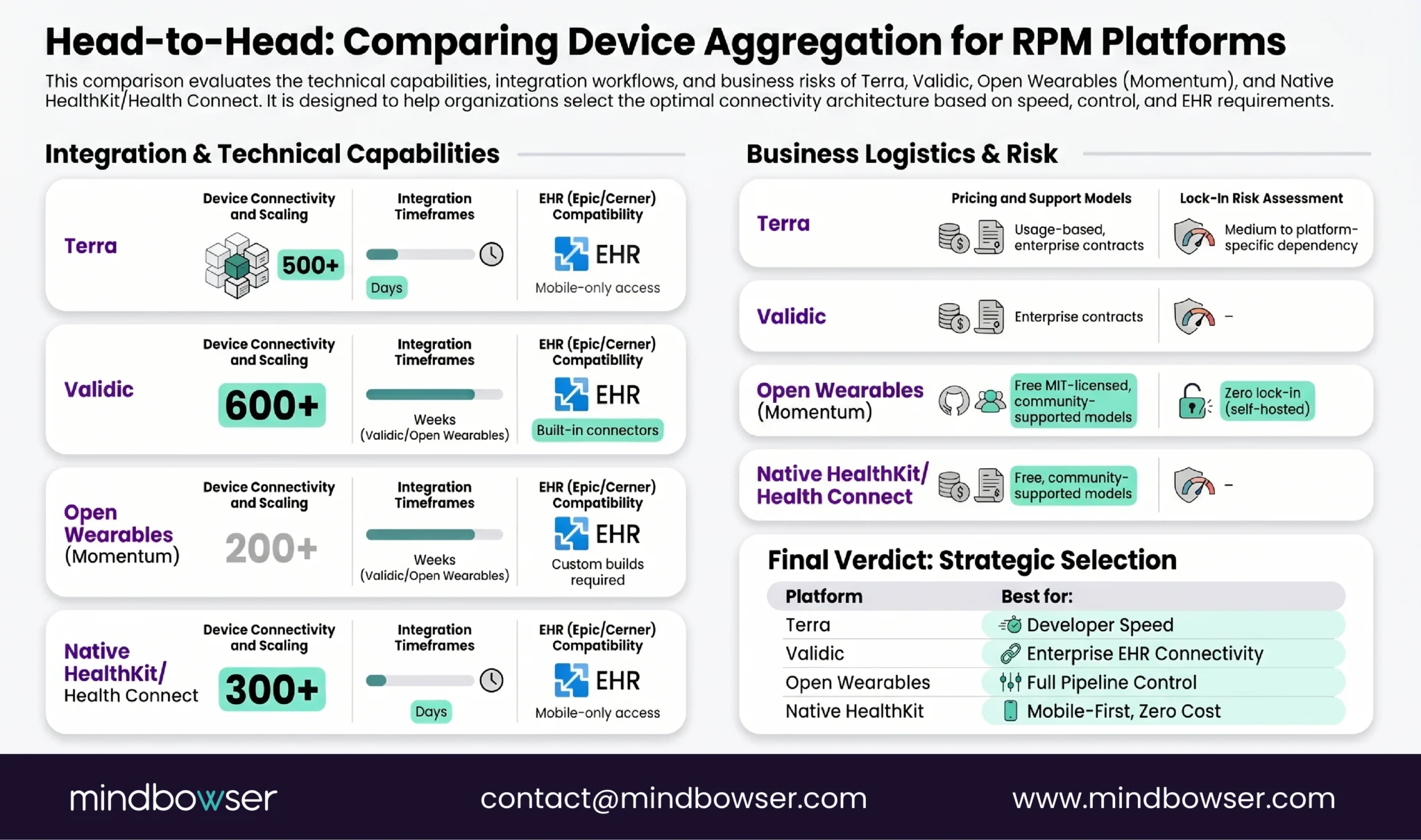
The comparison that matters most for RPM specifically: clinical device depth and EHR connectivity. If your RPM program uses clinical-grade devices (cellular BP cuffs, medical pulse oximeters, clinical scales) and needs data in Epic, Validic is the only option that covers both natively. Terra and Open Wearables require you to build the clinical device integration and EHR connectivity yourself.
How Does WearConnect Fit Into This?
WearConnect is not an aggregation API competitor. It is a device normalization layer that sits downstream from aggregation, solving a different problem.
Aggregation APIs solve: “How do I get data from 10 device vendors into my platform?”
WearConnect solves: “Now that the data is in my platform, how do I make clinical sense of it?”
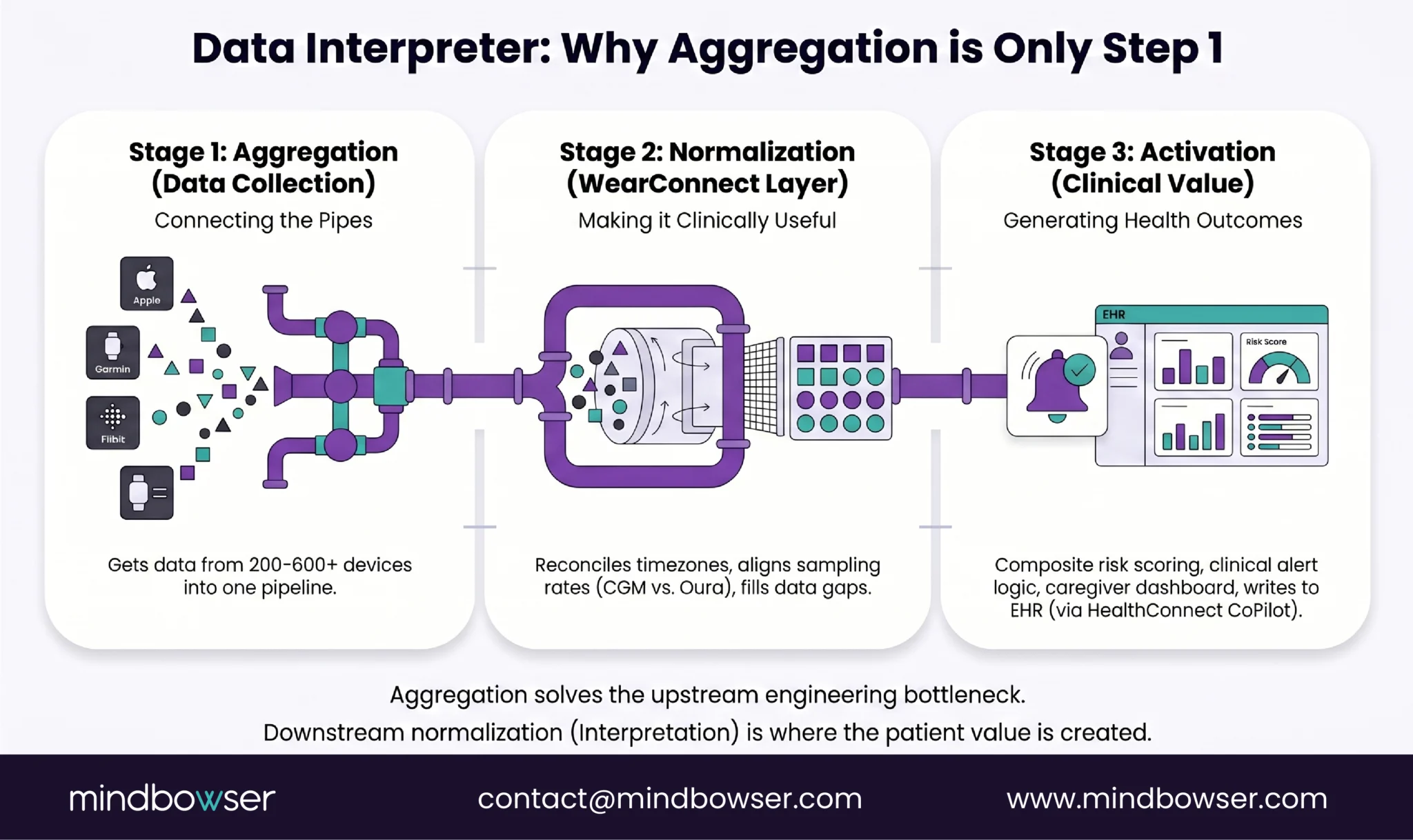
The architecture stack:
Devices → Aggregation (Terra / Validic / HealthKit / Native)
       → WearConnect (normalize, align, gap-fill)
       → RPM Platform (clinical logic, alerts, dashboards)
       → EHR (FHIR Observations via HealthConnect CoPilot)
What WearConnect handles that aggregation APIs do not:
- Timezone reconciliation across multi-state patient populations (a patient travels from Eastern to Central timezone, their readings shift by an hour, trend analysis breaks without timezone normalization)
- Sampling rate alignment (Libre sends readings every 1 minute, Dexcom every 5 minutes, Oura sends hourly summaries, weight scale sends once daily: all need to be in one timeline)
- Gap-filling interpolation (when a device loses connectivity for 4 hours, the gap in the time-series needs interpolation so trend analysis doesn’t treat it as a sudden drop)
- Clinical alert logic on the normalized multi-device data stream (composite risk scoring across vitals from different devices) the layer that prevents RPM alert fatigue from firing on uncorrelated single-device thresholds
For the Hearty build, we used native HealthKit plus direct Dexcom API plus Oura API plus Withings API. Five data sources, no aggregation API. WearConnect normalized the five streams into a single patient biometric view. The aggregation was native (5 vendors were manageable). The normalization was WearConnect.
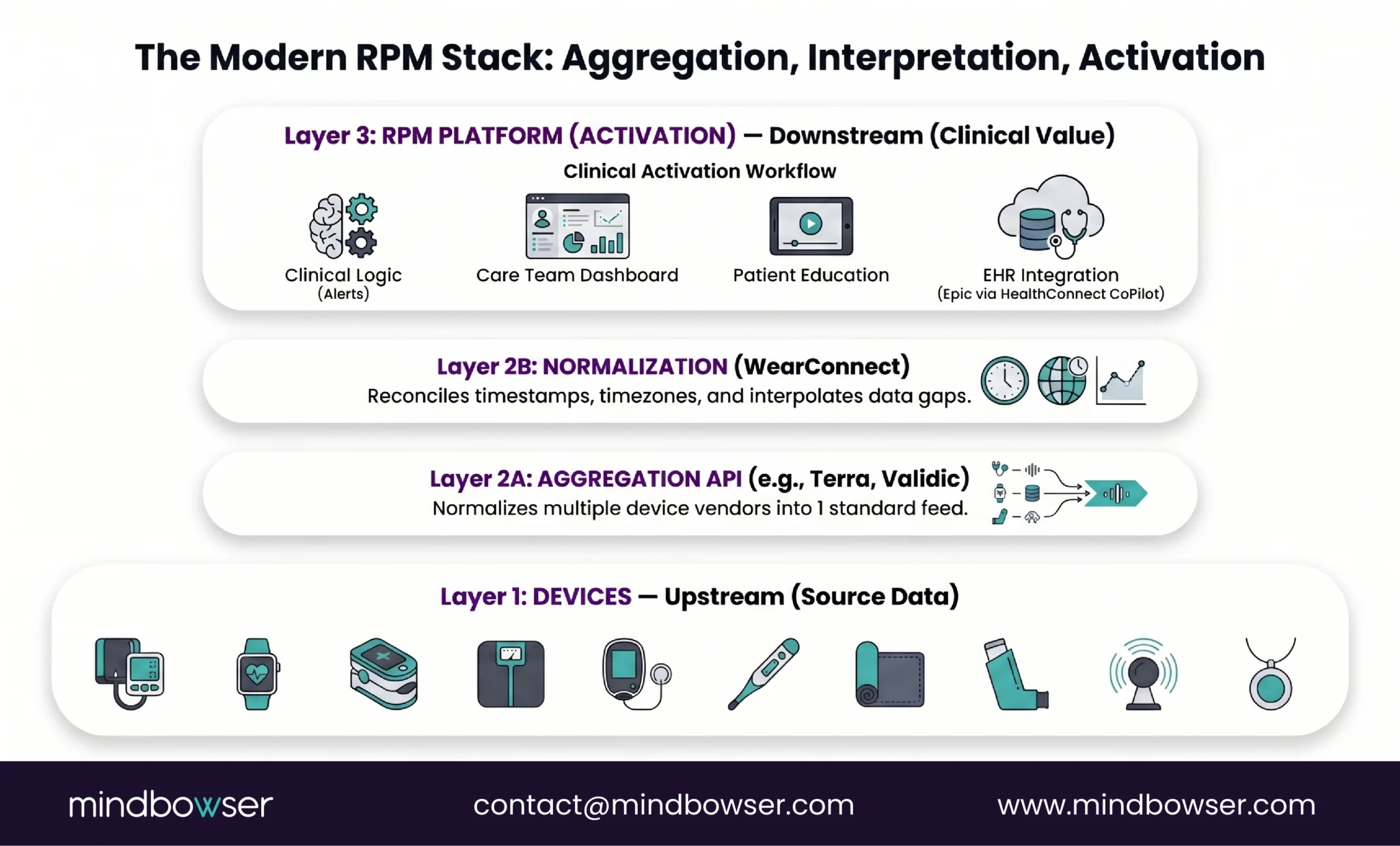
For programs supporting 15+ device types, the recommended stack is: aggregation API (Terra or Validic, depending on clinical requirements) plus WearConnect for normalization plus HealthConnect CoPilot for EHR delivery.
The Decision Is What You Do With the Data, Not How You Get It
Aggregation APIs solve data collection. They do not solve data interpretation. The clinical value of RPM is created in the platform layer that sits atop aggregation: trend analysis, anomaly detection, composite risk scoring, alert generation, care team routing, and EHR delivery.
The decision framework:
- Need the data fast, building a consumer app: Terra: best documentation, fastest integration, startup-friendly pricing.
- Need the data in the EHR, running an enterprise RPM program: Validic epic integration built in, clinical device depth, and enterprise support.
- Need zero vendor lock-in, have an engineering team: Open Wearables. MIT-licensed, self-hosted, AI-ready schemas. Accept the maturity trade-off.
- Patients already own an Apple Watch or a CGM: Start with HealthKit. It is free and already aggregating. Add Terra or Validic when you outgrow HealthKit’s limitations.
- Supporting 5-8 device vendors with engineering capacity: Consider native integration. We did this on Hearty with five vendors and found that the direct API connections gave us more control over data quality than the aggregation layer would have. Aggregation becomes essential when the device count exceeds 8-10, vendors.
- Building a hybrid telehealth + RPM platform? See how telemedicine software development integrates with wearable data pipelines.
We initially assumed we needed an aggregation API for every multi-device build. On the Hearty project, native integration produced better results because we controlled the data quality at each vendor connection. The assumption was wrong. Aggregation is the right choice at scale (10+ vendors). Below that threshold, native integration often produces higher data quality because you control each connection.
A device aggregation API normalizes data from multiple wearable device manufacturers and health platforms into a single, standardized data feed. Instead of building separate integrations for Dexcom, Abbott, Apple HealthKit, Fitbit, Oura, and Garmin (2-4 weeks each), you connect once to the aggregation layer and receive unified data. Leading platforms include Terra (500+ sources, startup-focused), Validic (600+ devices, enterprise/EHR-focused), and Momentum’s Open Wearables (200+ devices, MIT open-source).
Terra is developer-first with FHIR-native data, fast integration (days), and startup-friendly pricing. Best for consumer health apps and Series A-B digital health companies. Validic is enterprise-first with 600+ clinical devices, built-in Epic EHR integration, AI-powered clinical summaries, and 15 years of healthcare market presence. Best for health systems deploying RPM at scale. The core trade-off: Terra prioritizes developer speed, Validic prioritizes clinical depth and EHR connectivity.
Open Wearables is an MIT-licensed, open-source platform launched December 2025 that normalizes raw wearable data from 200+ devices into AI-ready schemas. Zero vendor lock-in because you own and host the code. No per-connection fees at any scale. The trade-offs: newer (less production-tested than Terra or Validic), fewer devices (200 vs 500-600), no EHR integration out of box, no enterprise support (community-supported), and requires your engineering team to host and maintain.
Yes, with limitations. HealthKit aggregates data from Apple Watch, CGMs, BP cuffs, scales, and 300+ health apps into a single pull point. Free, FHIR-native through Health Records. The limitation: data is only accessible through a mobile SDK on the patient’s iPhone, not through a server-side API. You need a patient-facing mobile app to access HealthKit data. For server-side processing without a mobile app, you need an aggregation API (Terra or Validic) or native vendor APIs.
Based on our experience: native integration is manageable and often produces better data quality at 5-8 device vendors. Above 8-10 vendors, the engineering cost of maintaining native connections (API updates, authentication changes, data format changes) exceeds the cost of an aggregation API. The Hearty build used 5 native integrations. Programs supporting 15+ device types benefit from aggregation. The threshold depends on your engineering team size and vendor API stability.
Aggregation collects data from multiple device vendors into one platform (Terra, Validic, HealthKit). Normalization processes that aggregated data into clinically useful form: aligning timestamps across devices with different sampling rates (1-min Libre vs 5-min Dexcom vs daily weight), reconciling timezones for multi-state patients, filling data gaps from connectivity interruptions, and unifying measurement units. Aggregation APIs deliver raw data. Normalization layers (like WearConnect) make that data clinically interpretable. Most RPM platforms need both.