BLOGS
BLOGS  NEWSROOM
  CASE STUDIES
  WEBINARS
  PODCASTS
  ASSET HUB
  EVENT CALENDAR


























TL;DR
“Which psychiatry EMR supports e-prescribing” is a real, recurring search, and almost nothing answers it properly. Most EMR comparison content treats e-prescribing as a single feature checkbox: supported or not. It isn’t that simple. EPCS (electronic prescribing of controlled substances) requires specific identity-proofing and DEA verification steps inside the EMR itself, PDMP integration that varies by state, and psychiatric documentation that generic behavioral health templates don’t cover. This piece covers what actually needs to be true of an EMR’s EPCS implementation, and where a practice’s specific setup pushes past what an off-the-shelf platform supports.
The Question Nobody Answers Properly

We looked directly at what shows up for “which psychiatry EMR supports e-prescribing” before writing this. It’s a low-volume query, but it’s exactly the right question, and the search results answer a different one. Every result treats e-prescribing as a single yes/no feature: does this EMR have it, checkmark or no checkmark. None of them explain what “has it” actually means once a practice is prescribing Schedule II stimulants for ADHD or Schedule IV benzodiazepines for anxiety, which is most of what a working psychiatry practice does.
EPCS isn’t one feature. It’s a set of specific technical and regulatory requirements the EMR has to implement correctly, and the gap between “e-prescribing enabled” and “EPCS-compliant for controlled substances” is where practices run into trouble after they’ve already signed a contract.
What EPCS Actually Requires Inside an EMR
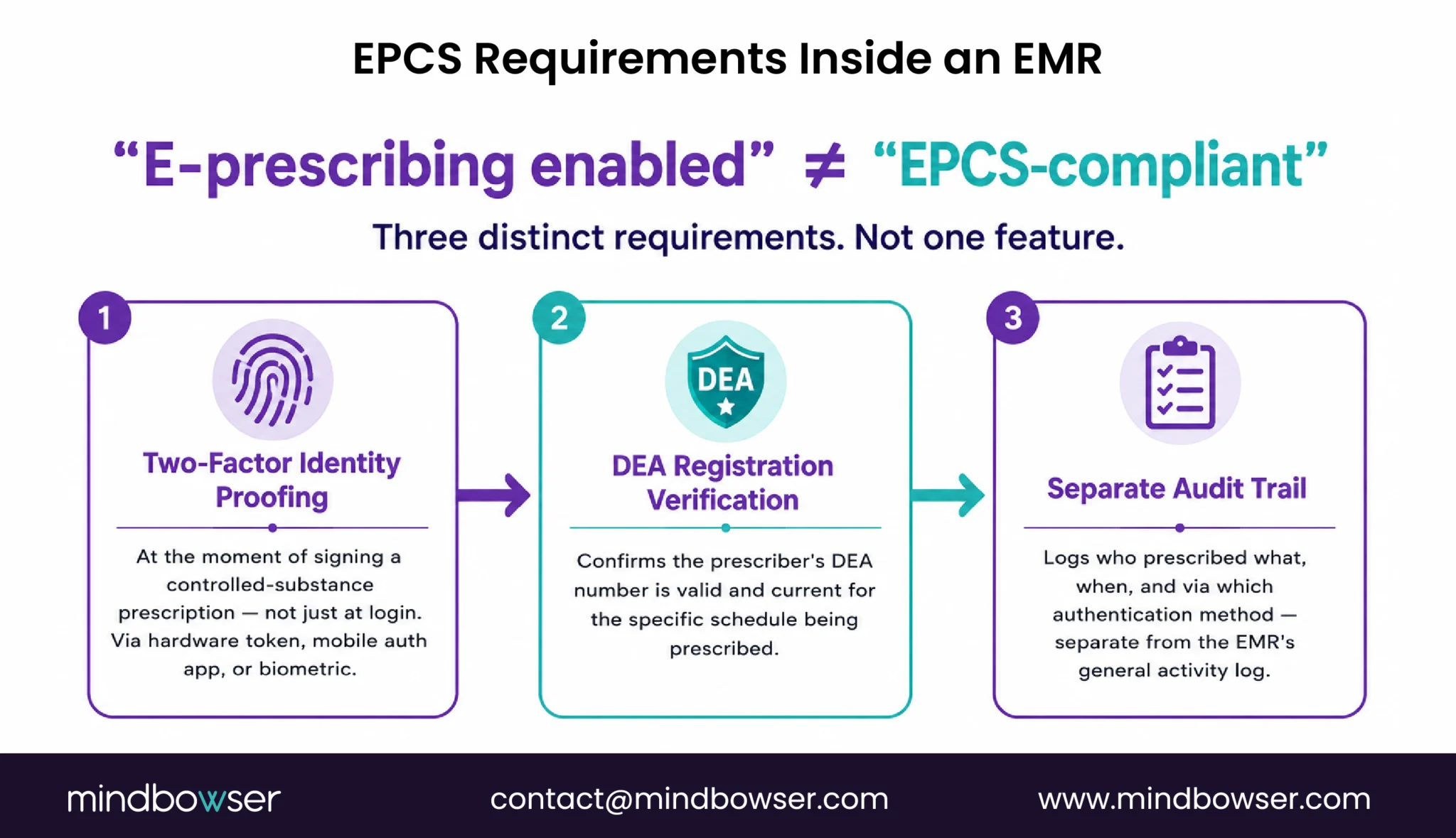
EPCS requires two-factor identity proofing for the prescriber, meaning the EMR has to verify identity through a second factor (a hardware token, a mobile authentication app, or biometric verification) at the moment of signing a controlled-substance prescription, not just at login. It requires DEA registration verification, confirming the prescriber’s DEA number is valid and current for the specific schedule being prescribed. And it requires an audit trail specific to controlled substances, logging who prescribed what, when, and through which authentication method, separately from the EMR’s general activity log.
Here’s a distinction worth getting right, since it’s easy to state backwards: the two-factor identity-proofing and authentication requirement under DEA’s EPCS rule (21 CFR 1311.115) is actually the same across every controlled-substance schedule, II through V. What makes Schedule II harder isn’t the identity-proofing step, it’s what happens after: no refills are allowed on a Schedule II prescription at all (21 CFR 1306.12), and quantity and partial-fill rules are stricter. That’s where we’ve seen EMRs marketed as “e-prescribing enabled” turn out not to actually support Schedule II EPCS at all, or support it through a clunky secondary workflow, not because the authentication is harder, but because the refill and quantity logic Schedule II demands wasn’t built into the core prescribing flow.
PDMP Integration Is State-by-State, and Most EMRs Don’t Flex for That
There’s no federal requirement that a provider check a Prescription Drug Monitoring Program (PDMP) database before writing a controlled-substance prescription. The federal SUPPORT Act only requires states to establish a PDMP in the first place; whether checking it before prescribing is mandatory is a state-by-state rule, and most states require it for at least some drug schedules, though not all states and not for every schedule.
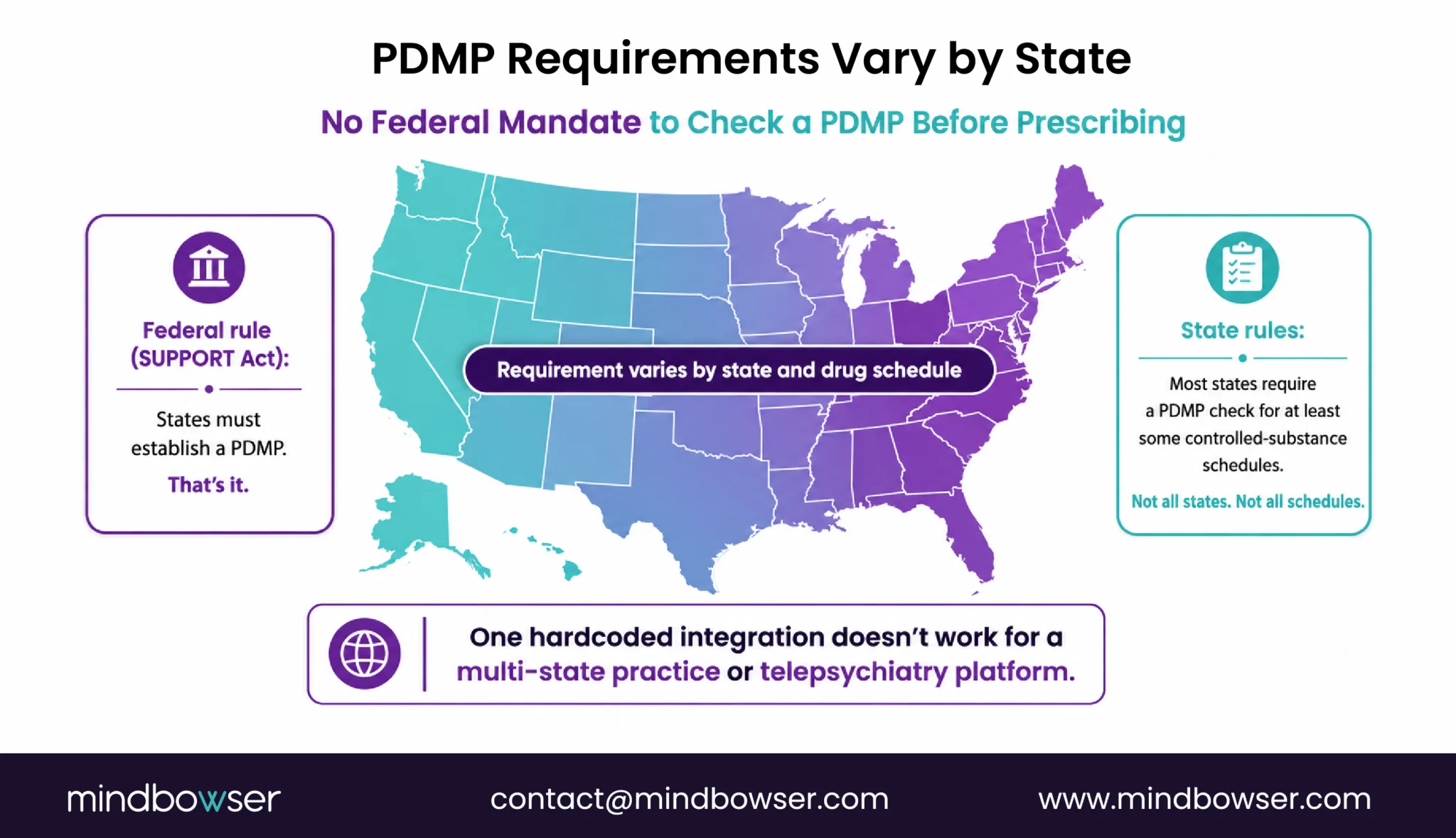
That variance matters more than it sounds like it should for an EMR evaluation. A psychiatry practice operating in one state, or a telepsychiatry platform serving patients across several, needs an EMR that can apply different PDMP-check logic per state rather than one hardcoded rule. It’s common in this market for a vendor to integrate PDMP data for exactly one state’s requirements and still market the feature as “PDMP integrated,” which is accurate as far as it goes and incomplete the moment a practice’s patient population crosses a state line.
Psychiatry-Specific Templates That Generic Behavioral Health EMRs Miss
A behavioral health EMR built primarily for talk therapy documents sessions differently than psychiatric care requires. A therapy note tracks session content, interventions used, and treatment plan progress. A psychiatric evaluation needs a structured mental status exam, a current medication list with dosage and titration history, side-effect monitoring specific to the medications prescribed, and diagnostic coding that supports both clinical accuracy and the billing codes tied to medication management visits, which are documented and billed differently than a standard therapy session.
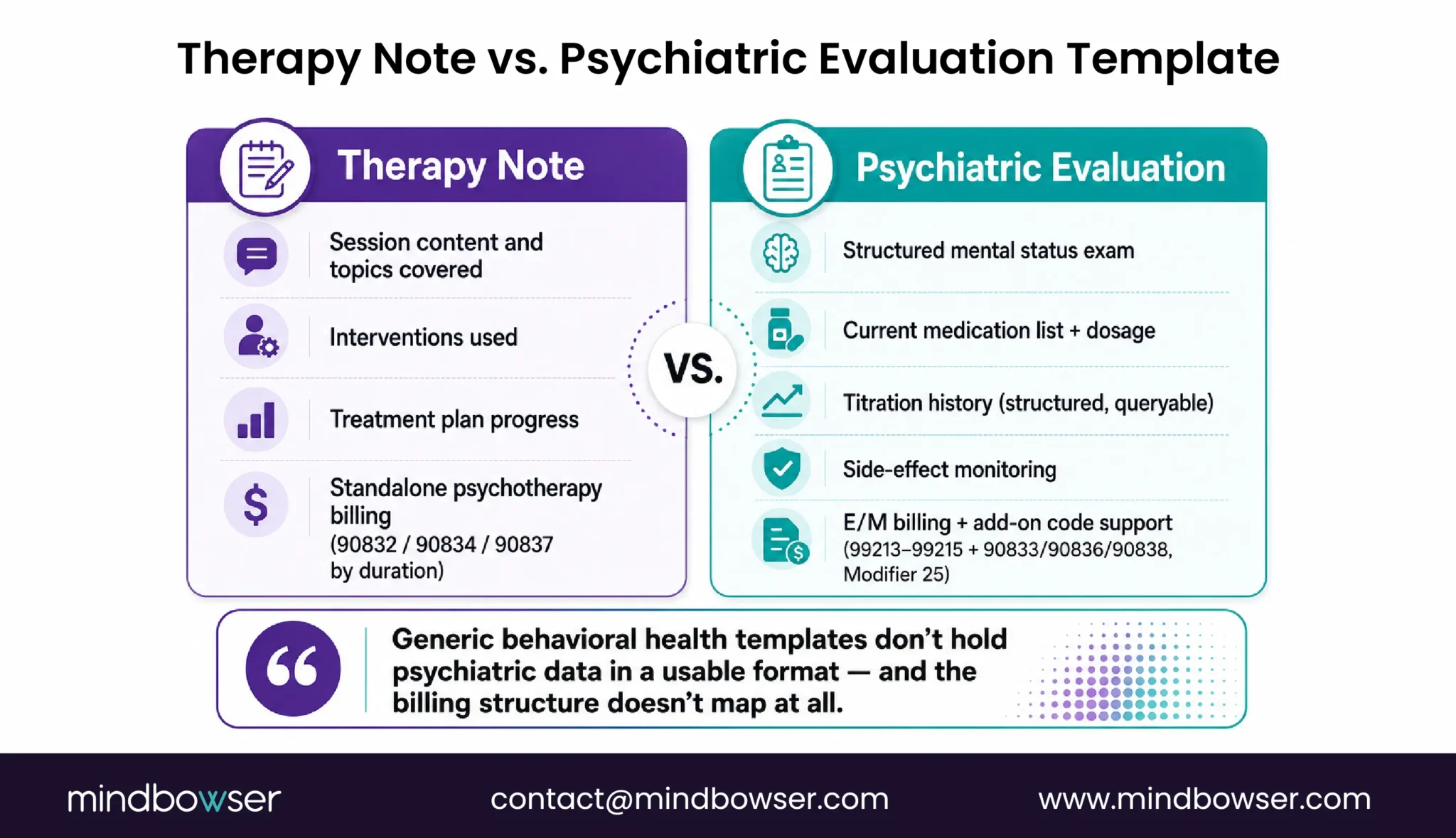
That billing distinction is worth being specific about, because it’s where a generic template actually breaks. A medication management visit typically bills under an E/M code (99213-99215, with 99214 the most common for an established patient), and when psychotherapy happens in the same visit, it’s added through a specific add-on code, 90833 for 30 minutes, 90836 for 45, or 90838 for 60, with modifier 25 appended to the E/M code to show it’s separately identifiable from the therapy. A standalone psychotherapy session, by contrast, bills under 90832, 90834, or 90837 depending on length, with no E/M code involved at all. I said above that generic templates “don’t capture titration history in a usable format,” and that’s true, but the sharper version of the problem is that a template built around standalone psychotherapy coding doesn’t have a natural place to attach an E/M-plus-add-on visit with modifier 25 at all, so practices either force it into a workaround or, more often, just don’t code it correctly.
We’ve seen practices adopt a generic behavioral health EMR, discover the templates don’t support this billing structure cleanly, and end up tracking medication changes in a separate spreadsheet because the EMR’s structured fields weren’t built for that specific documentation and coding need. That’s not a minor annoyance. It’s the kind of gap that shows up during an audit, or in a denied claim that took months to catch.
Need A Psychiatry EHR With EPSC Capabilities?
Telehealth Prescribing Rules vs. EMR-Level EPCS Requirements, Two Different Things
It’s worth being precise about a distinction that gets blurred constantly. We covered DEA’s telehealth prescribing flexibility rules in detail elsewhere, the current temporary extension governing whether a prescription can be written via audio-only versus audio-video telehealth, and when that flexibility expires. That’s a question about the modality of the visit.

This piece is about a separate question: once a prescription is being written, in person or via telehealth, does the EMR’s own EPCS implementation correctly handle the identity-proofing, DEA verification, and audit logging that prescription legally requires. A practice can be fully compliant on the telehealth-modality question and still be running an EMR that mishandles EPCS mechanics, and vice versa. They’re both real requirements, and they’re not the same requirement.
Evaluating a Psychiatry EMR for EPCS Fit
If you’re evaluating an EMR specifically for EPCS support, the vendor demo questions worth asking directly: does the platform fully support the no-refill and quantity-limit logic Schedule II specifically requires, not just the same two-factor authentication step it already uses for Schedule III-V. Which PDMP databases does it integrate with, and does that cover every state your practice or platform actually operates in. Is the controlled-substance audit trail separate and exportable for a DEA audit, or bundled into general activity logs that would require manual filtering. And can the platform’s psychiatric documentation templates capture medication titration history in a structured, queryable format, not free text that has to be read manually to reconstruct a patient’s medication history.
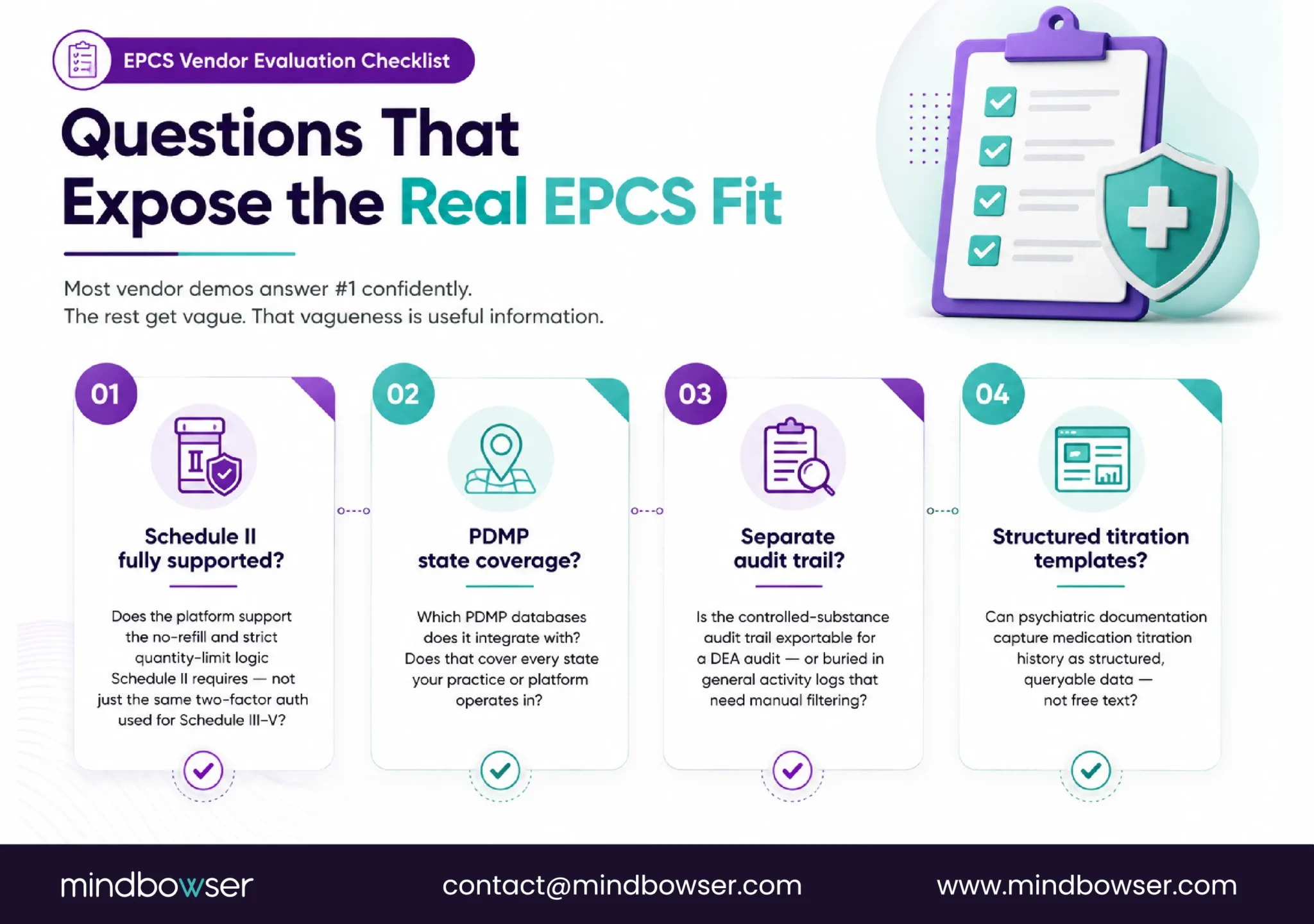
Most vendor demos answer the first question confidently and get vague on the other three. That vagueness is itself useful information.
When Off-the-Shelf Doesn’t Fit: Custom EPCS Integration
There’s no packaged accelerator that handles EPCS identity-proofing or multi-state PDMP integration generically, because the correct implementation depends on which EPCS vendor a practice’s existing e-prescribing runs through, which states its patients are in, and which specific psychiatric documentation gaps its current EMR has. That’s genuine custom integration work: mapping the identity-proofing flow to the specific EPCS-certified vendor a practice uses, building PDMP-check logic that flexes per state rather than assuming one rule applies everywhere, and extending or replacing documentation templates so titration history and the E/M-plus-add-on billing structure are structured, codeable data, not narrative text a biller has to interpret after the fact.
A concrete version of what that looks like, illustratively: take a multi-state telepsychiatry platform running one EPCS-certified e-prescribing vendor across its entire network, with a patient population spanning states that have different PDMP check mandates for the same drug class. The generic version of “PDMP integration” that vendor ships doesn’t know which state a given patient is in at the moment of prescribing. The actual build needed is a rules layer sitting between the EMR and the e-prescribing vendor that checks patient location against that state’s specific requirement before the prescription goes out, not a settings toggle, an actual decision point in the workflow.
How Mindbowser Helps
We’ve built e-prescribing integration work into custom EHR builds directly, including the identity-proofing and audit-logging requirements EPCS specifically demands, not just a general e-prescribing feature. What we don’t have is a packaged, one-size-fits-all EPCS module, because the correct build depends entirely on a practice’s existing e-prescribing vendor, state footprint, and documentation gaps, the same custom-integration reality described above. If you’re evaluating whether your current EMR actually handles this correctly, or scoping a psychiatry-specific build from scratch, that’s worth a direct conversation before a gap surfaces during a DEA audit rather than during an evaluation.
Closing
If you’re comparing psychiatry EMRs on e-prescribing capability, the checkbox on a vendor’s feature list won’t tell you what you need to know. Request an assessment and we’ll walk through what your specific EPCS and documentation requirements actually are.
EPCS (electronic prescribing of controlled substances) is the DEA-regulated framework for prescribing Schedule II-V medications electronically. It requires two-factor identity proofing, DEA registration verification, and a separate audit trail for controlled-substance prescriptions. It matters specifically for psychiatry because stimulants and benzodiazepines, both controlled substances, are core to psychiatric medication management.
Not necessarily. Many EMRs support e-prescribing for Schedule III-V medications through standard workflows but handle Schedule II, the category most psychiatric stimulants fall under, through a separate or incomplete process. Confirming Schedule II EPCS support specifically, not just general e-prescribing, is the question most comparison content skips.
No. The federal SUPPORT Act requires states to establish a PDMP database, but whether a provider must check it before prescribing a controlled substance is a state-by-state requirement, not a federal one. Most states require it for at least some drug schedules.
A psychiatric template needs to capture a structured mental status exam, current medication list with dosage and titration history, and side-effect monitoring, documentation a general therapy-session template isn’t built to hold. Practices using a generic behavioral health EMR sometimes end up tracking medication changes outside the system entirely because the templates don’t support it.