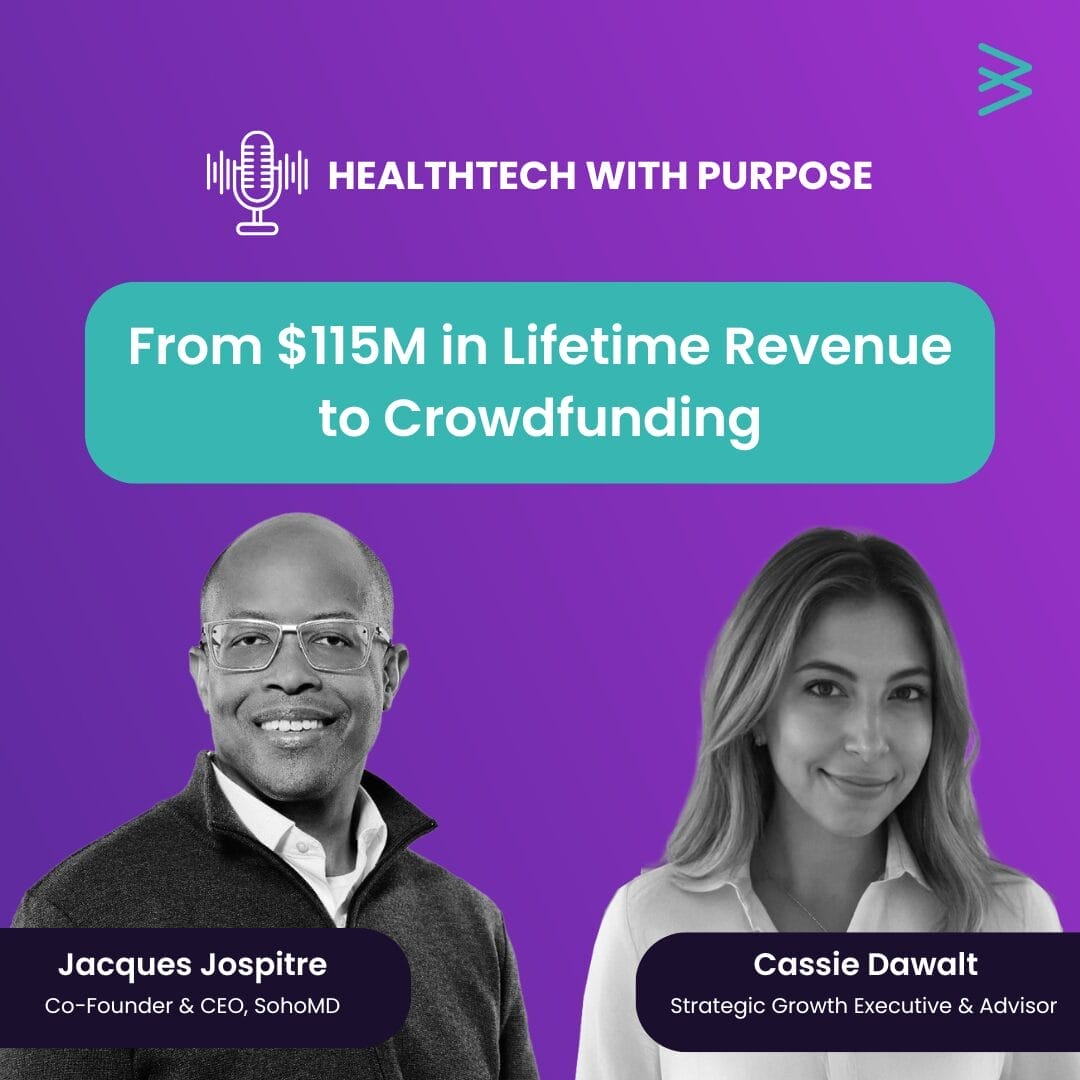
Dr. Jacques Jospitre, a board-certified psychiatrist and co-founder of the telepsychiatry practice SohoMD, joins host Ayush Jain with Cassie Dawalt, SohoMD’s new Chief Strategy Officer, to talk about starting again with an AI-first behavioral health venture. Jacques explains why he sees a short window to act: AI is recursive, so it speeds up its own development, and a company that organizes the right data set now can build a lead others will struggle to close.
The sharpest point is about what people get wrong. More computation doesn’t fix a noisy data set, Jacques argues, and useful models in psychiatry depend on clinicians deciding what goes in. Cassie adds the patient’s side: know who trained the model you’re using, and design for equity and cultural competency from the start.
Most of the conversation covers their decision to raise on Wefunder alongside conventional investors, which turns future patients into investors and champions, and what the campaign taught them about storytelling, networks and patience. Jacques closes with his five-year picture of psychiatry anchored in genetics, wearables and labs, and a plan to make clinicians co-owners of the company.
Jacques built SohoMD around what he calls the biology of psychiatry: moving beyond labels from the Diagnostic and Statistical Manual of Mental Disorders (DSM) toward the root causes of a condition. The new venture takes that a step further. Research on biological mechanisms piles up every day, and he sees AI as the tool that can make sense of it, with mental health and longevity aiming at the same thing.
His case for moving now is about speed. AI is “one of the few technologies that is recursive”: a solution can improve your ability to build the next version of itself, so timelines compress. Other teams are working on the same problems, and the plan is to build intellectual property around the data and the models while the field is still settling, then hold that lead.
Asked what people misunderstand about AI in mental health, Jacques points to signal and noise. Feed a system enough garbage and it won’t find meaningful patterns, however much computing power sits behind it. He compares it to image recognition, where people had to tag images by hand before the models could tell a car from a bicycle. Psychiatry needs the same human step: clinicians who pre-process and organize the data before it trains a model. That, he says, is where a small company can beat bigger ones.
Cassie looks at it from the patient’s side. People should know which model they’re using, who trained it and where it came from, and she keeps “safety, compliance, quality” front of mind, along with regulatory updates, equity for underserved populations and cultural competency. The same concerns run through Mindbowser’s guide to AI in mental health care, from bias to clinician oversight.
SohoMD chose to raise on Wefunder, which lets the people who might use its services also invest in it. Jacques describes it as a multifront marketing process: the same spend that brings in patients brings in investors, and those investors care about quality, equity and access to mental health care, beyond a 10x or 100x return. They aren’t skipping traditional capital. Conversations with conventional investors run in parallel, a model he says other successful Wefunder companies have used. It sits on top of the funding paths open to mental health tech startups, and it’s a useful contrast with what a strategic VC looks for in a digital health company, as Branden Fini described on this show.
He also makes the access argument: equity rounds usually require accredited, independently wealthy investors, while Wefunder lets someone invest from $100 and own shares side by side with venture and private equity funds.
Jacques lists what the team learned: tell a different story to the average investor than to a conventional one; lean on your personal network, since the earliest money came from people who knew him and were “investing in me even before the company”; partner with mission-aligned companies that help promote the campaign; and work with consultants who already have a playbook. The unlearning was about time. He expected the raise to take off in three months, and it took longer, though years of medical training had taught him patience.
Cassie’s biggest lesson was the message. She was used to pitching investors, health plans, hospitals and community organizations, and words like “payer” mean nothing to someone deciding whether to put money in on Wefunder. Explaining the company in terms anyone understands is still the hard part, especially while AI keeps changing.
Jacques expects the DSM to stay, but connected to biological anchors. Your genetics, sleep, movement and activity from a wearable, your diet and your labs would all feed a system that tells you what to change. Phone and watch data could flag early signs of depression, or show that anxiety rises every Tuesday afternoon around a particular meeting, and therapy sessions would pick up those patterns. The same pattern analysis companies use to sell to people, he argues, can help them pursue their own goals. Ayush sums it up as precision and personalization; Cassie adds empowerment. Getting there takes behavioral health software that brings those data streams together with clinical oversight.
His personal reason is the clinicians. He wants the psychiatrists and therapists who join to be equity owners, so they benefit from AI instead of being displaced by it. After residency he worked with homeless and recently incarcerated patients, and he believes untreated conditions such as post-traumatic stress disorder (PTSD) shape much of what people call bad behavior. Affordable, accessible mental health care, he says, makes communities better.
Hello everyone. Welcome to another episode of the HealthTech with Purpose podcast, the show where we sit down with the people building the future of healthcare from the inside out. Today’s guest is someone I’ve been really excited to talk to, not just because of what he’s building now, but because of what he has already proven as a physician entrepreneur. He’s a board-certified psychiatrist, an MD from Mount Sinai, an MBA from Baruch, and the co-founder of SohoMD, a national telepsychiatry platform that has delivered more than 850K patient visits, scaled across 19 states, generated millions in revenue, and is now doing 20 million plus in annual revenue, with massive growth over the last five years.
But here’s what makes today’s conversation different. After building one of the most meaningful behavioral health platforms in the country, he’s taking a second leap, launching a new AI-first behavioral health venture, and he has chosen a path we don’t hear enough about in medicine. So welcome, Jacques. Welcome to the show.
Thanks, Ayush. Thanks for having me here, and having us here.
Yes, thank you so much for joining in. Really looking forward to the conversation. But before we get into the deeper aspects of it, let’s start with somewhat more of an introduction: a bit more background about you and what you have been busy with.
Yeah, absolutely. So I’m Jacques Jospitre. I’m a psychiatrist with a background in business and tech. I finished grad school with an MD/MBA. I ran a psychiatry department for four years after residency, and then ran a clinic for three years after that. Those experiences inspired me to start SohoMD, initially looking at combining best-in-class treatment with affordability. We did that, and eventually that led us into integrative health and functional medicine, which is what we’ve focused on for the past 10 years.
So now I’m really excited about incorporating AI into the business model and seeing how we can help more patients get better using technology, and really seeing that as a solution to bridging the gap in healthcare delivery. And I also have here Cassie, who recently joined our team.
Hi, Ayush.
Hi, Cassie.
Nice to be here, thanks again. I’m Cassie Dawalt. I recently joined the team leading strategy, as chief strategy officer. I have been in healthcare over a decade now, with a large focus on behavioral health. I lead with genuine curiosity and lived experience, and I sit on some national advocacy boards. Prior to SohoMD, I was at a couple of virtual mental health platforms leading go-to-market strategy, helping increase millions in revenue as well as expanding access to quality mental health care. So I’m excited to be here and be part of the conversation.
Nice. Great. And my quick question would be: what made you join Dr. Jacques on his mission, Cassie?
Yeah, great question. So Jacques and I actually met last year at the Behavioral Health Tech conference. He was eating dinner with a mutual friend; I sat down, introduced myself, learned more about the business, and it instantly resonated with me. I do a lot of work within the space, and as I mentioned, I lead with genuine curiosity, so I’ve learned about all of these different virtual mental health companies, and I had not heard of one that was incorporating functional medicine within the model. And with SohoMD being around for over 10 years, I knew I wanted to be a part of the team in some capacity.
So we immediately started collaborating, via my last company as well as companies I was consulting with, and stayed in touch. I’m excited to be a part of the team. And it was fun: this year we were actually both at the same behavioral health conference a couple of weeks ago, and it was a full-circle moment, so it was very special.
Nice. So, Dr. Jacques, tell us more. Since you’ve already built a national telepsychiatry leader in this space, why start a new company? What made you conceptualize and start something new?
Yeah. So I think what we accomplished with SohoMD was to take the biology of psychiatry and incorporate it into day-to-day care: pivoting from just relying on the DSM to really trying to understand the root cause of different conditions. And the opportunity that I see now is to take that concept a step further, where there’s a lot of complexity around biology. There’s a lot of data that comes out every single day in terms of mechanisms and how they tie back into different conditions.
So I think this explosion of information, plus all the new tools we have in AI, creates an opportunity for us to really try to get to the heart of what is really causing a lot of people’s mental health conditions. And it also ties into this aspect of longevity; they’re all intertwined. The things that people are trying to achieve with longevity are the same things that we’re trying to achieve to optimize physical health and to optimize mental health. So there’s this whole pivot happening in the industry, and that’s what I see as a massive opportunity for us to go after: to use technology, and AI specifically, to really unravel and make sense of the complexity of biology and optimize people’s health.
Okay. And why do you see that the time is now, and not later or earlier, [inaudible] that are coming in together?
Yeah. So it’s like when people talk about getting on the bus or getting on the train: if you miss the train at the station, it’s gone. You’re not on it. So I think there’s a window of opportunity where people are still figuring stuff out, and we have the ability to implement technology very effectively, very efficiently, to figure out problems that other people are also working on. We’re not the only ones thinking that this is important and worth investing in. I think we have a lead in terms of how we think about it and the data set, in terms of how we’re approaching creating these models. And that window that we have to really pursue it is now. If we wait, someone else will catch up.
So we want to develop it, create a moat with intellectual property around what we’re developing, and be able to have a lead position and maintain that lead position by implementing the technology. AI is moving so fast, and it’s such an interesting time, both from a business perspective and from a technology perspective, because it’s one of the few technologies that is recursive. Meaning that when you develop an AI solution, it can actually improve your ability to develop the next generation of that same solution. You have code that can actually write its own code. So it’s an accelerating process, and we have all these trajectories in terms of how long things are going to take, but they’re going to be compressed because of that recursive nature of the AI world. That’s why this is the moment for us to really focus here in this area and leverage whatever advantages we have to come out with some really amazing solutions.
Right. So, Cassie, a question to you. Since you have been in healthcare for long, maybe you have a different perspective on how you see the current growth and nuances of AI in healthcare. What is your view, and what have you been seeing?
So I mirror similar sentiments to Jacques. It is constantly evolving. What I tend to stay the most attuned to are the regulatory updates and the implications in regards to mental health, primarily for underserved populations, and designing it with an equity perspective, keeping cultural competency in mind. Those are the things that I’m looking at as AI is evolving.
In healthcare we talk a lot about meeting people where they are, meeting providers where they are, and AI is going to be a huge part of that as that conversation continues. So I think if we can truly do that, truly meeting people where they are by understanding the patient’s perspective and being able to fine-tune and train AI models to then meet them at a cultural competency and biological level, that’s what truly excites me about the model that we have at SohoMD, and then the opportunity to grow and expand access to this type of work throughout different specialties.
Right. Definitely, AI does make a lot of these connections possible now, which were probably not possible, or very difficult to comprehend, in the pre-AI world, I would think. That brings me to another question. Dr. Jacques, what do you think most people misunderstand about AI in mental health?
Yeah, it’s a great question. I think what people miss with AI is they think that the power of computation can solve everything, and they don’t understand the notion of signal to noise. When you feed tons of data into a system, they assume that the AI will always pick up patterns. But if you put enough garbage in the system, even AI would take an infinite number of years to see patterns that are meaningful. And that’s where the human component is so critical for developing models that are useful.
People talk about how, for AI in vision recognition, they actually had to have armies of people who would tag things to train the AI. It wasn’t that they could just feed the AI tons of images and the AI figured out “oh, that’s a car, that’s a bicycle.” They actually had to have people tagging all these images for the AI to eventually see the patterns. That same process has to occur in every field. So you need this human component to sort signal from noise, meaning: how do you put in meaningful information, meaningful patterns of data, that the AI is then processing? You have to pre-process the information and make sense of it, and then use that to train your model.
I think people have this vision that AI is just going through the internet, sucking up information and figuring everything out. It’s actually critically involving humans in key aspects of that process to come up with models that are useful and meaningful. I think that’s a key part that people miss, which is why small companies like us have a massive opportunity: if we organize the data set in a way that other people don’t, that’s where we can have that competitive advantage.
And also having that advantage from a clinical perspective, having clinical folks in healthcare train and fine-tune AI, is important. As a consumer, as a patient, it’s important to be mindful of the AI model that you’re using, who trained it and where it’s coming from. And I’m hopeful that people will start to try to understand that more as AI evolves. You don’t believe everything you see on TikTok or on the internet, necessarily. Thinking about safety, compliance, quality: those are the main words I think of.
Right. No, definitely, we have to build a clinically vetted, niche-focused AI, and I think that’s exactly the path SohoMD is taking. Which brings me to a question I was very curious about. One of the non-conventional paths that you’ve taken is going to Wefunder and launching a campaign, which from early signs I see has been very successful as well. So what led to that decision, instead of going straight to a VC?
Yeah. So what’s interesting about crowdfunding and Wefunder is it allows us the opportunity to tell our story to the public, to tell it to the consumer. The very people who would be interested in our services are the very people who might want to invest in what we’re doing. And we see it as a multifront marketing process, where we’re marketing to people to potentially invest in the future of behavioral health, which we think we’re at the forefront of. So we’re not just marketing for them to invest; we’re also marketing for them to be a consumer of the products, for them to become our customer.
We pay the same to market and say, “Hey, come to us for services,” or “come to us and invest.” So the spend in terms of marketing is kind of the same, but we have the added advantage of having people who really care about quality of mental health care, equity in mental health care, and giving access to mental health care. All those things are part of our core mission. So having those people drive what the company’s doing, having people aligned with the mission, where it’s not simply “how do we 10x the company or 100x the company,” not simply “what’s the financial return for the business.” All of which we can do, like any other startup. But having investors who really care about the clinical service delivery, and about us improving the lives of individuals, of communities, of the world: that’s exciting to us. That’s a community that we want to be a part of.
So it checked off every box. It really fit every dimension of what we would want in terms of our interactions with investors, and that’s why it’s been a wonderful experience. The people who’ve joined us, we’re very happy to have them be part of this mission. So that’s been an interesting approach to our investment.
Nice. So what I understand is that it has been more about building a community of like-minded people to participate, join and become the mascots of the company, rather than building it with just a capital-intensive mindset.
Exactly. They become the champions and really go out there and become the face of the company. And the other thing is, at the same time, we are talking to conventional investors. So we have those conversations happening in parallel. The two things are not mutually exclusive, and some of the most successful companies that have leveraged Wefunder have done that: they’ve created a community of investors and users, and also have conventional investors working hand in hand. That’s the path that we’re taking as well.
Right. Why not bring the best of both worlds?
Exactly. That’s exactly right.
So maybe you guys can go a little deeper into the whole experience of launching the campaign. What were the learnings, or maybe some hot tips that you would like to share from running the Wefunder campaign?
Yeah, absolutely. The whole process was definitely new to all of us. It’s not a middle-of-the-road kind of process, so there was a lot for us to learn. The first thing we learned was how to craft the story: how do you tell the story to the average investor, versus the story you would tell to a conventional investor? That narrative is different, so it was about learning how to shape things so that you really connect with that audience.
The second thing is really leveraging your personal network. The most success came from people who knew me personally, who understood the work that I was doing, who really cared about me and wanted to support this mission. They were investing in me even before the company. So that was key, and that set the foundation for the early people who were ready to go right in and support the effort.
The third thing was partnering with other companies, companies with whom we shared a mission, who were able to help support us in promoting our campaign to people as well. That was important. And the fourth thing I would say is working with consultants who are in the space and who’ve done this before. They typically have playbooks in terms of how they implement things, so working with them helped us through that process. There’s a lot that we didn’t know, but we’ve had a lot of friends, old friends and new friends, who really helped us succeed in those efforts.
Okay, very nice. And was there any unlearning that you did in the process? Something you thought was how it’s done, and then you figured, okay, maybe the world has changed, or maybe that was just an assumption?
Yeah. Going into it, I thought we were going to have it up and done in three months, max. I thought it would take off like wildfire and everything would go super quick. It took longer than I would have expected. But I think that’s true of everything in life. And being a doctor, I’m used to being patient. I spent years and years in school after college, between med school and residency and the whole process. So the notion that patience is also needed here is something I wouldn’t have expected. I thought it would have gone faster, but that’s the way things are sometimes.
Right. Cassie, would you like to add or elaborate on any pointers around the Wefunder campaign?
I think what stuck out to me the most… I was familiar with Wefunder prior to joining a few months ago. One of the companies that I consulted for also raised money via Wefunder, but I wasn’t as involved with that; I just knew that it existed and helped spread the word. What stuck out to me the most was the messaging, for sure. I’m used to thinking about messaging in terms of speaking to investors, speaking to health plans, speaking to hospitals and speaking to community-based organizations, and the differences in that. Even the word “health plan” or the word “payer” is very different to an average investor, or an average person walking down the street who might want to go on Wefunder and invest any amount of money. So it’s really about conveying what we do in a way that resonates with anyone.
That was probably the biggest challenge, and it continues to be a challenge sometimes, because of how quickly things are changing in terms of AI and the world and everything. I think that is the most important thing for me, reflecting on everything with Wefunder. But I do really love the platform and the opportunity that it brings for healthcare as a whole, and for the consumer. The US healthcare system is certainly not perfect, and there are many people across the United States who would love to change something if they could, and this allows them to do so in a way that directly impacts them and their communities.
Right. When I look back at what you just said, it makes me think that crowdfunding, in your words, is not a plan B. It’s more of a community-powered strategy that an entrepreneur can take up: of course to raise funding, but also to get early champions, and maybe to test the stickiness of the idea, or how the overall vision you’re building your company on lands.
Yeah, absolutely. And another part of it is equity in terms of investment, right? Typically you have to be an accredited investor, meaning you have to be independently wealthy to some level before you’re allowed early access to shares of a company. The Wefunder platform gives the average person the ability, for as little as $100, to get shares in a startup effort, so that they’re investing side by side with the VCs, the private equity (PE) funds and the other professional investors. It’s an area that’s going to expand. Right now it’s a little bit on the edge, but it’s definitely going to become much more mainstream. You see a lot of the forward-thinking investment organizations out there already having some of their companies go to Wefunder on purpose. Even though they have funds, they see it as a community-building source. So it’s definitely going to be part of the future when people are thinking about the investment paths they can take.
Right. And of course, any alternate channel increases the leverage you have as an entrepreneur, so that’s great. I totally believe that even when you may have access to other capital, all of the advantages Wefunder is able to provide hold merit, for any entrepreneur to take a look and use Wefunder or an equivalent platform.
So, switching gears: Jacques, why don’t you talk to us more about the vision of the company? If we had a time machine and could fast-forward five years, what does the world look like if this idea becomes successful and it works?
Yeah. What will the world look like when this idea becomes successful? A couple of things. Psychiatry, as I was mentioning before, is very driven by the DSM, the Diagnostic and Statistical Manual. It’s looking at symptoms: with the symptoms you get a label, you get a diagnosis, and then your treatment is medication and/or therapy. The shift that’s happening now in psychiatry is to move to a more biological basis for care.
So what I think will happen in five years is that we will be able to upload your genetics. We’ll be able to look at your wearable data: your movement, your sleep, your activity. You’ll input your diet, what you’re consuming, and all of that will become biological inputs into a system that will then tell you the things you need to do to optimize your health. Even the symptoms that we see emerging in psychiatry… and again, the DSM has tremendous validity. I think it will persist, and it’ll be a key part of psychiatry, but it’ll be connected to these biological anchors in the future.
We’ll have ways, from your phone and from your watch, to know that you’re having early signs of depression. We’re going to know that you’re a little bit more anxious, or that when you walk down a certain street you’re more anxious, or that every time you spend Tuesday afternoon with these friends, you seem to have increased anxiety. What are you doing then? I’m going to look at your calendar, and it turns out you have this meeting with this person, and that connects to a change in your heart rate variability. All these patterns are going to start emerging, and we’ll have the ability to analyze those patterns in the data set and give some guidance: these are the things we need to change in your diet; these are supplements you should be taking, given your genetics; we need to augment you this way. I looked at your recent labs and I see that you’re deficient here, so we still need to make some adjustments. I looked at your calendar and noticed that you get very stressed on Tuesday afternoons, so we’re going to have you do yoga or meditation at lunchtime beforehand to help prepare you.
And during your therapy sessions, we’re going to incorporate these topics of conversation, because we’ve looked at what you’ve been focusing on. I’ve been looking at what you’ve been watching on TikTok and Instagram, and based on the videos you’re choosing to watch, it tells me where your thinking is right now. I envision a world where that information is used to empower the consumer, to help them achieve their life purpose and their life goals. That’s what I see. That’s what we want to focus on, and that’s what we’re doing as a company.
What’s fascinating is that a lot of these capabilities are currently being used by companies to maximize your consumerism. They look to understand what videos you’re watching, and how they can use those videos to get you to buy this, or to get you to go here and do that. So we’re using the power of understanding the patterns of your behavior to get you to buy things and spend money. That’s where it’s being used. At our company, we’d like to use that same power to connect you to your life purpose and your goals. That’s what I see: that we’re an intimate part of that evolution in the use of technology. That’s where I see us being in five years.
Right. And when you give this description, the two words that come to my mind are more precision and more personalization. Would that be right?
Yeah, I think so. More precision and personalization, I think that’s right. And I think we also serve, I wouldn’t say enlightenment, but expanding awareness, or expanding…
Empowerment.
Empowerment. Empowerment, I think, yeah, is a good word. So that you get to know yourself. You get to know what you really want, because I think we live in a world that tries to direct you toward what you should want and what you should be. You need to be thinner, you need to be more tan, you need to have more jewelry, or whatever. The world tries to steer people in terms of who they should be, what they should look like, what they should do. I think empowerment is a great word that Cassie brought up: helping people get back to who they are, who they want to be and what they want from their life, getting rid of all that noise for them and helping them focus and live a life that’s meaningful for them. I think that’s what we can do for people.
Right. No, makes sense. One question I still have: because I’ve known you as a person and as a friend for many years, I’ve seen you as a busy physician all the time, with so much work to do. And the amazing part is that you are still finding time and putting in the effort for this leap. So why is this leap important for you personally?
This leap is important because I want to create a community. We talked about patients as a community in terms of investing, but the other people I really care about are my peers, the other clinicians. The vision and goal I have is that the clinicians who are part of this company are also equity owners in the company. As we talk about this evolution of medicine, and how AI is going to get rid of jobs and really impact so many people negatively, I see that by having my peers, by having lots of providers, be co-owners of this company with me, it becomes a way for all of us to also benefit financially from the evolution that’s happening. So while AI might be taking up some of the work, you’re still getting enriched, because you’re part of that process instead of being a victim of it.
For me personally, I have a lot of doctors in my family, so medicine is something very near and dear to me in many different ways. So there’s the notion of creating an organization that is not here to take advantage of clinicians, which I think happens sometimes when you have people with no clinical background or perspective. I’ve lived the life. When I came out of residency, I worked with the homeless. I worked with people who were recently incarcerated. I worked with the poorest people, and my desire to really help improve their lives is what drove me in the first seven years of my career after residency.
So the notion of really creating an organization and being part of something that helps improve people’s lives is the driving force behind what I’m trying to do in mental health. It’s not just about how do I optimize the newest technology and make tons of money. Making money is great, but you can make money and also improve people’s lives. At the heart and soul of this company, that’s what really drives me, and that’s what drives everyone who joins the company. And the fact that we have a path for making that happen is why this is important, and why I can’t let it go. The world needs this.
We talk about how crazy the world is, and people don’t even understand the impact of mental health. When you look at the news and see someone who’s angry, some woman who’s getting upset and losing it, or you see someone with road rage, or even when they talk about the police, you see these videos of police overreacting: that’s PTSD (post-traumatic stress disorder). We live in a world where, if someone has PTSD and gets treatment for it, they have a chance of losing their job. So rather than get treated, they’ll persist and try to do their job while they’re dealing with psychiatric symptoms. And we say, “Oh, look how horribly that person is behaving.” But people don’t realize that’s untreated mental health issues. This notion of people being bad or doing terrible things: people have to start realizing that’s untreated mental health.
So when we start having a world where we give people access to great mental health care, where we make it affordable and accessible, people will treat each other better. Your community will be better. People won’t be manic. People won’t be having PTSD episodes where they’re losing it and don’t realize what they’re doing. We can create that world. We have that at our fingertips. And what really drives me is that I know I can make the world better with this team that we’ve assembled. We really can have a massive impact on people’s lives, on communities, on the whole planet. That’s the mission we’re on, and we can make money doing it at the same time. But the world needs what we’re doing.
Right. No, I love it. The way you speak about it with so much passion, Dr. Jacques, is very contagious. I’m feeling goosebumps.
Thank you so much.
And I think we’ve come to the end of this episode. So, folks who are listening: if this mission resonates, especially if you believe behavioral health needs an AI-first redesign, check out Dr. Jacques’ Wefunder campaign. You can invest at levels accessible to clinicians and community supporters, and be part of shaping where care is going next. I’ll put the link in the description. And for a bit of trivia, I am already endorsing it, and I’m part of the campaign, or the community, I would say. I’ve already put in my endorsement, and I believe those who are listening today should check it out. I think this is very interesting, and I know Dr. Jacques and Cassie are great people we can count on to change the world. Thank you so much.
Thank you so much, Ayush. Thanks for having us today, and for the support.
Thank you.
At the time of recording (published December 2025), Dr. Jacques Jospitre was a board-certified psychiatrist and co-founder of SohoMD, a national telepsychiatry and teletherapy practice that he says has focused on integrative health and functional medicine for about 10 years. He trained at Mount Sinai and holds an MD and an MBA. After residency he worked with homeless and recently incarcerated patients, ran a psychiatry department for four years and then a clinic for three years before starting SohoMD. In 2025 he was building SohoMD’s AI-first behavioral health venture and raising for it on Wefunder alongside conventional investors. Cassie Dawalt had recently joined SohoMD as Chief Strategy Officer. She has worked in healthcare for more than a decade with a focus on behavioral health, sits on national advocacy boards, and previously led go-to-market strategy at virtual mental health platforms, including Valera Health and Iris Telehealth.
Building an AI-first behavioral health product and working out how clinicians shape the data behind it? Tell us what you’re building and we’ll show you how we’d approach it.

Welcome to the HealthTech With Purpose podcast! In this episode, we chat with Michael Cardamone, CEO & Managing Partner at Forum Ventures. He shares his journey in the startup ecosystem and discusses Forum Ventures’ focus on early-stage B2B and health tech investments, highlighting companies like Remo Health and Finni Health. Michael notes a trend towards increased early-stage funding and explores AI’s potential in healthcare. He emphasizes the importance of market understanding and early engagement with key stakeholders.

Join us for an enlightening episode of HealthTech with Purpose as we delve into a conversation with Munjal Shah, the visionary Co-founder & CEO of Hippocratic AI, a pioneering company that’s transforming the healthcare industry with its safety-focused Large Language Model (LLM).
Partner with us to design, build, and scale digital solutions that drive better outcomes.
Global Tech Teams LLC, 525 Washington Blvd, Industrious at Newport Tower, Jersey City, NJ 07310, United States.
Let’s discuss your goals, workflows, and next steps in a focused consultation call.
 Schedule a Call
















 BLOGS
 NEWSROOM
 CASE STUDIES
 WEBINARS
 PODCASTS
 ASSET HUB
 EVENT CALENDAR