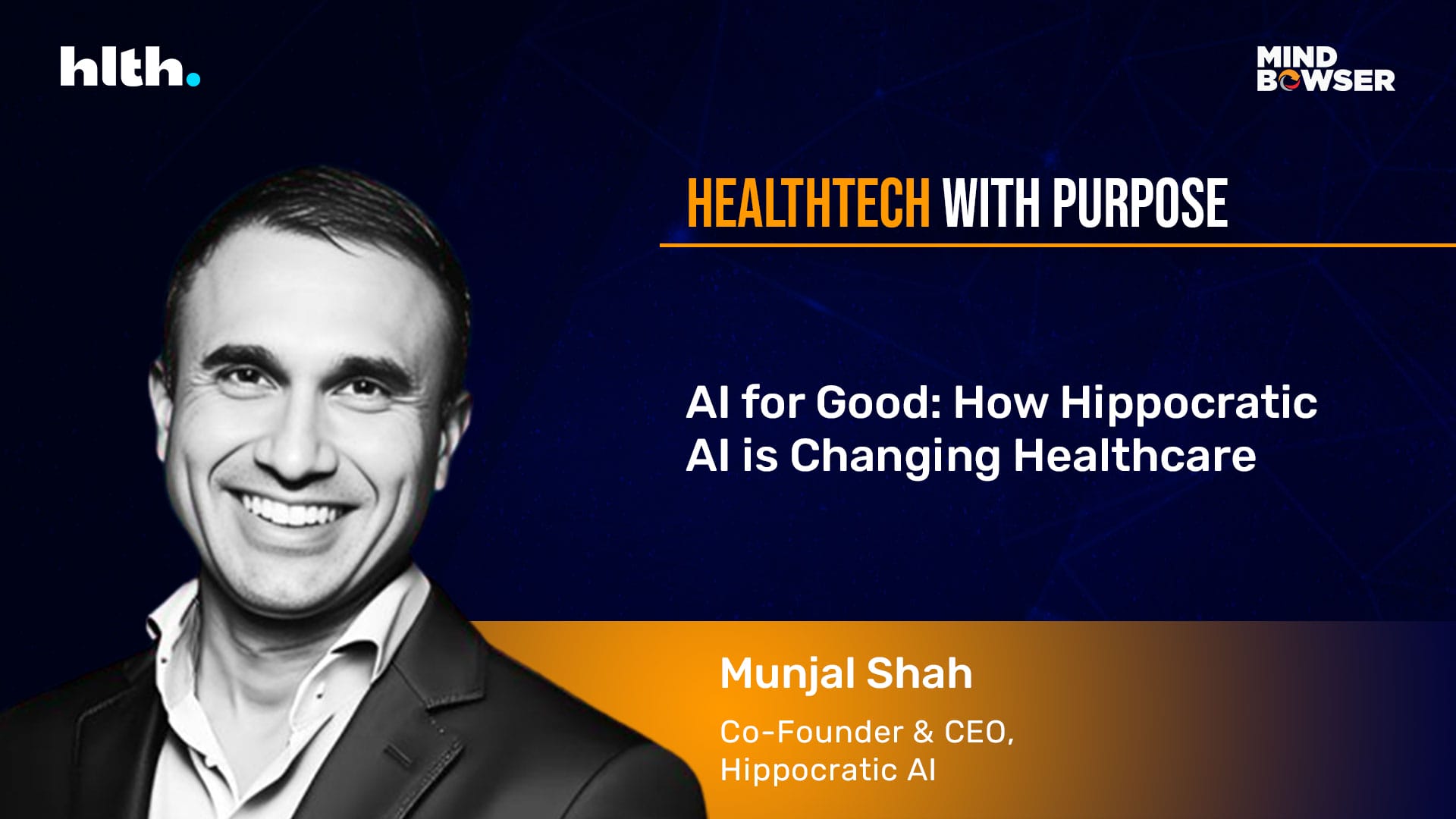


Join us for an enlightening episode of HealthTech with Purpose as we delve into a conversation with Munjal Shah, the visionary Co-founder & CEO of Hippocratic AI, a pioneering company that’s transforming the healthcare industry with its safety-focused Large Language Model (LLM).
In this HealthTech with Purpose podcast, Mahek Chhatrapati, CEO & Co-founder of DocNexus, shares the challenges faced during the development of DocNexus and his current focus on feature development and meeting evolving needs of the users.
Michael Cardamone, CEO and Managing Partner of Forum Ventures (formerly Acceleprise), joins host Ayush Jain to explain how a high-volume, early-stage investor looks at health tech. Forum runs three businesses: a B2B accelerator investing in 80 to 85 companies a year, a pre-seed fund, and a venture studio that builds companies from scratch, with health tech a key vertical since COVID.
He walks through check sizes at each stage and reads the market from Forum’s own data: follow-on funding rates dipped in 2022 and 2023 and are trending back toward historical averages, with pre-seed and seed returning to something like 2018 and 2019 while Series B stays hard. On AI, he looks past diagnostics to early detection and to health system operations such as claims, prior authorization and nurse data entry. His checklist for fundable health founders: earned insight into the problem, real pull from the market, a credible way to prove efficacy, and, for health systems, at least one engaged design partner and a path to contracts of $200K to $250K or more a year. His negotiating tip: when a health system asks for warrants, ask for introductions to other systems in return.
Forum Ventures started in May 2014 as a B2B accelerator and, ten years on, has 32 full-time people and three businesses. The accelerator invests in 80 to 85 companies a year on standard terms of $100K, usually as the first check into a founding team with an early product. The pre-seed fund writes $250K to $750K checks into rounds of roughly $1M to $2M, half of them follow-ons into its own accelerator companies. The venture studio, 11 of the 32 people, builds companies from scratch, recruits co-founder CEOs once an idea is validated and early customers are lined up, and puts $250K on the balance sheet. Health tech became a key vertical after Michael’s wife went back to school to become a nurse and COVID opened the market further. Portfolio examples include Remo Health (tech-enabled dementia care) and Finni Health (helping practitioners build private ABA therapy practices).
With ten years of data on follow-on rates, meetings per round and time to close, Michael sees 2022 and 2023 below historical averages and the numbers now trending back. Pre-seed and seed feel like 2018 and 2019 again, not the “craziness” of 2020 and 2021. Series A is opening up with a higher bar; Series B and later rounds are getting done for a much smaller set of companies at high growth rates. For fund managers, limited partners (LPs) took a flight to safety toward brand-name funds and are only cautiously coming back to emerging managers and smaller funds.
Setting aside diagnostics and treatment, Michael is most excited by early detection: new modalities, such as listening to someone speak, to spot stroke or cardiac risk early enough to act. The second area is health system finances. With margins tighter since COVID, he sees demand for AI that drives cost down in operations and the back office: claims, pre-authorization, call centers and billing, plus inside the hospital, fall detection and automatic data entry so nurses don’t key everything in. That operational work is where AI in healthcare claims processing is heading. The obvious categories are crowding fast, he says, but because health system sales are slow and sticky, no single winner takes all.
His first test is how much unique insight the founders have about the problem, and how they earned it: years inside health systems or health tech, a personal health crisis, or relentless customer discovery. The second is early pull. Even with six-to-twelve-month sales cycles, are health systems offering to be design partners, to invest, to get involved early? He also wants founders to have a plan for proving efficacy: if you can’t show within a reasonable time that your product is what improved outcomes, health systems won’t pay for it. That’s why we start healthcare product development from a validated problem and build the evidence trail into the product from the start.
For health system sales, Michael wants at least one system meaningfully engaged as a design partner, giving clinician and department-head time, and a credible path to contracts of $200K to $250K or more a year; $50K or $60K a year rarely justifies the sales cycle. For self-insured employers, he looks for brokers willing to distribute and early engagement data; for payers, a design partner and big contract sizes; for private practices, deep customer discovery and an “on fire” problem. His tactical tip: when a health system asks an early-stage company for warrants, negotiate for introductions to other health systems as part of earning them. Innovation leaders know each other, and trust with one lowers the friction with the next five. Steven Collens of MATTER described the same dynamic on this show: how startups bridge the gap into hospitals.
Hello everyone, welcome to another episode of HealthTech with Purpose. Today we have Michael Cardamone joining us on our show. Michael is the CEO and Managing Partner of Forum Ventures, a B2B SaaS-focused seed fund, pre-seed accelerator program and community. Join us on this exciting episode, where Mike talks about early-stage health tech investment, emphasizing deep market understanding, regulatory knowledge and early signs of market pull as critical factors for success in healthcare strategy. Hi Mike, how are you today? Welcome to the show.
I’m good, thank you. Thanks for having me. Doing well. How are you?
Great. I’m doing perfectly great as well, and very excited about how things are going in health. It’s exciting every day.
Yes. No regrets that way.
So, great to be connected, Mike, for this podcast. We really wanted to know more about what’s going on in the VC circles for health currently. But before we get into that, how about a quick introduction? Over to you to introduce yourself and talk a bit more about Forum Ventures and what you’re up to.
Yeah, sounds good. I appreciate it. The quick background is: I’m in the New York area now, but I spent nine years in San Francisco. I was early at Box, and then at another startup in the education tech space, where we grew to about 24 million in revenue. And then we just hit 10 years: I started this in May of 2014, initially as a B2B-focused accelerator. We were the first check in, founding team, very early, with an initial fund in 2014.
Fast forward 10 years: we’re 32 people full-time, and we’ve got three parts to the business. We still run the accelerator; we invest in about 80 to 85 companies a year through it. We have a pre-seed fund, where about half of the investments we make out of that fund are follow-on investments in our own accelerator companies and half are outside the accelerator. And then we also have a venture studio, so 11 of the 32 people are focused on just building companies from scratch and then pulling in co-founder CEOs to help build those businesses with us. Those are the three parts of the business.
While we’re broadly focused on B2B, health tech is a pretty big vertical for us. My wife actually went back to school, pre-COVID, to become a nurse, and in talking to her and learning more about the industry, I started leaning into it. Then obviously COVID changed a lot of things and created a lot of opportunities. So it’s an area we’ve been leaning into a lot more over the last four or five years, and it has become a key vertical within our overall thesis. We’ve done quite a bit of health tech investing at the very early stages over the last four or five years.
Great, great. Any interesting stories coming from these investments? If you want to name or talk about a few of the companies you have invested in.
Yeah. We’ve invested in 500-plus companies over the years, just given the volume of companies through the accelerator, so we’ve had a lot of early successes outside of health tech, before it became a key vertical. Within health tech, more recently, we’re in a company called Remo Health, which is building a lot of tech-enabled service around dementia care and is doing really well. We’re in a company called Finni Health, which is helping practitioners build out their own private practices around ABA therapy, and they’re growing very quickly; General Catalyst is also an investor in that company. So we’ve been in a bunch of companies around health tech, but those are a couple, just to name them.
Great, great. Can you tell us more about the size of investment you look at? Is it typically early stage, or do you do later stages as well? And what is your investment thesis, if you can share more about that?
Yeah. Like I said, we have three ways we can work with, engage and invest in founders. In the venture studio, we start the companies from scratch. We’re coming up with ideas and bringing CEOs in, and once we do a lot of validation and work in tandem with the CEO to iterate on the idea, validate it and line up early customers, we then form the company and put 250K on the balance sheet initially, so they can hit the ground running with some capital.
The accelerator is where we do about 80 to 85 investments a year, and our standard accelerator terms are 100K for 7.5%, so pretty typical accelerator terms. Every company that comes in gets 100K. It’s typically a founding team with some early version of a product; they may or may not have customers yet. We’re typically the first check in, or very early capital, and then we work very hands-on with them to help with go-to-market and fundraising, making sure they’re going after the right ideal customer profile, and really being in the weeds with them on tactical go-to-market strategy especially.
Then the pre-seed fund: we’re currently investing out of our second one, and check sizes range anywhere from 250K to 750K out of that fund. In that fund we’re typically investing in a 1 to 2 million round, and we’re either the largest or second-largest check in the round in most cases. Those are often pre-seed deals or small seed deals. They usually have some early traction, but not always; it depends on the market and the founder. But at a high level, those are the check sizes and strategies for all three.
Great, okay. A follow-up question: how is the investment environment currently, given that there has already been a lot of news? Are things picking up? Do you see any particular patterns you can share, especially in terms of investments?
Yeah, yeah. We’re in a pretty unique position, given the volume of companies we have coming through the accelerator, to see early signals, at least at the early stages, and even some of the later stages. I don’t have data on it yet, but it feels to me like things are starting to pick up. We have 10 years of data on follow-on funding rates out of the accelerator: how many meetings it takes to get a round done, how long it takes to get a round done. That data in ’22 and ’23 was lower than historical averages, and we’re starting to trend back up to the historical averages we’ve seen over 10 years.
So it feels a little bit like pre-seed and seed are starting to open up a bit. We’re obviously not anywhere near, nor should we be, the craziness of 2020 and 2021, but I think we’re getting back to a normal, like the 2018 and 2019 time frame, in early stage. I think Series A is starting to open up a bit, but the bar is certainly higher than it has been in the past. And I think B and later is still pretty challenging. Rounds are getting done, but in a much smaller subset of companies, and those rounds tend to be very big and competitive. The bar and growth rate to get those B rounds done is pretty high right now.
Okay. Most of the news we read or come across is from the point of view of a founder: how the environment is for them. For VCs, how is the environment, both for raising capital and for investment opportunities?
Yeah. LPs… it was really hard to raise capital as a fund in ’22 and ’23. It feels like right now LPs are at least taking more meetings. You saw a number of different factors that led to a flight to safety from LPs, which meant more capital in a subset of brand-name funds, because that’s viewed as safety. It’s like the old adage that you don’t get fired for buying IBM: you don’t get fired for investing in Kleiner or Sequoia or whatever. So you saw a pullback from emerging managers and smaller funds, and I think LPs are starting to lean back into that, but cautiously. It’s still hard to raise capital, and I think you’ll see a lot of funds that popped up in 2020 and 2021 struggle to raise second funds. But I do think it’s starting to open up a bit more, and LPs are starting to add new managers again in that emerging manager, smaller fund category. It’s just not anywhere near as frantic a pace as it was in ’21.
That was an outlier, and it spoiled us.
Yeah. Expectations, yeah.
Okay. So Mike, there has been a lot of talk about AI, and of course it has been exciting for both hospital systems, like a CIO, and VCs: the possibilities that exist. VC investment especially is all about counting on future opportunities and the future outlook. So in your opinion, how do you see the evolution of AI, and what are the real use cases or substantial progress you are seeing around AI?
Yeah, yeah. The obvious ones, which we can skip over, are that there’s a lot happening around diagnostics and treatment with AI. Outside of those areas, one is early detection. We’re seeing a lot of people trying to leverage new modalities for early detection: just listening to someone talking and trying to detect early signs of whether they’re at risk of a stroke, or whether there are things you can do around early detection of potential cardiac issues down the road, where you can leverage AI for much better preventive opportunities within healthcare, as opposed to just waiting for there to be an issue and then using AI to diagnose it. So I’m excited about a lot of the early detection work: biomarkers, or ways to detect someone trending negatively from a health perspective early enough that you can catch it and do something about it before it becomes a major issue.
Then on the financial side: health systems have struggled a bit financially since COVID, and margins have gotten tighter. So I think a lot of them are looking at solutions that can help drive costs down or bring incremental new revenue, but in a lot of cases drive costs down on the operating side and the back-office side. Things like how you handle claims and pre-authorization and all that kind of stuff: minimizing a lot of the back and forth and the need for call centers and billing, and trying to streamline and automate a lot of that. And even operationally within the health system: are there things you can do around fall detection, or automatic input of data, versus having the nurses input it every time, to save them time? I think there are a lot of areas within the operations of health systems where AI can have a pretty big impact on driving costs down over time.
Great. But is it a crowded market? Do you see this as a substantial wave already, or is it an early wave that may go through a Gartner hype cycle: go low, come back, and then a few winners emerge? How do you see it as a VC?
Yeah. I think the obvious opportunities are becoming crowded quickly, but it’s unclear who the winners are going to be still, because a lot of them are still early enough, and sales cycles are long with…
This episode of the HealthTech with Purpose podcast is brought to you by Mindbowser, a product engineering and digital transformation company focused on health. At Mindbowser, we enable health companies to build the future of health with accessible, equitable [inaudible] patient care. We strongly believe that technology can empower a healthier world, and that’s why we are partnering with healthcare experts like you to make it happen.
Hi guys, thanks for listening to HealthTech with Purpose. Make sure to subscribe to us on Spotify, Apple, and YouTube for more expert insights on industry innovation and transformation. And remember: share the knowledge.
…especially if you’re selling into health systems. I think it doesn’t have the dynamic of winner-take-all. Once you get into a health system, it’s going to be really sticky, and it takes a while to get into them. So I think there will be multiple winners across a lot of these categories, and it’s a big enough market that it can certainly support multiple big, venture-scale outcomes in a lot of these areas. So I think it’s starting to become crowded, but there’s still plenty of opportunity to find and invest in winners.
Great. So Mike, another interesting thing that is always on any health founder’s mind is how they become fundable, or successful, of course. Through the various programs you’ve run, from the accelerator to the venture studio to VC, what are the common themes, if you have any you can share? Like a checklist, or things to do for a health founder if they were to start today.
Yeah. This is maybe obvious, but I think having a deep understanding of the market and problem you’re trying to solve, and the nuances within it, is really important in almost anything you’re building, but in healthcare especially. That could be that you’ve spent a lot of time in healthcare, in health tech companies or at health systems, and you have a deep firsthand understanding from working there. It could be firsthand personal experience: you went through a health crisis, or someone in your family did, and you had to navigate it on the personal front. Or you’re just absolutely relentless about customer discovery: you talk to tons of people and really deeply understand the problem space you’re going after before you go after it. So one thing we look for is how much knowledge and unique insight the founders have about the problem they’re going after, and how they earned that knowledge.
Then on the other side, it’s more around: what are the early signs of pull from the market? Selling into health systems is not the only way to sell into healthcare, obviously; there are a lot of models. But is there strong pull, even if the sales cycles are really long? Are you getting health systems interested in being design partners? Are they interested in investing? Are they trying to figure out how to get involved even at the really early stage? Even though it may take 6 to 12 months to actually get to a full annual contract, you can start to sense how serious they are about the problem space, about this team, and about what you’re building and how you’re building it. That’s one way.
In Finni Health’s example, it was more about working with practitioners and spinning up private practices, and there was clear early pull and a mismatch in supply and demand, so a lot of market dynamics were in their favor. Remo Health has a lot of market tailwinds around it, obviously, with the baby boomers growing older and dementia being such a big problem. Most of the caretakers for people with dementia are not professionals; they’re family members who are caretakers. So helping them and empowering them to provide better care, and to provide more transparency back to the health systems, was a really important piece of dementia care where we thought there was a big opportunity.
So I think a lot of it is just understanding the market dynamics, understanding regulatory shifts that might create an opportunity, or new codes that come out that may create an opportunity, and then figuring out whether there are good tailwinds in the market and good pull from customers early, which is always hard to tell early. Health systems notoriously engage with a lot of early-stage companies, and then it’s actually pretty hard to get to that annual contract. So it’s really digging into how important this is, and what the engagement looks like with the people who are testing it in the beta phase, and trying to figure that out. It’s hard at the early stages, though.
Right. In fact, I always say that building a health startup is ten times tougher than building, say, an e-commerce startup or any other.
Yeah. Every industry has its challenges, but healthcare is certainly one of the harder industries to build in.
Yes. And even an MVP may not be just quickly setting up a web page or something. In most cases you still have to integrate, or manage PHI, or be compliant.
Yeah, yeah. There are extra compliance hurdles: being HIPAA compliant, depending on what you’re doing. And even then, we see a lot of things that are technology to augment care, improve care or improve outcomes, and part of it is: how long is it going to take to prove the efficacy of what you’re doing, and how clear will it be that your solution is the thing that improved it? Because if you can’t prove that over some reasonable amount of time, it’s going to be really hard to convince health systems to pay for it. So that’s another big piece health tech founders need to really think through. Intuitively, it sounds like what you’re doing could improve care, but there are so many moving parts. How do you actually prove that? How do you prove you’re improving patient outcomes? Because it’s really hard.
That’s right. So it must be tough, I can imagine, as a VC as well, to be able to bet, because there are so many unknowns that all have to fall into the right place, hopefully. So my follow-up question would be: what kind of market validation, or minimum market validation, would you look for in a health startup to be investable, or to count on as a winner in its early cycle?
Yeah. At the stage we’re investing in, which is very, very early, if you’re selling into health systems, we want to see at least one health system meaningfully engaged as a design partner: giving you time from the clinicians, from the head of whatever department you’re selling into, to give meaningful feedback on the product and help you build a product that will eventually become a six-figure-plus contract with them.
That’s another piece of it too: if everything goes well, what do we think the contract size will be, and is that big enough relative to what we think the sales cycles will be? So we try to validate: if all this works the way you think it’s going to work, and hope it’s going to work, talking to the health system that’s engaged, what do you think the willingness to pay is going to be, and what do you think this contract can become over time? Because we see a lot of health tech companies selling to health systems where maybe the end contract is only 50K or 60K a year, and we just don’t think that’s big enough to justify how hard the sales cycles are with health systems to build a really big venture-scale business. So we would need to see a clear path to 200K or 250K-plus type contracts, or it’s going to be hard to see it working at scale. That’s a lot of what we do on the health system side.
If you’re selling to employers, as a benefit for self-insured employers, some of what we’ll want to see is: do you have any employers on board, or any brokers who are willing to be distributors of this, because they think it’s additive for their customers? Have you had anyone beta test it, and what has the engagement been with employees? Because, again, is it actually being utilized as a benefit, and are you realizing the benefit? So some early signals around engagement and efficacy of what you’re trying to do to help that self-insured employer reduce their costs, and how hard that will be to prove over time. So we’re looking for meaningful engagement from either a broker who’s going to distribute it or a self-insured employer who thinks it could have a material impact, and then some early signs of engagement at the employee level.
And obviously, if you’re selling to payers, it’s similar to health systems. There just aren’t a ton of payers, so the contract sizes need to be big, and hopefully you have at least one engaged as a design partner. If it’s more for private practices, we want to see that you did a ton of customer discovery and talked to a lot of private practices, and that there’s a clear, on-fire problem they want to solve. It can’t be a nice-to-have. So we make sure they’ve really fleshed that out through customer discovery and have a bit of a pipeline of private practices they’ve talked to that are interested in what they’re building.
Right, right, well said. Those are all great points. A follow-up to that, Mike: you are someone who sees great companies on a daily basis. To solve this puzzle, are there any smart moves or smarter ways you’ve seen companies take, where you felt, oh, this was really a better way than what most people think? Any hacks or smart moves you’ve seen from companies, especially during that early, existential period when a lot of things have to fall into place?
Yeah. One of these is just going back to health systems, which I know is just one customer segment within healthcare. I’ve seen an increasing trend of health systems, when they take the risk of engaging with super early-stage founders, trying to get warrants or other things, to get some upside for the risk they’re taking in engaging with that early-stage company. I think that’s generally okay. But I think some health tech founders have been able to negotiate those warrants being tied not just to that customer, or to getting data from that health system, but also to saying: hey, can you also make introductions to other health systems in order to earn the warrant? Because all the innovation teams and department heads at all these health systems, a lot of them know each other. They meet at conferences, they talk about stuff. So if you can build trust with one, it reduces the friction in getting the next five.
So when a health system inevitably wants to come in and ask for warrants, or some equity, or some future right to invest at a price, or whatever they’re asking for (it’s different for every health system), try to build in some distribution and introductions as part of that, and make sure that’s a clear ask and that they’re willing to do it. I think that’s been a bit of a hack, because the reality is it’s just a grind to get your first two, three, four health systems on. It can snowball after that, once you build trust with multiple systems, but you need to do everything you can just to get those first few in, build trust, and show that it works.
So I think the [inaudible] is harder than the hundred.
Yeah, I mean, it’s never easy, but it becomes easier the more you build a little mini brand and build trust with other health systems. But man, getting those first few health systems over the goal line is hard.
Right. So one thing we’ve seen historically is that a lot of technology disruption, or more acceptance rather, happens when there’s a push from legislation, or something from CMS, or any big change happening at the top. Are there any such changes, rules or regulations that our viewers should be aware of, where through your research you’ve seen one big trend that could be happening?
Yeah. I don’t know of any right now. I’m sure there are; there’s stuff all the time, so I’d have to go back and look through it. I think, depending on what happens with this presidential election, there’s risk around the flexibility around telehealth, and things could change a bit depending on who’s in office. I tend to think there will be a lot of changes depending on what happens with the presidential election. And as you pointed out, any regulatory change creates opportunity, so we’ll watch it closely. I’m sure there will be a bunch of things that can create opportunities.
Great. And one last question: for any company looking to get themselves in front of you, what would be the best channel?
Yeah, they can send an email to mike@forumvc.com, or they can submit on our website, on the “pitch us” form. Those are probably the two easiest ways. The pitch form is probably better, because I get a lot of emails, but I try to respond to everyone from a founder. So those are probably the easiest ways to get in touch with us.
Great. Thank you, Mike. Super awesome. Thank you for all the great thoughts shared. I believe it will be super helpful for our viewers, and they can definitely take a few of these ideas, apply them and build better health. Thank you so much.
Great, yeah. Thanks for having me. I really appreciate it.
Thank you for joining us on the HealthTech with Purpose podcast. Before you leave, make sure to like and subscribe on Spotify, Apple, and YouTube. And if you would like to see someone on this podcast, do refer them to us; my contact details are in the description. Before I leave, I wish you: stay healthy, stay curious, and keep building.
At the time of recording (published July 2024), Michael Cardamone was CEO and Managing Partner of Forum Ventures, the early-stage B2B investor he founded in May 2014 as the accelerator Acceleprise and rebranded in 2021. Forum runs a B2B accelerator, a pre-seed fund and a venture studio, with health tech as a key vertical; its portfolio includes Remo Health and Finni Health. Before Forum, he spent nine years in San Francisco, including an early role at Box and a stint at an education technology startup that grew to about $24 million in revenue. LinkedIn: https://www.linkedin.com/in/michaelcardamone/
Lining up your first health system design partner? Tell us what they need to see working, and we’ll help you scope a build that can prove it.
Welcome to HealthTech with Purpose! In this episode, Ayush Jain talks with Doug Williams, a Product Lead at Orbit Software and an AI expert at MIT. Doug shares tips for turning ideas into reality, focusing on solving real problems, and prioritizing customers. He also discusses the future of technology, including AI’s role in empowering humans. If you’re interested in innovation or starting a business, don’t miss this episode!
Join us for an inspiring podcast featuring Ian Madom, CEO & Co-founder, and Sanji Silva, CPO, of Mocingbird. Explore their journey in building a CME management platform and their insights on healthcare, technology, and the future of the industry.
Partner with us to design, build, and scale digital solutions that drive better outcomes.
Global Tech Teams LLC, 525 Washington Blvd, Industrious at Newport Tower, Jersey City, NJ 07310, United States.
Let’s discuss your goals, workflows, and next steps in a focused consultation call.
 Schedule a Call














 BLOGS
 NEWSROOM
 CASE STUDIES
 WEBINARS
 PODCASTS
 ASSET HUB
 EVENT CALENDAR