In this episode of Mindbowser’s DEI podcast series, CMO Manisha Khadge talks with Dr. Brittany Barreto, geneticist, serial entrepreneur and founder of FemHealth Insights, known for her FemTech Focus podcast. Brittany traces her path from a PhD in molecular and human genetics at Baylor College of Medicine to founding Pheramor, a DNA-based dating app that closed when Apple changed its App Store policy on DNA data, and on to venture capital at Capital Factory.
She defines femtech as innovation in conditions that solely, disproportionately or differently affect females, and explains why she sees it as a diversity, equity and inclusion (DEI) story from the ground up: cell lines and animal models that are mostly male, sex-specific data that went unanalyzed until the NIH changed its policy in 2016, and a sleep drug whose dosing for women was eventually cut. She describes an industry where most founders are women and many are patient advocates, and a personal workaround she resents but recommends: wearing a lab coat to pitches so investors would stop asking where the CEO was. She closes with advice for women founders: the world is not on your shoulders.
Brittany defines femtech as innovation in women’s health and wellness across three kinds of conditions: those that solely affect females (maternal health, menopause, menstruation), those that disproportionately affect them (she cites autoimmune disease, where by her figure over 90 percent of patients are female), and those that affect them differently (heart attacks present differently in a female heart). Medicine, she argues, was built on a male paradigm that assumed everyone reacts to drugs the way a 180-pound man would. She credits Ida Tin, founder of the period-tracking app Clue, with coining the word “femtech” around 2016, and describes the field as science-driven, activist and, in her words, a trillion-dollar industry.
Her DEI case starts in the lab. By her figures, 75 percent of cell lines and 95 percent of animal models used in research are male, so a compound that might work in cells with two X chromosomes can be thrown out as a negative result. Until the NIH made sex a biological variable for its grants in 2016, researchers who tested both sexes weren’t required to analyze the data separately. Her example is Ambien: women metabolize it more slowly, and women were getting into car accidents the next morning until the FDA moved to sex-specific dosing. Danika Kelly of My Normative described on this show how her platform is built to close that same gap in female-focused health research data.
She also links the rise of femtech to more women in science, technology, engineering and medicine, and notes that by her estimate over 85 percent of femtech founders are women, many of them patient advocates who waited years for a diagnosis. The flip side is underfunding. For femtech teams building a product on tight capital, the choice of digital health product development partner matters as much as the idea.
At 22 or 23, pitching Pheramor to angel networks, Brittany was repeatedly asked whether she was there to set up for the CEO. Her fix was to wear a lab coat to pitches, even though, as a scientist, she knew lab coats exist for protection, not authority. Investors suddenly greeted “Dr. Barreto” and offered her coffee. She added “PhD” to her conference badges for the same reason. She hates that it took a costume, but tells women founders to do what they have to do, so they can become the people in the room making the decisions. Dr. Julie Harrigan told a similar story in this series about convincing people she was the doctor, not the nurse, and Mindbowser’s own research on women in healthcare leadership lists gender bias in hiring and promotion among the top barriers women report.
Brittany’s closing advice is aimed at underrepresented founders who feel they carry an entire movement. When Pheramor closed after raising about $1.3 million, she mailed the remaining roughly $50,000 back to her angel investors with handwritten apologies, then later heard of male founders who took the money and went to Hawaii. Her message: you don’t owe anyone that weight, your responsibility is to share your story, every setback is a trampoline to the next step, and rest is part of the work. She says her business didn’t slow when she stopped answering email after dinner.
All right, hello all. This is Manisha Khadge, Chief Marketing Officer at Mindbowser. Welcome to our DEI (diversity, equity and inclusion) podcast series. Today’s guest is Brittany Barreto. She’s the president and founder of FemHealth Insights, and globally known as the voice of femtech, dedicating her work to advancing women’s health. Brittany, I welcome you to our DEI podcast, and I would love to start with your quick introduction, please.
Thank you so much for having me here, it’s a pleasure. I’m Dr. Brittany Barreto. I’m a geneticist by training, a serial entrepreneur and an investor. I’ve had a long history of working in science and starting different startups, and we can dive into all of that. But most recently, I’m best known for my podcast, FemTech Focus, where I interview innovators, thought leaders and researchers on the past, present and future of women’s health innovation. We’ve also launched a landscaping tool through FemHealth Insights. FemHealth Insights is our corporate-facing company, and the landscaping tool is the largest database of femtech startups; a femtech startup is a startup working in women’s health. We also provide consulting and leadership services to other companies interested in engaging in women’s health innovation.
Great. And I would say, who could be a better person than you to talk about DEI? Before we jump into DEI more specifically, I guess the listeners would love to hear your journey as a scientist and…
Absolutely, yes. It’s not every day that you have a PhD podcaster, although podcasts are definitely getting more mainstream and more common, but I never thought that was my trajectory. So I’ll back up a little. I’ve always been obsessed with DNA. I think DNA and genetics are just the coolest thing to learn about, and I’m very much a nerd at heart. I pursued my PhD in molecular and human genetics at Baylor College of Medicine, and that’s where I found the entrepreneurship community. I had way too much personality to work in a lab my whole life, and red tape is not something I work well with, which is a very common trait of an entrepreneur.
I found the entrepreneurship community, and I had an idea for a DNA-based dating app. That was actually my first company: a DNA-based dating app called Pheramor, where we matched singles based on a cheek swab that looked at genes that could predict physical chemistry through pheromones. I fundraised, and I built and scaled that company, and unfortunately the company did close. It’s a whole other podcast episode; if you just Google Pheramor, with the “ph,” you can probably find the story. Essentially, Apple changed their policy around who could ask for DNA in the App Store, and dating was prohibited, so we got kicked off the App Store and my company closed.
So if you’re listening to this and you’re an entrepreneur who may see the writing on the wall, or has just recently closed their company, and you’re questioning yourself: believe me, the best entrepreneurs have had to close companies in the past, so you’re actually on track to do well. I always like to share that point in my story, because people will sometimes say, “Oh, everyone’s so successful all the time,” and it’s just not the case.
So I closed that company, and at that point I was recruited into venture capital, and I learned how investors actually made their decisions on the other side of the table. I was really good at fundraising as a founder, but I didn’t quite understand the science, or magic if you will, behind making an investment decision. I worked for Capital Factory, the largest and most active fund in Texas, and I ran their Houston branch. That’s where I came across some women’s health companies.
Femtech is an industry that is innovation in women’s health and wellness, and this includes things that solely, disproportionately or differently affect females. I’ll break that down really quickly. “Solely” is probably what you thought of when I said women’s health: maternal health, menopause, menstruation, things that only affect the female biology. Then you have things in women’s health that actually affect both sexes, but either disproportionately affect females or differently affect females. Autoimmune disease is a great example: over 90 percent of autoimmune patients are female, so it’s very much disproportionately on that sex. “Differently” is heart disease, as an example. The way heart attacks manifest in a female heart is actually quite different from a male heart, and that has to do with the mechanics and physiology of our hearts based on our sex.
What happened is that medicine, healthcare and science in general have been based on a male paradigm, assuming everyone reacts to medication or gets sick the same way a 180-pound white male would. I’m sure listeners are rolling their eyes, knowing that’s just not true. A little old lady who’s 90 pounds probably shouldn’t get the same dosage a 250-pound man should, and yet our healthcare system is not taking that into account. So femtech is this movement that says sex as a biological variable is critical when innovating in healthcare.
You may have wondered, where the heck has this industry been? Women have always been here, and healthcare has been here, but unfortunately this is a recent movement. It was founded in about 2016. Ida Tin, the founder of Clue, the period-tracking app, was the first person to use the word “femtech,” and it’s just really blown up ever since. I became extremely passionate about it. I love it because, number one, it’s very science-oriented: we’re talking about hormones, physiology and psychology. Number two, it’s an activist movement: we’re fighting for equality in healthcare based on sex and gender. And lastly, it’s a trillion-dollar industry where you just have to be willing to say the word “vulva,” and you could potentially become a global leader overnight.
That’s essentially what happened with the FemTech Focus podcast. I started it in March 2020, when we went into lockdown. What is a good feminist scientist supposed to do in lockdown? She starts a podcast. I mostly did it so I could learn more, because there were so few resources and so little information online about this industry, femtech, that I said, “Well, heck, I’ll just interview some people, throw it on Spotify and see what happens.” Within a few weeks we had a few thousand listeners, and the rest is history. It blew up. I’m happy to tell you a bit more about our programs today, but that’s my story of how I got into femtech.
Amazing, that’s an inspiring story for sure, and a DNA dating app sounds extremely interesting. You rightly said people would say others have always been successful; I don’t think so. That’s the realistic way to look at things. I think failure teaches you more than success. It’s the best learning experience, everyone goes through it, and that’s what makes them the human beings they are today. Great to know your journey. So, talking about diversity, equity and inclusion: how do you see the intersection of DEI with femtech? If you could talk a little about that.
I mean, sometimes it’s almost indistinguishable. Femtech is the industry focused on healthcare, and yet the whole thing is based on this DEI principle. First, let me reiterate what I said before: the backdrop to science has been male dominated. You can look at even the cells we use in basic scientific research: 75 percent of our cell lines are male only. So when you’re trying to screen compounds to find cures for certain diseases, if you’re only using male cells, maybe the compound you’re testing would work if you had two X chromosomes, but because your cell line is XY, it’s a negative result, and maybe it gets thrown in the trash. So we start with that basic understanding: science is male dominated.
You move into animal models: 95 percent of animal models are male only. There are studies where they actually gave endometriosis to mice. Endometriosis affects one in ten women; it’s a very painful uterine disorder where the endometrial lining, the tissue that comes off every month during menstruation, is outside the uterus, so it’s essentially like internal bleeding. They gave this to male mice, found a drug that cured it, and as soon as they went to human trials, it failed immediately. This is a really great case study of what happens when the backdrop to science is male and you then try to move it into female humans: oftentimes it doesn’t compute. It’s not the same, and there are really important factors we’re not taking into account.
Another factor, and again this is all DEI, is that historically scientists have been male. That’s not to say men were saying, “We don’t care about women,” but there are inherent biases we cannot see in ourselves until they are identified. What we actually see is that the rise of femtech corresponds to the rise of females in STEM (science, technology, engineering and mathematics). The more women we have in science, technology, engineering and medicine, the more female-specific solutions we create. In retrospect you can say, “Oh wow, look at that: when you have diversity in the laboratory, when you have diversity in clinical trials, whether that’s on the patient side, the cell side, the animal model side or the scientist side, we start to see other variables.”
2016 was the first time the NIH (National Institutes of Health) mandated that if you have an NIH research grant, you have to consider sex as a biological variable, which is bananas. What that means is that NIH research before 2016, if it tested males and females, didn’t have to separate that data and analyze it separately. So a lot of the time, drugs work really well for males and only subpar for females, and yet when you summarize the data it was statistically significant enough to get approved.
And you have consequences of this lack of DEI in research, regulation and policy. For example, Ambien. Ambien is a pill that helps people sleep, and it turns out the female metabolism metabolizes Ambien much more slowly than the male. So for 20 years, women were being prescribed Ambien and getting into car accidents the next morning. Finally somebody said, “This is uncanny. How does this keep happening? All these women taking Ambien are getting into car accidents.” It turns out they were still sleepy, so sleepy that they were getting into car accidents. It is the first and only drug to date that the FDA (Food and Drug Administration) recalled and then re-approved with sex-specific dosages. I hypothesize there are many other drugs out there that females are being overdosed on, because there are no sex-dependent dosages. So that’s the DEI part in terms of our industry and innovation.
Then there’s the founder side of it: who’s leading this movement. It is predominantly a female-led movement. Over 85 percent of the founders of these startups are female. I have yet to come across any other industry where 85 percent of the founders are female. I don’t know, maybe cosmetics or makeup or consumer packaged goods, but certainly not in deep healthcare. So it’s really interesting to see this industry driven predominantly by one sex and gender, and you can see how that manifests in how our industry operates. There’s a lot of collaboration, a lot of partnership, a lot of passion over profits, and just passion in general. I would actually categorize most of our founders as patient advocates. They’re usually women who had endometriosis and had to wait eight years for a diagnosis, or had cervical cancer, or felt a lump in their breast at 28 and their doctors dismissed them, and it turned out to be cancer. These are very, very passionate women who want to help themselves, but even more, want to help future women.
So in terms of the demographics of who’s leading the movement, we don’t have a DEI issue, unless you think we need more white men, maybe. It’s a really interesting flip of the script. We do have negative consequences because of that: we’re underfunded and under-resourced, and I can dive into the consequences of this awesome movement. But those are some of the aspects of the history and the present day of our industry for DEI.
Those are great insights. I guess 85 percent is such an encouraging number, and the women in femtech are absolutely doing a great job, because the real power is to empower others, and I think that’s precisely what the femtech women are doing. It’s great to know. You spoke about one challenge, which is fewer resources and less funding, but you might have come across many challenges during your entire journey, specifically around DEI. If you could throw some light on those challenges, how they impacted you and how you overcame them, I think that would be a great learning for people who listen to this podcast.
Well, I’ll give you an example from my own personal experience. This was pre-femtech for me, at my startup, Pheramor. I was 22 or 23 when I founded it, so I was relatively young for a founder. I would show up to a pitch at an angel network, and they would say, “Oh, welcome. Are you here to set up the presentation for the CEO? Where is he?” And I’d say, “It’s me. I am the CEO. I’m here to set up; it’s me.” I realized they really thought I was a secretary or an assistant, and then having to transition that into “No, I’m the CEO” created this giant wedge of awkwardness between us. That was not great for my conversion in getting investors.
So what I started to do was wear a lab coat to my pitches. Any actual scientist would say lab coats are meant for protection, not authority; they’re made to protect your skin from chemicals and vice versa. But I noticed investors didn’t know that. They just saw a white coat. So I would show up in a white coat, and immediately as I walked in the door they’d say, “Oh, Dr. Barreto, welcome. Do you need a water? A tea, a coffee? How can we support you?” And I’d be like, “I’m good, thank you.” All of a sudden the energy was, “Woman in a white coat. She knows what she’s talking about.”
I hate that I had to wear a costume to get respect, but I also tell female founders: do whatever you’ve got to do. You’re hustling so hard. If it’s just wearing a different colored shirt, or flats versus heels, or a suit versus a dress, it’s not fair, and I recognize that, but we’re playing the game here. You need to become successful so that you are the person in the room making the decisions, and you’re not making comments about whether you think someone’s an assistant or a CEO. So one is costumes.
The other thing I would do: my name’s Brittany Barreto, but I have a PhD, so at conferences I’d take my badge and write “comma, PhD” after Barreto, or put “Dr.” in front of Brittany. It was incredible the number of times I was talking to someone, say at a booth for my company, typically men, and they’d say, “Okay, yeah, you’re doing this, that’s nice.” I’d talk to them about genetics and so on, and then they’d look down at my tag, see the PhD or “Doctor,” and say, “Wait, you’re a doctor?” I’m like, “Yeah, I have a PhD in molecular and human genetics.” And they’d be like, “Oh, what are you working on again?” Oh my gosh, it would unnerve me and make me so mad, because it was like they weren’t listening. But you know what? I had to do what I had to do.
What’s really fun, Manisha, is that in femtech I no longer feel the need to wear a costume or put that on my name tag, which is beautiful and amazing and awesome. I think a lot of industries can learn from femtech: we all just respect each other at face value. But those are some of the things I had to do, and how I overcame them, in the past.
Amazing. I think these are learnings that would help others overcome the challenges you have faced, and that’s the reason we wanted to dwell on it. Maybe we should conclude with your thoughts, or a message you would like to give to the audience listening to you, not just with respect to femtech but also as a woman entrepreneur.
Ladies, if you’re listening: the world is not on your shoulders. That’s something I always felt, and sometimes I still struggle with it. I felt it was so much my responsibility to carry this industry on my back, because I’m breaking barriers for all the future diverse folks who want to come into it, and that pressure is just unsustainable.
I recently talked to a femtech company, two founders I’ve known for about three years now, and they’re leaning towards closing their company. I could just see the heaviness on them. It’s not just them closing their company and wondering what they did wrong; it was almost this weight of “We’ve let them all down: all the women, all the girls, all the people who aren’t white and male who want to start a company. We’ve let them all down.” I had that same feeling when my first company closed. What I’ll say is: you are not letting us down, and you do not owe anything to anyone.
I remember when I closed my company, I had fundraised about $1.3 million. We had about $50,000 left in the bank account, and I wrote checks out to all my angel investors, some as little as $500, based on the ratio of their original investment, each with a little handwritten apology note: “I’m so sorry this company didn’t work out the way we thought.” I felt so devastated. I have since heard of so many male founders seeing the writing on the wall that their company wasn’t going to go well, and they took the money and went to Hawaii. And I’m like, what? That was an option? That was even an option? So I think it’s a really dramatic example of the pressure female founders feel: “Oh my God, I’m the one female founder in this investor’s portfolio, and if I fail, they may never make that investment again.” That is not your responsibility at all. So I want to invite you to let yourself off that hook. If it’s in you, get that hook out and throw it away, because that’s not your responsibility.
Your responsibility, though, is to give back, to tell your story and to provide insights. You may feel ashamed of it and therefore not want to, but the most courageous and most helpful thing is actually to share your story, the way I’m just talking about it openly here. I don’t think anyone has thought any less of me throughout this interview. So I invite you to see your trials and tribulations as a jumping-off point. I wouldn’t have gotten a job as a venture capitalist after a PhD in genetics if I hadn’t had that startup in the middle. See each thing as the trampoline, the jumping point to the next level, and just, like, eff it. Go out there and try your best.
Choose your mental health. It’s absolutely a marathon. Every time I think, “Oh, this is just a sprint, just a season of intense work,” I have gone years with “Oh, this is just a season of intense work.” Take that vacation, go outside, breathe in that fresh air. I’ve had some of the best business ideas while at a lakeside. It is incredible to see that getting out of my inbox is actually the best thing for my business, versus sitting here for hours on end.
So those are some pieces of advice for people who are underrepresented, because I know we hold ourselves to such high standards so often. Don’t go back on your email after dinner. Spend that time with yourself, your partner, your kids, your animals, whatever. Those emails will be there tomorrow. I used to be someone who’d work all day, take a break and get back online. It’s probably been a year and a half or two years that I haven’t been doing that, and my business has not slowed, which I thought would be proportionate to the number of hours I sat at my computer. It’s not, because I’ve rested, I’ve digested, I’ve loved myself and others, and I came back refreshed and was able to be more effective. So those are some of the tips I always love to share with underrepresented founders who hold themselves to higher standards than anybody else even does.
Well, those are great thoughts, and your stories are absolutely inspiring. Thank you so much for talking to us so candidly. The takeaway I would particularly like to highlight, after talking to you, is that it’s okay to fail; what you do after you fail is what defines you and your journey, and your success is a true example of that. Brittany, thank you so much. It’s a great pleasure talking to you.
Thank you so much. If your listeners want to learn more about women’s health innovation, please listen to the FemTech Focus podcast. Subscribe, rate it, review it, share it with a friend. We have some really great episodes on there, and you don’t have to be female to listen; men listen to it all the time and learn really interesting facts about the innovations happening in women’s health. And if you work for a company that might be interested in working in women’s health, please reach out to me at FemHealth Insights, or just go to femhealthinsights.com and send us a note through the contact us form. We’d be happy to work with your business, no matter how big or small, on your women’s health strategy.
Sounds great, Brittany. Thank you so much.
Thank you.
At the time of recording (published September 2023), Dr. Brittany Barreto was the founder of FemHealth Insights, a women’s health market research company whose landscaping tool she describes as the largest database of femtech startups, and host of the FemTech Focus podcast, which she started in March 2020. She holds a PhD in molecular and human genetics from Baylor College of Medicine, where she founded Pheramor, a DNA-based dating app that raised about $1.3 million before closing. She then worked in venture capital at Capital Factory, where she launched and ran its Houston branch. In May 2025, FemHealth Insights was acquired by In Women’s Health.
Building a women’s health product and want it to hold up with clinicians and investors alike? Tell us what you’re working on and we’ll show you how we’d build it.

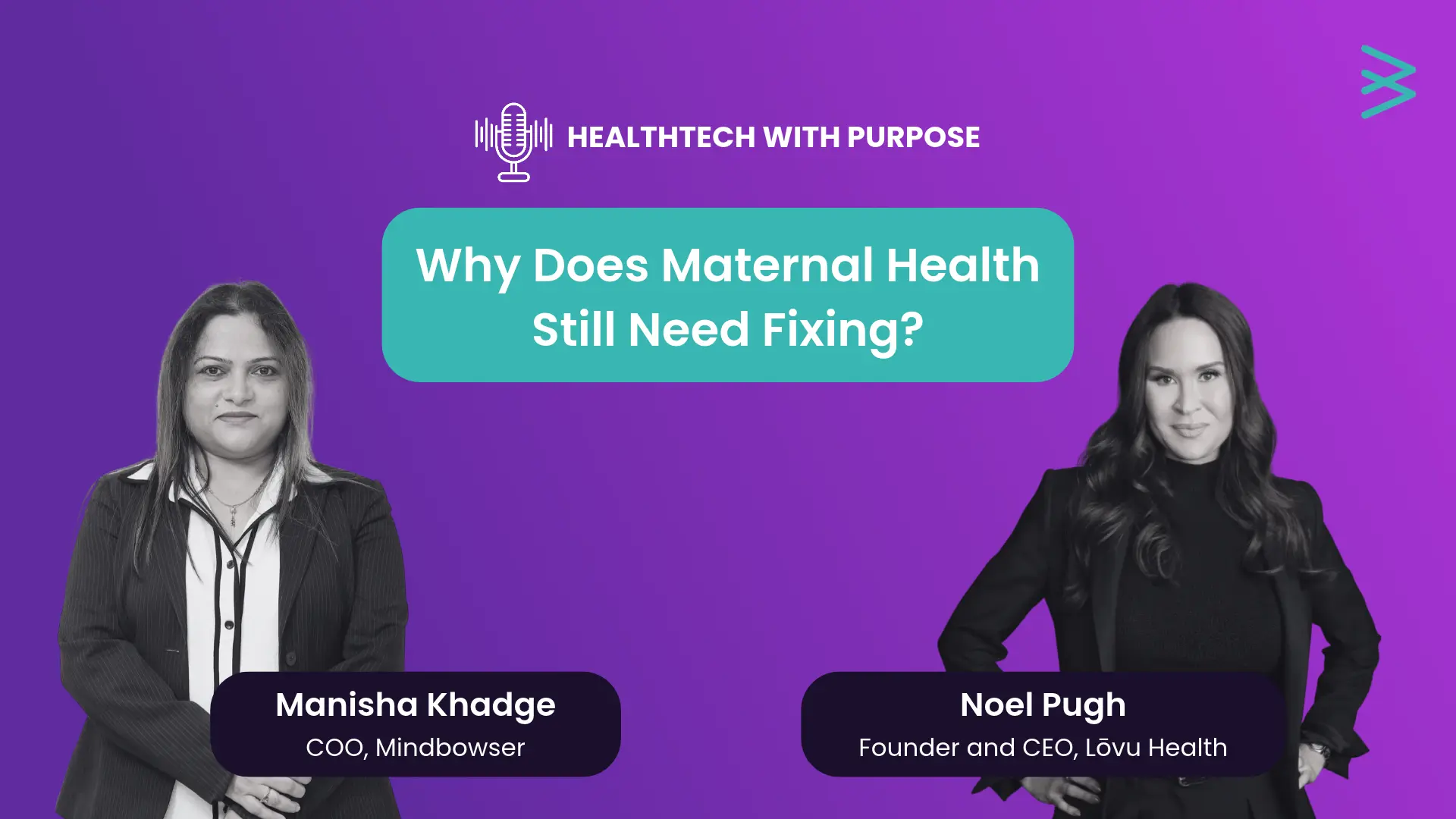
Noel Pugh, Founder & CEO of Lōvu Health, joins host Manisha Khadge, COO of Mindbowser, to unpack why maternal healthcare needs to move beyond monitoring complications toward supporting the everyday needs of mothers. She traces Lōvu Health’s journey building an insurance-reimbursed maternal monitoring and navigation program that connects mothers, clinicians, and community resources.
The conversation gets into the practical side of building that model: remote physiological monitoring, care navigation, EHR interoperability, and bidirectional data exchange. Noel explains how Lōvu’s athenahealth integration helped automate workflows, reduce manual work, and create a foundation for scaling across more healthcare organizations.
She also shares how Lōvu Health is approaching agentic AI, with potential applications across maternal navigation, clinical workflows, revenue cycle operations, and service recommendations, while keeping humans involved in critical decisions. The conversation closes with the realities healthcare founders face around reimbursement, investor skepticism, clinical adoption, go-to-market, and choosing the right technology partner.

Branden Fini, healthcare VC and partner at Providence Ventures, joins host Ayush Jain to explain how a strategic investor picks and backs digital health companies. He traces his path from pre-med sciences into more than a decade of venture capital, then lays out the Providence Ventures model: commercial-stage companies, Providence as anchor LP, and customer access as the edge that shortens healthcare’s notoriously long adoption cycles.
He argues the market reset that began in 2022 makes this a good time to invest, because valuations are more rational. On AI, he applies the same test he uses for any company: real, differentiated results for enterprise buyers who are risk averse and budget constrained, with no premium for technology looking for a problem. The sharpest section covers what goes wrong after Series A: sales teams built before there is a lead engine, raising more than growth can justify, and founders blaming the market once the early adopters run out. He closes with the two capital efficiency ratios he tracks, the firm’s move to an independent fund with more strategic LPs, and the thesis areas he’s watching: workforce, consumer engagement and behavioral health.
Partner with us to design, build, and scale digital solutions that drive better outcomes.
Global Tech Teams LLC, 525 Washington Blvd, Industrious at Newport Tower, Jersey City, NJ 07310, United States.
Let’s discuss your goals, workflows, and next steps in a focused consultation call.
 Schedule a Call













 BLOGS
 NEWSROOM
 CASE STUDIES
 WEBINARS
 PODCASTS
 ASSET HUB
 EVENT CALENDAR