Noel Pugh, Founder & CEO of Lōvu Health, joins host Manisha Khadge, COO of Mindbowser, to unpack why maternal healthcare needs to move beyond monitoring complications toward supporting the everyday needs of mothers. She traces Lōvu Health’s journey building an insurance-reimbursed maternal monitoring and navigation program that connects mothers, clinicians, and community resources.
The conversation gets into the practical side of building that model: remote physiological monitoring, care navigation, EHR interoperability, and bidirectional data exchange. Noel explains how Lōvu’s athenahealth integration helped automate workflows, reduce manual work, and create a foundation for scaling across more healthcare organizations.
She also shares how Lōvu Health is approaching agentic AI, with potential applications across maternal navigation, clinical workflows, revenue cycle operations, and service recommendations, while keeping humans involved in critical decisions. The conversation closes with the realities healthcare founders face around reimbursement, investor skepticism, clinical adoption, go-to-market, and choosing the right technology partner.
Noel Pugh calls herself a “recovering healthcare administrator,” out of HCA, Barnes Jewish, and Houston Methodist. Running Northern California strategy and children’s service lines at HCA, she watched OB physicians get penalized on C-section and NICU metrics with no tools to actually change the outcome. In a service-line meeting, she started talking with her co-founder, Dr. Santosh Pandipati, a maternal-fetal medicine physician. The two built a remote physiological surveillance model during COVID inside another company, then decided it had to stand alone. Her own path to the decision was personal: she’d struggled with infertility herself, which is part of why she calls Lōvu “my baby.” She ran the numbers over a weekend (roughly 60% gross margin if she could get the model reimbursed), and that’s when she agreed to be CEO.
Noel is direct about where she won’t let AI run alone: suicidal ideation, preeclampsia, spousal abuse. “An agent has no place in guiding a suicidal mother into a hospital system,” she says. That’s a human task, full stop. It’s the same discipline behind human-in-the-loop checkpoints in any healthcare AI deployment: approval gates and escalation paths for the moments where getting it wrong isn’t an option, even as the rest of the workflow gets automated.
Noel walks through a real patient story to make the model concrete: a 19-year-old on Medicaid, enrolled through her OB at no cost, given a blood pressure monitor, fetal heart rate monitor, and smart scale that sync automatically. That’s the same device layer (blood pressure cuffs, glucometers, pulse oximeters, smart scales) behind most remote monitoring programs, but here it’s paired with an Edinburgh Postnatal Depression Scale survey. When her score comes back at 16 (positive for suicidal ideation, her partner unreachable for three days), the platform escalates immediately: the clinical practice and a Lōvu navigator are notified, and the mental health team places an emergency call that connects her same-day to one of seven providers. Everything lands in an insight report inside the OB’s EHR before the next visit.
Mindbowser built Lōvu’s athenaOne integration with the team on ConnectHealth, so remote monitoring data can reach OB practices in the EHR they already use. Noel’s blunt about underestimating this part: a lot of vendors oversell how well they actually integrate with EHRs. It’s the same gap that shows up when a vendor claims FHIR Observation support that falls apart under real validation: the difference between a plug-and-play integration and months of costly rework.
Lōvu’s AI roadmap is four named “agentic companions”: a navigator agent for the mother, “Santosh” (named after her co-founder) as the clinician-facing agent flagging out-of-range vitals, “Justin” (named after her head of revenue cycle) curating CPT codes for human sign-off, which already let the team retire an eight-person manual coding function, and a newly built fourth agent, “Chloe,” for the services marketplace. The model today is roughly 20% technology and 80% human capital; Noel expects that to flip by 2028.
Asked for one piece of advice for founders building in maternal health, Noel doesn’t hedge: resilience matters more than having the best idea. It’s the same resilience that keeps entrepreneurs pushing through setbacks on the hard, unglamorous stretch of building a company that the public story always skips.
In the United States, the delivery system as it’s been designed really treats pregnancy which is a physiological state as a disease. Right? In the United States, we have women in cul-de-sacs alone, depressed, anxious, be water through gravel.
Manisha Khadge [00:19]
Welcome to HealthTech with Purpose. the show where we meet the people building healthcare technology with a purpose and a reason behind it. I am Manisha Khadge, your host for today and also chief operating officer at Mindbowser. Today’s guest is a friend and an extremely inspiring woman founder, Noel. She’s the founder and CEO of Lōvu Health, a maternal health company based in California. Noel, welcome to the show.
Noel Pugh [00:51]
Oh my goodness, thank you for having me and what a beautiful introduction.
All right, great. So probably you know we’ll kickstart talking about a big picture but certainly is all around why does maternal health still needs
Noel Pugh [01:09]
Yeah, thank you. Thank you for asking that. I mean, that’s the raison d’être of Lōvu Health is is the why and and what I would argue and share with the audience is that what ails the maternal health world and here in the United States and to some extent globally is actually problematic across all health conditions. It’s just uniquely obvious in healthcare as applied to maternal health. In the United States, the delivery system as it’s been designed really treats pregnancy, which is a physiological state, as a disease. And under that lens and under the reimbursement mechanisms of that lens, what you end up doing is really having a system that identifies major pathologies that might be obvious in a woman or major fetal abnormalities. But what it doesn’t do, the delivery system more broadly, is reward those micro movements that a woman needs to make on a daily basis in order to create her own what we call health production. That could be how do I expose myself to nutrition? How do I expose myself to lactation services? How do I get birthing support classes? So much of what I just articulated actually creates a better outcome for mom long term, but is not actively rewarded in the delivery system by this thing we call CPT codes and ICD10 codes and procedural codes in a way that has been obvious to the clinician until Lōvu. So that’s one piece of the problem. there hasn’t been the right resource and economic background to actually connect mom and baby to health production. The second piece is in the United States, we don’t have a whole woman care model. We don’t have a wraparound model. We have a model that really addresses a mom in isolation and as I said previously major fetal abnormality major identification of pathology but we don’t have a model that actively tethers together and this is where we’ll get deep into the work that Mindbowser does for for Lōvu how in the world we all come together to mom through this journey we call it sort of the digital village the marketplace the ecosphere but in a old and You know, you and I were just talking about South Asian culture. When a woman became pregnant, an entire community wrapped around her and brought resources, right? In the United States, we have women in cul-de-sacs, alone, depressed, anxious, suffering through what should be one of the happiest times in their lives in complete isolation without a companion to guide them through the necessary health production to create a better outcome. As a result of this, we see here in the United States that 85% of maternal mortality is absolutely preventable. This is what the CDC says. The vast majority of maternal morbidity or those sort of bad outcomes that don’t lend themselves to mortality are also preventable. And as a result of that, the healthcare delivery system from a payer perspective, the insurance companies are paying upwards of four billion dollars per annum for things that could have been avoided. Emergency department, NICU admissions, maternal ICU admissions. And it all comes from the system just being focused in the wrong way, right? System should be focused on health production, not hey, you’re pregnant, but there go you’re sick. Right.
Manisha Khadge [04:52]
Those are great insight and you’re absolutely right. I specifically want to understand where it comes from you know personally. So what was that moment or maybe a person or your own experience that actually made you say that you know I want to build something which takes care of this challenge
Thank you for the asking the origin story, Manisha. So I’m a recovering healthcare administrator. I hail from organizations like HCA, um, Barnes Jewish, uh, Houston Methodist. while I was working as a healthcare administrator at HCA and I was sort of running the Northern California footprint for strategy and children’s I began to recognize that there were women needlessly languishing in the OBEDs and the L & D floor and so many of those women were suffering from what I would call preventable outcome and I would meet with the OBS associated with the service line. I literally go to the service line chair meetings and in those meetings the OBS were saying you’re upset with us because our C-section rate is too high yet we don’t have the tools to actually create a better outcome and you’re counting our NICU admissions. It’s almost like you want to have bad outcomes. So recognizing the perverse nature of the delivery system and it was in a service line meeting I began speaking my co-founder Dr. Santosh Pandipati, a maternal fetal medicine guy, uh, Michigan grad, brainiac. He is literally the guy that the NIH will call when they want to have a position on how the environment affects preterm delivery. He looks up at me and he’s kind of like nodding. And we realize we’re sympatico. We began journeying together through different career phases and we recognized that the delivery system as it was built today was in need of an overhaul. it hadn’t been overhauled in 90 plus years. Now, there’s been some major innovations, but the care model in of itself that you had to have, you know, between eight and 12, maybe 14 visits in person hadn’t really been rethought in a very long time. And so, this is sort of during high COVID pandemic. He and started developing a remote physiological surveillance model. And then I said, it’s not enough just to physiologically monitor these women. we need to wrap them with the resources in order to create the better outcome. And while we were thinking about this, we were literally growing this idea in another company, incubating it in another organization. And then I said to him, I said, “There’s no way we’re going to be able to create this model, innovate this model, run this model within this company. It’s its own company.” And he said, “But you’re going to be the CEO, right?” And I sat there thinking, you know, I’m not a woman who’s had a bad outcome. Actually, I’m a woman who tried to become pregnant and I couldn’t get pregnant, which is why Lōvu is now my baby. And I’m grateful for it. For all the women who struggle with infertility, please know there’s alternative junk journeys to motherhood. But I sat down with a pot of coffee over a weekend and I said, “If I can commercialize this model, if I can figure out how to get reimbursement around the right answer and bring a net new delivery model to the ecosystem, I will be the CEO.” So I pots of coffee, a lots of candy, and there it was lines on. So about 60% gross profit margin. This thing is going to make sense from a revenue perspective. I think we’ve got a company from a commercialization perspective. Now, let’s go build the tech to support it.
Manisha Khadge [08:49]
Wow. You’re making it sound quite easy but I I assume at that time it must be a very very bold decision for sure. Was there any feedback which kind of stuck to you and you know or there was some push back kind of a feedback and how how did you deal with it?
Yeah absolutely and I love this question. So, first and foremost, Lōvu is the first maternal surveillance engine that is AI native, and we’re gonna I know we’re going to talk later about all things agentic. But we we have a tremendous amount of human capital still attached. And when you’re talking about things like suicidal ideation, preeclampsia, spousal abuse, we could never be wholly agentic. A real human does need to be attached to our model. But to that end, the other thing that’s attached to our model is a first-in-world services marketplace. So we knew we could not provide lactation solutions. We knew we could not provide nutrition counseling, mental health counseling. It was asking too much of our core team and asking us to become less of a technological firm and more of a services-based firm. So we partnered and we built the first in-world services marketplace. Now when you take our primary go-to-market strategy around physiological surveillance and then you combined it with the services marketplace that’s a lot to chew. So when we sat down with investors investors didn’t understand our model. The reason they didn’t understand our model is because the delivery system we were just talking about is so broken that the sophistication and the nuance of the solutions, the substack that must be built in order to put the plumbing together to solve for such a broken delivery system. It’s not sexy, right? It’s not so investable, right? Because it doesn’t feel sexy, right? And then it’s really hard to understand. You have to literally live and breathe and be a healthcare operator to get how Lōvu works from a from a like a guttural perspective. And so the investors would come back and say, “Your story doesn’t make sense. Your story’s broken. This doesn’t feel investable.” And I have to tell you, Manisha, we had to live and breathe off of checks coming in the door as we were raising capital from the OBS who were using our product from healthcare operators and CEOs of hospital systems that said, “I see what you’re doing. This is the right answer. This will work until we got to the necessary and requisite revenue marks.” So that we became unseeable, right? Investment community. And once they kept they wait a second, you’ve got 1.2 million in revenue. You’re growing this quickly. Your gross profit margin is sitting at 68%. I don’t understand what you’re doing, but you’re doing something right. That was the problem is that people kept saying our storytelling was broken. No, the delivery system is broken and the story that is told around the delivery system is almost impossible to understand.
Manisha Khadge [11:52]
Right. Right. Yeah. So it’s more like you kind of showed the proof point for them to actually believe what you’re building which is absolutely great. So that that’s a great segue to specifically talk about Lōvu Health itself. and maybe you know for the listeners you can probably try and define it what exactly Lōvu Health is in a a layman language or the other side of the story is that when you actually take it to the market and talk to these health plans and hospital system what’s your overall simplified version to explain what Lōvu Health does
Noel Pugh [12:39]
totally I think let me do this in two parts I think the First thing I’ll do is from a 30,000 foot perspective, what’s Lōvu? And then let’s talk about a use case like exactly how mom would journey through our platform.
Manisha Khadge [12:50]
Okay.
From a 30,000 ft perspective, Lōvu Health is an insurance reimbured physiological surveillance program that wraps around mom and the baby. And we follow moms from the time she’s pregnant to upwards of two years postpartum. When we do this, again, it’s reimbursed by insurance, but it is actually plugged into her obstetric office. Her doctor recommends it. And as she’s being navigated by the Lōvu platform and connected into resources and learning more about her body and learning how to become a better health producer, we’re managing that patient with the doctor. Good. We do. So, it may not seem intuitive, but we’re removing about 30% of the work that the doctors do around health education, health promotion, diagnostics, testing. We’re removing that work off the back of the doctor. Taking it on through an agentic workforce, right? So that’s kind of what we do. And the thing that our health systems love about Lōvu is that we unlock new revenue streams, new procedural codes that pay for everything I just said. Now, we take fair market value for those codes and then the doctors take the rest. So, there’s clinicians that are literally making 60,000 $100,000 a year off of our model. And you might be thinking, well, it sounds like more cost to the delivery system. we’re actually preventing the NICU admission, long-term maternal stay. And so we’re saving the delivery system at large more money because we’re reducing total cost of care, but we’re moving the investment in care upstream versus into the bad out bad outcomes. So that’s kind of how we work a use case support everything I’ve said. I’ll give you a patient story. U let’s make her second grade health literacy level. She’s 19 years old. She lives in West Texas. This is a real patient of ours. Okay. So, she comes into her OB’s practice pregnant and she’s kind of scared. She and her partner are not yet married. The family is supportive, but she’s really scared because she doesn’t know that her partner is going to stick around for this journey. So, she’s scared and worried about the pregnancy. And she’s on Medicaid. Mhm. And at the time she finds out her pregnant, her doctor says, “Hey, listen. There’s this program. It’s going to provide you with all sorts of connections to community resources, housing, food security, lactation services, but we’re also going to be able to monitor your pregnancy long term because you’ve got a family history of gestational diabetes and chronic hypertension.” Mhm. Mom says, “That sounds great. Now, we have an onboarding specialist that reaches out to mom, explains how Lōvu works with her insurance because she’s on Medicaid. There’s no co-pay, no deductible, right? Insurance pays for this program. And mom signs up, she receives a blood pressure monitor, a fetal heart rate monitor, a smart scale. All of these are precision devices and they automatically connect and mom is automatically passing on her data every time she takes a reading to the platform. Now our platform using multicriteria decision analytics today tomorrow and agent is going to connect her thoughtfully based upon gestational age her background her demographic her insurance to any resource she might need. So let’s imagine that mom is taking her measurements and then she’s done what’s called her Edinburgh depression survey on behalf of the platform. The platform pushes this out. That survey comes back at a 16, which is a big red flag, and it’s positive for suicidal ideation. Mom’s in crisis. Her partner has gone off to the rigs. She hasn’t heard from him in 3 days. She doesn’t even know if her relationship’s intact. And here she is 4 months pregnant. She’s thinking about ending her life.
If you or someone you know is having thoughts of suicide, the 988 Suicide & Crisis Lifeline is available 24/7: call or text 988.
Now, immediately this is going to be escalated to the clinical practice. The clinical practice is going to be notified by the Lōvu platform and also separately notified by a Lōvu navigator. Every receives a navigator who is culturally and community competence, speaks mom’s native language, this case oil and gas, and is actively navigating mom through the pregnancy. Once flags for the suicidal ideation, the Lōvu mental health team is going to immediately give her an exigent call, an emergency call, and we’re going to get her connected through the platform to one of our seven mental health providers who can see her same day and prescribe pharmacological intervention if needed. Now, all of the activity I just shared with you is curated into what’s called an insight report. And that’s part of the work that we’ve done together is to make this insight report is automatically configured and lives within the EMR, or electronic medical record of the physician practice. So the physician once mom comes back in for her monthly OB visit is able to see I see that you had this crisis. I know we talked about it in person when the crisis was active, but it looks like you’ve done well with your service provider for mental health. It looks like you were able to make it to the local local supports for housing security and meal security if you needed that and received some financial counseling as well. How are you feeling? And mom said, you know, that guy wasn’t the best guy. I’ve broken up with him, but I feel really safe and I feel really supported by my family and by Lōvu. Now, on the back end, the clinical practice is going to receive a large charge file that has all of the CPT codes or all of the procedural codes associated with all the work we just did on behalf of mom, the baby, and on behalf of the OB’s office, actively guiding mom through this health process. The clinician simply bills for the services, sends that off to the payer, and remits to us fair market value for our time, energy, and effort navigating mom through everything I just articulated. So, that’s kind of how the Lōvu program works.
Manisha Khadge [19:14]
Wow. That’s great. So, I would rather say that you’re not just helping, you know, moms, but this is basically, you know, saving lives for sure. tell us a little bit more about your partners and the whole integration ecosystem. I feel that the founders listening will want the honest version specifically around you connect with multiple system and what has been the hardest part of getting data to flow you know reliably.
Oh yeah. Oh my gosh. I mean this is this is the core of it. First let me just say you know we all know data data is the new oil right but it’s insufficient just to have data you have to have that right contextual layer informing the data in order for the new agentic world to operate effect effectively and forget the agentic world the rulesbased world too right now I think what Lōvu had to really think through is that folks realized that we were partnering with nutrition companies, lactation companies, exercise companies, grocery stores. We have over 70 partners nationally and internationally we’re partnered with today in order to wrap those services around mom. We had always requested of our services partners, we’re not going to charge you to be a part of Lōvu, but what we do ask of you is bidirectional data share and an integration strategy so that we can actively get back to the clinician and to the mom the power of your service. How do we know that a mental health intervention actually created a better outcome if we don’t know what the mental health intervention was? Right? So we need to know how many appointments did mom go to, what drug was prescribed, what’s her diagnosis, what’s her prognosis. That gives us the ability to really measure the interaction effects of our data and it brings again that contextual layer back to our data so that we have this now I will say Manisha Lōvu has a first and world data complement. We have mother’s data. We have the child’s data all coming together. We have consumer data genetic genomic. This has never been done before, right? We under anticipated the level of integrations lift, the level of interoperability work that would need be needed in order to make this thing is actually happening. The other thing we probably didn’t predict for was how many folks would show up on our doorstep saying we can do it. Misrepresenting their abilities. And listen, a lot of folks have all the ambition in the world and they don’t know how difficult it is until they try to do it. And so we had teams saying, “Oh yeah, I’ve got HIPAA experience. I know what it means to work with this EMR, that EMR.” And I have to be candid, it wasn’t until I sat down with you and you my reached conviction within two sentences understood that you guys, Mindbowser had the ability to actually help create an integration strategy through your AI platforms that made integrations more possible for Lōvu. But I think that that is if you’re if you’re going to survive and really have a competitive moat in the new world, you must be thinking about a powerful data integration strategy and pulling data from not only your world, but the worlds that are tangental or adjacent to you. And you’ve got to have a trusted partner to do that. So I I think that speaks to to the data that that we’re we’re building. And it’s it’s only as good as the integrations that support it. It’s only as good as the contextual layer around it.
Manisha Khadge [23:08]
Makes total sense. so if you could tell maybe another founder one thing about picking the right partner what would be the top in your list?
Noel Pugh [23:22]
Oh my god. Well, let’s just take one item off the the board and that is capacity and ability. Like you got to know that, right? But I think the most important thing is the emotional quotient of the team, right? Missionbased alignment, right? Does the partner believe in your product? Right? Does the partner get inspired when you as a founder speak about what you’re building? If you’re miss aligned and if you’re morally and ethically aligned, the level of work is going to be magnified because of trust, right? That is key. And I think, you know, that’s what we found with you like this instant sort of we’re on the same page and we believe in the mission of moms and babies,
Manisha Khadge [24:11]
right? Absolutely. I still remember our first meet and you know the way we clicked in those minutes and you know Yeah.
Noel Pugh [24:19]
Exactly. Yeah. Well, I mean, and you know, some of those I I have an advisor who is a billion-dollar CEO, okay? And he invested personally in Lōvu and he said, “If I’m going to invest in you, I I want to make sure.” And he got a huge check and that that really led to some of the growth of our investment strategy. He said, “I’m investing you personally, but I’m going to coach you.” And I said, “Great. Who gets an, you know, an adviser of this?” Right? That’s a bonus. You know, I thought this guy was going to be all data, all you know, this is, you know, these are the frameworks from which you make a decision. But he was just like that gut feeling. I know I can trust a human being. Follow it. When the organization starts to smell and tell if something’s not quite right, identify who could be the player that’s causing the stink, right? And remove it and remove it quickly. Don’t wait. So I tend to partner quickly and if it doesn’t work I term quickly. Right. So I’ll pause there.
Manisha Khadge [25:28]
Okay. Great. I assume that anything you create ultimately you know it boils down to the impact you create and the any tech you build has to be adopted well. so you know maybe if you can talk a little bit more about the overall impact and your go-to-market
So Lōvu had a very intented goal of making sure that we partner directly with clinicians because we really did believe if you’re going to move the needle on maternal mortality, you can’t do it just through a payer alone strategy, right? There’s a lot of companies that plug directly into employer benefit plans or into health health insurance plans. and more often not than not, women don’t even know they have that service available to them, let alone take advantage of it. Right? But if you go to your OB and your OB says, I believe in this program, you know about it, right? So that was the primary reason we partnered in with the OB and then the OB can actually help to move the needle on the health production elements, help to encourage health production. So we believed foundationally in the sacred nature of the physician recommendation or the clinical recommendation. We think that that’s still intact. so that go-to-market of go directly into OB communities and partner with innovative physicians that are looking to make a difference in a community was our primary thesis. Now one of the things that we look like look look at from a go-to-market perspective of you know the CPT codes that are in our model must be reimburseable within a market in order for us to approach that market. But then the other side of that is what’s the fertility rates? how many babies are being born in this community and then what is the appetite of the clinical body to actually innovate to adopt a new model to be part of a new care delivery system. So we really look at those three elements upon going into any given market. Once we go live I mean it’s pretty simple. We have a lightweight BAA meets contract and a physician can quickly install the Lōvu programming. And I think what made us very different and I would really encourage founders in health tech to be thinking about is you know investors love and they get really excited about the blue chip organizations the Beth Israel the UCSF the University of Utah as it were in in pregnancy. Don’t forget that the vast majority of healthcare delivery is still living within the private practice, right? Or in those practices that are backed by private equity and seem to be amalgamated in, you know, the major healthcare delivery groups. I privy comes to mind, right? The partnerships that we built are we really bifurcated how we grew in market. We said we’re not going to just have these long-tail long sales cycle conversations with the likes of Stamford. We’re also on the other side going to partner with the clinical bodies that deliver babies at Stanford, independent clinical clinicians. And it was that bifurcated growth strategy that enabled us to put up enough quick and fast numbers from a revenue perspective while the pipeline was growing on the healthcare delivery system side that enabled us to get the robust robust level of funding. and so so that’s kind of the the go-to market strategy. I would say today we’re deeply focused on still a human capital intensive model because the reimbursement around that is is what’s causing us to be that way but we’re always designing for a future state model which is going to be like for example Manisha today our model is about 20% 80% human capital we think we can flip that on its head and that’s growth strategy from a product perspective by 2028 now that will inform our go-to-market. that it’s going to look a little different and it may mean we’re still plugging into the clinician’s office but the insurance company is paying us a flat fee for
Manisha Khadge [29:39]
Right. Yeah. Okay. So I I think you certainly spoke about you know your series your funding and when I actually went through the actual release which you know and read it through it primarily you know heavily to build out AI. So when we talk about AI, AI is part of every healthcare.
Noel Pugh [30:06]
Oh, absolutely. Yeah. Yeah.
Manisha Khadge [30:10]
Yeah. So yeah,
let me let me me let me give you kind of where we’re headed. You’re exactly right. I mean, we raised in order to light our go-to-market on fire, but at the same time invest deeply in the necessary technology in order to become who we need to become in the new world. Lōvu began with the vision of really building out three agentic companions that would guide mom through pregnancy. One would be the navigator of the mother. The second would be the best friend to the clinician agent Santosh named after my co-founder. The third would be agent Justin named after my head of revenue cycle that would be reading a top constantly of all the activity of the platform and actually curating a body of CPT codes for blessing. nice. We since identified a fourth agent that we’re actively building. That’s agent Chloe and she’s going to be our marketplace agent actively recommending services and technologies on behalf of mom. now intelligently agent Justin’s built and that’s very exciting and you actually Mindbowser touch agent Justin because you’ve built our backend athenahealth integration and so agent Justin literally reads a top all of the activity associated with navigation assessing monitoring and triaging of mom through the various steps of the Lōvu platform and then turns that into CPT codes that Justin the human being then says yes that makes sense I bless as a result of and Justin we were literally able to deprecate an eight person team so that’s comp right sizing we no longer needed human capital to manually code Justin enabled us to do this so that was a gorgeous use of agentic technology and capability now what is coming down the pike which is really going to enable us to deprecate our reliance on so much human labor for purposes of navigating mom. Agent Sharon, who is going to be forming our navigators. This is what you should do for your mom at this time. And by the way, let me go ahead and push that education for you. So, it’s no longer manual, right? Let me go ahead and and push that answer for you. Does this answer make sense? It will always be humang guided. Mhm. But agent Sharon is going to start to do the lift. And then agent Santosh is going to be able to literally contact the physician and say, “Dear doc, you have a patient who’s materially out of range, blood pressure 147 over 83. Do you want to send that patient into L & D or would you like them to come into the physician’s office?” Now I know many of us have begun to learn and particularly the founders and anybody who’s tethered to Silicon Valley headless software is all the thing right how to directly connect into the back end as opposed to having this middleware interface Lōvu is getting pretty sexy there is too as well our future state just imagine you’re no longer logging into a physician’s dashboard you’re no longer logging into the Lōvu application you’re literally texting Lōvu as a doc, as a patient, asking for your insight report or telling agents to that you want the patient to go to the emergency department. So that’s where we’re headed.
Manisha Khadge [33:31]
Nice. So I think that 80% road map is all set. Yeah. I just had one question maybe you know with respect to AI in particularly and agentic AI is that do do you see any apprehension specifically from the hospitals and health plans and you know the actual private clinics who are act you know using your system. How do you basically address those challenges then?
Noel Pugh [33:59]
Yeah. From a healthcare delivery perspective, one of the things that’s always recognized is exactly what I said probably 15 minutes ago, which is pregnancy is sacred and it’s going to be managed agentically. There could be things that fall through the cracks that should always have human touch. And this is why I say Lōvu will always have human beings attached, right? An agent has no no place in guiding a suicidal mother into a hospital system or into her next steps from a care delivery perspective. That is human task. So we’ll always be attached and I think the apprehension of the healthcare delivery systems has nothing to do with the use of AI. I think they’re relieved to use AI where appropriate. and as long as we’re dealing with things that are, you know, high trust, SOC 2, ho HIPAA-compliant, all the words, all the things, the systems are pretty like, okay, that makes sense. Where the citizens are apprehensive today is that in the face of major administrative changes here in the United States, in the face of the one big beautiful bill, in the face of pervasive cuts to Medicaid, how are they going to sustain an OB service line? How are they going to sustain their acute care delivery footprint in the unknown? So they tend to freeze and constrict in today’s environment. So you see delayed decision-m and it it’s not about AI. It’s about uncertainty as to whether or not they’re going to even exist under the current reimbursement frameworks.
Manisha Khadge [35:36]
Got it. That brings us to our last section which is more like a rapid fire oneliner kind of a question. Of course it starts with one piece of advice for founders who are building you know m maternal health products and apps. what what would you say to them?
One my biggest piece of water through gravel. There is a way through be like there is always a way through. The resilience is what makes the difference in a founder. You can have the best idea in the world, but if you are not emotionally resilient, flexible, pliable, you will not make it. Be water through gravel.
Manisha Khadge [36:19]
Great. And what’s next for Lōvu in next 12 months, maybe?
Noel Pugh [36:23]
Oh girl. We are likely going to take on a pretty significant round of funding and we’re going to change the world. we believe will be the standard of care across the American delivery system. But it wouldn’t surprise me if you didn’t see us in India, if you didn’t see us in France, if you didn’t see us in Germany.
Manisha Khadge [36:44]
Wow, that’s that’s amazing way to probably end the podcast. th those are, you know, some of the great u goals to achieve and I’m sure that you will the way you are moving, you know, onward and upward. thank you so much for sharing your story and you know not just talking about the product but actually sharing the whole personal story and so for listeners I just want to mention that we are continuing this conversation at health in Vegas on November 16th at 11:15 where Noel is joining me on another panel session where we’ll have couple of more founders where we’ll talk about whose data and whose model and building AI that works for women’s health. So if you care about women’s health and the data behind it, please join us there. until next time, this is Healthtech with Purpose. Manisha signing off. Thank you for listening in.
Noel Pugh [37:44]
Thanks Manisha.
At the time of recording (November 2026), Noel Pugh was Founder & CEO of Lōvu Health, a maternal health platform pairing remote physiological monitoring with a human navigator and a vetted services marketplace, built into OB practice workflows. A former healthcare administrator at HCA, Barnes Jewish, and Houston Methodist, she co-founded Lōvu with Dr. Santosh Pandipati, a maternal-fetal medicine physician.
Building a healthcare product that has to know exactly where AI stops and a human has to take over? Tell us the workflow and we’ll show you how we’d build the integration and the guardrails around it.

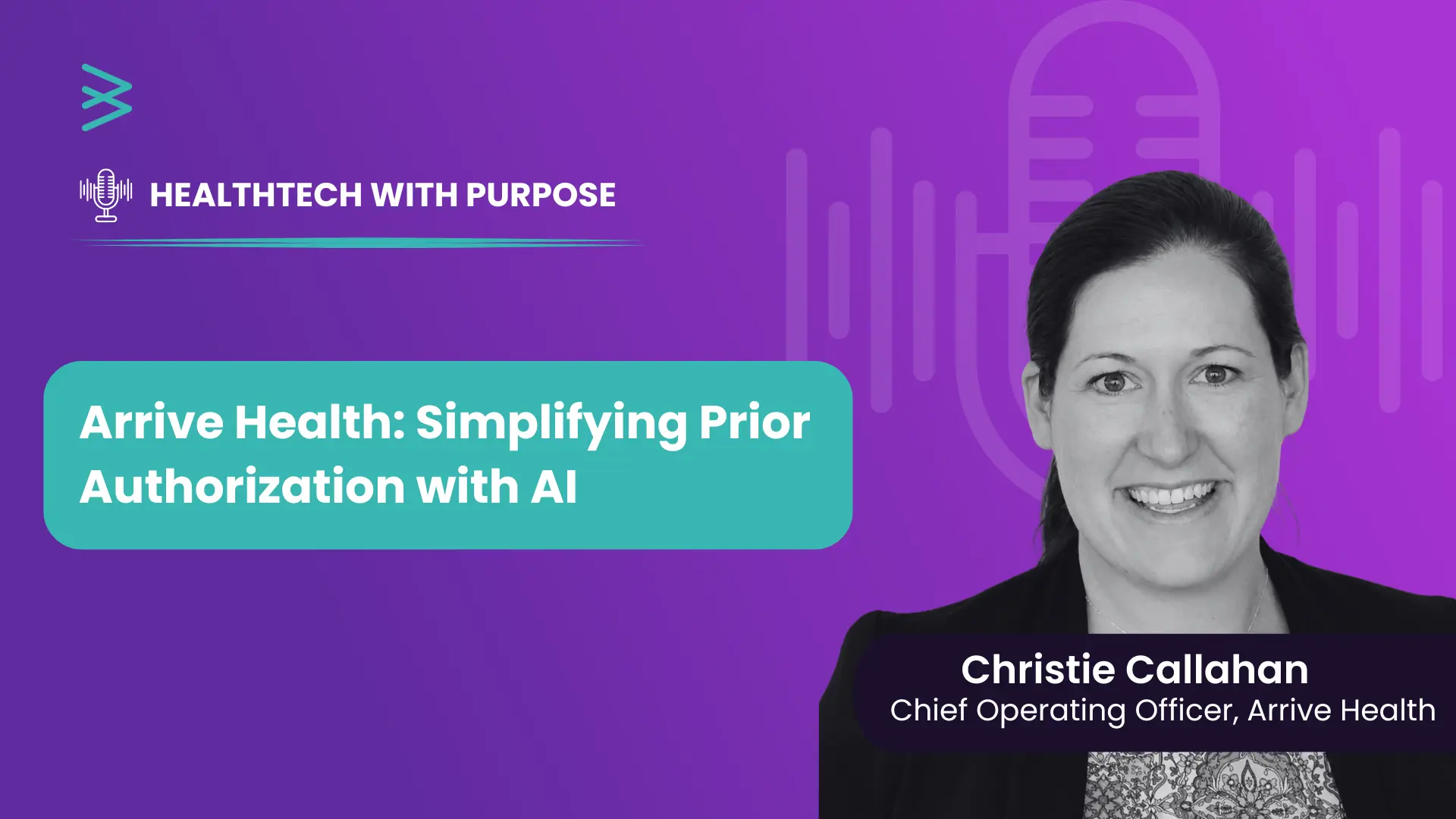
Welcome to the HealthTech with Purpose podcast! In this episode, we explore how AI is revolutionizing prior authorization with Christie Callahan from Arrive Health. Learn how generative AI and real-time benefits integration are streamlining workflows, reducing denied claims, and improving patient access. We also discuss the challenges of using PHI in AI models and the future of augmented intelligence in healthcare. Tune in for insights on AI-driven healthcare solutions!

In the podcast with Rushikesh Kulkarni, CGO at Mindbowser, Co-founder & CEO Ryan Lee discussed about HireMe Healthcare a job marketplace that specializes in connecting nurse professionals with job opportunities. Lee also shared the curation process for nurses on the app, and the challenges the company faced while building the platform.
Partner with us to design, build, and scale digital solutions that drive better outcomes.
Global Tech Teams LLC, 525 Washington Blvd, Industrious at Newport Tower, Jersey City, NJ 07310, United States.
Let’s discuss your goals, workflows, and next steps in a focused consultation call.
 Schedule a Call
















 BLOGS
 NEWSROOM
 CASE STUDIES
 WEBINARS
 PODCASTS
 ASSET HUB
 EVENT CALENDAR