BLOGS
BLOGS  NEWSROOM
  CASE STUDIES
  WEBINARS
  PODCASTS
  ASSET HUB
  EVENT CALENDAR





















We Improved Predictive Accuracy in Childbirth with Advanced EHR Integration
II. The FHIR Standard: The Common Language for Health Data
A. What FHIR Is and Why It’s Important
FHIR (Fast Healthcare Interoperability Resources) is a standardized framework developed to simplify and improve the exchange of healthcare information across different systems. Unlike earlier health data standards like HL7 v2, FHIR leverages modern web technologies to create a flexible and interoperable platform for healthcare data exchange. It allows data to be transmitted quickly and securely between systems, reducing the complexities typically associated with healthcare IT integration.
For wearable devices, FHIR is crucial because it provides a common language that enables the seamless exchange of data between disparate devices and Electronic Health Records (EHRs). With FHIR, healthcare providers can easily integrate patient-generated data into their existing workflows, ensuring that data from devices like Apple Watch, Fitbit, and Oura can be interpreted and used effectively in clinical environments.
B. The Observation Resource: Standardizing Wearable Data
One of FHIR’s most important components is the Observation resource. This resource standardizes how health data such as heart rate, blood pressure, and oxygen saturation is represented and shared. The Observation resource is specifically designed to handle a wide range of clinical measurements, making it an ideal tool for wearable data integration.
For instance, a heart rate measurement captured by an Apple Watch can be mapped into a FHIR Observation using LOINC (Logical Observation Identifiers Names and Codes), a standardized system for identifying health measurements. The data is categorized by type, unit of measurement, and the context in which it was captured. This ensures that the data can be easily read and understood by both human clinicians and machine algorithms.
By using the FHIR Observation resource, healthcare systems can eliminate data discrepancies, ensuring that wearable data is consistently formatted and structured for clinical use. This standardization also enables seamless data exchange across different systems and devices, which is essential for providing comprehensive and timely care.
C. How FHIR Facilitates Interoperability with EHRs
FHIR’s ability to enable interoperability between different health systems is one of its key advantages. For wearables, this means that data can be extracted, standardized, and transferred to EHRs like Epic, Cerner, and Allscripts without needing complex, custom integrations for each device or system.
In practical terms, when wearable data is mapped to FHIR Observations, it becomes interoperable with a wide range of healthcare technologies. This not only allows healthcare providers to view data from different wearable devices within their EHR but also helps integrate it with other clinical data, such as lab results, medications, and previous patient histories.
With FHIR-enabled wearables, a healthcare provider can see a patient’s real-time vitals from their wearable device, alongside their clinical data from lab tests or previous hospital visits. This consolidated data helps clinicians make more informed, data-driven decisions, improving patient outcomes and enhancing care coordination. In an increasingly digital healthcare ecosystem, FHIR is the common denominator that allows different technologies and devices to work together efficiently.

III. From Watch to Record: The Data Flow Pipeline
A. The Step-by-Step Data Journey
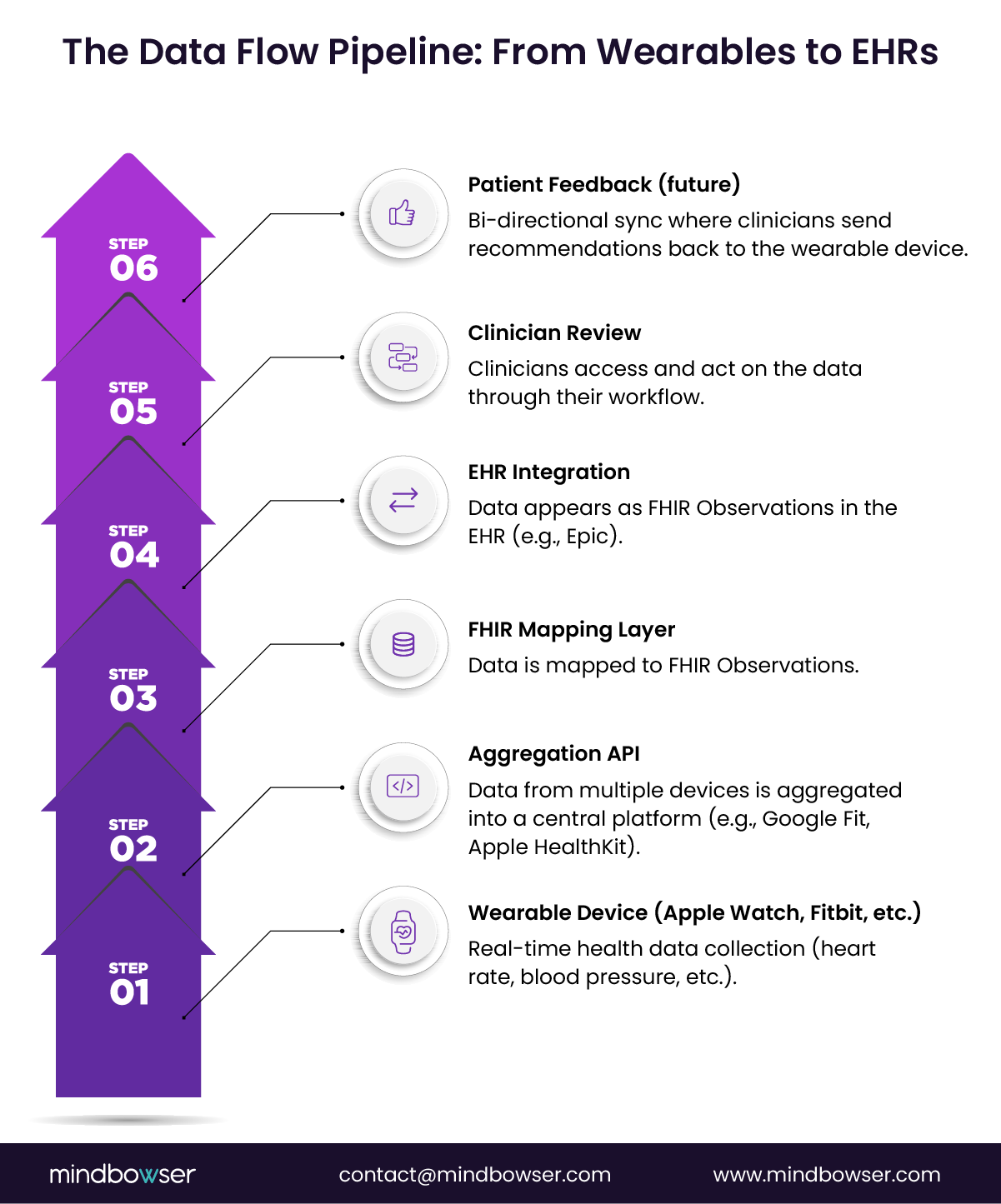
The journey of wearable data from device to Electronic Health Record (EHR) is a complex process, but when mapped to FHIR Observations, it becomes straightforward and seamless. Here’s how it works:
- Data Capture: The wearable device collects real-time health data, such as heart rate, blood pressure, or blood oxygen levels. This data is stored within the device’s app ecosystem, like Apple HealthKit or Google Fit.
- Aggregation: Data from multiple devices can be aggregated in one central platform. For instance, an aggregator API collects data from Apple HealthKit, Google Fit, and other wearables to create a unified source of health information. This aggregation step ensures that data from various devices is collected in one place, ready for processing.
- FHIR Mapping Layer: The aggregated data is then sent through a FHIR mapping layer, where it is transformed into standardized FHIR Observations. This is a critical step in converting device-specific formats into a clinical format that EHR systems like Epic can interpret.
- EHR Integration: Finally, the FHIR-compliant data is sent to the EHR, where it appears as a FHIR Observation in the patient’s record, ready for clinicians to access and act upon.
This data flow pipeline ensures that wearable data moves from device to clinical action in a matter of minutes, creating a seamless experience for healthcare providers.
B. Real-World Example: Apple Watch Heart Rate Data in Epic
To make this process clearer, let’s take a real-world example: Apple Watch heart rate data. The heart rate data captured by the Apple Watch is sent to the Apple HealthKit platform, where it is stored. An aggregator API pulls this data, aggregates it with other health information, and then maps it to the appropriate FHIR Observation standard.
This heart rate data is then transferred to an Epic EHR system where it appears in the patient’s chart as a FHIR Observation under the vital signs section. Clinicians can see real-time heart rate trends, compare them with historical data, and make decisions accordingly. This allows for proactive care, such as adjusting treatment plans if abnormal heart rate trends are identified.
This is a simple example of how data from wearables can seamlessly integrate into clinical workflows, ensuring healthcare providers have immediate access to patient-generated data alongside traditional clinical data.
C. Secure Data Sharing: OAuth + SMART-on-FHIR
For any data exchange, security is paramount, especially when it comes to health data. Wearable data is sensitive, and patient privacy must be protected at every stage of the process. To ensure secure data sharing between devices, aggregators, and EHRs, OAuth and SMART-on-FHIR protocols are commonly used.
- OAuth is an open standard for access delegation that allows users to authorize apps to access their health data without exposing their login credentials. It ensures that patient consent is obtained before any data is shared.
- SMART-on-FHIR extends FHIR by allowing apps to securely interact with EHRs via a standardized interface. It allows wearable data to be integrated into EHRs without compromising patient privacy, ensuring that data is only accessed by authorized users.
Together, these protocols help create a secure, patient-consented, and seamless connection between wearable devices and clinical systems like Epic, ensuring that data privacy and security are maintained throughout the data exchange process.
IV. The Hidden Work: Normalization, Units, and Context
Facing a similar challenge or have a unique use case in mind?
VII. How Mindbowser Connects Wearables to EHRs
Mindbowser’s ConnectHealth platform handles wearable-to-EHR integration as one of its connector types. It supports 100+ wearables, Apple HealthKit, Health Connect by Google, Fitbit, Garmin and maps each device’s data into validated FHIR Observations, so you skip the per-device custom build.
- Pre-built FHIR mapping. Device-specific metrics (heart rate, SpO2, sleep, BP) map to the correct LOINC-coded FHIR Observation automatically. Helix AI builds and maintains that mapping in plain English, instead of an engineer hand-coding each interface.
- Runs in your cloud. ConnectHealth deploys inside your own AWS VPC PHI never leaves your environment.
- HIPAA-ready by default. Encryption in transit and at rest, OAuth + SMART-on-FHIR auth, audit logging, consent management.
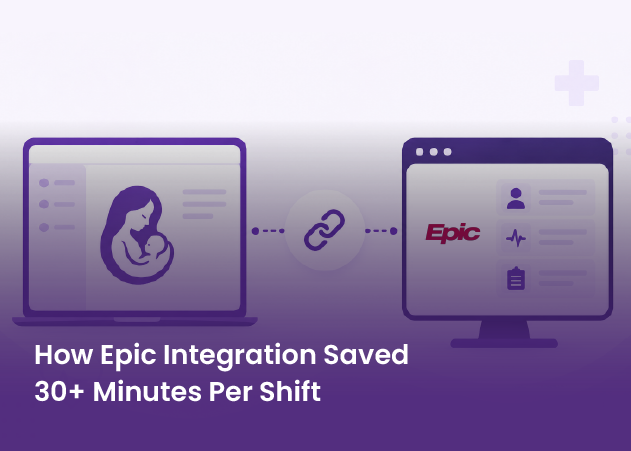
- Proven on real programs. BirthModel (maternal-health, FHIR R4 bidirectional).
If you’d rather not run a FHIR server or build connectors yourself, ConnectHealth is the managed path; if you have an in-house FHIR stack, the connectors feed it directly.
VIII. The Future of FHIR + Wearables
A. Bi-Directional Sync: Monitoring to Intervention
The future of wearable data integration will include bi-directional sync, allowing clinicians not only to monitor patients but also to send feedback and care plan adjustments directly to wearable devices. For instance, if a patient’s heart rate is elevated, a clinician can recommend relaxation techniques, which are sent directly to the device. This creates a dynamic, interactive care model, empowering patients to engage actively in their treatment while improving outcomes.
B. AI and Predictive Health Insights
Combining FHIR Observations with AI will enable predictive health insights, helping clinicians detect patterns in patient data and predict potential health issues, such as heart attacks or strokes. By predicting these events before they occur, healthcare providers can intervene earlier, improving patient outcomes and reducing emergency interventions.
C. Why “FHIR-First” Design Is the Future of Connected Care
A FHIR-first approach is essential for the future of connected care. As healthcare becomes more interconnected, FHIR will serve as the foundation for interoperability, allowing seamless data exchange between wearables, EHRs, and other health technologies. This ensures scalability and adaptability, preparing healthcare systems for the future of data-driven, patient-centered care.
Conclusion
Wearable devices have unlocked a new era of continuous health monitoring, but for this data to be useful in clinical settings, it must be transformed into FHIR Observations. By standardizing and mapping wearable data to FHIR, it becomes actionable, easily integrated into EHRs like Epic EHR, and valuable for clinicians in real-time decision-making.
As healthcare evolves towards more personalized, data-driven care, the importance of a FHIR-first approach cannot be overstated. Organizations that prioritize interoperability, compliance, and security in their integration strategies will be best positioned to lead this transformation. The future of healthcare is one where wearable data is not just collected, but actively used to improve patient outcomes and enhance care coordination.
By investing in structured, secure, and interoperable data pipelines today, with the support of partners like Mindbowser, healthcare organizations can harness the full potential of wearable data, turning raw information into actionable clinical insights.
FHIR Observations are standardized data formats used to represent clinical measurements such as heart rate, blood pressure, and glucose levels. They are essential for integrating wearable data into Electronic Health Records (EHRs) like Epic, as they allow data from devices such as the Apple Watch or Fitbit to be easily interpreted and used by clinicians. By transforming wearable data into FHIR Observations, healthcare organizations ensure that data is consistent, accurate, and actionable.
Mindbowser’s ConnectHealth accelerator simplifies the integration process by offering prebuilt connectors for over 100 wearable devices. This reduces the time and complexity of integrating devices into clinical workflows. ConnectHealth ensures that data from wearables is mapped to FHIR Observations, allowing healthcare teams to quickly integrate patient-generated data into EHRs like Epic and Cerner, accelerating remote patient monitoring (RPM) programs.
Yes, wearables play a crucial role in improving patient engagement by providing real-time feedback on health metrics. Continuous monitoring helps patients become more active participants in their care, increasing adherence to treatment plans. By delivering actionable insights, wearables enable early intervention and better chronic disease management, ultimately improving health outcomes.
FHIR is a standardized framework that allows data from various sources, including wearables, to be easily exchanged and understood across different healthcare systems. When wearable data is mapped to FHIR Observations, it can be integrated into any compatible EHR system like Epic or Cerner. This ensures that healthcare providers can access and use the data seamlessly, regardless of the device it came from or the system it was initially collected in.