











 BLOGS
 NEWSROOM
 CASE STUDIES
 WEBINARS
 PODCASTS
 ASSET HUB
 EVENT CALENDAR



















TL;DR
- “Hospital decision support software” splits into two entirely different products depending on who is searching: clinical decision support (CMIO/CNIO buyer, sits inside the EHR) vs financial/administrative decision support (CFO buyer, sits in finance systems). A shortlist assembled without that filter will contain both.
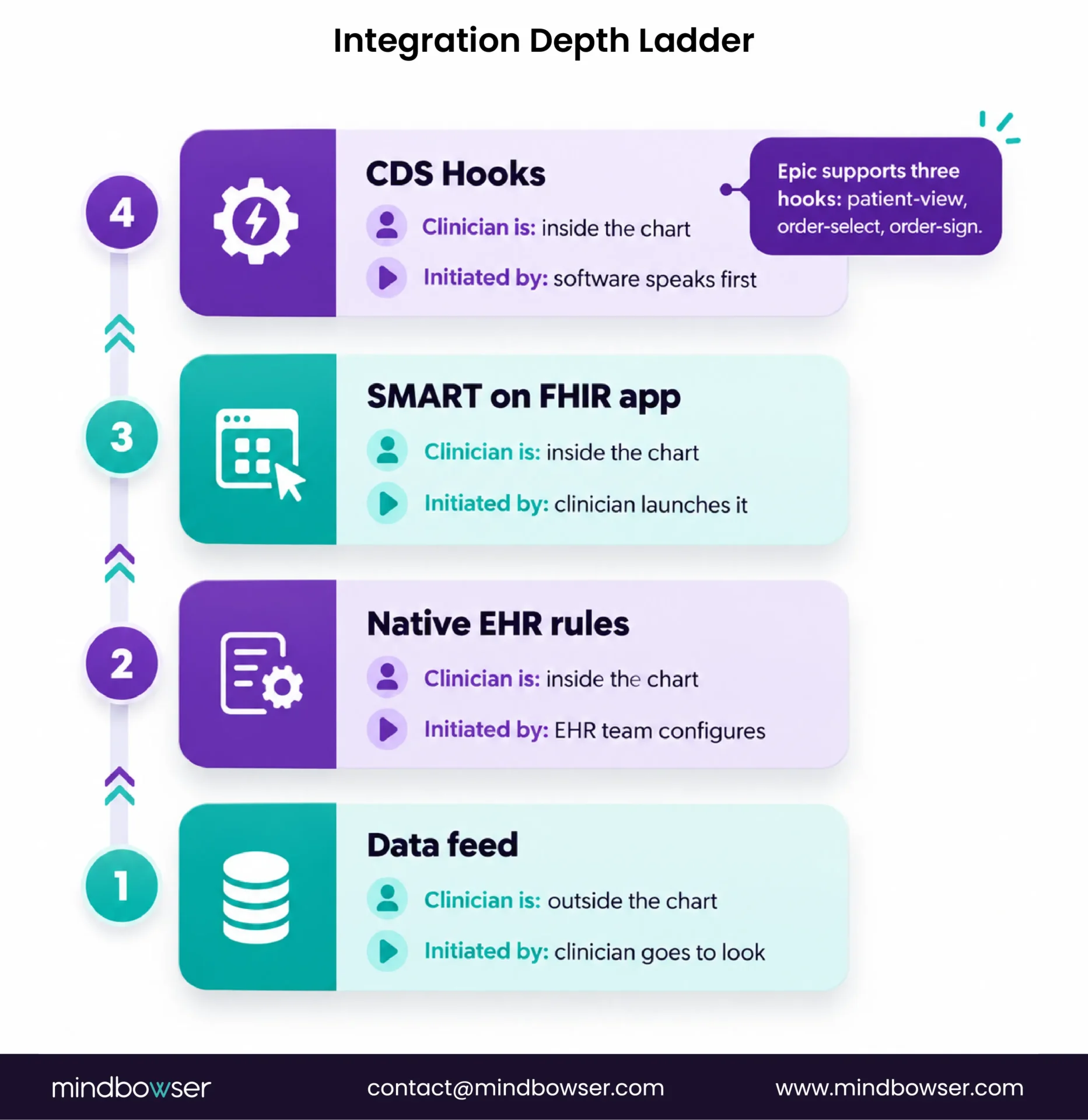
- Integration depth is what separates vendors, not features: Four levels exist: data feed, native EHR rules, SMART on FHIR app, and CDS Hooks. Only CDS Hooks speaks first without a clinician asking for it. Epic supports exactly three hooks: `patient-view`, `order-select`, `order-sign`.
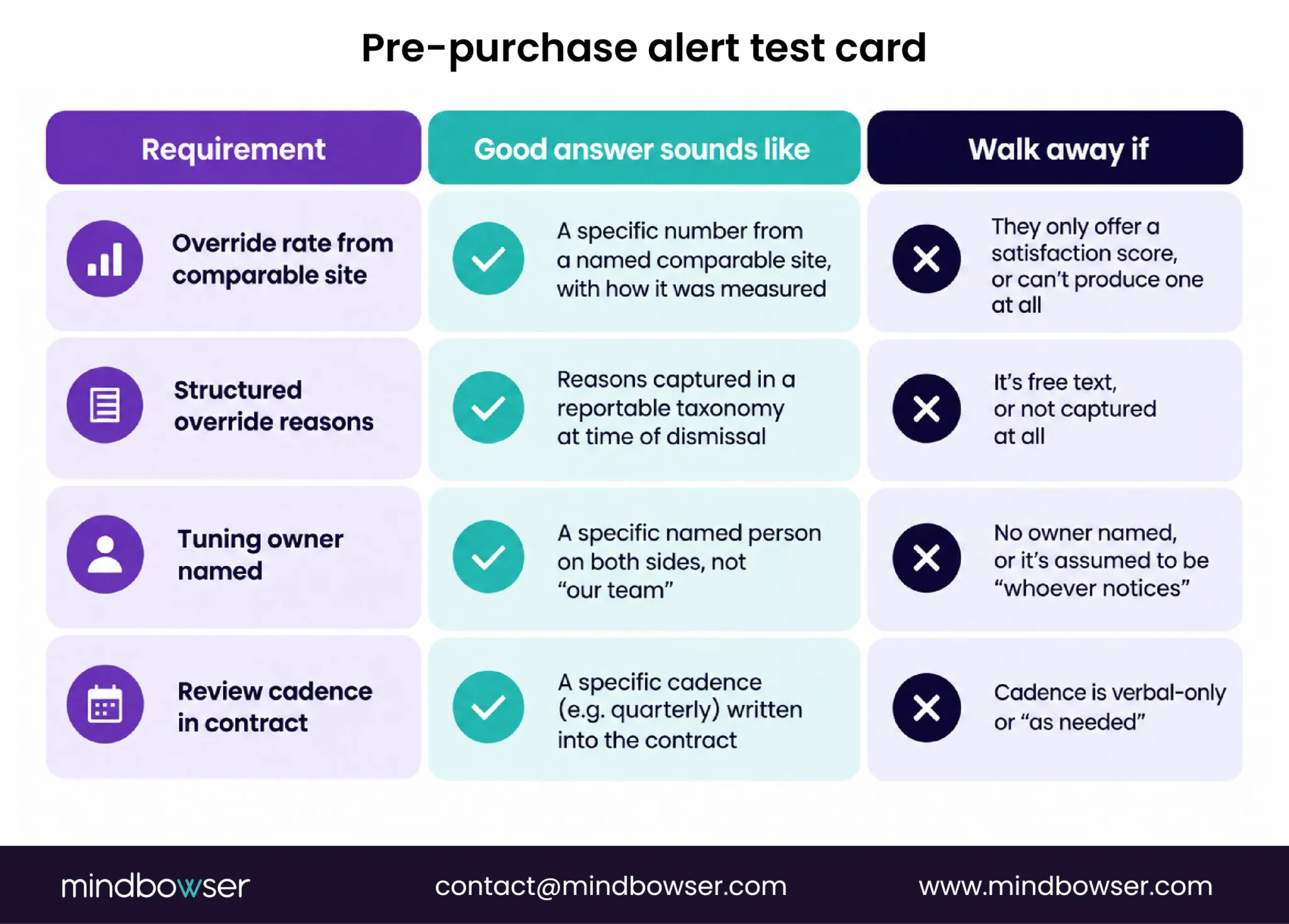
- Alert fatigue is a procurement question, not a launch problem: Ask for an override rate from a comparable site, structured override-reason capture, and a named tuning owner with a review cadence in the contract — before signing.
- FDA’s CDS guidance matters at shortlisting, not just at build: The condition products most often fail is whether a clinician can independently review the basis for a recommendation. Ask each vendor how they classify themselves and why.
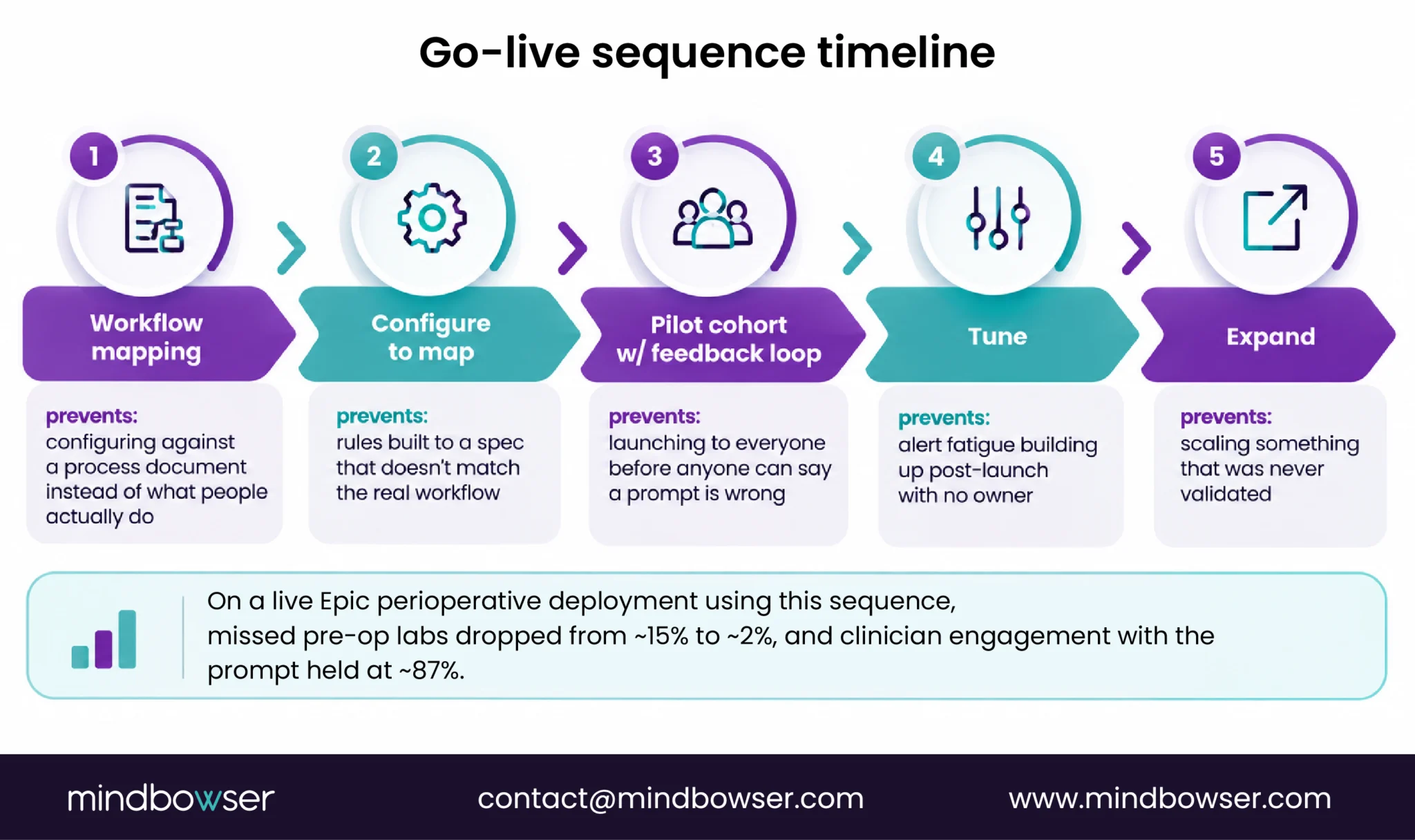
- Most go-lives fail on sequencing, not software: Map the actual clinical workflow before configuration starts. The piece ends with ten questions worth taking into every demo.
Watch: What Makes Hospital Decision Support Software Different
I get a version of the same call about twice a quarter. A health system is three vendors into a shortlist, everyone has demoed, and the person running the evaluation cannot explain why one product is better than another. Every deck said real-time. Every deck said integrates with Epic. Every deck had a slide with a green checkmark next to clinical decision support.
That is not a failure of diligence. It is what happens when the published material on a category stops at the vendor list.
What “Hospital Decision Support Software” Actually Means, And The Category It Gets Confused With
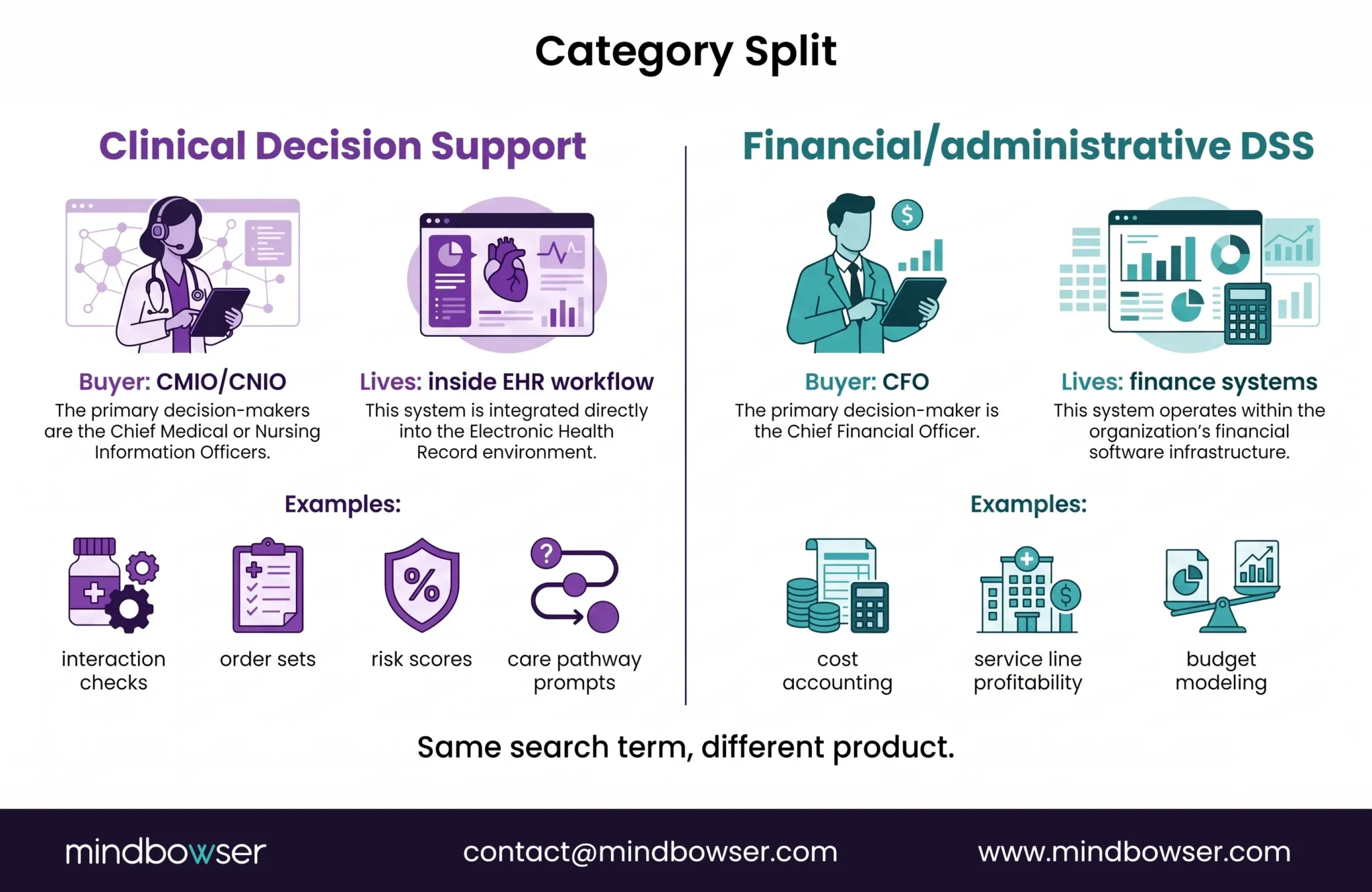
Search that phrase and the results split into two products that have almost nothing to do with each other.
One is clinical decision support: software that puts guidance in front of a clinician at the moment of a decision, usually inside the EHR. Drug interaction checks, order sets, risk scores, care pathway prompts.
The other is financial and administrative decision support: cost accounting, service line profitability, budget modeling. Real software, real category, entirely different buyer. A CFO and a CMIO can type the same phrase into the same search box and want opposite things.
Worth knowing before you brief a team, because a shortlist assembled from an unfiltered search will contain both. If you want the underlying taxonomy of clinical systems, we cover the types of clinical decision support systems separately. The short version: knowledge-based systems run explicit rules you can read and audit, non-knowledge-based systems learn patterns from data, and the distinction matters mostly when you ask a vendor to explain why the software said what it said.
The Vendors On Every Hospital Shortlist
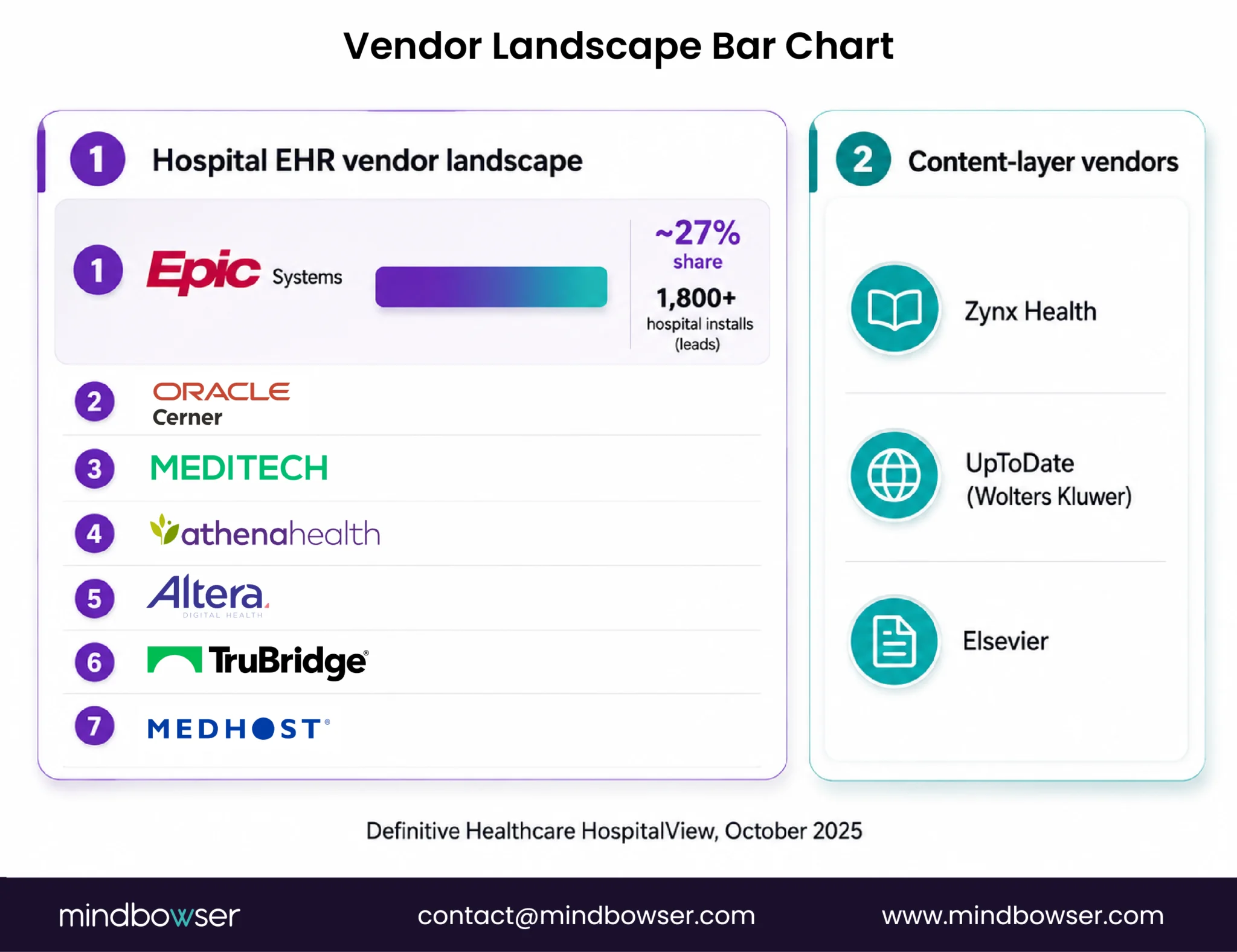
The install base is concentrated. Epic Systems leads clinical decision support deployment with roughly 27% market share and more than 1,800 hospital installations, according to Definitive Healthcare’s HospitalView analysis published in October 2025. Oracle Cerner, MEDITECH, athenahealth, Altera Digital Health, TruBridge, and MEDHOST account for most of the remainder.
Sitting alongside them is a second layer that gets counted differently depending on who is doing the counting: clinical content vendors such as Zynx Health, UpToDate from Wolters Kluwer, and Elsevier. These supply the evidence and the order set libraries rather than the delivery mechanism. A hospital frequently runs one of each and does not always realize it has bought two things.
Then there is everything outside the EHR: point solutions for sepsis, imaging, oncology pathways, perioperative workflow. This is where most of the recent build activity has gone, and where the integration question below becomes the whole decision.
Three procurement routes exist, and they are worth naming plainly because vendors will not: turn on what your EHR already ships, buy a third-party product and connect it, or build against your EHR’s developer surfaces. We break the tradeoffs down in native EHR rules vs third-party vs custom build. If you want to see what shipped systems look like in practice, there are worked examples here. We build custom clinical decision support for health systems and digital health companies, which is the lens I am writing this from, and I will flag where that lens has an interest.
Integration Depth Is The Thing That Separates Them
Every vendor in your shortlist will say they integrate with Epic. That sentence covers at least four different levels of engineering, and the gap between the shallowest and the deepest is the gap between software clinicians use and software they resent.
- Level one, a data feed: The product receives an HL7 or FHIR extract, does its work somewhere else, and shows results in its own interface. The clinician leaves the chart to look at it. In practice, they do not leave the chart.
- Level two, native EHR rules: The logic runs inside the EHR’s own rules engine. Well integrated by definition, limited to what that engine can express, and every change goes through your EHR team’s queue.
- Level three, a SMART on FHIR app: The product runs as an embedded application inside the EHR, reading and writing through standard APIs. The clinician stays in the chart. Launch is still something the clinician initiates.
- Level four, CDS Hooks: The EHR calls the service at a defined moment in the workflow and the guidance appears without anyone asking for it. This is the level that changes behavior, because it is the only one where the software speaks first.
Here is the detail worth carrying into a demo: Epic supports exactly three hooks. patient-view,which fires when a chart is opened. order-select,when a clinician picks an order. order-sign,when they sign it. That is the surface. A vendor promising a prompt at some other moment in an Epic workflow is either describing a different mechanism or describing something they have not built.
Two follow-ups separate people who have shipped this from people who have read about it. Ask whether their service exposes a discovery endpoint, because without one the EHR cannot enumerate what the service offers and the integration has to be hand-configured per site. And ask how they handle prefetch, because a service that makes its own round trips for patient data instead of accepting prefetched context adds latency at precisely the moment a clinician is waiting.
We go deeper on the mechanics in our CDS Hooks guide, and the broader integration picture across EHR platforms sits in our Epic integration work.
Talk to our team about your integration surface
Alert Fatigue Is A Purchase Decision, Not A Launch Problem
Clinicians override the large majority of the interruptive alerts they receive. The figure quoted most often sits above 90%, and while the exact number varies by study and setting, no serious reading of the literature puts it low. (verify at publish against a current primary source)
The reason this belongs in a procurement conversation rather than a post-launch retrospective is that override behavior is a property of the product, not only of your configuration. Some systems ship with a tuning workflow, an override reason taxonomy, and reporting that tells you which rules are being ignored. Some ship a rules engine and wish you luck.
Three things to require during evaluation:
- An override rate from a comparable site: Not a satisfaction score. If the vendor cannot produce one, that itself is the answer.
- Structured override reasons: If a clinician dismisses a prompt, the system should capture why in a form you can report on. Free text is not that.
- A named owner for tuning after go-live, on your side and theirs, with a review cadence written into the contract rather than assumed.
We have written at length on why alerts get ignored and what actually reduces it. The procurement-stage version is simpler: a product you cannot measure is a product you cannot tune.
Where FDA Draws The Line On Clinical Decision Support Software
A regulatory guidance document ranks on the first page of results for people shopping for this software. That is unusual, and it tells you buyers are asking a question no vendor page answers.
FDA’s guidance on clinical decision support software sets out the conditions under which a CDS product falls outside device regulation. The shape of it: the software must not analyze a signal or pattern from a medical device, must display or analyze medical information, must provide a recommendation rather than a specific directive output, and must allow the clinician to independently review the basis for that recommendation without relying primarily on it. Software that meets all of these sits outside the device definition. Software that fails one, most commonly the fourth, may not. (verify at publish against the current revision of the guidance)
That fourth condition is the one that catches products. A risk score presented as a number the clinician can interrogate is a different regulatory object from a score presented as an instruction with no visible reasoning. The more opaque the model, the harder that condition is to satisfy.
What to do with this during evaluation: ask the vendor directly how they classify their own product and why. A vendor who answers immediately, with the reasoning, has thought about it. A vendor who has not considered the question has told you something useful about their maturity.
Build Decision Support That Fits Your Hospital Workflow
What Goes Wrong Between Signature And Go-live
The build is rarely what fails. Sequencing is.
The pattern I see most often is configuration starting before anyone has mapped the actual clinical workflow the software is meant to sit inside. The rules get built to the spec in the contract, the spec was written from a process document, and the process document describes what people are supposed to do rather than what they do. The prompts then land in the wrong place, clinicians route around them, and six months later the system is technically live and functionally ignored.
The version that works looks duller. Map the workflow first, at the level of who is looking at which screen at which minute. Configure against that map. Put a small group of clinicians in front of it before it reaches anyone else, and give them a real mechanism to say a prompt is wrong, not a feedback form nobody reads. Then expand.
On a perioperative deployment we built inside Epic, the guidance fired at order signing to flag pre-operative labs that had been missed. Missed pre-op labs fell from around 15% to about 2%, and clinician engagement with the prompt held at roughly 87%, which is unusual for anything interruptive. The number that mattered was not the accuracy of the rule. It was that the prompt arrived at the moment a clinician could act on it without leaving what they were doing, and that took workflow mapping, not modeling.
Some things we would not attempt in a first phase: anything requiring a new clinical governance body to exist first, anything depending on data your EHR does not already capture reliably, and any rule whose owner has not been named.
Ask us what your first phase should include
What It Costs, And What Drives The Number
No page one result will give you a price, and neither will I, because a number without your specifics would be decoration. What is useful is knowing which variables move it.
- EHR surface: Native rules configuration is the cheapest route and the least flexible. CDS Hooks services cost more to build and are the only route to prompts that appear without being summoned.
- Rule volume and volatility: Fifty rules that never change is a different engagement from fifteen that change quarterly. Ongoing tuning is usually underestimated at contract time and is where the second-year budget goes.
- Content licensing: If your guidance comes from a commercial evidence library, that is a recurring line independent of the software.
- Integration and validation effort per site: Multi-site systems rarely get to configure once. Each site brings its own build.
Per-seat pricing deserves scrutiny at system scale. It is priced for a model where value scales with users, and clinical decision support value scales with the number of decisions the software touches, which is not the same curve. Ask for the enterprise structure.
We have broken the cost drivers down further in our budgeting guide for clinical decision support. And to be direct about the third option: where the workflow you need is not something an off-the-shelf product covers, we build it.
Ten Questions To Take Into The Next Demo
This is the part worth screenshotting.
- Which of the four integration levels are you, specifically?
- If Epic, which of the three hooks do you use, and at which moment?
- Do you expose a discovery endpoint?
- How do you handle prefetch, and what is your latency at the point of care?
- What is your override rate at a site comparable to ours?
- Do you capture structured override reasons, and can I report on them?
- Who owns rule tuning after go-live, on your side, and how often do we meet?
- How do you classify your product against FDA’s CDS guidance, and what is the reasoning?
- What does your implementation sequence look like before any configuration starts?
- What is the second-year cost, itemized, assuming our rules change quarterly?
A good vendor will answer eight of these without checking. That is the signal.
In clinical contexts, yes. The confusion is with financial and administrative decision support systems, which share the phrase and serve a different buyer entirely.
Often, for a first phase. Native rules are the fastest route to something live. The limits show up when you need logic the rules engine cannot express, or a prompt at a moment the EHR does not expose.
Three: patient-view, order-select, and order-sign. Any vendor describing an Epic prompt at a different moment is describing a different mechanism.
Not always. FDA’s guidance sets conditions under which CDS falls outside device regulation, and the condition products most often fail is whether a clinician can independently review the basis for a recommendation. Ask each vendor how they classify themselves.
Ask for a real one from a comparable site rather than anchoring on a benchmark. The published figures are high enough that any vendor claiming a very low rate should be asked how they measured it.