BLOGS
BLOGS  NEWSROOM
  CASE STUDIES
  WEBINARS
  PODCASTS
  ASSET HUB
  EVENT CALENDAR



















![5 Types of Clinical Decision Support Systems: Which One Fits Your Hospital? [2026]](https://www.mindbowser.com/wp-content/uploads/2026/03/medical-technology-network-telemedicine-health-insurance-virtual-hospital-healthcare.jpg.webp)


TL;DR
Clinical decision support systems (CDSS) come in different types, each designed to support specific clinical decisions and workflows. From rule-based systems to AI-driven models, and from passive reference tools to real-time alerting systems, understanding these categories helps healthcare organizations align decision support capabilities with clinical use cases.
Are your types of clinical decision support systems reducing readmissions and alert fatigue, or just creating another EHR pop-up nightmare?
Healthcare organizations face significant challenges, including rising clinical complexity, an explosion of data, and pressure to improve patient outcomes under value-based care models.
The question of how to select the right type of clinical decision support system (CDSS), from rule-based alerts to AI clinical decision support systems (AI-CDSS), is critical.
This guide provides an overview of the different types of clinical decision support systems, helping CMIOs and CIOs navigate the complexity of selecting systems that best align with clinical objectives, data readiness, and compliance risks.
Watch: How Different Types of Clinical Decision Support Systems Improve Healthcare
I. Why Healthcare Organizations Rely on Clinical Decision Support Today
A. Rising Clinical Complexity and Data Explosion
Healthcare systems are under increasing pressure to manage patients with multiple conditions, leading to rising clinical complexity. The sheer volume of data from EHRs, imaging, and remote patient monitoring (RPM) has overwhelmed many organizations. Clinicians are required to integrate vast amounts of information from diverse sources to make informed decisions. However, without a clinical decision support system, this process becomes inefficient and error-prone. Learn how AI-driven clinical decision support systems manage complex data
B. Value-Based Care and Quality Metrics
The shift toward value-based care (VBC) models has heightened the need for systems that improve clinical outcomes while reducing costs. VBC models emphasize quality metrics such as reducing readmissions and improving chronic disease management. CDSS tools help healthcare providers meet these expectations by offering real-time, actionable insights. However, the effectiveness of these tools depends heavily on selecting the right system for the right task.
C. Real-Time Intelligence Needs
Healthcare providers need real-time intelligence to make timely and accurate decisions, especially as the volume of healthcare data continues to grow. AI clinical decision support systems have emerged as powerful tools for predictive analytics and risk assessments, enabling clinicians to anticipate patients’ needs and adjust care accordingly. This shift to AI-driven systems has the potential to improve clinical outcomes dramatically, but only if implemented correctly.
D. The Need for a Structured Classification Guide
As healthcare organizations face various types of CDSS, selecting the appropriate one can be a daunting task. Different systems serve different purposes, some for real-time alerts, others for predictive analytics, and still others for information retrieval. Selecting the wrong system can lead to alert fatigue, poor compliance, and ultimately clinician burnout. This guide provides a structured classification of clinical decision support system types, offering CMIOs and CIOs a roadmap for making the right choice for their organizations.
II. Why Understanding the Types of Clinical Decision Support Systems Matters
A. Tailoring Decision Support to Clinical Objectives
Healthcare organizations are complex environments in which each clinical decision support tool must be selected with a specific goal in mind. The types of clinical decision support systems vary greatly in their functionality and impact on workflows. Some systems are designed for high-volume, low-complexity tasks, such as drug alerts, while others are suited for more complex, predictive tasks, such as patient risk stratification. Understanding the different CDSS types helps CMIOs and CIOs select the most appropriate system to achieve clinical objectives. A system that works well for improving medication safety might not be the right choice for reducing readmissions or predicting adverse events.
By clearly understanding the strengths and weaknesses of different types of decision support systems in healthcare, organizations can ensure that their decision-making processes align with clinical goals. For example, rule-based systems might excel at preventing medication errors, while AI clinical decision support systems (AI-CDSS) are better suited for predicting patient deterioration in real time. When the right system is chosen to align with clinical priorities, the effectiveness of decision support is maximized, improving patient outcomes and clinician satisfaction.
B. Reducing Alert Fatigue and Compliance Risks
A key challenge in healthcare today is alert fatigue, a direct consequence of poorly configured or misaligned CDSS. The wrong type of system can overwhelm clinicians with excessive alerts or irrelevant notifications, leading to desensitization and a risk of missed critical warnings. For example, rule-based systems that trigger alerts for every medication interaction, regardless of its clinical significance, may flood clinicians with non-actionable notifications. Learn how to reduce alert fatigue in CDSS systems
Understanding the types of clinical decision support systems is crucial for minimizing this issue. By selecting systems that are fine-tuned to a healthcare organization’s needs and workflows, CMIOs and CIOs can ensure that alerts are meaningful and actionable, thereby improving clinician engagement and compliance, and understanding how different systems handle compliance risks, especially in terms of meeting regulatory requirements like HIPAA or ensuring that clinical guidelines are up to date can help prevent costly mistakes and safeguard patient safety.
Ready to improve your hospital’s clinical decision-making?
C. Matching CDSS Types to Organizational Needs
Clinical decision support systems are a significant financial investment for healthcare organizations, so it is essential to understand which CDSS types offer the most return on investment (ROI). While traditional rule-based systems may have a lower upfront cost, AI-CDSS can provide long-term value by continuously learning and improving its predictive capabilities. Understanding the types of decision support systems helps organizations assess the potential impact on clinical outcomes, operational efficiency, and patient satisfaction, key metrics for justifying technology investments.
Selecting the wrong CDSS type can waste resources, especially if the system does not align with the organization’s data readiness, clinical workflows, or strategic goals. By having a clear understanding of how different types of clinical decision support systems operate, healthcare leaders can make smarter investments that yield long-term value.
D. Facilitating System Integration and Interoperability
Healthcare organizations operate within a complex ecosystem, often with multiple systems in place to manage patient data, clinical workflows, and administrative functions. CDSS systems must integrate seamlessly with EHRs, laboratory systems, pharmacy systems, and other healthcare IT infrastructure. Understanding the types of clinical decision support systems and their integration capabilities ensures smoother implementation and greater system interoperability.
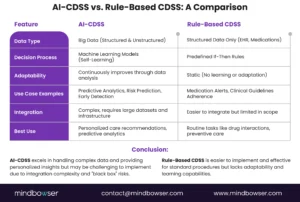
For example, some AI clinical decision support systems may require extensive integration with structured and unstructured data sources, whereas rule-based systems may be easier to implement. By understanding the specific requirements of different CDSS types, CMIOs and CIOs can avoid potential integration pitfalls, ensuring that the decision support system is implemented smoothly without disrupting other operational functions.
III. Core Types of Clinical Decision Support Systems
A. Knowledge-Based Systems
Knowledge-based clinical decision support systems (KB-CDSS) operate on structured rules, providing decision support through “if-then” logic based on clinical knowledge. These systems are commonly used for tasks like drug interaction alerts, allergy checks, and guideline-based recommendations. The key advantage of knowledge-based CDSS is their simplicity and reliability in addressing routine, predictable clinical tasks. However, they have limitations, particularly in complex, non-routine situations that require more sophisticated analysis.
While they excel at processing structured data, such as medication orders and lab results, KB-CDSS systems cannot learn from new data or adapt to evolving clinical practices. Their rigid, predefined logic can lead to “alert fatigue” if not managed correctly, as they may trigger an overwhelming number of alerts that do not always require action.
Best Use Cases: Medication management, adherence to clinical guidelines, and preventive care reminders.
Limitations: Lack of adaptability, inability to handle complex data patterns, and a higher risk of alert fatigue.
B. AI Clinical Decision Support Systems (AI-CDSS)
AI clinical decision support systems (AI-CDSS) leverage machine learning algorithms and advanced analytics to predict patient outcomes, identify risks, and support complex decision-making. These systems are designed to handle large volumes of data, from structured data like EHRs to unstructured data such as clinical notes, medical images, and real-time monitoring data. AI-CDSS are more flexible and can adapt to changing clinical environments, learn from new data inputs, and offer personalized recommendations.
For example, AI-based systems can predict patient deterioration, identify high-risk patients for readmission, and even suggest personalized treatment plans based on historical data and predictive models. However, these systems introduce new challenges, such as the “black box” nature of some machine learning models, which may reduce clinician trust in the system’s recommendations. To mitigate this, AI-CDSS must be implemented with transparent algorithms and clear rationales for decision-making.
Best Use Cases: Risk prediction, personalized treatment planning, predictive analytics for patient outcomes, and identifying early signs of clinical deterioration.
Limitations: Lack of transparency (black box risk), reliance on large datasets, and integration challenges.
C. Passive CDSS
Passive CDSS provide decision support by offering information or recommendations on demand rather than actively interrupting clinicians’ workflows. These systems are typically based on a knowledge base or clinical guidelines and are often used as a reference. Clinicians may query these systems when they need additional information, such as drug interactions, clinical guidelines, or best practices.
Unlike active CDSS, which trigger real-time alerts, passive CDSS require clinicians to seek out the system’s input actively. This makes them less intrusive, but they may also be underutilized if clinicians don’t consistently engage with the system. Passive systems can help reduce alert fatigue, but their effectiveness depends on the ease of access and the availability of relevant information at the point of care.
Best Use Cases: Information lookup, clinical guideline reference, and diagnostic decision support.
Limitations: Potential underuse due to the need for active querying and reliance on clinician initiative.
D. Active CDSS
Active clinical decision support systems provide real-time alerts and recommendations based on patient data, helping clinicians make timely decisions during patient care. These systems are deeply integrated into the clinical workflow and actively monitor patient data to provide actionable alerts about patient conditions, such as abnormal lab results, medication interactions, or clinical deterioration.
While active CDSS systems are highly effective in supporting real-time decision-making, they can also lead to alert fatigue if not properly configured. Excessive or irrelevant alerts can overwhelm clinicians and undermine the system’s effectiveness. Therefore, careful configuration and ongoing management are essential to prevent alert overload.
Best Use Cases: Real-time clinical decision support, identifying acute patient deterioration, and medication management.
Limitations: High potential for alert fatigue, dependency on real-time data quality, and potential disruption of clinician workflows if alerts are not relevant or timely.
Planning to build a Clinical Decision Support System?
IV. Comparison of Different Types of Clinical Decision Support Systems
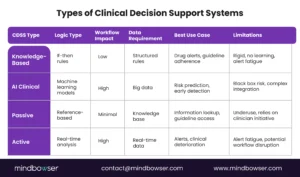
V. How to Choose the Right Clinical Decision Support System
While different types of CDSS serve different clinical needs, selecting the right system depends on workflow alignment, data readiness, and governance. For a detailed decision framework, explore how to choose an AI clinical decision support system
Not sure which type of Clinical Decision Support System is right for you?
VI. Clinical Decision Support Systems vs Clinical Information Systems
These two terms get used interchangeably, and they are not the same thing.
A clinical information system is the broader category: the systems that store and move clinical data. A clinical decision support system is the layer that acts on that data, applying logic at the moment a decision is being made. A CDSS is one type of clinical information system, not a synonym for the set.
The systems most commonly counted in that set:
- Electronic Health Record (EHR): the patient record itself, and the system the others integrate with.
- Laboratory Information System (LIS): orders, specimens and results for the lab.
- Radiology Information System (RIS): imaging orders, scheduling and reporting, usually alongside PACS.
- Pharmacy and Computerized Provider Order Entry (CPOE): medication ordering, dispensing and the checks that run at the point of order.
- Clinical Decision Support System (CDSS): the logic layer that turns the data those systems hold into a recommendation at a decision point. The five types are covered in Section III above.
You will see this list given as three, four, five or six types depending on the source, and that is not a disagreement about the systems, it is a disagreement about how finely to split them. Some sources fold pharmacy into CPOE, some count PACS separately from RIS, some treat administrative and billing systems as clinical. What does not vary is where CDSS sits: not beside the record systems, but on top of them.
VII. Challenges in Implementing Clinical Decision Support Systems
A. Integration Challenges
One of the most significant challenges healthcare organizations face when implementing clinical decision support systems (CDSS) is integration. Many hospitals and clinics already use multiple software systems, including EHRs, laboratory information systems, pharmacy management systems, and billing platforms. Introducing a new CDSS that doesn’t integrate seamlessly with these existing systems can lead to data silos, workflow disruptions, and poor system adoption.
For example, AI-driven systems, such as AI clinical decision support systems (AI-CDSS), often require data from disparate sources, including unstructured data from clinical notes and medical images, as well as structured data from EHRs. Integrating these systems requires a solid understanding of interoperability standards, such as FHIR and HL7, and ensuring that data flows smoothly across platforms.
To overcome these challenges, healthcare organizations need a robust integration strategy that involves cross-departmental collaboration, system testing, and planning for long-term scalability. Additionally, some CDSS types, particularly rule-based systems, are easier to integrate, while others, such as AI-CDSS, may require more sophisticated integration efforts.
Assessment Questions:
- Do you have the necessary infrastructure and expertise for system integration?
- Does the CDSS support industry-standard interoperability protocols like FHIR or HL7?
Red Flags:
- Lack of support for standard integration protocols
- Integration bottlenecks that delay the implementation process
B. Clinician Buy-in and Adoption
Even with the best clinical decision support system, if clinicians don’t trust or actively engage with the tool, the system will fail to provide value. This is a significant challenge with active CDSS, which provide real-time alerts and require clinician response. Overwhelming clinicians with excessive alerts or poor-quality recommendations can lead to alert fatigue, reduced clinician satisfaction, and poor adoption.
For AI-CDSS, clinician buy-in is even more critical. If the system’s decision-making process is not transparent or if it is perceived as a “black box,” clinicians may be hesitant to rely on its recommendations. Therefore, the system must be explainable and provide sufficient evidence to support its decision-making process.
Effective training, ongoing user support, and clear communication about the system’s benefits are essential for encouraging clinician engagement. The CDSS should be seen as a tool that supports clinical decisions rather than replaces human judgment.
Assessment Questions:
- How will you ensure clinician trust and engagement with the CDSS?
- Will the system be perceived as helpful, or as an additional burden?
Red Flags:
- A history of poor clinician engagement with previous technology
- Lack of transparency in AI decision-making processes
C. Data Quality and Governance
The effectiveness of any clinical decision support system depends heavily on the quality of the data it processes. Poor data quality can lead to inaccurate recommendations, increased clinician frustration, and ultimately a negative impact on patient outcomes. AI-CDSS, in particular, require large datasets to train machine learning models effectively. If the data used is incomplete, inaccurate, or biased, the system’s recommendations will be flawed, potentially putting patients at risk.
Healthcare organizations must establish robust data governance practices to ensure that their CDSS operate on clean, standardized, and complete data. This includes data validation, continuous data quality assessments, and maintaining a culture of data accuracy. Additionally, governance structures should be in place to monitor system use, ensure compliance with regulatory standards, and track outcomes to validate system effectiveness.
Assessment Questions:
- Is your data accurate, complete, and standardized for use with the CDSS?
- Do you have robust data governance practices in place?
Red Flags:
- Inconsistent or missing data
- Lack of data validation or ongoing monitoring processes
D. Resource and Implementation Considerations
Clinical decision support systems can be expensive, especially advanced systems such as AI-CDSS, which require significant investments in data infrastructure, integration, and ongoing maintenance. It’s crucial to evaluate the potential return on investment (ROI) of each system to ensure that the benefits outweigh the costs. This assessment should include both direct financial savings (e.g., reduced readmissions, fewer adverse drug events) and indirect savings (e.g., improved clinician efficiency, better patient outcomes).
Organizations should also consider the total cost of ownership, including training, system upgrades, and ongoing support. For instance, while rule-based systems may have lower upfront costs, they often require frequent updates to remain relevant may have higher initial costs but offer long-term scalability and predictive capabilities.
Assessment Questions:
- What is the expected ROI from the system in terms of improved patient outcomes, cost savings, and efficiency?
- Are there any hidden costs, such as integration expenses, training, or system updates?
Red Flags:
- High upfront costs with unclear ROI
- Unexpected or ongoing costs that strain the budget
VIII. The Future of Clinical Decision Support Systems
A. Advancements in AI and Machine Learning
The future of clinical decision support systems lies in the continued evolution of AI clinical decision support systems (AI-CDSS). As machine learning models improve, these systems will become even more capable of providing real-time, personalized recommendations based on vast amounts of data. The integration of AI with other advanced technologies, such as predictive analytics and natural language processing (NLP), will further enhance decision-making capabilities.
One exciting possibility is the use of AI to predict patient deterioration before symptoms become clinically obvious, allowing clinicians to intervene earlier and reduce adverse outcomes. Additionally, as AI systems continue to learn from large datasets, they will become increasingly accurate and effective at identifying patterns and predicting patient risks, leading to better patient outcomes and more efficient use of healthcare resources.
B. Seamless Integration with Emerging Technologies
As healthcare technology continues to advance, the next generation of CDSS will likely integrate more seamlessly with emerging technologies like telemedicine platforms, remote patient monitoring (RPM) systems, and IoT devices. This will enable real-time decision-making, allowing clinicians to manage patient care outside of traditional clinical settings. For example, wearable devices that continuously monitor patients’ vital signs can feed data directly into AI-CDSS, alerting clinicians to early signs of deterioration.
Moreover, the growing emphasis on interoperability in healthcare will ensure that these advanced CDSS tools can work across diverse healthcare platforms, further enhancing their utility.
C. Patient-Centered Decision Support
The future of clinical decision support systems will also be increasingly patient-centered. By incorporating patient preferences, health goals, and behavioral data into the decision-making process, AI-CDSS can provide personalized care recommendations that align with the individual’s needs and preferences. This shift towards personalized medicine will require not only technical advancements but also a cultural shift toward involving patients more directly in their care decisions.
IX. Key Takeaways: Understanding Clinical Decision Support System Types
A. Understand the Clinical Needs and Goals
The selection of a clinical decision support system (CDSS) should start with a clear understanding of the clinical objectives your organization aims to achieve. Whether your focus is on reducing readmissions, enhancing medication safety, or improving chronic disease management, the right CDSS type should align directly with these goals. Careful consideration of the types of decision support systems in healthcare will help you ensure that the technology you implement supports your clinical priorities, rather than adding unnecessary complexity.
B. Consider Data Infrastructure and Readiness
Before implementing any CDSS, it is essential to evaluate the readiness of your data infrastructure. AI clinical decision support systems (AI-CDSS) require sophisticated data processing capabilities and access to structured and unstructured data sources. If your organization’s data is fragmented or of low quality, this could hinder the system’s effectiveness. Additionally, real-time active CDSS may demand a high level of data integration and continuous updates to function optimally.
Ensure that your data is standardized and that your organization is prepared for the level of data management that these systems require. If your systems are not interoperable or do not follow current standards such as FHIR or HL7, you may face integration difficulties down the line.
C. Focus on User Experience and Clinician Engagement
Clinician engagement is paramount to the success of any CDSS. If the system causes disruption or frustration, clinicians may be hesitant to use it. It’s critical to select a system that aligns with existing workflows and addresses clinicians’ pain points. The system should also be easy to use, with intuitive interfaces and actionable alerts that provide value without overwhelming the user.
For AI-CDSS, transparency in decision-making is essential. Clinicians must trust the system’s recommendations. By offering explainability and clear insights into how recommendations are made, organizations can build trust with their clinical teams. Moreover, effective training and user support will increase clinician confidence in using the system and improve overall adoption rates.
D. Monitor and Optimize System Performance
Once a clinical decision support system is implemented, it’s essential to monitor its performance and impact on clinical outcomes continuously. Systems like AI-CDSS can improve over time as they learn from data, but their success depends on proper calibration and maintenance. Monitoring how well the system integrates with clinical workflows, its effect on patient outcomes, and clinician satisfaction will help you identify areas for optimization.
For active CDSS, it’s particularly important to assess the relevance and timeliness of alerts regularly. Over time, you may find that certain alerts need to be fine-tuned or reduced to prevent alert fatigue. Additionally, monitoring for signs of alert overload or clinician burnout is crucial to maintaining the system’s effectiveness.
E. Addressing Compliance and Data Security
Compliance with regulations such as HIPAA is non-negotiable in healthcare, especially when dealing with systems that manage sensitive patient data. When implementing a CDSS, ensure that the system complies with healthcare regulations and maintains the highest standards of data security. This is especially important for AI-CDSS, as these systems often require large datasets for machine learning and predictive modeling, increasing the risk of data breaches if not handled properly.
Data governance should also be a priority. Healthcare organizations should have systems in place to monitor the quality and integrity of the data being fed into the CDSS, as poor-quality data can undermine its effectiveness and lead to incorrect or unsafe clinical recommendations.
Navigating the Future of Clinical Decision Support Systems
The successful implementation of a clinical decision support system hinges on selecting the right type of system to meet your organization’s unique needs. With the right alignment of clinical objectives, data readiness, and system integration, CDSS can significantly enhance clinical decision-making, reduce readmissions, improve patient outcomes, and streamline workflows.
Understanding the types of clinical decision support systems, from rule-based systems to AI clinical decision support systems (AI-CDSS), is key to making informed decisions that support your organization’s goals. Whether you choose passive systems, active systems, or AI-driven solutions, it is crucial to ensure that the system you select integrates seamlessly into your existing IT infrastructure, supports clinician workflows, and is backed by robust data governance practices.
Healthcare organizations must remain mindful of the challenges associated with CDSS implementation, from clinician buy-in to data quality, and continuously evaluate their system’s performance. By following a structured approach to system selection, integration, and optimization, healthcare leaders can achieve greater success in using clinical decision support systems to improve care delivery and organizational efficiency.
Clinical Decision Support Systems (CDSS) are tools designed to assist healthcare providers in making informed decisions by analyzing patient data and providing relevant recommendations or alerts. These systems help clinicians enhance care quality, reduce errors, and improve patient outcomes by providing timely, evidence-based insights.
AI Clinical Decision Support Systems (AI-CDSS) use machine learning algorithms to analyze large datasets, including unstructured data like clinical notes, and provide predictive insights. In contrast, rule-based systems rely on predefined, structured “if-then” rules to offer decision support, making AI-CDSS more adaptable and capable of handling complex, data-rich environments.
Challenges in implementing a CDSS include ensuring proper integration with existing healthcare IT systems, addressing clinician adoption and trust, ensuring data quality and security, and preventing alert fatigue. Additionally, ensuring that the chosen system aligns with clinical objectives and meets regulatory compliance is crucial for success.
To prevent alert fatigue, healthcare organizations should fine-tune the CDSS to ensure it provides relevant, actionable alerts. Limiting excessive, non-urgent notifications and ensuring alerts are based on clinical priorities can help reduce clinician burnout. Ongoing monitoring and adjustment of alert thresholds are also essential.
When selecting a CDSS, healthcare leaders should consider clinical alignment, data readiness, system integration, and regulatory compliance. It’s important to assess how well the system will integrate with existing workflows and infrastructure, and how it will meet the organization’s clinical goals and data management needs.
The main types of Clinical Decision Support Systems (CDSS) include:
- Knowledge-Based CDSS: Uses predefined medical knowledge and guidelines to assist clinicians in decision-making.
- AI-Driven CDSS: Leverages artificial intelligence to analyze data and make predictions, improving accuracy and efficiency in decision-making.
- Passive CDSS: Provides recommendations without actively intervening in clinical workflows, typically offering alerts or suggestions when prompted.
- Active CDSS: Integrates directly into clinical workflows, providing real-time recommendations and guidance to healthcare providers as they make decisions.
- Hybrid CDSS: Combines features of both knowledge-based and AI-driven systems, allowing for more dynamic and adaptable decision support.
A knowledge-based CDSS uses predefined rules, medical guidelines, and expert knowledge to provide clinicians with recommendations. This type of system is based on established clinical practices and helps ensure that treatment decisions align with the latest medical standards and best practices.
- Active CDSS: Actively integrates into clinical workflows, providing real-time, context-aware recommendations and alerts to clinicians during decision-making. It is designed to assist during patient encounters and decision-making processes.
- Passive CDSS: Works in the background and does not actively interact with the clinician during decision-making. Instead, it provides alerts, suggestions, or recommendations when prompted, without interrupting the workflow or providing immediate, real-time support.
The best type of CDSS for hospitals is typically an active CDSS. These systems are integrated directly into Electronic Health Record (EHR) workflows, allowing for real-time, context-aware decision support during patient care. Active CDSS provides timely alerts, suggestions, and reminders, helping clinicians make more informed decisions efficiently, without interrupting their workflow.

Improving Predictive Accuracy in Childbirth with EHR Integration
Discover how Electronic Health Records integrated with machine learning can improve childbirth predictions, leading to better family outcomes

How AI and Real-Time Health Monitoring Are Shaping Patient Care
Explore how AI and real-time health monitoring are transforming patient care with personalized treatment plans and improved health outcomes.


![10 Clinical Decision Support System Examples With Real Metrics [2026]](https://www.mindbowser.com/wp-content/uploads/2025/08/Clinical-Decision-Support-System-1024x324.jpg)