











 BLOGS
BLOGS  NEWSROOM
  CASE STUDIES
  WEBINARS
  PODCASTS
  ASSET HUB
  EVENT CALENDAR



















The healthcare business is experiencing a digital transformation. A growing volume of healthcare technology businesses and different healthcare businesses are stirring the healthcare cloud migration. They know the immense capacity for capitalizing on advanced cloud-based solutions, improving on-demand scalability, advancing security, and enhancing resiliency—all while dodging large capital expenses.
For many establishments, the endpoint is known. But the ride might still include several difficulties. From technical ability gaps to inside resistance, these encounters could knowingly decelerate a cloud migration or halt its development.
Let’s examine the major seven cloud migration issues facing healthcare businesses and identify some main strategies for resolving them. With good plans in action, your organization can resolve possible problems, prosper with your process, and augment the worth of the cloud migration for attaining your business points.
➡️ Strategy for Healthcare Cloud Migration
Why cloud, and why now?
The global healthcare cloud computing market is expected to grow from USD 53.8 billion in 2024 to USD 120.6 billion by 2029, at a compound annual growth rate (CAGR) of 17.5%.
Migrating to the cloud is no longer just a trend in the healthcare industry—it’s a necessity to meet growing demands for data accessibility, interoperability, and patient-centric care. Here are strategies and value-driven insights to improve your healthcare cloud migration efforts:
🔹 Prioritize Data Security and Compliance
Healthcare organizations must address sensitive data protection as an important aspect of their migration strategy. Ensure compliance with regulations such as HIPAA, GDPR, and SOC2 by:
▪️Encryption Data: Implement both in transit and at rest to prevent unauthorized access.
▪️Access Control: Applying role-based access to sensitive information.
▪️Real-time Monitoring: Using AI-powered tools to identify potential issues or breaches.
Pro Tip: Partner with a cloud provider that offers built-in compliance frameworks, reducing the effort of manual audit preparation.
🔹 Build Interoperability into the Core Architecture
To improve care coordination and unify siloed systems, interoperability is important.
▪️FHIR Integration: One way to achieve this is through FHIR integration, where adopting standards like HL7 and FHIR enables seamless data exchange between EHR and third-party applications.
▪️API Management: An alternative approach is API management, which involves using secure APIs to integrate legacy systems with cloud-based solutions.
▪️Data Normalization: It plays an important role in standardizing data formats to prevent discrepancies when aggregating data from multiple sources.
🔹 Optimize Cost Management
Migration to the cloud without a well-defined financial strategy can result in unexpected expenses. To avoid cost overruns, consider utilizing AI-driven tools for cloud cost management. These solutions can help monitor resource usage and identify large resources that can be eliminated, optimizing your cloud spending. When implementing healthcare cloud migration, it’s beneficial to adopt a hybrid approach.
Start migrating non-critical workloads first while keeping sensitive or low-use data on-premises. It allows for an easy transition and ensures critical data remains secure.
Opt for a pay-as-you-go model, which enables you to align your expenses with usage peaks and troughs.
Check how we designed an affordable endoscopy system that optimized the workflows by optimizing 50% of cloud consumption
🔹 Improve Disaster Recovery and Business Continuity
The cloud offers a resilient framework for disaster recovery, guaranteeing seamless operations.
▪️Multi-Region Backup: Safeguard your data by storing it in multiple regions, minimizing the impact of localized disruptions.
▪️Automated Failover: Set up your systems to seamlessly transition to backup resources in the event of failure.
▪️Periodic Testing: Consistently simulate disaster scenarios to ensure preparedness and readiness.
🔹 Engage with Experienced Cloud Partners
Accelerate your migration timeline and mitigate risks by collaborating with a seasoned cloud provider that specializes in healthcare. Look for partners who have a deep understanding of healthcare regulations and workflows. Opt for ongoing support through managed services to handle maintenance, updates, and compliance audits. When evaluating potential partners, prioritize those with robust integrations for IoT devices, telemedicine platforms, and AI tools in their technology ecosystem.
This year’s trend sees many healthcare clients opting for an IaaS cloud solution, leveraging virtualized platforms for scalability and flexibility. Healthcare service providers’ motivation to embrace cloud computing solutions lies in the accessibility of cloud-based user billing and medical data. This accessibility encourages collaboration and interoperability among doctors across different locations, simplifying support as healthcare platforms expand.
The shift to cloud storage offers substantial cost savings, eliminating the need for significant investments in updating aging infrastructure tools. Outsourcing healthcare cloud services streamlines costs and reduces reliance on in-house technical staff.
However, migrating a healthcare system to the cloud is a meticulous process, requiring a custom strategy based on specific provider requirements, comprehensive training, and detailed planning. While there is no one-size-fits-all cloud migration plan for healthcare, technical managers are adopting an incremental approach. Each phase involves testing and evaluating the success of migrated applications before proceeding, reducing the risk of challenges like data loss and outages.
Navigate the healthcare landscape’s digital transformation with a well-crafted cloud migration strategy, ensuring a smooth transition and maximizing the benefits of cloud services.
Challenges and Shifts in Cloud Migration
The potential assistances of the cloud migration process are becoming strong for numerous healthcare establishments, but not altogether are ready to move onward. What could come in your path?
🔸 Inside Resistance
Transferring to the cloud platform can mean altering many inside groups, from development operations to finance. Using cloud services can require a new process of building applications; managing technology environments; connecting with partners and customers; paying and budgeting for technologies and much more.
Your expert group may not be keen to alter their present workflows or use new tools. They may not know the worth of the cloud migration process to the company, or why a change in IT resources needs changes to non-technical groups.
🔸 Technical Difficulties of App Transformation
If your strategy is to move current apps to the cloud platform, your app developers may need to create some updates to those applications before they are prepared to work in cloud settings.
Simply rehosting applications—shifting and lifting them to the cloud system with minimal updates—may be possible for applications you have previously built with new architectures. Other applications might need re-managing—optimizing a few elements for a cloud solution.
Legacy monolith applications will need even more running. You may need to use containers, split monoliths into small services, or more profoundly rearchitect applications. All of these functions can take major resources and time.
Related read: Top 5 Cloud Migration Mistakes and How to Avoid Them
🔸 Skills Disproportion
Updating applications may require expertise that your DevOps group does not currently possess. You may have employed your solution developers to back a specific legacy app. Significantly changing that application so it will work on the cloud can require further training.
Beyond making applications for the cloud platform, you require team members who can use cloud settings. A functional team with expertise in managing internal environments may not yet possess the skills to choose, configure, and use cloud services. Matching up to quickness with cloud solutions and services could need training and further guidance from external expertise.
🔸 Downtime
Without correct planning and implementation, moving vital apps to the cloud can result in an interruption. For some applications, significant intermissions are simply intolerable. You have to confirm that cloud movement will not undesirably affect customers’ productivity or your client’s ability to offer quality care and services.
Downtime can endanger not just your business’s reputation and income but also the achievement of subsequent application migrations. If you see downtime with the primary app you challenge to migrate, you may not be specified a prospect to migrate an additional application. Moving to the cloud system can signify change for several internal groups.
🔸 Compliance and Security
For healthcare businesses, maintaining good security and making sure regulatory compliance may always be the highest priorities. You have to ensure you are securing protected health information (PHI) and following HIPAA guidelines always. HIPAA defilements can be expensive, and data breaks can be even pricier.
Your team may have processes and solutions in position to protect your onsite configuration. But are you prepared for the healthcare cloud? Many cloud providers provide services for making HIPAA-regulated environments or getting certification. Yes, configuring and selecting the correct cloud system can be costly processes and time-consuming.
Discover everything you need to know about HIPAA compliance through our informative webinar video.
You Can Also Watch our Dedicated Video on HIPAA Compliance
What Is This Video About?
🌟The 7 fundamental elements of an effective compliance program
🌟How can you keep your data and business safe in a remote work environment?
🌟How to simplify your HIPAA Compliance Program?
🌟How to protect your business from breaches and fines?
🌟And many more tips and tricks!
🔸 Current Management
Once you have migrated applications, your business must handle the cloud settings where they are functioning. You have to ensure you are enhancing the properties you are compensating for, continuously keeping compliance, and engaging service-level contracts. Additionally, to ensure your expert has the requisite assistance, you have to approach the costs included with cloud management.
🔸 Costs
Business often transfers to the cloud system to move their price model. Cloud migration system allows you to overcome large capital expenses and instead costs as you target the cloud facilities you take. You can gauge your cloud properties down or up—and improve your spending—swiftly, as your requirements modify.
However, you should be organized for the correct prices of the cloud migration system. For instance, you will have to feature in the prices of updating applications, which may include expenditures for reskilling your present team, buying new tools, or employing additional staff.
Furthermore, you should contemplate the prices of applying new training and safety controls for your team to use applications in cloud settings. Unquestionably, you should also take into consideration the subscription cost you will compensate once your applications have been moved.
Checking your cloud use will be important for maintaining these subscription charges in assessment. If teams start to support outmoded services or let properties go underused, you could look for quick-rising cloud prices that put the cloud migration a possibility.
Related read: 3 Important Factors in Healthcare Cloud Migration Strategy
Important Considerations During Healthcare Cloud Migration
Successfully adopting the issue of cloud migration difficulties is a multi-faceted method.
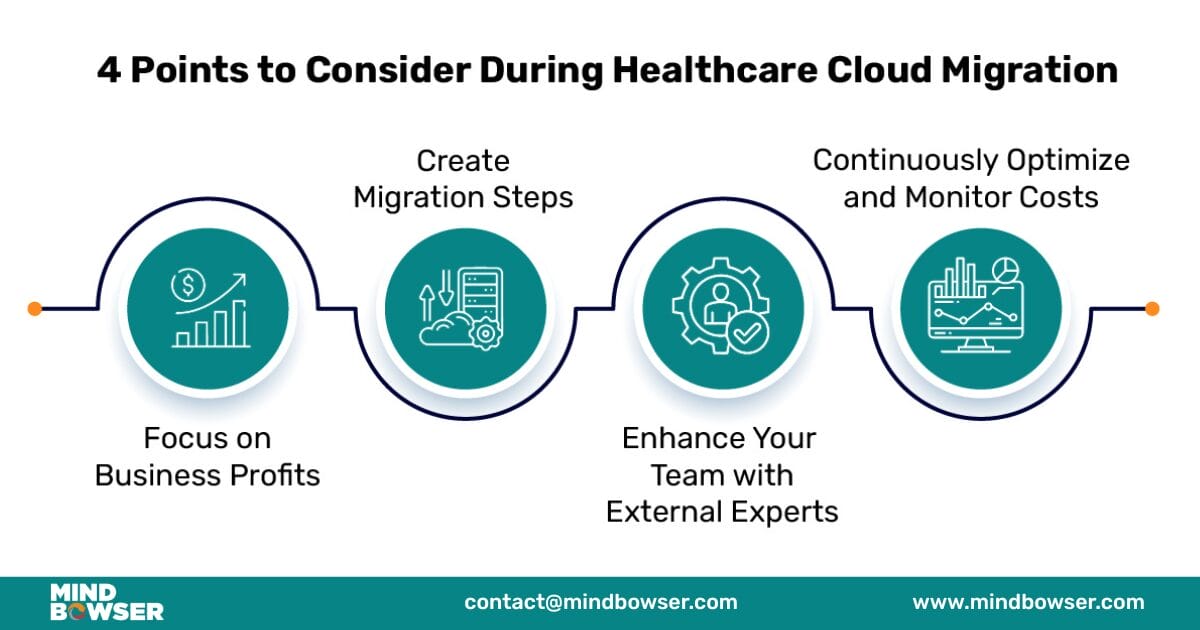
1. Focus on Business Profits
Your IT team may be traded on a cloud migration system, but you yet could see resistance from another group—including leadership who eventually controls the plan. Disabling that resistance needs a solid professional process for the healthcare cloud.
Emphasize how migrating to the cloud will improve agility and innovation while avoiding big-scale cost spending. As you order applications for migration, think first to concentrate on applications that will provide a quick return on assets.
Then emphasize those hits with your resistant or skeptical colleagues. Making buy-in across the company and crafting early motion will be vital for extended-term success.
2. Create Migration Steps
The right way to avoid stoppage is to migrate applications initially to a non-development configuration. You can accomplish a complete sequence of migration, re-migration, and rollback tests to confirm your current strategy and perfect your development.
Having a validated, tested process in location will allow you to evade any problems during the relocation that could cause downtime.
Related Read: Top Healthcare Cloud Migration Tips for Seamless Transition
3. Enhance Your Team with External Experts
To adopt the technical encounters of application modernization, cloud management, migration, security, and compliance, consider improving your group with external, health-focused specialists. Certainly, you can educate your team to manage a few of these crucial functions.
For instance, you may choose to educate existing software developers to containerize applications rather than employing outside staff. However, functioning with external experts can frequently accelerate those guiding processes.
In some instances, it may make sense to solely hand over specific cloud migration or management jobs to an expert MSP. You may decide to concentrate your inside team on making new application capabilities while letting cloud management.
4. Continuously Optimize and Monitor Costs
Knowing the actual prices of cloud systems is vital for an effective migration to the healthcare cloud. You have to accurately budget and estimate the cost of application implementation and modernization of new safety controls.
Going ahead, you have the means to continuously check and improve cloud prices so you can overcome being surprised by expenses and also confirm continued company assistance for your cloud management.
Working with a healthcare cloud migration can give you good visibility into every of your cloud spending and utilization. You can check all cloud properties from a sole pane of the page, function with a professional to correct-size your configurations and manage workloads to overcome wasted consumption.
Harness the Power of Cloud Services for Your Healthcare Application
Create Digital Processes to Increase Automation
Nowadays, all technology relies on cloud migration automation. However, in earlier years, we have viewed the growth of technologies like robotic process automation, which can effectively swap humans by imitating repetitive responsibilities.
Healthcare cloud migration has effectively reduced human jobs in administrative works like revenue cycle operations and claim processing. Many cloud migration services technology businesses have succeeded in employing online work which can complete repetitive jobs at a part of the outlay of physical work. A few years ago, this value proposition was upsetting for workers and employers alike.
Nevertheless, with the truth of job shortages gaping at businesses, there is innovative interest in governing automation to lessen the absence of workers and hypothetically redeploy jobs from more routine work to value-driven ones.
While digital automation has shown its attainment in a restricted range of management functions, different technologies are growing as viable alternatives for operational and clinical areas that can find the staff shortage and lessen the workload on healthcare employees. Text-to-speech has made a footprint, especially in the earlier years, pushing the lead for home healthcare and intensive care.
Informal interfaces such as messages, and chatbots have come to the front, enabled by the moving function of the epidemic, which needed a spark in evaluating for big numbers of people with illness symptoms. It is fair to mention the most known use case for message bots has been symptom screening.
Digital automation, chatbots, and voice technologies are stirring upstream into essential healthcare processes by making on the achievement of preliminary use cases. All at once, innovative technologies are developing as viable substitutes to reduce social intervention. While still making a deep effect on health operations, artificial intelligence technologies are enhancing beyond management use cases to key operations like user engagement and marketing.
Related read: ChatGPT and Generative AI in Healthcare: Exploring the Role, Challenges, and Future
Healthcare and the cloud migration in healthcare are known to use facial recognition effectively to identify users during check-in and registration. In the collective, a few times of retaining back and forth from the usage of technologies can augment some hours for doctors, which can create a substantial effect on the healthcare system.
For healthcare cloud adoption to remain updated on their healthcare delivery approaches, expand online health areas, and improve business efficiencies, the serious shortage of employees is forcing work like no other now in proceeding with the implementation of automating healthcare cloud migration.
Conclusion
Cloud migration in healthcare is a challenging yet essential endeavor. Despite facing obstacles such as data security and interoperability, a well-planned strategy and consideration of key factors can lead to numerous benefits. By embracing the cloud, healthcare providers can enhance efficiency, data accessibility, and patient care, paving the way for a transformative future in the industry.
Cloud migration is the process of moving data, applications, and systems from on-premises servers to cloud-based platforms. It is important for healthcare organizations because it enhances data security and privacy, improves collaboration and communication among healthcare providers, streamlines operations, and improves patient care.
A cloud migration strategy is a plan that outlines the steps and processes involved in moving data, applications, and systems to cloud-based platforms. Healthcare organizations can choose the right strategy by considering their specific needs, the complexity of their data and systems, and the expertise of their IT team. It is recommended to work with a qualified IT engineer who can guide them through the process and help identify the best strategy for their case.
Cloud migration services are professional services provided by IT companies to help organizations plan, execute, and manage the process of moving their data, applications, and systems to cloud-based platforms. The benefits of using cloud migration services include expert guidance and support throughout the migration process, increased efficiency and reduced risk of errors during migration, and ensuring compliance with industry standards and regulations.
A healthcare cloud is a cloud-based platform specifically designed to store, manage, and access healthcare data, applications, and systems. Its key features include advanced security features to protect patient data and privacy, scalability to accommodate the growing volume of healthcare data, and flexibility to support various healthcare applications and systems.
The potential benefits of healthcare cloud migration include modernizing the full suite of applications to provide agile functionality and delivery, creating an insights-driven organization, enabling transformational changes, and charting the course to the future.