














 BLOGS
BLOGS  NEWSROOM
  CASE STUDIES
  WEBINARS
  PODCASTS
  ASSET HUB
  EVENT CALENDAR




















TL;DR
Cerner (now Oracle Health) remains one of the largest EHR ecosystems in the U.S., especially across enterprise hospitals, federal systems, and academic medical centers. In 2026, most Cerner integration projects revolve around FHIR R4 modernization, HL7v2 coexistence, and migration away from deprecated DSTU2 APIs.
For healthcare organizations running multi-EHR environments, Cerner integration often requires a normalization layer that can unify Epic, Cerner, Athenahealth, and legacy systems into a single interoperability framework.
Cerner’s strengths include deep clinical workflows, enterprise scalability, and strong acute-care penetration. The biggest challenges typically involve implementation complexity, API governance, Cerner CODE review cycles, and migration planning after Oracle’s acquisition and platform transition.
Typical Cerner integration timelines range from:
3–6 weeks for read-only FHIR integrations
8–16 weeks for bidirectional integrations
4–7 months for enterprise multi-module interoperability projects
Cerner integration is a prominent figure in the healthcare industry, offering advanced EHR systems that streamline patient data management. Cerner integration is crucial to the global healthcare sector, with over 27,000 healthcare facilities worldwide using its solutions.
With Cerner integration technology, healthcare providers can efficiently organize, store, and access critical information across various medical settings. The ability to exchange data seamlessly is important in healthcare today. It ensures that patient information is accurate and up-to-date, facilitating informed clinical decisions and improving patient outcomes. Efficient data exchange is a technological advantage and a cornerstone of effective healthcare delivery, enabling better coordination and continuity of care.
Let’s learn more about Cerner integration and how it helps healthcare providers:
What is Cerner Integration?
Cerner integration refers to connecting the Cerner EHR system with other healthcare software and systems to facilitate efficient data exchange and interoperability. This integration allows healthcare providers to consolidate patient information from various sources, providing a unified view of patient health data.
Cerner integration utilizes standard protocols that ensure that different systems communicate effectively, improving clinical workflows, data accuracy, and patient care coordination. This approach supports informed decision-making and optimizes healthcare operations, making it easier for medical professionals to access and manage patient information.
How Does Cerner Integration Help Healthcare Providers?
Cerner integration improves healthcare delivery by connecting the EHR system with other healthcare applications and systems. The integration enables the efficient flow of patient data across various platforms, ensuring healthcare providers have access to accurate and up-to-date information. By consolidating patient records from different sources, Cerner integration helps create a unified patient history, which aids in better clinical decision-making and enhances patient care coordination.
With Cerner integration, healthcare providers can streamline workflows, reducing the time and effort required to input and retrieve patient data. Together with time savings, this effectiveness reduces mistakes, which enhances patient safety.
Additionally, Cerner integration supports interoperability, allowing different healthcare systems to communicate and share data effectively. This interconnection is critical for providing complete patient care, optimizing resource allocation, and increasing overall operational efficiency in healthcare institutions.
Now that we understand how Cerner integration helps healthcare providers, let’s learn more about the pros and cons of Cerner integration.
Pros of Cerner Integration
A. Improved Patient Care
Cerner integration allows healthcare providers to access the complete medical history of patients, leading to better-informed clinical decisions. This comprehensive view of patient information ensures accurate diagnoses and personalized treatment plans, ultimately improving patient outcomes.
B. Increased Efficiency
Modernizing workflows through Cerner integration reduces the need for manual data entry. Automated processes streamline administrative tasks, allowing healthcare professionals to focus more on patient care and less on paperwork. This efficiency boosts productivity and reduces the risk of human error.
C. Enhanced Billing Processes
Cerner integration optimizes billing procedures by reducing errors and speeding up claim submission. Accurate and timely billing ensures healthcare providers receive payments faster, improving the organization’s financial health. Streamlined billing processes also reduce administrative burdens and enhance overall operational efficiency.
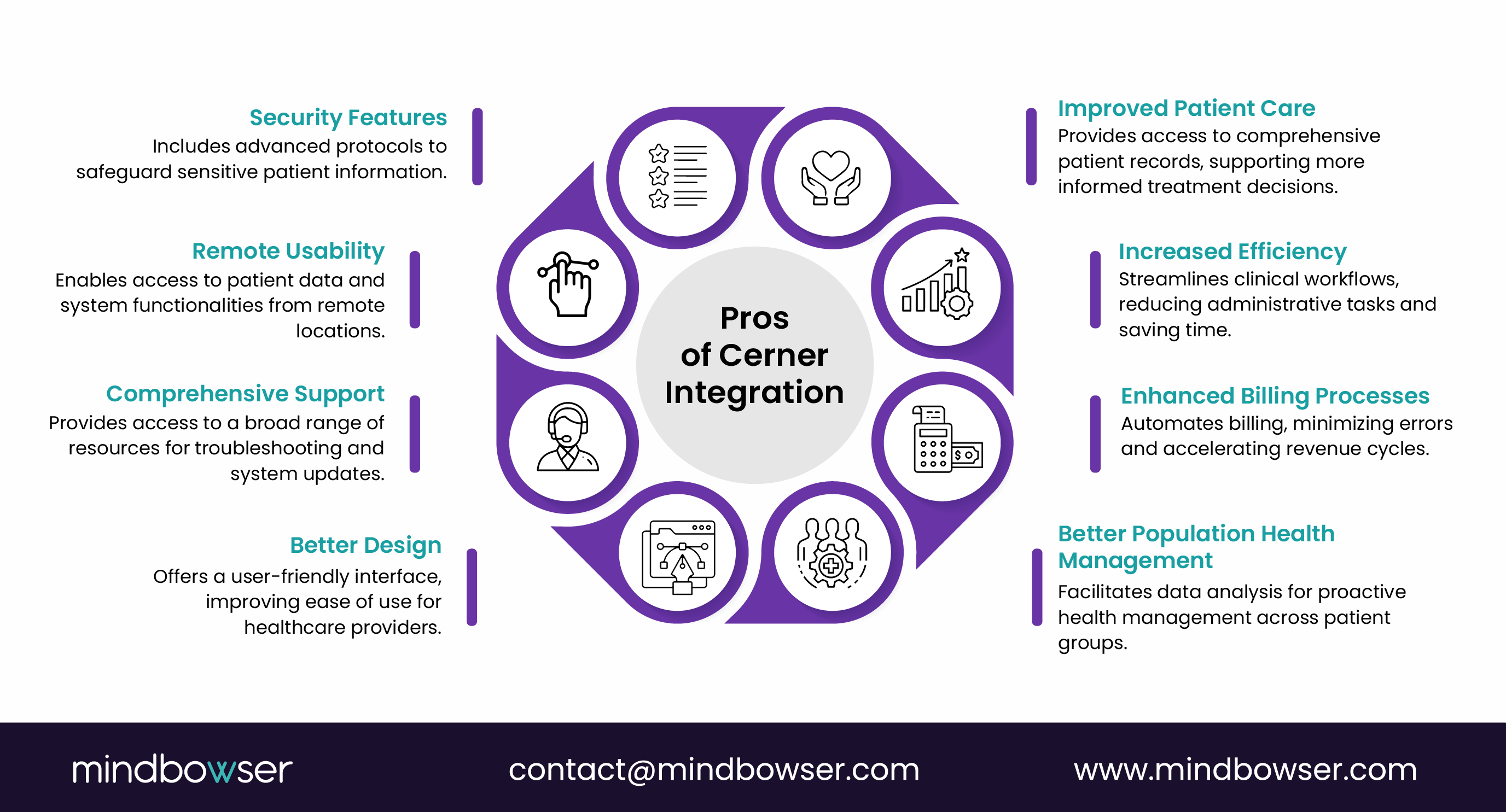
D. Better Population Health Management
Cerner integration supports better population health management by providing a unified platform for analyzing and tracking health trends across different patient groups. This capability helps healthcare providers identify at-risk populations, monitor health outcomes, and implement preventive measures, contributing to improved public health initiatives.
E. Better Design
Cerner’s EHR system is well known for having an intuitive user interface that makes it simpler for medical professionals to browse and handle patient data. The user-friendly design decreases the learning curve for new users while increasing productivity by simplifying complicated operations.
F. Comprehensive Support
Cerner offers substantial help to its users via email, phone, and live chat, ensuring that any concerns are resolved quickly. This degree of support is critical in healthcare settings where immediate help may make a difference in patient care.
G. Remote Usability
The ability to use Cerner EHR remotely is a significant advantage since it enables healthcare practitioners to access patient information and perform their commitments from anywhere. This adaptability is especially useful in today’s healthcare industry, where telemedicine is becoming more common.
H. Security Features
Cerner has strong security measures to protect patient data, meeting the essential requirements for privacy and adherence to laws like HIPAA. These features guarantee that sensitive information is protected from unwanted access.
These are a few of the pros of Cerner integration in healthcare businesses.
Know More about Cerner's FHIR Capabilities!
Cerner Integration Challenges in 2026
DSTU2 Migration Complexity
Cerner officially deprecated its DSTU2 FHIR endpoints in December 2025, pushing healthcare organizations toward FHIR R4 migration. For many health systems, this is not a simple endpoint replacement exercise. Existing integrations often contain hardcoded resource mappings, legacy OAuth scopes, custom SMART-on-FHIR workflows, and downstream dependencies built specifically around DSTU2 behavior.
The challenge becomes larger in multi-EHR environments where Cerner integrations coexist with Epic, Athenahealth, Meditech, or legacy HL7v2 interfaces. Teams frequently need a normalization layer that can reconcile differences between older DSTU2 payloads and current FHIR R4 structures while maintaining backward compatibility for downstream systems.
Healthcare organizations also underestimate the operational impact of migration. Testing cycles, API governance reviews, sandbox validation, and production cutover planning can significantly extend timelines beyond the initial API rewrite effort.
HL7v2 and FHIR Running in Parallel
Despite the industry’s shift toward FHIR R4, most Cerner environments in 2026 still operate hybrid interoperability architectures where HL7v2 and FHIR run simultaneously.
Core workflows such as:
- ADT messaging
- lab result delivery (ORU)
- scheduling workflows (SIU)
- document exchange
- radiology feeds
continue to rely heavily on HL7v2 infrastructure. FHIR is increasingly used for patient-facing apps, analytics platforms, SMART-on-FHIR applications, and modern interoperability workflows, but it rarely replaces HL7v2 entirely.
Oracle Health Platform Transition
Oracle’s acquisition of Cerner introduced a broader platform transition that continues to influence interoperability planning in 2026. While the core Cerner Millennium ecosystem remains widely deployed, healthcare organizations are simultaneously evaluating Oracle Health’s cloud roadmap, API standardization efforts, and long-term modernization direction.
This transition has created both opportunities and uncertainty for integration teams. Some organizations benefit from stronger cloud infrastructure and modernization investments, while others face challenges around evolving documentation, changing terminology, updated developer tooling, and shifting implementation priorities.
For healthcare CTOs and interoperability leaders, the key consideration is no longer just “Cerner integration,” but how Oracle Health’s long-term platform strategy impacts future interoperability architecture decisions.
Cerner CODE Marketplace and Review Cycles
Organizations building applications for deployment across multiple Cerner customers must often navigate Cerner CODE marketplace review and governance processes. While internal single-customer integrations may bypass some requirements, broader distribution scenarios typically involve security reviews, validation cycles, and marketplace approval workflows.
These governance layers can extend implementation timelines, especially for vendors building SMART-on-FHIR applications, patient engagement tools, AI-assisted workflows, or clinical decision support platforms.
For digital health companies, review-cycle planning becomes a critical part of go-to-market execution. Integration timelines are influenced not only by technical development effort, but also by approval queues, compliance validation, and enterprise deployment coordination.
Cons of Cerner Integration
A. Complexity of the Integration Process
One significant challenge of Cerner integration is the complexity involved in the process. Implementing Cerner’s system often requires a high level of technical expertise. Healthcare organizations must ensure they have the right personnel or third-party support to handle the intricacies of integrating various systems and workflows smoothly.
B. Potential for Data Security Risks
While integrating Cerner, the potential for data security risks arises. Ensuring secure connections and safeguarding sensitive patient information is crucial. Any vulnerabilities in the integration process can expose healthcare data to unauthorized access, making robust security measures and constant monitoring essential to protecting patient privacy.
C. Cost of Implementation and Ongoing Maintenance
The cost associated with Cerner integration can be substantial. Initial implementation expenses, including software, hardware, and training, can strain budgets. Additionally, ongoing maintenance and updates require continuous investment. Healthcare providers must weigh these costs against the long-term benefits of an integrated system, considering both financial and operational impacts.
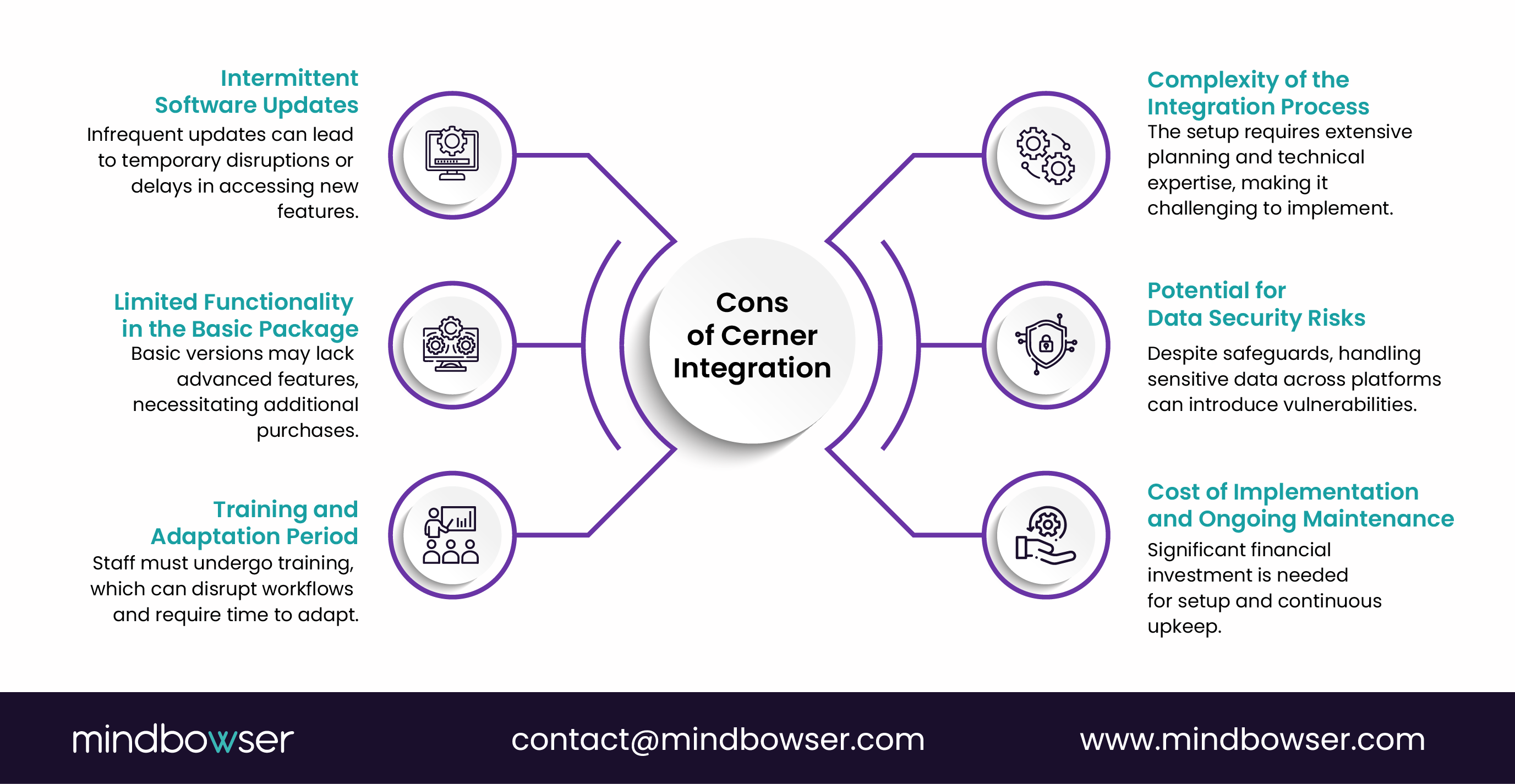
D. Training and Adaptation Period
Another drawback of Cerner integration is the training and adaptation period required for staff. Transitioning to a new system can be challenging for healthcare providers, who must learn new workflows and interfaces. This learning curve can temporarily impact productivity and may require ongoing training and support to ensure all users are proficient and comfortable with the new system.
E. Limited Functionality in the Basic Package
Startups often face significant challenges when integrating new systems into their operations. This is particularly true in healthcare, where the complexity of data and the need for seamless interoperability are paramount. Despite being reasonably priced, the basic package only offers a limited number of functions. Startups must carefully evaluate their needs and the capabilities of the basic package to avoid unexpected costs and ensure smooth integration into their workflows.
F. Intermittent Software Updates
While required for security and functioning, they can cause productivity disruptions. Users must often adjust to changes or endure brief outages during these upgrades.
Why Healthcare Organizations Use HealthConnect CoPilot for Cerner Integration
HealthConnect CoPilot offers a practical solution for addressing the challenges of Cerner integration. Designed to simplify the integration process, We ensure that healthcare providers can efficiently manage patient data across various systems. With an emphasis on ease of use, HealthConnect CoPilot minimizes the technical complexity typically associated with Cerner integration.
HealthConnect CoPilot supports interoperability across complex healthcare environments where Cerner integrations often coexist with Epic, Athenahealth, Meditech, payer systems, analytics platforms, and patient-facing applications. The platform is designed to manage both modern FHIR R4 workflows and legacy HL7v2 interoperability requirements without disrupting clinical operations.
Security is an important feature of HealthConnect CoPilot, providing healthcare organizations with confidence that patient data remains protected throughout the integration process. Additionally, HealthConnect CoPilot is built to scale, accommodating the needs of small clinics as well as large hospital networks, making it a versatile choice for any healthcare provider.
Choosing HealthConnect CoPilot brings added advantages. Our extensive experience in healthcare technology ensures that the integration process is handled with expertise. Their dedicated support team is available to assist at every step, ensuring a smooth and efficient transition to Cerner integration. This combination of innovative technology and reliable support makes HealthConnect CoPilot the ideal choice for healthcare providers looking to optimize their systems.
HealthConnect CoPilot offers a reliable solution for Cerner integration challenges, focusing on simplicity, security, and scalability. With us, healthcare organizations can navigate the complexities of integration with confidence, knowing that their data is secure and their systems are optimized for efficiency.
Integrating with Cerner offers improved interoperability, streamlined clinical workflows, and better access to patient data across systems. It enhances overall efficiency and supports more informed decision-making in healthcare settings.
Challenges may include the complexity of data migration, the need for extensive staff training, and potential disruptions to existing workflows. It’s crucial to plan and allocate resources effectively to manage these challenges.
Cerner integration can positively impact patient care by providing healthcare providers with comprehensive patient records, enabling more accurate diagnoses, and facilitating timely treatment decisions. However, initial implementation may temporarily affect workflow efficiency.
Consider your organization’s existing IT infrastructure, budget, and long-term goals. Assess the compatibility of Cerner with your current systems and the level of support available for integration and ongoing maintenance.
Cerner integration connects third-party apps to Cerner (Oracle Health) EHR systems through Cerner’s FHIR R4 APIs, HL7v2 interfaces, and Cerner CODE / Millennium-specific endpoints. The 2022 Oracle acquisition rebranded the product to Oracle Health; integration patterns remain similar to pre-acquisition Cerner with some cloud-platform shifts.
Both expose FHIR R4 + HL7v2. Epic has deeper App Orchard ecosystem and SMART on FHIR Vendor Services certification. Cerner has historically had stronger federal/DoD penetration and CODE marketplace. Multi-EHR shops typically integrate each separately to a unifying platform layer.
Cerner CODE is Cerner’s third-party developer marketplace (analog to Epic’s App Orchard). Apps distributed to multiple Cerner customers go through CODE listing and review. Internal apps for a single customer don’t require CODE listing.
Yes ,December 2025. Customers running DSTU2 must migrate to FHIR R4. See the DSTU2 deprecation section above for migration paths.
Typical ranges: 3 to 6 weeks for FHIR R4 read-only, 8 to 16 weeks for bidirectional write-back, 4 to 7 months for full custom multi-module builds. CODE listing review adds 4 to 8 weeks.
If your Cerner integration touches payer-side claims, prior auth, or member data, CMS-0057-F (Jan 2027 deadline) and CMS-0062-P (drug prior auth, proposed 2026) apply. Provider-side integration is mostly governed by HTI-1 (USCDI v3) and the Cures Act.
If your Cerner integration touches payer-side claims, prior auth, or member data, CMS-0057-F (Jan 2027 deadline) and CMS-0062-P (drug prior auth, proposed 2026) apply. Provider-side integration is mostly governed by HTI-1 (USCDI v3) and the Cures Act.