














 BLOGS
BLOGS  NEWSROOM
  CASE STUDIES
  WEBINARS
  PODCASTS
  ASSET HUB
  EVENT CALENDAR


























TL;DR
Three things that change your plastic surgery EMR shortlist:
- Plastic surgery EMR is a dual-workflow problem: cosmetic (cash-pay, patient financing, elective scheduling) and reconstructive (insurance, medical necessity documentation, prior auth). Most EMRs solve one. Not both. If your practice runs both tracks, evaluate on the billing split first, not features.
- Photo management and 3D imaging integration are the clinical differentiators. If an EMR doesn’t handle before/after documentation natively and link it to the patient chart (not a separate folder), your staff loses significant time per consult to manual workarounds (based on implementation benchmarks: typically 20+ minutes for a standard consult).
- The custom-build threshold for plastic surgery is specific: practices building commercializable patient platforms, running 3D imaging workflows that need bidirectional EMR integration, or operating hybrid surgical + aesthetics models where two billing universes need to merge into one.
Why Is Plastic Surgery EHR a Different Problem Than Any Other Specialty?
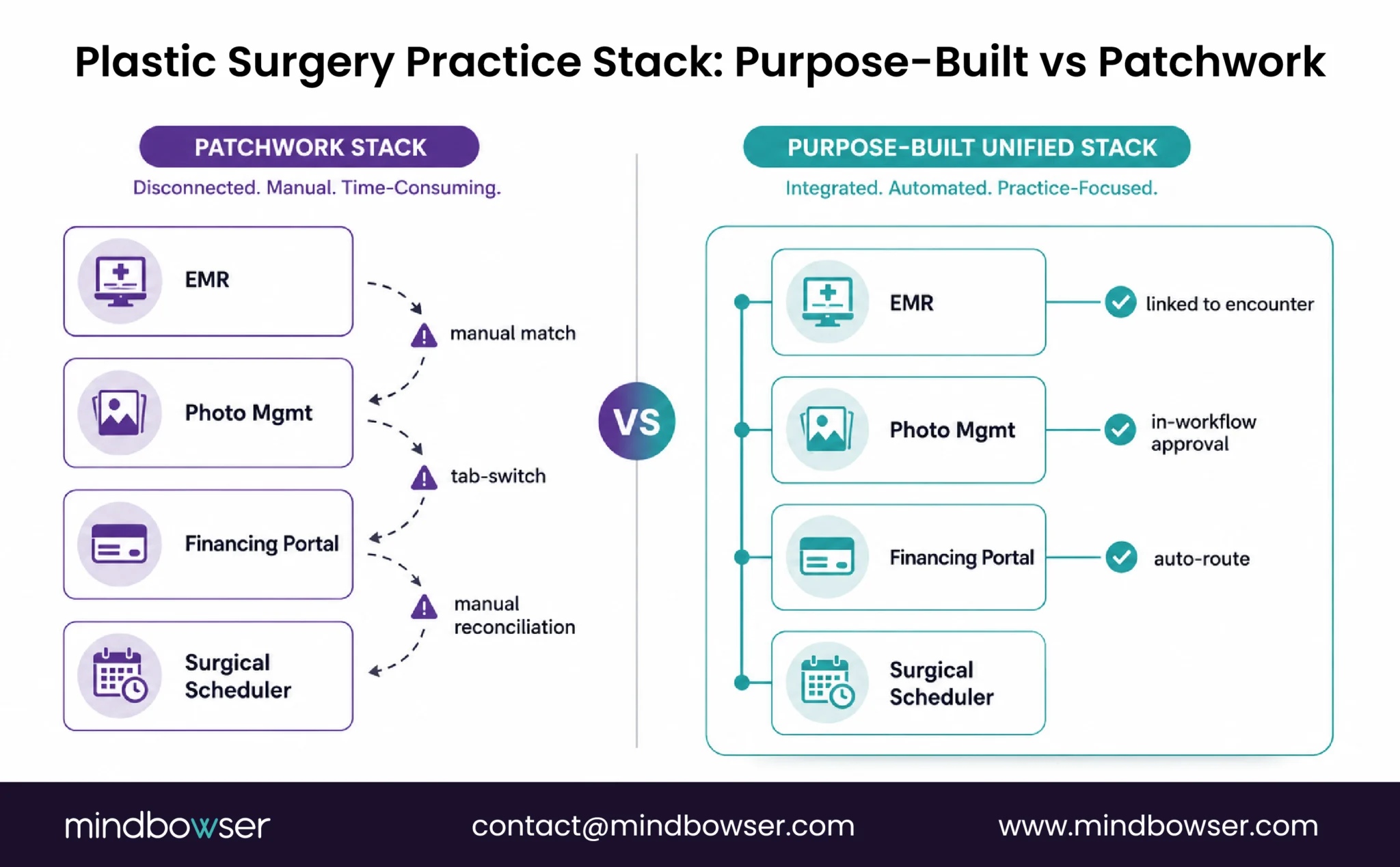
It’s a Wednesday morning in your consult room. A patient walks in for a rhinoplasty consultation. Before the surgeon walks in, someone on your staff needs to: capture standardized before photos, pull the prior consult notes, check financing approval status, and route the surgical booking through the scheduler. Four steps. If those aren’t in the same EMR workflow, your coordinator is tab-switching for 25 minutes before the appointment starts.
That’s not a process problem. That’s an EMR selection problem.
The data confirms what I see in every plastic surgery implementation:
ASPS 2024 data: 30.9 million total procedures, of which 1.6 million are cosmetic surgical procedures and 1 million are reconstructive. That’s two separate billing universes, often running in the same practice, sometimes in the same day for the same patient. Cosmetic billing is cash-pay plus patient financing (CareCredit, Alphaeon Credit). Reconstructive billing is insurance, medical necessity documentation, and prior authorization. Same surgeon, same EMR, two completely different billing tracks.
MGMA practice management benchmarks consistently flag surgical specialty practices with high documentation and billing reconciliation burden. Plastic surgery is one of the heavier loads in outpatient surgery precisely because the dual billing tracks (cosmetic and reconstructive) run through the same patient record without a unified workflow. That overhead isn’t about surgeon productivity. It’s about the patchwork.
The patchwork most practices piece together: EMR (one system), photo management (a second system), financing integration (a third), surgical scheduler (sometimes a fourth). Every system switch is staff overhead. Every manual match between the photo folder and the patient chart is a compliance gap waiting to surface.
The practices that struggle most in my experience are the ones that evaluated EMRs on feature lists and skipped the workflow integration test. The feature list says “photo management.” What it doesn’t say: are those photos linked to the patient’s chart encounter, or dumped in a folder that someone has to manually match to the patient record?
What Should You Actually Evaluate When Comparing Plastic Surgery EHRs?
The wrong evaluation question is “does it have a photo module?” The right question is “where does the photo live relative to the patient chart, and can the surgeon pull it up in the exam room without switching apps?”
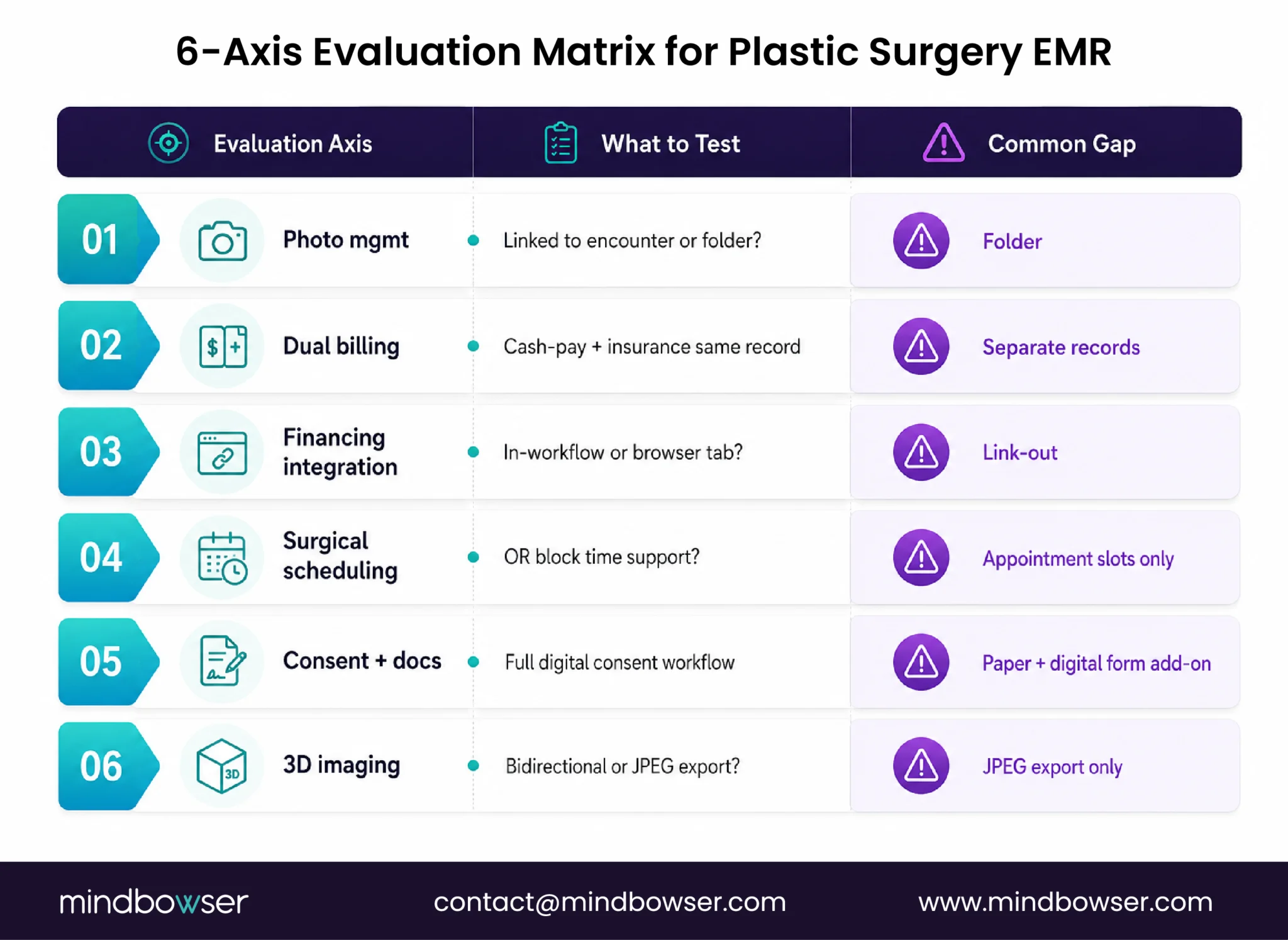
Six axes that matter for plastic surgery. Most comparison articles cover two of them.
Axis 1: Photo management workflow. The test: take a photo during consult. Where does it land? Is it linked to the encounter? Is it accessible from the exam room without opening a second app? If the answer involves a folder, a manual upload, or a separate photo management system that syncs overnight, that’s overhead.
Axis 2: Dual billing capability. Cash-pay and insurance in the same patient record without manual reconciliation. If your practice runs both tracks, this is the most important axis. Get it wrong and your billing team rebuilds the same record twice for every dual-track patient.
Axis 3: Patient financing integration. CareCredit, Alphaeon Credit, Cherry, in-workflow approval, not a link to a separate web portal. If your coordinator has to open a browser tab to check financing approval status, that’s a system you haven’t integrated, just linked.
Axis 4: Surgical scheduling. OR block time, suite booking, pre/post-op coordination, not just appointment slots. A general ambulatory scheduler doesn’t know what an OR block is. Your EMR’s scheduling module should.
Axis 5: Consent and documentation management. Digital surgical consent, procedure-specific templates, body diagram markup. These aren’t optional in surgical practices, they’re compliance requirements. If the consent flow is paper-based in a system that claims to be digital, ask the vendor to show you the full consent workflow, not just the form builder.
Axis 6: 3D imaging integration. Vectra, Crisalix, bidirectional, not just JPEG export. This axis matters most for high-volume cosmetic practices where 3D simulation is part of the consult workflow. I’ll cover what “bidirectional” actually means in a later section.
From my implementation experience: photo and imaging workflow is the #1 unmet need I encounter in plastic surgery EMR evaluations, consistently ahead of billing and scheduling in how much friction it causes day-to-day.
The test I run with every practice: demo the post-consult workflow from photo capture to appointment booking. Time it. If it takes more than 3 minutes or requires more than one system switch, the EMR isn’t built for surgical throughput.
Which Purpose-Built Plastic Surgery EHRs Are Worth a Serious Look?
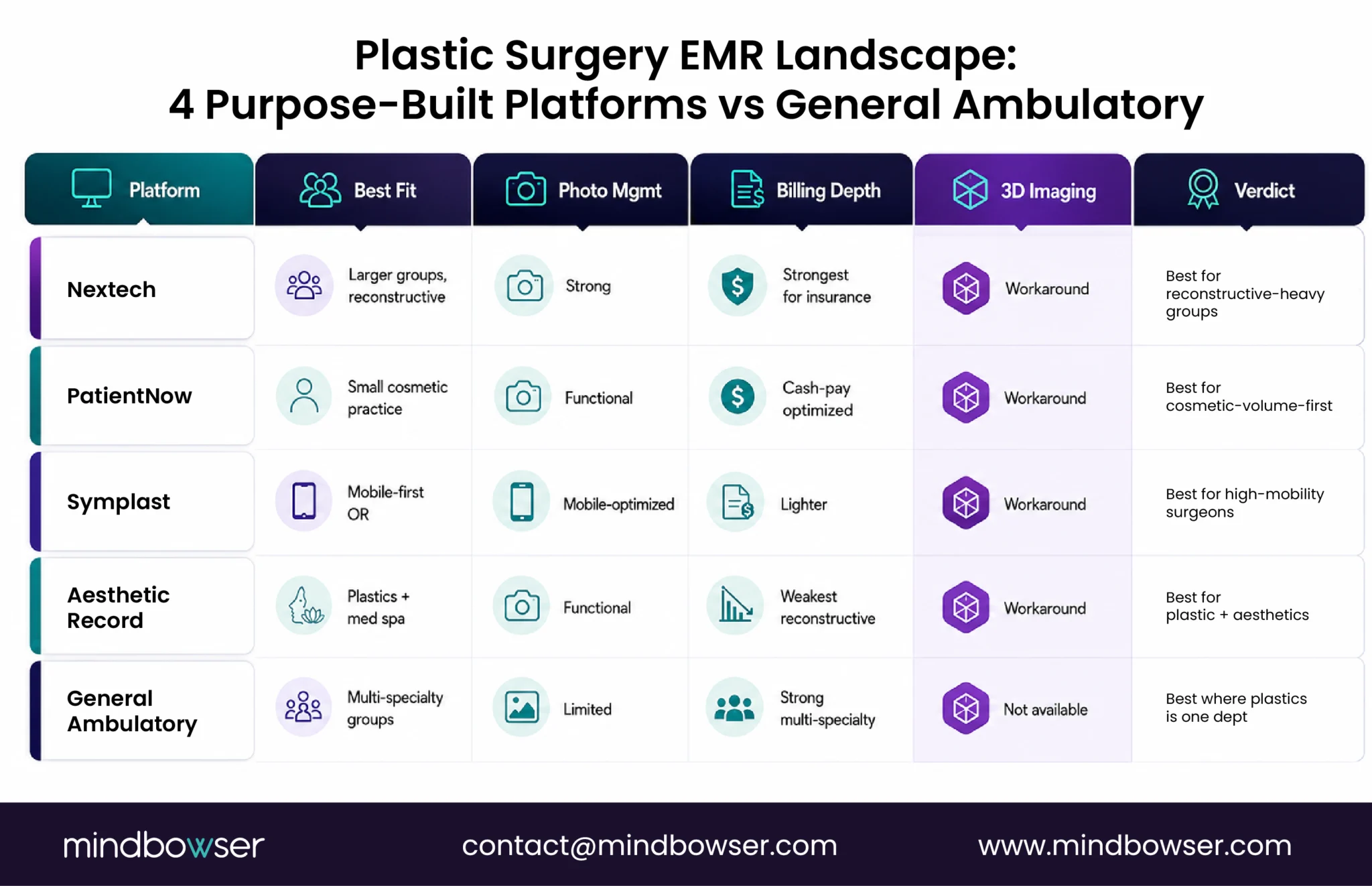
The purpose-built plastic surgery EMR market is small and concentrated. Four platforms dominate: Nextech, PatientNow, Symplast, and Aesthetic Record. They’re not interchangeable, and most comparison articles treat them as if they are.
Nextech: dominant in larger plastic surgery groups and dermatology-adjacent practices. Strong billing, photo management, and surgical scheduling. Complex setup, implementation timeline typically runs 4-6 months. The price point reflects that. If your practice is a 3-surgeon group with significant reconstructive volume and you need a system that handles prior auth tracking and medical necessity documentation at scale, Nextech is worth a serious evaluation. If you’re a solo cosmetic surgeon without the admin overhead to support a 6-month implementation, it’s likely overkill.
PatientNow: cosmetic practice focus. Patient financing integration is tighter than most purpose-built options. Best suited for practices where cosmetic volume outweighs reconstructive, the billing logic is optimized for cash-pay workflows. Photo tools are functional. They’re not sophisticated. If your practice’s clinical photo workflow requires anything beyond before/after capture and basic album management, expect to supplement.
Symplast: mobile-first. Built for surgeons who want to document from iPad in the OR. Better for practices where the surgeon moves between rooms and the documentation has to keep pace. Limited if you’re running significant reconstructive volume, the billing module doesn’t match the depth of Nextech for insurance-heavy work.
Aesthetic Record: strongest on aesthetics and med spa workflows. If your practice spans plastic surgery and med spa services (injectables, laser, non-surgical aesthetics) and you want a unified patient record across both, Aesthetic Record handles that better than the other three. The trade-off: the reconstructive billing module is the weakest of the four.
The honest read on all four: none of them handle 3D imaging bidirectional integration well out of the box. All four require workarounds for Vectra or Crisalix. That gap is consistent across the market.
General ambulatory EMRs (ModMed, Athena, eCW) are a different category. They work for multi-specialty practices where plastics is one department alongside primary care or other specialties. The trade-off: you lose specialty-specific photo and financing workflows, and you gain cross-specialty patient record continuity. For a hospital-affiliated plastic surgery practice or a multi-specialty group, that trade-off can be worth it.
Not Sure Which Fits Your Practice Model?
How Does Documentation Actually Hold Up When You’re Running a High-Volume Cosmetic and Reconstructive Practice?
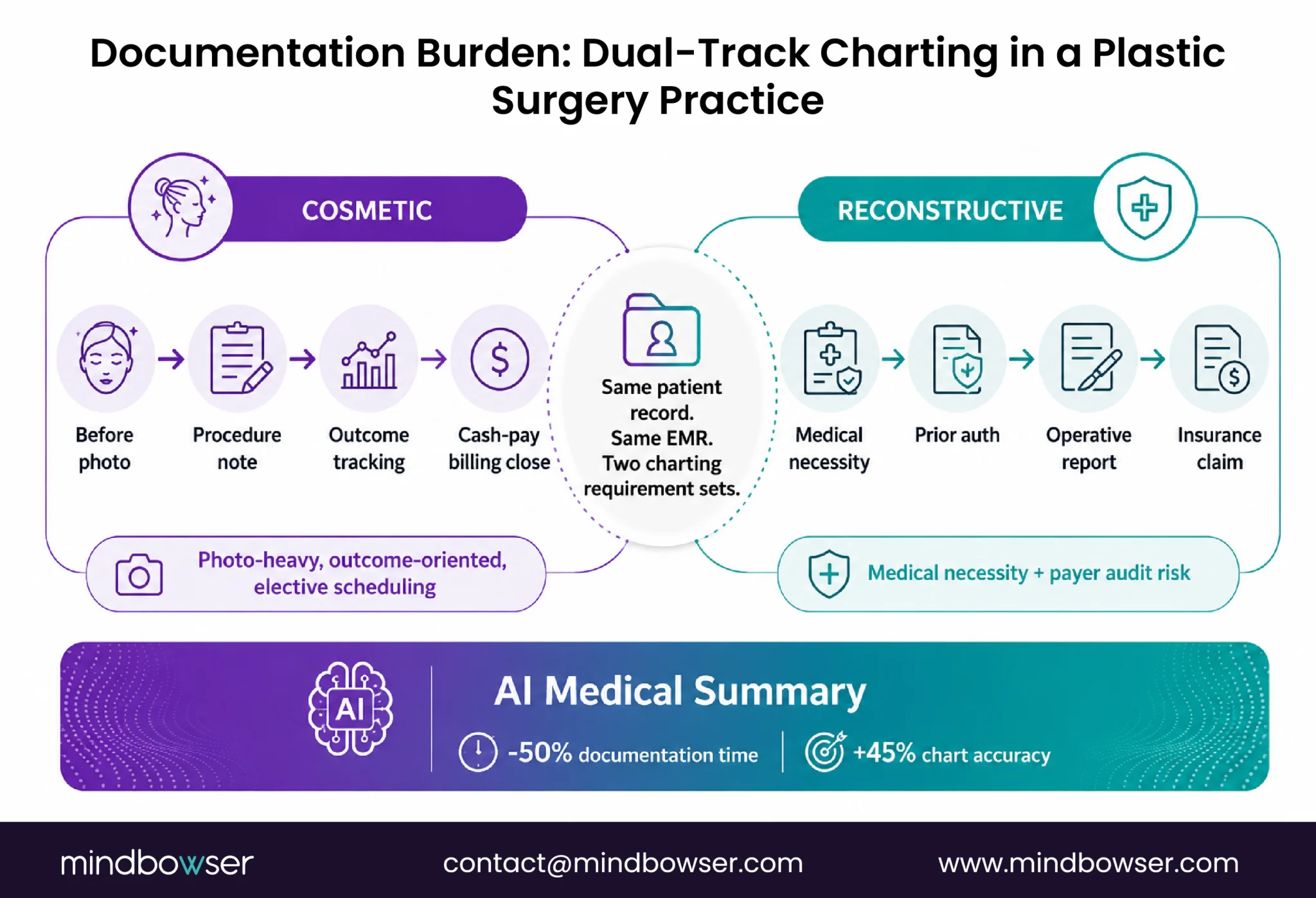
The documentation burden in plastic surgery is higher than most surgical specialties. Cosmetic procedures need pre/post photo documentation, detailed procedure notes, and patient-specific outcome tracking. Reconstructive procedures add medical necessity justification, insurance prior auth correspondence, and operative reports that have to hold up to payer audit. Multiply that by 20-30 procedures a week and you understand why surgeons in this specialty burn out faster than most.
The documentation overhead compounds across both billing tracks. Cosmetic charting is photo-heavy and outcome-oriented. Reconstructive charting adds medical necessity justification, prior auth correspondence, and operative reports that need to hold up to payer audit. The same MGMA benchmark pattern holds here: dual-track surgical practices carry some of the highest per-physician admin overhead in outpatient surgery, and it’s not because plastic surgeons are slower. It’s because two billing tracks in one patient record means two sets of documentation requirements with a single charting workflow.
AI Medical Summary reduces documentation time by 50% and improves chart accuracy by 45% in integrated deployments. Mechanism: ambient AI captures the clinical encounter, auto-populates structured note fields, flags documentation gaps, and routes the chart to billing review. It works on top of any FHIR-based EMR foundation, purpose-built or custom, because it writes to FHIR resource types, not to a vendor-specific schema.
One regulatory line to check: ONC USCDI v3 compliance (July 2026 deadline, HTI-1, 89 FR 1192) requires certified health IT systems to expose FHIR R4 APIs aligned with USCDI v3 data classes. Ask your plastic surgery EMR vendor specifically: which modules are USCDI v3 certified? If photo management isn’t FHIR-linked, it may fall outside the certification boundary, which has downstream implications for interoperability and audit trails.
The honest frame: AI documentation tools don’t replace the surgeon’s clinical judgment on photo capture or procedure note specifics. What they eliminate is the 15-minute post-consult transcription session and the end-of-day chart cleanup. That’s where the documented time actually goes.
What Does Cash-Pay and Patient Financing Integration Actually Require from a Plastic Surgery EMR?
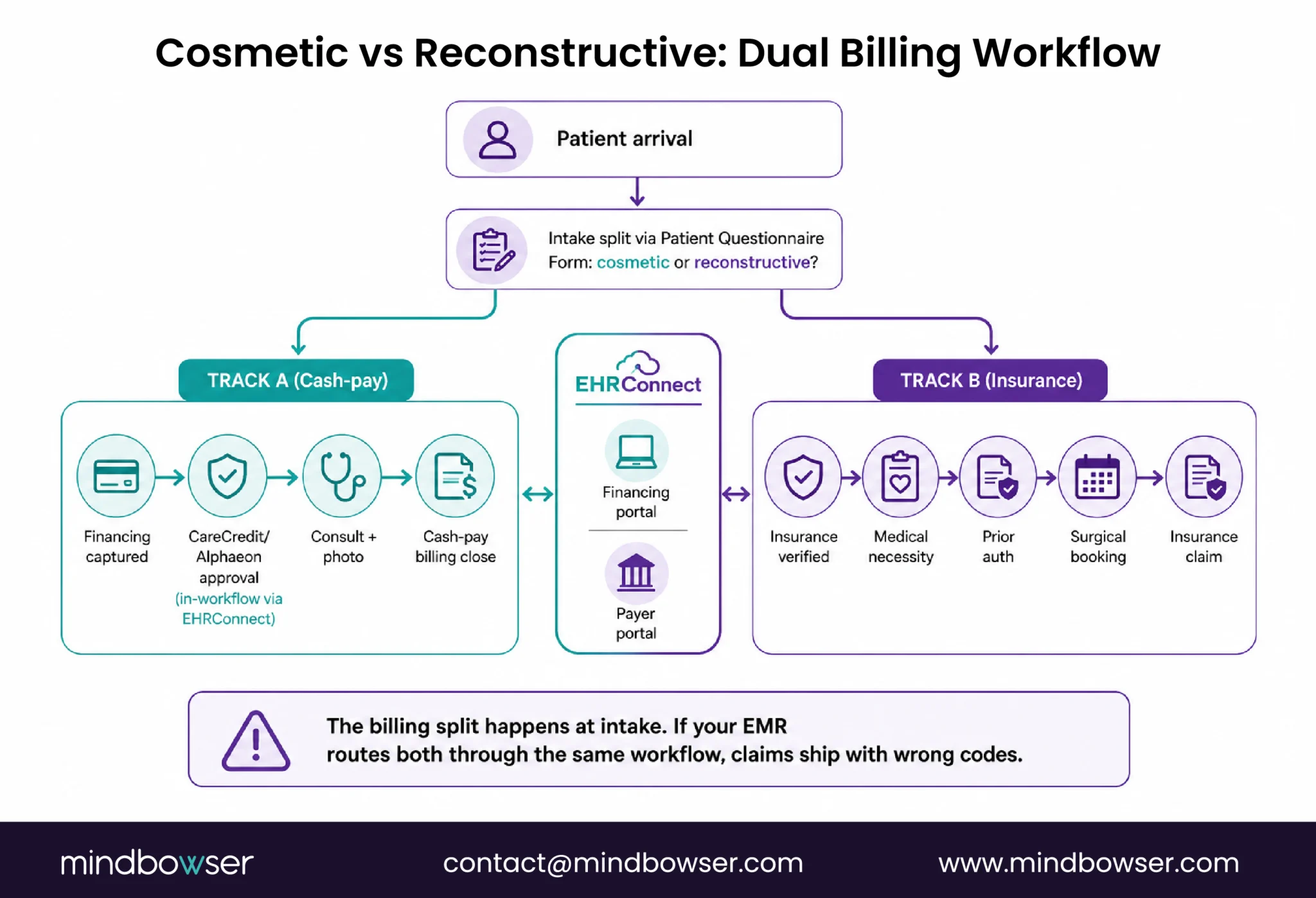
Cosmetic procedures are elective. The practice is the billing department, the financing advisor, and the payment processor, all before the procedure starts. If your EMR doesn’t integrate with patient financing platforms, your front desk runs three browser tabs and manually reconciles two records for every cosmetic consult.
Patient financing adoption in cosmetic surgery is high: CareCredit, the only patient financing company endorsed by ASPS, reports widespread adoption across their plastic surgery practice network, with industry estimates consistently in the 60-70% range for elective cosmetic patients using some form of financing. CareCredit, Alphaeon Credit, and Cherry are the three dominant platforms. Industry benchmark from plastic surgery practice managers: in-practice financing approval converts meaningfully better than sending patients to a web link to apply. If the approval status isn’t visible inside the patient record at the front desk, that conversion lift disappears.
None of the four purpose-built plastic surgery EMRs have bidirectional financing integration out of the box. Most have a link-out to the financing platform’s portal, which means manual data reconciliation. Staff checks approval status in one system, enters it in another, and hopes the records match at billing close.
EHRConnect compresses EMR-to-financing-platform and EMR-to-payer integration timelines from 6 months to 6 days via HL7/FHIR translation. For plastic surgery practices that want CareCredit or Alphaeon approval status inside the patient chart workflow (not a separate browser tab), this is the integration layer. Reconstructive billing routes to the payer portal without manual reconciliation.
Patient Questionnaire Form handles digital pre-registration for surgical intake: captures financing preference, insurance status, procedure interest, medical history, and surgical consent acknowledgment before the first consult. Routes the patient to the right billing workflow (cosmetic vs. reconstructive) at intake, before the coordinator has to ask.
The dual-billing test I run: take one patient coming in for both a cosmetic rhinoplasty (elective, cash-pay) and a functional septoplasty (reconstructive, insurance-covered). Follow that patient record from consult to billing close. How many systems does your staff touch? If the answer is more than two, the EMR isn’t handling your billing split.
How Does 3D Imaging Integration Change Your EMR Requirements?
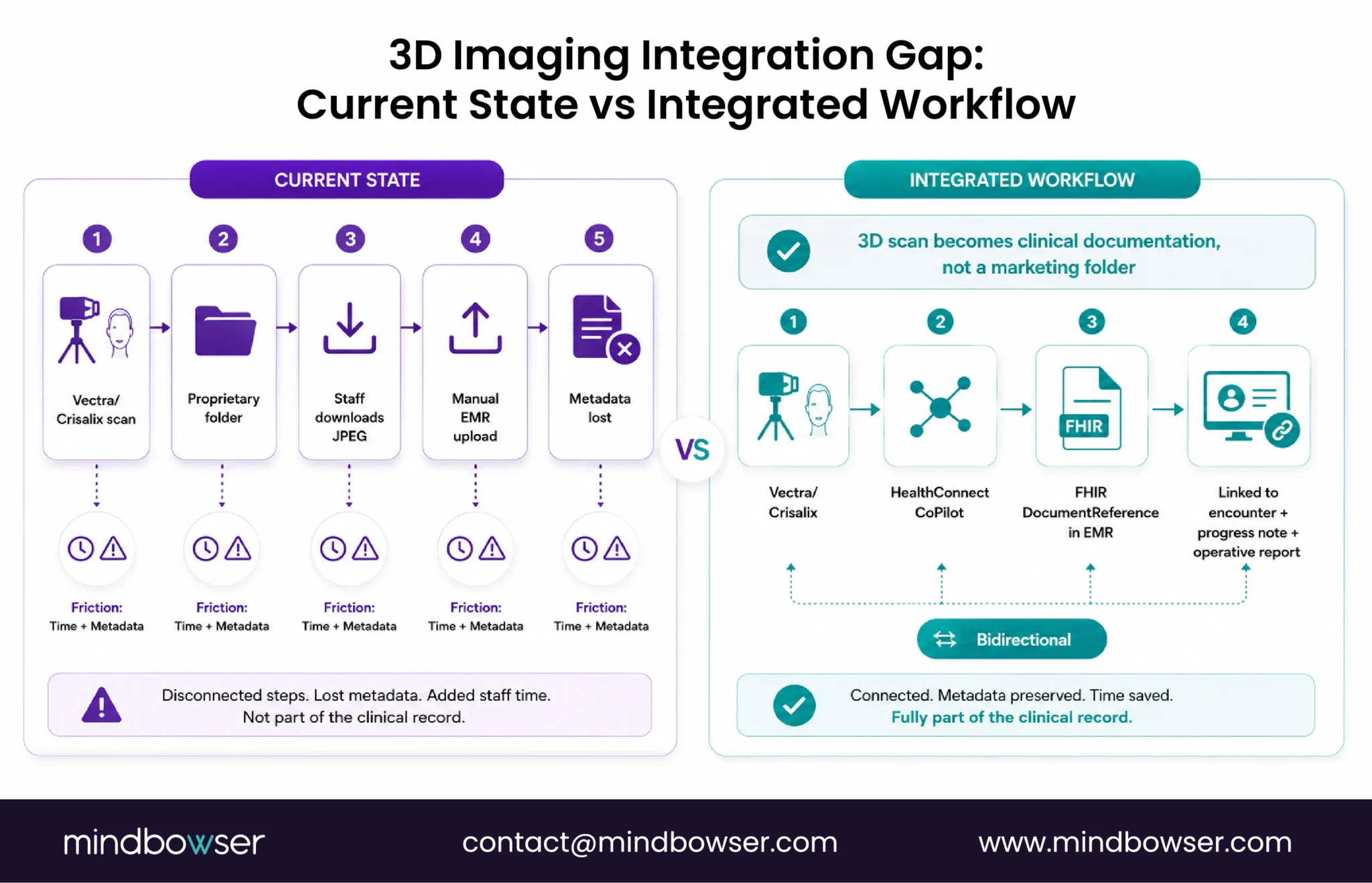
Vectra 3D and Crisalix are standard in plastic surgery practices above a certain volume. Surgeons use them for surgical planning, showing patients a simulation of what their outcome could look like. The problem: every major 3D imaging system stores images in a proprietary format. None of them talk to EMRs natively. That gap is where staff time disappears.
Vectra by Canfield is the dominant system: thousands of aesthetic practices globally use Vectra for 3D capture and surgical simulation (Canfield describes their installed base as spanning practices across more than 100 countries). Zero native FHIR integration. Images are stored in Canfield’s proprietary database. Export to EMR is manual, or via a JPEG that loses the clinical metadata embedded in the scan file. Crisalix is cloud-based 3D simulation with a published API. As of 2026, no major EMR vendor has built a native Crisalix integration.
ConnectHealth provides the FHIR/HL7 interoperability layer that bridges custom clinical builds to external imaging systems, labs, and payer systems. For plastic surgery practices that want Vectra or Crisalix images linked to the patient chart as clinical documentation (not a marketing folder), this is the integration layer. Bidirectional: images flow into the chart as FHIR DocumentReferences, and chart updates push context back to the imaging system for comparative outcome documentation.
The clinical documentation argument for this matters in reconstructive cases specifically. A 3D scan supporting a post-mastectomy breast reconstruction is clinical evidence: it documents the baseline anatomy and supports the surgical plan. When it’s in a separate folder, you can’t link it to the operative note. That’s a billing gap and a payer audit risk.
When 3D integration justifies a custom build: if your surgical workflow treats 3D imaging as a clinical asset that needs to be linked to the encounter, the progress note, the operative report, and the outcome documentation over time, no purpose-built plastic surgery EMR handles that today. That workflow requires a custom FHIR integration layer or a custom build.
When Does a Custom EHR Build Actually Make Sense for a Plastic Surgery Practice?
Custom EMR build is the decision fewer than 3% of plastic surgery practices will make. That number is probably right. But there’s a specific operational profile where purpose-built falls short and custom is defensible.
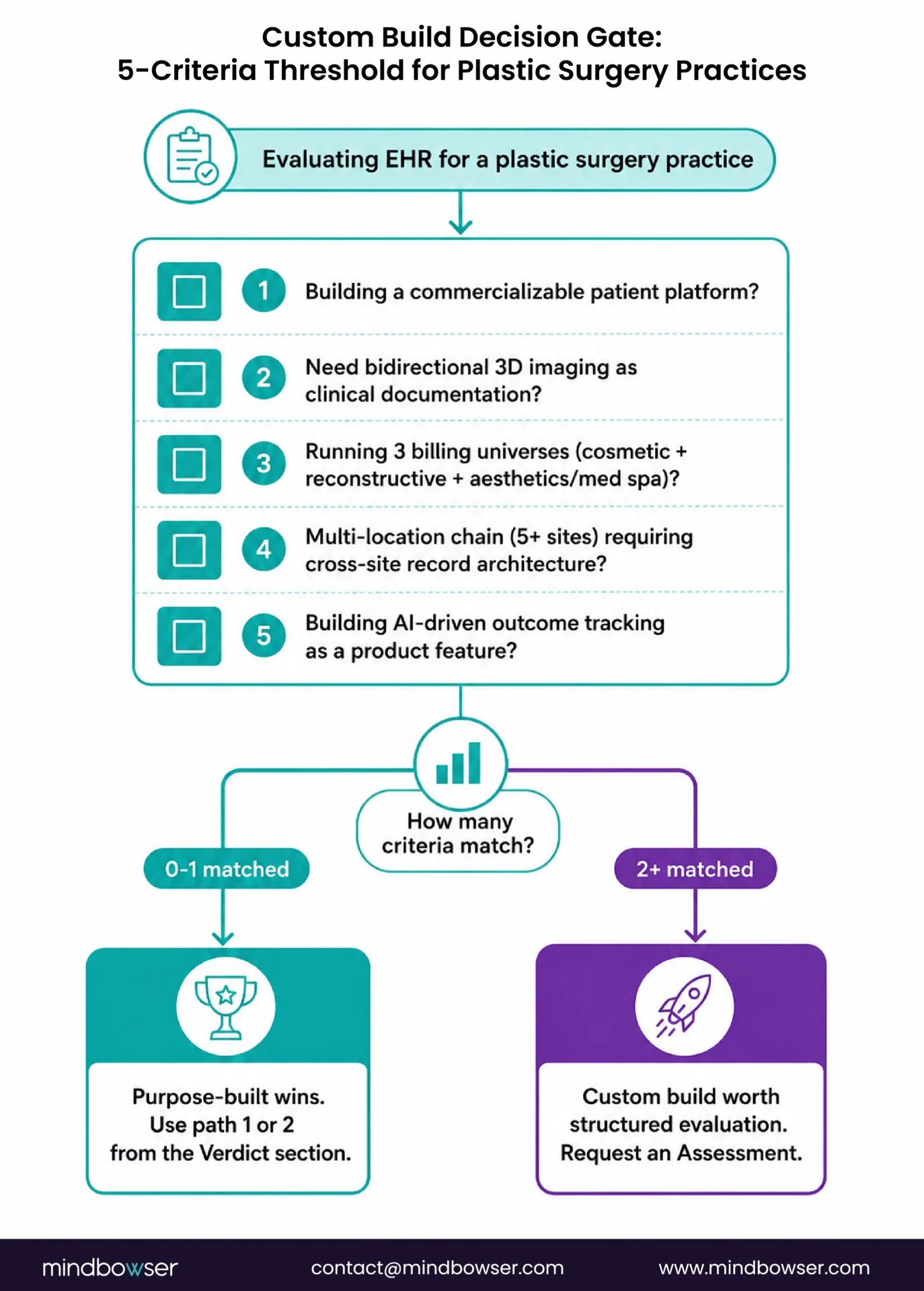
The threshold I use: meet any 2 of these 5 criteria and custom build is worth a structured evaluation.
Criterion 1: Commercializable platform intent. You’re building a patient engagement or surgical outcome platform you plan to sell to other practices. The EMR that works for you as customer -1 becomes a constraint for customers -2 through 50. Purpose-built platforms don’t support commercialization. Custom does.
Criterion 2: Bidirectional 3D imaging where scan data is a clinical record. No purpose-built plastic surgery EMR handles this today. If your surgical workflow requires that 3D scan data be linked to encounters as clinical documentation (not just stored as photos), the only path is a custom FHIR integration layer.
Criterion 3: Hybrid surgical + aesthetics + med spa with three billing universes. Elective cosmetic (cash-pay), reconstructive (insurance + medical necessity), and aesthetics/injectables (cash-pay, different CPT universe). Three billing tracks in one patient record without a custom data model is a reconciliation problem that doesn’t go away with better processes.
Criterion 4: Multi-location chains with cross-site patient record requirements that no purpose-built vendor meets without expensive middleware. If you’re running 5+ locations with centralized surgical outcome tracking, most purpose-built options require third-party middleware that becomes maintenance overhead. A custom clinical data model owns that requirement directly.
Criterion 5: AI-driven outcome tracking as a product feature. If your practice is building a proprietary outcome tracking dataset (surgical photos, patient-reported outcomes, and surgeon assessments over 12 months), you need to own the data model. No purpose-built EMR structures outcome data the way an AI training pipeline needs it.
For the build-vs-buy decision framework: Choosing Between Ready-Made and Custom EHR Solutions.
Cost structures for both paths: EHR Software Cost Guide.
I’ve implemented both. Standard solo or small-group cosmetic + reconstructive practice, purpose-built wins on cost and time to live. Custom is for practices with data product ambitions or multi-specialty complexity that purpose-built won’t support.
How Does Mindbowser Build EHR and Integration Layers for Plastic Surgery Practices?
What we build depends on where the practice’s workflow requirements exceed what purpose-built vendors support. For most practices, that’s an integration layer, not a full custom build.
Four gaps consistently drive plastic surgery practices to Mindbowser:
Gap 1: Financing and payer integration. EHRConnect: 6 months to 6 days for EMR-to-CareCredit/Alphaeon and EMR-to-payer integrations via HL7/FHIR translation. CareCredit and Alphaeon approval status inside the patient chart. Reconstructive billing routed to the payer portal without manual reconciliation.
Gap 2: Documentation overhead at scale. AI Medical Summary: -50% documentation time, +45% chart accuracy. Ambient AI captures the consult encounter, auto-populates cosmetic procedure notes and reconstructive operative report templates, routes to billing by procedure type.
Gap 3: 3D imaging as clinical record. HealthConnect CoPilot: FHIR/HL7 interop layer linking Vectra or Crisalix scan data to the patient encounter as a FHIR DocumentReference. Bidirectional, images flow into the chart, and chart updates push context back to the imaging system for comparative outcome documentation.
Gap 4: Surgical intake routing. Patient Questionnaire Form: digital pre-registration that captures financing preference, insurance status, procedure interest, medical history, and surgical consent acknowledgment. Routes to cosmetic vs. reconstructive workflow at intake, before the coordinator gets involved.
For practices crossing the custom build threshold: Custom EHR Development handles proprietary outcome tracking datasets, commercializable surgical platforms, and multi-location chain record architecture.
What’s the Honest Verdict on EHR Selection for Plastic Surgery Practices in 2026?
Purpose-built plastic surgery EMR is the right call for most practices. The decision is which purpose-built, and that depends on your cosmetic/reconstructive volume split and whether 3D imaging is a marketing tool or a clinical asset.
Three paths:
Path 1: Primarily cosmetic, high patient financing volume, moderate reconstructive billing.
Purpose-built (Nextech for groups with 3+ surgeons; PatientNow for smaller practices where cosmetic volume dominates). Evaluate specifically on financing integration workflow (is approval status inside the chart or link-out?) and photo management linkage to the encounter (linked or folder?). Feature lists won’t tell you this. Workflow demos will.
Path 2: Balanced cosmetic and reconstructive, or multi-specialty practice where plastics is one department.
Purpose-built plus an integration layer. EHRConnect closes the financing and payer integration gaps without replacing your core system. AI Medical Summary reduces documentation burden across both billing tracks. The core EMR handles the clinical workflow. The integration layer handles the system gaps.
Path 3: 3D imaging as clinical record, data product ambitions, multi-location chain with cross-site record requirements, or hybrid surgical + aesthetics + med spa with three billing universes.
Custom build or custom integration layer worth structured evaluation. The threshold: meet any 2 of the 5 criteria above and the math changes. Custom isn’t the premium fallback. It’s the defensible call when the platform’s constraints become more expensive than the build.
I’ve seen practices choose Nextech because it’s the largest name in the space, without testing the financing workflow in a real consult scenario. At month 6, the front desk is running the financing portal in a browser tab and manually matching approvals to patient charts. That’s the feature-list problem. Test the workflow. Not the specs.
Nextech is the dominant purpose-built plastic surgery EMR, holding the largest share of the purpose-built market for aesthetic and reconstructive practices. But market share doesn’t equal fit. PatientNow, Symplast, and Aesthetic Record each serve different practice models better depending on cosmetic/reconstructive volume split, practice size, and whether med spa services are part of the same patient record.
For larger plastic surgery groups (3+ surgeons) with significant reconstructive volume and the admin overhead to support a 4-6 month implementation, yes. Nextech’s billing depth, photo management, and surgical scheduling are the strongest combination in the purpose-built category. For a smaller cosmetic-focused practice, the complexity may exceed the benefit.
Most purpose-built plastic surgery EMRs have a photo module. The quality gap is in where the photos live relative to the patient chart. Functional: photos stored in EMR and accessible from the patient record. Better: photos linked to the specific encounter (not just the patient) and accessible in the exam room without switching apps. Best: photos linked to encounters as FHIR-structured clinical documentation, enabling interoperability, AI analysis pipelines, and payer audit trails. Most purpose-built systems operate at “functional.” Custom integration layers get to “best.”
Yes, particularly for hospital-affiliated plastic surgery practices or multi-specialty groups where cross-system patient records matter. The trade-off: neither Epic nor Athena was designed for high-volume cosmetic work. Photo management, patient financing integration, and cosmetic-specific billing workflows all require significant configuration. The value is cross-specialty patient record continuity; the cost is giving up the specialty-specific tooling that purpose-built systems provide out of the box.
General practice EHRs are built for primary care workflows: problem lists, chronic condition management, preventive care reminders, standard E&M billing. Cosmetic surgery EMRs are built for episodic surgical care: photo documentation linked to encounters, patient financing integration, surgical scheduling (OR block time and suite booking), digital surgical consent, and dual billing for cash-pay cosmetic and insurance-covered reconstructive in the same patient record. The architectural assumptions are different enough that adapting a general EHR for cosmetic surgery typically requires significant configuration and ongoing workarounds.