

 BLOGS
BLOGS  NEWSROOM
  CASE STUDIES
  WEBINARS
  PODCASTS
  ASSET HUB
  EVENT CALENDAR



















TL;DR
This guide covers everything you need to know about building a custom EMR or EHR system from choosing the right model, to development process, compliance, and what to look for in a build partner. For digital health leaders deciding between custom and off-the-shelf software.
Custom EMR/EHR software development services help healthcare providers build digital systems that fit their exact clinical, administrative, and compliance needs. Electronic Medical Records (EMR) typically contain a patient’s medical history within a single practice, while Electronic Health Records (EHR) offer a broader view, sharing data across different providers. Both systems improve charting accuracy, reduce paperwork, and centralize patient information, but custom-built solutions take this a step further, designed to align directly with a healthcare organization’s specific workflows and specialties.
Off-the-shelf software often forces hospitals and clinics to adjust their processes to fit the tool, which leads to inefficiencies. A custom EMR/EHR solution supports better patient experiences, faster decision-making, and easier compliance with HIPAA and other regulatory frameworks. As per the Office of the National Coordinator for Health Information Technology (ONC), 88% of office-based physicians and nearly 96% of non-federal acute care hospitals in the U.S. use some form of certified EHR system. Yet, many still face limitations due to rigid templates and poor integration. Custom development addresses these gaps, helping providers offer care that’s both efficient and personal.
EMR vs EHR: Key Differences Explained
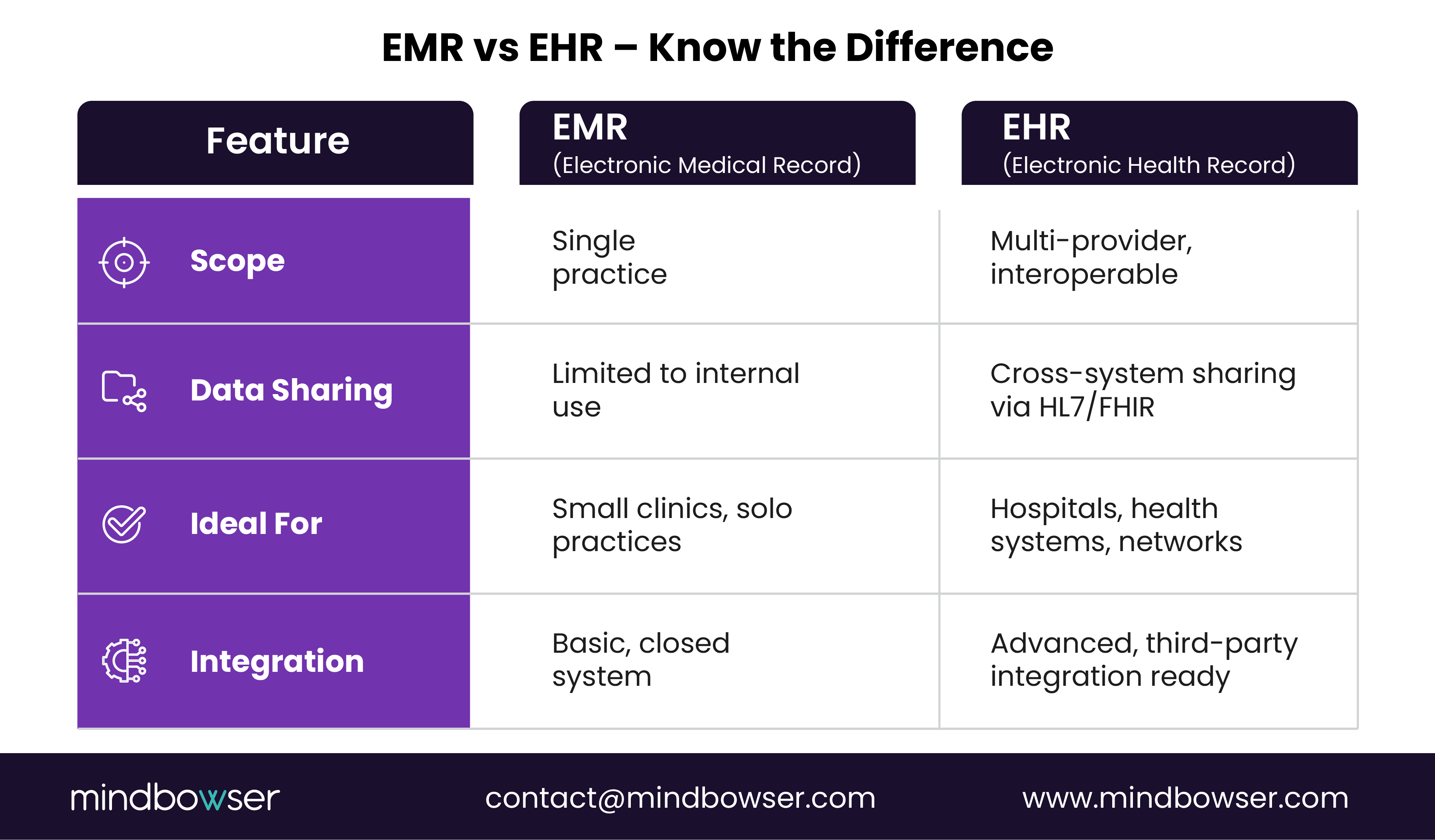
Electronic Medical Records (EMR) and Electronic Health Records (EHR) are often used interchangeably, but they’re not the same.
- EMR refers to the digital version of a patient’s chart, typically used within one practice.
- EHR, on the other hand, is a broader system designed to share health information across multiple healthcare providers and organizations.
In short, EMR is practice-specific, while EHR is patient-centric and interoperable.
Ready to scope your custom EHR build?
Development Process Overview of EMR/EHR
Creating a custom EMR/EHR system goes beyond writing code; it’s about aligning technology with clinical workflows, regulatory needs, and patient care goals. Here’s how the development process typically unfolds:
A. Initial Consultation and Requirement Gathering
The first step is deep diving into your current processes and future needs.
- We meet with clinical, admin, and IT teams to understand what’s working and what’s not.
- Key areas explored include patient flow, data formats, integrations, compliance expectations, and user roles.
- This phase results in a clear requirements document that guides the rest of the project.
Goal: Build what you need, not just what sounds good in a pitch.
B. Designing User-Friendly Interfaces
The best EMR/EHR system is one that people use willingly and effectively.
- Our design team creates wireframes and clickable prototypes.
- We prioritize clean layouts, intuitive navigation, and role-based dashboards.
- Accessibility and device responsiveness are built into the UI from day one.
Result: Interfaces that reduce training time and make daily tasks faster.
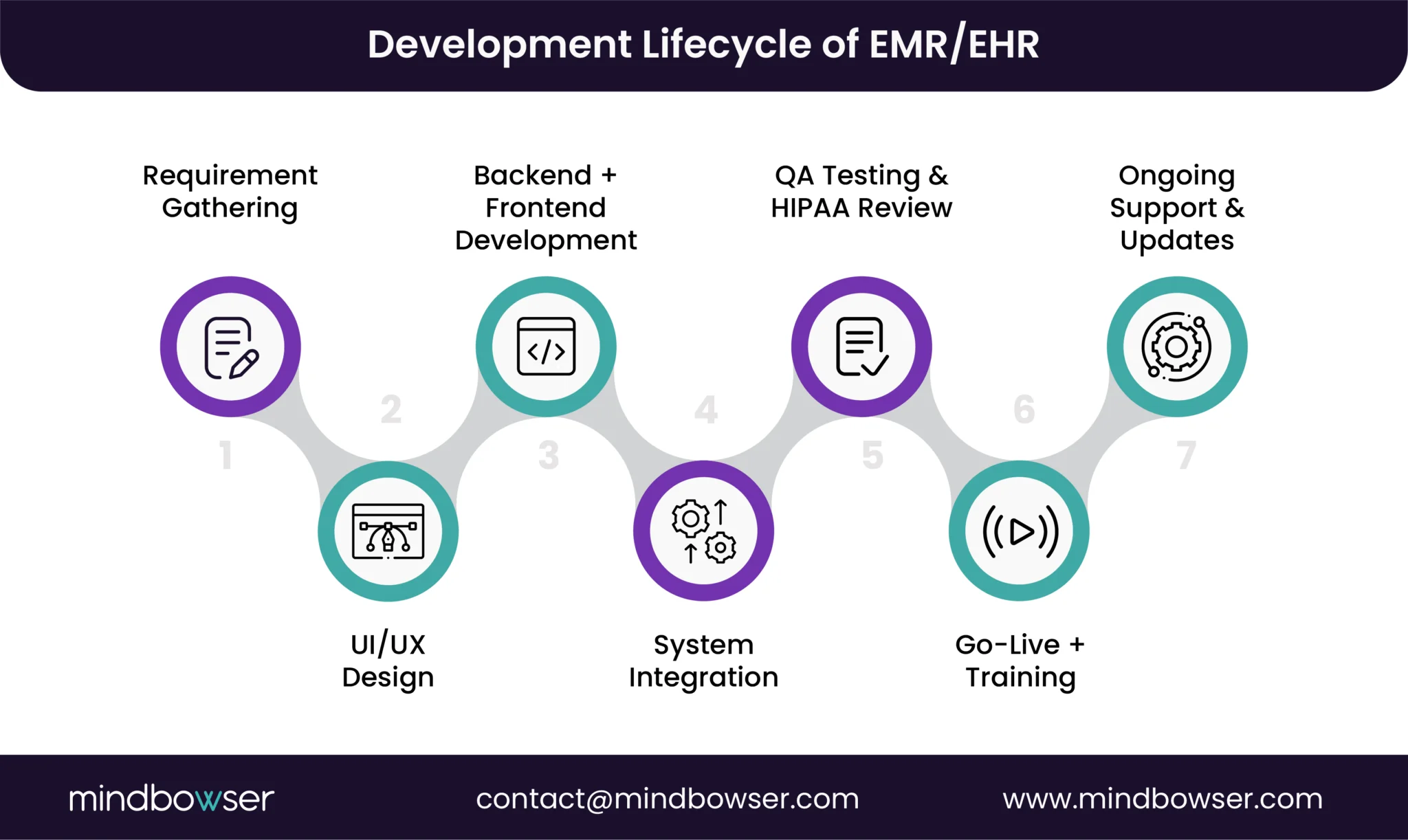
C. Backend Development and Database Structuring
Behind every smooth front-end is a powerful, secure backend.
- We build scalable architecture using modern tech stacks (Node.js, .NET, etc.).
- Data is structured for quick access and interoperability; think FHIR/HL7 readiness.
- Security protocols like role-based access, data encryption, and audit trails are implemented from the ground up.
Outcome: A fast, compliant system that supports future integrations.
D. Integration with Existing Systems
You shouldn’t have to abandon what’s already working.
- We connect your new EMR/EHR with labs, billing systems, patient portals, wearables, and more.
- Integration is done using secure APIs, custom connectors, or HL7/FHIR-based middleware.
- We also ensure bi-directional data flow where needed.
Why it matters: Connected data flow reduces duplication and boosts efficiency
E. Testing and Quality Assurance
No shortcuts here; healthcare systems demand reliability.
- We conduct unit, system, and end-to-end testing across devices and user roles.
- QA includes both automated test scripts and manual validation with real-world clinical scenarios.
- Any issues found are logged, fixed, and retested until performance is solid.
Guarantee: A system that works as expected, with zero surprises post-launch.
F. Deployment and Staff Training
A smooth launch is as important as the build itself.
- We plan a phased rollout or full deployment, depending on your readiness.
- Staff get hands-on training, quick-start guides, and video tutorials.
- Ongoing support ensures questions are answered fast, even after go-live.
End Result: Confident users, minimal downtime, and fast adoption.
Related Read: Choosing Between Ready-Made and Custom EHR Solutions
Compliance and Security Standards
Custom EMR/EHR software development services must prioritize data security and regulatory compliance from day one. Patient health data is among the most sensitive information; mishandling it can lead to severe legal and financial consequences. Here’s what healthcare providers and tech partners need to focus on:
A. HIPAA Compliance Requirements
HIPAA isn’t just a checkbox, it defines how electronic health information should be created, stored, accessed, and shared.
- Every module that handles PHI (Protected Health Information) must follow the Privacy Rule and Security Rule.
- Systems must support role-based access, user authentication, audit logs, and breach notifications.
- Partners involved in data processing should sign Business Associate Agreements (BAAs) to ensure shared compliance responsibilities.
For deeper insights, check our detailed HIPAA compliance guide.
B. Data Encryption and Secure Access Controls
Whether it’s in transit or at rest, data encryption is non-negotiable.
- AES-256 encryption is used for stored data, and TLS protocols are used for data in motion.
- Ensure multi-factor authentication (MFA) for all EMR/EHR platform users.
- Enable automatic session timeouts, IP whitelisting, and device restrictions to minimize unauthorized access.
Security needs to be proactive, not reactive.
C. Regular Audits and Ongoing Updates
Compliance isn’t a one-time task. It demands ongoing monitoring and updates to stay aligned with evolving regulations.
- Conduct regular internal security audits and risk assessments.
- Keep software up to date with patch management to address new threats.
- Have a structured incident response plan to manage breaches if they occur.
Regulations change, and so do threats. Your EMR/EHR solution should be built with future compliance in mind and ready to adapt.
Integration Capabilities: FHIR, HL7, and Third-Party APIs
One of the key advantages of custom EMR/EHR software development services is the ability to integrate with your existing tools and platforms. A well-integrated system ensures smoother workflows, less manual data entry, and better decision-making.
A. Compatibility with Third-Party Applications
Your EHR should work like part of your ecosystem, not in isolation.
- Integrate with lab systems, radiology tools, pharmacy portals, and billing software.
- Support for FHIR, HL7, and CCDA standards-based connectivity with external healthcare systems.
- Platforms like Medplum, an open-source FHIR-native healthcare platform, can be integrated to accelerate development with pre-built clinical workflows, a developer-friendly API layer, and a compliant data infrastructure, reducing time-to-market for custom EMR/EHR builds.
- Make interoperability a priority to improve care coordination and reduce redundancies.
B. API Development for Seamless Data Exchange
APIs are the backbone of scalable and connected healthcare platforms.
- Build secure, well-documented APIs to enable real-time data sharing between systems.
- Allow developers to extend functionality with third-party services or custom front ends.
- Enable bi-directional data flow between EMR/EHR and other apps like patient portals or scheduling tools.
Whether for wearables or partner systems, clean APIs reduce integration headaches.
C. Mobile App Integration for On-the-Go Access
Care teams are not always behind desks. Mobile integration brings flexibility without compromising data integrity.
- Allow physicians and nurses to access patient records, update charts, or receive alerts from any device.
- Build HIPAA-compliant mobile interfaces for clinical staff, administrative users, and patients.
- Use native or hybrid apps with built-in features like offline access, push notifications, and biometric login.
Mobility turns your EMR/EHR into a tool that supports care delivery anywhere, anytime.
Related Read: Different Permissions and Possibilities between Epic, Cerner, Athenahealth, and Meditech
Cost Considerations
Investing in custom EMR/EHR software development services can seem like a big commitment, but the long-term value often outweighs the initial cost. Understanding the key factors influencing pricing helps you plan better and get more from your investment.
A. Factors Influencing Development Costs
Not all EMR/EHR platforms are created equal, and neither are their budgets.
- Scope of features: More complex functionalities like ePrescribing, billing automation, or AI-driven insights will raise development time and cost.
- Integration needs: Connecting with legacy systems or third-party APIs (e.g., labs, pharmacies, insurance) adds time and testing effort.
- Compliance requirements: Building HIPAA-compliant infrastructure and conducting security audits are essential, but increase upfront costs.
- Custom UI/UX design and mobile support influence pricing depending on your user base and workflows.
The more tailored the system, the more precise your cost planning needs to be.
B. Long-Term Savings Through Efficiency Gains
What you pay now saves time and resources later.
- Custom systems reduce manual errors, data duplication, and redundant tasks.
- Automated workflows lead to faster charting, better billing, and quicker reimbursements.
- Integrating existing platforms saves staff from switching between tools and reduces training time.
Over time, these improvements translate to measurable cost savings.
C. Return on Investment (ROI) Analysis
A well-built EMR/EHR solution is not an expense; it’s an asset.
- Track ROI by measuring productivity improvements, revenue cycle efficiency, and patient satisfaction scores.
- Factor in reduced third-party licensing fees or subscription costs if replacing off-the-shelf systems.
- Better data insights also support stronger clinical outcomes, directly impacting value-based care reimbursements.
Your ROI begins when your system aligns with your workflow and grows as your practice scales.
Benefits of Custom EMR/EHR Solutions
A. Tailored Workflows to Match Specific Practice Needs
Every healthcare provider operates differently. A mental health clinic, a pediatric group, and a multi-specialty hospital don’t share the same workflows and shouldn’t share the same software.
Custom-built EMR/EHR systems allow providers to:
- Map software logic to their exact care delivery models
- Automate repetitive tasks like intake forms and chart updates
- Customize dashboards for roles like physicians, nurses, and admin staff
This means less friction during daily use, fewer workarounds, and higher team efficiency.
B. Improved Patient Care Through Integrated Systems
Fragmented tools delay decisions. A custom EMR/EHR solution connects the dots by integrating everything in one place:
- Lab systems
- Imaging platforms
- Billing portals
- Telehealth tools (e.g., Doxy.me, Amwell)
- Wearables and remote monitoring APIs (e.g., Dexcom API, Apple Health)
The result? Real-time insights, faster diagnoses, and a smoother experience for clinicians and patients.
C. Enhanced Data Security and Compliance
Off-the-shelf systems often carry unnecessary compliance risks due to limited configuration options. With a custom EMR/EHR system, data security is built into the foundation:
- Role-based access and audit trails
- End-to-end encryption
- HIPAA, HL7, and FHIR-compliant architecture
- Secure cloud infrastructure (e.g., AWS, GCP)
You control where data lives, who can access it, and how it’s used.
D. Scalability to Accommodate Growth
As your organization grows, adding new locations, departments, or services, your software needs to scale. A custom EMR/EHR system supports:
- Multi-facility management
- New specialty modules
- Workflow updates without starting from scratch
- Interoperability with emerging tools and APIs
It’s an investment that evolves with your practice, not one that holds you back.
Related Read: Choosing Between Ready-Made and Custom EHR Solutions
Choosing a Custom EHR Development Partner
The success of your custom EMR/EHR software development services hinges on who builds it. Choosing a partner with the right mix of healthcare experience, technical skill, and long-term support can make or break your project.
A. Evaluating Experience in Healthcare Software
Healthcare is complex, and your development partner should know that firsthand.
- Look for teams with real-world experience in building HIPAA-compliant applications.
- Ask about previous work involving EHRs, telemedicine, patient engagement, and HL7/FHIR integration.
- At Mindbowser, we’ve built solutions for providers, startups, and payers across the U.S. healthcare system.
B. Assessing Technical Expertise and Support Services
Building is one part; maintaining and scaling is another.
- Ensure the team can manage cloud infrastructure, security protocols, and interoperability standards.
- Look for partners who offer ongoing support, not just launch-and-leave services.
- Our team includes AWS-certified architects, health-tech engineers, and dedicated support teams for each project phase.
C. Reviewing Client Testimonials and Case Studies
Results speak louder than promises.
- Ask for case studies, not just portfolios.
- Read testimonials from real clients working in the healthcare space.
- We’ve helped digital health companies launch faster, reduce costs, and stay compliant. See how we delivered for them.
D. Return on Investment (ROI) Analysis
A great solution should pay off, not just solve a short-term issue.
- Evaluate how the custom EMR/EHR will improve workflow efficiency, reduce manual tasks, and cut operational costs.
- Consider the long-term impact on patient outcomes, revenue cycle management, and staff productivity.
Ready to scope your build? See how we approach custom EHR development end-to-end.
Conclusion
Custom EMR/EHR software development services allow healthcare providers to build systems that align with their workflows, specialties, and long-term goals. Unlike off-the-shelf solutions, which often have limitations, custom platforms support specific needs like wearable API integrations, mobile access, HIPAA compliance, and more, ensuring better outcomes for clinicians and patients.
As healthcare evolves, investing in a tailored solution isn’t just smart; it’s necessary. A custom EMR/EHR platform allows you to scale confidently, stay compliant, and offer a user experience that works in real-world clinical settings. If you aim to build a future-ready healthcare environment, now is the time to go custom.
EMR in software development refers to electronic medical records systems that digitally store patient data, such as diagnosis, treatment history, and test results, for a single provider or clinic.
In development, EMR means building software that helps clinics digitally manage medical records, automate workflows, and maintain secure access to patient data.
EMR services include designing, developing, and maintaining electronic medical record systems for healthcare providers, focusing on features like charting, scheduling, billing, and compliance.
EMR is used within one practice and contains a digital version of paper charts. EHR goes further, it’s designed for data sharing across multiple providers and organizations for coordinated care.