








 BLOGS
BLOGS  NEWSROOM
  CASE STUDIES
  WEBINARS
  PODCASTS
  ASSET HUB
  EVENT CALENDAR



















Voice technology has grown tremendously, becoming an integral part of daily life. From virtual assistants like Siri and Alexa managing smart homes to voice search on mobile devices, people are using voice commands to simplify tasks. In retail, voice shopping is gaining traction, allowing consumers to place orders with just a command. Automotive industries are integrating voice control to improve hands-free driving experiences, making commutes safer. With more businesses adopting voice interfaces, this technology is shaping a future where typing may no longer be necessary for most tasks.
In the healthcare industry, voice technology has transformed how clinicians interact with electronic records and patient data. Medical voice recognition software allows doctors to dictate notes directly into the system, reducing time spent on documentation. This improves accuracy and allows healthcare professionals to focus more on patient care.
If patients are spending their time interacting with voice as part of their consumer lives, we should make sure that as we’re taking advantage of the incredible advancement in tech that’s happening, we’re also meeting people where they already are.
—John Brownstein, Chief Innovation Officer – Boston Children’s Hospital
The voice recognition market is expected to grow at a 17.2% CAGR from 2019 to 2025, reaching $26.8 billion by 2025, which provides real-time transcription during consultations and streamlines workflows. Hospitals are adopting voice recognition software to assist with medical coding, diagnosis recording, and patient intake processes, making healthcare more efficient and accessible.
➡️ What is Voice Recognition Software and How Does It Work?
Voice recognition software is an advanced tool that converts spoken language into text. This technology relies on AI and NLP to interpret speech patterns, understand various accents, and accurately transcribe words. In the healthcare sector, voice technology has gained traction for its ability to streamline clinical documentation, making it easier for professionals to capture patient information without manual entry. Medical voice recognition software helps doctors and nurses dictate notes quickly, saving time and reducing the likelihood of errors, all while improving overall efficiency.
The underlying mechanics involve AI algorithms analyzing sound waves, breaking down speech into recognizable components like phonemes, and mapping those sounds to language models. NLP adds another layer by understanding context and meaning, allowing voice recognition in healthcare to grasp complex medical terminology. It is important to ensure the accuracy of patient records and reports. With the voice recognition market expanding, many healthcare organizations are investing in voice recognition software to improve workflows and deliver better patient care.
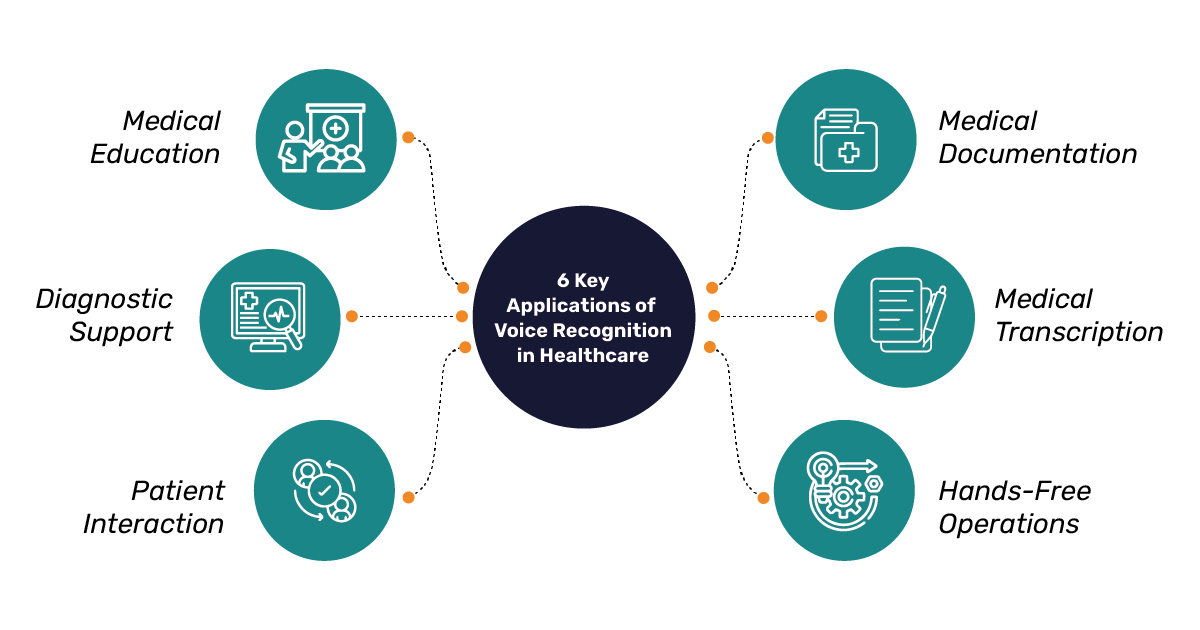
➡️ Key Applications of Voice Recognition in Healthcare
Voice recognition technology has become a game-changer in healthcare, streamlining processes and improving accuracy across various applications.
Let us Help You Build a Mental Health App!
➡️ Challenges and Considerations When Implementing Voice Recognition Technology
Implementing voice recognition technology in healthcare presents unique challenges that impact its effectiveness and usability for professionals. Here are a few we have mentioned below:
🔹 Accuracy and Medical Terminology
One of the primary challenges of voice technology in healthcare is the accuracy needed to interpret complex medical terminology. Medical voice recognition software must accurately capture terms that can be difficult to pronounce or sound similar to other words. For instance, abbreviations and jargon common in healthcare settings may lead to misinterpretation if not handled carefully. Choosing a solution that is specifically designed for the healthcare sector is critical. General-purpose voice recognition software can lack the depth to understand the nuances of medical language, resulting in documentation errors and miscommunication between providers.
Healthcare-specific voice recognition software must also account for dialects, accents, and differences in speech patterns. Not all healthcare professionals speak English as a first language, and speech software needs to accommodate this diversity without compromising accuracy. The voice recognition market is filled with options, and few are equipped with the specialized vocabulary needed in medical settings. Investing in a solution that integrates medical lexicons and keeps pace with evolving terminology will ensure that documentation is accurate and reliable.
🔹 Integration with EHR Systems
Voice recognition technology in healthcare must integrate smoothly with existing EHR systems. A poorly integrated system could disrupt the workflow, creating more challenges than it solves. Medical voice recognition software needs to pull data from various clinical systems and input information accurately into EHRs without requiring healthcare staff to manually edit or verify the results constantly. A lack of integration can result in duplicate work, missing patient data, or delays in treatment decisions, making seamless integration a critical consideration.
To avoid these issues, healthcare organizations must work with vendors who offer systems specifically built to collaborate with existing EHR platforms. A well-integrated system will streamline data entry and allow voice commands to update patient records automatically without additional steps. This reduces the administrative burden on healthcare workers, improving efficiency and reducing the risk of documentation errors. Ensuring compatibility with current technology frameworks is key to maximizing the benefits of voice technology in healthcare.
Related read: EHR Integration: Why It’s Essential for Healthcare Data Management
🔹 Training and Adoption
The success of implementing voice recognition in healthcare heavily relies on staff being properly trained to use the technology. Some healthcare professionals may initially resist adopting voice technology, particularly if they are accustomed to traditional data entry methods . Effective training programs focusing on hands-on learning are essential for helping staff become comfortable using voice commands. Medical voice recognition software should be easy to use, and the training should emphasize how it can reduce time spent on documentation tasks, allowing more focus on patient care.
Adoption challenges don’t end at training, though. Continuous support is often necessary to help staff adapt the software over time. As with any new technology, there will be a learning curve, and ongoing support will ensure healthcare staff remain comfortable with the system. Making staff feel confident using the software is essential for full adoption, leading to greater efficiency in their daily routines. Keeping this in mind will help drive successful implementation and long-term use of voice recognition in healthcare.
🔹 Cost and Investment
Voice recognition technology in healthcare presents upfront costs that must be weighed carefully against long-term benefits. Implementing medical voice recognition software typically requires a significant initial investment in software, training, and hardware. Healthcare professionals must carefully evaluate the potential ROI, as these systems promise to reduce administrative work and improve documentation accuracy, ultimately leading to more time for patient care. Calculating how much the organization stands to save in terms of efficiency and reduced errors is a key consideration before making the financial commitment.
Long-term savings from medical voice recognition technology can result in fewer documentation errors, improved billing accuracy, and more efficient workflows. Reduced reliance on manual data entry also lowers the risk of human error, which can have costly repercussions in healthcare. Decision-makers must consider the upfront cost and how the system can reduce administrative burden, free up time for staff, and support better patient outcomes over time. Viewing the investment strategically ensures the financial commitment pays off in the long run.
🔹 Data Security and Privacy
Healthcare leaders face growing concerns over data security and privacy when implementing voice recognition software. Voice data contains sensitive patient information, making it a prime target for cyberattacks. The voice recognition market includes various software options, but not all meet the stringent requirements of healthcare privacy laws like HIPAA. Decision-makers must ensure that their chosen medical voice recognition software has built-in encryption and other security features to protect sensitive information from breaches or unauthorized access.
Another consideration is how patient data is stored and transmitted. Voice technology in healthcare often relies on cloud-based systems, which have different security risks. Understanding how vendors handle data storage, encryption, and compliance is crucial for maintaining patient confidentiality. Failing to address these concerns can lead to regulatory penalties and, worse, a loss of trust between patients and providers. Taking a proactive approach to security and privacy from the start is essential to safeguarding patient data in this new technological environment.
Related read: Navigating the Regulatory Landscape: A Guide to Healthcare Compliance Regulations
➡️ Trends in Healthcare Voice Recognition Technology
Voice recognition technology is rapidly becoming a vital tool in healthcare, transforming how medical professionals interact with patient data. Let’s discuss below:
🔹 The Future of Voice Recognition Technology in Healthcare: ASR and TTS
Voice technology in healthcare will transform how medical professionals interact with systems and streamline tasks. Automatic Speech Recognition (ASR) and Text-to-Speech (TTS) have become integral tools, reducing manual effort. ASR allows clinicians to dictate notes, prescriptions, and treatment plans into electronic health records, improving accuracy and saving time. This shift has made medical voice recognition software necessary, offering more precise data entry while minimizing errors from traditional keyboard use.
TTS complements ASR by reading out medical records, patient histories, or treatment instructions, making information more accessible to healthcare providers and patients. Whether doctors need to stay updated on patient charts during rounds or patients need instructions read aloud, TTS bridges the gap between humans and technology. As this software continues to evolve, it’s expected to play a bigger role in increasing productivity and enhancing communication in the medical field.
🔹 AI Voice Chatbots and Advanced Customer Experience
Voice recognition in healthcare isn’t just about clinicians anymore; AI-powered voice chatbots are reshaping patient experiences. These systems handle appointment scheduling, and medication reminders, and even answer patient queries with time for human staff to focus on more critical tasks. Patients, too, can benefit from more timely responses without long waiting times, creating a smoother, more effective interaction between healthcare providers and those they serve.
Beyond scheduling and reminders, chatbots powered by voice recognition technology are evolving to conduct basic health assessments, gather symptoms, and guide patients to the next steps in their care journey. By integrating medical voice recognition software, the healthcare system provides an advanced customer experience that balances automation with personal care, making voice AI a valuable component in the patient experience strategy.
🔹 The Growing Role of ASR in the Voice Recognition Market
The voice recognition market is rapidly growing, especially within healthcare, where accuracy and speed are critical. ASR software is now crucial in medical environments, turning spoken language into text without requiring healthcare professionals to put information manally. This shift to voice-controlled systems has improved documentation and reduced burnout by lightening the administrative workload.
The demand for medical voice recognition software continues to expand as more healthcare providers recognize its impact on productivity. The voice recognition market is expected to grow exponentially as hospitals, clinics, and private practices adopt these technologies to streamline operations and improve patient outcomes.
🔹 Voice Recognition Software Impact on Medical Documentation
Voice recognition software in healthcare is more than just a convenience—it’s revolutionizing medical documentation. Doctors can now dictate patient notes directly into EHR systems, improving the accuracy and speed of record-keeping. Unlike traditional methods, voice technology eliminates the lag associated with typing or handwriting, allowing physicians to document care in real-time.
For many in the healthcare field, the transition to medical voice recognition software has been a relief, offering a more efficient way to manage the massive amount of data that clinicians deal with daily. This technology is expected to play a key role in the future, making documentation quicker and reducing the risk of errors.
➡️ Tips for Selecting the Best Voice Recognition Software for Your Medical Practice
Selecting the right voice recognition software can significantly streamline operations and improve efficiency in healthcare practices. Here is how we can choose the right voice recognition software:
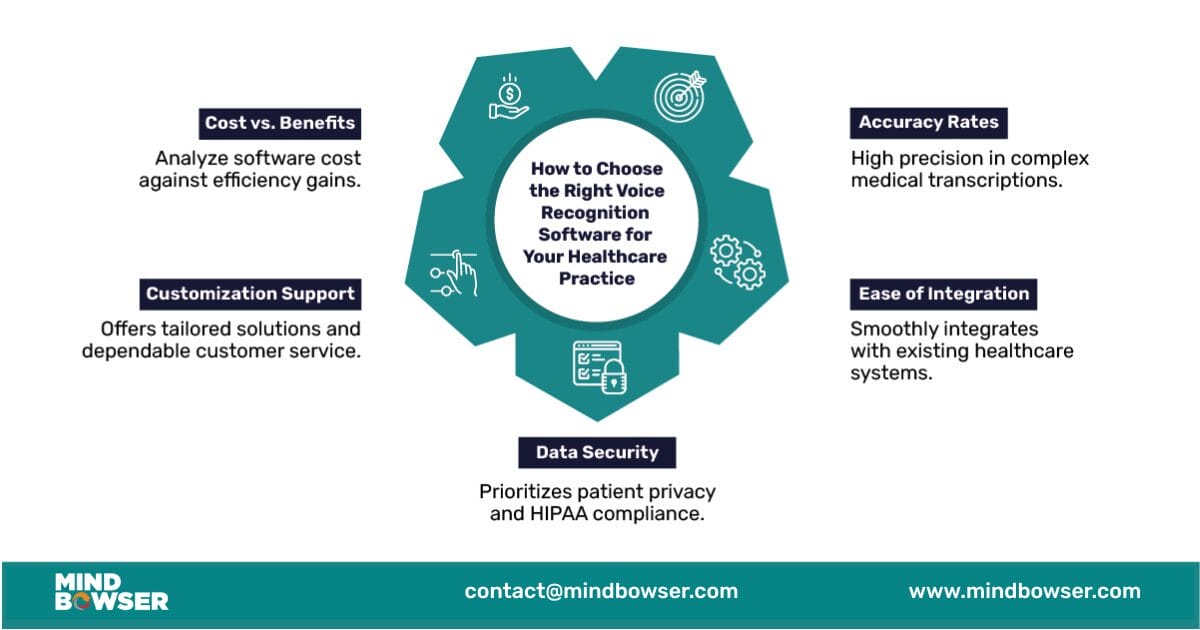
🔹 Accuracy Rates
High accuracy in voice recognition is vital for medical transcription, as even small errors can harm patient care. Choose healthcare-specific software that handles medical terminology, complex drug names, and diverse accents effectively for optimal transcription precision.
🔹 Adaptability to Different Speakers
A quality voice recognition system should adapt to varied speech patterns among healthcare professionals, improving accuracy over time. This enhances documentation efficiency, allowing clinicians to prioritize patient care over transcription corrections.
🔹 Integration with EHRs
Effective voice recognition software should integrate smoothly with existing EHRs and platforms, especially popular systems like Epic or Cerner. Seamless integration ensures smoother workflows without extensive technical changes or operational disruptions.
🔹 Data Security and HIPAA Compliance
Look for voice recognition software with strong encryption and HIPAA compliance to protect patient data. Prioritizing secure software ensures patient confidentiality and minimizes legal risks for healthcare practices.
🔹 Customization and Support
Each healthcare practice has unique needs. Choose a voice recognition vendor offering customization to match specific workflows and specialties, along with ongoing support for smooth operation and minimal downtime.
🔹 Cost vs. Benefits
Weigh the cost of voice technology against benefits like improved documentation, reduced transcription errors, and faster patient care. Long-term efficiency gains often justify the initial investment, leading to enhanced patient interactions and satisfaction.
How Mindbowser Can Help You Build Voice Technology For Your Healthcare Organization
Voice recognition software has streamlined tasks like documentation, allowing healthcare providers to focus more on patient care. With the growing demand for efficient solutions, the voice recognition market continues to expand, offering opportunities to integrate advanced medical voice recognition software into daily operations. Voice technology improves efficiency and provides better accessibility for those with physical limitations, allowing more inclusive care. As the demand for intuitive solutions grows, healthcare organizations turn to voice technology to simplify processes.
Mindbowser specializes in building voice technology solutions that align with the unique needs of healthcare organizations. Our team can design medical voice recognition software that integrates smoothly with your existing systems, making the transition simple for healthcare professionals. We can help you create intuitive, user-friendly solutions that improve workflow efficiency without disrupting daily operations. Whether it’s automating patient documentation or streamlining administrative tasks, we can help healthcare providers adopt voice recognition in healthcare that meets industry standards. With extensive experience in the healthcare sector, Mindbowser supports organizations in adopting voice technology to drive better care outcomes.
Frequently Asked Questions
Voice technology allows for faster, hands-free documentation and real-time data access, improving patient interactions and care accuracy.
Yes, it automates routine tasks like charting, appointment scheduling, and note-taking, freeing up time for patient care.
Most voice recognition software follows strict HIPAA compliance and encryption standards to protect patient information.
Voice technology optimizes workflows by enabling faster data input, reducing errors, and allowing clinicians to focus more on patients.
Modern voice technology is designed to be intuitive and easily adaptable to various healthcare environments, requiring minimal training.