
 BLOGS
BLOGS  NEWSROOM
  CASE STUDIES
  WEBINARS
  PODCASTS
  ASSET HUB
  EVENT CALENDAR
















TL;DR:
Diabetes and chronic-care platforms that scale without EHR integration run into manual data retrieval, fragmented records, and compliance risk. This post covers the 4 core challenges, how SMART-on-FHIR automation solves them, and the specific benefits for providers, patients, and administrators – with a real-world time-saving example from an Epic integration.
Managing chronic diseases like diabetes requires consistent care, personalized treatment, and uninterrupted access to patient data. Healthcare platforms focusing on reversing diabetes through lifestyle interventions such as nutrition and exercise have shown promising results. Yet, as these platforms scale, the need for EHR integration in diabetes management becomes increasingly critical.
In today’s connected healthcare environment, platforms that lack integration with Electronic Health Record (EHR) systems face inefficiencies, fragmented data, and compliance challenges. This blog explores how reliable EHR integration provides a scalable, secure, and intelligent solution for digital health platforms managing diabetes and other chronic conditions.
The Challenge: Manual Data Handling and Lack of Integration
Mindbowser delivers custom solutions focused on EHR integration for diabetes and chronic care management, enabling platforms to move data automatically and deliver better patient outcomes at scale.
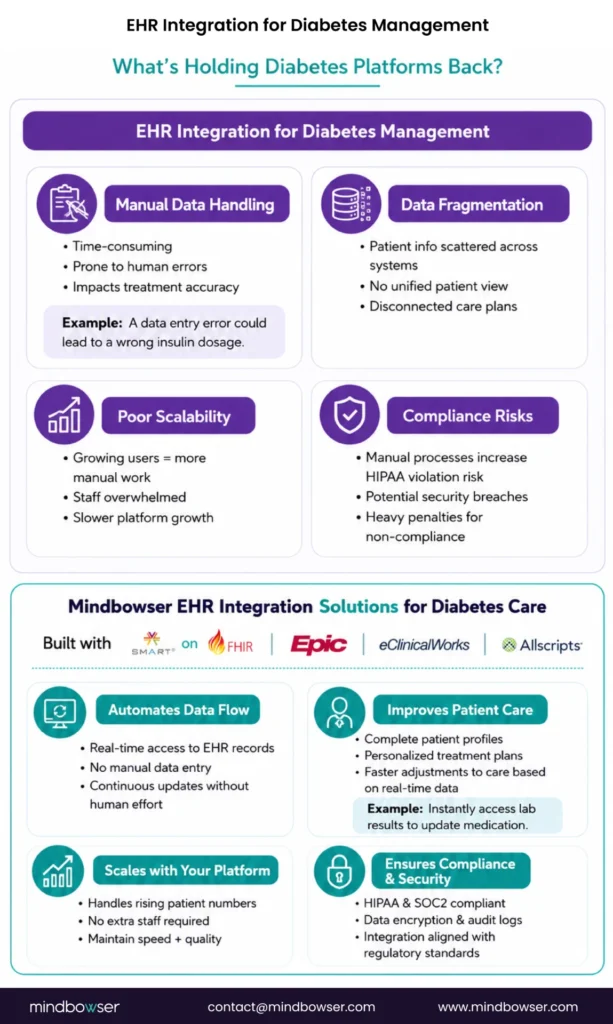
➡️ Manual Data Retrieval: Manually accessing patient data from EHR systems is both time-consuming and error-prone. It requires more resources and increases the risk of mistakes, which ultimately impacts the quality of patient care. For example, data entry errors can lead to improper treatment plans, resulting in patient dissatisfaction and poor outcomes.
➡️ Data Fragmentation: Without an integrated system, patient data is scattered across multiple platforms, making it difficult for healthcare providers to gain a comprehensive view of a patient’s progress. Fragmented data leads to inefficiencies, delays, and a lack of coordinated care.
➡️ Scalability Issues: As health platforms grow, manually handling patient data becomes increasingly impractical. This presents a significant scalability problem. More patients mean more manual effort, which will eventually overwhelm the team and slow down the platform’s growth.
➡️ Compliance Concerns: Healthcare platforms must comply with stringent regulations such as HIPAA. Manually handling patient data increases the risk of security breaches and non-compliance, which can have serious consequences for both patients and the platform.
The Solution: Automated EHR Integration
Mindbowser specializes in building customized EHR integration solutions so health platforms can exchange data directly with Epic, ECW, and Allscripts. For diabetes and chronic-care platforms, this often means deploying ConnectHealth – Mindbowser’s interoperability accelerator – pre-configured for chronic-condition workflows: SMART on FHIR data exchange, bidirectional care plan sync, and HIPAA-compliant data handling.
By automating the data flow between the health platform and EHR systems, we address the key challenges faced by health platforms, including efficiency, scalability, and compliance.
Here’s how Mindbowser can help:
✅ Automating Data Flow: Mindbowser uses the SMART on FHIR framework to enable secure, real-time data exchange between your health platform and EHR systems. This integration ensures that data is automatically retrieved from EHRs and delivered to your platform, eliminating the need for manual entry and reducing the chances of errors. This results in faster, more accurate care decisions.
✅ Improved Patient Care: With automated access to real-time, comprehensive patient data, healthcare providers can offer more personalized care. This allows providers to make better-informed treatment decisions, improving patient outcomes. For example, access to updated medication information and lab results enables providers to adjust treatment plans promptly and with confidence.
✅ Scalability and Efficiency: By automating the data exchange process, Mindbowser’s solution enables your platform to scale effortlessly. You can handle an increasing volume of patients without the need for additional manual labor, helping you maintain high-quality care while expanding your reach.
✅ Enhanced Compliance and Security: Mindbowser’s integration solutions adhere to HIPAA and SOC2 standards, ensuring that patient data is secure and your platform remains compliant with healthcare regulations. Our team ensures that your integration follows all necessary security measures, giving you peace of mind that your patient data is protected.
Related Read: Decoding SMART on FHIR for Healthcare Interoperability
Specific Benefits for Stakeholders
EHR integration benefits different stakeholders in the healthcare ecosystem. Here’s how integration can improve outcomes for everyone involved:
➡️ For Healthcare Providers: “With direct access to comprehensive patient data, healthcare providers can spend more time with patients rather than dealing with administrative tasks. Real-time data allows for more accurate diagnosis and timely adjustments to treatment plans.”
➡️ For Patients: “Patients benefit from quicker, more accurate care. Real-time data ensures that healthcare providers can provide the best treatment, leading to improved patient outcomes and reduced wait times for care.”
➡️ For Administrators: “Administrators benefit from reduced overhead as the integration automates data entry and retrieval. This frees up resources for other areas, optimizing overall operations and reducing costs.”
Related Read: Benefits and Challenges of The Electronic Health Record
Ready to Scale Your Healthcare Platform With EHR Integration?
Real-World Example: Integration in Action
Let’s consider a hypothetical example of a healthcare provider that integrated their platform with Epic EHR. Before integration, they spent an average of 30 minutes per patient retrieving data from the EHR manually. After integrating with Epic, data retrieval was automated, reducing the time spent per patient to just 2 minutes. This saved the provider an estimated 20 hours per week, allowing their team to focus on patient care instead of administrative tasks.
Potential Pitfalls in EHR Integration (and How Mindbowser Prevents Them)
EHR integration can present several challenges, but Mindbowser’s experienced team helps ensure a smooth process by addressing the common pitfalls:
1. Compatibility Issues: Different EHR systems have different requirements. Mindbowser ensures that the integration process is compatible with the specific EHR system in use, be it Epic, ECW, or Allscripts.
2. Data Security Risks: The transfer of sensitive health data is always a concern. Mindbowser uses secure authentication methods (e.g., OAuth, OpenID Connect) and data encryption to protect patient information during the integration process.
3. Downtime During Integration: While integration can involve system downtime, Mindbowser takes steps to minimize disruptions. We plan the integration process carefully to ensure that any downtime is as brief as possible.
Related Read: Healthcare Integration – Its Challenges, Solutions and Future
Why Choose Mindbowser for EHR Integration?
Mindbowser stands out for its deep expertise in healthcare IT and EHR integrations. Our team has a proven track record of working with major EHR systems, including Epic, ECW, and Allscripts. We understand the complexities of healthcare workflows and offer fully customized solutions to ensure smooth, secure, and efficient integration. Our solutions are designed for scalability, allowing your platform to grow without added manual effort or complexity.
Whether you’re building a diabetes management app or scaling a broader chronic-care program, the integration architecture matters. See how Mindbowser approaches EHR integration – from SMART on FHIR to bidirectional care plan sync.
EHR integration automates the data retrieval that otherwise requires manual effort per patient. For platforms growing from hundreds to thousands of enrolled patients, SMART on FHIR-based integration eliminates the bottleneck – data flows automatically from the EHR into your platform, so your team’s capacity scales with enrollment rather than against it.
Yes. SMART on FHIR uses OAuth 2.0 and OpenID Connect for authentication, and data in transit is encrypted. Mindbowser’s integrations are built to HIPAA and SOC2 standards, covering access control, audit logging, and secure data handling at every layer of the integration.
Epic has the most mature FHIR APIs (R4 + Bulk Data access), making it the most integration-ready but also the most complex to certify. ECW and Allscripts are more common in mid-market and community health settings and have more flexible API arrangements. The right choice depends on where your target health systems live – Mindbowser has integration experience across all three.