












 BLOGS
BLOGS  NEWSROOM
  CASE STUDIES
  WEBINARS
  PODCASTS
  ASSET HUB
  EVENT CALENDAR



















TL;DR
– Medical coding systems need bidirectional EHR integration — pulling patient data (ADT/ORU) and pushing finalized codes (DFT) back to billing modules.
– HL7 v2 is the reliable standard for real-time exchange; FHIR layers on top for future scalability.
– Epic certification requires sandbox testing, vendor approval, and a scalable middleware layer — but pre-built platforms cut the build time significantly.
The healthcare industry continues to struggle with fragmented medical coding workflows, especially when exchanging structured clinical data between systems like Epic and third-party platforms. Accurate medical coding plays a vital role in reimbursement, reporting, and clinical decision-making—yet interoperability remains a common barrier.
Vendors are often asked to meet certification standards from EHR providers like Epic, especially for bidirectional exchange of medical coding data. Whether using HL7v2 or adopting FHIR for faster integration, the goal remains the same: enable secure, reliable communication of coded information directly within the EHR workflow.
In this article, we explore how healthcare platforms can close this gap by building compliant, bidirectional interfaces that align with HL7v2 and FHIR standards—accelerating time to certification and strengthening partnerships with major EHRs like Epic.
I. Medical Coding Integration with EHRs: Key Challenges and Solutions
Medical coding is essential for accurate reimbursement, regulatory compliance, and complete clinical documentation. Yet, many healthcare organizations face integration issues when trying to exchange coding data with Electronic Health Records (EHRs) like Epic.
When implementing AI-driven medical coding solutions, two major challenges often arise:
🔹Bidirectional Integration
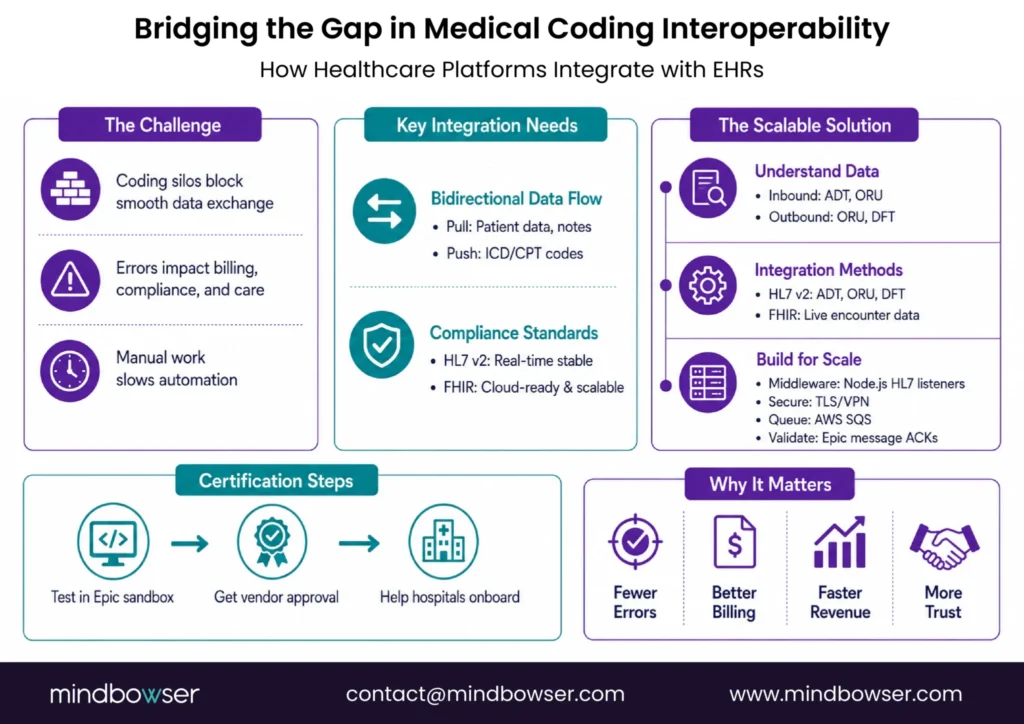
Platforms must retrieve patient demographics, encounter data, and clinical notes from the EHR and send back enriched coding outputs such as CPT and ICD codes.
🔹Standards Compliance
While HL7 v2 remains a widely used protocol, FHIR is gaining popularity due to its speed and flexibility. Choosing the right interoperability standard adds complexity to the integration process.
Without a clear strategy, these barriers slow down adoption, increase manual workload, and limit automation opportunities in revenue cycle management.
II. Medical Coding: The Solution Through Scalable EHR Integration
To improve medical coding workflows and achieve Epic-certified interoperability, healthcare organizations must adopt a scalable EHR integration approach. This ensures real-time data exchange, accurate billing, and reduced manual efforts.
1. Understand Medical Coding Data Exchange Workflows
Medical coding systems rely on both inbound and outbound data to function efficiently:
🔹Inbound Data
✅ ADT (Admission, Discharge, Transfer) messages to collect patient demographics and insurance details.
✅ ORU (Observation Result) messages to receive clinical documentation.
🔹Outbound Data
✅ Augmented ORU or DFT (Detailed Financial Transactions) messages to send finalized medical coding results to Epic’s billing module.
Building an interface that listens for ADT and ORU messages, then converts them into the internal data format, reduces errors and boosts coding accuracy.
2. Choose the Right Integration Method
Epic integration for medical coding requires selecting the most effective method:
🔹HL7 v2 (Preferred for Real-Time Coding)
✅ ADT A04, A08: Patient registration updates
✅ ORU: Code enrichment based on clinical data
✅ DFT: Accurate billing transmission
🔹FHIR (For Future-Ready Interoperability)
✅ Enables faster retrieval of encounters and supports cloud-native integration
✅ Works well for apps looking to scale with modern EHR ecosystems
Combining HL7 v2 for reliability with FHIR for long-term growth is the most effective strategy.
Related read: Decoding SMART on FHIR for Healthcare Interoperability
3. Architect a Scalable Integration Layer
A scalable architecture supports efficient medical coding integration at scale:
✅ Middleware Server: An HL7 listener (e.g., built on Node.js) for message exchange
✅ Security: Encrypted transmission via VPN or TLS tunnels
✅ Scalable Processing: Queue-based message handling with tools like AWS SQS
✅ Validation & Acknowledgment: Ensure messages are processed accurately and acknowledged by Epic
Teams that don’t want to build the HL7 listener and middleware from scratch use a pre-built integration platform like ConnectHealth to stand up the Epic interface in days rather than months.
4. Achieve Certification and Deployment
Becoming an Epic-certified medical coding solution builds trust and opens new opportunities:
✅ Sandbox Testing: Validate the app in a non-production Epic environment
✅ Vendor Approval: Submit documentation to Epic for review and approval
✅ Hospital Onboarding: Help hospitals install and activate your coding solution directly within Epic
Related read: How to Build a Smart Medical Coding Automation System for Healthcare
Build Your Medical Coding Integration Solution Today
III. The Business Impact: Why This Matters
Implementing an Epic-certified medical coding interface isn’t just a technical upgrade—it drives real business value. Here’s how it transforms your operations:
✅ Reduces Manual Errors
Automating coding workflows eliminates transcription mistakes, improving data accuracy.
✅ Improves Billing Accuracy
Proper code assignment minimizes claim rejections and helps reduce revenue leakage.
✅ Accelerates the Revenue Cycle
Faster and cleaner claim submissions result in quicker reimbursements and better cash flow.
✅ Strengthens Market Positioning
An Epic-certified tag builds trust and increases visibility among top healthcare providers.
IV. A Future-Ready Approach to Medical Coding Automation
Medical coding is rapidly evolving, and automation now plays a key role in boosting accuracy, speed, and efficiency. Integrating AI-powered medical coding systems with EHR platforms ensures real-time data exchange and scalable performance.
Using HL7 v2 for immediate transaction processing and FHIR for scalable interoperability lays the foundation for a coding engine that’s both future-ready and compliant.
For organizations planning to integrate with Epic or build a bidirectional medical coding interface, it’s essential to follow a structured approach aligned with healthcare regulations. Building the right architecture today helps ensure long-term success across coding, billing, and revenue cycle management.
Start with the EHR integration hub to understand the full integration landscape before scoping your architecture.
Not always — you can exchange data via a hospital’s existing Epic interface. But if you’re a third-party vendor selling a coding solution, Epic certification builds trust, speeds hospital procurement, and opens direct integrations via App Orchard.
Both, ideally. HL7 v2 (ADT, ORU, DFT messages) is still the standard for real-time transaction processing and billing. FHIR is better for cloud-native apps and long-term scalability. A hybrid approach gives you reliability now and flexibility later.
3–6 months end to end — sandbox setup, interface build, documentation submission, and Epic’s vendor review process. Teams using pre-built integration middleware typically cut that in half.