
Andy Kinnear spent 30 years in England’s National Health Service, more than 20 of them as a CIO, and now works with CHIME and Ethical Healthcare Consulting. He tells host Rushikesh Kulkarni he came in as a statistician and still calls himself “a slight fraud as a CIO” because he cares more about what technology changes for doctors, nurses and patients than about the technology itself.
He expects consumerism to define the next decade, with patients taking on work through digital services the way travellers now book their own trips, and names the workforce as healthcare’s biggest challenge. He explains how he judges new technology, leads by hiring people better than himself, and prioritizes projects by their front-line impact. The centerpiece is Connecting Care, the Bristol program he led to build a shared record across GP, community, mental health, hospital and social care systems, which changed clinical decisions and got organizations talking to each other. His closing advice: technology projects are people projects from the start.
Andy points to banking, travel and insurance, where companies handed work to customers through digital apps and customers ended up feeling more in control. He used to have someone book his flights and transfers; now he does it himself and prefers it. Healthcare, especially in the UK, is at the start of that journey. Consumer-led digital services can empower patients and take cost and workload off clinicians who, in his words, are absolutely swamped. RPA and AI will matter, but he sees the empowered patient as the seismic shift.
The single biggest challenge he names is the workforce: front-line clinicians running like crazy to stand still, too few new people coming in, and a global talent war for both clinical and technology staff. Pay and conditions are the hygiene factor. What keeps talented people is leadership they respect, a mission worth joining, and real development, which he says younger generations are “mad keen” on.
The same view shapes how he leads. He credits his career to hiring people more talented than himself, being clear about which problems a team is solving and which it isn’t, and then getting out of the way. He prioritized projects with ROI modeling, but the deciding test was a direct line of sight to the patient. That test is easy for everyone to understand, and it keeps teams motivated through hard, complex work.
Before Connecting Care, Bristol had separate electronic patient record systems in GP practices, community care, mental health, three acute hospitals and social care, probably hundreds of clinical systems in all, largely unconnected. Clinicians were making decisions “with one eye closed.” Over roughly ten years, starting in 2010, the program built a shared record platform so an emergency doctor could see the GP record and a GP could see a recent discharge summary. Clinicians make risk-based decisions, Andy says, and the more information they have, the better, faster and safer those decisions become. That is the case for interoperable data for providers in one sentence.
The benefit he didn’t plan for was cultural: hospitals, GPs, mental health providers and social care started talking to each other, and new projects grew out of those relationships. By his account it saved millions, improved care, and eventually let patients access the record to manage some of their own care. Laura Merrick described a similar effect in Chicago on this show, where breaking down silos around shared patients drove care coordination.
Andy’s advice is blunt: the biggest mistake on a technology project is believing it’s about technology. Most IT teams can deploy software. The real work is changing how people think and behave, with passionate believers on one side and people determined not to move an inch on the other. He tackles it early: map stakeholders, nudge behavior, accept that change management runs on a less certain timeline than deployment, and tell one story again and again that starts and ends with the patient, because blockers struggle to argue against it. Michael Archuleta made a similar argument on this show about why hospitals need transformational CIOs to shift culture.
Welcome to HealthTech with Purpose. Today we have Andy with us, who is doing a lot in the healthcare and health tech space. I’ll hand it over to Andy to quickly introduce himself, and then we’ll go ahead from there.
Thanks, Rushi. Great to be here; a real pleasure to be talking to you guys. My name’s Andy Kinnear. I was a CIO in the National Health Service in England for many years. I worked there for 30 years and was a CIO for more than 20 of those. I now divide my time between the College of Healthcare Information Management Executives, CHIME, and an organization called Ethical Healthcare Consulting. So I’m basically still working within digital healthcare, and supporting the National Health Service in England and others internationally.
Awesome. That’s a stellar record on the healthcare IT side. I’d really like to know your overall background on the healthcare side, and how you got started in the healthcare industry.
Well, like many people, it’s always a little bit accidental, I suppose. I did a geography degree at university, and in my final year we started to study epidemiology and disease patterns. I just got really fascinated by the way different diseases affected different populations and things like that, so I decided a career in healthcare was where I was headed.
I came in initially and spent most of my first few years working as a statistician. I did a lot of work around public health planning and worked with health statistics, so I really became a kind of data and analytics person. And then, as happens often, as you rise up through the management tiers and take team leader roles and then department roles, the expansion of your remit takes you into other areas. I began to pick up IT teams and technology teams, and in the end innovation groups and transformation programs and all kinds of things like that, and grew into a full CIO remit.
But I often say I’m a slight fraud as a CIO, because I’m not particularly technical by background at all. I came in as a numbers guy, and I’m much more interested in the way the numbers direct us toward serving and delivering healthcare. The technology is just a part of that, in reality.
I feel that having the domain knowledge is a really awesome combination. Great. So how do you see the role of digital technology evolving within the healthcare system over the next decade? What are your thoughts on that?
I think the next 10 years are going to be massive for healthcare. I think the big dominant agenda will be the rise of consumerism in healthcare. We’ve seen it in other industry sectors, whether it’s banking or travel or insurance, or pretty much every other walk of life. We’ve seen a real transformation in those industries. What they’ve been able to do is take work they used to do for us as their customers and hand it over to us. So we’re now doing work they used to do, but we’re happy about it, because the way it’s been handed to us, on digital apps and through digital developments, is actually making us more empowered and more in control as customers.
I think about the way my travel experience has changed over the years. There was a time when somebody else used to do all of that for me. They would book the flights, organize the transfers, sort out the [inaudible], and I would literally turn up and do the journey. Now I’m the one booking the flight, organizing the hotel, organizing the transfers and so on, and yet somehow I feel more in control. What they’ve done is really clever: they’ve taken working costs out of their industry and handed them to the customer, and yet the customer feels more empowered.
In healthcare we’re at the beginning of that journey. We’ve got a long, long way to go, certainly in the United Kingdom; we’ve got a real journey ahead of us. But there’s this idea that we can start to empower our patients and the public we serve through the development of consumer-led applications and different services on digital platforms, and do it in a way that also takes out cost and de-burdens some of the workload sitting on our healthcare professionals. For me, that’s going to be the seismic shift.
There’ll be lots of other agendas that play out through innovative new technologies, and through the way we can adopt RPA and AI and all of this fancy, really cool stuff. But in reality, I think the big seismic shift will be that we empower our consumers in the way we’ve seen in other industries, and therefore change the face of healthcare, and frankly take some of the pressure off the front-line organizations, which, certainly in my country, are absolutely swamped at the moment and struggling to cope. So how do we help them? We get some of the people to do some of the work for them, basically.
A very interesting thought, because everything is going into the hands of consumers, and with more power comes more responsibility. So what do you think are the biggest challenges the healthcare industry is facing today?
I mean, there are a number, to be absolutely honest, but I think the single biggest one is going to be the workforce challenge. What I’m witnessing in my front-line clinical colleagues at the moment is pressure on them like I’ve never seen before. They’re incredibly busy; they’re running like crazy just to stand still. They’re under immense pressure to deliver the workload, and we’re not seeing the numbers of replacement, if you like, additional new workforce, coming into that space quickly enough. I think we’re going to see a real global talent war to attract the best people and make sure we have sufficient numbers of professionals at all levels, whether in the clinical services or in the technology services.
So the single challenge is: how do you make your organization, your industry, your country even, India versus the UK on this, appeal to that group of people? There’s a certain amount of hygiene factor required. You’ve got to look after people properly, pay them a decent wage, and provide the kind of things they’d expect from any good employer. But you’ve also got to lead them well. Lots of evidence shows that talented people stay in organizations where they respect and admire the leadership, so there needs to be genuinely strong and vibrant leadership to succeed.
You need to create a mission that people want to be part of, and in healthcare we’ve got a great chance to do that. There can be nothing more satisfying than being part of the community supporting the health of your nation. That’s a really proud mission for most people, so stressing that mission is really key.
The other differentiating factor will be how we develop people. The younger generations, I’m witnessing, are mad keen to be developed. They really want to learn, they want to grow, they want to expand their portfolio, they want to progress in their careers, and so on. I think they’ll be drawn to the organizations that support them on that journey.
So for me, that’s the challenge above all else. Don’t get me wrong, there are huge political challenges, funding challenges, global dynamics challenges, real economic challenges. In the United Kingdom we’ve still got massive Brexit challenges. There’s all sorts of other stuff on the table. But when you peel it all away, our fundamental biggest challenge will be around the workforce: attracting, retaining and developing the very best people. That applies in the United Kingdom, in the United States, across Europe, and I’m sure across India and the geographies you’re in. So that’s the focus: people.
People, exactly. And highly skilled people, who can not just get the job done but get it done well, because this is healthcare we’re talking about. A very interesting take on the challenges. So how do you feel tech is going to enable solving some of these challenges? What’s your take on that?
Tech is interesting, actually, because, as I said earlier, I’m not massively interested in technology, in a way. It’s a strange admission, but I feel I can say that out loud now that I’m no longer in a formal CIO role. I’m much more interested in the way we support people.
So whenever I’m looking at new technologies, reading or listening to podcasts or watching videos or whatever I might be doing to try and understand them, within seconds my brain is leaping to: OK, but what’s the impact going to be? What’s the difference going to be? How is this going to help a nurse discharge his or her duties more easily? How is it going to help a doctor? How is it going to help a patient navigate whatever it might be? I’m interested in that side of things. That’s one question I’m asking myself.
The other question I like to ask, and I’m sure you’ve seen this too, is this. Often with technologies there are some predictable benefits: we’ve designed this thing, it’s going to do this task, it’s going to solve this problem, and the benefit is going to be this. But there are also some unforeseen benefits, and sometimes unforeseen negatives. One of the tricks I like to play with myself is to try to understand what somebody hasn’t thought of yet as a result of this technology. I like to play this little game: well, what about this, or what about that? And play those things through.
Certainly, in projects I’ve been involved in in the United Kingdom, the most exciting aspect has been the benefits we didn’t imagine at the beginning, the things nobody thought of before we started. Once we got into it, we suddenly started to see services change, or doctors and nurses come up with new ways of doing things. So when I’m looking at the latest technologies, I’m also trying to understand what unforeseen benefits this thing, whatever it is, might deliver, because it’s always going to be more than people think.
So kind of playing devil’s advocate, and at the same time trying to see how much extra mileage a particular technology can give.
Exactly that. Understanding what problems it might solve, and the problems you hadn’t thought of that it might have some kind of impact on.
Totally. That makes me wonder: how do you approach problem solving in your role as a healthcare leader?
I’ll be really honest with you, Rushi. I’ve got to the position I’ve reached in my career by standing on the shoulders of giants. I have constantly recruited people who are much more talented, much more energetic and much more visionary than me. So my major tactic for solving any of the problems I’ve faced in my career has been to surround myself with immense talent who are probably going to solve those problems for me. Frankly, I just climb on their shoulders and ride right along on that journey.
The other aspect of problem solving is almost good discipline. Be really clear about what problems you are solving, and equally clear about the ones you’re not solving: what are we actually aiming to achieve here? Then be unapologetic in your pursuit of that solution: we are here to do this, nothing is going to get in our way, we’re absolutely determined to make it happen. And when we do make it happen, we’re going to celebrate it and shout about it from the rooftops, and make sure everybody understands that we recognized this problem, found a solution, deployed it, and have now solved it, and we’re on to the next thing.
In reality, the clue’s in the question, in a way. When you’re in a leadership role, when you’re a healthcare leader, don’t make the mistake of thinking your job is to solve all of the problems. Your job is to bring in the resources and the talent, and then give those folks the environment in which to solve the problem. The thing that has stood me in quite good stead in my career has been being quite hands-off with my teams, being quite empowering as a leader: putting the challenge in front of people and then getting out of their way so they can solve it, and dealing with the major challenges you get drawn into, whether that’s funding or additional resources or contractual stuff with vendors. But in essence, my approach to solving problems has largely boiled down to getting people who are better than me to do it for me.
That’s really interesting. Basically, you can’t be the smartest guy in the room. That’s the thing.
Exactly.
Awesome. While doing this, I believe one of the critical aspects is prioritizing and allocating resources. How do you go about that for health tech initiatives within your organization?
We would do some ROI, proven-methodology-type modeling: what’s the investment here, what do the projected benefits look like, what’s the time to deliver, what’s the resource investment, and things like that. So we’d end up with some fairly hefty spreadsheets with projections and benefit realization predictions, and largely use those as a schema to begin prioritizing.
I would slightly caveat that by saying I also had a few other, softer criteria in play. For example, I don’t think you should work in healthcare if the project you’re working on hasn’t got a direct line of sight to the patient. I’m interested in things that will benefit the front line first and foremost. That’s not to say there aren’t projects you have to deliver, and activities you have to undertake, where it might not be so clear how they benefit patients. But ultimately, I think the role of a CIO is to make the roles of your doctors and nurses easier, and ultimately make the lives of your patients better as a result. So a massive factor in prioritizing projects for me was: what will be the front-line impact of this piece of work, and what’s our confidence that we can realize it and make it happen?
In a way, that transcends everything else, because it has a few knock-on benefits. First, everybody can understand it. When you’re explaining why you’ve prioritized a project list the way you have, and why your priorities are these things, sure, you can talk about the financial benefits, the cost savings, the resource efforts and so on. But everybody understands the concept of making things easier for doctors, nurses and ultimately patients. It’s almost a thing of beauty: you’re describing a reason so fundamental to why we work in healthcare that it becomes powerful.
The second benefit is that once you’ve prioritized your work and decided which projects to mobilize, and you start putting people onto them, you want those people to feel passionate about what they’re about to deliver, and to feel that what they’re doing is important. Some of this work is really tough and really exhausting. These are challenging, complex projects with lots of moving parts and lots of reasons to be frustrated and tired and find it difficult. So you want somebody, underneath all of that, to feel that the reason they’re going through it is because it really matters. It’s not a priority just because it will save money, or because it will give us a new piece of technology we didn’t have before, or because the chief exec likes it. It’s a priority because it’s making an impact for patients and for the doctors and nurses who serve them. So you end up with a team that’s far more motivated than it might otherwise have been, because they can clearly understand how your prioritization worked, and that what you’re putting first and foremost is the people we’re working for.
Great. That’s really helpful, especially for some of the viewers who will be watching the podcast. One of the key aspects, as you mentioned, is the impact on the front line. Very interesting; thank you for sharing that, Andy. You’re dealing with a lot of projects, and you’ve done that in the past as well. Is there a particular health tech project you led, and could you tell us about its impact?
Yeah, there is actually, and I’m glad you’re giving me a chance to talk about it, because whatever I do in my career, I will never do anything that gives me more pride than this particular project. It was a really important piece of work for me: a program called Connecting Care.
I worked for a long time in a city called Bristol, in the West Country, in the west of England. In a nutshell, we had implemented electronic patient record systems across our city, but in silos. We had different electronic patient records in our GP practices in primary care. We had different ones in community care, with district nurses, health visitors and so on. Different ones in mental health, in psychiatry and the mental health disciplines. And we had different systems in all three of our acute hospitals. Alongside that, in the United Kingdom we have a publicly funded social services and social care setup, and social care had implemented different systems. So across our city we probably had, I don’t know, hundreds of different clinical systems with medical records in them that weren’t connected, or were only partly connected to some of the rest of the ecosystem.
We set about this program to essentially build a shared record platform and allow these systems to share their information. So a doctor in an emergency department could have access to the GP record, a mental health professional could see what had happened in the emergency department earlier that day, or a GP could see the discharge summary for a patient who had recently left hospital and was now under their care. All of these bits of information existed in these systems, but many of the doctors and nurses didn’t have access to them and couldn’t see them. They were making decisions with one eye closed, really; they were unable to make the best decisions they could.
By building a shared record program over a 10-year period, we got to the point where we were sharing immense amounts of information. I’ve got countless stories of doctors and nurses coming to me and saying what a difference it had made to their ability to make decisions, because all of a sudden they could see information on the patient they hadn’t had before.
As any doctor or nurse will tell you, when they’ve got a patient in front of them, they’re essentially making a risk-based decision. They’re working out the risk of doing A versus the risk of doing B versus the risk of doing nothing. That’s the mental conversation they’re having with themselves as they talk to the patient, and that risk decision is based entirely on the information they have available: what the patient is telling them, what they’re seeing in their system, and so on. So the more information you can make available to doctors and nurses at that point of care, the higher the likelihood they’ll make better, faster, safer, more clinically impactful decisions. We saw that time and time and time again: just better things happening as a result of being able to share the records.
The side benefit, and I talked earlier about how sometimes you don’t see all the benefits you imagine, is that it actually became the vehicle through which different parts of the health community spoke to each other. All of a sudden our hospitals were talking to our GPs, our GPs were talking to our mental health provider, and our community people were talking to social care, in a way they hadn’t been talking before. We started to see all sorts of projects springing up all over the place, because these people were now friends and had begun to build working relationships.
So I’m incredibly proud of the impact it had. It saved millions in financial terms, but undoubtedly it also saved lives and improved care for people across that community, as well as having quite a big cultural impact on the way organizations work together. So yes, super proud of that one, and I never refuse the invitation to tell the story.
Pretty awesome, and I’m pretty sure everybody who was involved in that project is equally passionate and keen about telling the story, because, as you rightly mentioned, it impacted not just the doctors and everybody involved in the process, but it would have helped save lives.
Exactly.
That’s amazing. And what was the duration of the whole program, if I may ask?
Well, it’s still running. It began in 2010. We started in about 2010, and, oh boy, that’s the whole story, but we probably got to about 2013 or 2014 before we started to have seriously measurable benefits. After that it just got better and better. Once people used it more, and once doctors and nurses got used to it being available and the impact it could have, it just grew and grew. We shared more information, we designed the screens in different ways to support different use cases, more organizations came on board and began to share their information through it, and in the end we even started doing some work with patients accessing it directly to manage some of their own care. A really nice project, actually.
Great to know about it, and great to meet somebody who actually led it. Thank you for sharing that with us, Andy. So what advice would you give to organizations looking to implement health tech solutions with purpose?
I mean, it’s a bit of a cliché to say this, but I do think it’s true: the biggest mistake you ever witness on a technology project is people believing it’s actually about technology. The reality is that these are people projects from the get-go. So the single most important piece of advice you can give anybody is to recognize that you’re actually doing a transformation project, one that will require people to change the way they think, act and behave. In reality, that needs to be your primary focus, because you will have passionate believers in that change, and you’ll have equally passionate disbelievers who are determined not to move one inch. Dealing with the people change, the culture change, the transformation, is really key to the technology’s success.
I’m absolutely convinced most CIOs can deploy a piece of software successfully into their organization. Most good tech departments can handle the technology element; it’s relatively straightforward. Of course it takes planning and organization and so on. But in reality, it’s not the technology you’re dealing with. It’s the people. One of the secrets for me is to recognize that right from the beginning and work on it right from the beginning: actively manage your stakeholders, actively understand people’s different positions, where they stand mentally on these things, and then work out the ways you need to nudge their behavior in the right direction and influence them to become supporters of the change.
Also recognize that some of this takes time. Often with the technology aspect of a project you can come up with quite a structured plan and be fairly confident in the deployment timetable. When you’re dealing with people it can be a bit less certain, so you need to understand that quite a lot of the people change and culture change will take time. But with some active management, some heavy focus, and some sympathy toward the need to [inaudible] through, you can be successful with it.
The one really key tip that has served me quite well: people will find reasons to block technology projects. They’ll find reasons why it’s not important to them, or they don’t need to do it, or it shouldn’t be done this way. But if you’ve got an overall purpose that is about serving the public better, serving your customers better, serving the patients, it’s very hard for those blockers to stand up to real scrutiny. If you can find a narrative within your technology project that points to the benefits it will deliver for the patient, it’s quite hard for other people to stand in the way and say that’s not important, because, seriously, what can be more important than serving the patient?
So quite often I would work out at the beginning: what’s the story I’m going to tell on this project? And I’m going to tell it again and again and again, and it’s always going to start and finish with the patient, because that’s the story that makes the change harder to resist. So it’s that real focus on people. The tech will look after itself. Just focus on people, people, all the time.
Great. And at the end of the day, tech is an enabler. The purpose, the benefits and the reason why we’re doing something are key. That’s one of the takeaways I’ll take from this.
It is. Ultimately, that’s the point of it. If you’re part of the technology team deploying this, sure, it’s exciting to deploy new technologies; it’s really cool. I’ve worked with lots of folks who really love dealing with the actual tech. But it’s a heck of a lot cooler if you can also point to the benefit it’s delivering to patients. “I built this technology thing here, and by the way, it went and delivered all these benefits to all these patients over there.” Who doesn’t want to come to work and do a job like that? It’s great.
Awesome. It was a great interaction with you, Andy, and some of the aspects you mentioned were really amazing. Good to learn from somebody who has implemented big projects that are still going on. Thank you for your time, and I hope everybody listening to this podcast got something out of it. That’s why we call it HealthTech with Purpose: the next time you’re thinking about health tech, there has to be a solid purpose behind it, and technology is an enabler.
Thanks ever so much. A real pleasure to come and speak to you, and hopefully your listeners will enjoy a few of my thoughts. And I get to spend a bit more time with colleagues in India over the months and years ahead.
At the time of recording (published May 2023), Andy Kinnear divided his time between CHIME International and Ethical Healthcare Consulting, a UK not-for-profit digital health consultancy, after 30 years in England’s National Health Service, more than 20 of them as a CIO. He joined the NHS as a statistician working on public health planning after a geography degree, and moved into IT, innovation and transformation leadership. He was programme director for Connecting Care, the shared care record for Bristol, North Somerset and South Gloucestershire, and his last NHS role was director of digital transformation at NHS South, Central and West, which he left in 2020. He has also chaired the BCS Health and Care Executive, and holds the MSc, FBCS and CHCIO credentials listed in the episode description.
Trying to get records flowing between systems that were never built to talk to each other? Tell us what you’re connecting and we’ll walk you through how we’d approach it.
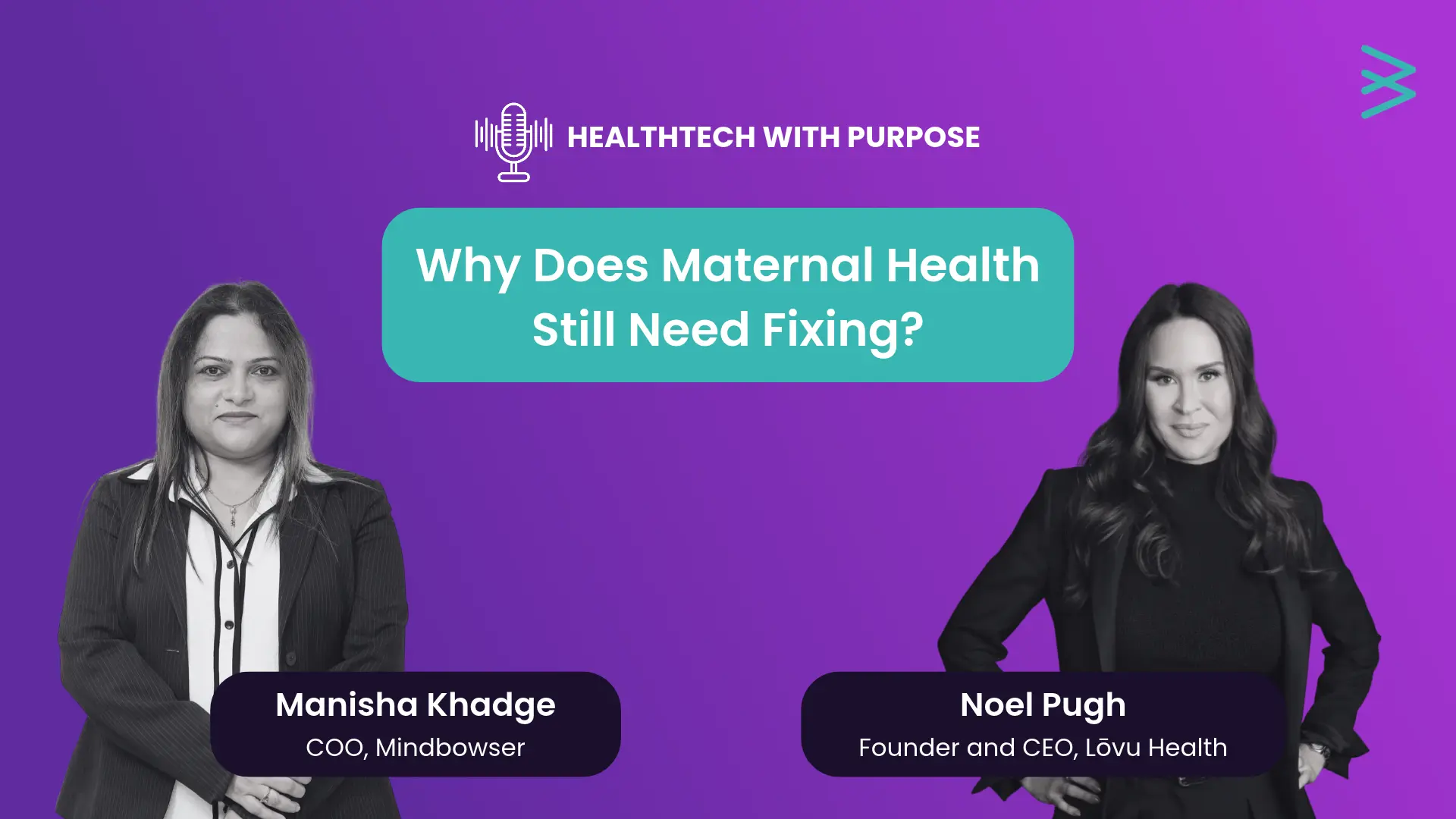
Noel Pugh, Founder & CEO of Lōvu Health, joins host Manisha Khadge, COO of Mindbowser, to unpack why maternal healthcare needs to move beyond monitoring complications toward supporting the everyday needs of mothers. She traces Lōvu Health’s journey building an insurance-reimbursed maternal monitoring and navigation program that connects mothers, clinicians, and community resources.
The conversation gets into the practical side of building that model: remote physiological monitoring, care navigation, EHR interoperability, and bidirectional data exchange. Noel explains how Lōvu’s athenahealth integration helped automate workflows, reduce manual work, and create a foundation for scaling across more healthcare organizations.
She also shares how Lōvu Health is approaching agentic AI, with potential applications across maternal navigation, clinical workflows, revenue cycle operations, and service recommendations, while keeping humans involved in critical decisions. The conversation closes with the realities healthcare founders face around reimbursement, investor skepticism, clinical adoption, go-to-market, and choosing the right technology partner.
Branden Fini, healthcare VC and partner at Providence Ventures, joins host Ayush Jain to explain how a strategic investor picks and backs digital health companies. He traces his path from pre-med sciences into more than a decade of venture capital, then lays out the Providence Ventures model: commercial-stage companies, Providence as anchor LP, and customer access as the edge that shortens healthcare’s notoriously long adoption cycles.
He argues the market reset that began in 2022 makes this a good time to invest, because valuations are more rational. On AI, he applies the same test he uses for any company: real, differentiated results for enterprise buyers who are risk averse and budget constrained, with no premium for technology looking for a problem. The sharpest section covers what goes wrong after Series A: sales teams built before there is a lead engine, raising more than growth can justify, and founders blaming the market once the early adopters run out. He closes with the two capital efficiency ratios he tracks, the firm’s move to an independent fund with more strategic LPs, and the thesis areas he’s watching: workforce, consumer engagement and behavioral health.
Partner with us to design, build, and scale digital solutions that drive better outcomes.
Global Tech Teams LLC, 525 Washington Blvd, Industrious at Newport Tower, Jersey City, NJ 07310, United States.
Let’s discuss your goals, workflows, and next steps in a focused consultation call.
 Schedule a Call














 BLOGS
 NEWSROOM
 CASE STUDIES
 WEBINARS
 PODCASTS
 ASSET HUB
 EVENT CALENDAR