BLOGS
BLOGS  NEWSROOM
  CASE STUDIES
  WEBINARS
  PODCASTS
  ASSET HUB
  EVENT CALENDAR
























TL;DR
- Epic OpTime is Epic’s operating room management module built into its EHR.
- It streamlines surgical scheduling, staffing, documentation, and coordination.
- Compared to other OR management systems, it excels in integration, compliance, and data-driven insights.
- This guide examines its strengths and compares it to alternatives such as Cerner SurgiNet, Meditech OR Manager, and PICIS.
I. What Makes Epic OpTime Stand Out in OR Management?
Epic OpTime is Epic’s operating room scheduling and management module. It was designed to simplify how hospitals coordinate surgeries, assign staff, and track resources. Because it sits inside the larger Epic EHR, OpTime avoids the data silos that often slow down surgical teams.
This guide takes a closer look at how OpTime compares with other OR systems. The focus is on usability, integration, compliance, and ROI, key decision points for hospitals evaluating whether to adopt or expand their current OR management tools.
II. Why OR Management Systems Are Critical for Hospitals
Efficient operating room management is one of the most important drivers of both patient outcomes and financial performance in hospitals. Operating rooms are among the most expensive resources to run, and delays or inefficiencies can quickly translate into higher costs and patient dissatisfaction.
A. Role in Improving OR Utilization and Reducing Delays
- OR management systems enable hospitals to optimize the use of their surgical suites by creating clear schedules and minimizing downtime between cases.
- Features like block scheduling, real-time updates, and conflict resolution help surgical teams anticipate bottlenecks before they occur.
- Improved utilization not only supports higher case volumes but also reduces staff overtime and resource waste.
B. Impact on Patient Safety and Satisfaction
- Reliable OR scheduling means fewer last-minute cancellations, which directly affects patient trust and experience.
- Integrated systems enhance communication among surgeons, anesthesiologists, nurses, and administrative staff, resulting in fewer errors during handoffs.
- Documentation and tracking tools support safer surgeries by ensuring all instruments, implants, and medications are accounted for.
C. Link Between Optimized OR Workflows and Hospital Revenue
- Operating rooms generate a significant share of hospital revenue. Even small improvements in case throughput can result in significant financial gains.
- Systems that automate charge capture and integrate with billing modules help reduce missed charges and denial rates.
- Better scheduling and turnover management increase the number of surgeries performed, which supports both financial performance and community access to care.
In short, OR management systems are no longer optional. They are essential to running surgical services safely, efficiently, and profitably.
III. Overview of Epic OpTime
Epic OpTime is Epic’s operating room management solution, built to integrate directly with the rest of the Epic EHR. It was created to help hospitals simplify scheduling, documentation, and resource management in a highly complex surgical environment. Because it resides within the broader Epic ecosystem, it allows clinical and administrative teams to work from a single source of truth, rather than juggling multiple systems.
A. Core Functionality: Scheduling, Resource Allocation, Intraoperative Documentation
- OpTime supports comprehensive surgical scheduling, including block time assignment, preference cards, and staff allocation.
- It ensures that operating rooms, surgeons, nurses, and anesthesia teams are all coordinated in a single unified schedule.
- During procedures, OpTime provides intraoperative documentation tools that capture time stamps, case notes, and anesthesia details.
B. Integration Strength: Native to Epic EHR
- Because OpTime is part of Epic, it connects directly with modules like Epic Anesthesia and Epic Resolute.
- This reduces the need for manual data entry or third-party connectors, cutting down on errors and saving staff time.
- Integration also means preoperative, intraoperative, and postoperative workflows are connected, providing visibility from patient admission through discharge.
C. Compliance: HIPAA, FHIR, HL7 Compatibility
- OpTime supports HIPAA-compliant data exchange, ensuring patient privacy and security.
- With FHIR and HL7 standards, it can communicate with other clinical and administrative systems.
- Hospitals benefit from easier interoperability while meeting federal and payer-driven compliance requirements.
D. Target Users: Mid-to-Large Hospitals Using Epic EHR
- OpTime is best suited for health systems that already use Epic as their enterprise EHR.
- Mid-sized hospitals can adopt it to centralize OR management while leveraging existing Epic infrastructure.
- Large health systems benefit from the ability to scale OpTime across multiple sites while maintaining consistency in workflows and reporting.
Epic OpTime is not just an add-on scheduling tool. It is a fully integrated operating room management platform designed to help hospitals achieve safer surgeries, smoother coordination, and stronger financial outcomes.
IV. Key Features of Epic OpTime
Epic OpTime combines the essential functions required to manage busy surgical environments. Its features are designed to help hospitals improve scheduling, reduce delays, and maintain accurate records across every step of the surgical journey.
A. Surgical Scheduling and Resource Planning
- Hospitals can use block scheduling to reserve operating rooms for specific specialties or surgeons, ensuring predictable access and reducing conflicts.
- Surgeon preference cards store each provider’s unique requirements, such as instruments, implants, and supplies, which helps staff prepare quickly and accurately.
- Automated conflict checks reduce double-booking risks and ensure staff, equipment, and rooms are available when needed.
B. Real-Time Intraoperative Documentation
- OpTime allows surgical teams to document every stage of the procedure, from incision start times to anesthesia events.
- Timestamps and case notes captured in real-time improve accuracy and accountability.
- Integration with Epic Anesthesia ensures that anesthesia records flow directly into the surgical chart, eliminating redundant documentation.
C. Instrument and Implant Tracking
- The system connects with the hospital supply chain and inventory management, allowing staff to track surgical instruments and implants.
- Real-time tracking reduces the chance of missing items, improves compliance with safety protocols, and streamlines replenishment.
- Hospitals benefit from accurate case costing and stronger oversight of expensive surgical supplies.
D. Analytics and Reporting
- OpTime provides dashboards and reports that measure OR utilization, case duration, and turnover times.
- Predictive analytics enable hospitals to forecast procedure lengths more accurately, thereby reducing delays and improving scheduling efficiency.
- Leaders can monitor trends over time, compare surgeon performance, and identify bottlenecks that affect both patient outcomes and financial results.
Together, these features make Epic OpTime a comprehensive system for managing surgeries from scheduling to completion, while providing data insights that guide long-term improvement.
V. Epic OpTime’s Integration with Other Epic Modules
Epic OpTime delivers its full value when paired with other Epic modules. Hospitals that already run Epic can connect OpTime across perioperative and administrative workflows, reducing friction and creating a single view of patient and operational data. This integration is one of the main reasons hospitals choose OpTime over standalone operating room management systems.
A. Epic Anesthesia
- OpTime integrates directly with Epic Anesthesia, allowing anesthesia events, medications, and monitoring data to flow into the surgical record.
- This connection eliminates duplicate documentation and ensures a comprehensive record for each case.
- It also supports patient safety by providing anesthesiologists and surgeons with the same up-to-date information in real time.
B. Epic ASAP
- For emergency departments using Epic ASAP, OpTime can connect to make urgent OR scheduling more efficient.
- Critical cases can be flagged and assigned operating room slots without disrupting planned elective procedures.
- This reduces delays for emergency patients and helps surgical teams prepare with minimal disruption.
C. Epic Cadence
- OpTime works with Epic Cadence to manage outpatient surgical scheduling.
- Pre-op appointments, lab work, and imaging can be scheduled alongside surgery dates, reducing the risk of missed steps.
- Patients benefit from coordinated scheduling across clinics and operating rooms, leading to fewer cancellations.
D. Epic Radiant
- Radiology is often essential in surgical planning. Integration with Epic Radiant ensures imaging orders, results, and schedules are visible in OpTime.
- Surgeons can review imaging data directly within the OR workflow, avoiding delays from system switching.
- This supports accurate case planning and reduces unnecessary repeat imaging.
E. Epic Stork
- For labor and delivery departments, Epic Stork integrates with OpTime to support surgical births such as C-sections.
- OR teams gain visibility into scheduled or emergent procedures tied to maternal care.
- This ensures smoother coordination between obstetrics and surgical teams.
Related read: What Is Epic Stork? A Comprehensive Overview for OB/GYN Providers
F. Epic Willow
- Epic Willow connects pharmacy and supply chain data with OpTime.
- Implants, medications, and surgical supplies are tracked automatically, improving inventory control and compliance.
- This integration enables hospitals to reduce waste and more effectively manage high-cost items.
G. Epic Resolute
- Financial accuracy is critical in surgical services. Epic Resolute integration ensures surgical charges flow directly from OpTime to billing.
- Automated charge capture reduces missed revenue and improves claims accuracy.
- Hospitals benefit from faster reimbursements and fewer billing errors.
H. Epic MyChart
- From a patient perspective, MyChart integration makes surgical care more transparent.
- Patients can receive pre-op instructions, access post-op follow-up materials, and complete forms digitally.
- This improves patient engagement and reduces the administrative burden on staff.
Through these integrations, Epic OpTime extends beyond scheduling and documentation. It becomes the central hub for managing surgical care within the broader Epic ecosystem.
Related read: Epic Bones Module: Optimizing Orthopedic and Sports Medicine Workflows
VI. Common Alternatives to Epic OpTime
While Epic OpTime is a strong choice for hospitals already using Epic, many facilities consider other operating room management systems. Each has its own strengths, limitations, and ideal fit depending on the size of the hospital, its existing EHR, and its budget.
A. Cerner SurgiNet
- Cerner SurgiNet is a direct competitor to Epic OpTime and integrates natively with the Cerner EHR.
- It offers comprehensive OR scheduling, case documentation, and perioperative tracking tools.
- Hospitals with multi-facility operations often value SurgiNet’s ability to manage resources across multiple locations.
- Its adoption is usually easier in environments where Cerner is already the enterprise EHR, reducing integration complexity.
B. Meditech OR Manager
- Meditech OR Manager is better suited for small to mid-sized hospitals that need operating room scheduling but may not have the IT resources of larger health systems.
- It provides core features like scheduling, case documentation, and resource management without the complexity of larger systems.
- For hospitals already running Meditech as their main EHR, the OR Manager provides a cost-effective way to centralize surgical services.
- The trade-off is that it may lack the advanced analytics and deep interoperability found in Epic or Cerner environments.
C. Picis OR Manager
- Picis OR Manager has a long history in the surgical management space and is known for strong functionality in anesthesia documentation and case costing.
- It supports detailed financial tracking, helping hospitals understand the true costs of each surgical case.
- Many hospitals that are not fully Epic or Cerner environments consider Picis because of its flexibility in integrating with different EHRs.
- While powerful, it often requires more customization and third-party integration to achieve the same level of workflow automation as Epic OpTime.
D. Standalone OR Platforms (e.g., Surgical Information Systems, Orion Health)
- Independent OR platforms are designed to be flexible and can be integrated with various hospital information systems.
- They typically offer strong scheduling and documentation tools but rely on custom EHR integration to connect with the rest of the hospital workflows.
- These systems can be a good fit for niche or specialty hospitals that want more control over customization.
- The challenge is that they often require more resources for integration and maintenance, which can lead to increased long-term costs.
In evaluating alternatives, hospitals need to weigh how well each option aligns with their current EHR infrastructure, staffing resources, and financial goals.
VII. Comparative Analysis — Epic OpTime vs. Others
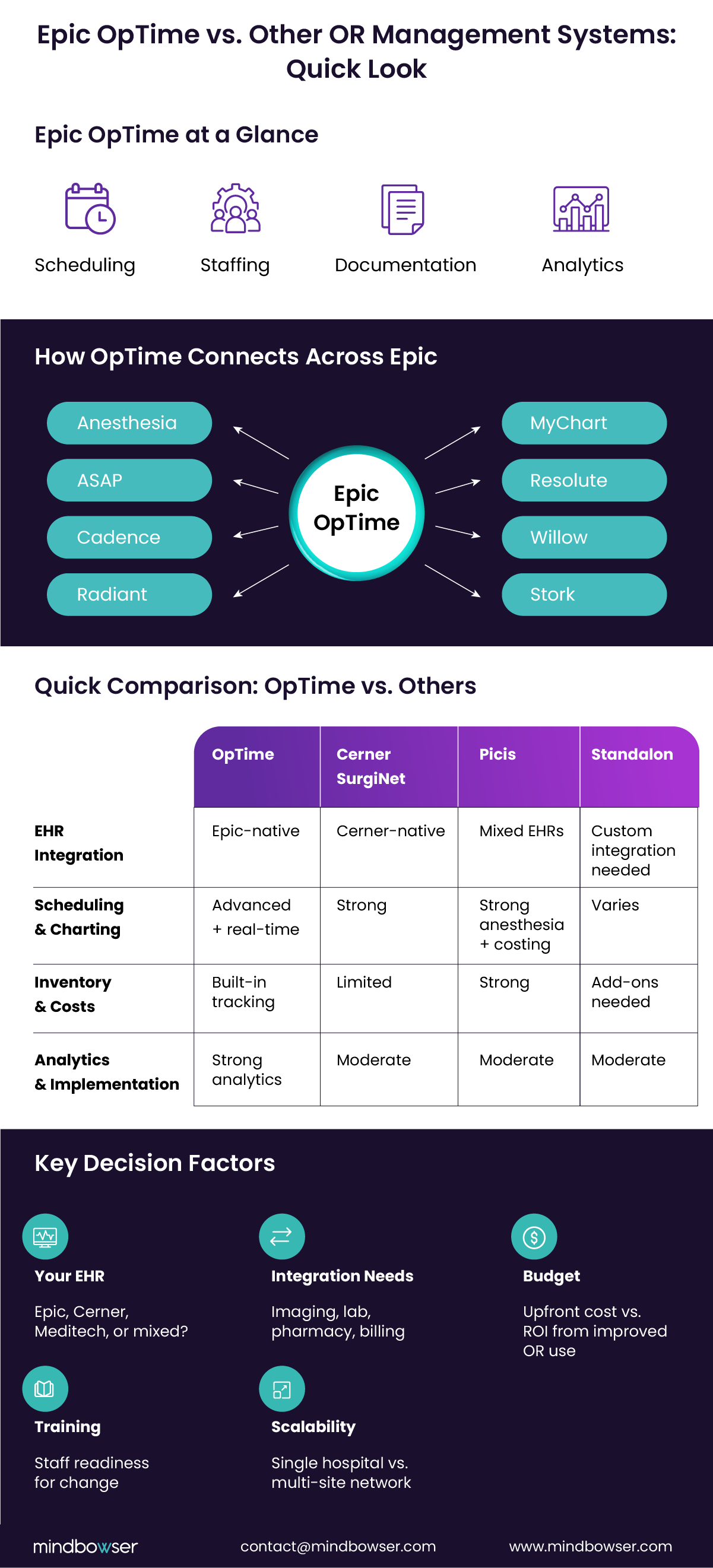
Hospitals considering an operating room management system often compare Epic OpTime with Cerner SurgiNet, Meditech OR Manager, PICIS OR Manager, and standalone platforms. Each solution has advantages depending on the hospital’s size, EHR ecosystem, and goals.
A. Criteria-Based Comparison
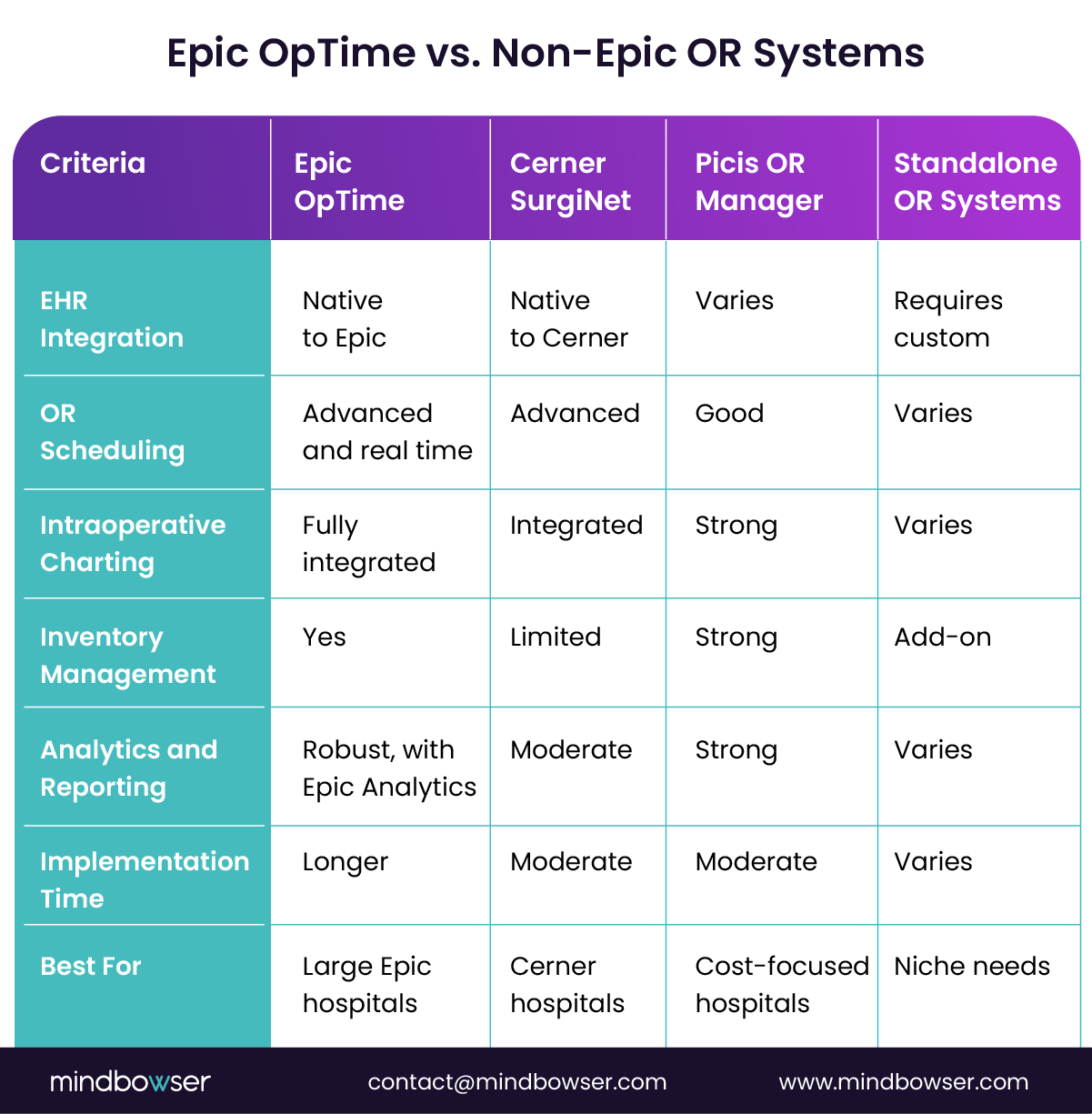
B. Key Takeaways from the Comparison
- Epic OpTime excels in integration and compliance, making it an ideal solution for large hospitals already using Epic. It provides advanced analytics and automation but requires significant investment and a longer implementation timeline.
- Cerner SurgiNet is a natural fit for hospitals already using Cerner. It offers strong multi-facility management and solid scheduling tools, though its analytics capabilities are less advanced compared to Epic.
- Picis OR Manager offers flexibility for hospitals operating in mixed EHR environments. Its strengths lie in anesthesia integration and financial tracking, but it may require additional customization to achieve consistent, automated workflows.
- Meditech OR Manager is well-suited to smaller hospitals that prioritize affordability and simplicity over advanced analytics.
- Standalone OR systems offer niche or specialty hospitals flexibility, but they rely on custom integration and often incur higher maintenance costs.
Hospitals must look beyond feature lists and consider how well each system fits into their broader EHR environment, their readiness for change management, and the long-term financial return.
VIII. Strengths and Limitations of Epic OpTime
Epic OpTime is one of the most widely adopted operating room management solutions in the United States, particularly among large health systems that already utilize Epic. Like any enterprise system, it brings clear advantages but also requires careful planning to overcome its limitations.
A. Strengths
- Deep Integration with Epic Ecosystem: OpTime is fully embedded within the Epic EHR, which means surgical scheduling, anesthesia documentation, billing, and postoperative workflows all connect within a single system. This reduces duplicate work and improves data consistency.
- Strong Compliance Framework: Epic OpTime is designed to meet HIPAA requirements and supports industry standards, including HL7 and FHIR, for interoperability. Hospitals benefit from a system that can securely exchange data across multiple clinical and administrative platforms.
- Advanced Analytics for Surgical Efficiency: With Epic’s analytics tools, OpTime provides detailed reports on operating room utilization, turnover times, and case durations. These insights help leaders identify bottlenecks, reduce delays, and make more accurate forecasts for scheduling and staffing.
- Scalability for Large Systems: Multi-hospital health systems can use OpTime to standardize processes across facilities. This supports consistent patient care while giving executives consolidated visibility into performance.
B. Limitations
- High Implementation Cost and Timeline: Deploying Epic OpTime requires significant financial investment and time. Hospitals must allocate resources for software, infrastructure, training, and change management. Smaller facilities may find the cost prohibitive.
- Steeper Learning Curve: Because of its depth, OpTime can be complex for staff to learn, especially for those without prior Epic experience. Adoption requires structured training programs and ongoing support.
- Less Flexible for Non-Epic Environments: OpTime is most effective when paired with other Epic modules. For hospitals not running Epic as their enterprise EHR, integration can be challenging and may require custom solutions.
Epic OpTime delivers measurable benefits in efficiency, safety, and financial outcomes. Yet hospitals need to evaluate whether they have the resources, staffing, and infrastructure to fully leverage its capabilities.
IX. Decision Factors When Choosing an OR Management System
Selecting the right operating room management system is a decision that affects clinical operations, staff satisfaction, patient safety, and hospital finances. Leaders need to evaluate not only the software features but also how the system aligns with their existing infrastructure and long-term strategy.
A. Current EHR Platform (Epic, Cerner, Meditech)
- Hospitals already using Epic as their enterprise EHR are better positioned to adopt Epic OpTime, since it integrates directly with other Epic modules.
- Organizations on Cerner or Meditech may find it more practical to stay within their native ecosystems to avoid expensive integration projects.
- For hospitals without a dominant enterprise EHR, standalone platforms may offer more flexibility; however, integration planning will be critical.
B. Integration Complexity
- Integration needs extend beyond the EHR and include imaging, lab, pharmacy, billing, and patient engagement tools.
- Hospitals must assess whether the OR system supports standards like HL7 and FHIR to ensure smooth data exchange.
- The greater the number of third-party systems in use, the higher the complexity and cost of integration.
C. Budget and ROI Goals
- Epic OpTime requires a higher upfront investment but delivers long-term returns through improved scheduling, reduced delays, and better charge capture.
- Smaller hospitals with tighter budgets may prefer lighter OR management systems that meet essential needs without overextending resources.
- Decision-makers should model potential financial gains, such as increased OR utilization and reduced cancellations, against implementation costs.
D. Staff Training Requirements
- Successful adoption depends on how quickly staff can learn and use the system effectively.
- Epic OpTime, with its breadth of features, requires comprehensive training and change management support.
- Hospitals should consider whether they have the internal training infrastructure or will need external support for ongoing education.
E. Scalability for Multi-Site Operations
- Large health systems must ensure their OR management system can scale across multiple facilities while maintaining standardized workflows.
- Epic OpTime supports system-wide deployment with centralized data and reporting, making it attractive for multi-site networks.
- Standalone or smaller systems may be suitable for a single hospital, but they can create data silos when expanded to multiple locations.
A clear assessment of these decision factors helps hospitals choose the OR management system that aligns with their clinical, operational, and financial priorities.
Looking to Build Your EHR with Epic Integration Capabilities?
X. How Mindbowser Helps with Custom EHR Development and Epic OpTime Integration
OpTime:
OpTime runs the OR inside Epic. When you want that scheduling, utilization, and case data in your own surgical dashboard, predictive-scheduling tool, or a mixed-EHR environment, you integrate through Epic’s APIs (FHIR, HL7) — normally a multi-month build. ConnectHealth, Mindbowser’s healthcare integration platform, ships a pre-built Epic connector plus Helix AI to do it in days, and connects OpTime with non-Epic systems where hospitals run mixed environments. See the wider Epic integration picture or the other Epic modules.
Care Everywhere:
To surface Care Everywhere data in your own app or analytics layer, you integrate via Epic’s FHIR APIs ConnectHealth’s pre-built Epic connector + Helix AI does that in days, not a multi-month custom build.
Conclusion
Epic OpTime is more than just a scheduling module. It is a comprehensive operating room management solution that integrates tightly with the Epic EHR ecosystem. Hospitals that adopt it gain better visibility across the surgical process, stronger compliance safeguards, and advanced analytics to drive efficiency.
For large health systems already using Epic, OpTime is often the best choice for standardizing surgical workflows and connecting perioperative care with other clinical and financial modules. At the same time, other platforms such as Cerner SurgiNet, Meditech OR Manager, and Picis remain viable options for hospitals operating in different EHR environments or working with tighter budgets.
The right decision ultimately comes down to aligning the system with the organization’s goals. Factors such as current EHR platform, integration complexity, staff readiness, and long-term ROI should guide the evaluation.
Hospitals that choose Epic OpTime and pair it with expert support for customization and integration can realize significant gains. With the right approach, operating rooms become more efficient, safer for patients, and more financially sustainable for the institution.
Epic OpTime is Epic’s operating room management module. It helps hospitals manage surgical scheduling, staff assignments, intraoperative documentation, and supply tracking. Because it integrates with the broader Epic EHR, it provides a single platform for surgical and perioperative workflows.
Both are strong OR management solutions, but Epic OpTime works best in Epic-based hospitals while Cerner SurgiNet is ideal for hospitals running Cerner as their enterprise EHR. OpTime offers deeper analytics and integration across perioperative modules, while SurgiNet is valued for its ability to manage resources across multiple facilities.
Yes, Epic OpTime can connect with non-Epic platforms through HL7 and FHIR standards, but the process can be complex. Many hospitals partner with technology teams, such as Mindbowser, to ensure seamless interoperability with PACS, laboratory systems, billing platforms, and other applications.
Hospitals using Epic OpTime often see improvements in OR utilization, fewer scheduling conflicts, faster turnover times, and better charge capture. These gains translate into higher patient satisfaction, safer surgical workflows, and stronger financial performance.
Epic OpTime is Epic’s operating room management module, built natively into the Epic EHR. It handles surgical scheduling, block scheduling, preference cards, staff allocation, intraoperative documentation, instrument and implant tracking, and OR analytics. Because it sits inside the Epic ecosystem, scheduling, billing, anesthesia, pharmacy, and patient records are all connected in a single system, no separate OR software, no data silos.
It depends on your EHR. Epic OpTime is the right choice if your hospital runs Epic — native integration with the full perioperative suite, Anesthesia, Cadence, Radiant, Willow, Resolute, connects without middleware. Cerner SurgiNet is the right choice if you’re on Cerner. Switching EHR ecosystems just for OR management rarely makes financial sense. For hospitals on neither, Picis or standalone platforms are worth evaluating. The comparison table above covers all five options by best fit, integration depth, analytics, and cost.
Rarely. Epic OpTime’s value comes from native connections to Epic Anesthesia, Billing, Resolute, Pharmacy, Willow, and scheduling, Cadence. Outside of Epic, you lose most of that integration benefit and take on a complex, costly custom-integration project. For non-Epic hospitals, Cerner SurgiNet, if on Cerner, Picis, mixed-EHR environments, or standalone platforms are the realistic alternatives. If you’re evaluating a full EHR migration that includes OR management, that’s a different question, but OR management alone is not the reason to move to Epic.
Epic OpTime integrates natively with all major Epic modules: Epic Anesthesia, anesthesia events + records; Epic ASAP, emergency OR scheduling; Epic Cadence, outpatient pre-op scheduling; Epic Radiant, imaging in the surgical workflow; Epic Stork, C-sections and L&D; Epic Willow, pharmacy + implant tracking; Epic Resolute, charge capture + billing; and MyChart, patient pre-op and post-op. For non-Epic systems in mixed environments, integration requires custom middleware or a pre-built connector like ConnectHealth.